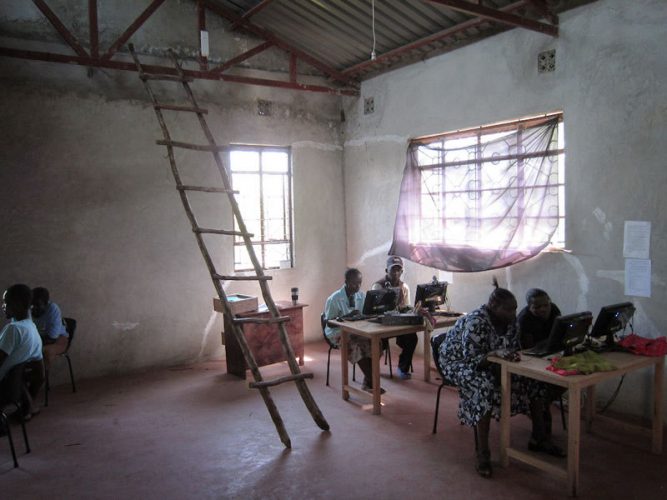
 Most technology is limited in Mfangano, a fishing community off the Kenyan shore of Lake Victoria. The first time a car drove around the entire island was in 2007. Islanders only receive spotty coverage from cell providers due to the difficulties of building cell towers on Mfangano. Providers face difficulty constructing links from the mainland, and islands perceive key construction platforms as sacred.
Worst of all is the lack of internet access.
Chas Salmen, the director of the Organic Health Response (OHR), a small Kenyan NGO that provides HIV/AIDS-related services, noted the Islanders’ repeated desire for internet at community meetings. OHR started the meetings as a means to educate the public about HIV/AIDS and encouraged feedback in order to understand the lives of the islanders.
One of OHR’s primary difficulties was getting a substantial proportion of the community to attend the meetings. This was solved when OHR built the Ekialo Kiona Center (EK). The EK has a computer center, library and training facility. “Ekialo Kiona” means “Whole World” in the Suba language; the name refers to the OHR’s policy of allowing anyone access to the EK and the internet in exchange for maintaining a schedule of HIV tests every 6 months.
Participation in OHR’s programs has grown rapidly with the internet incentive. Now over 2,000 participants, or 10 percent of the population, use the EK and attend the regular meetings.
“The timing of the project was just perfect,” said Salmen. “It went live just before schools closed for a one-month break and we had 250 secondary students enroll right away. 75 percent of our new enrollment has been young people, under 25. They engage with us in a way that wasn’t possible before.”
The OHR also set up a network-connected radio transmitter to broadcast, which has greatly increased the amount of the population on the receiving end of their educational messages.
Salmen said, “When we broadcast we get SMS messages from a huge area, including Kisumu, 90km away. EK Radio fan pages have started appearing on Facebook without any prompting on our side. It’s a total game changer to start those conversations and have everyone listening at once.”
Broadband connectivity is not a high priority for those aiding developing communities. But, as Cisco’s Senior Vice President of Corporate Affairs Tae Yoo noted, it creates jobs, higher productivity and ultimately enables economic and social development.
The United Nations now classifies broadband as a basic human right because it helps developing communities advance economically and socially. Yet, UNESCO estimates that 90 percent of communities in developing areas are without access to broadband.
Inveneo has launched the Broadband for Good Initiative (BB4G) to speed up access to broadband throughout the developing world. BB4BG uses low-cost technologies to deliver broadband into urban and rural areas. BB4G currently provides broadband access to 20 percent of rural Haiti, and certain areas of Micronesia, Kenya, Uganda and the West Bank of Palestine.
“Mfangano is a great pilot for building sustainable broadband networks,” said Eric Blantz, senior program director for Inveneo. “The challenges we’ve seen here are not unique, but the solutions we’re finding are innovative and replicable across the developing world.”
– Kasey Beduhn
Source: The Huffington Post
Photo: Organic Health Response

Social Impact Bond Model of International Aid
The Social Impact Bond model of international aid is a relatively new way of helping foreign countries; many call it a “pay for success” model. Social Impact Bonds, or SIBs, are based on outcomes, rather than intentions. Despite the name, they do not fit the average definition of a “bond,” which would imply those receiving the investors’ money are obligated to return it no matter what happens. Rather, in a nutshell, the independent investors will only get their money back (plus interest) if the program succeeds. The social impact bond model of international aid is meant to be a preventative course of action to benefit society; only those programs that have the most chance of success will be funded.
Due to the existence of private investors, the social impact bond model of international aid does not threaten public funds or rely on the United States (or any other country’s) federal budget. SIBs could also provide a huge benefit to foreign aid if the right programs exist. Rather than merely expecting those wealthy enough to donate their cash to these causes, they are investing in them, and like any other investment, there is a chance of failure. Still, if they invest wisely, not only will they reap the rewards, but so will those who have received help from the various nonprofits.
Although there are certain flaws to SIBs, because not all programs will be able to gather funding (such as pilot programs, because they have not proved they can be successful), it certainly would help in some cases. Moreover, it will protect the U.S. budget and, if successful, will benefit a large number of people across the globe, including investors in the U.S.
Instiglio is an example of a nonprofit organization that deals primarily with social impact bonds.
– Corina Balsamo
Sources: McKinsey, US News
Photo: Tech
The Queen of Katwe
Imagine living in a slum. There is little food to split between you and your family and you are a minority in your age group because you have regularly attended school before. This was exactly the situation that teenager Phiona Mutesi found herself in when she started learning chess.
The slum where Phiona lives is called Katwe, and it is located right in the Ugandan capital of Kampala, where veteran and refugee Robert Katende began a chess program for children, giving them food in return for completing a lesson. Of his program, Katende has said that he had started it hoping to teach analytic and problem-solving skills that the children could apply to succeed in their own lives.
This was the program that would come to change Phiona’s life and turn her into “The Queen of Katwe”.
“I was living a hard life, where I was sleeping on the streets, and you couldn’t have anything to eat in the streets. So that’s when I decided for my brother to get a cup of porridge,” Mutesi told CNN.
Although she was unfamiliar with the game, as is most of Uganda, Phiona worked hard, practicing every day for a year. Eventually, she began to win against older children and compete for titles. Since those early days, Phiona has represented her country in several international chess competitions in countries such as Sudan, Siberia, and Istanbul.
Although life for her is still hard – she still lives in the Katwe slum with her family – winning competitions and working hard to one day become a Grandmaster keeps her hopeful. A grant that she has received through her competing has even allowed her to go back to school and develop her reading and writing skills.
While Phiona’s story of success has yet to win her the chess title of Grandmaster, she has gained another, unofficial reputation as the ultimate underdog. She is an underdog on the global chess stage both because she comes from Africa, a continent where chess is culturally absent in most countries, and because she is from Uganda specifically, a nation that is one of the poorest on the continent. The fact that she is from Katwe, a slum, is a strike against her even to other Ugandans. However, despite these odds, she has achieved enormous success given her circumstances.
Phiona Mutesi’s inspiring story was written into a book called “The Queen of Katwe,” by Tim Crothers, and was published in October of 2012. Since then, Disney has bought the rights to the story and has started making a movie to chronicle Phiona’s journey to the international chess stage. The Queen of Katwe remains steadfast in attaining her dream of becoming a Grandmaster and is an inspiration to us all.
– Nina Narang
Source: CNN
Accountability and Transparency with U.S. Aid
Financial foreign assistance is one of the most powerful ways that developed nations can help lower-income countries fight their way through poverty. It also provides the most immediate results, given that aid investment is effectively distributed both to short-term direct programs as well as long-term indirect programs. Many in aid-giving communities, including the United States, criticize foreign aid spending because they believe it a wasteful investment, used to line administrator’s pockets or be lackadaisically distributed to corrupt governments.
Futuregov estimates that annually, around $150b is contributed globally to aid and assist socio-economic and social development.
Given the global community’s demands for greater accountability and transparency in funding, the AidData Centre for Development Policy organization was established. The organization is “a joint venture between the College of William & Mary, Development Gateway, Brigham Young University, the University of Texas at Austin, and Esri.” AidData will be funded $25 million over five years in its conjoined efforts with the United States Agency for International Development.
The program will combine the work of experts in a menagerie of different fields to track and make public the effects of specific foreign aid projects. The purpose of the program assessments is also self-reflective, as programs become more stringently criticized. The aim is to have less money spent will have efficiently maximized impacts.
– Nina Narang
Source: futureGOV
Photo: BIPPS
Broadband – A Basic Human Right
Worst of all is the lack of internet access.
Chas Salmen, the director of the Organic Health Response (OHR), a small Kenyan NGO that provides HIV/AIDS-related services, noted the Islanders’ repeated desire for internet at community meetings. OHR started the meetings as a means to educate the public about HIV/AIDS and encouraged feedback in order to understand the lives of the islanders.
One of OHR’s primary difficulties was getting a substantial proportion of the community to attend the meetings. This was solved when OHR built the Ekialo Kiona Center (EK). The EK has a computer center, library and training facility. “Ekialo Kiona” means “Whole World” in the Suba language; the name refers to the OHR’s policy of allowing anyone access to the EK and the internet in exchange for maintaining a schedule of HIV tests every 6 months.
Participation in OHR’s programs has grown rapidly with the internet incentive. Now over 2,000 participants, or 10 percent of the population, use the EK and attend the regular meetings.
“The timing of the project was just perfect,” said Salmen. “It went live just before schools closed for a one-month break and we had 250 secondary students enroll right away. 75 percent of our new enrollment has been young people, under 25. They engage with us in a way that wasn’t possible before.”
The OHR also set up a network-connected radio transmitter to broadcast, which has greatly increased the amount of the population on the receiving end of their educational messages.
Salmen said, “When we broadcast we get SMS messages from a huge area, including Kisumu, 90km away. EK Radio fan pages have started appearing on Facebook without any prompting on our side. It’s a total game changer to start those conversations and have everyone listening at once.”
Broadband connectivity is not a high priority for those aiding developing communities. But, as Cisco’s Senior Vice President of Corporate Affairs Tae Yoo noted, it creates jobs, higher productivity and ultimately enables economic and social development.
The United Nations now classifies broadband as a basic human right because it helps developing communities advance economically and socially. Yet, UNESCO estimates that 90 percent of communities in developing areas are without access to broadband.
Inveneo has launched the Broadband for Good Initiative (BB4G) to speed up access to broadband throughout the developing world. BB4BG uses low-cost technologies to deliver broadband into urban and rural areas. BB4G currently provides broadband access to 20 percent of rural Haiti, and certain areas of Micronesia, Kenya, Uganda and the West Bank of Palestine.
“Mfangano is a great pilot for building sustainable broadband networks,” said Eric Blantz, senior program director for Inveneo. “The challenges we’ve seen here are not unique, but the solutions we’re finding are innovative and replicable across the developing world.”
– Kasey Beduhn
Source: The Huffington Post
Photo: Organic Health Response
Food Security in the Democratic Republic of Congo
In a project facilitated through World View, 2,000 farmers had been brought into classes of 30 for a farmer field school meant to teach new and innovative agricultural techniques to farmers, including simple but extremely valuable practices such as drip irrigation and proper seed spacing. These techniques help to stretch valuable and limited resources and increase harvests to unprecedented yields.
The program also involves empowering women in their local communities, trying to make sure that equal and efficient work is understood by everyone and that no one is disadvantaged in the future.
The farmers in this project plan to form collectives and resource pools for the betterment of their community; after all, there is strength in numbers.
“Learning about improved techniques has enabled them to increase yields: where once they harvested two bags of cassava, now they get 15,” writes The Guardian.
The optimistic outlook for this project is that it will significantly help alleviate poverty for more subsistence farmers. As far as food security in the DRC goes, ongoing military conflict undermines the gains from improved methods because harvests and resources are taken by militias from both the DRC and Rwanda.
Thus, the prospects for food security in the DRC are uncertain. Societal innovation and destruction are continuously at odds but hopefully, when the violence ends, the farmers will be ready to produce sustainable quantities.
– Nina Narang
Source: The Guardian
Photo: Catholic Relief Services
UN Central Emergency Response Fund
Since 2006, the UN CERF has helped speed up relief efforts by collecting donations to ensure that programs providing life-saving assistance receive adequate funding. Since then, the Fund has managed to secure a total of $900 million to address crises. In 2012, CERF allocated a total of $465 million to programs delivering humanitarian aid in 49 countries including Syria, South Sudan, Haiti and Pakistan, the highest amount allocated in a year.
On December 11, 2012, in a statement at the high-level CERF conference, Under-Secretary-General for Humanitarian Affairs and Emergency Relief Coordinator, Valerie Amos, praised the Fund’s work in aiding those affected by crises. “CERF’s support has been critical to saving the lives and livelihoods of millions of people throughout the world,” Amos said. “It has bolstered the transformative agenda, which aims to strengthen humanitarian response, and our efforts to have a robust and well-coordinated UN-led humanitarian response in support of national efforts.”
Amos reviewed CERF’s work in supporting Syrians in Turkey, Lebanon, Jordan and Iraq, refugees in South Sudan, and disaster response in Haiti and Cuba post-Hurricane Sandy. The UN Secretary-General Ban Ki-Moon had also praised the fund’s range of services: “From flood zones to war zones, CERF stops crises from turning into catastrophes.” Ban Ki-Moon emphasized the Fund’s ability to mobilize funds “in stubbornly under-funded situations” through its “quick, targeted support” mechanism.
CERF supports the following countries: Afghanistan, Algeria, Burundi, the Democratic People’s Republic of Korea, Djibouti, Eritrea, Ethiopia, Haiti, Liberia, Sudan, Uganda and Yemen. CERF selection criteria include humanitarian needs and analysis of funding levels. These situations include the Sahrawi refugee operation in Algeria, life-saving programs in Eritrea and agencies working in Afghanistan.
The objective is to target ‘forgotten’ or ‘neglected’ emergencies. A second round of allocating funding will follow in July 2013. Amos reiterated that the CERF continues to help millions of people “after the media spotlight fades.” She hopes more governments will cooperate with CERF in providing funds to those trapped in “hidden emergencies.”
“CERF is more than a message from the international community – it is a real help for the most vulnerable members of our human family,” concluded Ki-Moon.
– Rafael Panlilio
Source: UN News, UN News, OCHA
Chinese General Secretary Visit To Fuping County
Xi Jinping visited two villages’ homes, clinics, and businesses and spoke with each community concerning income, food, education and medical care. Xi’s visit was broadcast on national television to showcase the rural poor of China. Fuping County resident Tang Zongxiu imparted, “The General Secretary knows life here is difficult and he visited us to ask about our situation. He won’t let us suffer.”
Following his visit to Fuping County, government and private sponsors donated money, food, and other household items. Government work crews and researchers were dispersed and also aided the county. Xi stated, “The most arduous and heavy task facing China in completing the building of a moderately prosperous society is in rural areas, especially poverty-stricken regions.”
The General Secretary emphasizes a renewed focus on policies that support agriculture, rural areas, farmers, and poverty alleviation. Xi Jinping also condemns the embezzlement of poverty-reduction funds. Xi commented on Fuping County remarking, “I want to know how rural life is here. I want to see real life.” Xi Jinping is next in line to become president of China following incumbent President Hu Jintao.
– Rafael Panlilio
Source: CCTV, NY Times, Shanghaiist
“Survival Still” Offers Help in Disasters
The system relies heavily on distillation; it boils the water and collects the steam, which is the only pure part of the process. The Survival Still is made of stainless steel and does not need any filters. As seen in the photograph above, the Survival Still only needs the water and heat to provide fresh drinking water for the user. In any case, the process can be done in almost any location, provided there is an acceptable heating source.
Although the Survival Still was primarily created for victims of catastrophes such as Hurricane Sandy or other devastating natural disasters, it can be used by those who constantly struggle for access to clean drinking water, such as those in the developing world who face poverty on a daily basis. Many people do not have easy access to clean, safe drinking water that many U.S. citizens enjoy. They travel miles to reach clean water, and if they choose to drink water closer to their homes, they run a high risk of receiving potentially fatal waterborne diseases.
The design of this product was mastered over 20 years, and the current version is simple but functional. The reason Meder created the Survival Still was both to give one to every home in the United States (just in case) and also to help attempt to solve the water crisis that is occurring on a global scale. The lack of water in developing countries is one of the biggest issues of today, and the Survival Still, if distributed properly, could help move us towards a sustainable solution.
– Corina Balsamo
Source: Water World
Bill Gates on “Why Measurement Matters”
Bill Gates currently leads one of the most successful and far-reaching humanitarian organizations. Despite constant criticism on his attempts to maximize investments, Bill Gates’ focus on ‘Why Measurement Matters’ in his 2013 Letter may be the perfect question to “help drive global change”.
Every year Bill Gates writes a letter on behalf of his and his wife Melinda’s foundation. Inspiring stories, powerful words, and optimism fill up several pages along with photos of villagers. This year however, Mr. Gates sounded more similar to a business consultant than a humanitarian. His campaign “Why Does Measurement Matter” discusses the need to think in the most basic terms: quality over quantity. Instead of asking governments to increase their funding for foreign aid, organizations must begin training their volunteers and workers to begin thinking like business owners. Collecting data, mapping progress, accepting failures, and brainstorming for solutions all need to be incorporated into the daily tasks for health clinics, schools, and centers around the world.
Mr. Gates illustrates that keeping records, enforcing strict organization, and creating a comfortable environment for workers are key to ensuring the effectiveness of a non-profit humanitarian organization. In a business, financial analysts track the rising and falling of stock prices over decades; marketing directors report successful or failing advertisement techniques; CEOs receive reports on company losses and gains. These techniques must become commonplace within humanitarian organizations not only to ensure their donors that their money is being put to good use, but be able to guarantee successful projects.
But does mimicking a business model go against the basic purpose of a non-profit? A business’ goal is to make profit while an NPO or NGO focuses on increasing the well-being of individuals or a community. So then why do most people automatically associate the word ‘profit’ with money? Business models work for for-profit companies not only because they are designed specifically to help increase the company’s sales and worth but because they incorporate common sense and basic administrative work to achieve set goals.
One of the examples in Bill Gates 2013 Annual Letter of how new measuring techniques can bring about efficiency is the increase of children’s immunization in Ethiopia. Even with health clinics spread out in the most rural areas, accurate record keeping of birth certificates and simple organization helps clinic workers collect a significant amount of data. These records identify which areas need focus, as well as mapping the appearance and disappearance of diseases.
Bill Gates does not suggest a dramatic increase in funding or introduce expensive materials. He does not suggest holding conferences with major donor countries or criticizing local organizations for failing to meet their goals. The simple solution comes down to “quality monitoring…setting clear goals, picking the right approach, and then measuring the results to get feedback”. Yet as simple as this approach may be to a business manager, this solution is much harder to achieve naturally in poorer countries. Heads of organizations must create a work environment in which volunteers and employees will feel comfortable reporting negative results. Therefore, it is important understand the necessity of not cutting corners when taking down vital information of patients who come into the clinics.
Through simple and realistic propositions, Bill Gates 2013 Annual Letter offers: a focused resolution for revitalizing humanitarian organizations, to debunk the myth that foreign aid is a waste, and to encourage organizations around the globe that defeating extreme poverty, child mortality, and the spread of diseases is an obtainable goal.
– Deena Dulgerian
Source: Gates Foundation
Video: Gates Foundation
A Penny Saved, A World Changed? Diverting
Let me start by saying that I love my dog.
When I’m not working on this blog I am teaching English to Ethiopian immigrants here in Columbus, OH. I work mostly with adults and so far the class has been a great experience and I learn a few neat things as I teach and converse with the students. Just the other day we spent a long time learning the new term “pet”. Most English speakers will be able to recognize that word and meaning right away because they have heard it or used it many, many times and they have the linguistic competence to use the word without thinking much about it. The first step of explaining the new word was easy enough and led to the understanding that these “pets” where animals. We would ask “Did you have any pets back home?” “Yes, three cows and a goat.”
We spent a few minutes more explaining the difference between domesticated pets and livestock and continued with the day’s lesson. One man asked whether pets should be called “it” or “he/she”. After answering that man’s question I realized how much we really do love our pets. To many pet owners, their animals are almost human. I’m much more than guilty of being “that dog guy”, I will talk to the dog of a stranger in a foggy park at dusk, I will share the bed with my dog and I’ll even talk to the dogs’ owners sometimes.
That being said, my dog is a dog. She (I still can’t call her “it”) may seem almost human, but she is just a dog. I was thinking about this recently as I stopped in the store to buy some dog food. My healthy, four-year-old dog eats generic, dry, boring dog food that comes in 50 lb. bags. Walking around the dog care aisle I saw designer foods that cost a hefty penny more and I remembered the simple fact that people love their dogs. But, what about the difference? One national name brand dog food is about $12.50 for about 18.5lbs. of food. One designer name brand food costs $29 for 15 lbs. Even if we disregard 3.5 lb. the difference in favor of the cheaper alternative that gives us about $16.50 saved. Now, $16.50 saved for every 15lbs of dog food will add up to a significant sum by the end of the year, especially with multiple dogs.
What if that money went to help other humans, other people? The idea of diverting isn’t anything new, save a bit of money on things here and there and give to a greater cause, but it does work. I’m not saying that we shouldn’t love animals, or that we shouldn’t occasionally spoil the creatures we spend so much time with, but maybe we could take a chunk of that saved change and share it with our human brothers and sisters as well, be it through groups like The Borgen Project or any organization you’d like.
– Kevin Sullivan
Photo: DoggySpace