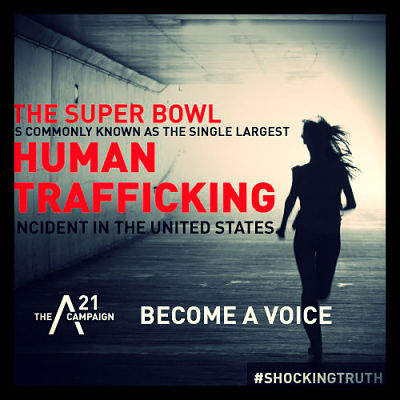
Human trafficking is one of the most prevalent, discerning issues of our time. The fact of the matter, which has been professed by organization after organization for years now, is that there are more slaves now than there have ever been in the history of mankind. In the US alone, The Huffington Post has estimated that the industry brings in over $9.5 billion annually.
While this truth is distressing, there is a silver lining. At no point in mankind has there ever been so much support against human trafficking, nor the technology or infrastructural support to combat it, as there is now.
Human trafficking generally implies either forced labor or sex trafficking, the latter occurring in higher frequency around large gatherings of people, where there may be a larger pool of potential clients. An example of such a situation was the Super Bowl XLVII, which passed on February 3rd.
Fionna Agomuoh of The International Business Times writes that there was an “estimated 10,000 women and minors that were trafficked in the Miami area during the 2009 Super Bowl in Tampa, Fla., according to the Florida Commission Against Human Trafficking.” One can only assume that the issue of trafficking around this annual event has only increased in the four years since then.
In anticipation for sex trafficking at Super Bowl XLVII, local businesses, advocacy groups, and law enforcement agencies joined together in a public campaign to support victims and make themselves available to individuals looking to escape the sex work industry by raising awareness in the form of “handing out pamphlets to local clubs and bars detailing how to spot and what to do if sex trafficking is suspected, as well as distributing bars of soap to hotels with hotline numbers etched on them to aid victims looking to escape.”
USA Today also posted a full-page ad against human trafficking prior to the Super Bowl and the “A 21 Campaign, established in 2008, released several Super Bowl-related info-graphics about human trafficking this year.”
Awareness will breed more advocacy on the issue, of course, so while sex trafficking is one of the largest understated issues of American life, much like poverty, arming ourselves and our communities with knowledge and facts about the issue is definitely a step in the right direction.
– Nina Narang
Source: International Business Times
Photo: ChicagoNow

Sting Promotes Indestructible Soccer Ball
Kids in war-torn Darfur playing soccer with a ball made from crumpled trash bags, encircled with twine was the catalyst for Tim Jahnigen’s invention of the indestructible soccer ball. His compassion for these kids who had suffered so much, but still had the spirit to play and thrive, compelled him to create a ball that would never wear out, never deflate, and never need a pump. His idea remained in the concept stage until Sting provided the support necessary to start the One World Futbol Project.
With Sting promoting the indestructible soccer ball, soon Chevrolet came on as the founding financial sponsor for the project, and now these supper soccer balls are distributed around the world. Through the group’s “Buy One, Give One” program, for every ball purchased they will donate another to an organization working with disadvantaged communities, including refugee camps, conflict zones, disaster areas, and inner cities. Overall, 100 organizations help to distribute balls in 120 countries – a symbol for kindness, caring, and compassion that does make us all One World.
– Mary Purcell
Source: You Tube
Hillary Clinton Announces The Open Book Project
The media is constantly overflowing with updates on technological advancements and products, but their emphasis is truly reflective of the most important aspect of our changing world. Technology, as the humanitarian world has seen in the past decade or so, is not just a luxury for consumers in the first world. In fact, perhaps the greatest use of technology has been in developing countries.
Last week, the now-former Secretary of State Hillary Clinton held a small ceremony for the newest collaborative initiative coming out of the Department of State called “The Open Book Project”. Along with the Arab League Educational, Cultural and Scientific Organization (ALECSO), MIT, Rice University, and the non-profit Creative Commons, among other educational organizations, The Open Book Project strives to extend open educational resources (OERs) to the Arab world in their native language.
While many countries are familiar with OERs, which allow free access to non-commercial users to legally license material for educational or research purposes, translating American textbooks and materials into Arabic is a huge step towards providing much-needed information in an area that does not have adequate access to the best universities or schools.
Websites such as KhanAcademy.org or Coursera.org are priceless tools for young children and adults alike who want to learn more or further their knowledge. In the Arab world, where education can be limited by wealth, geography or gender, The Open Book Project hopes to break these boundaries. This is much more than a technological program; it can and should be seen as an example of “educational diplomacy”. It is a promising relationship between the United States and the Arab League as they come together on the issue of improving the opportunities for young people around the world.
Ambassador Mohammed Al Hussaini Al Sharif, the Arab League’s envoy to the U.S., sees The Open Book Project as “a huge step forward in the Arab-American relations”. By presenting themselves as supporters of increasing education and access to such resources, not only will the United States be improving its public image but more importantly, it is making huge strides in terms of addressing the many issues surrounding global poverty. Education is the main key to achieving success no matter what country someone lives in. By opening up this portal to documents, textbooks, lectures, research and other types of media, The Open Book Project will help people around the world to become productive and active members within their own communities.
– Deena Dulgerian
Source:U.S. Dept. of State,Voice of America
Perspectives of Poverty
By taking two different photos of the same person, one as the symbol of poverty and the other at their finest, McNicholl wanted to change the way we perceived the people who lived in rural Africa. Organizations, in pursuit of funding, tend to depict those living in these areas as the typical symbol of poverty, “a teary-eyed African child, dressed in rags, smothered in flies, with a look of desperation.” Having had firsthand experience living in these regions, McNichol “felt lied to” finding these photos incomplete, inaccurate and outrageous.
“How had these photos failed so spectacularly to capture the intelligence, the laughter, the resilience and the capabilities of so many incredible people?” he writes.
Pictured above is Edward Kabzela, an area borehole maintenance mechanic of the Chagunda Village in Malawi. Besides being an area mechanic, Kabezla also takes part in other business ventures such as growing tobacco and owning a basket weaving business. McNicholl writes that Kabzela is “a great example of how little a thatched roof says about someone’s livelihood.” Upon hearing about how some photos portrayed his village of Chagunda, he commented that when NGOs come they take pictures of “only people who are dressed poorly.”
McNicholl is unsure of what Perspectives of Poverty will look like when it is done and will continue taking photos like these to possibly put on exhibit.
– Rafael Panlilio
Source: Water Wellness
Obama’s State of the Union and Global Poverty
President Obama’s State of the Union speech for 2013 is a grand vision of America, mapping out the ambitious future he sees for it. He spoke of fellow citizens who put their neighbors and civil “obligations” before their own needs, as examples of the American identity. He said, “America must remain a beacon to all who seek freedom.” And he affirmed the necessity to eradicate extreme poverty around the world, as a matter of principle and self-interest.
“We also know that progress in the most impoverished parts of our world enriches us all. Not only because it creates new markets, more stable order in certain regions of the world, but also because it’s the right thing to do.”
Obama went on to say that the United States would join with their international allies in a mission to end “extreme poverty in the next two decades.” A proclamation of concerted effort to connect more people to the global economy, to elevate women’s social status, encourage Americans to serve communities in need – to help them help themselves, save children from preventable death, and work towards eliminating AIDS.
Obama talked of Americans living in poverty, asking Congress to raise the minimum wage to $9.00 so that no one working full time would still have to suffer from lack of adequate pay. Additionally, he stressed how fare and free international trade would “support millions of American jobs,” thus helping to increase income for everyone.
In the President’s eloquent fashion, he connected the strength and honor of American citizens to citizens all over the world fighting for human rights and integrity. In the end, he asked citizens to be “the authors of the next great chapter in our American story.”
– Mary Purcell
Source: You Tube
Sex Trafficking at Super Bowl XLVII
Human trafficking is one of the most prevalent, discerning issues of our time. The fact of the matter, which has been professed by organization after organization for years now, is that there are more slaves now than there have ever been in the history of mankind. In the US alone, The Huffington Post has estimated that the industry brings in over $9.5 billion annually.
While this truth is distressing, there is a silver lining. At no point in mankind has there ever been so much support against human trafficking, nor the technology or infrastructural support to combat it, as there is now.
Human trafficking generally implies either forced labor or sex trafficking, the latter occurring in higher frequency around large gatherings of people, where there may be a larger pool of potential clients. An example of such a situation was the Super Bowl XLVII, which passed on February 3rd.
Fionna Agomuoh of The International Business Times writes that there was an “estimated 10,000 women and minors that were trafficked in the Miami area during the 2009 Super Bowl in Tampa, Fla., according to the Florida Commission Against Human Trafficking.” One can only assume that the issue of trafficking around this annual event has only increased in the four years since then.
In anticipation for sex trafficking at Super Bowl XLVII, local businesses, advocacy groups, and law enforcement agencies joined together in a public campaign to support victims and make themselves available to individuals looking to escape the sex work industry by raising awareness in the form of “handing out pamphlets to local clubs and bars detailing how to spot and what to do if sex trafficking is suspected, as well as distributing bars of soap to hotels with hotline numbers etched on them to aid victims looking to escape.”
USA Today also posted a full-page ad against human trafficking prior to the Super Bowl and the “A 21 Campaign, established in 2008, released several Super Bowl-related info-graphics about human trafficking this year.”
Awareness will breed more advocacy on the issue, of course, so while sex trafficking is one of the largest understated issues of American life, much like poverty, arming ourselves and our communities with knowledge and facts about the issue is definitely a step in the right direction.
– Nina Narang
Source: International Business Times
Photo: ChicagoNow
Unpaid Corporate Tax Could End World Hunger
On January 31, Oxfam came out with a statement revealing that a third of the unpaid corporate tax belonging to developing countries could end world hunger. The amount lost to corporate tax dodgers is estimated at around $160 billion, more than three times the $50.2 billion needed a year to end hunger globally.
Tax dodging practices are possible through a combination of legal and illegal activities such as tax havens, price manipulation across borders, and false invoicing. Oxfam has urged the UK government to close loopholes that allow corporate tax dodging to continue. Chief Executive of Oxfam Barbara Stocking, regarding UK Prime Minister David Cameron’s attendance at the U.N. high panel meeting last week, said that “David Cameron should be pushing for an end to global hunger by 2025, and an end to tax dodging which could pay for this and much more. These companies are effectively taking food from hungry mouths.”
A week before the U.N. high panel meeting, Cameron spoke at the World Economic Forum in Davos, Switzerland promising to prioritize tax evasion.“This is an issue whose time has come,” said Cameron. “After years of abuse, people across the planet are rightly calling for more action and most importantly there is gathering political will to actually do something about it.”
Oxfam was one of 100 organizations to launch the Enough Food for Everyone If campaign. The campaign plans to hold Cameron to his “commitment to lead the world in a battle against hunger.”
– Rafael Panlilio
Source: Gov.UK, Oxfam
Photo: Oxfam
India Organizes Call to Action Summit
India has organized a national summit on Call to Action for Child Survival and Development from February 7th to 9th. Held in Mahabalipuram, the summit brought together both national and international experts, policymakers, as well as representatives of developmental agencies including the U.N., to assess challenges and work toward achieving India’s development goals.
India is the regional front-runner when it comes to social entrepreneurship and its rapid advances in the health sector, specifically in dealing with maternal and child mortality rates. The summit additionally presents the need to build upon this great momentum both locally and globally. Since the 1990s, India’s maternal mortality rate has dropped by more than 50 percent, while its child mortality rate has reduced by 45 percent.
The United States government has pledged its support for India’s Call to Action initiative. USAID has been actively working with the government of India in its development undertakings, especially eradicating preventable child deaths. USAID is now initiating the Country Development Cooperation Strategy, which will focus on fostering partnerships locally and work towards co-funding rather than fully funding agreements in support of the efforts for finding solutions for child survival.
USAID expressed its commitment to this effort voicing, “An investment in India’s children is an investment in India’s future.”
– Pimrapee Thungkasemvathana
Source: USAID
Photo: UNICEF India
World’s 100 Richest People Could End Global Poverty
According to Oxfam, an international NGO committed to fighting poverty, the money made by the world’s top 100 billionaires in the last year alone could end global poverty four times over.
Oxfam asserts that the wealth amassed by the world’s richest is encouraging inequality and deepening a divide between those in abject poverty and the rest of the world – making it even more difficult to end poverty once and for all. They assert that the world’s rich are getting richer at the expense of those in extreme poverty, and that the $240 billion that was collected in 2012 by the wealthiest 100 billionaires could end global poverty four times over.
Although a few American billionaires have already pledged to donate much of their wealth back into the public sphere, including Bill Gates and Warren Buffet, the exact figure has not been disclosed, and foreign billionaires have not made any such pledge to match those given by Gates and Buffet.
The Chief Executive for Oxfam GB Barbara Stocking cites a report that will be unveiled at the upcoming World Economic Forum. The report, titled “The Cost of Inequality: How Wealth and Income Extremes Hurt Us All”, found that within the last 20 years, the wealthiest 1% have increased their wealth by 60%. Stocking points out that this trend has led to extreme poverty as low-income earners have taken home an even smaller share of the total income as the rich get richer, which has also stifled growth and investment.
The report states that this trend has affected even Westernized countries, citing levels of high income inequality in the UK and South Africa. The report points out that top earners in China own over 60% of the overall income, similar to the situation in South Africa, where income inequality has risen even past levels seen at the end of apartheid.
Income inequality also persists across the United States, where the portion of total national income going to the top 1% has doubled within the last 30 years – the top 1% now take home 20% of the national income.
Oxfam is urging global leaders to committ to lowering income inequality levels to those seen in the 1990s, and Stocking asserts that doing away with tax havens, which reportedly would create $189 billion in additional tax revenues, would help alleviate the problem.
The World Bank and International Monetary Fund have taken a similar stance, saying that income inequality hinders development and growth, and say that they aim to fund projects that limit the perpetual cycle of inequality.
– Christina Mattos Kindlon
Source: The Guardian
UN Delivers Sanitary Water Supplies to Syria
The conflict in Syria, which began in 2011, has left over four million people in need of humanitarian aid. The current shortage of sanitary water supplies is producing grave repercussions on children’s health. UNICEF, coordinating with other organizations including the Syrian Aran Red Crescent and the Ministry of Water Resources, is working to provide sanitary water supplies for over 10 million people.
Access to safe water supplies has grown increasingly difficult as chlorine supplies in Syria have significantly declined. Shortage of clean water greatly increases the risk of contracting water-borne diseases, including diarrhea. The effects are most detrimental to children, whose systems are not as able to bear the strain.
On February 3rd, 80 tons of sodium hypochlorite water chlorination supplies were been delivered to Syria through the Jordanian border. UNICEF will transport 1,000 tons of chlorine to regions across Syria over the coming weeks.
At the same time, the World Health Organization, co-signing an agreement with Saudi Arabia, will donate medicines and medical equipments worth $2.1 million, which will assist over 3 million people and last the period of a year.
Relieving the shortage of medicines, waste management, and the lack of clean water supplies are the three foremost steps to humanitarian aid in Syria; the international community has pledged more than $1.5 billion for this cause.
– Pimrapee Thungkasemvathana
Source: UN
Photo: Reuters
Health Care Success in Rwanda
1994 marked the end of genocide in Rwanda and the beginning of an effort to rebuild a country that was dismantled by genocide. Now, almost two decades later, Rwanda has become a story of evident progress.
In the last two decades, Rwanda has seen tremendous social and economic improvement. The percentage of the population living below the poverty line has sharply decreased from 78 percent in 1994 to 45 percent in 2013. The gross domestic product of Rwanda has more than tripled. Average life expectancy has doubled from 28 years to 56 years of age. Maternal mortality has decreased by 60 percent. The chance of a child under 5 dying has decreased by 70 percent. 99 percent of primary-school-age children are in school.
How has this happened?
According to a research study conducted by Partners in Health that was recently published in the British Medical Journal, improved health care has been the Rwandan answer.
Cameron Nutt, a member of the Partners in Health research team, stated, “The Rwandan government has attacked the deadliest diseases in the most vulnerable parts of the population”. It has subsidized the prices of many medicines and made it possible for nearly 98 percent of the population to have health insurance and access to preventative care, such as mosquito nets and vaccines. Rwandan leaders have taken a proactive approach to ensure the advancement of its health care system. The country has successfully utilized Western aid to train Rwandans in medical fields and improve the way in which major diseases, such as AIDS, tuberculosis, and malaria, are treated.
For Rwanda, health care has meant vast amounts of change and improvement. Health care has equated for fewer people living below the poverty line, more people living longer, and more people being able to work and contribute to their country. Health care has resulted in successful development.
– Angela Hooks
Photo Source: PHR