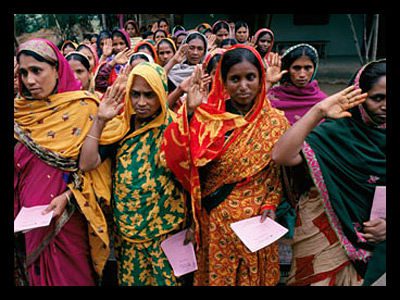
Poor populations in developing countries worldwide are often ignored by most lending institutions. Traditional banks typically do not loan to those with little income or other forms of collateral. As a result, it is extremely difficult for those in poverty to advance economically without access to forms of credit, insurance, or savings mechanisms.
Microfinance services provide these low-income individuals with a broad range of financial tools involving small amounts of money in the hopes that services like capital, banking, and insurance will assist them in rising out of poverty. The World Bank estimates that there are around 160 million people in developing countries that are currently benefiting from microfinance. Many of the institutions that provide microfinance services are nonprofit organizations like Kiva and government agencies such as the United States Agency for International Development (USAID).
Many case studies have demonstrated that microfinance is responsible for helping low-income households meet basic needs, improve their economic welfare, and grow their livelihoods. Microfinance also helps to empower women by providing microcredit, thereby promoting equality and economic opportunities.
Microcredit provides poor entrepreneurs the ability to start or expand their businesses. Having this reliable source of credit makes it easier for them to manage cash flow and business activities. Even though the size of the capital lent seem comparatively small, sometimes less than a couple hundred dollars, it is a significant sum for half of the world’s population, who lives on less than $2 a day.
After using credit to start a business or buy land, poor individuals in developing countries can benefit from savings services that microfinance institutions provide. Since the poor are more likely to lose control of their money due to mismanagement, fraud, and corruption, secure financial services allow safer and more responsible transactions. Additionally, low-income families in developing countries are more likely to be adversely affected economically due to many uncontrollable factors such as death, illness, and natural disaster. Access to credit, insurance, and savings can make these precarious conditions easier to manage and maintain financial security.
Empirical evidence from the Consultative Group to Assist the Poor (CGAP) shows the benefit that microfinance services can provide to the world’s poor. For example, members of the Grameen Bank, a nonprofit microfinance organization for women, who use microfinance services have over 40% higher incomes than those who do not. Development in countries like India, the Philippines, and Morocco has also been advanced due to microcredit. Businesses have expanded and industries have diversified.
Individuals in developing countries are in dire need of a broad range of financial services. Microfinance services provides these people with the opportunity to develop their own businesses, build assets, and manage their incomes and risks. Those who are given access to microfinance services live in significantly better economic conditions than those who do not. And in time, many of these people are able to pull themselves out of poverty.
– Rahul Shah
Sources: KIVA, CGAP, Lend with Care
Photo: The Guardian

Jim Yong Kim on Reducing Poverty
At the USGLC (US Global Leader Coalition) 2013 Conference, June 26-28, Jim Yong Kim president of the World Bank spoke of the importance of poverty reduction. Kim believes that “for the first time in human history, we have an opportunity [to eradicate poverty]”.
The first of Kim’s goals is to end poverty by 2030. By reducing poverty rates to below 3 percent, we can “bend the arc of history”, Kim told the USGLC. With consistent growth rates, the 2030 projected poverty rate is between six and nine percent. But lowering the poverty rate down below three percent will virtually remove all poverty and leave only frictional poverty, according to Kim.
Kim defined frictional poverty as the poverty resulting from circumstances difficult to control. Situations that have to be responded to on a case by case basis, like famine or other natural disasters, will be the only poverty left after levels are reduced to below three percent worldwide.
Kim’s second goal is to boost the incomes of the bottom 40 percent. Kim emphasized that without an all-inclusive economy, societies will become increasingly unstable.
The World Bank president also placed critical importance on foreign assistance. Today, total development assistance is about $125 billion. Although influential, the amount of assistance needs to increase, Kim said. Funding for Africa infrastructure is $95 billion alone. Kim also emphasized the importance of private sector investment in eliminating poverty.
“Change will not happen,” Kim concluded, unless everyone “decides that the ultimate goal is more important than raising the flag for our single organizations.”
– Danielle Doedens
Sources: USGLC, YouTube
Photo: Merco Press
Venezuela’s Crime Rates Rise Due to Poverty
Venezuela is a beautiful country known for its striking natural beauty and urbanized culture. Venezuela is also home to some of the world’s largest oil deposits, and houses large quantities of coal, iron, ore, bauxite, and gold. The country has experienced great wealth and prosperity as a result of its natural resources.
However, economic growth in Venezuela had disproportionately benefited some people more than others. A majority of Venezuela’s citizens live in impoverished areas and have not benefited from the oil wealth. Over 60% of the households in Venezuela are poor families, and the unemployment rate has only been increasing over the last few years. Sewage flows into the once beautiful Guaire River, which has led to its declining safety and toxicity. Streets are covered in trash, and citizens to not have enough clean water to bathe in regularly.
Venezuela has also been experiencing an increasing crime rates. Families such as the Olivero family, live in fear of the violence, for gangs and increasing violent crimes are growing in their home town of Caracas. Every night around six, the family gathers together in their home and locks the main entrance to their house. Their homes are not the most secure protection from the violence outside, for Mr. Olivero has stated to the Huffington Post that their neighbor’s roof was penetrated by a stray bullet recently.
For the Olivero family and many others, the violence does not seem to end. Venezuela’s homicide rate is the fifth highest homicide rate in the world and is 20 times higher than that of the United States. Unfortunately, RFI explains, crime within Venezuela continues as a result of the high poverty and lack of impunity, and will not come to an end until the country’s economy improves.
Venezuelan cities are also undergoing current food shortages, for store owners are unable to fill their shelves with basic goods. Anglys Bericote, a local, explains how private businesses hold on to the supplies and goods. Bericote also stated to the Huffington Post that her town has been so low on supplies, that she was unable to buy toothpaste or toilet paper for herself and her family.
Another local, Yaneth Solano, said she does not believe that the government will help the citizens of Venezuela with these current issues of violence or poverty. She believes that nothing can or will change Venezuela, for only God could help them now. As crime, food shortages, and littering continue within Venezuela, its citizens will not see improvement until the government places more focus on helping the impoverished improve their standard of living.
– Grace Elizabeth Beal
Sources: The Huffington Post, BBC, RFI
Improving Access to Reproductive Health Services
Improving access to reproductive health services in the developing world is critical to poverty alleviation. Pregnancy and childbirth-related complications are a leading cause of death of girls, aged 15 to 19, in developing countries. An estimated 7.3 million girls under age 18 give birth each year, and a great percentage of births occur in Africa. To counter this, the United Nations Population Fund (UNFPA) has announced it will partner with eight African countries to improve access to reproductive health services for millions of girls. The programs will span over the next three years, and will hopefully make a difference in lives of millions of young people.
“We are working specifically to ensure that the continent’s adolescent girls, between the ages of 15 and 19 – some 45 million of whom live in sub-Saharan Africa – get a good education, are able to decide whether and when to marry and have children, are protected from HIV, remain safe from violence, and have their fair share of opportunities to work and contribute to the economic development of their countries,” said UNFPA Executive Director Babatunde Osotimehin.
UNFPA will partner with the Democratic Republic of the Congo, Ethiopia, Mozambique, Niger, Nigeria, Sierra Leone, South Sudan and Tunisia. The programs will deliver comprehensive sexual and reproductive health services for young people. The hope is to reach disadvantaged and impoverished girls who are most at risk for poor sexual and reproductive health, violence and exploitation.
UNFPA programs will ensure young people have access to age-appropriate sex education, whether they are in school or out, to prepare them for adult life. The programs will bring together governments, young people, the private sector and other stakeholders to access the needs of young people.
UNFPA is the lead United Nations agency that promotes sexual and reproductive health services. They are at work in 150 countries, ensuring that young people have the information, services, and supplies they need to make safe and healthy decisions.
“Over the next three years, in partnership with governments and young people themselves, we will commit to making a tangible difference in the lives of millions of young people right across the continent. It is their rights we must uphold and it is they who are our best hope for a prosperous and peaceful Africa,” said Dr. Osotimehin.
– Catherine Ulrich
Sources: UNFPA, UN News
Photo: Join Tokyo
HIV/AIDS and Poverty in South Africa
For South Africa, HIV/AIDS is a disease specific to poverty. In 2009, over half the country’s population lived in poverty. As of 2011, almost 6 million South Africans were living with HIV/AIDS, the highest number of affected in a single country in the world. Despite these daunting figures, this year?s scientific breakthrough in antiretroviral drugs brings hope.
Samantha Oliver, 23 and a Michigan State University graduate, spent August through December in 2011 interning in Cape Town, South Africa. While working with an organization to promote HIV/AIDS research and best practices, she saw the effects of the disease. “HIV/AIDS spreads poverty and poverty spreads HIV/AIDS,” she said. Though which came first is harder to determine. Oliver went on to explain that the disease “attacks what should be the most productive sector of an economy.” People between the ages of 15-49 are most likely to contract HIV/AIDS and they are also the people making most of the contributions to the economy. When a family member becomes sick from the disease, they are unable to work and another family member must stay home to help care for them. As of 2011, about one fifth of South African women in their reproductive ages had HIV, thus continuing the problem of mother-infant transmission of HIV/AIDS.
The United Nations reported that in a national South African survey, 66 percent of people asked reported a drop in the amount of income per household due to “HIV-related illness, including the direct loss of earners.”
Despite the cyclical nature of the relationship between HIV/AIDS and poverty in South Africa, progress has clearly been made throughout the past decade. While in Cape Town, Oliver saw something a lot of people watching the news or reading online reports do not see. She was able to see the work being done by South Africans for South Africans. “A lot of people think that over in Africa in particular, people are sitting around waiting for foreign aid to happen… All I saw was local doctors, nurses and pharmacists going way above and beyond their jobs to try to come up with solutions,” Oliver said. “It was creative problem solving… I think that people would be a lot more supportive of different types of aid programs if they could see that local people on the ground are already starting the kinds of projects that the funding would be needed for.” Oliver’s stay in Cape Town in 2011 was her sixth visit to South Africa.
In March of this year, the Center for Strategic and International Studies reported that the transition from United States-led policy to South African-led policy that began in October of 2010 was going well. The U.S. is no longer “a lead role in the provision of lifesaving services” and has moved “to an approach focused increasingly on technical support.” The good news continues this July as the UN noted that South Africa has the second largest antiretroviral program in the world and their continued battle against the spread of HIV/AIDS is showing progress. The UN also estimated that in South Africa, the rate of infection is between 17 and 32 percent lower than if the treatment were not being provided.
While attending Michigan State University, Samantha Oliver double majored in International Relations and Comparative Politics with a specialization in International Development. Of her experiences while in Cape Town, Oliver said, “If people could see what community-based organizations are doing [in South Africa], I think they would be really moved.” She also recommended that if someone were interested in learning more that they look into South Africa-based aid organizations as well as international organizations.
– Jordan Bradley
Sources: The Center for Strategic and International Studies SouthAfrica.info United Nations Development Programme Times Live UNAIDS UN Chronicle
Photo: The Telegraph
Poverty in Mexico
This July, Coneval, the Mexican government social development agency, reported that while the national poverty rate declined a measly .6 percent, an increase in the population meant a half million increase in the number of people living at or below the poverty line. The report revealed that 45.5 percent of Mexico’s citizens live in poverty. Coneval defines poverty as living on 2,329 pesos, the equivalent of $183, per month in the city and 1,490 pesos, or $117, in rural areas. It defines extreme poverty in the city at $88 per month and $62 per month in rural settings. As of 2012, almost 10 percent of the population of Mexico lives in extreme poverty, totaling 11.5 million people.
After the Coneval data was published, Mexican Finance Minister Luis Videgaray said, “The only feasible, permanent answer to reducing poverty in Mexico is through economic growth.”
President Enrique Peña Nieto echoed a similar sentiment, promising plans for modernizing existing assistance programs and creating new programs. While Mexico’s current government assistance program Oportunidades has been internationally recognized for its success, the program mainly offers monetary support and lacks focus in policies concerning income growth.
The National Bureau of Economic Research found suggestive evidence of a connection between globalization and poverty in Mexico. Because the country was so aggressive when they opened their economy completely in 1985, Mexico’s GDP has almost tripled. In 1980, five years before tariffs were cut and other trade restrictions removed, eleven percent of the GDP was from international trade. In 2002, it reached 32 percent.
A majority of Mexico’s poorest states are in the southern region of the country. The four poorest in the nation are Chiapas with 74 percent of its population living in poverty, Guerrero at 69 percent, Puebla at 64 percent and Oaxaca at 61 percent. All four states sit well above the national poverty percentage of 45.5 percent. In Oaxaca, Chiapas and Guerrero, 50 percent of the population lives on $62 or less a month.
Rural areas in Mexico are the areas that see the least amount of economic growth and development. This is also where 61 percent of the indigenous population lives in extreme poverty. Oportunidades focuses 99 percent of its services on rural or semi-urban areas. They are currently assisting 6.5 million families in a number of ways. Most benefits come in the form of cash deposits for the people who qualify for the program. A section of the program called Youth with Oportunidades gives economic incentives to students who graduate high school before they turn 22 years old. Because women head eight of every ten single-parent household in Mexico, Oportunidades also gives cash transfers to help pay for high-quality food for children.
The assistance that Oportunidades is offering those living in poverty benefits lives in the short run, but the global community hopes it will be a launching pad for greater economic growth in Mexico.
– Jordan Bradley
Sources: The Latin Times, World Bank, The National Bureau of Economic Research, Rural Poverty Portal, Mexidata Reuters
Photo: Allison Orthner
Biogas Program has Major Benefits for Ugandans
Heifer International’s Uganda Domestic Biogas Program has drastically changed the lives of many Ugandans. The instillation of the biogas units (12,000 over five years) is not only bringing jobs, revenue, and efficiency to the people of Uganda, it also cutting down on pollution.
The biogas program works with readily available resources to provide Ugandans with essentials to improve quality of life. The units convert animal manure into clean and cheaper energy. This energy can be used as electricity for lighting and cooking. Not only is this a cleaner option than using kerosene lamps and burning charcoal and wood, it is also much cheaper. Households are now able to save the money they would have spent on firewood and charcoal, as well as healthcare expenses they may have been forced to pay from contracting illnesses related to breathing in unclean air.
This program teaches masonry skills and provides jobs to men and women. These masonry skills are transferrable to future jobs and have even attracted many young people. The energy has also afforded new business options for Ugandans small business owners.
The biogas program also benefits environment as it stops deforestation by reducing the need for wood and charcoal. It also cuts down on harmful burning fumes. Bio-slurry, which is a byproduct of the process, can also be uses as a fertilizer as it is much cheaper and more effective than other options on the market. Bio-slurry is organic and has resulted in higher crop yields and better-enriched soil than can continue producing crops in future years. Some households have even been able to sell excess bio-slurry to neighbors and colleagues to gain extra income.
Uganda is one of six African countries in the Africa Biogas Partnership Program (ABPP). Including Kenya, Ethiopia, Tanzania, Burkina Faso, Uganda, and Senegal, the ABPP’s goal is to fund 70,000 biogas units across these countries by the end of 2013 to bring much-needed revenue to people.
– Sarah C. Morris
Sources: Tanzanian Domestic Biogas Programme, Electrify Africa Act
Photo: The Global Journal
Women’s Disempowerment in Yemen
In Yemen, the custom of early marriage just met a vocal challenger.
Going viral last week was a video of 11-year-old Nada al-Ahdal ranting about her parents’ decision to forcibly marry her off to a much older man. “What have the children done wrong? Why do you marry them off like that?” she asks the camera. Her powerful words have touched a delicate nerve amongst Yemenis, some of whom have upheld and continue to practice the custom of early marriange for generations. According to a 2006 joint report by the Ministry of Public Health and Population, the Pan-Arab Project for Family Health and UNICEF, this tradition is still widely practiced: 52% of Yemeni women and girls are married by the time they turn 18.
The recent video highlights Yemen’s history of early marriage laws and the government’s and society’s unwillingness to modernize conceptions of marriage. In 1994, the official age for lawful marriage stood at 15. Five years later, the law was abolished on religious grounds, eliminating a minimum age for early marriage. A brief legislative effort in 2009 to amend the situation was ultimately stalled and aborted, despite that fact that Yemen is party to multiple international treaties that require married couples to be at least 18 years old. Overall, the issue remains to be addressed, leaving countless children susceptible to premature marriage and the social and economic disadvantages that come with it.
Interviews with Yemeni girls and women reveal troubling facts. In rural areas, some girls were married off at the age of 8. Once married, women often have little power in their marriages which can also mean they have limited control over the timing and spacing of children, which increases the risk of reproductive health problems. Early marriage also diminishes the chance that wives will return to school to complete their education, putting them at a distinct social and economic disadvantage. Verbal and physical abuse against women is also prevalent in early marriages in Yemen.
In some ways, Nada al-Ahdal’s words do not just refute the practice of robbing girls of their childhood and sexual purity; they also underline the crucial “cycle of poverty and early marriage” that plagues tens of millions of women around the world. Poverty and early marriage tend to be mutually reinforcing phenomena: girls born into poverty are more likely to have mothers who ‘transmit intergenerational poverty’ and lack social assets and networks. In addition, early marriages greatly increase the chance that young girls will live in poverty. The cycle, parallel to the strong customary tradition of early marriage most prevalent in rural areas, reinforces young women’s roles as undereducated child-bearers with limited social networks.
Nada al-Ahdal eloquently defends her decision to flee from arranged marriage. But behind her words lies Yemen’s ugly reality of women’s disempowerment and its central role in the country’s greater puzzle of poverty reduction and economic growth. As one of the poorest nations on earth and a hotbed of terrorist activity, poverty in Yemen has resulted in a globally destabilizing situation. Instituting a minimum age for marriage could be a key policy for addressing women’s inequality and poverty. In doing so, Yemen would have a more solid foundation for development and more human capital to support its economy.
– Zach Crawford
Sources: BBC, Multiple Indicator Cluster Survey (MICS), Human Rights Watch, Save the Children’s “Champions for Children” report, Washington Post
Photo: Washington Post
Dubai “End Poverty. Educate Now.” Campaign
Dubai Cares, a nonprofit working to improve children’s access to education in developing countries, recently launched a new campaign called “End Poverty. Educate Now” to raise awareness about the link between education and eradicating poverty.
The “End Poverty. Educate Now” campaign will run through the Islamic holy month of Ramadan to raise funds to assist children worldwide by improving their access to primary education. Dubai Cares is currently reaching more than 8 million children in 31 developing countries worldwide. The campaign is building and renovating classrooms, providing clean water wells and latrines, distributing nutritious meals, and providing treatment for intestinal worms. Additionally, teachers are receiving training and millions of books are being distributed.
CEO of Dubai Cares, Tariq Al Gurg, stresses that education is one of the most important investments in breaking the cycle of poverty. Education leads to in increases in income levels and reductions in social inequalities caused by poverty.
Gurg states that this campaign seeks the support of the United Arab Emirates community in order to reduce the number of underprivileged children globally who do not have access to education, which is currently estimated to be 57 million according to UNESCO. UNESCO affirms that education is one of the best tools to combat poverty by stating that if all children in developing countries could read, global poverty rates would fall by at least 12 percent.
Dubai Cares is running this campaign by setting up an interactive stand at the Dubai Mall’s Star Atrium. The campaign is also raising funds through donations via SMS and the Internet. Visitors of the Dubai Mall will be able to make contributions while shopping or through donations boxes throughout the mall. In the atrium, there are black and white posters on tiles which show children living in destitute conditions. These images will gradually transform into a positive colored images as more people donate. These colored images represents the lives of children who are receiving the opportunity for an education.
This symbolic transformation represents the dramatic change that education can make in the lives of children and the fight against poverty.
– Rahul Shah
Sources: The Gulf Today, Emirates Today, Gulf News
Sources: Sunny Varkey
Tibetan Atrocities Revealed by Communist Party Official
An ethnic Tibetan who grew up under the Chinese Communist regime and currently works as a high-ranking Communist Party official has decided to speak out against the Tibetan atrocities currently taking place. Choosing to remain anonymous, the government official claims that the current state of Tibet is “far worse than people in the West suspect.”
When the Chinese military invaded Tibet in 1950, many Tibetans thought the Chinese would modernize the region and bring order to the land that was previously ruled by monks and monasteries. These thoughts were quickly dashed when the Chinese began erasing any signs of Tibetan culture and forcibly removing people from their homes into communes. During the Great Proletarian Cultural Revolution from 1966 to 1976, Tibetan leaders were sent to Maoist reeducation camps and hundreds of monasteries and relics were destroyed. Many of these injustices are still occurring today.
The streets of Lhasa, Tibet’s capital city, are still patrolled by Chinese security forces that act like occupiers. The Communist official claims that the security forces often take property and beat residents at their own discretion and without cause. During another Lhasa revolt surrounding the 2008 Beijing Olympics, the military arrested 6,000 people. The practice of self-immolation, or the public death by lighting oneself on fire, has gained popularity with monks to raise awareness for their struggle. Since 2011, over 100 people have resorted to self-immolation to protest the Chinese occupation of Tibet.
Another horrifying byproduct of Chinese rule has been the destruction of the Tibetan plateau. The Communist official alleges that the increase in cultivation due to Chinese immigrants coming to Tibet has resulted in diminished grasslands and desertification. The number of rivers that feed into Qinghai Lake decreased from 108 to 8 due to extensive irrigation systems. Furthermore, the area as a whole is said to be a toxic dumping ground for Chinese industries.
Human Rights Watch recently published a 115-page report corroborating many injustices that the Communist official is claiming. Their report focuses on the re-housing project currently underway that has relocated over 2 million Tibetans since 2006. Hundreds of thousands of nomadic herders have been placed into “New Socialist Villages” destroying their livelihoods without adequate compensation.
These obvious and blatant human rights abuses are occurring all across Tibet. The Communist official hopes to publish a book in the West detailing his eyewitness accounts of the current state of Tibet and hopes that the Chinese will someday allow public debate on the matter. He says that a style of democracy tailored to the culture and people of Tibet would be the best solution if such an option were possible.
– Sarah C. Morris
Sources: Spiegel, Human Rights Watch
Sources: New York Times
Microfinance and the World’s Poor
Poor populations in developing countries worldwide are often ignored by most lending institutions. Traditional banks typically do not loan to those with little income or other forms of collateral. As a result, it is extremely difficult for those in poverty to advance economically without access to forms of credit, insurance, or savings mechanisms.
Microfinance services provide these low-income individuals with a broad range of financial tools involving small amounts of money in the hopes that services like capital, banking, and insurance will assist them in rising out of poverty. The World Bank estimates that there are around 160 million people in developing countries that are currently benefiting from microfinance. Many of the institutions that provide microfinance services are nonprofit organizations like Kiva and government agencies such as the United States Agency for International Development (USAID).
Many case studies have demonstrated that microfinance is responsible for helping low-income households meet basic needs, improve their economic welfare, and grow their livelihoods. Microfinance also helps to empower women by providing microcredit, thereby promoting equality and economic opportunities.
Microcredit provides poor entrepreneurs the ability to start or expand their businesses. Having this reliable source of credit makes it easier for them to manage cash flow and business activities. Even though the size of the capital lent seem comparatively small, sometimes less than a couple hundred dollars, it is a significant sum for half of the world’s population, who lives on less than $2 a day.
After using credit to start a business or buy land, poor individuals in developing countries can benefit from savings services that microfinance institutions provide. Since the poor are more likely to lose control of their money due to mismanagement, fraud, and corruption, secure financial services allow safer and more responsible transactions. Additionally, low-income families in developing countries are more likely to be adversely affected economically due to many uncontrollable factors such as death, illness, and natural disaster. Access to credit, insurance, and savings can make these precarious conditions easier to manage and maintain financial security.
Empirical evidence from the Consultative Group to Assist the Poor (CGAP) shows the benefit that microfinance services can provide to the world’s poor. For example, members of the Grameen Bank, a nonprofit microfinance organization for women, who use microfinance services have over 40% higher incomes than those who do not. Development in countries like India, the Philippines, and Morocco has also been advanced due to microcredit. Businesses have expanded and industries have diversified.
Individuals in developing countries are in dire need of a broad range of financial services. Microfinance services provides these people with the opportunity to develop their own businesses, build assets, and manage their incomes and risks. Those who are given access to microfinance services live in significantly better economic conditions than those who do not. And in time, many of these people are able to pull themselves out of poverty.
– Rahul Shah
Sources: KIVA, CGAP, Lend with Care
Photo: The Guardian