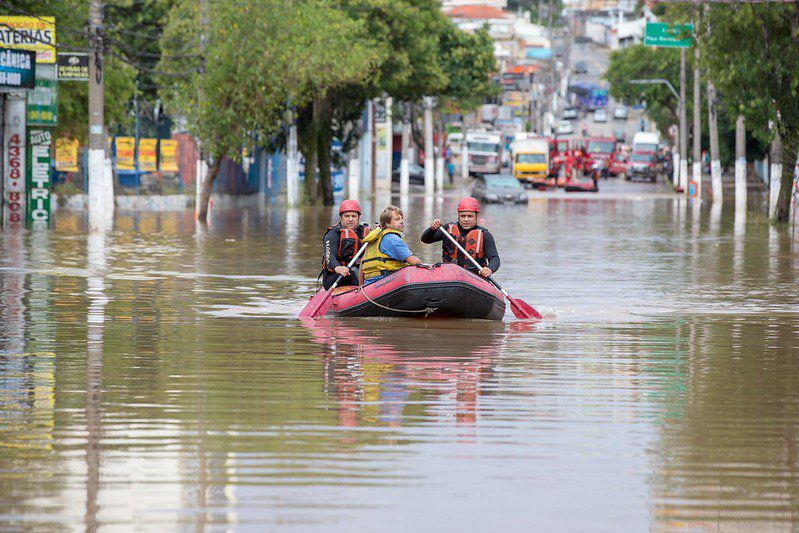
 The 2024 floods in Brazil, specifically in Rio Grande do Sul were considered the worst natural disaster in the region’s history. Heavy rain started to pour in April 2024 and did not stop for 10 days, overwhelming the basins of the Taquari, Caí, Pardo, Jacuí, Sinos, and Gravataí rivers. The water eventually overflowed as it reached the cities and ravaged several municipalities in Porto Alegre.
Floods in Brazil
Several neighborhoods and communities in the Rio Grande do Sul had been completely submerged in two weeks. People lost their homes, jobs, possessions, and loved ones, having to find shelter in churches and stadiums or, in the case of more vulnerable communities, under boats and cars. Around 163 people died, almost 600,000 were displaced and more than 65,000 were in shelters.
A recent study by the Metropolis Observatory showed that poorer families were the most affected by the floods in Brazil as they were struggling to rebuild themselves. Neighborhoods like Humaitá, in which the majority of the population earned a minimum wage, suffered the most. Similarly, in the Delta do Jacuí islands, 200 people had to improvise shelter in tents, cars, and under bridges. Floods have always been common in the city and have always affected the low-income population the most.
Volunteers
Alexandre da Silva, who volunteered in Porto Alegre’s shelters, said that it looked like a “war scene.”
“There was a lot of water. There were many volunteers with boats and helicopters—the rescues were non-stop. Hospitals [were full of] with people suffering from hypothermia, fainting and [those] who had ingested a lot of water.”
Overnight, residents from Porto Alegre found themselves in poverty. The unemployment rate could rise from 5.3% to 6.1%, and the investment needed to rebuild the city could cost billions of dollars. Specialists state that, despite a trend of impoverishment in the region, the extent is uncertain.
“People lost their jobs and did not get any compensation. They lost their houses and had no place to stay; they left with just the clothes on their backs because the flood was very fast. Imagine you are in your house and suddenly it starts flooding. Within three hours, the water had taken over”, declared Alexandre.
People Helping
The disaster quickly reached social media as people detailed their stories and asked for any sort of help. What was expected to be a small movement mobilized the entire country. At the time, the most popular content creator was the make-up artist Camila Pudim. In response to the floods and her new-found success, she posted on TikTok to encourage people to donate to Rio Grande do Sul. The video amounted to more than 90 million views, and several other creators followed in her footsteps, promising to donate their content’s revenues to the cause.
The previous 70,000 people in shelters fell to 1,800 by November 2024 in a continuous decline, and efforts are still ongoing towards the complete restructuring of the cities. The Brazilian government has recently authorized the budget to reconstruct 7,500 houses and the regional authorities have allocated 212 temporary residences aimed at providing homes to those awaiting definite housing.
Solidarity Campaign
Additionally, System Fiep organized the Solidarity Campaign, which continues working towards supporting the flood’s victims. Since its beginning in May, it has raised more than 65 tons of donations among them water bottles, food, clothing, bedding, hygiene products, cleaning products and toys.
The state is now implementing a new strategy, “Plano Rio Grande”, for reconstruction, adaptation, and climate resilience – allocating around 2.2 billion reais to the project. The actions taken include the transfers from the Civil Defense to the affected municipalities (which amount to a total of R$148 million), resources for the reconstruction of roads (R$117.7 million), the Volta por Cima social program, which allocated R$251.2 million to homeless and displaced families, and a program for dredging small rivers and streams (R$300 million).
Corporations Involving
SLC Institute, an organization within the agricultural business, helped with equipment, logistics, fundraising, and by donating R$ 500,000 to the Food Bank, an aid campaign. Renner, one of the most popular fast-fashion companies in Brazil, funded boat rentals that, according to its own Public Relations team, made 900 rescues in Porto Alegre and surrounding metropolitan areas. CMPC, a major player in the forest sector, also used trucks, helicopters, and backhoe loaders to assist in rescuing people and animals.
In addition, when combining the efforts, donations from the former and latter organizations summed up to 80,000 pieces of clothing, 75,000 liters of water, 5,000 bedsheets and towels, 14,000 blankets, 14,000 hygiene items, 15 tons of food, 4,000 food bank parcels, dozens of chemical toilets, and 750 mattresses destined to shelters.
– Beatriz Cicci
Beatriz is based in London, UK and focuses on Good News and Politics for The Borgen Project.
Photo: Flickr

Things to Know About Haiti’s Gender Wage Gap
Haiti’s Gender Wage Gap and Unemployment
On average, female salaries are around 32% lower than their male counterparts in Haiti. About a third of this wage difference “can be explained by factors such as age, number of children, education, and industry of employment,” according to the International Monetary Fund (IMF). However, the rest of Haiti’s gender wage gap has no explanation, pointing towards a culture of gender discrimination. In rural areas, this manifests itself as more women living in poverty; households headed by women are more likely to live below the poverty line (62% compared to 54% of male-led households).
In 2017, women in Haiti were 20 percentage points more likely to be out of work than their male equivalents This was exacerbated during the COVID-19 pandemic, with women more likely to be unemployed or leave their positions, “reflecting a pattern of low labor market attachment among women that was already present and that expanded during the pandemic.” Although female unemployment has reduced slightly in the post-lockdown era, it still stood at 17.78% in 2023, compared to 11.79% for men.
Women and the Informal Sector
The informal sector contributes around 60% of Haiti’s GDP. Haitian women tend to dominate in this informal economy, partially due to a lack of opportunities or education, but also because Haitian women have “traditionally carried the brunt of family responsibilities” and the society sees them as “poto-mitan” – or backbone- of their families and wider communities. Thus, many women become informal merchants to earn money and juggle domestic responsibilities, contributing to Haiti’s gender wage gap. Women tend to work more in this informal sector which “small production units with low-profit margins” define, including a lack of protections and security for workers (10), which further disadvantages women in terms of pensions and rights, making job progression more difficult.
Traditional Gender Roles and Violence
Around half of Haitian homes, according to the May-June 2020 Haiti Gender Assessment, claimed that chores like cooking, cleaning and child-rearing were a woman’s responsibility in the home. This significant domestic burden inevitably places women at a disadvantage when looking for employment in comparison to men, who tend to have fewer if any domestic tasks.
Also, women have much less access to “productive resources” like land and financial tools, with only 8% of women in rural Haiti owning their own land, compared to 20% of rural men, according to the World Bank. Although only a third of Haitians have a bank account, the gender gap is around 5 percentage points, with much less women having access to these services.
An acute problem with gender-based violence could also be contributing to the persistence of Haiti’s gender wage gaps, given that violence against women “has profound implications for women’s [labor] market participation, driving economic and workplace barriers that erode financial independence and restrict access to meaningful employment opportunities.” In just the first quarter of 2024, there were 1,793 reports of GBV 94% of which came from women and girls, according to the Center for Strategic and International Studies (CSIS). Combatting chauvinist ideas and domestic violence towards women is key to empowering and integrating them into the workplace.
Education Gap Reversing
Despite a lack of progress regarding women’s involvement in the workforce, there has been progress in improving female education and attendance rates. Gender gaps have “closed or even reversed at the secondary and tertiary levels” with more girls between 15-24 years attending school than boys in rural areas, the World Bank reports.
However, gender gaps persist in lower stages of the education system, and men are still more likely to have graduated from secondary and higher education institutions than their female counterparts. This persisting gender gap in higher education attainment is inevitably worsening this gender pay gap, given that many women in Haiti have not been provided with the same level and quality of education as their male peers.
Solving Haiti’s Gender Wage Gap
The Haitian government has tried to make progress regarding the country’s marked gender wage gap, signing international accords addressing women and gender equality. It also has a Ministry for the Status of Women and Women’s Rights (MCFDF) and a Gender Equality Office for the Parliament, established in 2013, “to foster gender equality on the legislative level and women’s participation in formal politics.”
However, implementation has been slow, considering institutional weakness, political instability and a lack of funding for the MCFDF. Quotas for female representation in government have not had major success within these bodies, with women making up less than the constitutional requirement in both houses of the Haitian Parliament (less than 30%). Compared to its neighbors, Haiti is underperforming regarding the promotion of gender quality and equal opportunities, according to the World Bank.
USAID has also attempted to empower women and girls and combat Haiti’s gender wage gap. They have focused on programs intermingling economic factors and improvements to health and sanitation provision with measures to reduce poverty and gender-based violence. USAID initiatives to reduce poverty and stimulate growth have created 27,000 permanent jobs since 2011, 53% of which employed women, in sectors like construction and manufacturing.
Final Notes
Haiti is a country with a young population and much potential but has suffered at the hands of dictators, natural disasters, and political instability. The country’s gender pay gap has been fed by and worsened female participation in the labor market and the lack of employment opportunities for women. Despite great efforts by the Haitian government and USAID, the 32% gender wage gap persists, and women still find themselves without work, or limited to employment within more informal sectors without workplace protections.
– Ciara Howard
Photo: Flickr
Tackling Learning Poverty in Lesotho
Causes of Learning Poverty
While primary education (grades 1-7) is free in Lesotho, many students fail to complete their studies and even fewer transition to secondary education (grades 8-10). There are two leading causes of large declines in students:
Few primary schools in Lesotho offer pre-primary education, limiting access. Students in pre-primary education face the same challenges as older students, such as being unable to afford books or transportation. The shortage of schools across all grade levels caused significant overcrowding, a problem that began in 2009 after free primary education was implemented. The government failed to allocate enough funding to prepare school infrastructure for the influx of students. Overcrowding has also caused a shortage of qualified teachers. While many teachers work in schools, they are not enough to adequately educate all students. Additionally, many teachers lack the literacy and mathematical skills necessary for effective instruction, compromising the quality of education. The lack of training opportunities worsens the issue, leaving many educators without proper qualifications.
Initiatives Tackling Learning Poverty
The Ministry of Education and Training also provides the Orphans and Vulnerable Children Education Grant, which covers costs for uniforms, books, transportation and secondary education fees for children in need. This program ensures that financial barriers do not prevent access to education for the most disadvantaged students.
Moving Forward
Efforts to combat learning poverty in Lesotho extend beyond education, incorporating proposals to address the health and well-being of children. By combining infrastructure projects, curriculum reform and targeted support for vulnerable students, Lesotho aims to tackle learning poverty at its roots. These initiatives reflect the country’s commitment to providing a brighter future for its children.
– Nivea Walker
Photo: Flickr
Cancer in West Africa: A Growing Health Challenge
Common Types of Cancer in the Region
Breast, cervical, liver and prostate cancers are the most prevalent types in West Africa. Among women, breast and cervical cancer dominate diagnoses, while prostate and liver cancer are the leading causes among men. Cervical cancer, largely preventable through HPV vaccination and regular screening, remains a major cause of death due to the absence of widespread immunization programs and early detection services. Similarly, liver cancer is often linked to exposure to aflatoxins—poisonous substances found in mold-contaminated food—compounding health risks in the region.
Environmental and Lifestyle Factors
Geographic and environmental factors also play a significant role in cancer prevalence. Increased exposure to environmental pollutants from urbanization and industrialization has raised cancer risks. Lifestyle changes, including dietary shifts, reduced physical activity and higher rates of tobacco and alcohol consumption, have further exacerbated the burden of noncommunicable diseases in West Africa.
Health Care Gaps and Access Issues
Limited health care infrastructure presents one of the most significant barriers to addressing cancer in West Africa. A shortage of oncologists, inadequate diagnostic equipment and poorly resourced health care systems mean that many patients receive diagnoses in advanced stages of the disease. Countries such as Sierra Leone and Guinea have minimal specialized medical personnel, leaving large portions of their populations without adequate care. This stark disparity in access to treatment makes combating cancer in the region considerably more challenging.
Efforts to Combat Cancer
Despite these ongoing challenges, efforts to tackle cancer in West Africa have grown over the past decade. Public health campaigns, led by organizations like the West African Health Organization (WAHO) and supported by global entities such as the World Health Organization (WHO), have focused on:
Notable success stories include Ghana’s cervical cancer screening expansion and the introduction of HPV vaccines in schools, as well as Nigeria’s national cancer control plans, which aim to improve early detection rates.
Looking Ahead
Beyond its medical implications, cancer poses a developmental challenge, straining families, communities and economies in a region already facing significant vulnerabilities. Addressing the rising cancer burden in West Africa requires comprehensive strategies that prioritize preventive care, education and strengthening health care systems. Furthermore, collaborative efforts that focus on expanding vaccination programs, improving access to diagnostic tools and training medical personnel are essential. By investing in sustainable health initiatives, the region can potentially work toward reducing mortality rates and mitigating the socio-economic impact of cancer on communities.
– Joe Lockett
Photo: Flickr
How Historical Resource Extraction in Africa Fuels Modern Poverty
Historical Resource Extraction and Economic Dependency
During colonial rule, European powers extracted valuable resources from African nations without regard for long-term economic development. In the DRC, Belgium controlled vast resources, including rubber, copper and ivory, while failing to invest in essential infrastructure like roads, schools or health care. The Belgian administration’s primary attraction to the DRC was its natural resources that could be exploited for profit. This exploitation by Belgium set the stage for decades of future conflict and violence leaving behind an unstable country unable to grow economically. Evident in how the majority of Congolese people have not benefited from the natural resources. The DRC is one of the poorest countries in the world with an estimated 73.5% of Congolese people living on less than $2.15 a day in 2024.
Similarly, Nigeria’s British colonial rulers focused on extracting oil, positioning Nigeria as one of Africa’s major oil producers. However, with approximately 40% of Nigerians living below the national poverty line, wealth distribution remains a significant issue.
Nigeria’s economy, heavily reliant on oil exports, faces the consequences of price fluctuations in global markets, which can destabilize the local economy and deepen poverty. The United Nations Development Programme (UNDP) has documented the economic instability that accompanies raw material dependency, noting that countries lacking the infrastructure to process their resources into higher-value products struggle with poverty and limited economic diversification.
Long-Term Impacts
Historical resource extraction systems left African countries reliant on raw exports, which today are often controlled by foreign corporations. In Nigeria, international oil companies hold a significant stake in oil production. Their influence limits Nigeria’s ability to fully capitalize on its oil wealth for national growth, as foreign profits outstrip contributions to the local economy and infrastructure.
In the DRC, foreign corporations dominate cobalt mining, a resource crucial to technology production worldwide. Local communities receive minimal benefits from the cobalt industry, often facing poor working conditions, environmental damage, and limited economic opportunity. Artisanal miners, who produce over 20% of the DRC’s cobalt, frequently earn less than $2 per day despite grueling and dangerous conditions.
Furthermore, child labor remains a significant concern, with an estimated 40,000 children working in cobalt mines across the country, Wilson Center reports. According to the UNDP, economies heavily reliant on raw exports without diversified industry struggle with job scarcity and vulnerability to market fluctuations, hindering efforts to reduce poverty. The presence of foreign corporations in critical industries leaves these countries at the mercy of global market dynamics, which often prioritize profit over local development.
Sustainable Development and Economic Empowerment
Several African nations have launched initiatives to reduce reliance on raw exports and foreign corporations in response to colonial legacies. Nigeria, for instance, has started developing oil refineries to process crude oil locally, hoping to reduce its need for imports and increase job opportunities. By adding value within Nigeria, these efforts aim to boost economic resilience and retain a larger share of resource-generated wealth within the country.
The U.S. government-supported Public-Private Alliance for Responsible Minerals Trade (PPA) focuses on creating a sustainable and responsible minerals trade in the Democratic Republic of Congo (DRC) by promoting local ownership and ethical mineral sourcing. By creating conflict-free supply chains for resources like gold and cobalt, the PPA helps communities gain more control over their resources.
It also emphasizes empowering women in mining communities and improving working conditions. These efforts aim to create sustainable economic opportunities, reduce exploitation by foreign corporations, and build resilience in the DRC’s mining regions. Transparent supply chains and community-focused projects are critical steps toward self-sufficiency and long-term poverty alleviation.
Addressing Colonial Impacts to Alleviate Poverty
Historical resource extraction continues to affect African economies, leaving many reliant on raw exports and vulnerable to global market shifts. European powers took significant wealth from African nations without fostering sustainable local industries, creating economic structures that persist today. Sustainable development and resource sovereignty initiatives are helping African countries reclaim control over their resources and invest in local economic growth. Addressing these historical injustices remains crucial for building economies that empower African communities and reduce poverty by ensuring African wealth benefits the continent itself.
– Harriet Conway
Photo: Flickr
Floods in Brazil: Avoiding Another Disaster
Floods in Brazil
Several neighborhoods and communities in the Rio Grande do Sul had been completely submerged in two weeks. People lost their homes, jobs, possessions, and loved ones, having to find shelter in churches and stadiums or, in the case of more vulnerable communities, under boats and cars. Around 163 people died, almost 600,000 were displaced and more than 65,000 were in shelters.
A recent study by the Metropolis Observatory showed that poorer families were the most affected by the floods in Brazil as they were struggling to rebuild themselves. Neighborhoods like Humaitá, in which the majority of the population earned a minimum wage, suffered the most. Similarly, in the Delta do Jacuí islands, 200 people had to improvise shelter in tents, cars, and under bridges. Floods have always been common in the city and have always affected the low-income population the most.
Volunteers
Alexandre da Silva, who volunteered in Porto Alegre’s shelters, said that it looked like a “war scene.”
“There was a lot of water. There were many volunteers with boats and helicopters—the rescues were non-stop. Hospitals [were full of] with people suffering from hypothermia, fainting and [those] who had ingested a lot of water.”
Overnight, residents from Porto Alegre found themselves in poverty. The unemployment rate could rise from 5.3% to 6.1%, and the investment needed to rebuild the city could cost billions of dollars. Specialists state that, despite a trend of impoverishment in the region, the extent is uncertain.
“People lost their jobs and did not get any compensation. They lost their houses and had no place to stay; they left with just the clothes on their backs because the flood was very fast. Imagine you are in your house and suddenly it starts flooding. Within three hours, the water had taken over”, declared Alexandre.
People Helping
The disaster quickly reached social media as people detailed their stories and asked for any sort of help. What was expected to be a small movement mobilized the entire country. At the time, the most popular content creator was the make-up artist Camila Pudim. In response to the floods and her new-found success, she posted on TikTok to encourage people to donate to Rio Grande do Sul. The video amounted to more than 90 million views, and several other creators followed in her footsteps, promising to donate their content’s revenues to the cause.
The previous 70,000 people in shelters fell to 1,800 by November 2024 in a continuous decline, and efforts are still ongoing towards the complete restructuring of the cities. The Brazilian government has recently authorized the budget to reconstruct 7,500 houses and the regional authorities have allocated 212 temporary residences aimed at providing homes to those awaiting definite housing.
Solidarity Campaign
Additionally, System Fiep organized the Solidarity Campaign, which continues working towards supporting the flood’s victims. Since its beginning in May, it has raised more than 65 tons of donations among them water bottles, food, clothing, bedding, hygiene products, cleaning products and toys.
The state is now implementing a new strategy, “Plano Rio Grande”, for reconstruction, adaptation, and climate resilience – allocating around 2.2 billion reais to the project. The actions taken include the transfers from the Civil Defense to the affected municipalities (which amount to a total of R$148 million), resources for the reconstruction of roads (R$117.7 million), the Volta por Cima social program, which allocated R$251.2 million to homeless and displaced families, and a program for dredging small rivers and streams (R$300 million).
Corporations Involving
SLC Institute, an organization within the agricultural business, helped with equipment, logistics, fundraising, and by donating R$ 500,000 to the Food Bank, an aid campaign. Renner, one of the most popular fast-fashion companies in Brazil, funded boat rentals that, according to its own Public Relations team, made 900 rescues in Porto Alegre and surrounding metropolitan areas. CMPC, a major player in the forest sector, also used trucks, helicopters, and backhoe loaders to assist in rescuing people and animals.
In addition, when combining the efforts, donations from the former and latter organizations summed up to 80,000 pieces of clothing, 75,000 liters of water, 5,000 bedsheets and towels, 14,000 blankets, 14,000 hygiene items, 15 tons of food, 4,000 food bank parcels, dozens of chemical toilets, and 750 mattresses destined to shelters.
– Beatriz Cicci
Photo: Flickr
The Fall of Assad’s Regime and Challenges Facing Syrians
Additionally, “more than 14 million Syrians have been forced to flee their homes in search of safety” since 2011. The United Nations (U.N.) also reports that about 70% of the country’s population needs humanitarian assistance, with 90% living below the poverty line. However, the fall of Assad’s regime has happened and many Syrians are thinking of returning home. Although the fall of Assad’s regime can be seen as a positive development, the future for Syria and its people remains unclear. Here are five obstacles for the Syrian people after Assad fell from power.
Destruction of Infrastructure
Although Assad is gone and Syrian refugees consider the possibility of going back, Syria’s infrastructure has been obliterated by the 13-year civil war. “Basic amenities like clean water, electricity and housing are difficult to find,” Vox reports. For people whose homes were not destroyed, some of them have other people living in them now and “many refugees lack documentation to prove they own their properties.”
On top of that, the new government will unlikely be able to resolve “property disputes” as they are stretched so thin. The vast majority of the country’s population needs aid. The U.N. Refugee Agency reports that 90% of the population depends on humanitarian assistance. In addition, it is the beginning of winter. If refugees start returning now, they will need “shelter, food and water.” There are continuous obstacles for the Syrian people.
Economic Problems
Syria’s economy is in dismal condition and high inflation presents problems for people in Syria, as well as refugees considering returning. The Central Bank of Syria reports that inflation reached 122% in April 2024. In addition, schools have been destroyed, leaving many children without education. In tandem with that, few job opportunities exist for people to earn a reasonable living. Employment is yet another one of the obstacles for Syrian people.
During Assad’s reign, countries like the U.S. put heavy sanctions on Syria, hurting the nation’s economy even further. However, the current “de facto leader of Syria, Ahmed al-Sharaa,” is asking for sanctions to be lifted; he asserts that Syria does not pose a threat to other parts of the world as it did under Assad’s regime. The sanctions are currently still in place.
Uncertain Future
Although many feel joy at the end of Assad’s tyrannical and oppressive regime, the future remains uncertain for Syria. Ahmed al-Sharaa is the leader of Hayat Tahrir al-Sham (HTS), “the dominant group in the rebel alliance,” which defeated Assad. HTS is designated as a terrorist organization by the U.S., U.N. and others. Also, the group was formerly part of the terrorist organization Al-Qaeda. Many are skeptical about whether or not the new leadership will bring peace to Syria.
Many countries hosting Syrian refugees are eager to send them back. However, too many people returning at once could cause new problems, as the government is already dealing with great hardship. Obstacles for Syrian people in and outside of the nation are ever-present. In the north of Syria, Turkish-backed groups are fighting Kurdish-led groups, which might lead to further violence. Even more, many Syrians are doubting that HTS will bring a peaceful future, as they led an authoritarian rule in the northwest of the country.
Humanitarian Aid
Syria Relief & Development (SRD) is a nonprofit organization that addresses Syria’s most urgent need for aid. It was founded in 2011 and intends to provide humanitarian relief and encourage sustainable development in Syria. Since 2011, SRD has been involved in more than 18 million humanitarian interventions in Syria. The organization continues to provide support in health care, education, disaster relief and much more.
Final Thoughts
Syria’s future may be unclear, but there is no doubt that the fall of Assad’s regime has brought great joy to the Syrian people. Obstacles for Syrian people are still present and much aid is still needed. However, there seems to be a hope that Syria will be able to forge a newer and better future.
– Michael Messina
Photo: Pexels
Fighting Food Insecurity Among Indigenous Canadians
The organizations listed below combat food insecurity among Indigenous communities in Canada by reconnecting communities with traditional knowledge and sustainable practices. They focus on education, empowerment and skill-building, offering programs that improve food access, teach cooking and promote cultural practices. These efforts help communities build lasting solutions to food insecurity and enhance self-sufficiency.
Ojibiikaan Indigenous Cultural Network
Ojibiikaan Indigenous Cultural Network, located in Toronto, Ontario, is an Indigenous-led organization that strives to deepen the connection between people and the land. The organization focuses on three key pillars: the education of food and nutrition, implementing sustainable food systems and revitalizing traditional ecological knowledge.
Its programs include a variety of activities such as medicine walks, which is a form of meditation and an Indigenous rite of passage; snowshoeing, which is both a mode of transportation and a sport; sugarbush tapping, which is the collection of maple sap and the boiling of it to make maple syrup; gardening and traditional cooking. Through these programs, Ojibiikaan fosters a more profound respect for the environment while promoting both individual and community well-being.
Qajuqturvik Community Food Center
Qajuqturvik Community Food Center, located in Nunavut, Canada, works to address the significant challenges of food insecurity and high food costs in the region. With food prices more than twice the national average and limited availability of local country food, more than half of the households in Nunavut face food insecurity. Indeed, only a tiny fraction of daily calories come from traditional, locally sourced food.
In response, Qajuqturvik focuses on three key pillars: improving access to nutritious food, developing essential cooking skills and empowering community members to become active voices in advocating for change. The organization’s programs address immediate needs while fostering long-term community growth and self-sufficiency. These include a daily community meal, a food service training program, children’s cooking classes, a community cooking club and a food box distribution initiative.
Working Group on Indigenous Food Sovereignty
Indigenous Canadians established the Working Group on Indigenous Food Sovereignty to bring awareness of food insecurity among Indigenous communities in Canada. Furthermore, the group aims to ensure Indigenous voices are part of discussions surrounding food networks in the province of British Columbia and its major surrounding areas. Members of this organization come from diverse backgrounds, including traditional harvesters, farmers and gardeners, Indigenous community members, academics and researchers, Civil Society Organizations (CSOs), nongovernmental organizations (NGOs) and political advocates.
The organization’s Indigenous Food Systems Network Website connects individuals and organizations involved in Indigenous food-related action, research and policy reform. The Indigenous Food Systems Network is a hub of information about the land, economics, health, ecology, generational care, community and responsibility.
– Nina Bujewski
Photo: Flickr
Community-Led Development in Comoros Driving Progress
Reshaping the Vanilla Industry
Vanilla farming, a key source of income for many in Comoros, has long been hindered by fluctuating markets and outdated methods. However, women-led cooperatives are transforming this industry into a sustainable and profitable venture.
The Union of Women Vanilla Farmers of Comoros, established in 2015, trains farmers to use agroforestry techniques that preserve biodiversity while boosting crop yields. By combining vanilla cultivation with tree planting, farmers protect the soil and reduce the environmental impact of farming.
Direct trade agreements have empowered Comorian vanilla farmers by eliminating intermediaries, allowing them to earn significantly higher prices for their crops. For example, direct market access has contributed to Comoros becoming the 11th largest exporter of vanilla, with exports valued at $7.72 million in 2022.
Revitalizing Marine Ecosystems
Fishing is a vital industry in Comoros, but overfishing and environmental degradation have impacted fish stocks. Community-led marine protected areas (MPAs) are reversing this trend, promoting sustainable fishing and alternative livelihoods.
The Moheli Marine Park (MMP), established in 2000, involves local communities in managing marine resources. Studies in similar regions suggest that effective MPAs can lead to a 2 to 4 times increase in fish biomass. Additionally, MPAs have created opportunities in eco-tourism, such as snorkeling and marine research. These ongoing efforts align with Comoros’ Blue Economy National Plan, aiming to restore ecosystems and boost sustainable economic growth.
International Support Driving Grassroots Innovation
International support has significantly bolstered grassroots innovations in Comoros. The Global Environment Facility’s Small Grants Programme (SGP) has funded numerous community-led projects, directly benefiting local households. In 2017, three cooperative companies in Comoros secured trade financing worth more than $400,000 for vanilla and clove harvesting and export, due to a joint project by the International Trade Centre (ITC) and the Enhanced Integrated Framework (EIF). These initiatives have strengthened the vanilla industry’s contribution to the national economy, enhancing production efficiency and reducing post-harvest losses.
A Model for Sustainable Growth
Women’s cooperatives are revitalizing the vanilla industry, while marine conservation projects protect ecosystems and create sustainable livelihoods. For instance, the Enhanced Integrated Framework (EIF) has supported cooperatives and provided training for female entrepreneurs in the vanilla sector, laying the foundation for increased trade in the country.
Comoros’ story demonstrates the potential of local initiatives to drive change in low- and middle-income countries. By building on its successes and strengthening international collaborations, the nation offers a model for sustainable growth that can inspire others worldwide. The launch of the ReSea Project in 2024, for example, aims to empower coastal communities for climate resilience, further contributing to sustainable development. Through determination and innovation, Comoros is not only addressing poverty but also building a future of resilience and opportunity.
Looking Ahead
Community-led development in Comoros exemplifies how local solutions can address global challenges. Through the empowerment of women in vanilla farming and the revitalization of marine ecosystems, the nation has demonstrated that community-driven innovation can lead to sustainable economic growth and environmental stewardship. Supported by international partnerships and a commitment to grassroots leadership, these initiatives have improved livelihoods and provided a blueprint for development in other low-and-middle-income countries. Community-led development in Comoros is a reminder that resilience and creativity at the local level could drive transformative change, paving the way for a brighter and more sustainable future.
– Fiza Meeraj
Photo: Flickr
How Save the Children’s Jumper Day Fights Child Poverty
Child Poverty
Child poverty is a global issue that affects low-, middle- and high-income countries to varying degrees. An estimated 1 billion children worldwide experience multidimensional poverty, lacking essentials such as food, clean water, shelter, education and health care. Additionally, 333 million children live in extreme poverty, surviving on less than $2.15 per day. While extreme poverty is most prevalent in sub-Saharan Africa, millions of children in some of the world’s wealthiest nations also face poverty, underscoring the universal nature of this challenge.
The Day’s Impact
Hosted in schools and workplaces, Christmas Jumper Day raises funds and increases awareness about child poverty and efforts to combat it. In 2023, 1.5 million children and teachers, along with 27,000 workplaces, raised £3 million. The funds support initiatives such as training midwives, keeping children in school, reuniting families separated by conflict, predicting food crises to deliver timely aid and ensuring access to essential medications.
Christmas Jumper Day also supports Save the Children’s Emergency Fund, which aids children living in crisis zones like Gaza, Lebanon and Ukraine. The charity provides emergency supplies, cash assistance, education and mental health support to children in these regions. In Gaza, Save the Children offers medical care for children with severe injuries, mental health services and safe spaces for maternity health care. In October 2024, the organization opened a medical center in Khan Younis, treating more than 800 patients. Funds raised through the day will enable the charity to expand its medical services, a critical need with more than 14,100 children killed in Gaza.
Celebrity Involvement
To raise awareness for the day, celebrities including Olly Murs, Myleene Klass, Alison Hammond and Laura Whitmore modeled their Christmas jumpers to encourage fundraising and participation. When asked about the day, Nadia Sawalha commented: “Wearing a jumper and donating a small amount has the power to transform children’s lives for good. Christmas Jumper Day 2024 introduced a new Shaun the Sheep animation, “The Knit Before Christmas,” designed to engage children ahead of the event. The animation follows the beloved characters as they prepare for the big day. Actress Ashley Jensen premiered the animation at Launde Primary School in Leicester, which was the top fundraiser in 2023, raising £3,744.84.
Looking Ahead
The ongoing efforts by Save the Children demonstrate the importance of innovative fundraising campaigns in addressing the challenges faced by children living in poverty. Events like Christmas Jumper Day connect communities to a global cause, generating resources that support life-changing programs. By integrating public participation and targeted aid, the organization continues to provide critical assistance to children in need, fostering hope and resilience in some of the most vulnerable regions worldwide.
– Ellie Western
Photo: Unsplash
Project Hawaii Inc.: Supporting Hawaii’s Homeless Population
Homelessness In Hawaii
Hawaii’s number of homeless people jumped by more than 12% in 2023, with the state having the third-highest rate of homeless youth staying in unsheltered locations. Connie Mitchell, the executive director for the Institute of Human Services, said to Hawaii News Now, “Chronic homelessness is driven a lot by the fact people can live unsheltered here, number one, I think the other one is that we have a combination of very high rents here and a job market that doesn’t necessarily pay a living wage.”
The minimum wage in Hawaii is $10.20 an hour. However, the wage needed for the average two-bedroom apartment is $25.88 per hour, more than double what most local Hawaiians earn. Combined with environmental factors like the recent Maui fires, more Hawaiian locals sleep on the streets. Indeed, the Maui fires in August of 2023 destroyed nearly 3000 structures and contributed to the already high homeless population. Project Hawaii Inc. relies on public donations and sponsorships to run its programs, which are all rooted in Hawaiian culture and aim to deliver the simple pleasures that homeless people often lack.
Missions
Project Hawaii Inc. runs multiple programs for all children of all ages centering around the core values it holds: Aloha (providing love, compassion and respect to every child), Kuleana (embracing the responsibility to empower and uplift homeless children), ‘Ohana (creating a supporting community), Imua (the commitment to moving forward and improving), Malama (stewardship and care for the community) and Lokahi (the unity and cooperation involved in bringing people together).
Project Hawaii’s programs are holistically designed to impact every aspect that homeless children need help with. With projects ranging from providing essential needs like shelter and food, encouraging the children to participate in sports and helping mothers bond with their children.
Furthermore, the College Dormitory Rehab Project is a block of six rooms that can house up to 13 female college students. It provides centers that can teach skills like cooking, gardening and yoga, helping them build sustainable skills for their future. This project aims to help students who have experienced homelessness further their opportunities by supporting them through college.
On top of that, the Healthy Hearts project encourages homeless children to engage in team sports like football, soccer, baseball and many more. The project started due to the lack of athletic shoes for homeless kids, excluding them from physical education and recess. Providing these shoes and encouraging the children to participate in sports can ensure a healthier lifestyle during their most critical developing years.
Finally, the Mommy and Me program focuses on the mothers impacted by homelessness in Hawaii, helping equip them with nurturing skills that help them connect and aid their baby’s development. The project helps assist struggling mothers and also aims to decrease the delays unsheltered babies often grow up with, helping their speech and motor skills develop for when they enter education.
Summary
Project Hawaii Inc. empowers Hawaii’s homeless children and youth through culturally rooted programs that address immediate needs and foster long-term growth. Driven by volunteers and donor support, the organization creates meaningful change and brighter futures for the state’s most vulnerable populations.
– Caitlin Mulholland
Photo: Flickr