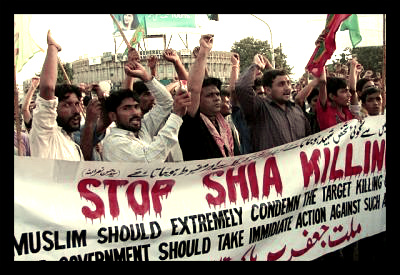
Sectarianism reared its ugly head again in Pakistan last month, as a Shia procession on one of the faith’s holiest days devolved into bloody street clashes that left at least 11 people dead and underscored the violent nature of sectarian fissures in Pakistan, where more than 300 members of the country’s long-disenfranchised Shia minority were killed during the first half of 2013 alone.
Last month’s clashes between Sunnis and Shias in the garrison city of Rawalpindi were a mere appetizer from a much larger menu of religiously-tinged violent incidents that have rocked Pakistan since 2011. Unfortunately for the country’s Shia community, members of this minority faith have borne the brunt of this sectarian violence, as militant Sunni outfits such as Sipah-e-Sahaba target followers of an Islamic sect for which they hold not just contempt, but venal hatred.
Sectarian violence aimed at Pakistan’s religious minorities is not a new phenomenon to this predominately Sunni country, but its escalation since 2011 has been palpable. That year, according to a report by Human Rights Watch, was one in which, “Religious minorities faced unprecedented insecurity and persecution.” Extremist attacks took the lives of scores of people across the country, including two prominent government officials, Punjab Governor Salmaan Taseer and Federal Minorities’ Minister Shahbaz Bhatti, both of whom were murdered by religious fanatics for publicly supporting a revision of Pakistan’s hard-line blasphemy laws.
The carnage continued unabated in 2012, as Sunni militants from such extremist groups as Sipah-e-Sahaba and Lashkar-e-Jhangvi (L-e-T), both of which adhere to the austere Deobandi school of Islam, unleashed a bloody wave of violence that included a September massacre in which gunman stopped a bus in Baluchistan Province, and after checking identity cards, removed the Shia passengers from the bus and then gunned them down, killing 26 Shia pilgrims.
Altogether, nearly 400- mostly Shia- Pakistani’s were killed in sectarian violence in 2012, according to the Center for Research and Policy Studies. This year is on pace to be just as deadly, with more than 300 Shias killed in four large-scale attacks in the first half of 2013, including twin blasts that took the lives of at least 93 people in the city of Quetta on a particularly bloody day in January.
Many of the plethora of sectarian attacks that have torn Pakistan’s delicately knitted social fabric in the past few years also have an ethnic dimension to them. Most of the Shias killed in these attacks are also Hazara’s, a Persian-speaking ethnic group whose Mongolian features easily distinguish them from Pakistan’s ethnic Punjabi’s, Pashtun’s, Baluchi’s, Sindhi’s and Mujahir’s.
The plight of the Hazaras, more than a thousand of whom have died in targeted killings in the past decade, is compounded by the fact that most members of this minority ethnic group are Shia. Their distinct facial characteristics make Hazaras, who are found in greater numbers in Afghanistan and Iran, an inviting target for Sunni extremists seeking to kill members of an Islamic sect they derisively denounce as heretics.
While most governments would take swift action to shut down militant groups seeking to sow sectarian discord among their country’s citizens, successive Pakistani governments have been cowed and intimidated by extremists, doing next to nothing to corral the groups that publicly assert responsibility for attacks targeting Shias or Ahmedis, another sect of Islam despised by the myriad hard-line Sunni Islamist groups that openly operate in Pakistan.
In its report on the state of affairs inside Pakistan in 2011, Human Rights Watch notes the Pakistani governments laissez-faire attitude towards dealing with extremists, asserting that, “Sunni militant groups, such as the supposedly banned Lashkar-e Jhangvi, operated with impunity even in areas where state authority is well established, such as the Punjab province and Karachi.”
The propensity of Pakistani politicians to placate sectarian extremist groups was on full display this past March, when the provincial government of Punjab, Pakistan’s most populous province, released some 150 militants it had rounded up following an especially vicious sectarian attack in Quetta the previous month that killed at least 79 people in a market packed with Shia Hazaras.
The political party that ruled Punjab- the Pakistan Muslim League-Nawaz–at the time of the militants release–now heads the federal government, an ominous portent for Pakistan’s Shia community, who must be left wondering if Pakistan’s leaders possess the political will to give reconstructive surgery to the county’s ugly sectarian face.
– Eric Erdahl
Sources: Christian Science Monitor, BBC, BBC, Dawn, Human Rights Watch
Photo: Opinion Maker

The Ugly Face of Sectarianism in Pakistan
Sectarianism reared its ugly head again in Pakistan last month, as a Shia procession on one of the faith’s holiest days devolved into bloody street clashes that left at least 11 people dead and underscored the violent nature of sectarian fissures in Pakistan, where more than 300 members of the country’s long-disenfranchised Shia minority were killed during the first half of 2013 alone.
Last month’s clashes between Sunnis and Shias in the garrison city of Rawalpindi were a mere appetizer from a much larger menu of religiously-tinged violent incidents that have rocked Pakistan since 2011. Unfortunately for the country’s Shia community, members of this minority faith have borne the brunt of this sectarian violence, as militant Sunni outfits such as Sipah-e-Sahaba target followers of an Islamic sect for which they hold not just contempt, but venal hatred.
Sectarian violence aimed at Pakistan’s religious minorities is not a new phenomenon to this predominately Sunni country, but its escalation since 2011 has been palpable. That year, according to a report by Human Rights Watch, was one in which, “Religious minorities faced unprecedented insecurity and persecution.” Extremist attacks took the lives of scores of people across the country, including two prominent government officials, Punjab Governor Salmaan Taseer and Federal Minorities’ Minister Shahbaz Bhatti, both of whom were murdered by religious fanatics for publicly supporting a revision of Pakistan’s hard-line blasphemy laws.
The carnage continued unabated in 2012, as Sunni militants from such extremist groups as Sipah-e-Sahaba and Lashkar-e-Jhangvi (L-e-T), both of which adhere to the austere Deobandi school of Islam, unleashed a bloody wave of violence that included a September massacre in which gunman stopped a bus in Baluchistan Province, and after checking identity cards, removed the Shia passengers from the bus and then gunned them down, killing 26 Shia pilgrims.
Altogether, nearly 400- mostly Shia- Pakistani’s were killed in sectarian violence in 2012, according to the Center for Research and Policy Studies. This year is on pace to be just as deadly, with more than 300 Shias killed in four large-scale attacks in the first half of 2013, including twin blasts that took the lives of at least 93 people in the city of Quetta on a particularly bloody day in January.
Many of the plethora of sectarian attacks that have torn Pakistan’s delicately knitted social fabric in the past few years also have an ethnic dimension to them. Most of the Shias killed in these attacks are also Hazara’s, a Persian-speaking ethnic group whose Mongolian features easily distinguish them from Pakistan’s ethnic Punjabi’s, Pashtun’s, Baluchi’s, Sindhi’s and Mujahir’s.
The plight of the Hazaras, more than a thousand of whom have died in targeted killings in the past decade, is compounded by the fact that most members of this minority ethnic group are Shia. Their distinct facial characteristics make Hazaras, who are found in greater numbers in Afghanistan and Iran, an inviting target for Sunni extremists seeking to kill members of an Islamic sect they derisively denounce as heretics.
While most governments would take swift action to shut down militant groups seeking to sow sectarian discord among their country’s citizens, successive Pakistani governments have been cowed and intimidated by extremists, doing next to nothing to corral the groups that publicly assert responsibility for attacks targeting Shias or Ahmedis, another sect of Islam despised by the myriad hard-line Sunni Islamist groups that openly operate in Pakistan.
In its report on the state of affairs inside Pakistan in 2011, Human Rights Watch notes the Pakistani governments laissez-faire attitude towards dealing with extremists, asserting that, “Sunni militant groups, such as the supposedly banned Lashkar-e Jhangvi, operated with impunity even in areas where state authority is well established, such as the Punjab province and Karachi.”
The propensity of Pakistani politicians to placate sectarian extremist groups was on full display this past March, when the provincial government of Punjab, Pakistan’s most populous province, released some 150 militants it had rounded up following an especially vicious sectarian attack in Quetta the previous month that killed at least 79 people in a market packed with Shia Hazaras.
The political party that ruled Punjab- the Pakistan Muslim League-Nawaz–at the time of the militants release–now heads the federal government, an ominous portent for Pakistan’s Shia community, who must be left wondering if Pakistan’s leaders possess the political will to give reconstructive surgery to the county’s ugly sectarian face.
– Eric Erdahl
Sources: Christian Science Monitor, BBC, BBC, Dawn, Human Rights Watch
Photo: Opinion Maker
Poverty in Nepal
Poverty in Nepal? Sadly, yes. Nepal is one of the poorest countries in the world. The UN estimates that 40% of Nepalis live in poverty. Food insecurity, poor housing, low soil quality, low literacy, natural disasters, and ethnic discrimination plague the Nepalese people. Though subsistence farming is the main way of life in Nepal, most of the population lives in the rural, mountainous region where the rocky terrain and arid soil make agriculture difficult.
Ownership of the fertile land is based on the feudal system. Most families have land holdings of less than 1 hectare, too small to meet their family’s needs. Most villages are made up of large families, and migrants come from the mountains to the lowlands. Refugees from Bhutan fled to Nepal during the violence in the 1990s. The growing population is putting pressure on the little cultivable land.
As a country straddling two tectonic plates, earthquakes, floods, landslides, and glacial melting inhibit economic growth. Socially, Nepal unofficially recognizes the caste system, especially in rural areas. This means poverty of lower castes is justified and expected. Women also face discrimination in terms of healthcare, nutrition, education, and the domestic realm. Women are unable to make major decisions or take responsibility for their own economic advancement. Many women go hungry, and female babies are sometimes victims of infanticide.
The Maoists that rose up against the monarchs of Nepal from 1990s to the early 2000s dominate the government. There is a president and a prime minister; however, there has not been a parliament since May 2012 after they failed to draft a new constitution. Political instability is a major obstacle to socioeconomic reform and international cooperation.
Tourism, especially for climbing, is a key industry for the rural regions with urban areas surviving off of trade with India. Major exports include carpet, clothing, leather goods, and grain. Nepal is highly dependent on foreign aid and assistance from NGOs. Ongoing NGO projects include energy access, skills development, environmental protection, infrastructure, clean water, and education.
– Stephanie Lamm
Sources: ADB, Rural Poverty Portal, BBC
Photo: Wikipedia
Africa’s Philanthropic Billionaires
When it comes to international aid programs, everyone has heard of the Bill and Melinda Gates Foundation, as well as Warren Buffett’s astronomical donation track record, with last year’s donations reaching $1.87 billion. However, outside of the American audience, African billionaires are also stepping up and contributing to causes they care about. Here is a list of African philanthropic billionaires that lead programs in their own countries.
The wealthiest African, Aliko Dangote, worth an estimated $20.2 billion, donates millions of his wealth to education, health and social causes. Last year Dangote took part in the first ever Forbes 400 Summit on Philanthropy, where he discussed the benefits of donating, listing Gates and Buffett as inspirations.
Nathan Kirsh, a South African native, earned his $3.6 billion wealth by monopolizing the small goods market in New York City. According to Forbes, his philanthropic efforts focus on Swaziland, where he supplied approximately 10,000 people with starter capital for small businesses. Kirsh states that 70 percent of his recipients are women with a 70 percent success rate for his program overall. He also hopes to make Swazi schools the first in Africa to boast guaranteed computer literacy for all graduates.
Folorunsho Alakija hails from Lagos, Nigeria and is Africa’s richest woman thanks to her very profitable ownership of an oil block in the 1990’s. Since then, Alakija has expanded her $7.3 billion enterprise to real estate around the world, notably $200 million worth in the United Kingdom alone. With her money, Alakija founded the Rose of Sharon Foundation in 2008 which aids orphans and widows in her native country of Nigeria.
Mohamed Mansour has an estimated $2.3 billion fortune from his investment company the Mansour Group, which owns Egypt’s largest grocery store Metro and Egypt’s McDonald’s franchises, among other businesses. Mansour founded the Lead Foundation, a nonprofit that has provided over 1.3 million loans to small business endeavors and under-privileged women in Egypt. Mansour also chairs the Mansour Foundation for Development, which strives to eliminate illiteracy, poverty, and disease in order to expedite the development of Egyptian society.
– Emily Bajet
Sources: Daily Mail, Forbes, Rose of Sharon Foundation, Mansour Foundation For Development
How To Be More Globally Aware
We’re all busy. Hectic schedules and technology practically run our lives, so here are nine easy ways to make them work in your favor and become more globally aware.
1. Twitter
It’s not all celebrities and witty screenwriters. Worldwide news organizations like CNN, BBC, and the Financial Times host Twitter accounts. Follow them or have their updates sent directly to your phone. Keeping an eye on worldwide trending topics can also help alert you if news is breaking.
2. Google Alerts
More along the lines of a “target acquired” approach, Google Alerts allows you to plug any phrase, country, word, or person into the endless Google engine and have the new results delivered to your inbox whenever you’d like.
3. RSS Feeds
Most sites these days will have an RSS Feed option. Signing up for it allows you to have the most important news right on your tablet or computer without having to search the internet.
4. Global News Sites
Go directly to the source. Sites like BBC News and CNN allow you to see the most important articles around the globe and then divide them by continent and country.
5. Magazines
Political magazines tend to take the occasionally dull topic of foreign affairs and make them digestible for larger audiences. However, because they tend to be monthly issues, you only get the greatest hits.
6. Council on Foreign Relations Daily Briefs
Delivered to your inbox every morning, the Council on Foreign Relations (CFR) gives you a summary of the most important events around the globe, analyzes them, and explains why what they’re giving you is important. CFR tends to be nonpartisan, gathering analysis from both sides of the aisle.
7. News Television/Radio Channels
Turn that remote to your favorite news channel of choice and have it serenade you with factual goodies while working the evening away. Not a morning person? Turn on the news while making coffee or getting ready to help get the juices flowing.
8. Books
Transport the written word to your iPad or tablet and take it with you on the morning commute, or take a mental health break while waiting for a meeting. If non-fiction books aren’t your thing, try historical fiction like Khaled Hosseini’s novel, “The Kite Runner.”
9. Newspapers
They’re still alive! Subscribe to a newspaper and have it on your phone or tablet whenever you have time.
– Hilary Koss
Sources: CFR, Amazon, Financial Times, BBC News
Fast For Families
On the 11th day of a hunger strike, Vice President Joe Biden made a surprise visit to a Fast for Families strike tent on the National Mall in Washington. The Vice President then prayed with the group and encouraged their efforts to bring immigration reform.
The U.S. Senate passed a bipartisan immigration bill (S.744) in June. However, the House of Representatives has been deadlocked on the issue. Fast for Families supporters have vowed to fast until the House votes on the immigration reform bill that has already passed in the Senate. The Fast for Families effort in Washington is in conjunction with local fasts and events taking place in congressional districts all over the country.
The Vice President’s visit inspired the fasters as he addressed the crowd saying, “[w]e’re going to win this.” Vice President Biden and President Barack Obama have struggled to keep immigration issues in the spotlight since the President made a promise to bring immigration reform in his campaign.
Biden also said during his visit to the Fast for Families tent, that the 11 million undocumented men, women, and children working for citizenship are already Americans. Throughout the first eleven days, Fast for Families has been visited by many public officials including Rep. David Valadao (R-CA), Secretary of Labor Tom Perez, Secretary of Agriculture Tom Vilsack, House Minority Leader Nancy Pelosi (D-CA), and Reverend Jesse Jackson.
Fasters have vowed that they will continue fasting until they can no longer sustain themselves or are “medically prevented” from continuing. Long time immigration reform activists participating in the fast received the Vice President’s visit and message as inspiring. In fact, Biden’s visit, in connection with House Speaker John Boehner’s recent comments at a news conference on November 21 that immigration reform is not dead, has offered hope to immigration reform advocates and a sign that the change they hope for is coming.
For more information and Fast for Families updates, please visit fast4families.org.
– Daren Gottlieb
Sources: Time, Los Angeles Times, Fast for Families
Photo: Media Heavy
Top 10 U.S. Charitable Foundations
Charitable foundations give numerous amounts of money every year to help people in need. Thousands of them exist in the world. Here are the top ten that give the most.
1. Bill and Melinda Gates Foundation
We have all heard of the co-founder of Microsoft, Bill Gates. His foundation, The Bill and Melinda Gates Foundation, gives over $3 billion for global development and health programs, as well as U.S. programs.
2. Lilly Cares Foundation
The Lilly Cares Foundation gives over $600 million to help needy U.S. patients receive medical prescriptions.
3. GlaxoSmithKline Patient Access Programs Foundation
Over $600 million through the Glaxo Smith and Kline Foundation is used for health and education programs.
4. Abbot Patient Assistance
The Abbot Patient Assistance Foundation provides nearly $600 million toward helping uninsured individual’s access prescription medicines.
5. Pfizer Patient Assistance Foundation, INC.
The Pfizer Foundation gives over $575 million to assist low income individuals and families with prescription costs.
6. Genentech Access To Care Foundation
Genentech gives over $575 million to helping patients access to low cost or free Genentech medicines and care.
7. Sanofi Foundation for North America
The Sanofi Foundation gives nearly $500 million to reduce healthcare inequalities and provide free prescription drugs to families.
8. Johnson and Johnson Patient Assistance Foundation, Inc.
The Johnson Foundation gives nearly $500 million to allow low income families gain access to medical assistance.
9. Walton Family Foundation, Inc.
The Walton Foundation gives over $480 million for education reform, water conservation, and quality of life initiatives.
10. Ford Foundation
This foundation was created by Ford company founder Henry Ford and Edsel Ford. It gives nearly $480 million to help fight poverty.
Everyone can help in the fight against global poverty. Donating to your favorite charity is one way; contacting your local congressmen will also help. Let them know that you want more global poverty bills introduced and aid to be set aside for impoverished nations.
– Amy Robinson
Sources: Foundation Center, Fund for NGOs
Photo: Deviant Art
How MP3s Promote Education in Africa
For many high school teachers, the explosion of the iPod represented another way for their students to become distracted in the classroom. It turns out that instead of using those MP3 players to blast music, they are being used to promote literacy and education all across Africa.
Meet the Lifeplayer MP3. A solar-powered radio, recorder and MP3 player, the Lifeplayer is manufactured by Lifeline Technologies to give rural African communities greater access to education. The Lifeplayer comes with reading and writing lesson plans already pre-loaded. Since it is solar-powered, rural communities without access to electricity can now enjoy this technological wonder without worrying about access to electrical outlets for recharging.
The company currently runs initiatives in Ethiopia, Kenya, Rwanda, South Sudan and Zambia. In Ethiopia, Lifeline has partnered with the British Council to promote English language education to over 50,000 school children. Kristine Pearson, the CEO of Lifeline, traveled to South Sudan to deliver 15,000 Lifeplayers to educators.
Pearson instructed trainers and teachers on how to use the technologically-advanced device in the hopes of reversing the discouraging education trends in the country.
“Nearly three-quarters of the population can neither read nor write,” states Pearson. “According to the Overseas Development Index (ODI), less than 2% of the population have completed a primary education and even less completed secondary school.”
In addition to the Lifeplayer MP3, the company also produces two other solar-powered marvels: the Prime Radio, an analogue radio with an LCD display, and the Solarstor, a portable charging station for cell phones.
The Prime Radio has been especially beneficial in Rwanda, where the company spearheads an initiative called Project Muraho. Partnering with organizations such as UNICEF, the initiative has provided 13,000 radios and power sources to families ravaged by the effects of the Rwandan genocide and the continued devastation of HIV/AIDS.
Although access to education has improved worldwide in the past decade, there are still great disparities in rural areas and communities without power and electricity. The Lifeplayer MP3 is a wonderful invention to help push education in these struggling communities.
– Taylor Diamond
Sources: World Economic Forum, Lifeline Energy: Technology, Lifeline Energy: Projects
Photo: Texarkana Gazette
Stars Team Up on Songs for the Philippines
Music has always been one of the most provocative and powerful mediums to promote advocacy and change. From the protest folk of Woody Guthrie and Bob Dylan, to the Civil Rights soul of Sam Cooke and Curtis Mayfield, to the politically poignant hip hop of The Roots and Mos Def, music engages us with the issues of our time on an emotional level.
Last week, some of music’s most well known figures joined together to release Songs for the Philippines on iTunes. Stars both past and present are featured on the album, the proceeds of which will go solely to the Philippine Red Cross to aid in the aftermath of Typhoon Haiyan.
Packed with 39 songs (many of which are classics) and a price tag of $9.99, the album makes for a wonderful addition to your holiday shopping list. Some of the artists included on the album are Bob Dylan, Beyonce, Eminem, The Beatles, Lady Gaga, Red Hot Chili Peppers and Earth Wind & Fire. Where else can you find such an eclectic mix? The variety alone makes it a great purchase.
Benefit albums have become a staple for iTunes following natural disasters. Songs for Japan was released in 2011 to support the victims of the tsunami in Japan. Much like Songs for the Philippines, Songs for Japan featured a similar variety of artists ranging from John Lennon to U2 to Foo Fighters. These benefit albums show how the music industry can stand united to support a greater cause.
Of course, that is not to suggest that the artists are randomly chosen. “This brilliant collection is united by a message of hope and compassion,” according to the iTunes synopsis of Songs for the Philippines. With titles such as “Hero,” “Stronger (What Doesn’t Kill You),” “Carry You Home,” and of course, “Let It Be,” it’s easy to see such themes.
Songs for the Philippines is a great way to show your support and compassion for the people of the Philippines. Oh, and in the unlikely event that you already own all 39 songs on the collection, iTunes features a link to the American Red Cross’s donation site for Typhoon Haiyan relief right beside the album. There is no reason not to contribute.
– Taylor Diamond
Sources: Huffington Post, Spin, iTunes
Photo: Straits Times
Kenya Launches Railway Project Funded by China
On Thursday, November 28, Kenya launched a multi billion-dollar railway project that will link the port city of Mombasa to the capital of Nairobi. The President of Kenya, Uhuru Kenyatta calls the project, “a historic milestone.” Kenyatta told the media, “The project will define my legacy as President of Kenya.” The railway was built by a Chinese state-owned firm called China Road and Bridge Corporation (CRBC), and is funded by the Chinese government. Completion of the first section is estimated within the year 2017.
This is certainly a big deal for Kenya, and for Africa. The current railway in Kenya was built back in the Colonial Era. This project is said to be the nation’s largest infrastructure venture since Kenya’s independence 50 years ago. The new railway comes with economic and China-Kenya relational benefits.
The new transportation addition will impact the people in the region tremendously. This first link of the project, Mombasa to Nairobi, will cut travel time from 15 hours to about 4 hours. Passenger trains will reach a maximum speed of 75 mph.
At the railway launch ceremony, President Kenyatta said, “What we are doing here today will most definitely transform… not only Kenya but the whole eastern African region…east Africa will become a competitive investment destination. A busy growing east Africa is good for us as a country.”
Chinese Ambassador to Kenya, Liu Guangyuan also spoke at the ceremony. He said the railway is a strategic endeavor for Kenya. He noted how railways have powered China’s economy for quite some time.
Deputy Director of the African Department at the International Monetary Fund in Washington, Roger Nord, also explained the impacts this project will have on the east African people. “From an economic point of view, this is quite beneficial, improving both access to global markets and boosting regional trade,” he said.
The railway has allowed a Kenya-China relationship to grow and look toward the future. In regard to the relationship, Guangyaun said, “Kenya is stepping forward…it will be a landmark project for Kenya and east Africa.” In reponse, President Kenyatta praised the Chinese for their support, and felt the Chinese are, “A true friend to Kenya.” Kenyatta pointed out how the Chinese are currently technological leaders when it comes to railway infrastructure. Kenyatta thoroughly thanks the Chinese leaders present at the launch ceremony.
Sources: FT, Aljazeera, BBC, Global Post
Photo: WUNRN
5 Essential Novels by African Authors
With the tragic and irreplaceable loss of Nelson Mandela, the world now must take to his words and memories to keep his inspirational message of hope alive. Thankfully, his spirit lives on in Long Walk to Freedom, his sensational autobiography, and Conversations with Myself, a collection of his most private essays and letters. Mandela will forever be available for any one to access. His words will resonate on the page for long-time followers or perhaps someone not yet familiar with the great leader.
In the spirit of Nelson Mandela and his written legacy, the following is a list of five essential works by African authors:
1. Things Fall Apart by Chinua Achebe
Perhaps the single most famous piece of African literature, Achebe’s first novel is a two-part story about Ibo tribesman Okonkwo. The story narrates African life prior to the arrival of colonial powers, and then the subsequent colonization of Nigeria by Britain.
2. Native Life in South Africa by Sol Plaatje
Sol Plaatje was a political activist and intellectual fighting for the freedom of native Africans during colonization by both the British and the Dutch. Plaatje was in many ways a forefather for Nelson Mandela, and Native Life in South Africa is one of the most important works in African literature. In it, Plaatje makes an emotional plea for enfranchisement and basic human rights for black Africans suffering at the hands of colonialism.
3. Purple Hibiscus by Chimamanda Ngozi Adichie
Adichie is considered an important figure in contemporary African literature, as she represents the next generation of authors following Achebe. Purple Hibiscus takes place in post-colonial Nigeria, and is the painful coming-of-age story of a young girl in a disintegrating family.
4. The Hairdresser of Harare by Tendai Huchu
This novel is a story about a hairdresser named Vimbai and her struggle to make a living and raise her son in modern day Harare, Zimbabwe. Described by many critics as “bittersweet,” the novel is both humorous and dark at the same time.
5. Petals of Blood by Ngugi wa Thiong’o
Petals of Blood looks at the interconnectedness between four murder suspects in the wake of the Mau Mau uprising in Kenya. The novel is a skeptical look at postcolonial Kenyan politics and the impossibility of escaping a colonial past.
– Taylor Diamond
Sources: Good Reads
Photo: Kubatana Blogs