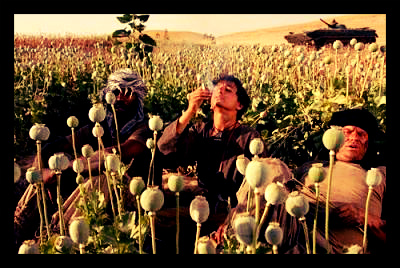
Part of the U.S. war in Afghanistan has been centered on eradicating opium production and distribution in the war torn nation. Billions of dollars have been invested by the U.S. to achieve this end.
Unfortunately, the U.S. has objectively failed on all counts to realize this goal. Just this past year, Afghan opium was produced at record levels despite a hefty U.S. investment of $7 billion dollars.
Currently, the opium trade composes 15 percent of the Afghan economy. Its heroin production, derived from opium, accounts for over 75 percent of the entire world’s supply.
The prospects of significantly reducing poppy cultivation in Afghanistan seem slim at best due to its embedded nature within the culture as well as the extreme poverty most Afghans live in. The lucrative prices opium sells for can provide a decent living for Afghan families struggling to get by.
For example, just one kilogram of opium can sell for up to $200. This is significantly more money compared to the paltry 41 cents per kilogram one gets for selling wheat.
NPR profiled one farmer who makes $9,000 per year by producing 150 lbs of opium. No other opportunity in Afghanistan provides a comparable income.
Previous measures implemented by the Afghan government have been aimed at providing disincentives for farmers who desire to enter the drug trade. But, resources have become scarce in recent years, forcing the programs to be shuttered.
In one such program, the Afghan government subsidized alternative crops such as cotton. The subsidies inflated the price, making the move away from poppies more palatable for Afghan farmers.
The international community also attempted to provide disincentives by shipping seeds and fertilizer to farmers, but the program in no longer being implemented. Absent these programs, farmers simply return to the lucrative poppy trade.
One of the most disturbing consequences from the ubiquity of opium in the country is the presence of addicts in staggering numbers. Out of the total population of 35 million people, one million are currently addicted.
The treatment capacity to provide for these addicts is extremely limited. The government only has the ability to treat 20,000 people at any one time. Availability for treatment is limited depending on one’s location in the country.
Also, the ease at which one can obtain drugs in Afghanistan only adds to the problem. For instance, in Kabul, the price for heroin only amounts to $6 and to many is as easy to obtain as food.
The major security implications for the sale of these drugs lie with who directly benefits from the profits, namely the Taliban forces. The UK Daily Mail reports that in 2011 the Taliban is estimated to have earned up to $700 million dollars from the sale of opium and heroin.
The strategic importance of eliminating the opium trade in Afghanistan was typified by a comment made by former U.S. special envoy to Afghanistan, David Holbrooke. Holbrooke stated, “Breaking the narco-state in Afghanistan is essential, or all else will fail.”
With the inevitable troop draw down coupled with the uncertain status of a residual counterterrorism force to stay behind post-2014 — the possibility of making major headways toward eradicating the Afghan drug trade is nonexistent.
– Zachary Lindberg
Sources: NBC News, Daily Mail, NPR, Christian Science Monitor
Photo: GAIFF

2013: Year of Success in Global Health
2013 marked a year of progress and prospect for global health. In the collaborative effort to end extreme poverty and create growth in developing countries, health plays one of the most important roles. These victories of 2013 create a vision for emerging health care and the impact on development as we enter a new year.
World leaders gathered for the Global Vaccine Summit in Abu Dhabi to discuss progress achieved and plans for moving forward in the “Decade of Vaccines,” focusing on the importance of building sustainable immunization programs and providing access to children. A significant portion of the conference focused on polio, acknowledging the power of vaccines by recognizing how close we are to declaring the world polio-free. With $4 billion in donor pledges to the Global Polio Eradication Initiative, we have seen great progress this year in the number of new cases in Afghanistan and Nigeria. The meeting in Abu Dhabi showed growing leadership, especially in the Middle Eastern and Islamic communities, to build strong vaccination programs and child health worldwide.
The Global Alliance for Vaccines and Immunizations (GAVI) Alliance confirmed that it was on track to immunize a half-billion children by the end of 2015. Working in 73 developing countries, GAVI strives to deliver affordable and life-saving vaccines against preventable diseases such as pneumonia, diarrhea, and meningitis. GAVI also works to strengthen immunization programs and health systems within the countries they work in.
The Global Fund to Fight AIDS, Tuberculosis, and Malaria saw a combined pledge of $12 billion from donors around the world. Since it was founded in 2002, The Global Fund has distributed 360 million insecticide-treated bug nets, provided 6.1 million people with antiretroviral therapy for AIDS, and have tested and treated 11.2 million people for tuberculosis. The $12 billion pledged December 2013 is a 30 percent increase in funding that will bring significant change in the progression of the epidemics.
In November, the International Conference on Family Planning was held in Ethiopia. With over 120 countries represented at the conference, the organization was able to call upon delegates to take action with their governments. Targeting the Millennium Development Goals relating to maternal mortality, access to contraception, high quality family planning and sexual reproductive health services. Focusing on these areas further promotes gender equality and women’s rights. When women are empowered and given the tools to make these decisions, countries will benefit through long-term economic growth. Family planning is a necessary and cost-effective, sustainable investment for nations. In the last year alone, 10 developing countries have adopted separate family planning conferences into their own agendas.
– Maris Brummel
Sources: Impatient Optimists, Global Vaccine Summit, The Global Fund, International Conference on Family Planning
Record Levels of Afghan Opium Production
Part of the U.S. war in Afghanistan has been centered on eradicating opium production and distribution in the war torn nation. Billions of dollars have been invested by the U.S. to achieve this end.
Unfortunately, the U.S. has objectively failed on all counts to realize this goal. Just this past year, Afghan opium was produced at record levels despite a hefty U.S. investment of $7 billion dollars.
Currently, the opium trade composes 15 percent of the Afghan economy. Its heroin production, derived from opium, accounts for over 75 percent of the entire world’s supply.
The prospects of significantly reducing poppy cultivation in Afghanistan seem slim at best due to its embedded nature within the culture as well as the extreme poverty most Afghans live in. The lucrative prices opium sells for can provide a decent living for Afghan families struggling to get by.
For example, just one kilogram of opium can sell for up to $200. This is significantly more money compared to the paltry 41 cents per kilogram one gets for selling wheat.
NPR profiled one farmer who makes $9,000 per year by producing 150 lbs of opium. No other opportunity in Afghanistan provides a comparable income.
Previous measures implemented by the Afghan government have been aimed at providing disincentives for farmers who desire to enter the drug trade. But, resources have become scarce in recent years, forcing the programs to be shuttered.
In one such program, the Afghan government subsidized alternative crops such as cotton. The subsidies inflated the price, making the move away from poppies more palatable for Afghan farmers.
The international community also attempted to provide disincentives by shipping seeds and fertilizer to farmers, but the program in no longer being implemented. Absent these programs, farmers simply return to the lucrative poppy trade.
One of the most disturbing consequences from the ubiquity of opium in the country is the presence of addicts in staggering numbers. Out of the total population of 35 million people, one million are currently addicted.
The treatment capacity to provide for these addicts is extremely limited. The government only has the ability to treat 20,000 people at any one time. Availability for treatment is limited depending on one’s location in the country.
Also, the ease at which one can obtain drugs in Afghanistan only adds to the problem. For instance, in Kabul, the price for heroin only amounts to $6 and to many is as easy to obtain as food.
The major security implications for the sale of these drugs lie with who directly benefits from the profits, namely the Taliban forces. The UK Daily Mail reports that in 2011 the Taliban is estimated to have earned up to $700 million dollars from the sale of opium and heroin.
The strategic importance of eliminating the opium trade in Afghanistan was typified by a comment made by former U.S. special envoy to Afghanistan, David Holbrooke. Holbrooke stated, “Breaking the narco-state in Afghanistan is essential, or all else will fail.”
With the inevitable troop draw down coupled with the uncertain status of a residual counterterrorism force to stay behind post-2014 — the possibility of making major headways toward eradicating the Afghan drug trade is nonexistent.
– Zachary Lindberg
Sources: NBC News, Daily Mail, NPR, Christian Science Monitor
Photo: GAIFF
Michael Jackson: We Are the World 25 for Haiti
Legendary pop king Michael Jackson has been dead for the past five years, but the sentiment of his charity single “We are the World” rings on brightly and truly. The charity single was originally composed by Michael Jackson and Lionel Richie and performed by USA for Africa to promote humanitarian efforts against famine in Africa.
Since its release in 1985, the globally-successful super-hit single has gone on to sell over 20 million copies, raising over $63 million for charity and has gleaned three Grammy Awards, an honor regarded as the highest accomplishment in the American music industry.
Following its original release, venerated artists have continued to remake the single. For instance, preserving the benevolence and enthusiasm of the original recording, over eighty artists, including the likes of Justin Bieber and Janet Jackson, participated in recording “We Are the World 25 for Haiti” in 2010 following the devastating magnitude 7.0 earthquake in Haiti. In the months after the earthquake, Haitians scrambled to recover from the widespread mutilation of their homeland.
According to the Disasters Emergency Committee, as a result of the earthquake, 220,000 lives had been lost, 1.5 million civilians lost their homes, and over 19 million meters of debris, a vast enough amount to stretch from London to Beirut, was scattered through Port-au-Prince, the Haitian capital. In response, artists featured on “We are the World 25 for Haiti” rallied together, forgoing royalties, in order to raise money for aid in Haiti. Although the single received largely negative reviews from critics, it was commercially successful, debuting at number two on the Billboard Hot 100.
Despite the efforts of “We are the World” remake, nearly four years after the earthquake in Haiti, recovery remains slow, with many spectating that relief organizations themselves have misused the aid money. However, progress, albeit timely, has indeed taken place. For instance, the United Nations has pledged to donate $2.2 billion to protect Haitians against cholera, while the Red Cross has donated nearly all of its $486 million in donations to help rebuild the nation.
Although critics allege that most relief efforts that have taken place in Haiti only tackle superficial problems rather than healing more inherent, complex issues that require more than mere repair of infrastructure and clean-up of debris, with donations and international support, Haiti continues to rebuild and recover from the destruction wrought by the 2010 earthquake. As long as people around the globe spread the message of “We Are the World,” Haiti, along with other countries affected by natural disasters, will be able to mend and flourish.
– Phoebe Pradhan
Sources: We are the World Foundation, Disasters Emergency Committee, NBC, Billboard, Huffington Post
Mbeki on a Post-Mandela South Africa
In 2006 South African President Thabo Mbeki presented the Nelson Mandela Memorial Lecture at the University of Witwatersrand. Aware Mandela’s health was declining, Mbeki spoke of Mandela’s legacy, and the world that he will leave behind.
South African President Mbeki, who spoke of “a good, a moral, a humane and a caring South Africa,” headed the memorial lecture. He spoke of harmony, peace, and forgiveness as the tenants of the “new South Africa.” Mbeki believes South Africa still needs a “Reconstruction and development of the soul,” as Mandela used to say. Alluding to a new period of economic growth and infrastructure modernization, the South African President says Mandela’s message must not die with him.
“All revolutions…are in the end, and in essence, concerned with human beings and the improvement of the human condition…we must also say that human fulfillment consists of more than access to modern and effective services,” says Mbeki. Modernization includes “the soul” of human society. A society can build up infrastructure, grow GDP, and invite investment, but if the collective soul of society is sick, it can never advance. Mbeki spoke of satisfying the spiritual needs of the people as well as the economic needs for survival.
The leader looks to capitalism as an economic provider, but not a spiritual provider. “Unsure of what they stand for, people increasingly rely on money as the criterion of value,” says George Soros. “People deserve respect and admiration because they are rich. What used to be a medium of exchange has usurped the place of fundamental values, reserving the relationship postulated by economic theory.”
Critic of capitalism, Mbeki says laissez-faire income redistribution is unjust, prompting a “survival of the fittest” mentality in an unequal world. Mbeki believes economic and social development relies on cooperation rather than competition, saying “nothing can come out of [competition] except the destruction of human society.”
President Thabo Mbeki says the best way to remember Mandela’s legacy is to band together, cooperating rather than competing, for a better South Africa. Mandela spent his whole life nurturing the soul of human society, and now this job has been handed down to the South African people he loved so dearly.
– Stephanie Lamm
Sources: International Relations and Cooperation, Nelson Mandela
Photo: Giphy.com
The United States African Development Foundation
The United States African Development Foundation (USADF) is an organization that seeks to give a helping hand to marginalized groups in Africa. The foundation grew out of the African Development Foundation Act of 1980, an initiative that identifies active community participation in Africa as key to developing a better social and economic system. The foundation provides grants of up to $250,000 to various groups that will benefit individuals who are in need, yet remain overlooked by other NGO’s and government organizations. The African Development Foundation provides grants in order to create higher income, improve social conditions, and increase jobs for marginalized groups.
The foundation is currently working in more than 20 countries in Africa. Community groups small and large have the opportunity to apply for a grant with the African Development Foundation. If the foundation finds that the group’s cause will promote more jobs, improve living conditions, and ultimately help to end poverty in Africa, then the foundation agrees to provide the grant. Thus far this year, the foundation has supplied $17 million to help engage marginalized communities in improving the socioeconomic conditions throughout Africa. The majority of USADF’s grants go towards expansion projects, small enterprises, farming associations and cooperatives.
One of the foundation’s program focuses includes a five-year $10 million grant program in the region of Lake Turkana in Kenya. The grant is going towards the development of a sound agricultural system in Kenya which will provide more jobs, and create better food sustainability. The Lake Turkana program will establish an agricultural system that the community can participate in and thrive on well into the future.
The foundation takes government transparency very seriously. As a government organization, USADF desires to operate in the sense of an open government, in which all of their grant plans and financial spending are open for all to see. USADF wants individuals to know where their tax dollars are going, and to be able to understand the issues happening in Africa in a simple way. The foundation also greatly encourages participation from African communities and collaboration with partners across government levels to help achieve their goals.
So far, the USADF has 336 active project grants and 100 small grants. The estimated number of people that the foundation has impacted is 1.5 million. With such high numbers the impact that the foundation is making is clear. USADF intends to increase their number of grants in the years to come and further contribute to ending poverty in Africa.
– Chante Owens
Sources: African Development Foundation, Advance Africa
Photo: Giphy.com
Rwanda Redefines HIV Care
In a country where just 20 years ago, genocide claimed nearly one million lives, the Rwandan government has revamped HIV treatment for the poor by reforming the standards of successful care.
In Sub-Saharan Africa, there are now over 7.5 million people receiving antiretroviral therapy, 150 times as many as a decade ago. Medications have become easier to manage and overall, more effective, forcing some patients to take no more than one pill each day. Also, HIV testing has become much more widely available and the virus is being detected at an earlier stage before the circumstances are too dire.
In Rwanda, many HIV patients are taking their medications as directed, medication which suppresses the virus in their bodies to the point where it is essentially non-detectable. Success here is achieved when the HIV positive individual can earn a living, support their family and care for their community no differently than uninfected individuals. Furthermore, patients who would have previously been hospitalized with severe complications of HIV are now receiving regular preventive care.
The steps forward being taken in this small country are undeniable. Compared with 54 percent of medical patients worldwide, 91 percent of Rwandan patients who require HIV medications have access to life-saving treatment. Even more encouraging, 98 percent of women undergo HIV testing during their prenatal visits. In a country with only one doctor for every 17,000 people, nurses and community health workers have been trained to provide HIV services that were before, only available from physicians. Aggressive media campaigns by the government and other international organizations remind and encourage the public to “Know Your Status” while targeted outreach programs concurrently focus on the high-risk groups.
Rwanda is one of the first sub-Saharan countries to nearly eradicate the transmission of HIV from mothers to their newborns. Due to this, the number of new HIV cases has been cut in half during the last decade, and perhaps soon, it will fulfill the dream of accomplishing an “AIDS free generation.”
– Sonia Aviv
Sources: The Atlantic, The World Bank, BWH Global Health
Photo: AIDS Health
Empowering Education: Girls Learn International
One in six girls in the developing world will not complete an education past the sixth grade. Add this sobering statistic to shocking numbers which illustrate that the entire continent of Africa has less than a 60% literacy rate, and one can see just how many challenges in completing an education the youth of the developing world face. However, girls in particular face an even greater challenge due to the widespread gender inequalities that still exist.
Girls Learn International (GLI) is a nonprofit, student-run organization and movement that encourages U.S. students to promote education for women throughout the world. Lisa Alter founded the movement with her two teenage daughters in 2003. Alongside Arielle and Jordana, Lisa began to inspire various youths to get involved in humanitarianism and women’s rights while still in school. As a result, GLI currently has 114 chapters in over 26 states across the country. GLI also boasts partnerships with 47 schools in 11 countries, including Afghanistan, India, and Ghana.
Countries not providing equal access to education for women will end up losing out on $92 billion for their respective economies, according to Girls Learn International. Additionally, 7 million cases of HIV/AIDS could be prevented if every child received a primary education, hence why GLI lives by the creed, “Women’s Education is a Basic Human Right.”
Furthermore, GLI has numerous partnerships and sponsors. GLI is part of the Feminist Majority Foundation, the Feminist Campus, and is a sister organization to Ms. Magazine. The organization has also partnered with the Global Campaign for Education’s U.S. Chapter while also fielding a delegation to the United Nations Commission of the Status of Women.
The organization seeks to empower young women and have them take initiatives towards working for global education. However, gender equality cannot be achieved without the contributions of idealistic young men as well. To drive this point home, GLI boasts having an all boys’ chapter in Pennsylvania. Regardless of gender, if you are a young person interested in providing education for women everywhere, GLI is the organization for you.
– Taylor Diamond
Sources: Girls Learn International, Global Campaign for Education
Photo: The Alternative Press
NPR Makes a T-Shirt
Take a look at the shirt you’re wearing. Odds are it’s better traveled than you are.
National Public Radio’s (NPR) Planet Money recently published a multimedia series on the making of a T-shirt and its extraordinary journey through the world economy.
Believe it or not, your shirt and others like it are a wonder of the modern world.
The five part series follows a T-shirt from cottonseed to ink print. It would seem like a simple process, but the Planet Money special reveals the hidden complexity of a global enterprise.
Behind each of these cheaply produced shirts are multinational corporations and complex trade deals between nations — but, most of all, people’s lives. While the series takes a look at the entire process, it is the human connection that it seems most poised to drive home.
Although the chapters are mostly delivered through a dispassionate reportage, the deleterious effects of the garment industry in the developing world are likely to ignite the passions of most viewers.
Perhaps the most illuminating of these stories is that of Jasmine in Bangladesh.
More than 4 million people like Jasmine work in the garment industry in Bangladesh. Many of these people work for less than 35 cents an hour.
Cramped living and working environments, the absence of electricity and running water as well as disease make life extremely difficult. Jasmine, herself, lives in a small group home without running water and sends most of her earnings to her parents.
However, these hardships pale in comparison to the risk many of these workers face.
For instance, while the Planet Money team was filming, a major garment building in Bangladesh collapsed killing over one thousand workers. The online series shows difficult images of bodies tangled in the framework of the building.
Tragically, without the garment industry, NPR argues, Bangladesh would be worse off still.
In the end, the shirt they made traveled thousands of miles by air, by land and by sea. Even so, it’s total production cost just over 12 dollars. The cost in time, travel and human toil, however, is something a bit larger.
It is a complicated process with complicated results but for people in developing nations that make the goods that the developed world buys, the garment industry’s work is a double bind.
On the one hand, it sustains their entire nation and on the other, it does not sufficiently provide for, or protect, its workers. If nothing else, NPR has created a series that does not shy away from presenting a complex image of an industry, its products and its people.
– Chase Colton
Sources: NPR, Al Jazeera
Photo: Giphy.com
African Mistrust of Chinese Investment
In 2009, China surpassed the United States as Africa’s largest trading partner. Its investments on the African continent have seen astronomical growth in a relatively short period of time — going from $10 billion in 2000 to $200 billion in 2013.
Because of this trading relationship, Africa has experienced an explosion of infrastructure projects and cheap Chinese goods supporting Africa’s consumer market. In exchange, Africa trades valuable minerals and oil, which supports China’s ever growing manufacturing sector.
Mostly, this relationship has been stable but recent shifts in African attitudes toward its biggest investor have caused tension. Some claim that China is no different from the colonial powers that dominated the continent in the past.
Many Africans point to China’s crusade for minerals as evidence of a one-sided relationship that mostly benefits the Chinese. Jobs are scarce in the region with 80% of Africans in “vulnerable employment.” Some claim Africans are missing out on potential jobs, due to the fact that minerals are exported to China in their raw form instead of being processed prior to export. These processing jobs are lost on the African people.
Another example of disappearing jobs can be found in the agricultural sector. For example, many peanut processing plants face extinction simply because China buys the crop and immediately exports it home, forgoing the processing in Africa.
Even the credit that China supplies to Africa comes with hefty strings attached. The money loaned is only to be spent on Chinese goods and Chinese infrastructure. Many of the infrastructure projects are built exclusively using Chinese workers instead of locals.
A sense of losing out on lucrative business opportunities, and the suspicion of colonial intentions, has ultimately boiled over into violence against Chinese workers. Recently, residents of Ghana attacked Chinese miners, blaming them for taking jobs usually reserved for Africans. The miners were mercilessly beaten — up to 200 were eventually deported.
African citizens are not the only ones bearing mistrust for Chinese investment; government officials have been involved in blocking Chinese oil production in multiple countries.
The Niger government has been erasing various parts of a Chinese oil contract that it deems threatening. It commissioned an auditor to review business expenses by the Chinese National Petroleum Corporation and found instances of price gouging and charges that seem less than fair.
In Gabon, an oil field permit was revoked from the Chinese company Sinopec. It was then awarded to a national company.
Many see Africa leveraging its resources as an attempt to prevent wealth from leaving the continent. This is due to the fact that despite numerous mineral deposits and a lucrative trading relationship with China, millions of Africans still suffer in extreme poverty.
Although tensions have flared within the Africa-China relationship, it is still an arrangement that most Africans prefer over the Western style of aid where business and infrastructure projects remain separate. Also, as opposed to aid provided by Western nations, China does not attach human rights or democratic reform requirements as a condition of receiving aid.
– Zack Lindberg
Sources: New York Times, Reuters, The Christian Science Monitor
Photo: The Guardian
Economy Strong, Poverty in Israel
Over the last several years, Israel has enjoyed economic growth and low unemployment. Unfortunately, that is not all good news. A report recently released by Israel’s National Insurance Institute and the Central Bureau of Statistics indicate that over 1.7 million people, or 23.5 percent of the population, live below the poverty line. Of the 1.7 million people living in poverty, 817,000 of them are children and 180,000 of them are elderly. In addition, one in five households is living at or below the poverty line.
In recent years, Israel has been seen as up and coming in the high-tech sector, drawing international attention. Even though Israel is seeing significant progress, The Organization for Economic Cooperation and Development (OECD) released a statement saying, “Israel’s output growth remains relatively strong, unemployment is at historically low levels…However, average living standards remain well below those of top-ranking OECD countries, the rate of relative poverty is the highest in the OECD area.” The report also adds that the poverty problem is affecting some groups more than others, “Among Arabs and in the rapidly growing ultra-Orthodox Jewish community poverty is over one in two, mainly due to low employment rates among Arab women and ultra-Orthodox men”
The OECD indicated that Israel surpassed some of the average measures of other OCED members; it ranked far below average in similar social themed categories. These categories included housing, education and skills, social connections, work life balance, environment quality, personal security, and civic engagement. Fixing some of these social problems could help alleviate poverty in Israel. Action that should be taken should target groups that are endemic with poverty and other related problems such as Arabs and the ultra-Orthodox Jewish community.
The OECD did offer several options for different solutions that could help alleviate poverty in Israel. One major suggestion was to improve education, especially in areas with severe levels of poverty. Another suggestion was to begin the process of pension and welfare reform to ensure that it is capable of coping with an aging population. Finally, the OECD favored sales tax increases over income tax increases so the tax does not become more of a burden on already cash-strapped families.
– Colleen Eckvahl
Sources: Your Middle East, JTA
Photo: Ivarfjeld