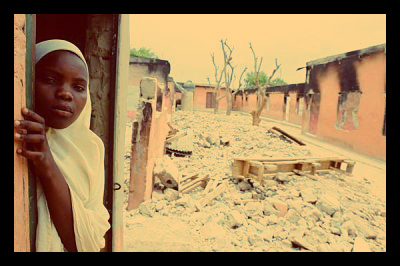
Schools in northern Nigeria are again the targets of religious tension, after a fatal attack by Boko Haram on February 24. The militant group set fire to the dormitories of a boarding school in the town of Budi Yani, Adamawa killing 29 young boys ages 11-18.
This is one of a growing number of attacks by the organization, which is responsible for roughly 1,700 deaths since their establishment in 2009. It is eerily similar to the burning of the College of Agriculture in Yobe State last September, during which 42 students were killed and 18 injured. Again on February 12, an estimated 50-90 civilians lost their lives in the village of Izghe in Borno state.
Tension is prevalent across the northern states of Borno, Yobe, Kano, Adamawa, Kaduna and Bauchi, where Boko Haram seeks to create a separate Islamic state, under the rule of Sharia law. Their sectarian stance is adamantly opposed to Western influence and Christianity, as indicated by their name, which translates to “Western education is sinful”.
Religious conflict between the predominantly Muslim north and the mainly Christian south arose in 1914, when British colonial rule created the West African nation. Demographics were not considered when the borders were drawn, combining culturally distinct and incongruous populations.
Boko Haram’s presence has been disastrous for Nigeria’s education system. Schools across the north are closing indefinitely, and even those that remain open are seeing extremely low attendance. Previously, State Commissioner of Education Mohammed Lamin frequently claimed that the government was winning the war on terror, and urged schools to reopen. However, many frightened parents remain unconvinced.
Aside from schools, Boko Haram also targets local banks, businesses, homes, churches and public buildings. Many families have fled to nearby Chad and Cameroon, choosing refugee status over sectarian violence.
Local chairman of Izghe, Maina Ularamu, says, “there is no protection. We cannot predict where and when they are going to attack. People can’t sleep with their eyes closed.”
The boarding school assault has been interpreted as an “open declaration of war,” according to Nigeria’s Senate President David Mark, along with other government leaders. The state of emergency declared in the region last year, as an attempt to end the insurgency through formal military deployment, will continue.
International efforts continue to be implemented against Boko Haram. France and the United States recently pledged their support for the Nigerian government, and leaders of neighboring Senegal, Niger, and Cameroon promise to help fight the militants on the ground. Nigeria’s President Jonathon will also soon be attending a security conference in Europe, where he hopes to garner even more awareness of the issue.
– Stefanie Doucette
Sources: Al Jazeera, Al Jazeera, NPR, NPR, BBC, The Guardian
Photo: LA Times

Katharine McPhee and BuildOn Help Burkina Faso
When Burkina Faso gained independence from France in 1960, the school attendance rate was 6%. Now up to 66%, the country still has a long way to go if it plans to achieve the Millenium Development Goal of attaining universal access for children to primary education.
Why do Boys Have a Higher Literacy Rate?
A girl in Burkina Faso is more likely to be married and give birth before the age of 18 than she is to graduate secondary school. Before she received a scholarship, Burkinabe 15-year-old Lucie walked more than 10 miles to school each day. With her new bicycle, she has an easier time getting to school and fetching water for her family. Boys have a higher literacy rate than girls in Burkina Faso because they are given preference in schooling.
A project called Burkina Response to Increasing the Development of Girls’ Education sponsors school-aged children in Burkina Faso’s two regions with the highest dropout rates by building new secondary schools, adding more classrooms and girls’ dormitories to existing schools, providing scholarships for needy girls and working with community leaders, teachers and parents to build a supportive framework for girls’ education and development.
Primary Education: The First Step
Elementary education in Burkina Faso is required for children between the ages of 7 years old and 14 years old, but it is not strictly enforced. The elementary education system in Burkina Faso is based on the French model; thus, classes are taught in French. Only 29% of children finish primary school, according to UNICEF data. Burkina Faso has one of the world’s highest dropout rates, second to Niger.
Secondary Education Has a Price
Burkina Faso is the third-poorest country in the world as ranked by the United Nations. Some families hardly have enough money to buy necessities like food, much less pay for secondary education. While some countries in Africa are implementing a free secondary school system, Burkina Faso charges the equivalent of $166 per year for secondary school education, a mandatory fee that many Burkinabe families cannot afford.
Currently the free, public and compulsory education takes children through age 16. From age of 13 to 16 years old, children attend a “post-primary” school, which is intended to prepare the students for secondary school. When a fee is involved, as it is for secondary education, the government does not make schooling mandatory because many families do not have the means to pay for it.
A Pop-Star’s Dedication to Help
Burkina Faso is the seventh country to benefit from a BuildOn Project. Katharine McPhee, star of the NBC hit TV show SMASH and runner-up of the 2006 American Idol, and her husband, Nick Cokas, are partnering with BuildOn to expand access to schools in Burkina Faso. The couple provided mosquito nets to the country through Malaria No More and funded the construction of a school in the country’s capital, Oagadougou. Their dedication to Burkina Faso continues as they fund BuildOn’s first two schools in the country.
“Investing in education and opportunity for young people is a major priority in our lives, and we are thrilled that with the help of BuildOn, we can maintain our ongoing commitment to improving education for the children of Burkina Faso,” McPhee said.
– Haley Sklut
Sources: Looking to the Stars, UNICEF, Burkina Faso Embassy, Plan USA, Classbase, Intervida
Photo: Build On
Guinea-Bissau: From Independence to Poverty
Guinea-Bissau is one of the poorest nations in the world, ranked 176 out of 187 countries on the United Nations Human Development Index in 2012. With a population of 1.5 million inhabitants, approximately 40 percent are under the age of 14-years old. In many communities, women and girls have limited education and health services. Many fall victim to forced marriage, exploitation, sexual violence and childhood pregnancy.
Guinea-Bissau has had substantial military and political upheaval since its independence from Portugal in 1974. Shortly after, a military coup appointed Joao Bernardo “Nino” Vieira as its president in 1980. Vieira created a nice path to a multi-party system and market economy, but his regime was characterized by suppressing his political opposition and by purging political rivals.
Throughout the 1980s and 1990s, there were multiple coup attempts against Vieira, but they all failed to cast him out. He was elected as president in the country’s first free elections in 1994 only to be expelled from the country in 1999 after a military mutiny and civil war that started in 1998.
A transitional government turned over power to the opposing leader Kumba Yala after he was elected president in transparent polling in 2000. After only three years in office, Yala ended up being overthrown in a nonviolent military coup in 2003, and Henrique Rosa, a businessman at the time, was sworn in as interim president. Vieira came back to Guinea-Bissau, was re-elected in 2005 and pledged to pursue national reconciliation and economic development, but he was assassinated in 2009.
In an emergency election in June of 2009, Malam Bacai Sanha was elected, but he passed away in 2012 from a pre-existing illness. To determine his successor, there was supposed to be an election in April of 2012, but a military coup prevented it from taking place. Currently, Manuel Serifo Nhamadjo is the transitional president and the transitional government keeps postponing the new presidential election that was supposed to take place two years ago.
All of this political strife has led Guinea-Bissau’s economy to be severely harmed and it has been very difficult for it to recover. A UN human rights expert called out the Guinea-Bissau authorities on February 28 in her visit to the nation to inform them how crucial it is that they help out their own people that are in extreme poverty. She said the population cannot wait any longer for the transitional state policies to become effective and that the government needs to work to ensure the welfare of future generations, especially those living in abject poverty.
Much of Guinea-Bissau suffers from low levels of school enrollment, illiteracy and unemployment. Development of Guinea-Bissau is mostly dependent on the investment in basic services like health and education. The country cannot successfully improve the situation of the poor until its framework is improved first.
– Kenneth W. Kliesner
Sources: UN News Centre, The World Factbook
Photo: Tia Mysoa
NGO Profile: CARE
Care about what? Care about ending global poverty. CARE is an organization that works with other businesses, schools, communities, and more to help extract people from the condition of poverty. They have main office headquarters in Atlanta, as well as an office in each of the 84 countries in which they work.
The U.S. government, European Union and United Nations help support CARE financially as well as individual donations from over 100,000 people each year. CARE works to help young girls and women become self sufficient, sustain business opportunities and escape a life of severe poverty.
All of the financial records of CARE’s use of donations and resources are available online for public viewing. A huge reason why CARE is such a great organization in terms of aid and effectiveness is that they enhance local economies whenever possible.
Instead of accepting clothes or tangible items from donors, they attempt to buy these supplies locally to help the countries they are working with. When recruiting people to help execute programs and fundraising events, the CARE staff also tries to hire locally from residents of the nations in which they are currently holding the events.
The focus on women and girls stems from the impact that gender inequality has on the cycle of poverty. More often than not, men are afforded jobs and opportunities for education and a better future through manual labor or schooling that women are not. Denying females career options and land ownership as well as many other civil rights only serves to perpetuate the timeline of poverty. A population cannot be pulled from such bleak conditions if the men are the only ones with the ability to break free.
The CARE website is designed with excellence and provides tons of information on how the organization works, as well as how and when people can participate. One section brings viewers to learn more about the history, founders, and partnership network of CARE, while other sections promote newsworthy stories of people whose lives have been changed for the better. Links are provided to financial records, success stories, and the CARE Twitter feed.
The most recent twitter campaign was called #IamCourage and encouraged people to tweet their personally courageous photos to the CARE Twitter feed, @Care. Another recent campaign involves getting supplies to the south of Sudan before aid is blocked by the rain season and planes can no longer deliver food, clothes, or medicine due to the poor visibility conditions.
The country is in desperate need of help and the UN has been trying to generate contributions because they are concerned about a possible severe food shortage in Sudan next year. CARE helps not only the residents of nations in need, but other organizations who are also trying to help. They work to inspire others to not only care about saving people from global poverty but to actually take action and do something about it.
– Kaitlin Sutherby
Sources: CARE, Twitter, UN South Sudan, UN in South Sudan
Photo: Primary Care UK
Rohingya Abuse Sanctioned by Burmese Government
You probably have never heard of the Rohingya, as they are arguably one of the world’s least known and more persecuted indigenous groups. They are making the news lately, however, as their culture and very way of life is under attack by the Myanmar government. A number of leaked documents have come to light that reveal the deplorable and insidious nature of these crimes.
The South Asian human rights organization, called Fortify Rights, recently released an 80-page report that details the abuses that the Rohingya people are suffering, with the added twist that the Myanmar government has given these various abuses their consent and blessing. Some background is needed in order to fully understand the situation.
Rohingya in Myanmar are widely considered to be illegal immigrants and are not widely welcome due to their practice of Islam. Myanmar is a predominately Buddhist country, and tensions erupted in 2012 which resulted in 88 deaths and the displacement of nearly 100,000 people. There was evidence during these riots, according to various United Kingdom-based NGOs, that both the Burmese police and military played a large role in the persecution of the Rohingya.
The abuses that the Rohingya are enduring have been ignored by members of the international community; however, the sanctioning of these abuses by the government of Myanmar is a new development. The report that was published by the human rights organization Fortify Rights gives a behind the curtain look at what is really occurring to the Rohingyas in Myanmar.
The sheer number of ways in which the Rohingyas are limited or hindered by the regulations and sanctions is quite astonishing. The sanctions seem to be an attempt to drive the Rohingya’s from Myanmar. On July 23, 2012, Myanmar Minister of Home Affairs Lieutenant-General Ko Ko told parliament that the authorities were “tightening the regulations [against the Rohingya] in order to handle traveling, birth, death, immigration, migration, marriage, etc…”
There are over 1.5 million Rohingya living in Myanmar, but a 1982 citizenship law stripped their citizenship status. To complicate the matter even more, the government of Myanmar does not recognize the Rohingya as a group. For example, the United Nations and the government of Myanmar are working together to conduct a nation-wide census. However, there is no “Rohingya” nationality to select as an option, the Rohingya will have to identify themselves as “other.”
The government of Myanmar has also imposed a two-child policy on Rohingya who live in the northern townships of Maungdaw and Buthidaung. Fortify Rights obtained “Regional Order 1/2005,” which only applies to the Rohingya. It states “Starting the date of this regional order, those who have permission to marry must limit the number of children, in order to control the birth rate so there is enough food and shelter.
The Rohingya are in dire need of assistance from the outside world. The fact that there is no rampant violence occurring on a daily basis does not mean that the Rohingya are in any less need of assistance. The sanctions that are being placed on the Rohingya are being used as a tool to eliminate their presence inside Myanmar and the international community has to step up and help protect them.
– Arthur Fuller
Sources: Fortify Rights, BBC, BBC, Wall Street Journal, Reuters, DVB
Photo: Press TV
Boko Haram Targets Schools in Northern Nigeria
Schools in northern Nigeria are again the targets of religious tension, after a fatal attack by Boko Haram on February 24. The militant group set fire to the dormitories of a boarding school in the town of Budi Yani, Adamawa killing 29 young boys ages 11-18.
This is one of a growing number of attacks by the organization, which is responsible for roughly 1,700 deaths since their establishment in 2009. It is eerily similar to the burning of the College of Agriculture in Yobe State last September, during which 42 students were killed and 18 injured. Again on February 12, an estimated 50-90 civilians lost their lives in the village of Izghe in Borno state.
Tension is prevalent across the northern states of Borno, Yobe, Kano, Adamawa, Kaduna and Bauchi, where Boko Haram seeks to create a separate Islamic state, under the rule of Sharia law. Their sectarian stance is adamantly opposed to Western influence and Christianity, as indicated by their name, which translates to “Western education is sinful”.
Religious conflict between the predominantly Muslim north and the mainly Christian south arose in 1914, when British colonial rule created the West African nation. Demographics were not considered when the borders were drawn, combining culturally distinct and incongruous populations.
Boko Haram’s presence has been disastrous for Nigeria’s education system. Schools across the north are closing indefinitely, and even those that remain open are seeing extremely low attendance. Previously, State Commissioner of Education Mohammed Lamin frequently claimed that the government was winning the war on terror, and urged schools to reopen. However, many frightened parents remain unconvinced.
Aside from schools, Boko Haram also targets local banks, businesses, homes, churches and public buildings. Many families have fled to nearby Chad and Cameroon, choosing refugee status over sectarian violence.
Local chairman of Izghe, Maina Ularamu, says, “there is no protection. We cannot predict where and when they are going to attack. People can’t sleep with their eyes closed.”
The boarding school assault has been interpreted as an “open declaration of war,” according to Nigeria’s Senate President David Mark, along with other government leaders. The state of emergency declared in the region last year, as an attempt to end the insurgency through formal military deployment, will continue.
International efforts continue to be implemented against Boko Haram. France and the United States recently pledged their support for the Nigerian government, and leaders of neighboring Senegal, Niger, and Cameroon promise to help fight the militants on the ground. Nigeria’s President Jonathon will also soon be attending a security conference in Europe, where he hopes to garner even more awareness of the issue.
– Stefanie Doucette
Sources: Al Jazeera, Al Jazeera, NPR, NPR, BBC, The Guardian
Photo: LA Times
10 Quotes From People That Changed the World
What do a French priest, Spanish poet, U.S. President, Scottish philosopher and self-freed African American all have in common?
They all think it’s time to end world poverty. Famous and brilliant men and women have been saying for years that at last we have the ability to make lasting change in the war on hunger. Below are ten quotes from people that changed the world.
1. “Where justice is denied, where poverty is enforced, where ignorance prevails, and where any one class is made to feel that society is an organized conspiracy to oppress, rob and degrade them, neither persons nor property will be safe.” – Frederick Douglass, escaped slave, abolitionist leader and supporter of woman’s rights.
2. “The war against hunger is truly mankind’s war of liberation.” – John F. Kennedy, former U.S. President
3. “The real tragedy of the poor is the poverty of their aspirations.” – Adam Smith, Scottish philosopher
4. “Hunger is not an issue of charity. It is an issue of justice.” – Jacques Diouf, Food and Agricultural Organization Director-general
5. “This is the first generation in all of recorded history that can do something about the scourge of poverty. We have the means to do it. We can banish hunger from the face of the earth.” – Hubert H. Humphrey, former U.S. Vice President
6. “[P]eace does not mean just putting an end to violence or to war, but to all other factors that threaten peace, such as discrimination, such as inequality, poverty.”– Aung San Suu Kyi, Burmese opposition politician and chairperson of the National League for Democracy in Burma
7. “What I would say to the young men and women who are beset by hopelessness and doubt is that they should go and see what is being done on the ground to fight poverty, not like going to the zoo but to take action, to open their hearts and their consciences.” – Abbé Pierre, French priest and member of the Resistance in WWII
8. “Poverty is everyone’s problem. It cuts across any line you can name: age, race, social, geographic or religious. Whether you are black or white; rich, middle-class or poor, we are ALL touched by poverty.” – Kathleen Blanco, former Governor of Louisiana
9. “The day that hunger is eradicated from the earth there will be the greatest spiritual explosion the world has ever known. Humanity cannot imagine the joy that will burst into the world.” – Federico Garcia Lorca, Spanish poet
10. “Hunger is not a problem. It is an obscenity. How wonderful it is that nobody need wait a single moment before starting to improve the world.” – Anne Frank, Holocaust victim
Change isn’t just needed, it’s also possible. It’s time to join the movement that’s fighting back against the greatest killer of people the world has ever seen – hunger. If any of these people inspire you, it’s because they accomplished something in the face of great opposition.
People are what change the world. Join us.
– Lydia Caswell
Sources: Do One Thing, Brainy Quote, Do Something Now
Photo: PBS
World Poverty on the Decline
Despite the ever-pressing need to lend aid to the global community, as of recently, world poverty has been declining-presumably from a convergence of factors such as foreign aid, economic stabilization and increased development. As a result of increased investment in education, health, housing and facilitated access to water, living conditions around the globe have undergone improvement, further contributing to the decline in world poverty. According to a development report by the United Nations, the decline of poverty in the developing world was surpassing predictions.
The UN reported that “The world is witnessing an epochal ‘global re-balancing’ with higher growth in at least 40 poor countries helping lift hundreds of millions out of poverty and into a new ‘global middle class.’ Never in history have the living conditions and prospects of so many people changed so dramatically and so fast.” Furthermore, shortly after the release of the UN report, Oxford University conducted a study supporting the UN’s findings.
According to Oxford University’s poverty and human development initiative, poverty in many regions of the world is no longer as acute. According this initiative, acute poverty in the poorest countries could become eliminated within the short time frame of 20 years. Among the countries that could experience the eradication of severe poverty are Nepal, Bangladesh, Ghana, Tanzania and Bolivia.
Furthermore, the method of gauging poverty has also changed. Sabine Alkire and Maria Emma Santos of the UN engendered the Multidimensional Poverty Index (MPI) in 2010 to provide a more compressive measure of poverty. The MPI measures poverty along ten dimensions, such as nutrition, child morality, schooling, cooking fuel, water, sanitation, electricity and infrastructure. Unlike older measures of poverty that overlook critical indicators of poverty such as nutrition and health, the MPI is a far more thorough assessment.
Despite the economic crises of 2008 and 2009 that had catapulted the global economy into a recession, the world’s poorest nations are still able to rapidly approach the achievement of Millennium Development Goals. According to estimates by the World Bank, the global poverty rate is projected to fall below 15 percent by 2015, implying that other consequences of poverty such as hunger and death are also projected to decline significantly.
– Phoebe Pradhan
Sources: The Guardian, UN
Photo: Dreambook
Global Citizen Nights: Promoting Poverty Awareness
Ever since the great success of “We Are the World,” the music industry has been known for being a big part of poverty awareness, as many artists use their notoriety to make a difference.
The Global Poverty Project (GPP), started in 2008 by Hugh Evans, is best known for its once-per-year event, the Global Citizen Festival. Due to all the success the festivals have had in the past few years, the GPP has started a new concert series to help work toward its goal to end global poverty by 2030: Global Citizen Nights.
Billboard announced on February 26, 2014 that The Fray will be the headliner for the very first Global Citizen Night, taking place at Emo’s East in Austin, Texas on March 10. In addition to The Fray, Allen Stone and Saints of Valory will also be playing the event.
The lead singer of The Fray, Isaac Slade, said to Billboard recently, “It’s almost unimaginable how many people live in extreme poverty today. With all the technology and connectivity in our so-called modern global landscape, you’d think we’d have this figured out by now. We hope the Global Citizen Nights concerts will help bring attention to this important issue.”
The GPP is planning for additional Global Citizen Nights in Nashville, Chicago and St. Louis. Those performers and the venues they will be playing will be announced soon.
The process to earn tickets for Global Citizen Nights will be in the same vein as earning tickets for the Global Citizen Festival. Anyone can take action online by visiting Globalcitizen.org and entering a prize draw for whichever event he or she chooses. Any person can put his or her name in the draw up to three times. These tickets that are earned are completely free of charge. In addition, there are a small number of VIP tickets available that guarantee a ticket to the show and better seating.
One of the trademarks of the GPP is that it works tirelessly to get everyday citizens involved and to educate them about the extreme poverty that exists in our world. Partnering with musicians has further allowed the GPP to connect with the “Global Citizens” that it tries to create and unite, because it provides both incentive and inspiration to make a difference.
Evans hopes that this new venture will continue to attract a young crowd, as these individuals can become some of the most involved Global Citizens. Evans has said, “The Global Citizen Nights concert series lets us bring major artists to small venues as a reward to young, energetic, and socially-conscious Global Citizens who are engaging with us online.”
Evans is taking a unique approach to demonstrate the progress that has been made in alleviating poverty and emphasizing what still needs to be done to end poverty as a whole. By encouraging activism and spreading awareness, Evans’ goal is get increased United States government funding to provide a wide range of aid.
The focus of Global Citizen Nights, in addition to spreading awareness, is to guarantee that every single child has access to food, clean water, an education and basic healthcare. By partnering with the music industry and using free concerts as rewards, the GPP is targeting a younger audience and uniting Global Citizens to successfully end poverty by 2030.
– Julie Guacci
Sources: Global Citizen, Billboard
Photo: Global Citizen
The Struggle of Circassians in Sochi
With the Winter Olympics now over, many are lamenting the failure of civil society and LGBT advocacy to impact the games, due in large part to the IOC’s unwavering apolitical stance. Yet what is more shocking is how little of Sochi coverage went to the Circassians, a North Caucasian ethnic group indigenous to the region.
In the 19th century, Circassians were the subject of a bizarre European and American fixation which arose in part from anthropologist Johan Friedrich Blumenbach’s claim that they were the origin of the white race. The image of the “Circassian Beauty” was extolled by authors from Pushkin to Dumas—all while the Arab-African slave trade imported Circassian women into Ottoman harems through the 18th and 19th centuries. Then in the early 1800’s, the Russian conquest into the Caucasus led to what many are calling the ethnic cleansing and genocide of Circassians.
During the years before the Winter Olympics, the Circassian Cultural Institute, among other organizations, united Circassians worldwide to raise awareness about the tragic history of the region and get recognition from the Russian government that the Russo-Circassian War was in fact a genocide—an allegation that Russian leaders, from Tsar Nicholas II to Vladimir Putin, have downplayed and denied. Roughly 700,000 Circassians live in Russia, with significant numbers in Turkey, Jordan, Syria and New Jersey in the U.S., where the Institute is based.
Delegations in Israel and Turkey have lobbied and protested both the IOC and the Russian embassies in their respective countries, with little response from either. Moreover, Circassian advocates and local community leaders were detained in the months prior to the Olympics. Many have also accused Putin of downplaying the ethnic heterogeneity in the region, and misleadingly portraying Sochi as an ethnically Russian region. While the struggle has been reported on by several reputable news outlets, discussions on Circassians in Sochi have failed to launch from the blogosphere into mainstream media.
Martin W. Lewis at Stanford University attributes the lack of reporting to confusion, uncertainty and overwhelming lack of awareness by Western audiences of the history and demographics of the Caucasus region. Lewis suspects that the story, in the minds of reporters, may be too complicated for observers to bear, and furthermore distracts audiences from the “tunnel vision” of the Caucasian narrative—which has predominantly focused on Chechnya, not Circassia.
The disproportionate focus on LGBT rights and allegations of corruption in funding—not to mention the anecdotal and overdone coverage on Sochi hotel rooms and bathrooms—may have very well swayed attention away from the plight of Circassians in Sochi. And now that the Olympics are over, Ukraine and Crimea take center stage in Eastern European affairs. Looking back, Sochi seems like a lost opportunity for garnering the global awareness that only the Olympics can bring, especially for a region that has, until now, kept out of the spotlight.
– Dmitriy Synkov
Sources: Buzzfeed, The New Yorker, GeoCurrents, The Asahi Shimbun, Mirror of Race
Photo: The Nation
Sin Nombre: Looking Back at Cary Fukunaga’s Directorial Debut
Sin Nombre may seem like old news compared to Cary Fukunaga’s most recent project “True Detective.” This is especially the case since the newly popular HBO crime drama, starring Matthew McConaughey and Woody Harrelson, has cemented the fledgling director’s reputation as a serious filmmaker.
However, before 2014’s “True Detective,” and even before his critically acclaimed 2011 adaptation of Jayne Eyre, Fukunaga debuted as a director with the much less watched Sin Nombre (Spanish for “nameless”). The 2009 U.S.-Mexican production tells the story of two emigrants travelling north through Mexico to the United States. One of them, a young girl from Honduras accompanied by her family. The other, a former gang member from Chiapas, Mexico, escaping from the Mara Salvatrucha, known colloquially as the infamous MS-13.
While the film lacked the mainstream success of some similar area films (like Alejandro Gonzalez Iñárritu’s “death trilogy”) it fared well on the festival circuit and received overwhelmingly positive feedback from critics. The film currently holds an 88% on Rotten Tomatoes, a score of 77 on Metacritic and a 7.6 on IMDB. The film was popular both domestically and internationally, receiving awards at the Sundance and Stockholm film festivals, among others.
Sin Nombre is noted for its gritty and at times harrowing portrayal of Central American gang culture, particularly focusing on the entrapment faced by young men growing up in poverty. The film’s protagonist, known as El Casper, decides to escape after his gang leader questions his loyalty. Atop a northbound train, full of other U.S.-bound emigrants, Casper is befriended by a young girl named Sayra, despite her family’s reproach.
According to Roger Ebert’s review, Fukunaga was inspired by a story of 80 illegal immigrants found trapped in a truck in Texas, 19 of whom had died. Unlike many films on social issues, however, Sin Nombre is an apolitical and one could even say an amoral film, depicting the dangers of emigration without the politicking of immigration reform.
Though the film lacks the gloss, subtext and moral of what you would call “socially conscious films,” the movie is socially conscious in its own way, depicting desperation that transcends political ideals and the legality of immigration. Its message is not in its words, but in the adrenaline of watching its characters go through struggle.
The protagonist, after all, is hardly a hero. The film does not ask its viewers to respect or adore him. It shows the other side of the border which we rarely see, and tries to explain that for some, the risks of emigration are small compared to the consequences of home.
What is also important to note is how films like Sin Nombre have reached wide-ranging audiences through outlets such as Netflix—especially its “Watch Instantly” feature. Viewers looking to watch a film immediately (as opposed to planning to see it in theaters) are more likely to go beyond their genre comfort zone. The fact that films like Sin Nombre, Maria Full of Grace and Whore’s Glory have become well-known in the U.S.—all of which are foreign or transnational productions—shows how filmmakers can use neutral outlets such as Netflix to reach new audiences, sparking discussion and interest.
– Dmitriy Synkov
Sources: Rotten Tomatoes, Meta Critic, Nth Position, Roger Rebert, IMDB, New York Times, The Borgen Project
Photo: Brad Nehring