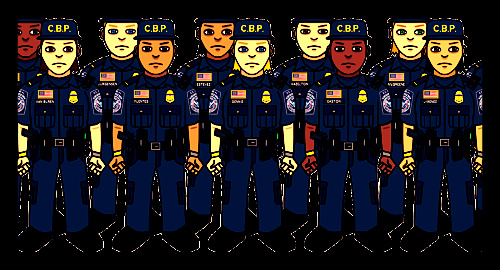
It is early September and Guillermo Arevalo Pedroza is taking his wife and two young girls on a picnic on the south side of the Rio Grande. A couple of shots fired later and Arevalo is dying in the arms of his 9-year-old daughter. These are the types of atrocities that are occurring with dismaying frequency at the hands of the U.S. Customs and Border Protection (CBP).
Juan Pablo Perez Santillan, Carlos Lamadrid, and Sergio Adrian Hernandez Guereca are some of the names of those who have lost their lives in similar incidents.
Questions continue to arise regarding the integrity of the CBP, especially in lieu of the recent shooting of 41-year-old Mexican native, Jesus Flores-Cruz.
The incident occurred on Tuesday, February 18th in Mission, Texas, when two agents on foot suspected multiple people of attempting to cross the border illegally from Mexico. One agent, whose identity remains undisclosed, fired two shots after being attacked by several rocks, killing Flores-Cruz. There were no witnesses.
In a statement following the incident, the Border Patrol claimed that the agent feared for his life at the time of the attack. Spokeswoman for the U.S. attorney’s office in San Diego, Kelly Thornton, said that prosecutors decided against charging the agent with a crime.
Amongst the responses to the shooting are many who are concerned about the continuing pattern of human rights abuses committed by the Border Patrol under their use-of-force policy.
Both the Inter-American Commission on Human Rights (IACHR), as well as the Southern Border Communities Coalition (SBCC), expressed their indignation following the event. In a statement on behalf of the SBCC, director Christian Ramirez said that the incident “is yet another reminder that the Border Patrol operates with impunity and on the fringes of the Constitution and international law.”
Although bold, this statement holds weight given the number of people killed with lethal force by the CBP. Since 2010, 21 Mexican citizens have been killed, and not one agent involved in the deaths has been prosecuted for their use of lethal force.
This continuing use of lethal weapons raises questions about the agency’s lack of both accountability and oversight. For example, agents are not required to carry non-lethal repellents, such as ‘pepper ball’ guns, which shoot pellets of pepper spray at long-range distances. However, those agents who have made use of such devices have been successful at repelling rock attacks such as that which occurred in the case of Flores-Cruz. 160 separate incidents have been resolved by using these non-lethal devices.
Given that this is the case, it is highly alarming that the CBP rejected a recommendation that they prohibit agents from using lethal weapons against rock throwers and assailants in vehicles.
So, what can be done?
Twenty members of Congress have recently asked to meet with ranking members of the CBP to discuss their growing concern. In addition, the Police Executive Research Forum an independent police review agency, has issued a report with recommendations for the CBP. Among the recommendations are ways for agents to de-escalate tense encounters by taking cover, moving out of range, and/or using non-lethal weapons.
Customs and Border Protection boasts of being the largest law enforcement agency in the United States, which carries with it the responsibility of being accountable to the American public. If attacks continue, it could have serious implications for the CBP’s credibility and integrity.
– Mollie O’Brien
Sources: Southern Borders Communities Coalition, Latin Times, Daily News, ACLU
Photo: Deviant Art

International Women’s Day
International Women’s Day has been observed since the early 1900s, when 15,000 women marched through New York City demanding shorter hours, better pay and voting rights. Since then, women have made great progress, but there is still a long way to go. International Women’s Day celebrates the political, economic and social achievements of women.
Education
Ramatou Sambo, a 12-year-old girl in the West African country of Benin, escaped a forced marriage to continue her education and build her leadership skills. With the help of her friends, Ramatou said no to dropping out of school for marriage. The girls asked for help from the Students’ Mothers Association; Ramatou is currently enrolled in school and planning to continue her education. She has the blessing of her parents, who publicly renounced their plan to marry their daughter at such a young age.
Voice
A Yemeni woman, whose name was withheld to protect her identity, goes to great lengths to have a say in her government. She spends one night per week walking through mountainous terrain to make sure that her government does not neglect her opinions. In a country where women are only half as valued as men, it is extremely brave for women to take a stand to make sure their voices are heard.
Growth
From a young girl playing barefoot in an Ethiopian village to the first black Miss Israel, 21-year-old Yityish Aynaw has taken the world by storm. After losing both of her parents, Aynaw moved to Israel to live with her Ethiopian Jewish grandparents.
Aynaw had always wanted to model but it was her friend who signed her up for the Miss Israel competition. When she won, Aynaw was invited to dine with one of her role models, United States President Barack Obama. Aynaw herself is now a public role model to not only the 125,000 Ethiopian immigrants in Israel, but also to women everywhere.
Community
Another beauty queen is using her celebrity status to help underprivileged children and women in her birthplace, the Democratic Republic of Congo (DRC.) Noella Coursaris founded the Georges Malaika Foundation, which sponsors the education of young girls who have been abandoned or sexually abused. The Foundation financially supports the girls’ school, food, orphanages and uniforms.
Coursaris believes that educating DRC’s young girls will help the entire country progress. “We believe that showing the culture and the creativity of the Congolese orphans and girls through education they will know how to manage themselves — they will have an education, they will have work one day and they will be able to have a voice politically, economically, socially,” she says.
This year’s theme for International Women’s Day is “equality for women is progress for all,” emphasizing the importance of gender equality, empowerment of women, human rights and the eradication of poverty. Women are powerful agents of change in today’s society; in some countries, International Women’s Day is celebrated similarly to Mother’s Day.
– Haley Sklut
Sources: International Women’s Day, Care, United Nations, CNN, CNN, Care
Photo: CSMonitor
Olympic Youth Development Center Celebrates Third Year
The International Olympic Committee (IOC) thinks sports are the answer to improving life in developing countries. The IOC’s “Sports for Hope” program provides communities with better opportunities to exercise and learn about the values of Olympism.
The organization believes practicing sports in a safe and welcoming environment has the power to bring hope and positivity to developing countries. Sports have the ability to foster cognitive development, social interactions and community integration. The program involves building multi-functional sports facilities in developing countries.
Besides improving the health of those who participate, the program will also help young athletes actively develop their minds. Other goals of “Sports for Hope” include offering athletes professional training opportunities, organizing sports competitions and providing health services.
The pilot project for the program is in Lusaka, Zambia. In addition to the Olympic Youth Development Center, the project provides community development services, Olympic education, health services and sports administrators’ seminars. The Olympic education covers girls’ empowerment and civic education.
The Center, costing a total of about $10 million, includes outdoor sports fields, indoor multi-purpose courts, a boxing arena, a gym, classrooms, administrative offices, locker rooms and storage rooms. The IOC partnered with the Government of the Republic of Zambia and the National Olympic Committee of Zambia to bring the center to the people of Zambia.
Now in its third year, the Center welcomes about 10,000 children and teenagers each month. The facility offers opportunities for young athletes to train in 16 different sports.
Following the success of The Center in Zambia, the IOC is currently building its second Olympic Youth Development Center, this one in Port-au-Prince, Haiti. The Haitian Center will feature large shaded areas to protect athletes from the heat of the region.
The Centers offer educational classes, including HIV/AIDS programs. Zambia has one of the world’s most devastating HIV/AIDS epidemics; at least one in every seven adults in the country live with HIV. Woman and girls aged 15 years old to 24 years old are most vulnerable to the disease with double the prevalence of men in the same age group. The educational programs on female empowerment focus on positivity, including safe sexual practices to prevent the transmission of HIV/AIDS.
Zambia’s Olympic Youth Development Center is an example of how a sports complex and sports in general, can be so much more than what meets the eye. Zambian Olympian Samuel Matete says, “As an Olympian myself, I look forward to using the Center to provide great opportunities for young people to achieve their dreams.”
– Haley Sklut
Sources: Olympic, Olympic, Olympic Youth Development Center, Avert, YouTube
Photo: Asian Wave Mag
The World’s e-Dumpsite
When you were little, you may have wondered where the souls of your deceased pets went, but have you ever wondered where defunct or discarded electronics go? After all, they have to be disposed somewhere. In the Ghanaian capital Accra is the Pearly Gate—or perhaps more appropriately the limbo—of the electronic dead.
Agbogbloshie (altogether now, come on: uh-g-bog-blo-shee), a suburb of the capital, is the world’s largest e-dumpsite. Here, many scrap dealers—mainly economic migrants from the poorest parts of Ghana—are busy toiling their days away dismantling non-figurative tons and tons of gadget remains. When their day at work is over, they return to nearby shantytown called Old Fadama whose sobriquet is—and I kid you not—“Sodom and Gomorrah.”
There are around 80,000 residents in this shantytown of around 3, 000 square feet. In order to retrieve metals and other sellable materials, children and young adults smash and burn these toxic. Operating without any safety equipment, most workers laboring in this horrendous condition die from cancer within their 20s. For many who work on the dumpsite, if they were to get injured or ill, medical care would be beyond their means, translating to s shortened life expectancy.
As for the living condition in “Sodom and Gomorrah,” which is the country’s biggest slum, they are appallingly precarious. Aside from being located adjacently to the world’s biggest e-dumpsite, the community also lacks basic sanitation such as running water, waste collection, and medical care. It is also estimated that around 49% of the inhabitants of this slum do not have any education at all.
Furthermore, due to the infamy brought with extreme impoverished, the district and its inhabitants are highly stigmatized in the Ghanaian society. Perhaps due to this attitude, this poisonous shantytown has long suffered negligence from the society at large. Despite the fact that there is pressure to relocate its inhabitants, an endeavor for which the Ghanaian government has allocated almost $13 million (in USD), this effort has been met with strong resistance from its targets. It is evident that the dwellers view the government’s effort as forced eviction rather than an attempt to improve their living standard.
The case of Old Fadama is not the only instance of extreme poverty and destitution in Accra. The People’s Dialogue on Human Settlement estimates that around 80% of the city’s residents live in slums—though with varying degrees of material inadequacy.
The situation in Agbogbloshie also raises the question of the responsibility that consumers all over the world must take with regard to their electronic consumption. Even though dumping their broken or unfashionable apparatuses in Ghana may provide the residents of Old Fadama with paltry incomes, their health and wellbeing are greatly compromised.
Where then should these electronic devices be disposed? By whom? And, perhaps, the most important questions of all in the cosmos of consumerism—what will be the cost and who will pay for it?
–Peewara Sapsuwan
Photo: Trade 2 Save
Sources: Think Africa Press, Think Africa Press, The Guardian, e.tv Ghana, GhanaWeb
Credibility and Integrity: What’s At Stake for the CBP
It is early September and Guillermo Arevalo Pedroza is taking his wife and two young girls on a picnic on the south side of the Rio Grande. A couple of shots fired later and Arevalo is dying in the arms of his 9-year-old daughter. These are the types of atrocities that are occurring with dismaying frequency at the hands of the U.S. Customs and Border Protection (CBP).
Juan Pablo Perez Santillan, Carlos Lamadrid, and Sergio Adrian Hernandez Guereca are some of the names of those who have lost their lives in similar incidents.
Questions continue to arise regarding the integrity of the CBP, especially in lieu of the recent shooting of 41-year-old Mexican native, Jesus Flores-Cruz.
The incident occurred on Tuesday, February 18th in Mission, Texas, when two agents on foot suspected multiple people of attempting to cross the border illegally from Mexico. One agent, whose identity remains undisclosed, fired two shots after being attacked by several rocks, killing Flores-Cruz. There were no witnesses.
In a statement following the incident, the Border Patrol claimed that the agent feared for his life at the time of the attack. Spokeswoman for the U.S. attorney’s office in San Diego, Kelly Thornton, said that prosecutors decided against charging the agent with a crime.
Amongst the responses to the shooting are many who are concerned about the continuing pattern of human rights abuses committed by the Border Patrol under their use-of-force policy.
Both the Inter-American Commission on Human Rights (IACHR), as well as the Southern Border Communities Coalition (SBCC), expressed their indignation following the event. In a statement on behalf of the SBCC, director Christian Ramirez said that the incident “is yet another reminder that the Border Patrol operates with impunity and on the fringes of the Constitution and international law.”
Although bold, this statement holds weight given the number of people killed with lethal force by the CBP. Since 2010, 21 Mexican citizens have been killed, and not one agent involved in the deaths has been prosecuted for their use of lethal force.
This continuing use of lethal weapons raises questions about the agency’s lack of both accountability and oversight. For example, agents are not required to carry non-lethal repellents, such as ‘pepper ball’ guns, which shoot pellets of pepper spray at long-range distances. However, those agents who have made use of such devices have been successful at repelling rock attacks such as that which occurred in the case of Flores-Cruz. 160 separate incidents have been resolved by using these non-lethal devices.
Given that this is the case, it is highly alarming that the CBP rejected a recommendation that they prohibit agents from using lethal weapons against rock throwers and assailants in vehicles.
So, what can be done?
Twenty members of Congress have recently asked to meet with ranking members of the CBP to discuss their growing concern. In addition, the Police Executive Research Forum an independent police review agency, has issued a report with recommendations for the CBP. Among the recommendations are ways for agents to de-escalate tense encounters by taking cover, moving out of range, and/or using non-lethal weapons.
Customs and Border Protection boasts of being the largest law enforcement agency in the United States, which carries with it the responsibility of being accountable to the American public. If attacks continue, it could have serious implications for the CBP’s credibility and integrity.
– Mollie O’Brien
Sources: Southern Borders Communities Coalition, Latin Times, Daily News, ACLU
Photo: Deviant Art
Ben Affleck Testifies to the US Senate on DRC
Ben Affleck may be famous for his role in movies such as Argo, The Town and Good Will Hunting, but nowadays he’s making an impact in a new role. Because of his philanthropic involvement in eastern Congo, Affleck went before the Senate Foreign Relations Committee to testify about the Congolese people and the need for U.S. involvement in the region. The hearing provided an opportunity for Affleck to draw increased media attention to the precarious human rights situation in the Democratic Republic of Congo and pressure lawmakers to do more to help.
Affleck first became involved in the Congo through his grant-making and advocacy organization, the East Congo Initiative (ECI). This organization seeks to increase investments in Congolese-led programs that create safe and sustainable communities. Additionally, ECI advocates for increased U.S. involvement in Congo while working against key problems such as rape and sexual violence as well as inadequate education and health resources for children. The East Congo Initiative also seeks to reintegrate former child soldiers back into their homes while leading community-level peace and reconciliation programs.
During his testimony, Affleck highlighted many of the struggles the Congolese people are enduring every day. For instance, Affleck cited UN reports that not only indicate that 2.9 million Congolese had been displaced internally, but also that 428,000 others have become refugees in neighboring countries. These people are being scattered throughout the region by the armed militia known as M23 that had previously taken over the capital of a northern Congolese province. A UN peacekeeping force recently coerced the M23 to surrender and sign a peace agreement. Affleck cited the UN group as evidence that “when the international community acts, and the Congolese government rises to the moment, these challenges are in fact solvable.”
Affleck finished his testimony by sharing a story about one of ECI’s partners, Theo Chocolate. An organic, fair-trade chocolate company, Theo imports more than 50% of its Chocolate from the DRC. Theo Chocolate’s business was connected to small folder farmers in the DRC by ECI and has helped support many of these small Congolese business operations. Through professionally directed investments, ECI was able to help spur economic development in the Congo and improve the lives of several Congolese people.
Through his charitable initiatives with ECI, Affleck is an example of how ordinary Americans can make a difference in influencing Congress and bring attention to the issues they care about. Affleck acknowledged, “I am, to state the obvious, not a Congo expert. I am an American working to do my part for a country and a people I believe in and care deeply about.” Through his actions, Affleck not only successfully drew the attention of the United States Senate to the plight of the Democratic Republic of the Congo, but he also gives hope for a better life to many impoverished people.
– Martin Levy
US Senate Committee on Foreign Relations, East Congo Initiative
Photo: Heritage
Physical Inactivity Taking a Toll in Middle East
As life expectancy across the globe steadily increases, chronic and degenerative diseases are becoming the norm in many countries, fueled by the rapid rise of obesity due to physical inactivity.
The World Health Organization (WHO) and the Ministry of Health of the United Arab Emirates (UAE) convened in Dubai, UAE on February 23 for a two-day ‘Move for Health’ forum to address just that.
The push for the forum came following recent statistics naming the Middle East as the most unfit region for young adults, age 15 to age 29. It is also the second-most unfit region for adults and the most unfit region for women worldwide. Approximately 50% of Middle Eastern women are deemed physically inactive.
Given what people know about global inactivity trends, these statistics are not so shocking.
Physical inactivity is the fourth-leading risk factor for global mortality, accounting for 3.2 million deaths worldwide. It is also directly responsible for 27% of diabetes cases, 30% of heart diseases, and 21-25% of breast and colon cancer cases. More than 30% of people over the age of 15 are physically inactive, 28%t of them men and 34% of them women.
Given these daunting numbers, it is no surprise that physical inactivity is one of the most pressing global health challenges at present.
Among those who spoke at the forum was Dr. Ala’a Alwan, the regional director of the Eastern Mediterranean Region at the WHO. Noting the severity of the issue, Alwan reiterated the importance of making efforts to recognize physical inactivity as a public health priority by developing national awareness campaigns.
The forum also shed light on a new policy to be implemented in the UAE, as well as 34 other signatory countries. The policy follows a multi-sectoral approach and pledges to reduce physical inactivity levels by 10% by the year 2025. Included is a seven-step program targeting public education, school-wide programs, community programs, healthcare, sports awareness, urban design and transport policies.
Specifically, the policy aims at communicating to the general public the idea that physical activity is not limited to sports. It also includes any bodily movement produced by skeletal muscles that uses energy, from walking or cycling to dancing and swimming.
The WHO and UAE’s Ministry of Health are promoting having people exercise five days each week for 30 minutes to reduce current levels of inactivity across the globe, and in the Middle East.
– Mollie O’Brien
Photo: Niwemang
Sources: Emirates 24/7, Zawya, World Health Organization
Ben Affleck DRC Testimony
Ben Affleck, co-star of the upcoming film Superman vs. Batman, spent time in Washington, D.C. on February 26 discussing the situation in the Democratic Republic of the Congo (DRC). Using his celebrity and networking super powers, Affleck has previously launched the Eastern Congo Initiative (ECI) in 2010 and has since helped raise awareness and generate public action against violence in the DRC.
While in D.C. Affleck testified in front of the Senate Foreign Relations Committee and Committee Chairman Sen. Robert Menéndez (D-N.J.). He began his testimony by acknowledging the significant progress made in the last three months. He also thanked Congress, U.S. President Obama and the State Department for their roles in achieving the surrender of M23, the Congolese Revolutionary Army, which has been violently rebelling against the DRC government.
Affleck emphasized that though progress has been made, it is important to stay on track, and that deviating could risk losing the fruit of their hard diplomatic labor. The ECI created five key points for Congress to ensure sustainable peace in the country:
Ultimately, the ECI believes the DRC can be revived through enhanced security on one side and injecting small amount of development aid throughout pockets of the community. This will allow the Congolese people to stand on their own and create a market economy, eventually joining the global market.
– Sunny Bhatt
Sources: YouTube, Eastern Congo Initiative
Photo: Ryot.org
World Bank: Economic Consequences of Discrimination
United States history is rife with racial and sexual discrimination. This history has shown, however, that systematic alienation of particular social groups comes with costly economic consequences.
For example, the 381 days long 1955-1956 Montgomery Bus Boycott, spurred by the arrest of Rosa Parks, reportedly ameliorated 75 percent of the city bus line’s revenue. The damage translated to approximately a loss of $3,500 per day, calculating a total loss of over $1.3 million.
It is no coincidence that as segregation was outlawed, U.S. economic growth accelerated.
Discrimination based on race, gender or sexual orientation in the U.S. business practices are still rampant today. A report from the Center for American Progress revealed the significant costs involved in discriminatory practices—an estimated $64 billion of revenue per year.
On February 24, Ugandan President Yoweri Museveni signed an anti-gay law. The legislation called for a 14-year prison sentence for each initial homosexual act committed and the possibility of life imprisonment for continued homosexual relations.
In response to this discriminatory law, World Bank President Jim Yong Kim has frozen all of the Bank’s loans, totaling $90 million, to Uganda.
Kim has also harnessed the seismic forces of this bold move to address further forms of discrimination worldwide, such as sexism and racial discrimination. He stressed that discrimination in any form is not only destructive in a moral sense, but harbors the growth of economies around the world.
In a recent public statement, Kim used the negative economic impact of he marginalizing women from job opportunities as a key example. In countries with low economic participation from women, a World Bank study revealed income losses of 27 percent in the Middle East and North Africa. The same study showed that raising female employment and entrepreneurship to equal male levels could improve average income by 19 percent in South Asia and 14 percent in Latin America.
Marginalizing people based on gender, race or sexual orientation is destructive to economies. Legislation that aims to alienate potentially some of the most talented and efficient of a country’s or business’s workers is nothing short of self-mutilation on a macro scale. As Kim said, “Eliminating discrimination is not only the right thing to do; it’s also critical to ensure that we have sustained, balanced and inclusive economic growth in all societies — whether in developed or developing nations, the North or the South, America or Africa.”
– Malika Gumpangkum
Sources: The World Bank, HuffPost, Bloomberg, The Washington Post, Robert J. Walker
Photo: Economic Times
HRW Reports Violence Against Women in Iraq
There are many women in Iraq who have faced and continue to face abuse within the Iraqi judiciary system, as outlined in a new report from the Human Rights Watch (HRW). According to the HRW, although both men and women suffer from the severe flaws of the criminal justice system, women suffer a double burden due to their second-class status in Iraqi society.
Iraq has had other allegations challenging its reputation for gender discrimination in the past. During the 1970s, Iraq guaranteed equal rights to women before the law by mandating compulsory education through primary school for both genders and changed labor, employment, and personal laws to grant women greater equality in the workplace, marriage, divorce and inheritance. These advancements were done, however, in order to create loyalty to the ruling government and Baath Party.
After losing the Gulf War, Saddam Hussein tried to boost his power and popularity by embracing Islamic and tribal traditions. This led to the rapid deterioration in social status for women in Iraq, which has only worsened since the Iraq War.
Although there has been some debate in the international community as to the legitimate use of interrogation tactics like water-boarding, the abuses these women sustained seem to have amounted to torture. Nearly all of the women in Iraq that were interviewed by the HRW were handcuffed, kicked, punched, beaten with cables, subjected to electric shocks, and subjected to falaqa, which is the practice of tying someone upside down and beating their feet.
Many also reported being raped and sexually assaulted by security officials who also threatened to do the same to their daughters. After succumbing to torture, these women were forced to sign and fingerprint confessions they could not read, or in some cases, that were just blank pieces of paper.
Although prohibited by both Iraqi and international law, corruption and a lack of government oversight ensures that these abuses continue with no repercussions for the abusers and no relief for the victims. By detaining women without arrest warrants, holding them for indefinite periods before allowing them to see a judge and demanding bribes for their release, the actions of the government are synonymous to kidnapping.
The current situation is also influenced by religious strife, as the vast majority of these women and girls are Sunni and being illegally detained by the Shia-led government solely because of their branch of Islam. The majority of the women interviewed were held for allegedly covering up for crimes committed by male family members, and charged under Iraq’s Anti-Terrorism Law. Many were convicted not by evidence, but based on coerced confessions and testimony from “secret informants.”
The response from Prime Minister Nuri Al-Maliki’s administration has been criminally insufficient. They have yet to begin investigating allegations of abuse, and many government officials have denied that there is a problem, with some even accusing the women of lying. To move past the legacy of corruption left by Saddam Hussein, a greater sense of transparency of and accountability for government procedures could greatly improve the situation.
– Kenneth W. Kliesner
Sources: Human Rights Watch, Al Jazeera
Photo: Aljazeera
Rehabilitation for Al-Qaeda Generation
The youth who have grown up saturated with extreme jihadist ideology will form a criminal generation that poses a threat to not only their country, but to the world.
Children, almost exclusively young boys, are targeted by terrorist groups to be trained to be military-minded from a young age for several reasons. Most importantly, they are easier to persuade and control. Many recruited children are orphans who have grown up in conflict zones. The inclusion in a powerful group gives them the illusion of acceptance.
Children can also move around unnoticed much easier than adults; they are more likely to be overlooked in a situation where a man might trigger caution, and soldiers often hesitate to shoot them even if they know the child is carrying explosives.
Most importantly for recruiters, children who are trained as extremist soldiers will grow into adults willing to kill and die for those same ideals and will offer up their own children to the same training. Cairo University psychology professor and family relations consultant Waliyuddine Mukhtar says that “As a result [of their intensive training], years from now, a new generation of youth will emerge and pose a very serious threat not only to Syria but to surrounding countries as well.
Camps to train “cubs” have been opened in Syria and have released footage showing children ages four to 17 years old shooting AK-47s, undergoing military training and shouting for the “Islamic State of Iraq and the Levant.” Recruiters rely heavily on orphans and the donated children of extremist families to fill these ranks.
Egyptian child psychologist and Ain Shams University lecturer Enas al-Jamal discusses the devastating effects on the psyche of child soldiers. “This child grows up on violence and the use of force, while internally suppressing fear that could erupt at any time after he is moved away from the fighting.”
Al-Jamal is realistic about the hardship of establishing these children in a peaceful civilian lifestyle. “The difficulty in rehabilitation stems from the fact that they were subjected to comprehensive brainwashing that turned them into killing machines convinced of the legitimacy of murder and suicide via suicide bombings.”
The work of undoing everything these children are being taught will take tremendous effort and a collective awareness. The leaders of al-Qaeda may be cut down, but they have planted their seeds deeply. However, people’s tending to those seeds could prevent their resurrection.
– Lydia Caswell
Sources: Al-Shorfa.com, Central Asia Online, Hudson Institute
Photo: Sodaheadr