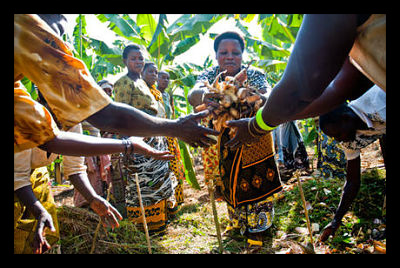
 The concept of crop insurance is a well-established practice in developed countries: in anticipation of natural disasters or other impediments to good crop yields, farmers purchase insurance to cover the cost of lost revenue.
Yet traditional agriculture insurance is either unavailable or overly expensive in many developing countries, leaving small-scale farmers, particularly women, vulnerable to natural disasters.
Nevertheless, recent expansions of index insurance programs, in particular the Global Index Insurance Facility, are enabling small-scale women farmers across Sub-Saharan Africa, Asia, the Pacific, Latin America and the Caribbean to adequately ensure their crops at affordable prices.
Unlike traditional insurance, index insurance “pays out benefits on the basis of a predetermined index for loss of assets and investments … without requiring the services of insurance claims assessors,” the World Bank reports.
More specifically, “a statistical index is developed before the start of the insurance period to measure deviations from normal for such parameters as rainfall, temperature, seismic activity, wind speed, crop yield or livestock mortality rates.”
Since 2009, GIIF, a program managed by the World Bank Group, has been leading and supporting index-insurance programs across the developing world. In collaboration with partners like MicroEnsure and Kilimo Salama (now ACRE), GIIF often aggregates farmers into groups and enrolls them into insurance programs—an approach both commercially feasible for insurers and empowering for women farmers.
Recent statistics indicate that women farmers in the developing world are at particular risk for agricultural instability. A recent study by the World Bank Group and the ONE Campaign found that although roughly half of the farmers in Sub-Saharan Africa are women, women farmers in Africa produce between 13 and 25 percent less than their male counterparts.
The World Bank Group and the ONE Campaign attributed this difference largely to women farmers’ lack of access to credit and other financial tools.
According to estimates by the Food and Agricultural Organization, if women farmers worldwide had the same access to resources as their male counterparts, “their yields could increase by as much as 30 percent, resulting in 150 million fewer people going hungry.”
GIIF’s index insurance programs are already reaping benefits in many developing countries. In Kenya, a payout initiated by the GIIF program during a drought kept thousands of women farmers in business, allowing them to purchase seeds and fertilizer for the next growing season.
In Haiti, a GIIF partner is offering weather index insurance to 70,000 clients, mostly women farmers who provide essential goods and services to communities.
The World Bank reports that overall, these index insurance programs have helped close the gender gap for farmers in the developing world—a critical step in fighting hunger, tackling malnutrition, and boosting global food security.
– Katrina Beedy
Sources: World Bank 1, World Bank 2
Photo: Siani

Index Insurance Reaps Benefits for Female Farmers
Yet traditional agriculture insurance is either unavailable or overly expensive in many developing countries, leaving small-scale farmers, particularly women, vulnerable to natural disasters.
Nevertheless, recent expansions of index insurance programs, in particular the Global Index Insurance Facility, are enabling small-scale women farmers across Sub-Saharan Africa, Asia, the Pacific, Latin America and the Caribbean to adequately ensure their crops at affordable prices.
Unlike traditional insurance, index insurance “pays out benefits on the basis of a predetermined index for loss of assets and investments … without requiring the services of insurance claims assessors,” the World Bank reports.
More specifically, “a statistical index is developed before the start of the insurance period to measure deviations from normal for such parameters as rainfall, temperature, seismic activity, wind speed, crop yield or livestock mortality rates.”
Since 2009, GIIF, a program managed by the World Bank Group, has been leading and supporting index-insurance programs across the developing world. In collaboration with partners like MicroEnsure and Kilimo Salama (now ACRE), GIIF often aggregates farmers into groups and enrolls them into insurance programs—an approach both commercially feasible for insurers and empowering for women farmers.
Recent statistics indicate that women farmers in the developing world are at particular risk for agricultural instability. A recent study by the World Bank Group and the ONE Campaign found that although roughly half of the farmers in Sub-Saharan Africa are women, women farmers in Africa produce between 13 and 25 percent less than their male counterparts.
The World Bank Group and the ONE Campaign attributed this difference largely to women farmers’ lack of access to credit and other financial tools.
According to estimates by the Food and Agricultural Organization, if women farmers worldwide had the same access to resources as their male counterparts, “their yields could increase by as much as 30 percent, resulting in 150 million fewer people going hungry.”
GIIF’s index insurance programs are already reaping benefits in many developing countries. In Kenya, a payout initiated by the GIIF program during a drought kept thousands of women farmers in business, allowing them to purchase seeds and fertilizer for the next growing season.
In Haiti, a GIIF partner is offering weather index insurance to 70,000 clients, mostly women farmers who provide essential goods and services to communities.
The World Bank reports that overall, these index insurance programs have helped close the gender gap for farmers in the developing world—a critical step in fighting hunger, tackling malnutrition, and boosting global food security.
– Katrina Beedy
Sources: World Bank 1, World Bank 2
Photo: Siani
Improving Indonesia’s Infrastructure
Improving Indonesia’s infrastructure could have long-term benefits that could help people affected by poverty. According to the Copenhagen Consensus Center, anywhere between 10 to 50 percent of crops are wasted while traveling from the farm to consumers. If there was a way to make this number smaller by a mere 10 percent, prices could be reduced; if prices are reduced, 60 million fewer people would go hungry.
President Widodo plans to invest in infrastructure by scrapping subsidies on fuel and providing subsidies for farmers to use on fertilizer and seeds. He also wants to improve irrigation systems for farmers, improve roads and land and provide more forms of communication. In the long run, this can improve overall food distribution.
This tactic has been proven effective in the past.
“Indonesia experienced rapid agricultural growth in the 1970s and 1980s together with reductions in malnutrition and poverty,” Mark W. Rosegrant, director of the Environment and Production Technology Division at the International Food Policy Research Institute, said.
Rosegrant was also involved in the Copenhagen Consensus Center study. “This growth and improvements in food security were significantly driven by increasing investments in rural infrastructure and in agricultural research and development,” he said.
Rosegrant and others behind the Copenhagen Consensus study are suggesting that there are even better ways for President Widodo to reach his goal. The study concluded that it would also be beneficial for President Widodo to invest in agricultural research along with infrastructure. Even if only $6 billion is devoted toward researching how to increase crop yields, the result could be 79 million fewer hungry people around the globe.
President Widodo is hopeful that improving power plants and rural roads will help the people of Indonesia and around-the-world significantly. This is excellent news, and perhaps President Widodo will look into the benefits of agricultural research and save even more lives.
– Melissa Binns
Sources: The Australian Business Review, The Wall Street Journal
Photo: MTCP2
Ghana Climate Innovation Center Sponsors Clean Tech
In early March, twenty Ghanaian start-up companies completed the first national boot camp designed to promote “local entrepreneurship and innovation in clean technologies.” The boot camp, sponsored by the new Ghana Climate Innovation Center, aimed to highlight Ghanaian entrepreneurs who have been active in developing locally feasible solutions to global climate change.
If current climate trends persist, experts predict dire consequences for Ghana’s economy, people and overall development. According to the World Bank’s report, “Economics of Adaptation to Climate Change” and Ghana’s National Climate Change Policy Framework, crop yields “are predicted to decline by 7% by 2050 due to higher temperatures.”
Meanwhile, the reports predict that sea levels are expected to rise over one meter over the course of the 21st century, “causing the erosion of 1,120 square kilometers of land.”
The boot camp followed a rigorous nation-wide application process overseen by the World Bank and its global grant program Information for Development, the sponsors of the Ghana Climate Innovation Center. According to the World Bank, only the companies with the “highest level of innovation, technical expertise, and potential for commercial success” were invited to the boot camp.
The boot camp participants are pioneers in some of Ghana’s most prosperous green technology sectors, including biofuels, solar energy and waste and water management.
The boot camp represents the first project for the Ghana Climate Innovation Center, a newly implemented institute that draws support from the World Bank, InfoDev, and the Danish International Development Cooperation Agency.
In the future, the GCIC hopes to “assist more than 20,000 households to increase resiliency to climate change through improved access to potable water, availability of clean energy, and more sustainable agriculture techniques.”
– Katrina Beedy
Sources: InfoDev 1, InfoDev 2, World Bank
Photo: Green Ghanaian
Drug Counterfeiting in Nigeria
Drug counterfeiting is not just a developing world problem. In 2005, the U.S. Attorney’s Office of Missouri indicted three businesses for a 42 million dollar conspiracy to sell counterfeit, smuggled and misbranded Lipitor, a mainstream cholesterol lowering drug. The FDA had to recall 18 million Lipitor tablets which is one of its largest recalls related to counterfeiting.
In Nigeria, this is a particularly big problem. This Day Live reports that in 1989, over 150 children died due to diethylene glycol present in fake paracetamol syrup. The problem reached such a high level, that sale of Nigerian-manufactured products was banned in other African countries. The National Agency for Food and Drug Administration and Control Nigeria, or NAFDAC, website continues to be filled with reports on recent impounding and destruction of fake drugs and public alert notification on drug recalls. A report on March 5 on the destruction of N500 million, approximately 2.5 million dollars, worth of fake drugs in Anambra state, was immediately followed by a March 6 report on the impounding of N270 million in counterfeit medication.
NAFDAC is employing many strategies to curb the problem including control at points of entry, inspecting manufacturing plants in producing countries and employing foreign analysts to certify drugs before exportation from India, China and Egypt. Under the leadership of the late Prof. Dora Akunyili, NAFDAC came down hard on counterfeiters and corrupt officers. Due to NAFDAC’s efforts, the incidence of fake drugs has dropped by 90 percent since 2001 and the ban on Nigerian-manufactured drugs has been lifted.
Yet the problem persists. The New York Times reports that in 2008, 84 children died after consuming fake teething mixture in Nigeria. In a recent interview with CNBC Africa, Dr. Bell Ihua, COO of NOIPolls, says 18 percent of Nigerians believe they have been a victim of fake pharmaceuticals. A whopping 70 percent worry that counterfeiting is rampant. This means that 70 percent of people actually worry that a drug they are consuming could be fake. A large proportion of victims only know they have consumed fake drugs when they have an adverse reaction.
Public awareness is a large obstacle. High illiteracy and low exposure makes it hard for the public to be on their guard. NAFDAC broadcasts short messages and jingles on the radio to educate and warn the public. Novel solutions are now slowly entering the field. Ashifi Gogo, a Ghana based enterprise, allows customers to scratch off labels inside the pill box and text the code to get a verification of drug quality. Of course, the system is not foolproof as counterfeiters can make fake labels. More campaigns and programs to educate the public will aid this effort. The involvement of community leaders can bring this down to the grassroots level where such programs really need to create an impact.
– Mithila Rajagopal
Sources: Africa Renewal, CNBC Africa, FDA, NAFDAC, New York Times, ThisDayLive, WHO 1, WHO 2, WHO 3
Photo: Code Wit
AGOA: Strengthening Economic Relations
The act was initially set to expire in 2008, but President George W. Bush signed the AGOA Acceleration Act of 2004, which extended AGOA to 2015. The Act’s apparel special provision, which permits lesser-developed countries to use foreign fabric for their garment exports, was to expire in September 2007.
However, legislation passed by Congress in December 2006 extended it through 2012.
The legislation authorized the President of the United States to determine which sub-Saharan African countries would be eligible for AGOA on an annual basis. The eligibility criteria was to improve labor rights and movement toward a market-based economy. Each year, the president evaluates the sub-Saharan African countries and determines which countries should remain eligible.
Currently, there are 44 African countries eligible with AGOA.
What are the benefits of AGOA for African countries?
AGOA provides trade preferences for quota and duty-free entry into the United States for certain goods, expanding the benefits under the Generalized System of Preferences, or GSP, program.
AGOA expanded market access for textile and apparel goods into the United States for eligible countries, though many other goods are also included. This resulted in the growth of an apparel industry in southern Africa, and created hundreds of thousands of jobs.
In addition to growth in the textile and apparel industry, some AGOA countries have begun to export new products to the United States, such as cut flowers, horticultural products, automotives and steel.
;Agricultural products is a promising area for AGOA trade; however, much work needs to be done to assist African countries in meeting U.S. sanitary and phytosanitary standards.
What are the benefits of AGOA for US firms?
By creating tangible incentives for African countries to implement economic and commercial reform policies, AGOA contributes to better market opportunities and stronger commercial partners in Africa for U.S. companies. The Act strengthens commercial ties between Africa and the United States, while it helps to integrate Africa into the global economy.
U.S. firms may find new opportunities in privatizations of African state-owned enterprises or in partnership with African companies in infrastructure projects.
– Alaina Grote
Sources: AGOA, International Trade Administration
Photo: Financial Mail
Iraq Trying to Reclaim Tikrit from ISIS
The U.S. and Iran have both steered clear of each other’s operations in Iraq, according to U.S. officials. In general, when Shiite militias are involved in a military operation, the U.S. doesn’t provide support.
Sunni radical group Islamic State began taking over parts of Iraq last summer, gaining control over Shiite-dominated territories. Shiite Iran aiding Shiite-dominated Iraq could potentially fuel another religious-based civil war in Iraq, reinforcing predictions that Iraq could break up.
Approximately 30,000 fighters participated in the offensive, nearly equal in numbers between Iraqi military fighters and Shiite Iranian volunteers. Sunni and Shiite officials both emphasized that a smaller contingent of 1,000-2,000 Sunni tribal fighters native to the Tikrit region would assist the government in the battle.
“Tikrit is a crucial strategic area and it represents the key for the liberation of Mosul itself,” said General Abdul Wahab al-Saidi, the commander of the Tikrit operation.
The Islamic State, also known as ISIS, took control of Tikrit last summer during a dramatic assault. Monday was Iraq’s third attempt to regain control of Tikrit, located on the Tiger River northwest of Baghdad. Previous operations failed most likely due to failed communication between the Iraqi fighters and Shiite volunteers.
Iran has carried out airstrikes within Iraq in support of Shiite militias. Last October, Shiite militias supported by Iranian advisers helped retake a Sunni town outside Baghdad, according to U.S. officials. The Tikrit fight, according to U.S. officials, represents the most sizable Iranian support yet for an Iraqi offensive.
The United Nations has stepped in to help the thousands of people who have been displaced from their homes or had their homes destroyed in the fights. Many children do not attend school anymore or partake in responsibilities and jobs at home.
– Alaina Grote
Sources: BBC, Reuters, Wall Street Journal
Photo: i.ensonhaber
Education in Turkmenistan
Education in Turkmenistan is now a national priority. By partnering up with UNICEF and the U.N., Turkmenistan has been able to provide structure to their education system. Since this team formed, the amount of schooling that children were required to attend has increased.
President Gurbanguly Berdimuhamedow also announced that in all five regions of Turkmenistan, there would be model schools built so that they could promote interactive teaching and learning methods.
Higher education has also been included in the spotlight. One of the primary objectives, underpinning the development and also the improvement of education in Turkmenistan, is the increase in the qualifications and profile of scientific personnel. Currently, young students have the opportunity to receive a professional education that meets international goals.
In 2008, research projects that were supported by the state commenced. Scientists involved in the projects have aimed to address important issues of social development. The goal is to develop and introduce technologies in industry. The advancements have lead to the decision to increase the amount of technology involved in education, which has provided support and a platform for the future of science education in Turkmenistan.
There is, however, some push back from citizens. The teachers feel that the amount of education that is forced may be too much and is producing overstressed students who haven’t grasped the concepts.
Though some of the policies that have been created aren’t perfect, education in Turkmenistan is headed in the right direction. “The conditions have been created in Turkmenistan for young people to receive a world-class education and for companies and organizations to be furnished with highly qualified cadres,” said the president.
– Erik Nelson
Sources: Eurasianet, European Commission, UNICEF
Photo: Turkmenistan Info
Poverty in Alexandria, Egypt
Overcrowded housing, bias urban development and limited access to food, water, quality health and education are among the root causes of poverty in Alexandria.
Although poverty rates in large urban cities such as Alexandria and Cairo remain high, it does not compare to the percentage of impoverished people in the rural areas of Egypt, also known as “upper Egypt,” and Egypt as a whole. In recent years, poverty rates in Alexandria have increased by one percent and is currently still rising.
According to the World Fact Book, Alexandria’s total population is approximately 4.4 million compared to Egypt’s total population of 86.9 million. Overall, 25 percent of Egypt’s population is in poverty, compared to 15.3 percent of the urban population of Egypt who live in poverty.
As one of the largest cities in Egypt, second to only Cairo, Alexandria’s urban development has caused an inequality of wealth distribution—the more money spent on development in urban cities, the less money spent on rural Egypt.
Essentially, Egypt’s developmental policies are focused in urban areas causing bias that has prompted a high rate of poverty in upper Egypt.
The agriculture sector represents a large percentage of Egypt’s population. These rural areas are home to 40 percent of the country’s population and about 70 percent of the country’s impoverished people. Focusing development in cities like Alexandria have allowed room for neglect in rural parts of Egypt where poverty remains one of the highest compared to other areas in Egypt.
The uneven distribution of development have caused people from rural parts of Egypt to migrate to urban areas such as Alexandria and Cairo. However, the migration only fuels the cycle of poverty and state of underdevelopment in rural areas. Instead of targeting Egypt’s root of poverty in rural areas, the efforts are being focused on urban development.
The inability to reduce poverty in Egypt is blamed on urban development.
A large difference between poverty in Alexandria and rural areas in upper Egypt is the public infrastructure such as electricity, education, health and water. Explaining poverty rates in Egypt is closely tied to the urban development in the metropolitan areas of Egypt, where a large percentage of Egypt’s manufacturing, trading and major constructions is concentrated.
Aside from urban development, education also impacts high poverty rates. There’s a known link between lack of education and poverty—the less education accessed, the higher the rate of poverty.
According to the World Bank, about 46 percent of Egypt’s poor is illiterate and 40 percent have a basic education, while the remaining population have advanced degrees. Fighting poverty in Egypt is not only about development in rural parts of Egypt, but also about education.
Ultimately, focusing efforts on improving education in Alexandria and redistributing development across Egypt can aid in the fight against poverty.
– Nada Sewidan
Sources: CIA World Factbook, Egypt Independent, Save the Children, World Bank
Photo: Flickr
Poverty in Suriname
Poverty in Suriname affects nearly one out of every two people. The official rate is 47 percent. Some of the issues contributing to Suriname’s poverty are health, education, child labor, sexual exploitation and violence.
The children of Suriname do not have equal access to health care, which results in the neglect of serious illnesses. AIDS is the number one killer of children who are five and older. Any child that is infected by AIDS often has to be hospitalized immediately because there is no chance of taking care of the child at home. Malnutrition further catalyzes the effects of disease and a large amount of children are often hospitalized because of this.
Education in Suriname is also in shambles. The country favors the development of schools in the capital, leading to severe education inequality. Many primary schools that are not in the capital have teachers that are poorly trained, giving little hope for any improvement over time.
The amount of poverty in Suriname has often led to children having to take on jobs. The fixed age at which a child can start working is 14; however, eight percent of children ages five to 14 work, often in the agricultural industry where they are exposed to toxins.
Due to discrimination, there is also a lot of violence among the inhabitants of Suriname. The country is composed of several ethnicities and those belonging to the smallest group of minorities often get slighted when it comes to basic rights. These marginalized groups are often subject to forced labor and sexual exploitation.
There are improvements happening in Suriname though. For one, Suriname’s stance on child labor has improved. In 2013, Suriname made a moderate advancement in efforts to eliminate the worst forms of child labor. Recently the age limit for employment increased to 18. Increasing the capacity to enforce all child labor laws is also a goal for Suriname.
Education is also seeing improvements. The Netherlands Institute for Curriculum Development, or SLO, has been actively participating in the development of the Surinamese basic education curriculum. Another sector in which we see the poverty in Suriname being addressed is the housing market. The Inter-American Development Bank supported Suriname by providing a single upfront subsidy for the poorest families to build new homes or improve an existing solution.
– Erik Nelson
Sources: Humanium, Inter-American Development Bank, Netherlands Institute for Curriculum Development, U.S. Department of Labor
Photo: Flickr
Hunger in Mozambique
Underlying causes include inadequate nutritional intake due to poor diet diversity, low meal frequency, poor breastfeeding practices, high levels of disease and teenage pregnancy. The high incidence of HIV infection further aggravates the malnutrition that people suffer.
The U.N., the World Food Programme and The Hunger Project have all come together to help fight hunger in Mozambique. Mozambique is a “Delivering as One” country meaning that all U.N. agencies, if logistically capable, contribute toward a U.N. Development Assistance Framework. The UNDAF and the WFP have aligned priorities in Mozambique, and Mozambique is benefiting from it.
The WFP has two distinct programs that are set to run this year: the Country Program, or CP, and the Protracted Relief and Recovery Operation, or PRRO.
CP pursues the WFP’s transition from food aid to food assistance, supporting and enhancing government programs to constitute sustainable, national solutions to food insecurity through prevention, protection and promotion. The program attempts to stimulate local economies using innovative delivery methods of payment such as cash, vouchers and mobile phone transfers.
The five main components of the CP are school meals, social protection, nutrition, risk reduction and market access.
WFP’s other program dedicated to fighting hunger in Mozambique, PRRO, provides food assistance in support of response and early recovery activities, targeting the disaster-affected as well as displaced persons who have sought refuge in Mozambique. CP is a program centered on sustainability and growth while PRRO is centered on disaster relief due to the surrounding circumstances of the location of Mozambique. The key approaches of the PRRO are relief activities (sudden onset emergency), early recovery activities (post-relief assistance) and capacity development.
WFP and the U.N. aren’t the only ones that are fighting the hunger in Mozambique; The Hunger Project is also on the front line. THP works to build sustainable community-based programs using their Epicenter Strategy. An epicenter is a dynamic center of community mobilization and action, as well as an actual facility built by community members. Epicenters bring together 15,000-20,000 people from rural villages and give the groups a voice that has more influence than if they did not band together.
In Mozambique, there are three epicenters. These epicenters serve a population of about 22,200 partners in 10 villages. With the epicenters functioning at full capacity, the local areas will see an increase in economic sustainability and, therefore, more food security.
The U.N., the World Food Programme and The Hunger Project have all been aiding Mozambique for the past decade. Together these organizations have been providing beneficial practices spanning from immediate emergency relief to sustainability to community building programs.
– Erik Nelson
Sources: The Hunger Project, World Food Porgramme
Photo: Flickr