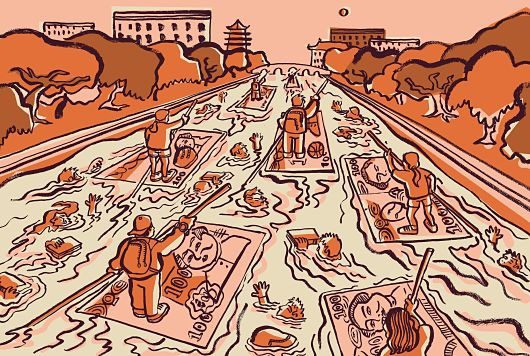
 During the 2008 Summer Olympics held in Beijing, China’s notoriously polluted capital, a controversial interview surfaced on the website of Tsinghua University. Alleged to have the support of university president Binglin Gu, the interview condemned the Chinese higher education system as teeming with “serious academic corruption dry and irrelevant to society curriculum, and rote memorization teaching methods.” It continued on to say, “The old-fashioned methods of teaching and teaching material caused our society to lose many Da Vinci’s and Bill Gates … up to now, China has no Nobel prize-winners, which has a lot to do with this kind of education pattern.”
While the interview was later revealed to be a fabrication by hackers, it still garnered enough attention to challenge the effectiveness of Chinese higher education, now the largest system of tertiary education in the world. The question remains though: Are the claims true?
As the report claims, China’s education style is, in a way, old fashioned. China has long favored memorization and exams for its education. This tradition dates all the way back to the 7th century, when China’s growing bureaucracy created the challenging keju exam system in order to select the best administrators. More than a millennium has passed, but the importance of the exam in Chinese education remains.
The college entrance exams, or the gaokao, a modern form of the ancient keju, serves as the single admission criteria for all Chinese universities. It has become a national obsession for college-bound students. In order to succeed on these intensely rigorous tests, the college hopeful have resorted to “cram-schools,” which fill the hours between school and bedtime with studying. On weekends, some 20,000 students will arrive at certain cram schools at 6:20 in the morning only to return home over 14 hours later.
The college admissions process has also received criticism for its bias and discrimination. Reports have suggested that more wealthy, urban students from influential cities like Shanghai and Beijing are 41 times more likely to be admitted to Peking University compared to more rural and poorer students from the province of Anhui.
Not surprisingly, more testing means Chinese students spend more time in classrooms than their Western peers. While more than one-third of Chinese college students experience 30 hours of class time a week, the average UK college student spends 14 hours equally working inside and outside of the classroom. In comparison, 40 percent of Chinese college students spend less than five hours working outside of class.
The Chinese obsession with tests corresponds to the increasing attendance and funding among the country’s colleges. In 1999, the Chinese government expanded its education system in order to jumpstart its stagnant economy. The number of graduating students has spiked since then. In 2003 there were 2.12 million university graduates in China, with almost 7 million a decade later, according to government estimates.
However, this investment in education has not entirely paid off. As more and more Chinese have enrolled in universities, China has found its economy actually decelerating, albeit in small amounts. Recent graduates have also struggled with employment, with only 35 percent having found employment. Post-graduate students fare even worse, with only 26 percent having found employment.
While China has invested greatly in its own higher education, its best universities still cannot hold a candle to those elsewhere, particularly in the West. This has led a large number of Chinese students to seek more valuable college educations abroad to get an edge in an increasingly difficult domestic job market. More than 3 million Chinese students have chosen to study abroad and they represent 20 percent of international students from OECD countries.
These international students often do not return home. In fact, according to a study, 85 percent of Chinese students who earned their doctorate in America in 2006 were still there five years later. With so many potential academics and intellectuals not returning to the country, many proclaim that China has a “brain-drain.” Only recently have Chinese citizens begun to win Nobel prizes for work done in their home country.
To entice its many expatriate academics back to their homeland, China has offered generous benefits. Those who return can expect free housing, a 1 million Yuan bonus and state-of-the-art facilities. The results were exceptional: From 2005 to 2012, published research articles from universities rose by 54 percent, with patents increasing eightfold. However, returning professors still have to work in an academic environment that restricts their research. Currently, the Chinese government plays a major role in directing research and rewards academics for the quantity of articles published rather than their quality.
Yet the sheer amount of money China has invested in its higher education system should guarantee results, a Harvard Business Review article stressed. It predicted that China will soon produce the most PhDs of any country in the world and lauded the increasing productivity of its professors.
The question still remains as to whether or not China can innovate and compete in both the realms of business and education. While perhaps less revered and creative, China’s universities are pioneering a controversial yet forward-looking path. To those guiding this burgeoning system, quantity has a quality of its own.
– Andrew Logan
Sources: The Economist, Harvard Business Review, New York Times 1, New York Times 2, Times Higher Education, TIME, University of Buffalo
Photo: New York Times

Eliminating Poverty with Sustained Economic Reform
In recent years, sustained economic growth in the Philippines has brought more jobs and improvements in living conditions for the country’s poor population. Over the course of just one year, more than a million jobs were created. What is more, unemployment is also at the lowest rate that it has been in ten years.
World Bank leading Economist Rogier van den Brink stated, “If growth is sustained at 6 percent per year and the current rate at which growth reduces poverty is maintained, poverty could be eradicated within a single generation”. In order to achieve this goal, however, key structural reforms will need to be sustained and sped up.
The most important structural reforms to focus on will be increasing investments in infrastructure, health and education, enhancing competition, simplifying regulations to promote job creation, and protecting property rights.
Back in January, the World Bank’s Philippine Economic Update was released, with the theme “Making Growth Work for the Poor.” The report lists the aforementioned goals and recommends rationalizing tax incentives by making them more targeted, transparent, performance-based, and temporary.
The potential success of continued reforms depends hugely on strengthening tax administration and improving the transparency and accountability of government spending. Once the Filipino population can agree with the manner in which their tax dollars are being spent, the new growth cycle can perpetuate itself accordingly.
During a press conference, Mr. Ven den Brink was probed on the Philippines’ lower-than-expected growth in Gross Domestic Product during the first quarter. He responded by explaining that since 2013, it has become much easier to see the way that even slow economic growth can directly reduce poverty.
Ven den Brink explained that regardless of the specific GDP number, what really matters is how that growth affects the poorest people. According to the World Bank economist, household and labor survey data all paint the same poverty-reducing picture.
While it is true that slow-moving government spending has limited the growth of the Philippine economy during the first quarter of the year, significant changes in poverty still pervade. Rates of underemployment and poverty are decreasing, and the lowest real income is growing 20-30 percent faster than the rest of the country.
Van den Brink also noted that the government’s Conditional Cash Transfer program has been a key poverty-reducing tool. The program gives out payments every month to the poorest households, which has successfully helped to lift entire families out of the poverty cycle.
Although some remain skeptical, poverty elimination in the Philippines is starting to seem like more of a feasible reality. This could be a major milestone not only for the Philippines, but for all of those involved in the global fight against poverty. Sustained economic growth could finally level the playing field, once and for all.
– Sarah Bernard
Sources: Business World, InterAksyon, World Bank
Photo: Flickr
For Bangladesh Refugees, Salvation in a Former Disaster Zone
Thailand has recently cracked down on human trafficking rings, especially after finding mass graves in the jungles on the border with Malaysia. Because of this, the Thai, Malaysian and Indonesian governments refused to allow smuggling ships to land on their shores, causing thousands of refugees to find themselves adrift at sea on boats with little resources or food.
However, the people of Aceh, a city in Indonesia, could not ignore the suffering of these refugees. They allowed the boats to land on their shores, defying their government and welcoming the burden of 2,000 starving, impoverished people. Many Acehnese have suffered decades of political turmoil as well as the 2004 tsunami that caused immeasurable damage. Many refugees settled at a port called Kuala Langsa, which is currently housing 425 Bangladeshi and 231 Rohingya migrants. “I feel that they are part of our family, part of Acehnese society, because they have suffered as much as us. It’s better if they stay permanently here,” says a Aceh native and restaurant owner who has provided meals to the refugees. Many agree, saying Aceh is the safest place for them to settle.
The citizens of Aceh even held a concert to help raise funds for the recent migrants. The event was organized by Rafly, a local singer and political figure. It was also a Pemulia Jamee, or traditional Indonesian ceremony to honor guests. Rafly has remarked that he hopes the migrants stay in Aceh.
Before successful landing in Aceh, migrants say they were turned away by the Thai government three times and the Malaysian government twice. The second refusal by the Malaysian government came with a threat that it would bomb their ship if they did not turn away.
Back in Bangladesh, prospects for change are bleak. Prime Minister Sheikh Hasina calls the Rohingya “mentally sick” and “tainting the image of the country” by escaping their government-controlled impoverishment, which limits their access to medical care and education. Rohyinga people are Muslim and reside in Rakhine state in western Myanmar. 140,000 remain in tent camps since their hometowns were destroyed by state-sanctioned fundamentalist Buddhists who view the Rohingya as Bangladeshi settlers.
Shortly after Aceh welcomed its refugees, Malaysia and Indonesia issued a statement saying the two countries would provide food and shelter to the 7,000 people who remained floating on the Straits of Malacca, provided these people seek permanent homes after a year.
– Jenny Wheeler
Sources: IRIN, Aljazeera
Photo: NY Daily News
United Nations Reduces Global Poverty
The United Nations set a goal to reduce global poverty and did – overwhelmingly so. In 2000, 191 countries of the U.N. created the Millennium Development Goals, a set of eight goals that sought to cut extreme poverty in half by 2015.
Since then, the Goals have helped 700 million people overcome extreme poverty. From 1990 to 2010, the efforts of the U.N. reduced global poverty by half, five years before the target date. Today, the amount of undernourished people in developing countries has decreased from 23 percent in 1990-92 to 14 percent.
Furthermore, the U.N. wanted to see universal primary education. By 2010, enrollment in primary school had reached 90 percent, an eight percent increase from 1999. By 2012, the number of children not attending school had declined by two million.
Such successes have been achieved not only through foreign aid but also through several programs that teach impoverished communities to lead sustainable lives.
This September, the U.N. will meet again to develop new goals and advance old ones for international development through 2030. The global goals, called the Sustainable Development Goals, are shaped to end extreme global poverty, fight gender inequalities and address climate change. One objective for the next 15 years is to lift another 1.2 billion people out of poverty.
Additionally, the new set of goals will address the 842 million people that remain hungry, as well as the unfortunately high number of children that are not receiving a proper education. Though the number of children in school today is at its highest, 126 million youth between the ages of 15 and 24 remain illiterate.
Unquestionably, the U.N. has made a significantly positive difference in the reduction of global poverty since 1990, having met or exceeded several criteria from the Millennium Development Goals. However, the fight against global poverty is not over, and the U.N. will continue to fight until it is completely eradicated.
– Sarah Sheppard
Sources: UN MDGs, SF Chronicle, The Global Goals
Photo: Child Fund
Ghana: A Poverty Success Story
Through a carefully crafted recipe of World Bank support, social protection, and government intervention, Ghana has been able to overcome major economic and societal hurdles. It was the first in sub-Saharan Africa to achieve the Millennium Development Goal of reducing poverty and hunger ahead of the 2015 deadline.
Kulyk originally recommended a reverse mission between the World Bank and Ghana under Ghana’s Social Protection program. This was the first of its kind in the history of the World Bank’s relations with Ghana. Its theme, “Safety nets in Ghana- Innovation and Successes,” helped guide anti-poverty action in the right direction.
Currently, the World Bank supports Social Protection interventions in Ghana through an $88.6 million Social Opportunities Project. Additionally, $50 million is financed for ongoing projects, making the Bank’s total contribution $138.6 million. In the future, the Bank will continue to help reverse Ghana’s poverty situation.
In terms of social protection, there are forty-four programs targeting extremely poor individuals, households, and entire communities in Ghana. For Ghana’s most vulnerable and severely marginalized, these mechanisms bring the social assistance and capacity enhancement needed to break out of poverty.
The government is currently working to ensure that the living conditions of Ghana’s poor population are improved through social intervention programs. Specifically, labor-intensive programs implemented across sixty districts will soon be scaled up in order to achieve the best poverty-reducing and livelihood-improving results.
In countries like Bangladesh, Mexico, and Ghana, regular cash and asset transfers to the poor have helped alleviate poverty by securing food needs and improving access to health and education. Additionally, small, regular income transfers enable the poor to make small investments — a hugely important step in poverty reduction.
It is important to note that while Ghana has successfully cut poverty in half, nine years from now approximately 6 million people will still live in poverty, with 2.2 million living in extreme poverty. Although this does not negate the significance of what has already been achieved, it is a crucial reminder of what is to come.
It is true that there is no perfect model for poverty alleviation. However, there are certainly key elements of focus that have consistently brought the most significant results. By adhering to this wide-reaching, gradually emerging poverty-fighting recipe, Ghana has made leaps and bounds in its poverty fight.
The most common poverty-fighting packages include some combination of microcredit financial aid, public works, training, agricultural extension services, financial literacy and links to credit units. In other African countries like Rwanda, childhood development and childcare services have become key areas of focus too.
Poverty is a complex issue that can be attacked from an infinite number of points. Depending on the time, place, and people involved, target areas fluctuate in terms of severity and significance. Still, at the most basic level, there is a lot to be learned from such success stories. Hopefully, Ghana’s model will spur more like its kind.
– Sarah Bernard
Sources: Graphic Online, allAfrica
Photo: Flickr
China’s Ambitious Plan for its Higher Education System
While the interview was later revealed to be a fabrication by hackers, it still garnered enough attention to challenge the effectiveness of Chinese higher education, now the largest system of tertiary education in the world. The question remains though: Are the claims true?
As the report claims, China’s education style is, in a way, old fashioned. China has long favored memorization and exams for its education. This tradition dates all the way back to the 7th century, when China’s growing bureaucracy created the challenging keju exam system in order to select the best administrators. More than a millennium has passed, but the importance of the exam in Chinese education remains.
The college entrance exams, or the gaokao, a modern form of the ancient keju, serves as the single admission criteria for all Chinese universities. It has become a national obsession for college-bound students. In order to succeed on these intensely rigorous tests, the college hopeful have resorted to “cram-schools,” which fill the hours between school and bedtime with studying. On weekends, some 20,000 students will arrive at certain cram schools at 6:20 in the morning only to return home over 14 hours later.
The college admissions process has also received criticism for its bias and discrimination. Reports have suggested that more wealthy, urban students from influential cities like Shanghai and Beijing are 41 times more likely to be admitted to Peking University compared to more rural and poorer students from the province of Anhui.
Not surprisingly, more testing means Chinese students spend more time in classrooms than their Western peers. While more than one-third of Chinese college students experience 30 hours of class time a week, the average UK college student spends 14 hours equally working inside and outside of the classroom. In comparison, 40 percent of Chinese college students spend less than five hours working outside of class.
The Chinese obsession with tests corresponds to the increasing attendance and funding among the country’s colleges. In 1999, the Chinese government expanded its education system in order to jumpstart its stagnant economy. The number of graduating students has spiked since then. In 2003 there were 2.12 million university graduates in China, with almost 7 million a decade later, according to government estimates.
However, this investment in education has not entirely paid off. As more and more Chinese have enrolled in universities, China has found its economy actually decelerating, albeit in small amounts. Recent graduates have also struggled with employment, with only 35 percent having found employment. Post-graduate students fare even worse, with only 26 percent having found employment.
While China has invested greatly in its own higher education, its best universities still cannot hold a candle to those elsewhere, particularly in the West. This has led a large number of Chinese students to seek more valuable college educations abroad to get an edge in an increasingly difficult domestic job market. More than 3 million Chinese students have chosen to study abroad and they represent 20 percent of international students from OECD countries.
These international students often do not return home. In fact, according to a study, 85 percent of Chinese students who earned their doctorate in America in 2006 were still there five years later. With so many potential academics and intellectuals not returning to the country, many proclaim that China has a “brain-drain.” Only recently have Chinese citizens begun to win Nobel prizes for work done in their home country.
To entice its many expatriate academics back to their homeland, China has offered generous benefits. Those who return can expect free housing, a 1 million Yuan bonus and state-of-the-art facilities. The results were exceptional: From 2005 to 2012, published research articles from universities rose by 54 percent, with patents increasing eightfold. However, returning professors still have to work in an academic environment that restricts their research. Currently, the Chinese government plays a major role in directing research and rewards academics for the quantity of articles published rather than their quality.
Yet the sheer amount of money China has invested in its higher education system should guarantee results, a Harvard Business Review article stressed. It predicted that China will soon produce the most PhDs of any country in the world and lauded the increasing productivity of its professors.
The question still remains as to whether or not China can innovate and compete in both the realms of business and education. While perhaps less revered and creative, China’s universities are pioneering a controversial yet forward-looking path. To those guiding this burgeoning system, quantity has a quality of its own.
– Andrew Logan
Sources: The Economist, Harvard Business Review, New York Times 1, New York Times 2, Times Higher Education, TIME, University of Buffalo
Photo: New York Times
10 Facts About Internet in Africa
1. In October 2007, the International Telecommunication Union (ITU) held the first part of its Connect the World series in Kigali, Rwanda to demonstrate its commitment to foster development of telecommunications across Africa, a key aspect of the Millennium Development Goals.
2. As a continent, Africa has seen steady growth in Internet penetration since its rate of .78 percent in 2000. Internet has now reached 20.7 percent of Africa, but there are major disparities in Internet access and use across the continent.
3. The leading countries with the highest Internet penetration rates are Morocco at 56 percent, Egypt at 50 percent and South Africa at 49.8 percent. Meanwhile, various nations throughout the continent are still at rates below 2 percent. Despite these differences, all African nations have experienced Internet growth in recent years.
4. The majority of African countries have Internet penetration rates below 10 percent, which is well below the 20 percent benchmark rate determined for Internet access to benefit countries economically.
5. A total of 10.7 percent of African households have Internet access. Meanwhile, almost half of African Internet users access the Internet via mobile device. Social media usage accounts for about a third of Internet use for these users.
6. Bandwidth is significantly more scarce across Africa than in developing nations, making Internet access much more expensive across the continent. In recent years, increased investment in infrastructure such as national landing stations has allowed some bandwidth expansion, therefore slightly increasing capacity for connectivity.
7. According to Kojo Boakye, policy manager of the Alliance for Affordable Internet, no developing countries have met the ITU’s affordability benchmark of connectivity costing less than 5 percent of monthly income for the world’s potential users that survive on less than two dollars per day. He said that, for many countries in Africa, the cost of fixed broadband comprises almost half of an average citizen’s monthly income.
8. Internet users in Africa pay up to 40 times more for access than users in developed countries. There are many initiatives in place to decrease these rates, but there has been substantial difficulty in implementation. One of these goals involves establishing at least one Internet eXchange Point (IXP) in every African nation in order to promote the construction of infrastructure that makes Internet access cheaper and faster. Another initiative is in place to migrate from analog to digital broadcasting in order to free up unused spectrum, thus increasing access opportunities. However, by June 2014, only 19 countries had begun this transition and only three had completely transitioned. Another initiative is to accelerate adoption of IPv6, which ensures enough availability of IP addresses to allow anything capable of having an IP address to connect to the Internet. South Africa and Egypt account for 97 percent of all of the IPv6 addresses in the continent, which indicates major lagging for the rest of Africa. This development is seen as necessary for long term expansion of Internet.
9. The Internet contributes 1.1 percent to the overall African GDP, which is substantially lower than the global average contribution of over 4 percent. There are large disparities across the continent, with the contribution to GDP being 3.3 percent in Senegal and .8 percent in Nigeria. These rates are measured using iGDP, which evaluates use of networks and services in private consumption, public expenditure, private investment and trade balance.
10. Key players in Africa’s Internet community come together with global members of the industry for the annual Africa Internet Summit. Participants discuss the continent’s challenges and use it as a platform to exchange knowledge. This year’s conference was themed “Beyond connection: Internetworking for African Development,” and took place in Tunisia from May 24 – June 3.
– Arin Kerstein
Sources: All Africa, International Telecommunication Union, Internet Society, Africa Internet Summit, IT Web Africa
Photo: Africa Renewal
How the 1979 Revolution Brought Iran Into Poverty
After the revolution, the new government federalized businesses, which has ended up further hurting the economy. With the new sanctions and laws regarding the businesses, families have experienced a more difficult time to provide for themselves.
To add to the shift in government and adjusting to the new laws, a baby boom occurred in Iran following the 1979 revolution. Following the revolution, Ayatollah Ruhollah Khomeini asked women of the new Iran to have a substantial amount of babies that could one day protect their nation and faith.
After his call for children, the population came close to doubling from 34 million citizens to 62 million, according to The United States Institute of Peace: The Iran Primer.
With such a drastic jump in population, the Islamic Republic soon came to realize that they could not “feed, clothe, house, educate and eventually employ the growing numbers.” Without the ability, space or resources necessary, many families fell into poverty at a significant rate.
As more families sought refuge and aid in any form available, the option of terrorism became more tempting. Not because they desired terroristic actions, but often terrorist groups will travel through impoverished areas promising to pay considerable amounts to those who join their groups.
When in desperate need of money to care for one’s family, the willingness to join radical alternatives becomes a considerable option. With the insecurity of families and nations placed upon them, the feeling of hopelessness only grows.
However, after the dramatic increase in population, a progressive family planning program was enacted in an attempt to slow the population growth and allow the government to provide for those already born.
The program was advanced, especially for the time. Billboards went up across the nation encouraging smaller family sizes, volunteers were sent door-to-door to advocate for why fewer children were the better option, family planning classes were required before marriage and health centers began distributing free birth control and condoms all in an effort to slow the birth rate and end the baby boom.
With the new program in place, birth rates soon began to decline at what was a comforting rate. In 1988, women were averaging 5.5 births. By 2006, the average had decreased to 1.9 births per woman and was continuing to drop.
Though the birth rate had declined like intended, with the continually dropping rate, a new concern arose. There was now an exceedingly large generation of baby boomers being followed by a generation that would not even replace their parents.
The abrupt decline in births has, and still is, causing problems regarding their ability to support the immense aging population.
With this vast difference in situations and problems, the Iranian government and population are continuing to feel a struggle in the prolonged wake of the 1979 revolution.
Between the excessive number of babies and then the sudden drop in births, the population fluctuation is one of Iran’s numerous economic issues that they as a nation and separate communities are having to deal with.
– Katherine Wyant
Sources: Iran Primer, International Affairs Review, Iran Primer
Photo: Iran News Update
Albert Pujols Helping the Poor in the Dominican Republic
But his work is not limited to baseball; he is also giving back to those in need in his native Dominican Republic.
Pujols, who was formerly with the St. Louis Cardinals and is currently playing for the Los Angeles Angels, began the Pujols Family Foundation (PFF) as a way to give back to those around him.
PFF works in two main areas: in the U.S. for those with Down Syndrome, including his daughter, and in the Dominican Republic for those that live in poverty.
The Dominican Republic’s population is over 10 million and the World Bank classifies the country as upper-middle class. Even so, there are millions of people living in slums and “bateys.”
“Bateys” are villages made of shacks and dirt roads. They are near sugar cane plantations, which is where those living in the bateys typically work. Children leave school at a young age to help their parents in the fields cutting sugar cane. The workers get paid by the pound of sugar cane cut, not by the amount of time spent in the field.
PFF works to bring educational opportunities, medical care, and basic necessities to the people living in poverty.
The foundation’s work includes:
How can one help this great organization? PFF is a nonprofit foundation that relies on individual donations for support. Their website lists lots of ways to help out, but two unique ways are directly related to Pujols and his work on the baseball field.
PFF is an active charity on FantasyHub. By playing fantasy sports and linking to PFF, one can donate a portion of any winnings to the foundation and its work.
Alternatively, one can make a Home Run Pledge linking one’s personal giving to the number of home runs Pujols hits. As of the end of June, Pujols has hit 23 home runs for the Angels. A potential donor can look at the stat box and follow a great ball player while pledging to help those in need.
PFF has helped many people at home and abroad. Their work with those with Down Syndrome is exemplary, and the fact that PFF goes back to the Dominican Republic and actively works to improve the lives of those in poverty is inspiring.
So much good can happen when people use their influence and resources to help better the lives of the economically disadvantaged as Albert Pujols does.
– Megan Ivy
Sources: Fox News Latino, Huffington Post, MLB, Pujols Family Foundation, WHO
How Does Ebola Impact Poverty
Ebola, a rare and deadly disease contracted through bodily fluids, still continues to affect parts of West Africa. In March of 2014, Ebola ravished Guinea, Sierra Leone, and Liberia, which resulted in 15,065 cases and 11,207 deaths.
So far, the outbreak shows no sign of slowing. The upcoming October election in Guinea has become increasingly concerning, especially because contraction is easier in overcrowded city environments.
Furthermore, Ebola impacts more than just patients; it impacts their families and the lives of others. With the outbreak in West Africa, food prices increased and food supplies dwindled. Sickness resulted in less work and less pay.
So how can the spread of Ebola be reduced? While medical quarantine has been used during the outbreak, many experts say that attacking poverty is the only true solution.
This being said, sanitation and hygiene are key. This includes clean and safe water. When a patient first contracts Ebola, scientists have discovered that replacing the liquids lost can successfully treat the disease. However, without a substantial supply of water for the number of patients, Ebola quickly weakens its victims.
Also necessary are protective and sanitary shelter, as well as greater accessibility to quality health care, even for those with struggling incomes.
Experts have also recently discovered that the disease can remain in semen up to five months after a successful recovery from Ebola. This suggests that education about safe sex and abstinence, as well as access to condoms, is crucial to the decline of patients with Ebola.
As of late, Ebola treatment research may offer hope to reducing the spread of the disease.
In April 2015, members of the Sierra Leone college of health services, sanitation, and centers for disease control teamed up to create a vaccine trial. This study called the Sierra Leone Trial to Introduce a Vaccine against Ebola (STRIVE). The study will assess the safety and effectiveness of the RVSV-ZEBOV vaccine. For more information on the details and successes of this study, visit https://www.cdc.gov/vhf/ebola/strive/qa.html.
For the even more good news, on June 24, 2015, researchers reported in MBio that generic heart disease medications might also have the potential to improve the immune systems of patients with Ebola. After a trial in Sierra Leone last fall, researchers were pleased to see improvements in the patients.
While these medications would not prevent or cure the disease, “it could allow individual patients to survive long enough to develop an immune response that eliminates the virus. These agents could be used in combination with anti-virals if they are available,” says David S. Fedson, MD.
Scientists plan to move forward with their research by performing more studies in West Africa. For more details, visit https://www.infectioncontroltoday.com/news/2015/06/generic-heart-disease-medications-offer-promise-for-ebola-treatment.aspx.
While these scientific discoveries offer hope, it is important that all people have access to vaccinations. Only then will able-bodied people be equipped to fight off poverty.
– Kelsey Parrotte
Sources: ABC News, CDC 1, CDC 2, Huffington Post, Infection Control Today, Scientific American, WSWS,
Photo: Inhabitat
Three Snack Companies Making a Difference
Kallari Bars
While chocolate is a major part of snacking, the chocolate industry is, unfortunately, somewhat notorious for unethical practices. The divide between wealthy chocolate companies based primarily in the United States or Europe and farmers in the developing world has lead to an industry notorious for abusive labor practices and economic exploitation.
Kallari bars are an important agent in fighting against this exploitation. Based in the Amazon, Kallari chocolate is owned by the Kichwa nation and controlled at every step of production by 850 growers from the nation.
Focusing on maintaining local control of natural resources in a sustainable way, Kallari can break the cycle of exploitation in the chocolate industry while empowering indigenous communities.
This Bar Saves Lives
Plumpy’nut is quite possibly the most important invention in the modern era. A cheap peanut-based concoction that stays fresh after opening and does not need to be refrigerated, cooked or consumed with clean water, this life-saving paste is reaching over 2 million malnourished children yearly.
For every nutrition bar purchased from the food company, This Bar Saves Lives, a packet of plumpy’nut is given to a child in need. And, to top it off, the bars are delicious.
This Bar Saves Lives comes in three flavors: Wild Blueberry Pistachio, Dark Chocolate Cherry & Sea Salt, and Madagascar Vanilla Almond & Honey. Made with all-natural, non-GMO, ethically sourced ingredients, the bars are delicious and nutritious.
The snacks also make a huge difference. Since June of 2013, This Bar Saves Lives has donated 515,546 packets of plumpy’nut. That is a number that speaks for itself. Customers can order packages of bars individually or can subscribe to a monthly shipment for a discount.
Kutoa
Kutoa is a Swahili word meaning “to give.” The food company of the same name does just that.
Like This Bar Saves Lives, Kutoa focuses on the issue of malnutrition by providing plumpy’nut to those in need. The focus has been successful, allowing the snack bars to make a huge difference. Since 2011, Kutoa has sent almost 200,000 meals to those in need.
Kutoa bars have a bit more variety than those offered by This Bar Saves Lives and include Chocolate Espresso Bean and Peanut Butter & Jelly, among others. Unfortunately, Kutoa does not yet offer the subscription service offered by its competitor.
Snacking is great. It’s no secret that everybody loves a little treat. With companies like these three that do good with their snacks, that little treat just got a whole lot bigger.
– Andrew Michaels
Sources: Kutoa, The Independent, This Bar Saves Lives, Kallari Cooperative, PCC Natural Markets, Snacknation,
Photo: Kutoa