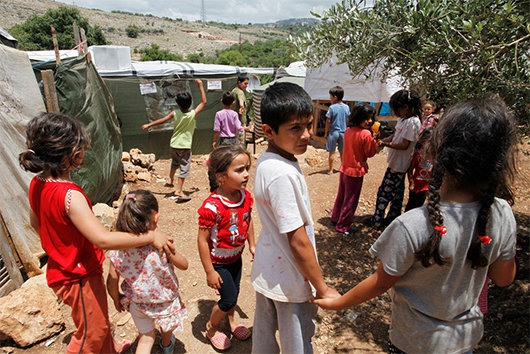
Since the civil war in Syria broke out just three years ago, four million people have sought refuge in the neighboring countries of Lebanon, Turkey, Jordan, Iraq and Egypt. So far, 100,000 have been killed. 7,000 of them are children.
The Middle East’s biggest refugee camp, Zaatari, lies in Jordan. It shelters 120,000 Syrians in a community divided into 12 districts. It costs $500,000 to run the camp. Camp workers dole out 500,000 pieces of bread and 3.5 million liters of water a day. Three-fourths of residents are women and children.
Of the 650,000 people that fled Syria to arrive in Turkey, one-third are allowed into refugee camps. There is no room for the res; they have to fend for themselves. Nizar Najjar is the assistant director of Camp Bab al-Salameh. He explains, “Sometimes we do not have the capacity to receive new refugees. Some people (are forced to) just put up their tents in fields.”
Those in camps do not have it much better. Dr. Al-Naser is a part of a group called “Medical Relief for Syria”. He says that the spread of disease is a big concern. “It’s a problem with sanitation, how to dispose of bathing water and used toilet water. There are lakes of waste in some areas.” Trucks bring in the camp’s only source of freshwater.
Young Syrian refugees are often traumatized. They have faced the horrors of being under siege, losing their homes and being separated from their families. Groups that flee travel by night and hide during the day. Some are shot at by fighter jets. Even once they reach the border, shelling still echoes in the distance.
Sara* is a 12-year old girl who fled Syria with her mother and brother along with her aunt, uncle and grandmother one year ago. She does not know the whereabouts of her father, who was kidnapped in 2013. The family was forced to leave once they lost touch with a brother-in-law that was providing them with money and resources.
Sara’s family arrived at a camp in Lebanon run by activists. They managed to find a simple apartment. It gives them a safe place to stay, but it is not insulated and floods as soon as it rains. Rent and electricity cost $230 each month. Back in Syria, they were a middle-class family, and now charities help them with essentials like food, rent and medical expenses. Sara’s grandmother has diabetes and high blood pressure.
It also costs money to renew visas, which is now mandated every six months. Many times, families are forced to return to Syria because they cannot afford it. It is difficult for refugees to find jobs and earn money. Sara’s 14 year-old brother makes $30 each week working for a nearby mechanic.
Affording school is nearly out of the question with high costs of transportation, books and other fees. Sara loved school back in peace-time Syria and completed grade five. She has not been in school for over three years now but is able to take French and English language classes that are offered by aid agencies in the area.
Antonio Guterres is the UN commissioner for refugees. He asks countries around the world do more to help these displaced people, including raising money to support them and their host countries. The president of the World Bank, Jim Yong Kim, makes a similar request. He also hopes to rebuild Syria and add more access to basic public services.
Sara dreams of becoming a doctor and for her country’s healing. “I want this war to end. I expect the world is so much bigger, with so many more people. With time, the world changes. I hope the war will be over one day.”
*Names has been changed to protect her identity
– Lillian Sickler
Sources: Care, Daily Mail, The Guardian, CBS News, World Vison, The Daily Beast, MIC, NPR
Photo: Flickr

Arktek: Keeping Vaccines Cool
This is the challenge Bill Gates presented to Nathan Myhrvold. The result was a thermos model device that looks like a keg and can be easily transported on a motorcycle. Arktek, the Passive Vaccine Storage Device, uses regular ice water and no power, keeping vaccines at a temperature just above freezing for months.
Arktek has just one small battery for the display screen at the top, which has a built-in cell phone to send text messages to alert others if, for example, you are running low on ice. The device was tested in up to 110 degrees Fahrenheit, where it can last 6 to 8 weeks. In a cooler area, it can last for months.
Well, how this is possible, you may ask?
Arktek uses super insulation, similar to what is used for cryogenic fluids, at very low temperatures and to protect spacecraft from extreme temperatures.
The device has already saved millions of lives. It was used in West Africa to transport the experimental Ebola vaccine during the recent outbreak. According to Bill Gates, the current vaccine-preventable disease to focus on is polio, which the Bill & Melinda Gates Foundation hopes to eradicate by 2018. Once polio is conquered, the next vaccine-preventable disease would be malaria.
The device is also practical in countries with reliable power, such as the United States, for the transportation of organs. Currently, organs are transported in hand-held coolers that do not last long very long. Myhrvold states the example that if the organs are not transported within a certain amount of time they will go bad in the current device used. That is when Arktek comes in handy, as a superior alternative method for transporting organs.
Arktek has received awards and recognition for its innovative technology. These include the 2014 Good Design Award in the Humanitarian Category from the Chicago Athenaeum Museum of Architecture & Design and the 2014 ViE Award for the best technological development.
Arktek is the result of Intellectual Ventures’ Global Good Program and Intellectual Ventures Lab. The innovative company is owned by Nathan Myhrvold, former Chief Information Officer at Microsoft. Intellectual Ventures has partnered with AUCMA, China’s largest refrigeration manufacturer, to help distribute these devices to remote areas. This is a partnership that will save millions of lives from vaccine-preventable diseases and potentially result in a healthier future for the world’s poor.
– Paula Acevedo
Sources: CNN Videos, Intellectual Ventures
Photo: Fast Company
Mind Over (or at Least on Par with) Matter for HIV Patients
HIV-positive individuals face enormous challenges, in terms of both size and quantity, and the psychosocial aspect of their plight is often underestimated.
Living with the stigma of being someone who is “infected” can interfere with opportunities, relationships and one’s overall position in society. Many individuals living with the diagnosis face issues ranging from anxiety to suicidal thoughts, from personality disorders to substance abuse.
Feeling the reality of mortality, along with the sudden ostracism from the community that a person once belonged to due to the stigmatized nature of HIV, is enough to bring up these issues for anyone.
While the war against the physical symptoms and spread of the diseases is in full force, the psychological issues faced by sufferers are just as important to address.
While these “side effects” are not always taken into consideration as a priority, the World Health Organization itself “recommends that attention to the psychosocial needs of people with AIDS should be an integral part of HIV care,” according to a National Institutes of Health (NIH) study. Globally, there are many cases where it is being done with great effectiveness.
Microcredit programs provide small loans to people who, due to their life-threatening diseases and discrimination (despite legislation seeking to prevent it), are hard-pressed to receive them from other places. In the case of the Positive Partnership Program in Thailand, loans are provided for partnerships between one HIV-positive and one HIV-negative person.
Infected individuals who received loans through this program reported feeling a greater sense of self-efficacy, increased acceptance in the community and an overall improved outlook on life. HIV-negative individuals who participated in the program reported an increased understanding of HIV and decreased levels of anxiety, fear and discomfort toward HIV-positive individuals.
Programs like this one are exemplary in the move toward integrating HIV-positive individuals into the rest of society. This is on top of the opportunity they offer them to reach and prove their full mental and economic potential, as, in the study’s period of 2004-2006, 91% of the loans given were repaid on time.
Projects similar to this one include a study of a cognitive-behavioral-group program for HIV-positive men in Hong Kong, and another done in rural Uganda using interpersonal psychotherapy. Both of these studies showed that psychosocially-based programs were effective in reducing symptoms of depression and increasing overall mental health.
In truth, the efforts of groups that work to reduce stigma and increase quality of life are incalculably important. As lecturer in ethics and HIV prevention Bridget Haire says, “showing the nation how people living with HIV are a vibrant, vital and productive part of our community cannot be overestimated.”
Perhaps even more poignant are the words spoken by one of the participants in the Thai Positive Partnership Program: “Life is much improved. My social life is back. I may have HIV, but I am still a human being. I have my self-esteem, and my honor.”
– Em Dieckman
Sources: UNAIDS, NCBI, The Conversation
Photo: Flickr
Roughly One-Third of Californian Residents Live in Poverty
An article published by the Sacramento Bee reported that about one-third of all Californian residents live at or below the U.S. poverty line. An immediate answer to this staggering statistic is the high cost of living one experiences as a Californian resident. A study by the United Ways of California “identified housing costs as the major factor in poverty, with struggling families spending over half of their incomes for shelter, with rents of two-bedroom housing units ranging from $584 a month in Modoc County to $1,905 in Marin, San Francisco and San Mateo counties.” In the simplest of terms, California isn’t cheap.
The percentage of Californians in poverty is composed of various demographics. For example, a little over 50% of all Latino families and 40% of African-American families reside under the poverty line, compared to 20% of all white families. Poverty levels spike within urban areas, with inner-city Los Angeles accounting for an astonishing 80% of all Californian residents in poverty.
At times, Californians are crippled with unrealistic housing costs. An article by AlJazeera America explored the alarming costs of owning property in California. An excerpt from the article reads, “In some California counties, the ‘real cost of living’ can exceed the federal poverty level by 300 percent. In San Diego County, for example, the household budget for two adults with one infant and one school-age child is $57,759 or 248 percent above the federal poverty line.” People in California spend more than half of their income just trying to pay their rent.
Times are vastly different in California now than they ever have been. Gone is the image of the original “Golden State.” The West Coast now offers a cruel glimpse into global poverty right here in our United States.
– Diego Catala
Sources: Sacbee, Al Jazeera
Photo: The Huffington Post
Peru Kidnap Rescue Mission: 30 Years in the Making
Despite the state’s success in decapitating a major terrorist organization in Peru 30 years ago, many victims are still being rescued from captivity today. This includes a kidnap rescue mission by the Peruvian army, which took place just this past July.
The army of the Peruvian state rescued 39 people from a farm where some of them have been held there for 30 years after being kidnapped. Others, children now, were born within the confines of their captivity. These individuals were all victims of the terror that reigned over Peru from the Shining Path, or as it is called in Peru, Sendera Luminoso.
The Shining Path was an infamous and extremely destructive terrorist and politically radical group, responsible for the death of thousands of Peruvians over the years, as well as the disappearance of many innocent people. Despite the state’s ability to end the group’s terror in 1992, when the leader Abimael Guzman was taken down, these victims were not released until over 20 years after the dismantlement of the organization.
The victims found within the walls of these particular farms, which are labeled “production camps”, were primarily children. Many were kidnapped from rural areas and forced to work in these camps. They were to do agricultural work in the fields, as well as procreate with other captives.
Unfortunately, there are many cases in which the Shining Path still leaves its mark and affects those still living in Peru today. The government of the country is making an effort to permanently wipe out any impact the terrorist group continues to make, starting with these camps that are still in existence, hidden throughout the jungles and rural areas of the country.
– Alexandrea Jacinto
Sources: Inside the World, BBC
Photo: The Independent
HIV Prevention Through Childhood Education
Oftentimes, medical interventions in the developing world consist of sending and administering medical supplies, personnel and medical training. However, when it comes to HIV prevention, secondary school education might be a “two birds, one stone” scenario, cost-effectively cutting down the rate of new infections in the first place rather than focusing on expensive treatment.
Traditional HIV/AIDS reduction programs such as the U.S. President’s Emergency Plan for AIDS Relief (PEPFAR) have focused on primary school education and generally expanding access to information regarding HIV/AIDS as a prevention strategy. However, programs like PEPFAR generally don’t go so far as to include secondary school education as a strategy, which can be a rather ambitious objective.
A recent study published by The Lancet suggests that secondary school education ought to be the main feature of programs such as PEPFAR.
The study correlates a drop in new cases of AIDS with extra schooling in Botswana. Jacob Bor of Boston University School of Public Health, one of the co-authors of the study, made this point succinctly saying, “investments in secondary schooling are a slam dunk and should go alongside biomedical interventions in any effective HIV prevention strategy.”
According to the study, young people who attended an extra year of secondary school were 8.1% less likely to contract HIV. Girls, in particular, were 11.6% less likely if they attended at least two years of secondary school. The study found that there was no such correlation with primary school attendance. Apparently, the greater impact on preventing new cases of HIV in girls might be due to the fact that there are simply more women with the virus to begin with; in 2013, almost 80% of new adolescent infections in Sub-Saharan Africa occurred among girls.
Because AIDS has a disproportionate impact on women, secondary school education might even represent a grand slam of development objectives, improving health, education and gender equality; expanding opportunities for women and girls is widely regarded as one of the most effective poverty-reduction strategies.
The Millennium Development Goals included the objective of achieving a universal primary education for all children, which even now is a lofty goal. However, to realize a substantial improvement in AIDS reduction as well as other related goals, universal secondary school education might need to be included in the next set of global development objectives.
– Derek Marion
Sources: SciDevNet, The Lancet, PEPFAR
Photo: Flickr
The MDGs Are the “Most Successful Anti-Poverty Movement in History”
The MDGs proved the power behind global action. This reassured the United Nations that this methodology demonstrates success and shows encouraging results. The United Nations and other intergovernmental organizations monitored more than 28 countries during the fifteen years to determine the results of eight MDGs, the first of which was a reduction in global poverty.
The results were highly satisfying. The United Nations noted that the MDGs showed shortcomings in its inability to reach the most vulnerable and did little to improve the conditions of the “ultra-poor,” but the U.N. Secretary-General firmly stated that these “successes should be celebrated [by] our global community,” while staying “keenly aware of where we have come short.”
The success of these developing countries was a direct consequence of “targeted interventions, sound strategies, adequate resources, and political will.” While the U.N. Secretary General’s special adviser, Jeffery Sachs, states that the upcoming Sustainable Development Goals (SDGs) proposal will be “the greatest, most complicated challenge humanity has ever faced” due to a “juggernaut of a world economy is pressing against the finite limits of the planet,” the MDGs are a shining beacon of hopeful resolve.
The global problems of the world are a global and generational responsibility that Sachs believes “requires the best intellects around the world to help solve [these] problems and design new, more sustainable systems.” Innovation is key. Sachs states that the world needs to reimagine its vision for the future in order to make the improvements envisioned in the SDGs to be proposed in September.
Millennium to Sustainable Development Goals, the United Nations clearly visualizes a future that, as Ban states, “strives to reflect these lessons [learned from the MDGs], build on the successes and put all countries together, firmly, on track towards a more prosperous, sustainable, and equitable world.” The SDGs aim to take a working methodology, global action and universal cooperation to see extreme poverty eliminated by 2030.
– Felicia L. Warren
Sources: UN 1, UN 2, UN 3, The Guardian
Photo: The Guardian
Experience Poverty Challenge: Empathy as the Catalyst for Change
The general challenge is to simply spend three days living on only $1.50. The provisions that can be bought on this insignificant amount seem near to none, but that is the point. The goal of the challenge is for those participating to be sponsored for his or her participation. Funds received for fulfilling the terms of the challenge go to a sponsored charity.
The sponsored charity is the Deworm the World Initiative. This charity focuses its efforts on the provision of life-saving medicines to those who live in poverty, conditions where individuals can hardly afford food, let alone healthcare.
Half of the world spends $2.50 or less on food a day and this quantity of income highly suggests an inability to afford basic healthcare. Furthermore, the charity does not limit its expectations and goals to resolving a lack of healthcare issues produced by poverty.
The Deworm the World Initiative aims to tackle poor living conditions as a whole through the “Evidence Action Beta” (EAB) approach. “Beta,” in this case, refers to the “beta” testing solutions that focus on efforts that have been tested and proven to maximize results and minimize possible consequences of intervention.
This means research-based solutions. An example of this is seen in the charity’s approach towards what they call “seasonal hunger.” During certain times of the year, some developing countries experience famine due to changing environmental conditions. One working solution that EAB noticed was a success with travel subsidies for work migration.
These travel subsidies would allow individuals to leave their families during these seasonal famines and work in neighboring locations. This would allow the families to receive capital and resources from the work-migrating individuals, which would show improvements in consumption and nutrition in these affected areas.
In order to participate in this challenge and support this innovative charity, one can visit www.experiencepoverty.causevox.com.
– Felicia L. Warren
Sources: WTXL, Experience Poverty, Evidence Action
Photo: Experience Poverty
The Young Syrian Refugees
Since the civil war in Syria broke out just three years ago, four million people have sought refuge in the neighboring countries of Lebanon, Turkey, Jordan, Iraq and Egypt. So far, 100,000 have been killed. 7,000 of them are children.
The Middle East’s biggest refugee camp, Zaatari, lies in Jordan. It shelters 120,000 Syrians in a community divided into 12 districts. It costs $500,000 to run the camp. Camp workers dole out 500,000 pieces of bread and 3.5 million liters of water a day. Three-fourths of residents are women and children.
Of the 650,000 people that fled Syria to arrive in Turkey, one-third are allowed into refugee camps. There is no room for the res; they have to fend for themselves. Nizar Najjar is the assistant director of Camp Bab al-Salameh. He explains, “Sometimes we do not have the capacity to receive new refugees. Some people (are forced to) just put up their tents in fields.”
Those in camps do not have it much better. Dr. Al-Naser is a part of a group called “Medical Relief for Syria”. He says that the spread of disease is a big concern. “It’s a problem with sanitation, how to dispose of bathing water and used toilet water. There are lakes of waste in some areas.” Trucks bring in the camp’s only source of freshwater.
Young Syrian refugees are often traumatized. They have faced the horrors of being under siege, losing their homes and being separated from their families. Groups that flee travel by night and hide during the day. Some are shot at by fighter jets. Even once they reach the border, shelling still echoes in the distance.
Sara* is a 12-year old girl who fled Syria with her mother and brother along with her aunt, uncle and grandmother one year ago. She does not know the whereabouts of her father, who was kidnapped in 2013. The family was forced to leave once they lost touch with a brother-in-law that was providing them with money and resources.
Sara’s family arrived at a camp in Lebanon run by activists. They managed to find a simple apartment. It gives them a safe place to stay, but it is not insulated and floods as soon as it rains. Rent and electricity cost $230 each month. Back in Syria, they were a middle-class family, and now charities help them with essentials like food, rent and medical expenses. Sara’s grandmother has diabetes and high blood pressure.
It also costs money to renew visas, which is now mandated every six months. Many times, families are forced to return to Syria because they cannot afford it. It is difficult for refugees to find jobs and earn money. Sara’s 14 year-old brother makes $30 each week working for a nearby mechanic.
Affording school is nearly out of the question with high costs of transportation, books and other fees. Sara loved school back in peace-time Syria and completed grade five. She has not been in school for over three years now but is able to take French and English language classes that are offered by aid agencies in the area.
Antonio Guterres is the UN commissioner for refugees. He asks countries around the world do more to help these displaced people, including raising money to support them and their host countries. The president of the World Bank, Jim Yong Kim, makes a similar request. He also hopes to rebuild Syria and add more access to basic public services.
Sara dreams of becoming a doctor and for her country’s healing. “I want this war to end. I expect the world is so much bigger, with so many more people. With time, the world changes. I hope the war will be over one day.”
*Names has been changed to protect her identity
– Lillian Sickler
Sources: Care, Daily Mail, The Guardian, CBS News, World Vison, The Daily Beast, MIC, NPR
Photo: Flickr
Roger Federer Visits Children in Malawi
Roger Federer is an all-star on and off the court, scoring major points for his contributions to ending global poverty.
The tennis player recently visited Malawi to check out the progress of the preschools built through his nonprofit, the Roger Federer Foundation. The Swiss athlete created the charity 10 years ago to help poverty-stricken countries in Southern Africa.
The organization is committed to providing quality education for all children, seeing education as a basic and necessary human right. As a supporter of the Early Childhood Development program in Malawi, the Roger Federer Foundation is making major progress in providing quality education for primary learners.
In Malawi, they’ve built 50 preschools and benefited 37,000 children. During his visit to the country, Federer sat in on classes, helped out in the kitchen and played with the kids during recess. He also had the opportunity to attend the launching of a new childcare facility.
Federer and his foundation aren’t just about sending funds to build preschools; they want to see the impact they are making and physically be apart of making education happen. In addition to their work in Southern Africa, the organization also promotes quality education in impoverished areas of Switzerland, Federer’s home country.
The Roger Federer Foundation believes that the children of today are the leaders of tomorrow and would like to empower children affected by poverty by providing them a sustainable and accessible education. So far, the foundation has benefitted 215,000 children in seven countries, with plans to reach a million children by 2018.
Quality education is fundamental to ending the cycle of global poverty. Education contributes to sustainable living and stronger livelihoods, and preschool education serves as the foundation of learning.
Despite his tough loss at Wimbledon, Federer proves admirable success through the accomplishments of his foundation in bringing education to impoverished youths.
– Sarah Sheppard
Sources: Independent, Roger Federer Foundation 1, Roger Federer Foundation 2
Revolutionary Period Panties in the Developing World
May 28th marks Menstrual Hygiene Day, a day of awareness seeking to break the taboo that exists in cultures and societies around the world. Menstrual Hygiene Day also seeks to raise awareness about the importance of good menstrual hygiene management (MHM).
Why is this so important?
Menstrual Hygiene is fundamental to education, the economy, health, the environment and human rights. Below are some statistics:
What is THINX?
A new company is trying to break the taboo surrounding menstruation, which is usually referred to as the “week of shame” in developing countries. THINX has designed period-proof underwear that they claim protects from leaks and keeps you dry.
The idea emerged when wearing a white skirt to a meeting and was developed over the course of three years of research by three women in New York City who sought underwear that was reliable during their periods. The end result is stain-resistant, anti-microbial, leak-resistant, absorbent underwear with a moisture-wicking layer.
THINX claims they can replace tampons and pads if you’re comfortable doing so. It offers underwear designed for light, medium and heavy days, with the level of absorbency ranging from one half, one, and two tampons worth or absorbency, respectively. They wash just like regular underwear, just cold wash and hang dry.
For the 80 percent of American women who have had accidents and have expressed anxiety during their periods, these period-proof panties may seem like a good investment.
How does your purchase help girls in the developing world?
The three women behind THINX love to travel. While they were in Africa, they met a young girl named Amale on a weekday, asked her why she wasn’t in school, and she said, “It’s my week of shame.” Amale misses about one week of school each month due to her period. She uses things she can find such as sticks, leaves, mud and dirty rags.
The women decided to partner with AFRIpads, an organization based in Uganda that makes washable, reusable cloth pads at an affordable price. The result is that for every pair of underwear you buy, seven washable, reusable pads will be produced for one woman. THINX felt that instead of giving them away, they are helping this movement grow by creating jobs for local women who make these pads and their girls can go to school with no shame. The underwear are currently made in a family-run factory in Sri Lanka.
THINX has received reviews from companies such as ELLE calling them “magic panties” and Fast Company saying they are “ingeniously designed.”
Considering that a woman throws away five or more pairs of underwear every year, it would be a better and more thoughtful investment to buy period panties that are stain-resistant and that help women and girls around the world.
– Paula Acevedo
Sources: Thinx, Menstrual Hygiene Day
Photo: Menstrual Hygiene Day