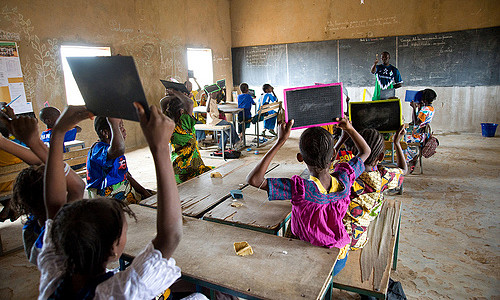
 Once known around the world as the finish line of the famous Paris-Dakar Rally, the small West African country of Senegal stands out in from its neighbors. Unlike many of other West African countries like Cote d’Ivoire, Nigeria and Sierra Leone, Senegal has never experienced any notable conflicts or civil war in the last century.
This distinction has helped to garner the country a deserved reputation for high political stability in an often war-torn continent. However, Senegal also lacks the natural resources of many of its African peers and consequentially ranks as one of the poorest nations on earth. According to UNICEF, 22 percent of its population lives on less than a dollar per day.
For the youth of Senegal and for girls in particular, this has hindered the effectiveness of Senegal’s education system. However, the country has experienced a significant improvement in recent years. In 2009, 92.5 percent of Senegalese children attended primary school. This represents a dramatic improvement from 82 percent in 2005 and only 54 percent in 1994.
Yet, this overall progress belies a residual and significant flaw in education in Senegal; in the long run, girls are far more likely than boys to drop out and to receive less education. At a casual glance, however, it might not seem this way. In 2012, primary school enrollment was actually higher for girls than it was for boys at 74 percent and 72 percent respectively.
While the data for primary school enrollment suggests gender parity, this is not actually the case. As the children progress through their schooling, girls experience noticeably lower rates of attendance. This first becomes apparent upon the transition to secondary school. In contrast to 62 percent of their male peers, 57 percent of girls begin secondary school.
The disparity only widens as their education continues. Secondary school enrollment for boys was 34 percent for boys and 27 percent for girls. Ultimately, one can see the results of gender inequality in Senegal’s adult literacy rate; 62 percent of males and only 39 percent of females were literate. For every 10 literate men in Senegal, only 6 women have attained literacy.
These severe and disparate dropout rates reflect the economic challenges that affect poorer families in Senegal. Children frequently must quit their schooling in order to provide more money for their families by working.
This burden falls harder on girls. Often families will marry off daughters at a young age to lessen their economic burden or they will employ them around the house conducting domestic duties. Many will expect to do domestic work for the rest of their lives. This career choice puts girls and women at greater risk of sexual abuse and financial exploitation.
For families of higher economic standing, education in Senegal is less of an issue and more of an expectation. Girls from wealthier households have twice the attendance rate in primary school.
In the city of Dakar, one of the economic pillars of the Senegalese economy, private schools are becoming even more common. In fact, most schools in Dakar are private rather than public. This has created an even greater educational disparity for those without the money to pay for education.
The wealth and gender inequality in secondary education also carries over to higher education.
UNESCO reported that an increasing amount of private institutions has hindered accessibility for many college students. Additionally, more men were enrolled than women as college students. According to the World Bank, for every 10 male college students, there were only 6 female students.
With the help of foreign aid from USAID and The World Bank, Senegal is attempting to develop and expand its education system. Already, funds from USAID have greatly improved education in the nation.
In total, it has allowed for 500,000 children to enroll in school of which 300,000 were girls. USAID has also helped to expand the educational infrastructure of Senegal through the construction of over 100 middle schools. It has donated more than 3 million textbooks and provided 20,000 schoolchildren with internet access.
The World Bank initiated an ongoing project called “Tertiary Education Governance and Financing for Results Project for Senegal” which is aimed at “[enhancing] the efficiency and quality of the higher education system” in Senegal. While the project is not expected to end until 2016, it has already posted impressive results. It found that 88 percent of academic programs fit quality standards in June 2015 with the target set at 90 percent in September 2016.
To lessen gender inequality, UNESCO and the Senegalese government have teamed up to initiate the “Girls and Women’s Literacy in Senegal” program. It aims to provide 40,000 women and girls with high-quality education and more professional opportunities.
More still needs to be done, and with only 750,000 dollars of funding, this initiative cannot single-handedly solve the issue of inequality in Senegal’s education system. With the help of more foreign aid, Senegal can expect further progress.
– Andrew Logan
Sources: The Guardian, Institut de Recherche pour le Développement, UNESCO 1, UNICEF, UNESCO 2, USAID, The World Bank
Photo: Open Equal Free

Poverty and Engagement in Arts, Culture and Leisure
The first object of research was measuring how much poverty impacts people’s participation in sports. It found that adults who lived under the poverty line played fewer sports for far less time. These findings replicated those in similar studies in Canada and Australia. The lack of involvement in sports is believed to increase health risks such as obesity that are already present in lower income groups.
Some people blamed the lack of sports facilities provided in their neighborhoods. Financial and logistical barriers are a constraint. Sports equipment and transportation to and from facilities may cost extra money that the family cannot afford to spend. Moreover, parents who work more than one job find it difficult to take the time out to supervise their children, especially if their neighborhood is perceived as unsafe.
Another reason for poorer people’s reluctance to take part in sports is that they are simply not interested in them, as a study in Ireland concluded. Research in Australia demonstrated that even with ease of access to facilities and training, lower income children and adults were still less likely to play sports than their middle and upper income counterparts.
The second objective of the research was to determine how poverty impacts people’s engagement with arts, libraries and museums. Unsurprisingly, people living under the poverty line were less likely to be interested in or involved in their community’s culture. Even libraries, which are free and open to the public, see lower levels of engagement from poorer people. Children living in poverty are more likely to use the computer or TV for entertainment.
In addition to the obvious barriers of transportation costs and time constraints (for adults), poorer people frequently voiced the view that arts were for “other people and not for them.” They reported feeling out of place and uninterested. In their daily lives, art was perceived as being completely irrelevant.
To fight the main barriers to engagement in sports and culture — a dearth of facilities, extra costs and a lack of interest — the literature review recommends a few solutions: community-based solutions, personal and trusting relationships between mentors and participants, and lower costs.
– Radhika Singh
Sources: UK Department of Culture, Arts and Leisure, Art Council of Wales
Photo: PxHere
Malala Fund Aims to Secure Free Education for Children
Goal 4 of the proposed SDGs is to “ensure inclusive and equitable quality education and promote life-long learning opportunities for all.” By 2030, the U.N. hopes to ensure that primary and secondary education is free and easily accessible, as well as more equal for boys and girls.
Malala spoke at the Oslo education summit in July, urging leaders to invest in SDG 4 in order to reduce gender disparities and the negative outcomes of non-enrolled children. If the world can meet the goal by 2030, and every girl attends primary and secondary education, child marriage rates would decrease 64 percent and under 5-year-old child deaths would decrease 49 percent.
“In fact, and unfortunately, $39 billion is spent on [the] military in only eight days,” she said.
There are many challenges to providing universally free primary and secondary education, even if the $39 billion annual investment goal is reached. Many families send their children to the labor force because they live in extreme poverty, conflict plagues the ability to send children to school, and other countries lack infrastructure and resources to provide effective education.
Currently, the cost of 12 years of free education is $340 billion per year, which means lower-income countries need to invest 20 percent of their budget to education. Right now, the average budget spent on education is 15 percent.
In May 2015, more than 100 countries promised to provide free education to their children by signing the Incheon Declaration in Korea. The agreement will coincide with the SDGs to reach this goal by 2030.
Enrollment in primary education reached 90 percent by 2010, an increase from 82 percent in 1999, but 61 million children remained unenrolled in school. 31 million primary-aged school children dropped out worldwide and 32 million more repeated a grade. The Millennium Development Goals and the World Food Program provided support for the increase but more educational investments are needed to make a significant impact.
The Malala Fund pushes for the empowerment of education for girls. About two-thirds of the women in the world are illiterate. Also, education helps reduce population growth. For example, educated women in Mali have three children on average compared to the average of seven for uneducated women.
Despite the progress made through the MDGs, there are significant gaps between countries and regions.
“Conflicts remain the biggest threat to human development, with fragile and conflict-affected countries typically experiencing the highest poverty rates,” the U.N. said in a statement.
– Donald Gering
Sources: Do Something, Huffington Post, IB Times, Malala Fund, UN 1, UN 2, Yahoo News
Photo: Flickr
South Sudanese Refugees Warmly Welcomed by Uganda
Refugees who travel to Uganda for asylum are met with an abundance of economic and social opportunities upon their arrival. Unlike many other nations currently experiencing heightened influxes of refugees due to the persistence of several regional conflicts, Uganda does not place newly arrived migrants into refugee camps operated by the UN and other foreign aid organizations.
Instead, refugees who successfully escape their conflict-ravaged homelands for the peace and security of Uganda are presented with the opportunity to move into permanent settlements where they are provided with their own plot of land. Additionally, various UN agencies provide access to food, water, and home construction resources for newly arrived refugees. Localized primary schools and health clinics are commonly accessible in these areas of Uganda, and are responsible for providing valuable resources to newly settled migrant populations.
Titus Jogo, Refugee Desk Officer for the Adjumani District in Northern Uganda, stated in a recent interview regarding the legal statuses of South Sudanese refugees seeking asylum, “They have all the rights that are attributed to any human being, irrespective of their status as refugees.”
The conflict within South Sudan, the newest nation in the world after its founding in 2012, was initially caused by political disputes between President Salva Kiir and his former Deputy Minister Riek Machar. The conflict is largely consistent of multiple tribal factions which include the Neur Tribe, loyal to Machar, and the Dinka group, loyal to President Kiir; both of these tribal groups have been accused by international monitoring groups of committing war crimes and human rights violations, including ethnically targeted massacres and sexual assaults.
The most recent report provided by the UNHCR estimates that over 730,000 people have fled the conflict in South Sudan to neighboring nations such as Uganda, Sudan, Ethiopia, and Kenya. This report also estimates that an additional 1.5 million South Sudanese civilians are currently suffering from internal displacement due to the escalation in ethnic violence. Many of these displaced civilians experience frequent relocations to areas known as ‘protection-of-civilians’ sites, which are coordinated by the UN Mission in South Sudan and provide secure refugee camps for civilians who have fled their homes.
Secretary General of the UN Ban Ki-moon recently explained in a statement regarding conditions within South Sudan, “The violence that has ravaged South Sudan over the past 18 months proves that there can never be a military solution to this conflict. I therefore call on all leaders of South Sudan – particularly President Kiir and former Vice-President Riek Machar – to prove their leadership by investing in a political solution and immediately concluding a comprehensive peace agreement. At the same time, the international community must take decisive steps to help end the fighting.”
The UNHCR recently released an international appeal for increased foreign aid designated for the current mission within South Sudan, noting the mounting number of refugees traveling to neighboring countries has depleted financial resources. While the organization estimates that $99 million US is necessary to continue funding this operation, only 9% of this goal has been raised to date.
The report explained that “Current resources remain insufficient to provide vital life- saving assistance and services, particularly in the areas of health, education and livelihoods and environment. Many South Sudanese refugee children, their country’s hope for the future, face key barriers to education including overcrowding in classrooms, a lack of teachers, and a lack of recreational activities to support constructive social engagement.”
– James Miller Thornton
Sources: The Guardian, Shanghai Daily, UN
Photo: UNHCR
Equal Education in Senegal
This distinction has helped to garner the country a deserved reputation for high political stability in an often war-torn continent. However, Senegal also lacks the natural resources of many of its African peers and consequentially ranks as one of the poorest nations on earth. According to UNICEF, 22 percent of its population lives on less than a dollar per day.
For the youth of Senegal and for girls in particular, this has hindered the effectiveness of Senegal’s education system. However, the country has experienced a significant improvement in recent years. In 2009, 92.5 percent of Senegalese children attended primary school. This represents a dramatic improvement from 82 percent in 2005 and only 54 percent in 1994.
Yet, this overall progress belies a residual and significant flaw in education in Senegal; in the long run, girls are far more likely than boys to drop out and to receive less education. At a casual glance, however, it might not seem this way. In 2012, primary school enrollment was actually higher for girls than it was for boys at 74 percent and 72 percent respectively.
While the data for primary school enrollment suggests gender parity, this is not actually the case. As the children progress through their schooling, girls experience noticeably lower rates of attendance. This first becomes apparent upon the transition to secondary school. In contrast to 62 percent of their male peers, 57 percent of girls begin secondary school.
The disparity only widens as their education continues. Secondary school enrollment for boys was 34 percent for boys and 27 percent for girls. Ultimately, one can see the results of gender inequality in Senegal’s adult literacy rate; 62 percent of males and only 39 percent of females were literate. For every 10 literate men in Senegal, only 6 women have attained literacy.
These severe and disparate dropout rates reflect the economic challenges that affect poorer families in Senegal. Children frequently must quit their schooling in order to provide more money for their families by working.
This burden falls harder on girls. Often families will marry off daughters at a young age to lessen their economic burden or they will employ them around the house conducting domestic duties. Many will expect to do domestic work for the rest of their lives. This career choice puts girls and women at greater risk of sexual abuse and financial exploitation.
For families of higher economic standing, education in Senegal is less of an issue and more of an expectation. Girls from wealthier households have twice the attendance rate in primary school.
In the city of Dakar, one of the economic pillars of the Senegalese economy, private schools are becoming even more common. In fact, most schools in Dakar are private rather than public. This has created an even greater educational disparity for those without the money to pay for education.
The wealth and gender inequality in secondary education also carries over to higher education.
UNESCO reported that an increasing amount of private institutions has hindered accessibility for many college students. Additionally, more men were enrolled than women as college students. According to the World Bank, for every 10 male college students, there were only 6 female students.
With the help of foreign aid from USAID and The World Bank, Senegal is attempting to develop and expand its education system. Already, funds from USAID have greatly improved education in the nation.
In total, it has allowed for 500,000 children to enroll in school of which 300,000 were girls. USAID has also helped to expand the educational infrastructure of Senegal through the construction of over 100 middle schools. It has donated more than 3 million textbooks and provided 20,000 schoolchildren with internet access.
The World Bank initiated an ongoing project called “Tertiary Education Governance and Financing for Results Project for Senegal” which is aimed at “[enhancing] the efficiency and quality of the higher education system” in Senegal. While the project is not expected to end until 2016, it has already posted impressive results. It found that 88 percent of academic programs fit quality standards in June 2015 with the target set at 90 percent in September 2016.
To lessen gender inequality, UNESCO and the Senegalese government have teamed up to initiate the “Girls and Women’s Literacy in Senegal” program. It aims to provide 40,000 women and girls with high-quality education and more professional opportunities.
More still needs to be done, and with only 750,000 dollars of funding, this initiative cannot single-handedly solve the issue of inequality in Senegal’s education system. With the help of more foreign aid, Senegal can expect further progress.
– Andrew Logan
Sources: The Guardian, Institut de Recherche pour le Développement, UNESCO 1, UNICEF, UNESCO 2, USAID, The World Bank
Photo: Open Equal Free
Need to Prevent Malaria in Pregnancy
The presence of the malaria epidemic in the developing world has decreased significantly. However, for specific populations, malaria is still a life-threatening disease. There is a strong demand and need to prevent and treat malaria in pregnancy.
Malaria poses a threat to pregnant women and contributes to both maternal and infant mortality. In addition, malaria during pregnancy can result in maternal anemia and low birth weight of children. Stillbirths, miscarriages and preterm births are associated with malaria in pregnant women.
Given these facts, malaria poses a risk to communities and families, particularly when pregnant women contract the disease.
In Sub-Saharan Africa, malaria in pregnancy is associated with Plasmodium falciparum infection, but can also result from Plasmodium vivax.
Current strategies to address malaria in pregnancy include intermittent preventive treatment with sulfadoxine-pyrimethamine, use of insecticide-treated nets and treatment if malaria is contracted.
Pregnant women in the developing world have had difficulty receiving necessary health care due to inefficiencies within health care systems and lack of awareness about specialized treatment.
Local staff may not have the training or resources to offer pregnant women. In addition, preventive sulfadoxine-pyrimethamine and insecticide-treated nets are not widely available. There is a lack of skill and the ability to scale up the resources that are available.
Moving forward, malaria treatment for pregnant women would likely be more successful if policies and programs could work with other maternal and reproductive health programs.
Clara Menéndez, a medical researcher at ISGlobal, and her colleagues emphasize that a multidisciplinary approach will be required to fully address malaria and how it impacts the lives of pregnant women and their families.
– Iliana Lang
Sources: The American Journal of Tropical Medicine and Hygiene, The Lancet Global Health The London School of Hygiene and Tropical Medicine
Photo: 100X Development Foundation
With Food Needs Set to Triple, African Farmers Need Investment
Recent progress in Africa’s agriculture sector faces a number of potential threats according to Dr. Agnes Kalibata, the president of Alliance for the Green Revolution in Africa (AGRA). Kalibata, formerly the Rwandan Minister of Agriculture and Animal Resources, cites global climate change as African agriculture’s biggest threat if it’s not met with increases in further investment.
Thanks to recent financing in the form of development aid, agriculture insurance and foreign direct investment (FDI), many African farmers have developed the means to overcome the formidable climatic and economic conditions that threaten food access for hundreds of millions of people. But Kalibata says that without sustained investment, Africa’s food needs, which are set to triple by 2050, could prove unattainable.
“[Climate change] is eroding the momentum we had gained in terms of getting farmers to use improved seeds and buy fertilizers,” said Kalibata. “If a farmer puts his small savings into seeds and fertilizers and loses the whole crop, that’s the end of his whole career … Farmers are getting less rain, it’s more irregular and it’s beginning to affect their production and undermine the investment they are making.”
In a policy paper presented at the development finance summit in Addis Ababa earlier this month, AGRA estimated that the value of African agricultural output could increase from $280 billion to $800 billion by 2030. In order for the sector that employs around two-thirds of Africa’s population to realize this possibility, potential investment needs to be substantially increased and diversified.
One such opportunity for American investment comes in the form of agriculture insurance, which people and countries are increasingly relying upon to withstand conditions out of their control, such as natural hazards and climate-related disasters. Because agriculture is a high-variable venture, particularly in the harsh environments of sub-Saharan Africa, farmers are often left without the means of recovering lost investments or repaying debts associated with past loans. Insurance coverage enables those farmers to participate in riskier but more lucrative activities, like diversified harvests or mechanization.
Investment in African agriculture comes with economic and moral implications that reach deeper than the immediacy of food insecurity. Access to reliable sources of food is essential for countries in the early stages of economic development and, once established, can empower people and countries to achieve previously unattainable levels of security and self-determination.
“Agriculture is everyone’s business: national independence depends on its development because it enables us to escape the scourge of food insecurity that undermines our sovereignty and fosters sedition,” writes The New Partnership for Africa’s Development CEO Ibrahim Assane Mayaki in the United Nations’ Africa outlook. “[It] is the sector offering the greatest potential for poverty and inequality reduction, as it provides sources of productivity from which the most disadvantaged people working in the sector should benefit.”
The Food for Peace Reform and Electrify Africa Acts introduced earlier this year mark a number of Congressmen’s sustained efforts to make African development a focus of U.S. foreign policy. But in order for Africa to meet its future agricultural needs, investors and donor organizations will need to take further steps to establish infrastructure, mechanization and resistance to climate-related challenges. Those investments in food security could help to deliver increased opportunities for the African and American economies alike.
– Zach VeShancey
Sources: The Guardian, AGRA, United Nations
Photo: Flickr
FoPo Food Powder and World Hunger
1.76 billion tons of food is wasted globally each year. Food waste is caused by buying or preparing more food than necessary, and not cooking or eating food purchases at all.
To solve this problem and to alleviate world hunger, a group of Swedish master students created FoPo Food Powder. The product is created by turning cheap, nearly expired produce into powder form. By freeze-drying the food, pressure is lowered and water is removed, which results in longer-lasting nutrition in powder form.
Team members Kent Ngo, Gerald Marin, Vita Jarolimkova, Lizzie Cabisidan and Ada Balazy hope that their discovery can help end world hunger and minimize food waste.
The team has three objectives: reduce food waste by turning it into an innovative food product that can be used by people all over the world; extend shelf life while preserving all the nutritional properties and taste; give ugly and expiring food a chance.
“We are not into using a new product or new technology, but creating value out of the inefficiency of the food system,” Marian says.
So far, the powder comes in three flavors: banana, raspberry and mango. The powder retains 30-80% of its nutritional value and can be topped on yogurt and ice cream, baked into recipes, and blended into smoothies.
FoPo Food Powder also offers benefits for food producers and retailers. They can donate or sell their unsellable food, buy FoPo and incorporate it into their recipes, and sell FoPo for a source of good nutrition without additives.
Even further, FoPo offers hope for disaster relief, military and space needs, and providing nutrition to impoverished locations.
Since beginning their project in December 2014, the team has discovered that powdered food is becoming more accepted by consumers, and freeze-drying preserves nutritional value better than other techniques.
FoPo won the Ben & Jerry’s Join Our Core crowd-funding and placed runner-up for Thought For Food Summit, a challenge that helps students with projects to make the world a better place. Currently, FoPo is a finalist for MassChallenge, a community that helps early-stage entrepreneurs with their projects.
FoPo also receives support from both the United Nations Food and Agriculture Organization and the Philippines. They are currently launching a test run in natural disaster areas of the Philippines. Local farmers near the test sights will also be donating fruits such as pineapples and mangoes to the trial run.
The team continues to raise awareness and money about their product. With funds, they can find a manufacturer, acquire legal advice and perform further safety testing.
The team hopes to sell to grocery stores and online to big manufacturers in the near future. They also hope to create more flavors of FoPo, see more consumers interested in their product, and feed 9 billion people healthy and nutritious food produced from wasted food.
– Kelsey Parrotte
Sources: FoPo Food Powder, Mashable, Mother Jones
Photo: FoPo Food Powder
Aid Worker Attacks Decline After Worst Year on Record
Newly released data for 2014 shows a drop in worldwide aid worker attacks.
The report was published by Humanitarian Outcomes, a research institution that specializes in the international humanitarian system. The team collected the data through public sources and partnerships with the United Nations and major NGOs.
Humanitarian Outcomes has been tracking aid worker attacks and data since 1997. According to the group, more attacks occurred in 2013 than in any other year on record.
There were 190 major aid worker attacks in 2014, 74 less than in 2013. Still, an estimated 328 aid workers were affected last year with kidnappings, shootings and use of improvised explosive devices (IEDs) – all common types of attack.
In an innovative, joint project, Humanitarian Outcomes and Integrated Regional Information Networks (IRIN) created an interactive map that details all major aid worker attacks since 2000. The organizations state that their database is “the sole global open-source of this data.”
Some experts say that last year’s lower attack figures reflect the efforts that aid agencies have taken to improve security. Many agencies have stepped up their efforts to gain community support and use new technologies to keep workers safer.
Other experts believe that fewer aid worker attacks have occurred because international humanitarian groups are choosing to withdraw from volatile regions. As some organizations make the shift to “remote management,” which allows staff to oversee the agency from outside the conflict zone, they rely on local NGOs to deliver assistance. Analysts caution that these local groups are usually even less capable of providing security for their workers.
More than 3,000 aid workers have been attacked in the last 15 years. Of the 27 countries where these aid worker attacks took place, Afghanistan, Syria and South Sudan have the highest rates of violence. Many aid agencies feel pressure to maintain a presence in areas of conflict, even as violence worsens
In early June 2015, armed gunmen stormed an Afghan compound of People in Need, a Czech NGO that has worked in Afghanistan since 2001. The attackers shot aid workers “execution-style,” killing nine. Some were shot dead as they slept.
Afghanistan is the most dangerous country in the world for aid workers; nearly a quarter of all aid worker attacks occur in the conflict-ridden country.
Aid worker attacks have also been startlingly high in many central African countries, including in the Central African Republic (CAR). The United Nations Humanitarian Coordinator in CAR recently denounced the country’s growing trend of violence against aid workers. The July 22, 2015 statement came just days after the driver of a U.N. food convoy was shot dead while traveling on a major supply route.
“Humanitarian access continues to be hampered by various constraints in the country, particularly violence against civilians and humanitarian workers,” stated coordinator Marc Vandenberghe.
Years of civil war and sectarian violence have displaced an estimated 450,000 people in CAR. Many internally displaced persons are in desperate need of the humanitarian assistance aid workers provide.
Vandenberghe called on all conflicting parties in the CAR to cease the attacks on aid workers: “Allow them to do their jobs and save lives safely in the whole country.”
– Caitlin Harrison
Sources: IRIN News 1, IRIN News 2, IRIN News 3, The Guardian, Humanitarian Outcomes, UN News Center, Aid Worker Security Database
Photo: Huffington Post
Protecting Displaced Mothers-to-Be
For mothers-to-be, few things are scarier than not knowing where they will have their baby. During wars and conflicts like those in Yemen, Sudan and Nigeria, people flee and become refugees. Some of those leaving are pregnant women. Despite being displaced persons, they still need the same care during their pregnancies and deliveries; however, many times refugee camps are unsanitary and have few medical staff with limited supplies. The United Nations Population Fund (UNFPA) and USAID work together to bring proper medical care to pregnant refugee women in Nigeria who have fled from Boko Haram.
The goal is to provide safe, clean, dignifying births to mothers. USAID sent UNFPA birth kits from Deluxe Childbirth Services to be handed out to mothers and potential mothers. This ensures that no matter where a woman ends up giving birth, she will have with her the items necessary for safe delivery. Included in the kit are a delivery mat, three infant diapers, antibacterial soap, methylated spirits, five pieces of gauze, cotton wool, an infant cord clamp, a scalpel and mucus extractor. USAID is also providing funding for training skilled delivery nurses in refugee camps and areas. Upon delivery, mothers receive baby packs with clothes and items that newborns need.
The goal of the packs is to provide the tools for doctors and nurses to deliver a baby in resource-limited areas as well as necessary sanitation items to prevent infection. Infections and lack of proper tools are the leading cause of maternal deaths in developing countries.
It is expected that there will be 60,000 births by displaced women in Nigeria alone this year. That means already limited resources will be taxed. The birth kits are a welcomed item in refugee camps because it means more women can have a safe and healthy delivery.
– Katherine Hewitt
Sources: Premium Times, news24
Photo: Premium Times
Empowering Youth to End Poverty
We are always told that children are the future; that to have a successful future we must invest in them, giving them the opportunities and the education they need and deserve. The youth makes up 43% of the world’s population. This means there is a large potential force out there that can change the world. Of these youth, 90% live in the developing world. That means there is a huge importance to reach these youths. If given the proper tools, they could change poverty in their countries.
Ensuring that children in developing nations have access to education is crucial. By attending school, boys and girls learn skills that enable them to find professions besides agriculture and mothering, respectively. It gives them a sense of empowerment and self-esteem.
Government leaders and organizations have seen success in addressing policies and programs for the young populations of their countries. The key is to “create and support the enabling conditions under which young people can act on their own behalf, and on their own terms.”
The United Nations has implemented Youth Empowerment and Employment Programs across the developing world. The programs work to provide business development and career advice to youth. There are three goals that the programs hope to address. First, institutional and policy development to ensure that government policies passed help youth gain employment. Second, the programs empower youth by creating and working with existing youth councils and youth leadership positions. Lastly, the programs provide employment and job experience by providing internships and directing student graduates to jobs.
In Sierra Leone, the results of these programs have been positive and have expanded businesses. In one community, there have been 204 jobs created, 400 students (half being women) supported to create their own businesses, and 150 interns placed in 20 institutions. Both men and women had access to the resources and saw success as the numbers show that about half of the empowered youth were women.
In the end, giving the youth education and training provided them opportunities to flourish. They were able to use their skills and make better lives for themselves. They were able to find jobs, which means that they were not left in dire poverty. Empowering the youth not only helps them to feel successful, but it also helps the local community by growing the economy.
– Katherine Hewitt
Sources: OECD, UN, UNCSD 2012, UNDP
Photo: AANF