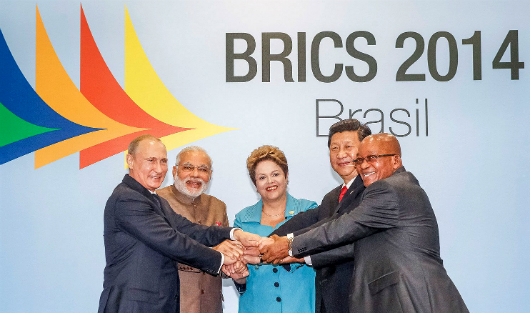
After three years of negotiations, officials from the world’s five major emerging national economies, Brazil, Russia, India, China and South Africa (BRICS), have officially unveiled their new collective multilateral development bank.
Considered a potential rival to the global influence of U.S.-led institutions like the World Bank and International Monetary Fund (IMF), the Shanghai-based New Development Bank (NDB) is the second multilateral bank poised to begin operations in the near future, along with the Asian Infrastructure Investment Bank (AIIB), which announced its launch earlier this year. Both banks will aim to provide increased funding for large-scale infrastructure development projects in poor and developing regions.
The leadership of the $100 billion NDB will come in the form of a rotating five-year presidency, with the inaugural term going to K.V. Kamath, an Indian banker who had previously worked at multilateral development institutions like the Asian Development Bank.
Experts anticipate that the emergence of the NDB and AIIB will mark a new era of development that will greatly complement Western-led development efforts. An increase in the level and diversity of multilateral investment will help to combat extreme poverty in more effective and creative ways.
“I’m optimistic that we are going to get a very different era when it comes to development cooperation. We’re at the beginning of the end of aid-led, Western-funded, post-colonial development,” said Civicus secretary-general Dhananjayan Sriskandarajah in an interview with Devex. “It’s not just about the rich giving charity to the poor through aid. It is about new forms of cooperation.”
In an open statement to the NDB, 44 civil society groups and social movements declared their hopes that the bank will deliver inclusive and participative development, prioritize poverty-focused goals and emphasize human rights and the environment. The signees claimed that these aims are critical if multilateral development institutions are to realize effective results in the coming years.
“Investment cannot bring development if it does not meet people’s needs. The NDB should support inclusive, accessible, participative development that is driven by communities, addresses poverty and inequality, removes barriers to access and opportunity, and respects human rights,” reads the statement. “If the BRICS can help create an institution that lives up to the above principles, they will have done the cause of international cooperation a great service, true to the name ‘New Development Bank’.”
Development experts note that many of the anti-poverty policies currently touted by leading institutions – austerity, privatization and liberalization, to name a few – have not yielded the results that poor and developing countries have hoped for. The emergence of alternative development institutions like the NDB and AIIB could challenge those long-prescribed economic policies.
According to the chief executive of ActionAid International Adriano Campolina, increased competition among multilateral development institutions will only increase the scale and effectiveness of anti-poverty projects in the regions that desperately need them. However, he noted that these institutions must strive to make poverty-reduction policies a focus on infrastructure development.
“Both industrialized and developing economies have been seeing a rapid increase in inequality,” he wrote in an article for Devex. “Development must also, therefore, prioritize policies like fair and equitable land tenure, creation of decent jobs, strong social protection and free access to quality education that have been proven to reduce inequality.”
Campolina and other experts note that in order for the New Development Bank to successfully differentiate itself from existing institutions, it must prioritize the aims of people in poor and developing countries, not those of itself and of its own donors. If it succeeds, it may well contribute to the absolute elimination of extreme poverty and help to develop the infrastructure required for poor countries hoping to make substantial steps in economic development.
– Zach VeShancey
Sources: Devex 1, All Africa, Devex 2
Photo: Merco Press

How to Improve Pakistan’s Agricultural Sector
Amidst recent reports of a shrinking agricultural sector, Pakistani officials have initiated meetings with the United Nations Food and Agriculture Organization (FAO) in an attempt to create a long-term sustainable agricultural program. Over the past few years, the Pakistani landscape has been ravaged by a range of destructive climate forces varying from desertification to over-flooding. As a direct result of these factors, Pakistan’s overall economy has suffered, and it will continue to do so unless the U.N.’s FAO can help develop a new approach.
Agriculture is critical to the well-being of Pakistanis, as well as for Pakistan’s relevance on an international stage. The industry alone accounts for 40 percent of all Pakistani jobs, with agriculture comprising 25 percent of the nation’s GDP. With such a large contribution to the success of Pakistan, it would be expected that a large agricultural infrastructure would exist to satisfy the need for a quality agriculture division.
Pakistan has the fortune of being in an advantageous position to the Indus River, a powerful tool for thriving agriculture in that region, yet it fails to capitalize on this geographic asset. An excerpt from the Pakistan Times reads: “There are few regions in the world that have rivers like mighty Indus, but one could still find a vast desert and arid areas here. This has happened just due to the negligence of policymakers to modernize irrigation and agriculture.” Pakistan’s woes stem from an inability to adapt to new and future agricultural practices.
The partnership with the United Nations gives Pakistan an opportunity to learn and eventually cultivate proven agricultural techniques. The FAO’s representative for Pakistan, Patrick Evans, said this about assisting Pakistan: “We would like to bring in proven experiences of improved agriculture and irrigation practices and introduce climate-resilient crop varieties, which can sustain heat waves, floods, salinity and drought conditions, which are becoming frequent in Pakistan.” The issue in Pakistan lies with a refusal to move past ancient agricultural practices. For this country to succeed, it must accept outside assistance and focus on maximizing agricultural yield.
– Diego Catala
Sources: Pakistan Today, Samaa
Photo: Flickr
“Internet Hospital” in China Helps Patients Access Care
The Internet has proven a great advancement in many fields of work with recent trends of globalization. We are more connected than ever, and access to the Internet is not dependent on economic status. For example, people living in developing countries can access the Internet through inexpensive mobile phones.
What if patients could receive healthcare services via the Internet?
This concept has been actualized in the Guangdong province of China with the innovation of an “Internet Hospital.”
This “hospital” provides outpatient service delivery. Patients only need to travel short distances from their homes to local medical consultation facilities. At the facility, the patient is able to meet with a doctor from a high-level hospital that is more central to the city. The consultation occurs with a webcam and instant messaging.
The doctors ask questions of the patient, who can also send or show images of medical checks. While this takes place, the patient’s body temperature, blood pressure and other medical information are collected. It is then sent to the doctor, who can use the data in combination with the webcam interaction to diagnose the patient and write a prescription immediately.
This type of healthcare service is ideal in China because high-level hospitals are often overcrowded expensive. Patients are less likely to visit local health clinics because they are perceived to provide low-quality care. To some extent, skilled doctors also choose not to work in small communities with fewer opportunities for career growth and increased salaries.
The advantages of the Internet hospital include high-quality and personalized health care accessed from more convenient locations. In high-level hospitals, doctors are likely to spend only a couple of minutes which each patient; however, the Internet hospital allows these same doctors to spend more than 10 minutes with each patient. Furthermore, the average cost of drugs from local clinics is only a quarter of that of drugs purchased at top-level hospitals. While the same skilled doctor writes the prescription, the medicine is purchased from the local clinic versus the large hospital.
Implementation of the Internet hospital has proven successful. More than 500 patients are seen every day and there are now over 1,000 sites for the medical consulting facilities. These facilities have high satisfaction scores.
While health insurance, quality control and the cases of diagnoses that cannot be made via the Internet all pose potential challenges for the Internet hospital, it has helped many people and continues to make healthcare more affordable and accessible.
– Iliana Lang
Sources: The Lancet Global Health, The Journal of Health Economics
Photo: Global Times
Always Campaign Looks to Boost Confidence
During adolescence, a girl’s confidence drops dramatically. She has grown up with the stigma and stereotype that to do something “like a girl” is an insult and something that makes her weaker than the boys. But that just isn’t so. Always is looking to boost confidence among girls with the #LIKEAGIRL campaign, both for girls in the United States as well as those who are in poorer countries abroad.
Always says that 72 percent of girls feel that society limits what they are able to do. This limitation, especially during puberty, distorts a girl’s perception of herself and creates barriers to what she wants to achieve. The campaign wants girls to know that “girls everywhere can be unstoppable #LIKEAGIRL when they smash limitations.”
This campaign is another extension of the work Always has done for the last 30 years with their puberty education. In Ethiopia, Nepal and other developing countries, Always has provided classes that educate girls about what they are going through during puberty. Many girls miss school during their periods because of false information, shame and/or lack of resources. Confidence for these girls drop, but with Always’s puberty education, absenteeism due to periods is being reduced.
Always started telling people that to do things #LIKEAGIRL is amazing with their 2015 Super Bowl ad. Since then, they have created another ad showing girls and young women physically breaking down societal barriers in the form of boxes, such as the notion that “Girls are weak,” to represent that doing things #LIKEAGIRL is actually a show of strength. The girls that see these ads at home are given a confidence boost and the men that are presented with this idea are shown how they might be limiting the women in their lives.
This message is so important for every girl regardless of socioeconomic status, but it can have a powerful psychological message for those girls in poverty who have restricted education, financial freedom, job choice and even choice of a spouse because of cultural gender expectations that they face.
Studies have shown that expanding women’s education is one factor in reducing poverty. UNICEF says, “When all children have access to a quality education rooted in human rights and gender equality, it creates a ripple effect of opportunity that will influence generations to come.”
Always has already partnered with UNESCO in order to help women become literate. Their work directly supports literacy development in Africa; they cite that over 60,000 girls in Nigeria and Senegal have received benefits from the programs there. Literacy education is another way in which girls are given the confidence to be their “amazing, unstoppable selves.”
#LIKEAGIRL has already created a volume of commentary in the United States and has positively impacted girls that have previously suffered from lack of confidence. #LIKEAGIRL will be shown in action on their website coming soon.
Boosting a community out of poverty means boosting girls’ confidence and education. Showing girls that it takes strength to do things #LIKEAGIRL is a positive message that will bring great results.
– Megan Ivy
Sources: Always, UNICEF
Photo: Always, Chymfm
Twin Pregnancy in Developing Countries
Multiple births, two or more babies born at the same time, are a relatively small percentage of all the births worldwide. Twins represent only 3.3 percent of births in the United States (CDC) and, depending on the global region looked at, the rate is even lower in the developing world.
But even with such small numbers, twin births can present a large health concern for both mother and unborn children alike. The risks are even more pronounced in the developing world.
Twins have a much higher chance of being born prematurely, and they can be underweight, which often leads to more time in the NICU. Also, twin-twin transfusion, “when identical twins share a placenta and one baby gets too much blood flow, while the other baby doesn’t get enough,” is a possibility. The most startling statistic is that in the developing world, “among stillbirths, the proportion of twins is probably somewhat higher than among live births, as fetal (and neonatal) mortality is higher among twins.”
Complications arise when mothers do not receive adequate prenatal care. Women in the developing world often do not receive enough care when they are pregnant with a single child, let alone the need for additional monitoring and ultrasounds when having a multiple birth.
A study conducted in urban Guinea-Bissau found that “sixty-five percent (245/375) of the mothers who delivered at the hospital were unaware of their twin pregnancy.” Sometimes a mother will not measure larger than average to indicate a twin pregnancy, a second heartbeat is not always discernable, and/or bloodwork is not drawn to measure hCG (pregnancy hormone). Even if any of those previous criteria were met, only an ultrasound can confirm a multiple birth.
The unborn children are not the only ones at risk; mothers also face pregnancy complications at a higher rate when carrying multiple children, like pre-term labor, anemia, gestational diabetes, preeclampsia, hyperemesis gravidarum (severe morning sickness), polyhydramnios (too much amniotic fluid), miscarriage/stillbirth, postpartum depression and postpartum hemorrhage.
While these issues have the possibility to affect all mothers experiencing a multiple birth, the complications can be exacerbated when they live in poverty. Access to a hospital for an emergency may not be possible, especially in regions that are remote. Finances to afford a hospital stay can also be an issue, especially since many multiple births are delivered through c-section.
A 2008 study done in a rural mission tertiary hospital in Nigeria found that of the twin deliveries that happened there, 60 percent of the twins were delivered c-section, 36.4 percent were vaginal deliveries and the remaining 4 percent had vacuum deliveries. C-sections are often performed due to emergencies, premature delivery and fetal malpresentation.
Even though it seems like twin pregnancy is bleak, the opposite can be true. The UN’s fifth Millennium Development Goal is to improve maternal health. While multiple births are not specifically addressed, the positive improvements to help mothers and their unborn babies will also help those pregnant with twins. Multiple births must be monitored as a high-risk pregnancy but not all (or any) complications may occur. But with improved medical care, when those complications do arise they can be addressed and the rate of stillborn twins can decline even further.
– Megan Ivy
Sources: NIH 1, CDC, March of Dimes, UN, NIH 2, NIH 3
Photo: Babies Magz
Hershey Brings Goodness to Help End World Hunger
The Hershey Company does more than produce delicious sweets. The company shares goodness with malnourished people all around the world in order to help end world hunger. To do this, their mission consists of a balance between having good business, fostering a better life for others and creating a bright future for those in need.
The company is dedicated to its mission. In the last three years, they increased cocoa farm yields around the world by 45 percent and improved cocoa farming knowledge in Ghana. In addition, Hershey has started Project Peanut Butter, which helps save the lives of starving children in Ghana. The company has also raised over 4 million dollars for Children’s Miracle Network, which helps treat sick and injured children.
The candy company constantly continues to touch the lives of others.
On July 16, 2015, Hershey partnered with Stop Hunger Now for their fourth event geared towards ending world hunger.
Stop Hunger Now is an organization that aids people who face starvation and disaster.
Todd Camp, director of Hershey’s Corporate Social Responsibility and Community Relations said, “We are excited to partner with Stop Hunger Now and have such an impact on the hungry around the world.”
More than 700 Hershey employees gathered and packaged 255,744 meals put together by Stop Hunger Now. The packaged meals contain rice, soy, vegetables and 23 essential minerals and vitamins. They will be sent to Stop Hunger Now partner organizations in Haiti, El Salvador, Liberia and Burundi.
“It’s not just about that we make candy, it’s not about the stockholders, it’s that we’re helping children every solitary day. To know we get to keep giving back… it’s a great feeling,” said Hershey volunteer, Denise Price.
Another Hershey volunteer, Scott Rownd said, “We just sat here for two hours and packed 2,000 meals to make a difference in maybe 10,000 people’s lives. It’s an amazing feeling.”
Hershey packaged 15,000 more meals this summer than last summer. With the commitment shown by the Hershey volunteers, next summer’s event is sure to be promising. Like many others, The Hershey Company hopes to contribute to the end of world hunger.
-Kelsey Parrotte
Sources: Stop Hunger Now, The Hershey Company, Virtual Strategy Magazine
Photo: Business Wire
Fair Trade Football Production in Pakistan
Scottish co-operative Bala Sport, an organization dedicated to improving the lives of Pakistani factory workers, has launched a crowdfunding campaign aimed at importing thousands of fair trade footballs from the Pakistani city of Sialkot.
The campaign has raised over $120,000 from donors, who in turn earn membership to Bala Sport and stakes in the organization’s future. The organization works primarily with manufacturers in Sialkot, which accounts for 70 percent of the world’s hand-stitched football production. The ball-making industry’s 40,000 laborers produce tens of millions of footballs every year for corporations like Adidas, which provides the official balls of the quadrennial FIFA World Cup.
For those working in Sialkot’s ball-making industry, labor has historically been characterized by low pay (workers earn an average annual wage of $1,100) and subpar working conditions. In 2006, Nike terminated a deal with local ball manufacturer Saga Sports over concerns of “significant labour compliance violations,” which included the alleged utilization of child labor and which were often found in cases where manufacturers had outsourced jobs to Pakistani households.
According to Bala Sport co-founder Angus Coull, the difference between fair trade-certified and traditional Sialkot factories is stark.
“We visited four factories producing balls under fair trade agreements. You could see that they had fire escapes, fire extinguishers, health and safety notices, proper ventilation and everything you’d expect to find in a U.K. factory. The workers had face masks and eye protection,” Coull said of his visit to Sialkot in 2014. “But when we went to another factory there was nothing like that. It was underground in the basement of a building, and the only ventilation was from holes in the ceiling.”
While current investors include schools in the Scottish cities of Paisley, Renfewshire and Irvine, the lack of a major retail distribution deal has been a setback for the organization’s distribution goals. Though certain fair trade products like sugar, coffee and tea have become popular among Western consumers, fair trade footballs have yet to gain similar traction.
“The biggest problem we’ve had has been price. If you have a big chain selling two balls for [$10.91], we’re not going to try to compete with that, because the people who suffer are the men and women who make the balls,” Coull added. “They’re after a Nike or a Mitre ball, and the shop staff doesn’t have the time to explain to them what a fair trade ball is all about.”
Suppliers of fair trade-certified footballs sold in the U.K. guarantee that laborers are paid a fair wage and experience fair working conditions. Bala Sport also pays a 10 percent premium on manufacturing costs, which goes to community development projects, healthcare and educational training for workers and their families.
According to Coull, however, the crowdfunding campaign (being hosted on crowdfunder.co.uk) is giving the organization hope for growth without resorting to large-scale private investors.
“We don’t want to have a handful of fat cats who get to control the shots,” he said.
If fair trade campaigns like that of Bala Sport realize financial success, organizations will continue to be able to improve working conditions in poor and developing regions. As working conditions in these areas become safer and stronger for laborers, the economic argument for companies outsourcing American jobs will be weakened, thus benefitting American workers and the American economy as a whole.
– Zach VeShancey
Sources: The Guardian 1, The Guardian 2, Bala Fairtrade Sports Balls
Photo: The News
New Development Bank Unveiled
After three years of negotiations, officials from the world’s five major emerging national economies, Brazil, Russia, India, China and South Africa (BRICS), have officially unveiled their new collective multilateral development bank.
Considered a potential rival to the global influence of U.S.-led institutions like the World Bank and International Monetary Fund (IMF), the Shanghai-based New Development Bank (NDB) is the second multilateral bank poised to begin operations in the near future, along with the Asian Infrastructure Investment Bank (AIIB), which announced its launch earlier this year. Both banks will aim to provide increased funding for large-scale infrastructure development projects in poor and developing regions.
The leadership of the $100 billion NDB will come in the form of a rotating five-year presidency, with the inaugural term going to K.V. Kamath, an Indian banker who had previously worked at multilateral development institutions like the Asian Development Bank.
Experts anticipate that the emergence of the NDB and AIIB will mark a new era of development that will greatly complement Western-led development efforts. An increase in the level and diversity of multilateral investment will help to combat extreme poverty in more effective and creative ways.
“I’m optimistic that we are going to get a very different era when it comes to development cooperation. We’re at the beginning of the end of aid-led, Western-funded, post-colonial development,” said Civicus secretary-general Dhananjayan Sriskandarajah in an interview with Devex. “It’s not just about the rich giving charity to the poor through aid. It is about new forms of cooperation.”
In an open statement to the NDB, 44 civil society groups and social movements declared their hopes that the bank will deliver inclusive and participative development, prioritize poverty-focused goals and emphasize human rights and the environment. The signees claimed that these aims are critical if multilateral development institutions are to realize effective results in the coming years.
“Investment cannot bring development if it does not meet people’s needs. The NDB should support inclusive, accessible, participative development that is driven by communities, addresses poverty and inequality, removes barriers to access and opportunity, and respects human rights,” reads the statement. “If the BRICS can help create an institution that lives up to the above principles, they will have done the cause of international cooperation a great service, true to the name ‘New Development Bank’.”
Development experts note that many of the anti-poverty policies currently touted by leading institutions – austerity, privatization and liberalization, to name a few – have not yielded the results that poor and developing countries have hoped for. The emergence of alternative development institutions like the NDB and AIIB could challenge those long-prescribed economic policies.
According to the chief executive of ActionAid International Adriano Campolina, increased competition among multilateral development institutions will only increase the scale and effectiveness of anti-poverty projects in the regions that desperately need them. However, he noted that these institutions must strive to make poverty-reduction policies a focus on infrastructure development.
“Both industrialized and developing economies have been seeing a rapid increase in inequality,” he wrote in an article for Devex. “Development must also, therefore, prioritize policies like fair and equitable land tenure, creation of decent jobs, strong social protection and free access to quality education that have been proven to reduce inequality.”
Campolina and other experts note that in order for the New Development Bank to successfully differentiate itself from existing institutions, it must prioritize the aims of people in poor and developing countries, not those of itself and of its own donors. If it succeeds, it may well contribute to the absolute elimination of extreme poverty and help to develop the infrastructure required for poor countries hoping to make substantial steps in economic development.
– Zach VeShancey
Sources: Devex 1, All Africa, Devex 2
Photo: Merco Press
The/Nudge Foundation and Job Training in India
Atul Satija, formerly an executive at Google and mobile advertising firm InMobi, recently left his lucrative corporate position to start a nonprofit organization called The/Nudge Foundation out of his native Bangalore. The goal of The/Nudge Foundation is to alleviate poverty by offering job training in India targeted at the economically disadvantaged.
The/Nudge Foundation announced on July 27, has already attracted a diverse group of notable supporters, including Naveen Tewari, Founder and CEO of InMobi, and Hugo Barra, Vice President of Chinese tech giant Xiaomi. The/Nudge Foundation will operate local training facilities called Gurukuls, aimed at people living below the poverty line. These schools will teach so-called “grey-collar” job skills like housekeeping and delivery skills as well as life skills such as financial management and literacy.
Satija, still fresh out of a corporate environment, seems to be utilizing some business tactics with his foundation, perhaps explaining his ability to draw support from powerful corporate executives in such a short amount of time. “It is about building the same level of impatience, goal setting that you have in the corporate sector. If you don’t carry that pressure in a nonprofit, you will never get to your goals,” he said.
The first Gurukul is scheduled to open on November 1, 2015, and will be exclusively targeting women. To ensure sufficient enrollment and motivation, The/Nudge Foundation will be issuing nominal loans to students who will presumably pay them back shortly after graduating from the schools and getting a job.
While Satija’s The/Nudge Foundation is a welcome addition to poverty reduction measures, it is not unique. The Indian government, NGOs, economists and development experts have long known that India suffers from a skills gap. Of the 400 million people living in poverty in India, many are young people seeking jobs who lack access to technical training.
That’s why in 2009, Indian Finance Minister Pranab Mukherjee established the National Skill Development Corporation (NSDC), a public entity that connects the private sector, job training facilities and people looking for work. The government ambitiously hopes to provide training to millions of people by 2022, with the overall goal of creating many industrial jobs to accelerate the Indian economy, whose growth has been more sluggish than expected.
However, the NSDC faces a daunting task. A report by the Federation of Indian Chambers of Commerce and Industry and consulting firm Ernst and Young revealed that India’s vocational training institutes only have the capacity to reach about 1.3 million people. Thus, India’s ability to provide vocational training to the hundreds of millions that need it is a formidable challenge.
That’s where organizations like The/Nudge Foundation come in. By focusing on the poorest demographic, they can help bridge the gap between available job training services and hard-to-reach portions of the population. When so many people are in need of technical training and life skills, every available measure is needed.
– Derek Marion
Sources: BBC, Economic Times 1, Economic Times 2, The Guardian
Photo: Cloud Front
What Bernie Sanders Could Mean For Global Poverty
Bernie Sanders has been dubbed the “underdog Democrat” in this presidential election. As a committed ally to labor unions and the middle class, Sanders is determined to run a campaign financially unaffiliated with American billionaires.
When he announced his bid for the U.S. presidency, many doubted that he could gain enough momentum to really compete with Democrat likely, Hillary Clinton. However, after raising $15 million in 2 months and pulling 10,000 people into a campaign rally, many are seeing him as a potential threat to Clinton.
For his entire career, Sanders has dedicated himself to being the voice of the average person. He speaks for those who are not often heard due to their lack of capital. Often being described as a socialist, Sanders’ economic policy reflects his constituents’ desires, creating a world that truly gives everyone the chance to be a part of the “American Dream” regardless of race, gender, class or religious affiliation.
Because Sanders’ potential presence in the Oval Office is positive for the U.S. working class and those subject to abject poverty in America, it would also be great for global poverty abroad.
Sanders has, for a long time, rejected poverty, seeing it as something that could be eliminated by congressional help. Sanders is likely to translate his stance on American poverty to global poverty, then, under his administration, global poverty could forever change.
The Sanders administration is likely to expand its foreign aid budget, positively impacting global health and introducing proper legislation to eradicating global poverty.
To a farmer in Kenya, this could mean the ability to make a sufficient living. To women in the Philippines, this could mean greater access to family planning resources.
Bernie Sanders’ presence in the White House could not only greatly impact those living in the United States, but also those abroad. His aggressive approach to eradicating poverty would be a great asset to those subject to absolute poverty in developing countries.
– Erin Logan
Sources: Bernie Sanders, Forbes, Huffington Post 1, Huffington Post 2
Photo: Breitbart
Global Education Fund: Success in Kenya
The quality of education and learning in Kenya is below that of what it should be, despite increases in student enrollment. Enrollment does not ensure attendance, and often times resources are not available to students to help them learn at the rate and level necessary.
The good news is that the Global Education Fund has implemented a program to address the quality of educational success in Kenya. With only 19% of sixth-grade students reading at the appropriate level, this program is much needed.
The program provides leadership training and scholarships for students living in Nairobi. A mentoring initiative for these students, the Young Leaders Program, was also developed from this project.
Global Education Fund scholars have achieved significant achievements: 100% of these students have completed secondary school, 86% have passed the national exam (compared to the average pass rate of 29%) and 55% have qualified for university courses.
The Young Leaders Program is unique because it combines the following components:
The Global Education Fund has worked with 140 high school students. Student progress is tracked and evaluated so that these students can have continued support throughout their development. This project is one example of many initiatives that can help break the cycle of poverty by securing quality education for young children.
– Iliana Lang
Sources: Global Education Fund 1, Global Education Fund 2
Photo: Extraordinary Journeys Africa