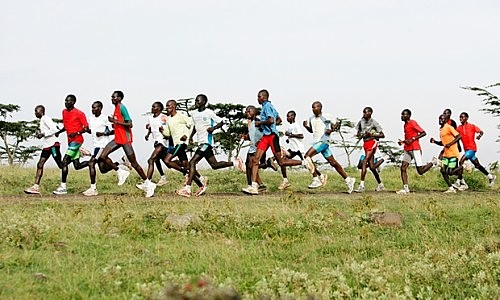
Aegis Trust hopes to unite the youth of Kenya and to inspire those of Africa to end the violence that is dividing countries. In the last two years, 72 of every 1,000 people in Kenya’s population of 45 million had a mobile device. Also, 39 out of every 1,000 had Internet access. In a country connecting with the world like never before, popular icons are joining a movement and encouraging others to follow in a peace-building opportunity.
The 522-mile Kenya peace march is scheduled to last 22 days as it takes world-famous athletes, their fans and many others through Turkana, West Pokot, Trans-Nzoia, Uasin Gishu, Elgeyo Marakwet, Baringo and Samburu. The Walk for Peace began July 15, 2015 and will end on August 6, 2015. Big-name contributors include John Kelai, Wilson Kipsang, Tegla Loroupe, Paul Tergat, Ezekiel Kemboi, Irine Jerotich, Andrew Lesuuda, Alex Kipchirchir, Stephen Kiprotich and Douglas Wakiihuri.
A torch lit to signify peace and humanity is to be handed from walker to walker across 25 miles daily. Halie Gebreselassie, who beat the 5,000-meter world record in 1995 by 11 seconds, is a star from Ethiopia who will join the race on its last day in August. In the meantime, others will be leading the peace march.
Commonwealth Marathon champion John Kelai organized the march. He did so in memory of his three uncles, who were murdered in cattle raids. Armed violence, including theft and cattle rustling, has been dividing ethnic groups in the North Rift Valley of Kenya.
Cattle raids have left hundreds dead and have caused 220,000 people to flee their homes. This growing offense is recruiting the country’s youth. Boys as young as eight are involved in theft, cattle rustling and other conflicts.
About 37,000 school children have seen violence; statistics were provided by the Kenyan National Union of Teachers. Commissioner Peter Okwanyo of Baringo County has recorded that some children between the ages of 12 and 17 possess illegal weaponry and are participating in violence.
This activity is made possible as boys drop out of school and need to make an income. When opportunities are not available, one way to make money is to raid cattle. When cattle die due to lack of sustenance and extensive drought periods, raids replace the loss.
Since northern Kenya lacks a strong police force, residents are armed to reinforce security. Trading weaponry is made possible thanks to Kenya’s neighbors in Somalia and other militants linked to al-Qaeda. The worst attack on police in Kenya’s history took place in 2012, when 32 officers were killed in an ambush.
Aegis Trust helped to organize the march for peace. The charity hopes to raise $250,000 to fund the reconstruction of communities affected by violence. Its hope is to recruit 10,000 youth members who are at risk and to protect the North Rift Valley from further damage.
Aegis Trust unites youth and those with conflicting interests in schools and communities by detailing the consequences of violence. The charity built a mobile exhibition that educates young people about the genocide that took place in Rwanda in 1994. The foundation is committed to preventing genocide by investing in rural communities.
Providing a platform for donations and contributions, Indiegogo.com is the place to learn how to participate, donate and fundraise for the cause. It hopes to extend the message enforced by Aegis Trust and the history of Rwanda. Exchanges between Kenyan and Rwandan youth are taking place.
Peace ambassadors, local workshops and community events are conversing about peace-building and communicating the message to others. Professor Lokapel Elim, the chairman of the Steering Committee and principal of Mount Kenya University, describes the march as a means to “experience forgiveness … The experience of speaking out against hatred, the impact that Aegis has, actually will change the thinking of our people.”
Athletes are also walking for women’s contributions to society and peace advocacy efforts. They hope to attract and hold the attention of religious activists who have the capability to influence peace in their communities. The most important target is the youth of the nation and their capability to sustain peace.
– Katie Groe
Sources: The Guardian, Aegist Trust, Walk For Peace, World Bank, Indiegogo, Reuters, Daily Nation, The Guardian
Photo: The Guardian

Working Australian Actors Still Live in Poverty
While many consider actors to make a decent amount of money, that couldn’t be farther from the truth for many actors working in Australia.
According to a recent University of Sydney study, 56 percent of actors in Australia earn less than $20,000 a year from their profession. An additional 36 percent earn less than $10,000 annually. One in four actors in the country are currently living below the poverty line.
“Actors as a group are extremely low paid,” Zoe Angus, director of the entertainment industry union Actors Equity told Perth Now. “Most have to earn supplementary income from other sources, but even then, one quarter still live below the poverty line.”
In Australia, the set union pay rate for an “established, experienced performer” on a television show is roughly $600 a day. While this may seem like a highly substantial paycheck, most television actors who aren’t very high-profile are only working around one or two days a month.
What Australian actors are experiencing represents the current plight of actors on a global scale. According to Equity, an acting union based out of the U.K., 56 percent of its members earned less than £10,000 between November 2012 and 2013.
“The industry is driven by dreams,” Macquarie University economics lecturer Dr. Jordi McKenzie told the Courier Mail. “People see actors like Liam Hemsworth, who’ve come through the local industry and go on to become some of Hollywood’s biggest names. Of course, those are the exceptions and not the rule. For every actor who makes it, there are probably 1,000 who don’t.”
– Alexander Khalid
Sources: The Sunday Times, The Courier Mail, The Telegraph
Photo: The Telegraph
What the Pope’s Encyclical Means for the World’s Poor
In June, Pope Francis aligned himself with mainstream science by accepting the truth of climate change. With the release of his 184 page encyclical that calls for immediate action on climate change, Francis has added a moral scope to the biggest problem that humanity has ever encountered.
In it, Francis cites the mindless drive toward monetary gain and economical shortsightedness as the main reasons humanity is this situation today.
While environmentalists around the world applaud the encyclical as a much needed call to action by country and individual alike, the encyclical also revealed who would be impacted the most by climate change: the poor.
Francis says the poorest have been left in the wake of consumerist ambitions of the richest nations. They are being displaced and disregarded.
He also implores that the countries mainly responsible for the climate crisis have an obligation to help the poorest countries.
Numerous studies back the words of Francis’s encyclical. In 2014, the U.N. Climate Panel released a report that found that global climate change, while affecting everyone, would affect poorer countries more and threaten human security.
The report notes the risk climate change presents to agriculture. As some regions become dryer and hotter, food yields will suffer. In an interview with The Guardian in 2014, Princeton Professor Michael Oppenheimer said that even now, the poorest countries are already struggling to adapt their agriculture methods. If climate change is left unchecked, the lack of food will result in higher prices and competition, thus causing violence and the destabilization of poor regions.
Impoverished countries also face heightened potential for natural disasters. Natural disasters are indeed, natural, and every country is at risk for them. However, the wealth of a country plays a pivotal role in how they are responded to.
When a natural disaster goes through an impoverished region, aid response is significantly slower. More people will end up dying from malnutrition and dehydration than from the actual disaster.
Maarten van Aalst, who directs the Red Cross Climate Center and co-authored the report, said that from 2000 to 2009, the number of natural disasters tripled compared to the same period in the 1980s.
This rise is attributed to climate change.
The poorest countries were already at a disadvantage. With climate change, those same countries may have a harder time climbing out of poverty.
Professors Francis Moore and Delavane Diaz out of Stanford published a study earlier this year noting the relationship between poverty and heat.
Impoverished countries, on average, are located in significantly hotter regions than non-impoverished countries. As mentioned by the U.N. report, agriculture in these countries are already struggling with adapting to the changing climate.
Moore and Diaz note that climate change will lower per-capita GDP in poor regions from 3.2 to 2.6%, making it harder to grow economically. This directly supports the findings in the U.N. report.
Wealthy countries are expected to continue economical growth.
With his encyclical, Pope Francis has not so subtly nudged the developed world to action on the environmental crisis. In doing so, extreme poverty may also be confronted as well.
– Kevin Meyers
Sources: The Guardian 1, The Guardian 2, New York Times
Photo: Grist
USAID’s Camp Hope Provides Relief in Nepal
Camp Hope is giving survivors of the Nepal earthquake a beacon of light and symbol of recovery. A single square kilometer compound in Jorpati, Kathmandu, Camp Hope is composed of innumerable tents that house 330 families who once lived in five villages north of Kathmandu. Eighty-eight percent of these families had no houses to return to after the earthquake—they were utterly destroyed. This tight community is representative of the broader 500,000 Nepalese who were displaced after the earthquake last April, which shook hilly terrain that once served as housing foundations into rubble.
However, Camp Hope is permeated with a sense of, well, hope. Children laugh in the open spaces between their temporary houses, people relax in the line for the water pump, the elderly bask in the sun amid clucking chickens. Set up by the owner of the boutique hotel chain, Dwarika, the camp is full of people of all ages strengthening a community that will one day serve as a launchpad for rebuilding and recovery. Sangeeta Shrestha, founder of the camp, describes how she came to acquire the land for the camp when a local youth club donated their soccer field.
“I am lucky to have my hotel team of engineers and technicians whom I could call on to help set up the camp,” she said. The resources offered by the hotel have certainly come a long way in making the camp what it is. A kitchen tent run by the Dwarika offers residents three meals a day that often include chicken and eggs. Beyond basic medical services, housing and meals, the camp also offers its residents emotional solace. There are prayer tents, job training facilities and field trips for the 83 children enrolled in the local school.
Beyond being an awe-inspiring emblem of growth after disaster, Camp Hope also serves as a prime example of the benefits that come when public and private partnerships cooperate to further a cause. USAID stepped in to provide heavy plastic shelters that would sustain heavy rains during monsoon season. Additionally, the organization provided shelter to 310,000 families across affected regions.
There’s clearly more to be done, both within Camp Hope and beyond its walls. At the recent International Conference on Nepal’s Reconstruction, USAID pledged emergency relief and early recovery assistance totaling $130 million, with promises of more funding in the coming years. The U.S. government has also committed to helping rebuild Nepal through a number of programs, including:
Despite the immense amount of work that lies ahead, the work of USAID in partnership with local groups such as Dwarika demonstrate how shared work between the private and public sectors can bring international resources to help build sustainable growth in at-risk communities. These efforts, like Camp Hope, are a source of inspiration for all.
– Jenny Wheeler
Sources: USAID, Dwarikas
Photo: Flickr
Flooding in Pakistan Highlights Need for Stronger Relief
Flooding in Pakistan for the fourth consecutive year has put the spotlight on fledgling programs meant to improve infrastructure and humanitarian aid policies. A combination of monsoon rains and melted glacier water convened, causing rivers to overflow into towns, bringing massive destruction in Punjab, Sindh, Khyber Pakhtunkhwa provinces as well as Baluchistan and Giljit Baltistan. In the Chitral district, water washed away more than 28 villages, leaving the area completely inaccessible by car and depleted of food, drinking water and communication technology.
More than 500,000 people have been affected and experts report the accelerated spread of disease in affected areas. This is the fourth consecutive year that the country has seen such conditions; in 2010, 20% of the country was underwater and 20 million people were displaced. Though this year’s floodwaters do not pose such grave dangers, Pakistani activists and politicians have been calling for political reform and funding to help lessen the impact of seemingly inevitable annual flooding.
In 2013, the Pakistani government adapted the National Disaster Risk Reduction (DRR) policy, which increased funding for disaster management to $1.6 million. The DRR policy plans to strengthen institutions that will work solely to tackle challenges posed by natural disasters and better prepare the country for such occurrences. The policy plans on passing new laws, including those related to fire safety, industrial hazards, construction, land use and building codes. It plans on expanding its Emergency Rescue Service, reviving civilian humanitarian organizations, and partnering with NGOs and local organizations to support disaster-prone areas of the country. The policy will also help pass on information to communities on more resilient innovations in home construction techniques, water and sanitation systems and alternative sources of electricity.
However, critics say the government isn’t working fast enough. The country’s water management system, for example, will continue to be overwhelmed by extreme amounts of water until the system is completely overhauled. A more proactive stance, critics say, that prevents the effects of flooding before they occur, is crucial. Rolling out programs such as the National Disaster Risk Reduction policy will help build stronger, better-informed communities that will cooperate with local organizations to improve technology and design. Doing so will create more sustainable regions that can both use their resources more efficiently and withstand the threat of natural disasters, a seemingly inevitable fact of life these days.
– Jenna Wheeler
Sources: Irin News, Prevention Web
Photo: Flickr
Congressional Thoughts on the Middle East and North Africa
On July 22, the Subcommittee on the Middle East & North Africa (MENA) met for a hearing on promoting U.S. commerce in the region. Congressional members of the subcommittee called upon two witnesses from the State Department, Mr. Scott Nathan, special representative for Commercial & Business Affairs, and Ms. Elizabeth Richard, deputy assistant secretary for the Bureau of Near East Affairs, to give testimony and answer questions.
The hearing largely consisted of a few Congress members inquiring about the state of the MENA economies and the State Department officials responding in optimistic anecdotes. Interestingly, throughout the hearing, certain assertions were made and accepted without dispute.
First, the economic state of affairs in the MENA region is far from ideal. As Congresswoman Ros-Lehtinen observed, the MENA region accounts for 5.5% of the world’s total population, yet economic output falls short of expectations, just contributing 4% of the world’s GDP.
Second, poverty facilitates the fostering of terrorism. This assertion was repeated by all Congress members who gave initial statements. For example, Congressman Darrell Issa said “Everyday ISIS is in the frontlines of discussion. When in fact, the areas that have fomented so much opportunity for extremism does not get looked at properly.” He followed up by listing one of the areas that does not get looked at properly as “the opportunity in an entrepreneurial, economic way to go from a lack of prosperity to prosperity.”
Third, U.S. businesses have a role to play in strengthening the economies of these countries. Congresswoman Ros-Lehtinen went as far as to say, “Increasing trade with the region will strengthen business, the missing piece of the Arab Spring in the region.”
In all, the Congress members argued that the poor state of the economies of the MENA region allowed terrorism to grow and that a crucial part of the U.S. strategy for thwarting terrorism should be to encourage U.S. business investment in the region.
Analysis of global poverty reveals the Middle East and North Africa, home to roughly 350 million people, are not in a particularly dire economic situation relative to other regions. Of the 350 million, only around 2% live in extreme poverty, on less than $1.25 a day, according to the World Bank in 2010. In contrast, in China that figure is 12%, in India, 33%, and in Sub-Saharan Africa, 48%.
Granted, since the Arab Spring in 2011, holistic data on the economies in the region have been hard to attain. Congressman Gerry Connolly’s line of questioning touched upon that reality and the State Department acknowledged it.
Nevertheless, certain realities are known for certain. Poverty has increased since the Arab Spring in certain parts of the region, notably Syria and Iraq. Since 2011, 4 million Syrians have fled Syria as the civil war rages, of which 2.3 million went to MENA countries. Where there is conflict and turmoil, inevitably the straining of resources and poverty follows.
But even with the worsening of the economic situation in certain areas of the MENA region, areas such as China, India and Sub-Saharan Africa still struggle with much greater extreme poverty.
Yet these regions do not face the specter of terrorism like the MENA region does. Leading to the obvious conclusion, terrorism is a multi-causal phenomenon that cannot be simply attributed to a lack of economic opportunity. But as the Congress members asserted, lack of economic opportunity intuitively does allow for terrorism’s growth as people in poverty have little to lose and less to hope for.
And although reducing poverty in the region will be far from a magic bullet against terrorism, it should not only be pursued for normative reasons but for geopolitical considerations as well.
Maybe the Congress members are right in the importance they place on the role of U.S commerce in the region in hampering terrorism. There is only one way to know, and millions to be helped out of extreme poverty.
– Connor Bohannan
Sources: Congressional Research Service, House of Committee Foreign Affairs, World Bank 1, World Bank 2, UN Refugee Agency
Photo: Flickr
Police Corruption and Preparing for a World Stage in Brazil
Although the country is preparing to host one of the largest athletic and globally recognized events in the world, attention in Brazil has not been as focused on the upcoming 2016 Olympics as one might think. Between police corruption and brutality, protests and utter violence plaguing the country, it is no wonder that the world is holding its breath to see how the country manages to resolve its issues before the rest of the world gathers there in just a year.
Due to large numbers of cases involving police brutality, protest involving the overthrow of the president and change in the overall political system, the entire country is in an uproar. The number of instances of police violence and even cases of homicide at the hands of police officers in the country have been incredibly high. That being said, many of these cases do not receive the type of attention that such instances would in, say the United States, and many officers go unpunished and victims’ families are left without retribution.
That being said, the most recent concern in Brazil is not focused on police corruption, but much higher up in the political sphere. Recent peaceful protests have people gathering in the major city of Sao Paulo calling for a change in the government, starting with the removal of the current president.
These protests and such controversy mean a few things for the country, at least over the next year. The country and the government have to respond to the people somehow, whether they satisfy any or part of their requests or not. Furthermore, the state is feeling the pressure with the Olympics happening in just about a year, meaning there needs to be an answer to the upheaval in time to create stability for the global stage. Over the next few weeks, and even months, it will be interesting to see how the state responds to the protests and what changes the public will push for leading up to the grand event next summer.
– Alexandrea Jacinto
Sources: CNN, New York Times
Photo: Storify
Indian Water Mafia: A Necessity’s Black Market
In the Indian capital, around 20% of a population of nearly 10 million have no access to safe, drinkable water—a resource that is supposed to be freely provided by the Indian authorities.
According to the BBC, there is a dangerous gap between supply and demand which has resulted in the official water supply falling short of Delhi’s water needs by 207 million gallons each day, helping to turn drinking water into a pseudo liquid gold. This is due to the fact that around 60% of water intended for Delhi residents is lost as a result of spillage, theft and failure to collect revenue. Official government-sponsored water tanks are also notorious for arriving erratically (at best) in Delhi’s poorest neighborhoods, such as in Sangam Vihar, where they show up “only… once every 10 days or so,” according to Rupa Jha, a local resident.
In response to the gap between water supply and demand, Delhi’s poorest residents have begun to turn to the Indian “Water Mafia,” an informal network of locals who steal water, and then sell it for a profit.
The Water Mafia business follows a model of simple economics. An association of truck drivers, as well as other mostly ordinary Delhi citizens, source water from illicit boreholes found below the earth’s surface, as well as by siphoning water from the city’s pipe network. Tanker bosses then buy water from the men who steal it, who then go on to sell the water directly to locals for a higher price than the $0 it “officially” costs (in Sangam Vihar, for instance, a gallon costs about one cent.) Employees, assuming they sell around a full tank (or 8,400 gallons), are then looking at a profit of $90 per day, or $2700 a month—a much higher wage than the $185 a worker earns in Delhi a month in minimum wage.
While the Water Mafia business is entirely illegal—sourced with water from illegal sources and sold without testing or treatment—it has nevertheless turned into a burgeoning trade that has come to fill in the gap for thousands of poor Delhi citizens who lack access to safe water. Many of Delhi’s poorest residents, in turn, have found that if they want water, they have no choice but to buy into the Water Mafia trade.
The business of stealing and selling water within Indian cities such as Delhi has enormously negative consequences for India’s future, according to authorities and experts who see the human and environmental toll that the practice is taking on the country. The Water Mafia business, for instance, exploits what are already the poorest citizens in a developing country by forcing them to scramble for funds to pay for a resource that is legally required to be free. The practice of extracting liquid for the ground also has negative environmental consequences for the country, especially as it depletes a scarce resource that has already been over-depleted in recent years as a result of India’s population boom. In 2014, for instance, a government report found that three-fourths of Delhi’s underground aquifers were being depleted, forcing boreholes to dig even deeper beneath the surface where water is more likely to be contaminated.
In order to crack down on the growing Water Mafia trade, authorities in recent years have offered a few solutions. In 2013, for instance, the Aam Aadmi Party (AAP) won local municipal elections on a platform of protecting the average person’s interests, as well as their desire to dismantle the Water Mafia business. However, these efforts have been largely ineffective.
According to Rajendra Singh, a conservationist and a winner of this year’s Stockholm Water Prize, however, greater political will and effort could help the country resolve its water issues. Singh, who helped build rainwater-harvesting structures in the arid northern state of Rajasthan, has claimed that major Indian cities have failed to try anything similar. Adopting similar tactics in Delhi—by purifying local rainwater rather than stealing from and depleting water from the city’s boreholes—is one alternative that could potentially help the city solve its water crisis, according to Shah.
In order to protect India’s most at-risk citizens and the country’s long-term interests, it is imperative that an alternative solution—in terms of strengthening the country’s infrastructure and cracking down on members of this illegal water network—need to be adopted. Otherwise, India’s poorest citizens, and those who are most in need of safe drinking water, will continue to have their livelihoods and access to one of humanity’s most basic rights—safe water—be at the mercy of the seemingly unstoppable Water Mafia.
– Ana Powell
Sources: BBC, Foreign Policy
Photo: BBC
U.S.-Cuba Relations: A New Future for Cuba
After 54 years of severed diplomatic ties, the United States and Cuba, once bitter Cold War enemies, demonstrated their newfound diplomacy by reopening each other’s embassies this past Monday.
It is the most concrete example of the diplomatic thaw since President Obama and Cuban President Raul Castro announced last December that U.S.-Cuba relations would be restored.
In an interview with MSNBC, President Obama said he believed that Proclamation 3447, the embargo signed by President Kennedy in 1962, has served neither people well and that it was time to go in a new direction.
Although Congress has to pass legislation to formally end the embargo — something that will be very challenging to do — Obama is using his executive power to ease travel and trade restrictions.
For the first time in half a century, the United States is able to transparently see the type of living conditions Cubans have been in for the past 50 years.
There is poverty in Cuba, but it’s not traditional poverty. When Fidel Castro came to power in 1959, the government became Socialist and then reformed to become the Communist Party of Cuba. During this time, all aspects of Cuban society became nationalized. For the past 50 years, Cubans have enjoyed access to a free healthcare system that has produced a very healthy populace.
Today, Cuba ranks 61st in the world for life expectancy. Its citizens live roughly to the same age as their American counterparts. This statistic is even more surprising considering that per capita GDP is almost ten times higher in the United States than in Cuba.
Economists have coined this phenomenon the ‘Cuban Health Paradox.’ Normally, countries with low per capita GDPs also have low life expectancies.
Cubans also have access to free education and the government has tried to make housing and nutrition a priority for its citizens.
Based on government numbers, Cuba ranks 48th in the world for poverty. The island nation is one of the least impoverished countries in the developing world
Although 15 percent of the population still lives in extreme poverty, most of the country is poor. Reports of living conditions are less than ideal. The Cuban peso, which hasn’t been convertible since the revolution, has suffered from inflation. In U.S. dollars, the average Cuban worker earns $17 to $30 a month.
Cuba also scores at the bottom of Freedom House’s annual report on civil and political freedoms. Freedom House describes Cuba as ‘not free.’
Since the Castro family has been in power, Cuba has been relatively isolated. This has led to the country’s lack of overall wealth. The fall of the Soviet Union worsened matters as the country lost the financial support it used to have from Moscow.
The country has persisted; however, this has usually caused Cuba to become more self-reliant, therefore poorer.
Recently, Cuba has tried to reform its economic system to open up investment to other governments and private companies to accelerate development.
The United States re-establishing diplomatic relations with Cuba presents a great opportunity for this to happen. The United States can expand trade markets to one of its closest neighbors, while the influx of capital will raise living standards in Cuba.
– Kevin Meyers
Sources: Procon, Geoba, MSNBC, New York Times, Poverties, Reuters, Rural Poverty Portal
Photo: USA Today
Marathon Stars to Join Kenya Peace March
Aegis Trust hopes to unite the youth of Kenya and to inspire those of Africa to end the violence that is dividing countries. In the last two years, 72 of every 1,000 people in Kenya’s population of 45 million had a mobile device. Also, 39 out of every 1,000 had Internet access. In a country connecting with the world like never before, popular icons are joining a movement and encouraging others to follow in a peace-building opportunity.
The 522-mile Kenya peace march is scheduled to last 22 days as it takes world-famous athletes, their fans and many others through Turkana, West Pokot, Trans-Nzoia, Uasin Gishu, Elgeyo Marakwet, Baringo and Samburu. The Walk for Peace began July 15, 2015 and will end on August 6, 2015. Big-name contributors include John Kelai, Wilson Kipsang, Tegla Loroupe, Paul Tergat, Ezekiel Kemboi, Irine Jerotich, Andrew Lesuuda, Alex Kipchirchir, Stephen Kiprotich and Douglas Wakiihuri.
A torch lit to signify peace and humanity is to be handed from walker to walker across 25 miles daily. Halie Gebreselassie, who beat the 5,000-meter world record in 1995 by 11 seconds, is a star from Ethiopia who will join the race on its last day in August. In the meantime, others will be leading the peace march.
Commonwealth Marathon champion John Kelai organized the march. He did so in memory of his three uncles, who were murdered in cattle raids. Armed violence, including theft and cattle rustling, has been dividing ethnic groups in the North Rift Valley of Kenya.
Cattle raids have left hundreds dead and have caused 220,000 people to flee their homes. This growing offense is recruiting the country’s youth. Boys as young as eight are involved in theft, cattle rustling and other conflicts.
About 37,000 school children have seen violence; statistics were provided by the Kenyan National Union of Teachers. Commissioner Peter Okwanyo of Baringo County has recorded that some children between the ages of 12 and 17 possess illegal weaponry and are participating in violence.
This activity is made possible as boys drop out of school and need to make an income. When opportunities are not available, one way to make money is to raid cattle. When cattle die due to lack of sustenance and extensive drought periods, raids replace the loss.
Since northern Kenya lacks a strong police force, residents are armed to reinforce security. Trading weaponry is made possible thanks to Kenya’s neighbors in Somalia and other militants linked to al-Qaeda. The worst attack on police in Kenya’s history took place in 2012, when 32 officers were killed in an ambush.
Aegis Trust helped to organize the march for peace. The charity hopes to raise $250,000 to fund the reconstruction of communities affected by violence. Its hope is to recruit 10,000 youth members who are at risk and to protect the North Rift Valley from further damage.
Aegis Trust unites youth and those with conflicting interests in schools and communities by detailing the consequences of violence. The charity built a mobile exhibition that educates young people about the genocide that took place in Rwanda in 1994. The foundation is committed to preventing genocide by investing in rural communities.
Providing a platform for donations and contributions, Indiegogo.com is the place to learn how to participate, donate and fundraise for the cause. It hopes to extend the message enforced by Aegis Trust and the history of Rwanda. Exchanges between Kenyan and Rwandan youth are taking place.
Peace ambassadors, local workshops and community events are conversing about peace-building and communicating the message to others. Professor Lokapel Elim, the chairman of the Steering Committee and principal of Mount Kenya University, describes the march as a means to “experience forgiveness … The experience of speaking out against hatred, the impact that Aegis has, actually will change the thinking of our people.”
Athletes are also walking for women’s contributions to society and peace advocacy efforts. They hope to attract and hold the attention of religious activists who have the capability to influence peace in their communities. The most important target is the youth of the nation and their capability to sustain peace.
– Katie Groe
Sources: The Guardian, Aegist Trust, Walk For Peace, World Bank, Indiegogo, Reuters, Daily Nation, The Guardian
Photo: The Guardian
Virtual Libraries to Boost Education
Approximately 4.4 billion people in the world do not have access to Internet and most of them are young. Internet access allows children, especially students, to easily find information and contributes greatly to their education.
In order to help the many students without broad access to information, a company called Outernet is going to build virtual libraries through data that is beamed from satellites. Outernet created a device, the Lighthouse, that plugs into a satellite dish, which allows the user to download information that is available to the Internet for free.
Outernet started the project by launching a Crowdfunding campaign to raise $200,000. After five days, their campaign had raised $215,000.
The Lighthouse has solar panels to recharge the battery, which has a 12-hour life for receiving data and a 4-hour life when the Wi-Fi is activated. It is about the size of a flashlight, sturdy, lightweight and is able to access webpages, ebooks, music and videos.
All of the information is accessed through a mobile phone and the device costs $99. For those who want to save more money, Outernet sells the individual parts so that the consumer can make it themselves and the assemblage is simple.
“Imagine what our world and global economy can accomplish when education is truly universal,” said Outernet CEO Sayed Karim. “If we can provide a Library of Congress in every village in the world, why should we not?”
The World Bank has commissioned Outernet to install the Lighthouse hardware in South Sudan and will sponsor the content being delivered by Outernet. Their company has recently joined Facebook’s Internet.org initiative, OneWeb, O3b and Project Loon from Google.
UNICEF is working with Outernet to have UNICEF’s Twitter feed available through their Lighthouse services.
One downside for the user of Outernet’s satellite service is that it works only one way. The user can download information, but they will not be able to upload any information or pictures. However, this allows Outernet to save money and makes it easier for the company to meet immediate needs in developing countries for more access to information.
In order to provide local information for citizens, Outernet will work with regional radio stations and newspapers to provide news and crop prices in different languages.
Until Internet access is expanded to rural villages and schools, Outernet provides a virtual library to expand the amount of information millions of people can access. It can provide the first look into what a true global network of information will look like and show the demand for Internet access in developing countries.
– Donald Gering
Sources: Crowdfund Insider, Good News Network, Washington Post, Wired
Photo: Flickr