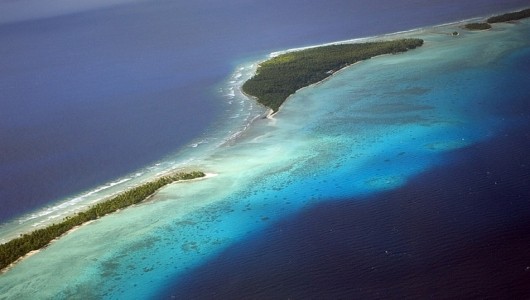
As climate change is debated hotly by the biggest carbon emitters of the world, temperatures increase and ocean levels rise, dramatically impacting the innocent. Although almost unnoticeable on the west coast of the U.S. or the harbors of Shanghai, the very same sea could soon be swallowing acres of farmland on tiny islands across the South Pacific, thus bringing the argument of climate change and food security to the forefront.
The Marshall Islands, a large grouping of 29 atolls located in the South Pacific Ocean, lies about halfway between Hawaii and Australia. Many of the islands only rise above the sea about two meters and are increasingly vulnerable to climate change.
According to The Japan Times, president of the Marshall Islands Christopher Loeak said the Pacific is fighting for its survival and climate change has already arrived.
Recently, the president declared a state of emergency for the Marshall Islands following some of the worst flooding ever experienced in conjunction with a severe drought. A freak tide nearly destroyed Majuro, a large coral atoll of 64 islands, breaching the sea wall and flooding the airport runway. A drought left 6,000 people surviving on less than one liter of water a day.
Many other South Pacific islands are experiencing the same problems. “Microstates,” as they’re called, including the Solomon’s, Tuvalu and the Carteret Islands are experiencing rapid erosion, higher tides, storm surges and inundation of wells with seawater. Kiribati, an island nation in the central Pacific Ocean comprised of 33 atolls and reef islands, is estimated by its president, Anote Tong, to be uninhabitable within the next 30 to 60 years. Its inhabitants from smaller surrounding islands are escaping the invading seawater and migrating to the capital south of Tarawa. The state is even planning the purchase of 2000 hectares in Fiji for farming and a possible place to live.
Although climate change might not be felt yet in some places of the world and those who profit from it work so tirelessly to bury the evidence, the effects are already changing in the islands of the South Pacific, a region of the world emitting only 0.1 percent of the planet’s carbon. The islander’s way of life is being jeopardized, threatening food security and stripping away their basic needs for survival.
In a 2007 report by the Intergovernmental Panel on Climate Change, observations were discussed on temperature rises in the South Pacific. In fact, compared to earlier historical records in the twentieth century, by 2003, it had become 15 percent drier and 0.8 degrees warmer. The ocean surface had risen about 0.4 degrees, altogether contributing to increased El Niño effects and cyclone frequency and intensity.
In the Pacific, about 70 percent of the main agriculture is geographically located to take advantage of the summer rainy season. Agriculture is therefore heavily dependent on seasonal rainfall for production, but rising temperatures and recurrent droughts are wreaking havoc on food supply and costing, on some occasions, more than island countries’ gross domestic products.
Many urban populations in the Pacific are now very much dependent on cheap foreign imports for their daily sustenance. However, according to a study by the University of Copenhagen in 2007, in the Solomon Islands, the majority of rural people still live and depend on subsistence food production and fisheries. A multitude of cultivated plants such as yams, taro sweet potatoes and other crops such as bananas and watermelon are still part of daily life.
In the recent past, El Niño events have devastated the sugarcane industry and killed off livestock totaling millions of dollars. Flooding and strong winds caused by tropical storms have, in the past, affected farming, but in the years to come it’s projected to only get worse. Precipitation variations are possible up to 14 percent on both sides of normal rainfall by the end of the century, according to the IPCC
Climate associated disasters such as tropical cyclones, flash floods and droughts impose serious constraints on development in the islands, so much so that some Pacific island nations seem to be in a constant mode of recovery. Food availability and people’s accessibility to food are among the first to be affected following such disasters.
The islands in the South Pacific are now leading the world by example, pursuing renewable energy for their power needs. They are beginning to substitute costly import-dependent diesel for homegrown coconut biofuel power and outer island communities are being converted to solar power. Tokelau, a territory of New Zealand, has become the first territory to become 100 percent solar-powered. The Cook Islands and Tuvalu are aiming to be all solar powered by 2020.
Someday, possibly in the not so distant future, the world may lose its jewel of the Pacific. The white sandy beaches and the sapphire seas will disappear for good, consumed by rising ocean waters.
– Jason Zimmerman
Sources: FAO, Japan Times
Photo: Flickr

Point Source Power Turns Fire Energy Into Electricity
Worldwide, nearly 1.3 billion people live without electricity. That’s about 18 percent of the global population, 97 percent of which live in sub-Saharan Africa and developing Asia.
Craig Jacobson, co-founder and CEO of Point Source Power, had a solution to this problem in the palm of his hand. Point Source Power created a device to harness thermal heat from cooking stoves and convert the energy into electricity. This invention was originally created for adventurers on camping trips so that they could charge their cell phones while on vacation.
However, he saw a much greater demand for the invention in developing countries, so Point Source Power produced the VOTO: a low-cost fuel cell that operates at cook-stove temperatures and converts biomass directly into electricity. This device includes a charger for cell phones and batteries, as well as an LED light.
In an interview, Jacobson said, “People view fuel cells as an advanced technology that only wealthy countries can afford. We see things differently. We’ve created a technology that uses inexpensive materials found in homes throughout developing regions of the world – biomass and cook stoves.” In addition, the VOTO fuel cells are very tolerant of contaminants such as carbon and sulfur, which would likely ruin other fuel cells.
The VOTO is easily integrated into the daily routine of the average person. Accessing electricity does not involve an extra step in their day; instead, it is a part of their time spent cooking. Jacobson added, “Cooking is something that has to be done every day. We have taken cutting-edge technology and matched it to this daily ritual.”
As of now, VOTO products are only available in Kenya. The goal is to have these fuel cells available in homes all across developing regions, increasing people’s overall access to electricity.
– Hannah Resnick
Sources: Berkeley Lab, International Energy Agency, Launch, Point Source Power, Smithsonian
Photo: PointSourcePower
Environmental Education as an Agent of Change in the Developing World
It is no secret that Earth is facing a massive environmental crisis. Changes to the environment have resulted in climate change that has affected weather across the world. Pollution sickens children and creates thick layers of smog that envelop entire cities.
Climate change hits hardest in the developing world, where it kills 8.4 million people a year, which is more than HIV/AIDs and malaria kill. Many in developing countries still use more traditional fuel sources like wood and coal instead of cleaner energy. The issue has dropped off the agenda of the Sustainable Development Goals, the successors of the Millennium Development Goals that expire this year.
What is the answer to all this doom and gloom? While there might not be a one-off solution to climate change, education on the issues facing the planet is certainly a big step in the right direction. Sadly, a recent study found that 40 percent of adults on earth are not aware of the idea of climate change. Lack of education also hits home in Africa and Asia, where people “are more likely to consider global warming a personal threat if they notice changes in the local temperature.”
It is often only by sensing a change in temperature that people deem climate change a threat. In Malawi, the local language does not have a word for the phenomenon. One way to combat climate change through education might be to explain the forces moving behind the slight temperature changes that people sense in order to make them understand the issue on a bigger, global scale. Knowledge on the subject can have an impact on a range of decisions that individuals might make – which crops to plant or where to place a new port, for example.
Environmental education can provide people with the necessary knowledge, behavior changes and skills that are needed in order to successfully carry out climate change mitigation and adaptation: it “can enable individuals and communities to make informed decisions and take action for climate-resilient sustainable development.”
The education of women and girls about the issues related to climate change is important. Recent studies have shown that when this happens, communities “are better able to adapt and thus be less vulnerable to extreme weather events and climate change.” When women are educated, they and their families are less likely to be vulnerable to death or injury during natural disasters.
More education on the specifics and intricacies of how natural environments function and change is needed in the developing world. Along with this, more knowledge must be spread on how individuals have an impact on their climate and the environment around them. With more of this in curriculae around the world, the effects of climate change might lessen.
Environmental education is an untapped resource when it comes to combating climate change. Those behind creating policy have not yet really utilized education as a sector that can fight climate change. Over the course of time, education has been used as a tool for social change. Today is no different – the planet needs a change in ideas and attitudes, and education is a way by which these changes can begin to sprout.
– Greg Baker
Sources: Washington Post, Brookings, AllAfrica, IPS News
Photo: UC San Diego News Center
Climate Change and Food Security in the South Pacific
As climate change is debated hotly by the biggest carbon emitters of the world, temperatures increase and ocean levels rise, dramatically impacting the innocent. Although almost unnoticeable on the west coast of the U.S. or the harbors of Shanghai, the very same sea could soon be swallowing acres of farmland on tiny islands across the South Pacific, thus bringing the argument of climate change and food security to the forefront.
The Marshall Islands, a large grouping of 29 atolls located in the South Pacific Ocean, lies about halfway between Hawaii and Australia. Many of the islands only rise above the sea about two meters and are increasingly vulnerable to climate change.
According to The Japan Times, president of the Marshall Islands Christopher Loeak said the Pacific is fighting for its survival and climate change has already arrived.
Recently, the president declared a state of emergency for the Marshall Islands following some of the worst flooding ever experienced in conjunction with a severe drought. A freak tide nearly destroyed Majuro, a large coral atoll of 64 islands, breaching the sea wall and flooding the airport runway. A drought left 6,000 people surviving on less than one liter of water a day.
Many other South Pacific islands are experiencing the same problems. “Microstates,” as they’re called, including the Solomon’s, Tuvalu and the Carteret Islands are experiencing rapid erosion, higher tides, storm surges and inundation of wells with seawater. Kiribati, an island nation in the central Pacific Ocean comprised of 33 atolls and reef islands, is estimated by its president, Anote Tong, to be uninhabitable within the next 30 to 60 years. Its inhabitants from smaller surrounding islands are escaping the invading seawater and migrating to the capital south of Tarawa. The state is even planning the purchase of 2000 hectares in Fiji for farming and a possible place to live.
Although climate change might not be felt yet in some places of the world and those who profit from it work so tirelessly to bury the evidence, the effects are already changing in the islands of the South Pacific, a region of the world emitting only 0.1 percent of the planet’s carbon. The islander’s way of life is being jeopardized, threatening food security and stripping away their basic needs for survival.
In a 2007 report by the Intergovernmental Panel on Climate Change, observations were discussed on temperature rises in the South Pacific. In fact, compared to earlier historical records in the twentieth century, by 2003, it had become 15 percent drier and 0.8 degrees warmer. The ocean surface had risen about 0.4 degrees, altogether contributing to increased El Niño effects and cyclone frequency and intensity.
In the Pacific, about 70 percent of the main agriculture is geographically located to take advantage of the summer rainy season. Agriculture is therefore heavily dependent on seasonal rainfall for production, but rising temperatures and recurrent droughts are wreaking havoc on food supply and costing, on some occasions, more than island countries’ gross domestic products.
Many urban populations in the Pacific are now very much dependent on cheap foreign imports for their daily sustenance. However, according to a study by the University of Copenhagen in 2007, in the Solomon Islands, the majority of rural people still live and depend on subsistence food production and fisheries. A multitude of cultivated plants such as yams, taro sweet potatoes and other crops such as bananas and watermelon are still part of daily life.
In the recent past, El Niño events have devastated the sugarcane industry and killed off livestock totaling millions of dollars. Flooding and strong winds caused by tropical storms have, in the past, affected farming, but in the years to come it’s projected to only get worse. Precipitation variations are possible up to 14 percent on both sides of normal rainfall by the end of the century, according to the IPCC
Climate associated disasters such as tropical cyclones, flash floods and droughts impose serious constraints on development in the islands, so much so that some Pacific island nations seem to be in a constant mode of recovery. Food availability and people’s accessibility to food are among the first to be affected following such disasters.
The islands in the South Pacific are now leading the world by example, pursuing renewable energy for their power needs. They are beginning to substitute costly import-dependent diesel for homegrown coconut biofuel power and outer island communities are being converted to solar power. Tokelau, a territory of New Zealand, has become the first territory to become 100 percent solar-powered. The Cook Islands and Tuvalu are aiming to be all solar powered by 2020.
Someday, possibly in the not so distant future, the world may lose its jewel of the Pacific. The white sandy beaches and the sapphire seas will disappear for good, consumed by rising ocean waters.
– Jason Zimmerman
Sources: FAO, Japan Times
Photo: Flickr
“Plant Doctors” Focus on Food Security
When called upon to picture an agricultural hotbed, one hardly thinks of Afghanistan. However, according to USAID, 60 percent of Afghanistan’s population relies on agriculture for their livelihoods and sustenance needs.
Unfortunately, in the wake of decades-long conflict and neglect, damaged farmland and infrastructure prohibit the flourishing food trade that once characterized Afghanistan as a high-quality producer.
Agriculture accounts for 40 percent of Afghanistan’s gross domestic product; when plants die the whole nation suffers. Afghanistan is just one of many countries where farming challenges have a great deal of influence. Food insecurity is a massive global problem. Nearly 795 million people across the world are undernourished.
Low-income farmers in such countries as Kenya, Bolivia and Bangladesh make up an important part of their nations’ economies. When these farmers inevitably lose crops to disease and pests their livelihoods are jeopardized and starvation becomes a prevalent issue.
Plantwise, a program supported by international nonprofit CABI, has answered this challenge. Endeavoring to “increase food security and improve rural livelihoods by reducing crop losses,” Plantwise has made 10,000 plant health resources accessible to people in 33 countries across the developing world through their online knowledge bank and free Android app.
One of the program’s key efforts is the construction of clinics where farmers can come for diagnoses and answers to their questions on an individual basis.
Plantwise also works to build integrated plant health systems that connect the various people, suppliers and organizations involved in the agriculture process, as well as operating on national levels to help foster sustainable agricultural policies.
Another innovative aspect of the Plantwise program revolves around plant health. With some small farmers losing as much as 80 percent of their crops to disease and pest problems, the ability to heal sick plants is invaluable.
https://www.youtube.com/watch?v=Xv5hidzZe6k
By training more than 2,000 “plant doctors” capable of diagnosing and treating agricultural issues, Plantwise has fostered a growing network of sustainable plant care.
The quickly growing initiative has positively impacted 600,000 farmers with their efforts thus far. As of 2013, Plantwise has established 720 plant clinics, nearly twice the amount that existed the previous year.
The program hopes to reach millions by 2020, continuing to train plant doctors, build on its network of 168 partner organizations and working to nurture farming-friendly policies in developing nations.
Plantwise describes their vision as one of sustainability, hoping “to improve food security and rural livelihoods around the world, achieving maximum long-term benefits for the countries in which we’re present.” The initiative focuses on building from within, emphasizing partnerships with local people, organizations and governments.
Although food insecurity remains an issue, the instance of undernourishment has declined by 167 million over the past decade. The work of many such organizations and initiatives like Plantwise plays a vital role in the fight to eradicate hunger through sustainable, economically sound methods.
“I’m passionate about training the next generation of plant doctors,” stated Miriam Otipa, a native of rural Kenya and one of Plantwise’s experts. “I am doing my bit to help feed my village and my nation.”
– Emma-Claire LaSaine
Sources: Plantwise, USAID, Zambia Daily Mail, USAID, FAO
Photo: Gaurdian
UNITAID: An Innovative Poverty Reduction Strategy
UNITAID is an organization that was originally conceived by French President Jacque Chirac and Brazilian President Lula. It is a World Health Organization global health initiative. Less than a decade ago, an airline levy was implemented through UNITAID, which adds between one and four euro to the cost of plane tickets.
Along with France, eleven other countries have adopted the new practice. In the short amount of time that the surcharge has been enacted, the levy has raised more than $2 billion. Over the course of only eight years, $2.5 billion has been raised, which is being used to improve international development in low-income countries.
More specifically, the money raised has improved access to treatments and diagnostics for HIV/AIDS, malaria and tuberculosis in less developed countries. For travelers, the small added cost is painless and relatively unnoticeable. The chairman of UNITAID, however, stresses the levy’s importance in the grand scheme of things.
Phillipe Douste-Blazy, the undersecretary-general of the United Nations, chairman of UNITAID, and mastermind behind the ticket surcharge program has stated, “With one euro, you can save children from malaria.” By breaking down the program’s significance into layman’s terms like this, he has painted the bigger picture for us.
The program’s ability to raise such a significant amount of funding in so little time has inspired Douste-Blazy to envision more potential fundraising solutions for other global crises. Namely, the funds could potentially be used to tackle the current migration crisis.
Douste-Blazy knows that disease and lack of health care options are two major factors that force migrants to seek refuge across international borders. An expansion of the current levy could bring dramatic improvements in the standards of living in migrants’ home countries.
A report released recently by the U.N.’s refugee agency revealed that most people fleeing to Europe by sea are attempting to escape conditions like war, persecution and other dangerous conflicts. Europe’s current response to deploying police and soldiers to intercept the migrants isn’t sustainable or cost-effective.
The biggest challenge of international development and poverty reduction strategies is funding. With countries facing significant debt and Greece – the number one recipient of overseas refugees – facing bankruptcy, money can no longer be appropriately allocated in traditional ways.
Douste-Blazy calls his proposed solution “painless solidarity contribution.” The process of taking small additional amounts of money out of existing financial transactions could bring money to the developing world that will not be missed anywhere else.
For the post-2015 agenda, UNITAID’s program offers an important lesson. Douste-Blazy explains, “As the needs are increasing, the money is decreasing, so we need to do something innovative.” Public engagement around the issue of poverty and international development is absolutely essential and can bring unprecedented results.
– Sarah Bernard
Sources: Huffington Post, Foreign Policy
Photo: Wikipedia
Australia’s Anti-Poverty Week 2015
Australia is preparing for Anti-Poverty Week, an annual event that raises awareness about poverty in Australia and around the world. During the week, people are encouraged to participate in activities and events that highlight issues of poverty.
This year, Anti-Poverty Week will take place from October 11-17. The event was originally established as an addition to the United Nation’s International Anti-Poverty Day, which is October 17.
Organizations, businesses and individuals are encouraged to fully participate in the events. Various activities will be held all over Australia to engage and educate others. Some of these events include providing food for those in need, educating children on what it means to be hungry and courses on how to save and donate finances.
In addition to attending events, people have the opportunity to organize an event of their own. Some of these events could include holding conferences, writing letters to newspapers or setting up fundraisers and exhibitions. Leaders of Anti-Poverty Week encourage participants to be creative and have published activity ideas.
An important aspect of Anti-Poverty Week includes involving and educating children about poverty. Schools can become involved in three ways: by organizing an event, by teaching students about the causes and consequences of poverty and/or by launching programs that help students assist others who face poverty.
Anti-Poverty Week also strives to connect with local government and communities. In the past, the event has created posters that are given to councils that are willing to participate with Anti-Poverty Week. However small the chance, Anti-Poverty Week leaders hope that local councils will embrace the opportunity to educate and assist those in need.
During Anti-Poverty Week 2014, 400 activities occurred. Six hundred organizations, including welfare agencies, overseas organizations, religious groups, businesses and schools, participated and sponsored events. The activities consisted of a wide range, from speeches to film nights to clothing drives. More than 150 articles were written about the event and more than 1,300 people followed Anti-Poverty Week on Twitter.
Every year for the last five years, the number of organized events has exceeded 400. Leaders hope that 2015 will be just as, if not more, successful as previous years.
So what does Australia’s annual event teach Americans? Their Anti-Poverty Week has succeeded in educating others and raising awareness about poverty. With a group of dedicated people, the event has changed lives. This event proves that in only seven days, people can change the face of poverty.
To find out more, visit Anti-Poverty’s website.
– Kelsey Parrotte
Sources: Salvation Army, Australian Government, Anti-Poverty Week
Photo: Arab Council
Wonder Women Initiative Takes Off in Indonesia
For decades, the iconic comic book superheroine Wonder Woman has been a representation of justice, strength and all that is right in the universe. Today, the spirit of Wonder Woman is as present as it has ever been, but it has been breathed into the organization titled, appropriately, Wonder Women. In 2015, it is this plural variation of the legendary superhero’s name that resonates the most with global change.
The Wonder Women Initiative is a movement to revitalize poverty-stricken areas by teaching the women of these communities to sell new pieces of technology and equipment to their neighbors and members of their towns or villages. The effort has been especially successful in Indonesia over the last few years. Some of the items sold include solar lanterns, clean cookstoves and water filters.
An article by CNBC detailing the Wonder Women program recently said, “Since the program started in 2011, more than 300 women have become ‘micro-social-entrepreneurs,’ selling around 10,000 clean technology products to their communities.” The Wonder Women initiative has been extremely successful because of its grassroots approach to eradicating poverty. This project operates under the umbrella of the large non-government organization Kopernik.
Kopernik was founded on the belief that only a simple piece of technology can drastically turn around poverty situations all over the world. The NGO’s website provides certain statistics such as “780 million people live with dirty water, when a simple filter can provide safe, clean, convenient drinking water” and “1.3 billion people rely on dim, dirty, dangerous kerosene for lighting, when simple solar lanterns can provide clean, bright light at night.” Kopernik receives money directly from donors all over the world and in turn, uses these funds to produce cost-effective technology products that can be sent to third world countries and commercialized by an initiative like Wonder Women.
Wonder Women is impacting thousands of lives every year and revitalizing the way nonprofits work. By teaching women how to sell technology at cost-effective prices within their communities, Wonder Women is positively affecting the global economy. Kopernik has a quote on its site that reads, “Our namesake, Nicolaus Copernicus, changed the way people see the world. Like Copernicus, we want Kopernik to be a catalyst for change.” Much like its namesake, Wonder Women is promoting justice and all that is right with the world.
– Diego Catala
Sources: CNBC, Kopernik
Photo: Dorkly
Online CBT for Low-Income Patients
The World Health Organization has stated that the world is facing a human rights emergency in mental health. In many developing countries, mental health concerns are left untreated and undiagnosed.
Many studies in the past have shown a correlation between poverty and depression, among other mental health issues (such as social anxiety and low self-esteem). Poor socio-economic status is also a significant risk factor for children to develop psychological disorders.
However, the sad truth is many of the poorer populations across the globe do not have adequate means of access to mental health professionals, if any access at all. Many patients are left undiagnosed due to both a lack of resources as well as the associated stigma of psychological issues.
Psychological health is undeniably vital to the functioning of a productive human being and, consequentially, a productive society. Unfortunately, treatments for mental health are usually expensive and lengthy, and diagnosis is more elusive than with any physical maladies. Even in developed countries like the United States, psychological disorders far outrun the span of available treatments.
One of the most popular treatments is cognitive-behavioral therapy, or CBT. It is used to address a multitude of behavioral and psychological complaints, including depression and anxiety. The therapy is different from usual psychotherapy in the sense that the patient does not talk about anything whatsoever. Instead, the therapist and the patient set up a tangible goal. They then work through the patient’s cognitive process to achieve said goal, as well as address the negativities that were keeping him from it. The process of cognition — everything the patient is thinking — is then used to change the behavioral outcome.
The results of this therapy have shown great success. It is advantageous not only in its effectiveness but also in its structure: by working through the patient’s psychological issues in a more cohesive manner, the technique can be time-effective as well. Despite its success, the fact remains that it is still quite inaccessible to many low-income patients in need of psychotherapy.
In an answer to this dilemma, psychotherapy has paired up with the marvel of our age: the Internet. Many providers now offer online psychotherapy, either for free or for a fraction of the cost of face-to-face interactions with a therapist. The increasing pervasiveness of the Internet, even in the remotest regions, coupled with the low cost means that online therapy makes a therapist accessible to score more people.
The added benefit of the online version of a therapist is that it removes social pressure. A patient in need can interact with a therapist and use self-help sections of the web through the anonymity of a computer screen. The structured and evidence-based nature of the therapy, as opposed to traditional methods, makes it ideal for self-help and interactive online methods in the absence of a real therapist. An online therapist or counselor can also guide patients through any difficulties.
Many studies that have been done in the recent past strongly indicate the potential for online CBT to help low-income patients. However, the issues associated with the methodology remain, particularly that of self-diagnosis. There are also concerns that the therapy being physically removed from a person may cause a higher risk of dropout in patients, especially those with chronic depression. If these logistical issues are ironed out, there is no doubt that online CBT will be the undisputed answer to the psychological concerns of low-income patients.
– Atifah Safi
Sources: WHO, Science Direct, Journals of The Royal College of Psychiatrists, Psych Central
Photo: Buzzfeed
Individualistic Culture and Its Opinions on Poverty
Societies and cultures often vary in regions of the world based on differing value systems that affect their social norms and behaviors. One attribute of society that is often influential is the point on the spectrum of individuality or collectivism on which the society operates. Asian countries, such as China and Japan, tend to be more collectivistic in nature, whereas the United States is one of the world’s most individualistic nations in terms of its cultural ideas. How does the spectrum of value placed on individuality or collectivism affect opinions on poverty in differing societies?
Often, political rhetoric in the United States revolves around the “American Dream.” Work hard, play fair, be responsible for your own affairs and everything will work out alright. If it doesn’t, then you probably lack personal responsibility and you deserve to be on your own. This isn’t the case for all politicians, but it isn’t uncommon to hear this type of rhetoric from many people in the United States, in public office or not. The idea that poverty is the result of one’s own fault is a reflection of the type of society that the United States possesses. Conceptualizing poverty as a result of an individual’s failure to not be impoverished shows the United States’ individualistic tendencies in public thought and discourse – as well as how it shapes the beliefs regarding poverty. These opinions on poverty, whether true or not, influence policy debates and legislation that changes the fates of many in poverty all over the world.
China’s opinions on the same issue are somewhat different. Whereas the United States’ view of poverty is largely based on an old history of Protestant work ethic ideas, China has undergone relatively recent socio-economic restructuring on a massive scale. As a result of these “new” political realities in China, economic growth has been the undisputed metric by which the Chinese government determines success and failure. Some believe that any poverty reduction rhetoric and action essentially takes the back seat to the most important issue, which is economic strength. If poverty can be improved by strengthening economic health, then by all means continue. If not, then it may take serious prods for the government to respond with the appropriate measure of action.
The rhetoric coming out of China with regards to poverty is different, but also similar in some respects. After four impoverished children committed suicide in a destitute part of China, the president, Xi Jingping, stated, “A good life is created with one’s own hands, so poverty is nothing to fear. If we have determination and confidence, we can overcome any difficulty.” This statement bears similarity to the pull-yourself-up-by-the-bootstraps mentality that often crosses United States political thought. At the same time, the use of the pronoun “we,” referencing overcoming the difficulties of poverty, is an important but subtle distinction to make. The use of “we” in this statement makes clear that the nation as a whole is in on the problem of poverty and the need for solutions. This contrasts with the United States’ rhetoric, where oftentimes the subject of poverty can transform into an “us versus them” dichotomy that divides people rather than bringing them together.
Both individualistic cultures and collectivistic cultures have serious rhetoric for what their opinions on poverty are, but much of both ends of the spectrum still don’t seem to fully grasp what poverty is and how it occurs when dealing with political discourse and public opinion. There is a dangerous divide between what politicians and people think about poverty, and what poverty actually is. Individualistic societies and collectivistic societies must work to reconcile the divide in order to be able to better treat the afflictions of poverty and improve the situations of the poor.
– Martin Yim
Sources: Marketplace, University of Massachusetts, The Guardian
Photo: USA Today
Photo: Kari Patterson
South Africa and Mobile Money
The matter of mobile money becoming popular in South Africa was not a question of if, but when. This claim is supported by South African payment experts who believe that the current local market factors support mobile wallet adoption.
Some believe that mobile money does not have a place in the developing world. Countries that have a smoothly running banking system like card payments and ATMs. There is no room for the digital use of money.
However, mobile phone usage in South Africa has soared. The country’s high rate of mobile phone users suggests that user education is not a barrier.
Consumers have become comfortable making payments online as well as on mobile devices. This fact supports the mobile wallet service as a viable option for many individuals.
The First National Bank’s mobile wallet is an example of how banks are looking to have access to low-cost channels to serve under- and un-banked customers. In South Africa, a key focus is on the seven million people who earn salaries but do not have their own bank accounts.
“The World Bank 2014 Global Financial Development Report estimates that about 2.5 billion people in the world do not have access to banking services.” Mobile money could change this.
In the United States, T-Mobile has introduced similar services to serve the needs of unbanked individuals. Romania faces the same challenge. There is a huge population of unbanked individuals that mobile money could help.
But it does not stop with mobile money: other services are likely to be incorporated within the banking infrastructure. In China, a mobile banking service lets brands reach consumers via mobile banner ads.
“A diversified offering will unlock value in a South African market that is socially savvy and has an appetite for integrated services,” says Mustapha Zaoiunu, the CEO of PayU, a mobile banking company. “It is an inevitable progression for large third-party players like Apple or PayPal to offer a suite of services through their wallets.”
Some of the integrated services could include price comparisons, relevant product information, the ability to make reservations, split billing and digital tickets for movies or concerts.
The world is starting to notice the role mobile money pays, including its efficiency, speed, access, reach and revenues. Mobile money is becoming the new way to be part of the banking network.
Because smartphone usage has soared in the developing world, mobile money will surely become a popular banking option. With its easy access and acceptance, it is predicted to become favored with the unbanked and banked individuals of the developing world.
– Kerri Szulak
Sources: IT News Africa 1, IT News Africa 2
Photo: Meme Burns