Individualistic Culture and Its Opinions on Poverty

Societies and cultures often vary in regions of the world based on differing value systems that affect their social norms and behaviors. One attribute of society that is often influential is the point on the spectrum of individuality or collectivism on which the society operates. Asian countries, such as China and Japan, tend to be more collectivistic in nature, whereas the United States is one of the world’s most individualistic nations in terms of its cultural ideas. How does the spectrum of value placed on individuality or collectivism affect opinions on poverty in differing societies?
Often, political rhetoric in the United States revolves around the “American Dream.” Work hard, play fair, be responsible for your own affairs and everything will work out alright. If it doesn’t, then you probably lack personal responsibility and you deserve to be on your own. This isn’t the case for all politicians, but it isn’t uncommon to hear this type of rhetoric from many people in the United States, in public office or not. The idea that poverty is the result of one’s own fault is a reflection of the type of society that the United States possesses. Conceptualizing poverty as a result of an individual’s failure to not be impoverished shows the United States’ individualistic tendencies in public thought and discourse – as well as how it shapes the beliefs regarding poverty. These opinions on poverty, whether true or not, influence policy debates and legislation that changes the fates of many in poverty all over the world.
China’s opinions on the same issue are somewhat different. Whereas the United States’ view of poverty is largely based on an old history of Protestant work ethic ideas, China has undergone relatively recent socio-economic restructuring on a massive scale. As a result of these “new” political realities in China, economic growth has been the undisputed metric by which the Chinese government determines success and failure. Some believe that any poverty reduction rhetoric and action essentially takes the back seat to the most important issue, which is economic strength. If poverty can be improved by strengthening economic health, then by all means continue. If not, then it may take serious prods for the government to respond with the appropriate measure of action.
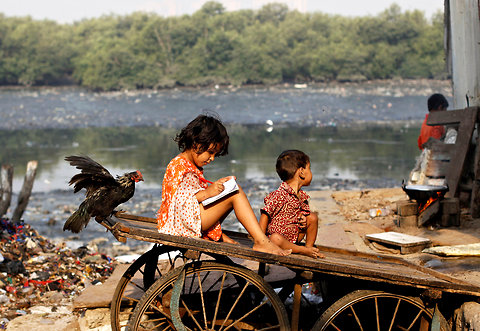
The rhetoric coming out of China with regards to poverty is different, but also similar in some respects. After four impoverished children committed suicide in a destitute part of China, the president, Xi Jingping, stated, “A good life is created with one’s own hands, so poverty is nothing to fear. If we have determination and confidence, we can overcome any difficulty.” This statement bears similarity to the pull-yourself-up-by-the-bootstraps mentality that often crosses United States political thought. At the same time, the use of the pronoun “we,” referencing overcoming the difficulties of poverty, is an important but subtle distinction to make. The use of “we” in this statement makes clear that the nation as a whole is in on the problem of poverty and the need for solutions. This contrasts with the United States’ rhetoric, where oftentimes the subject of poverty can transform into an “us versus them” dichotomy that divides people rather than bringing them together.
Both individualistic cultures and collectivistic cultures have serious rhetoric for what their opinions on poverty are, but much of both ends of the spectrum still don’t seem to fully grasp what poverty is and how it occurs when dealing with political discourse and public opinion. There is a dangerous divide between what politicians and people think about poverty, and what poverty actually is. Individualistic societies and collectivistic societies must work to reconcile the divide in order to be able to better treat the afflictions of poverty and improve the situations of the poor.
– Martin Yim
Sources: Marketplace, University of Massachusetts, The Guardian
Photo: USA Today
Photo: Kari Patterson
