Recently, an increasing number of indie video game developers have been producing games, interactive media and virtual realities that aim to teach people about pressing social issues.
These broadly termed “empathy video games” commonly seek to evoke compassion in the player by creating an experience that provides a detailed look into the trials and tribulations the game’s characters undergo.
These games have covered a broad range of topics such as cancer, gender dysphoria and child abuse, according to The Telegraph.
Lately, a number of empathy video games have sought to raise awareness and understanding for issues related to global issues such as poverty and the refugee crisis. Here are a few examples of empathy video games:
North
North, by Outland Games, aims to demonstrate the difficulties refugees face when attempting to migrate and integrate into new places. You play as a refugee seeking asylum in a strange city, finding yourself disoriented and confused as you attempt to decipher the customs and codes of those who govern.
“In terms of its design…we worked on a web documentary about European migration policies with a few other journalists from across Europe. We also worked in refugee centers and saw all these people getting lost in endless paperwork and absurd procedures. So we had all this background knowledge and personal attachment to the refugee situation that we wanted to come across in the game,” said Gabriel Helfenstein, one half of the duo that comprises Outlands Games.
The game does not attempt to realistically emulate any of the world’s ongoing refugee crises; rather, it highlights the universal emotions of horror, grief, confusion, frustration and guilt that accompany all refugee situations. This is reflected in its design, which takes on a dark, surreal form.
Project Syria
Project Syria is a virtual reality project that places the user in two separate scenarios: in the midst of a bomb explosion on a busy street in Aleppo and in a refugee camp. The team behind Project Syria conducted extensive research to depict the situations as accurately as possible.
“…we managed to find two handicam videos of the explosion and traced the location to find out exactly where and when it happened,” Vangelis Lympouridis, co-producer of the project, told Motherboard.
“We pulled still frames from the videos, created panoramic shots, and used those to build the Aleppo neighborhood hit by the blast. For the refugee camp, we sent a team to the camp to record the situation. The audio is all real, which really creates a sense of presence.”
Project Syria has been billed as “immersive journalism” for its capacity to put people inside the story. Its creator, Nonny de la Peña, has previously created several other immersive environments to help ordinary people understand the plights of those affected by pressing social problems.
“I want to tell important stories,” de la Peña told The Telegraph. “And I want to do that in a way that brings them to life as much as possible and helps the audience find out about, or better understand, or feel more strongly about, a particular situation. Virtual reality has the unique ability to make you feel present on scene and that in turn generates a very powerful feeling of empathy.”
Cross Dakar City
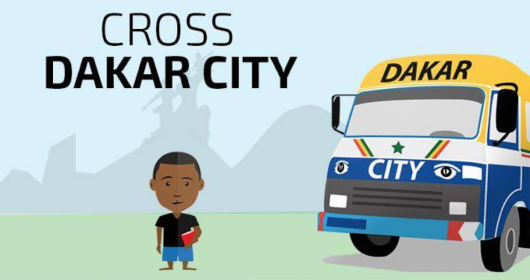
Cross Dakar City focuses on the issue of child beggars (enfants talibés) in Senegal. The game follows Mamadou, a child beggar who is trying to cross the streets of Dakar in order to find his parents and return home. Mamadou has to avoid fast-moving vehicles, trains, bombs and rivers during the six levels of the game.
This is a widespread problem in Senegal — there were an estimated 50,000 child beggars in the country in 2010, according to Human Rights Watch. The problem arises when poor parents send their male children to Islamic schools to secure a better future for them.
At the schools, Muslim religious leaders sometimes send the young children out to beg on the streets. Though the practice was outlawed in 2005, critics, including the game’s creator, Ousseynou Khadim Bèye, say that the government has done little to enforce the new rules.
In a phone interview with Motherboard, Bèye explained the rationale behind his making of the game. “I wanted to make something that had a positive impact on Senegal and to reach the widest public as possible with this game and highlight the issue of child begging in Senegal. Players have to ensure that Mamadou crosses the streets of Dakar with their iconic local taxis safely. Many child beggars, who are as young as seven, become accident victims; they are also subject to kidnappings and sexual abuse,” he said.
“They also live in terrible conditions, lack access to electricity or water and have very little food,” said Bèye.
Since its release in May 2015, Cross Dakar City has been downloaded 50,000 times. Bèye has plans to make more socially-charged games in the future. “Ultimately, I want to partner with non-profit organizations and make more games on themes like solar energy and deforestation that make people more aware of how these issues are affecting communities in Africa,” he said.
Hazy Days
Mike Ren’s “Hazy Days” is a breathing simulator game that seeks to demonstrate the struggles that China’s high levels of air pollution inflict on its citizens, particularly children.
The player controls Xiao Feng, a little girl about to visit her grandmother for Chinese New Year. The game seeks to replicate her day-to-day experience in a polluted environment.
The player controls her breathing, trying to inhale oxygen molecules and avoid air pollution particles on her walk to school. The goal is to make it through a week without getting sick, so Xiao can visit her grandmother for Chinese New Year.
As the week progresses, more and more air pollution particles build up in Feng’s lungs, illustrating the build-up effect that pollution has. Though it is possible to make it through the week without getting sick, it is a very challenging endeavor.
China’s air pollution problem continues to get worse, despite the widespread media coverage. Air pollution is harmful to everyone, especially children, whose lungs are still developing. Common health problems that develop include asthma, chronic bronchitis, weakening of the immune system and higher rates of cancer. Hundreds of thousands of premature deaths have been linked to air pollution levels.
The emergence of these “empathy video games” points to the expanding efforts to make global issues such as poverty and the refugee crises more well-known in the minds of the general public.
– Anton Li

China to Move 2 Million People Out of Poverty
On May 10, 2016, China announced the relocation of 2 million individuals from rural and remote areas to urban cities. The announcement enacts just one of the many changes China plans to make. China’s government hopes to lift all of its impoverished citizens over the poverty line by 2020.
The relocation strategy would move some of the country’s poorest citizens to areas with better resources, such as healthcare and education.
In addition, citizens will transfer to areas with better roads and access to water. For these individuals, moving to an urban city also offers opportunities for better jobs.
Reuters reported that Liu Yongfu, a Chinese government official from the Leading Group Office of Poverty Alleviation and Development, stated that the number of people relocated would gradually reach 3 million.
In March, the Chinese government also announced that they would increase poverty alleviation funding by 45 percent.
Poverty Action Lab, a research center at MIT, reported that urban relocation schemes contribute to the alleviation of poverty. Slums and poor communities can become ‘traps’ and provide little opportunity for individual economic growth.
As the most populous country in the world with over 1.3 billion people, China has previously struggled to improve the standard of living for all of its residents.
In October 2014, the Wall Street Journal reported that about 200 million people live under $1.25 U.S. dollars a day. In addition, almost half of those individuals lived under $1 a day.
In the same month, China announced its plans to alleviate poverty in its country altogether by 2020, with President Xi Jinping stating that the goal was achievable.
Since 1990, China has lifted almost 500 million individuals out of poverty. The World Bank reports that over half of China’s population was living in poverty at that time.
In 2010, the percentage of people living in poverty had dropped to 11 percent. Because its economic growth has slowed over the past two decades, the government is now relying on social schemes to alleviate poverty in China.
Despite all of the obstacles China has faced and will continue to struggle against, the nation is making considerable progress. President Xi is committed to reaching the U.N. Millennium Development Goals.
In fact, China was the first developing nation to meet the target of cutting its poverty rate in half by 2015. With that massive success behind them, China is confident that it will succeed.
– Isabella Farr
Photo: Flickr
The Difference Between Drought and Famine
The difference between drought and famine has the potential to be very confusing. Both result in an insufficient supply of food and water along with the wide and rapid spread of disease. Potentially both disasters could lead to the economic and social collapse of the community. However, the truth about both disasters is quite simple.
In the Merriam-Webster Dictionary, drought is defined as a period of dryness, especially when prolonged. Likewise, famine is defined as an extreme scarcity of food. While famine can sometimes be the outcome of a drought, it is considered to be more of a manmade disaster, therefore more preventable, and results from the lack of availability of food and water. A drought is solely the result of finicky Mother Nature and almost entirely unpreventable. In both cases, if aid is not immediately offered to the affected people, starvation, rampant disease, economic and social collapse and death will take its toll.
Here are eight quick facts that define these disasters in order to keep them straight.
Drought
Famine
-Kira Maixner
Source: Do Something, Merriam Webster Online
Photo: Asia News
How Turkish Soccer Is Fighting Poverty
The United Nations Development Programme has recently collaborated with the top Turkish soccer club, Galatasaray Sports Club, to help promote the Sustainable Development Goals, the world’s leading poverty eradication initiative.
After winning the UEFA Cup and UEFA Super Cup in 2000, the Turkish soccer club has kept worldwide support for its athletic ventures. With stars like Wesley Sneijder representing the team, fans of international competitions have taken their enthusiasm to the club scene. Galatasaray is able to add on an impressive domestic following with over 20 local league cup wins, and in addition, has established bases in Turkey’s biggest city, Istanbul.
Four of the iconic Galatasaray players, “captain Selçuk İnan of Turkey, goalkeeper Fernando Muslera of Uruguay, Aurélien Chedjou of Cameroon, and the Netherlands’ Wesley Sneijder,” starred in a video promoting the new partnership between the football club and the UNDP. In the video, the players stress the idea of “leave no one behind” in a world where many are forgotten in poverty.
Outside of the film room, the club continues to make its mark. Along with the UNDP, “Galatasaray will raise funds for a diversity of programmes to tackle poverty, inequalities and exclusion across the world,” according to a UNDP article. Even so, this isn’t the first Turkish soccer club that has set humanitarian goals. In 2014 and 2015, the organization assisted with the relief of flooded communities and victims of mining disasters.
Soccer unites people despite language, geographic and political barriers. The World Cup is the single most watched sporting event in the world, with over 700 million viewers watching the 2010 final. Millions of children, and even adults, admire the stars that play on their favorite teams. It’s only natural that these spotlighted individuals should take the lead in the fight against global poverty.
France’s Zinedine Zidane and Brazil’s Ronaldo are two iconic examples of soccer stars joining the fight against poverty. Last year the duo, along with many other stars such as van de Sar and Seedorf, put together the 12th annual Match Against Poverty, in conjunction with the UNDP and EUFA, the European soccer authority. The money from the tickets which cost “from €8 to €12” went to “aid specific projects in different countries dealing with difficult challenges.”
With power and wealth on the line, soccer’s role models quickly become the hopes and dreams of children all around the world. Youth most affected by poverty in countries with glorified soccer stars use the potential for glory and riches as motivation to conquer their own situations. Sometimes, the stories of players they watch are not unlike their own.
In Brazil, Adriano and Ronaldo are just two of those kids that have climbed out of poverty with their skills on the ball. A talent scout for Flamengo, a local professional club, says, “For Brazilian kids growing up in some of the world’s roughest neighborhoods, soccer is a ray of hope amid violence and poverty.” Around 800 Brazilian kids are able to escape the country and poverty with professional soccer careers, which is not many when the population size is considered.
Professional soccer careers are not the logical solution to poverty, but the sport is promoting poverty’s eradication in ways like Galatasaray’s public service announcement, which is in association with the Sustainable Development Goals. Soccer’s far-reaching scope and enthusiastic following can increase awareness and support for the goals of ending poverty.
– Jacob Hess
Photo: Flickr
Reducing Poverty: Lessons Learned from Peru
According to the World Bank, one in five people in Latin America are chronically poor.
Brazil, in particular, continues to face economic and political instability which has impacted the country’s ability to fight poverty. “We don’t have data for 2015, but we know there is an important economic crisis, with a recession and unemployment rise, and it is very likely that will negatively impact on poverty numbers,” said Alicia Barcena, head of the U.N.’s Economic Commission for Latin America and the Caribbean (ECLAC) in a Voice of America article.
Regionally, the poverty rate averages 21 percent with some countries recording poverty rates as low as 10 percent (Uraguay, Argentina and Chile) and others like Nicaragua, as high as 50 percent.
However, one of the greatest success stories is Peru, where the poverty rate declined from 54.7 percent in 2001 to 22.7 percent in 2014.
According to World Bank research, there are two key reasons that Peru has seen its poverty rates decrease — economic growth and sound fiscal policies. Much of this growth comes from an increase in exports, particularly of metals like gold and copper.
However, while Peru has been successful at reducing poverty, there are lessons that can also be taken away from its shortcomings. “Leaders must improve their ability to deliver services to the poor. Without improved capacity for quality delivery, even the best policies will mean little to their intended beneficiaries,” said World Bank President Jim Yong Kim.
Peru needs improvements to its infrastructure and social services, as the gap between rural and urban areas remains significant. The World Bank has helped to address these issues by “supporting the government in improving equity through social services, infrastructure and competitiveness, while continuing to preserve macroeconomic stability”.
It is hoped that other Latin American countries will take a cue from Peru when it comes to reducing poverty and securing sustainable futures for families and communities.
– Emily Milakovic
NextDrop Targets Unreliable Water Systems
Not surprisingly low-income households and small businesses are hit the hardest by water intermittency. Ultimately, unreliable water systems hinder health and economic development, especially in countries like India where 250 million people rely on imperfect water systems.
A University of California-Berkeley civil engineering graduate sought to address this issue when she created NextDrop, a phone-based program that notifies people when water will be available.
Founder Anu Sridharan and her team of fellow graduates began to put their idea into action after winning the Big Ideas@Berkeley contest in 2010. The year-long contest provides funding and support to teams of students who have innovative solutions for global challenges.
The system operates by collecting water flow information from valvemen who are responsible for opening and closing the valves that control water flow into various districts. By using NextDrop, households are typically alerted one hour before the valves open giving them peace of mind and the ability to carry out their daily tasks.
NextDrop has already reached 75,000 registered users in Bangalore, India. Now, USAID has announced plans to evaluate the effectiveness of the text message-based notification system and impact on quality of life.
If evidence from evaluations and surveys show NextDrop to be accurate and effective, funding will be provided for the service to be expanded into more major cities in developing countries.
As Phillip Denny, director of Big Ideas told USAID, “University-based programs like Big Ideas provide the perfect ecosystem for early-stage entrepreneurs by providing the resources, funding and ultimately the validation that allows ideas like NextDrop to thrive.”
– Emily Ednoff
Photo: Flickr
Education Reform in Liberia: Repairing a Broken System
Across Africa, bolstering public education infrastructure can be one of the best ways for governments to fight poverty in their own countries. UNESCO’s recent Education for All Global Monitoring Report cited that income jumps 10 percent for every grade finished and a country’s Gross Domestic Product benefits 0.37 percent.
As a global deficit of 69 million children out of primary school continues to grow in low-income countries, poverty threatens the societies in these nations.
Helping children to obtain basic reading skills has the potential to lift 171 million people out of poverty, almost double the primary school deficit. These results show the multiplying effect that education can have on income levels.
Liberia has recently taken steps towards education reform after being ravaged by Ebola. The African Business Review cites that “42 percent of children are out of school, and only 20 percent of children enrolled in primary school complete secondary school.”
These statistics are relatively high compared to education levels around the time of the Liberian civil war. Before the Ebola outbreak greatly affected the country, the Liberian Department of Education had enlisted the help of USAID to rebuild the school systems and replenish the trained workforce.
The aid organization cites that their “education programs focus on improving the quality of teaching and learning (especially in early grade reading and math) and increasing equitable access to safe learning opportunities for girls, as well as for youth who missed out on education due to the prolonged civil conflict.”
The relief efforts led to the passing of the Education Reform Act in 2011. The programs within the act looked to strengthen the degraded Liberian school system and provide the new framework more centralization with a way to gauge efficiency.
This year, the Ministry of Education will roll out a new program called the Partnership Schools for Liberia in September. The head of the Ministry of Education, George Kronnisanyon Werner, spoke to Medium last month about the change.
The project will take developing ideas from developed countries around the world and local African nations like South Africa and Kenya in order to design a system that, Werner says, can “adapt to our unique context.” Schools will be set up in conjunction with social organizations like NGOs, but funded by the public sector.
Initially, 120 schools will be opened in late 2016 so that methods and models can be tested before the program is implemented on a large scale. Werner hopes to “generate evidence before we scale further” so that funds are spent efficiently and results are guaranteed when expansion to the entire country is considered.
The Partnership Schools for the Liberia program looks to put the Liberian government in place to reduce the number of children out of primary school. With this tool at Minister of Education George Werner’s fingertips, he hopes to get one step closer to his mission “to provide every child, regardless of family background or income, access to high-quality education.”
– Jacob Hess
Photo: Flickr
Empathy Video Games: Raising Awareness About Global Issues
Recently, an increasing number of indie video game developers have been producing games, interactive media and virtual realities that aim to teach people about pressing social issues.
These broadly termed “empathy video games” commonly seek to evoke compassion in the player by creating an experience that provides a detailed look into the trials and tribulations the game’s characters undergo.
These games have covered a broad range of topics such as cancer, gender dysphoria and child abuse, according to The Telegraph.
Lately, a number of empathy video games have sought to raise awareness and understanding for issues related to global issues such as poverty and the refugee crisis. Here are a few examples of empathy video games:
North
North, by Outland Games, aims to demonstrate the difficulties refugees face when attempting to migrate and integrate into new places. You play as a refugee seeking asylum in a strange city, finding yourself disoriented and confused as you attempt to decipher the customs and codes of those who govern.
“In terms of its design…we worked on a web documentary about European migration policies with a few other journalists from across Europe. We also worked in refugee centers and saw all these people getting lost in endless paperwork and absurd procedures. So we had all this background knowledge and personal attachment to the refugee situation that we wanted to come across in the game,” said Gabriel Helfenstein, one half of the duo that comprises Outlands Games.
The game does not attempt to realistically emulate any of the world’s ongoing refugee crises; rather, it highlights the universal emotions of horror, grief, confusion, frustration and guilt that accompany all refugee situations. This is reflected in its design, which takes on a dark, surreal form.
Project Syria
Project Syria is a virtual reality project that places the user in two separate scenarios: in the midst of a bomb explosion on a busy street in Aleppo and in a refugee camp. The team behind Project Syria conducted extensive research to depict the situations as accurately as possible.
“…we managed to find two handicam videos of the explosion and traced the location to find out exactly where and when it happened,” Vangelis Lympouridis, co-producer of the project, told Motherboard.
“We pulled still frames from the videos, created panoramic shots, and used those to build the Aleppo neighborhood hit by the blast. For the refugee camp, we sent a team to the camp to record the situation. The audio is all real, which really creates a sense of presence.”
Project Syria has been billed as “immersive journalism” for its capacity to put people inside the story. Its creator, Nonny de la Peña, has previously created several other immersive environments to help ordinary people understand the plights of those affected by pressing social problems.
“I want to tell important stories,” de la Peña told The Telegraph. “And I want to do that in a way that brings them to life as much as possible and helps the audience find out about, or better understand, or feel more strongly about, a particular situation. Virtual reality has the unique ability to make you feel present on scene and that in turn generates a very powerful feeling of empathy.”
Cross Dakar City
Cross Dakar City focuses on the issue of child beggars (enfants talibés) in Senegal. The game follows Mamadou, a child beggar who is trying to cross the streets of Dakar in order to find his parents and return home. Mamadou has to avoid fast-moving vehicles, trains, bombs and rivers during the six levels of the game.
This is a widespread problem in Senegal — there were an estimated 50,000 child beggars in the country in 2010, according to Human Rights Watch. The problem arises when poor parents send their male children to Islamic schools to secure a better future for them.
At the schools, Muslim religious leaders sometimes send the young children out to beg on the streets. Though the practice was outlawed in 2005, critics, including the game’s creator, Ousseynou Khadim Bèye, say that the government has done little to enforce the new rules.
In a phone interview with Motherboard, Bèye explained the rationale behind his making of the game. “I wanted to make something that had a positive impact on Senegal and to reach the widest public as possible with this game and highlight the issue of child begging in Senegal. Players have to ensure that Mamadou crosses the streets of Dakar with their iconic local taxis safely. Many child beggars, who are as young as seven, become accident victims; they are also subject to kidnappings and sexual abuse,” he said.
“They also live in terrible conditions, lack access to electricity or water and have very little food,” said Bèye.
Since its release in May 2015, Cross Dakar City has been downloaded 50,000 times. Bèye has plans to make more socially-charged games in the future. “Ultimately, I want to partner with non-profit organizations and make more games on themes like solar energy and deforestation that make people more aware of how these issues are affecting communities in Africa,” he said.
Hazy Days
Mike Ren’s “Hazy Days” is a breathing simulator game that seeks to demonstrate the struggles that China’s high levels of air pollution inflict on its citizens, particularly children.
The player controls Xiao Feng, a little girl about to visit her grandmother for Chinese New Year. The game seeks to replicate her day-to-day experience in a polluted environment.
The player controls her breathing, trying to inhale oxygen molecules and avoid air pollution particles on her walk to school. The goal is to make it through a week without getting sick, so Xiao can visit her grandmother for Chinese New Year.
As the week progresses, more and more air pollution particles build up in Feng’s lungs, illustrating the build-up effect that pollution has. Though it is possible to make it through the week without getting sick, it is a very challenging endeavor.
China’s air pollution problem continues to get worse, despite the widespread media coverage. Air pollution is harmful to everyone, especially children, whose lungs are still developing. Common health problems that develop include asthma, chronic bronchitis, weakening of the immune system and higher rates of cancer. Hundreds of thousands of premature deaths have been linked to air pollution levels.
The emergence of these “empathy video games” points to the expanding efforts to make global issues such as poverty and the refugee crises more well-known in the minds of the general public.
– Anton Li
Sharon Njavika Starts a New Social Enterprise
She would have to travel to the next town over to get her hair chemically straightened and recalls becoming frustrated with the constant upkeep of her looks, which she believed were necessary in order to fit in with her surrounding culture.
Njavika told How We Made it in Africa, “one time my friend was doing my hair and I got a bad wound from the chemical relaxer. It was a big flesh wound, and the experience was traumatic.” After this incident, Njavika ditched the chemicals and started looking for a more natural way to manage her hair.
As an HCD (Health, Community and Development) graduate, Njavika utilized her practice of health and well-being to create her own social enterprise, AJANI handmade. Journalist Banke Falade recognizes that AJANI handmade markets natural hair products specifically for black hair as well as general natural hair care.
Njavika writes, “The business model is grounded in perpetuating messages and images of worth, beauty, agency and capacity by and for African women. Through participating in and facilitating conversations online and otherwise, we aim to address the sometimes ignored, often dynamic, social narratives that affect young African women.”
Njavika’s business is based in Kenya, where a growing number of women are embracing the natural look.
However, Njavika social enterprise faces some challenges, such as limited access to financing, raw materials and high quality packing materials. The young entrepreneur also keeps a full-time job in order to cover her personal expenses and fund the growing business.
An African blog writer commented, “she has such a passion and drive for this new company that I can only see it developing, growing and thriving in the months and years to come. I think the aspect that most caught my attention is the fact that AJANI Handmade is much more than just selling beauty/care products. They focus on self-love, confidence, well-being and supporting black women.”
Njavika focuses on perpetuating messages of beauty and self-worth, demonstrating the principles that drive her social enterprise, AJANI handmade.
– Megan Hadley
Eastern Congo Initiative: Eradicating Poverty
Conflict in the region has resulted in the displacement of a nearly 3 million and a death toll of around 5.4 million. In addition, the prolonged fight for power between competing militias has perpetuated a cycle of violence, poverty and disease for more than 20 years.
According to the Council on Foreign Relations, despite a promising growth rate of nine percent between 2014 and 2015, political and social instability has led to Congolese citizens surviving on “less than $200 a year—barely half of what they did in 1970.”
In order to help improve living conditions, ECI has invested in the Eastern Congo’s potential for redevelopment, gaining the attention of influential voices within eastern Congo and around the world. The organization uses “targeted methods to communicate directly to select individuals who can help shape policies and action in the government, academic and private sectors”.
Field research and direct polling conducted by ECI addresses the lack of verifiable information that previously discouraged many lawmakers and members of the private sector in the U.S. and Europe from becoming Congo advocates.
The United States, in particular, has stepped up its efforts to provide assistance in the DRC, actively working with the African and European Unions to broker regional peace agreements and becoming the largest financial contributor to the U.N. Organization Stabilization Mission in the Democratic Republic of the Congo (MONUSCO).
In 2011, in partnership with USAID, the Eastern Congo Initiative provided an in-depth analysis of community-based organizations throughout the DRC. This report allowed policy makers and investors to gain insight into the potential of sustainable growth in the DRC, opening the possibilities of increased funding and investment.
In addition, ECI has given grants to 23 Congolese organizations to support their efforts in improving economic development, education, access to justice and family health.
One organization, Children’s Voice, serves the needs of “young people living in extreme poverty, including orphans, former child soldiers and sex slaves”.
By providing primary schooling, vocational training and mental health assistance to approximately 600 children per year in the cities of Goma and Magunga, Children’s Voice is taking a critical step to break the cycle of poverty and hopelessness at an early stage.
Another organization, Dynamique de Femmes Juriste (DFJ) provides legal services to women who have faced rights abuses, from sexual violence to inheritance violations. In addition to advocating for laws that strengthen women’s participation in politics, DFJ trains paralegals in rural areas to process complaints in their respective communities.
The group also encourages female community leaders to run for office in local elections to encourage better female representation in the government.
According to the Eastern Congo Initiative’s website, in 2014, “DFJ prosecuted more than 200 cases in court, with a 37 percent success rate.” For a country whose justice system is incredibly weak, this is nothing short of a promising and remarkable achievement.
– Taylor Resteghini
Photo: Flickr
Mobile Schools in Mongolia: Expanding Enrollment
Since 2010, Mongolia has experienced a substantial and significant increase in the enrollment of kindergarten aged children, largely due to mobile schools through which thousands of nomadic children are given access to an early education.
Large strides have been made in Mongolia over the past decades to make a successful shift from a planned economy to a market democracy. However, despite this progress, the World Bank reported in 2008 that 35 percent of the population still lived below the poverty line.
The Mongolian Government and various humanitarian organizations addressed this issue by developing a number of resolutions to improve the living situations of the population. Many of these initiatives have been focused on educational development.
One such program is the Early Childhood Education Project of 2012 which aims to provide all young children with access to education. The components of this project are confronted with a unique cultural challenge. Mongolia is the least densely populated country on earth with roughly 1.7 people per square kilometer. A large portion of this population is nomadic and during the summer months, they reside in an area for only 2-3 weeks. Under these dispersed and fluid conditions, the young children of these nomadic families would never be able to attend a typical kindergarten.
In order to accommodate this common nomadic lifestyle, “mobile ger kindergartens” were developed. UNICEF Mongolia and Save the Children UK piloted these mobile schools in Mongolia in 1994, but their development accelerated when the Mongolian government and other organizations stepped in to assist with funding.
Tsendsuren Tumee, UNICEF Mongolia’s Early Childhood Development Officer, has reported, “Since 2012 more than 2600 children have attended ger kindergartens in Khuvsgul province . . . this year we established 10 more ger-kindergartens in the area with the help of the Government of Monaco providing nearly 280 children aged 2-5 with early childhood education programs and services. Access to early childhood has helped many children to develop to their full potential and perform better at schools.”
In addition to their benefits to young students, these mobile schools in Mongolia are cheaper to operate than their stationary counterparts throughout the country. They also assist the parents of these children by allowing them to spend more time with their herds, thus elevating their productivity.
In the report by UNICEF Mongolia, a mother named Jargal expressed the beneficial influence that these schools have for her family personally: “Summer is busy time for herders. We need to work extra hard in preparation for the cold winter ahead. Knowing that our son is safe at the kindergarten, learning new things and making friends, we feel so happy and do our work without any concern.”
The World Bank has reported that the overall trajectory of this project is a positive one. With it, young children will be better prepared for higher levels of education and their parents will be enabled to produce more. In addition, there will be decreased pressure on the government and other humanitarian participants.
The World Bank opines that more mobile ger kindergartens are needed to service the nomadic community which accounts for 40 percent of the total population. However, many are optimistic about the progress that has been made. The Asian Development Bank commented, “Reforms, streamlining, and repairs – mixed with ample optimism and dedication – are propelling Mongolia’s education system toward achieving its goal of education for all.”
– Preston Rust
Photo: UNICEF