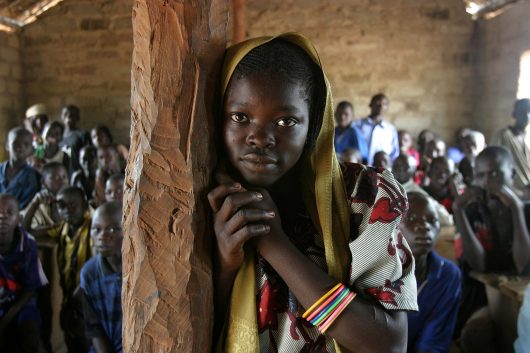
The U.N. Millennium Development Goal of achieving universal education has played a vital role in advancing education for boys and girls in African countries, however, obstacles still remain.
In addition to increasing access to education, the U.N. Millennium Development Goals also included overcoming extreme poverty, promoting gender equality and women’s rights, reducing child mortality and improving maternal health, combating HIV and malaria, creating a sustainable environment and advocating for global partnership. These goals are not isolated in nature, but rather each builds upon the next.
“Children who don’t have access to clean water and who aren’t taught proper hygiene practices like hand-washing with soap are more likely to be ill and absent from school,” according to Canadian Feed the Children (CFTC). “Combined with lack of proper nutrition – and often, the schools are the one place they have a guaranteed daily meal – children’s susceptibility to preventable, waterborne disease increases dramatically. Disease also spreads much more rapidly in schools without proper hygiene and sanitation.”
Canadian Feed the Children is a registered Canadian charity that works with local partners to establish food security and education in developing countries. The organization believes that “education is the best investment in prosperous, healthy and equitable societies.”
With more children having access to an education, more resources are needed; such as books, maps, research and reference materials, blackboards and writing materials. Infrastructure becomes a challenge when the number of students outgrows the number of available classrooms.
Additionally, kitchens and latrines are essential components for health and hygiene and each must be outfitted with their own supplies and equipment. A productive learning environment requires the availability of meals and safe, clean facilities.
When schools are overpopulated, understaffed and lacking necessary supplies, it is difficult to recruit teachers. Many times underqualified and unpaid volunteers step in to teach in impoverished communities, which can do more harm than good.
Crop failure, parents’ illness and rising prices are some of the barriers families living below the poverty line are facing when they sacrifice the education for one or more of their children in order to feed the family. Most often, it is the girls who are chosen to miss out.
Schools lacking a latrine present another obstacle for girls, for whom modesty and safety are important.
“For many girls, the need to leave the classroom several times a day makes going to school anxious and unpleasant. For older girls, menstruation in an environment where there is no toilet and no water causes embarrassment and further complicates matters. And where toilet facilities are not available or located far away, there is a much higher risk of violence for girls. The risks and hassle just aren’t worth it – and they drop out. There are so many barriers to girls’ education, toilets shouldn’t be one of them,” said Amboka Wameyo, CFTC’s Regional Program Manager – Africa.
Girls in African countries like Ghana, Ethiopia and Uganda endure early or forced marriage, the burden of chores, pressure to care for siblings and long-distance walks to school leaving them vulnerable to rape or violence. The dropout rate for girls around age 12 increases dramatically, sometimes reaching 100 percent.
According to Canadian Feed the Children, every year a girl attends school translates into a 15 percent increase in their income as they become less vulnerable to the threat of domestic violence and poverty.
Girls in African countries must be given the opportunity to improve their lives and subsequently contribute to the alleviation of the poverty cycle in their communities.
– Emily Ednoff
Photo: Flickr

How Refugees Improve Countries of Resettlement
More than 1.3 million refugees sought asylum in Europe in 2015 alone, the influx demonstrating the escalating urgency of the refugee crisis. As these unprecedented numbers flow in, refugee camps have been pushed far past the limits of their capacities and countries within the European Union have struggled to negotiate sharing the burden.
Citizens of these countries fear that the refugee influx could threaten safety and job security. For those who do not find humanitarian duty reason enough to intervene, the situation leaves many wondering how refugees improve countries.
However, a number of unexpected benefits of refugees entering a country make stepping up in this humanitarian crisis potentially beneficial for both parties. Below are six ways in which refugees improve countries to which they’ve been granted resettlement.
Germany has been at the forefront of countries extending open arms to refugees–announcing that it will accept 800,000. The country also has the lowest birth rate in the world, which continues to decline at a fast pace. In order to support the aging community and state pension system, an estimated 1.5 million skilled immigrants is needed. By 2060, Hamburg’s World Economy anticipates that Germany will need two workers to support each individual in retirement. As a result, there is a significant opportunity for refugees to improve countries with declining birth rates.
The biggest receivers of refugees have also become focus areas for humanitarian aid. While often this aid is woefully insufficient, what does come can accomplish a great deal for the host nation itself. It is estimated by the United Nations that in countries like Lebanon, the multiplier effect of aid means that every U.S. dollar worth of assistance generates $0.50 for the local economy.
Companies looking to grow need skilled, young workers to take on the roles of aging European work forces. Notably, the head of Mercedes Benz, Dieter Zetsche, has expressed that refugee workers are precisely what countries like Germany and corporations like Mercedes Benz need.
Putting systems in place to allow refugees to become employed and contribute to society creates a larger tax base. This enables refugees to help improve countries by decreasing tax burden, maintaining state systems and increasing public services.
A number of potential security benefits may come with accepting refugees from the Middle East to countries like the U.S. These movements have the ability to counter the anti-U.S. propaganda that many radical groups like ISIS depend on. The migration of people and the decreased potency of propaganda could deprive radical groups of the resources and recruits that they need. In addition, the inclusivity and acceptance which comes from welcoming refugees to Western parts of the world has the potential to decrease the marginalization of Muslim and Middle Eastern people living in the West. This could be a potent tool against internal-radicalization.
Obtaining information regarding realities on the ground in areas like Syria has been a large obstacle for the U.S. and other countries involved in combating terrorism. Patrick Eddington, a former CIA intelligence officer, has described Syrian refugees in the U.S. as the most valuable source of insight regarding the realities of living in ISIS-controlled territory. Through Syrian refugees, intelligence has been obtained regarding ISIS funding, leadership and military-related inventory. Therefore, refugees improve countries combating terrorism by contributing to security and intelligence needs.
These six examples of how refugees improve countries of resettlement demonstrate the multifaceted contributions of refugee populations. By joining the formal workforce, they have the potential to offset varying degrees of the economic burden which accompanies a humanitarian crisis and influx of migrants. Intelligence contribution and the decreased marginalization of refugees also offer significant security benefits. Finally, facilitating the movement of refugees to safety can decrease the efficacy of extremist propaganda and recruitment tactics.
– Charlotte Bellomy
10 Facts About Forced Migration
The subject of forced migration, especially related to refugees, is a major topic in current news and politics across the world. Columbia University defines forced migration as “the movements of refugees and internally displaced people (those displaced by conflicts within their country of origin) as well as people displaced by natural or environmental disasters, chemical or nuclear disasters, famine, or development projects.” Below are 10 facts about forced migration:
migrated within their own countries. The UNHCR reports there are over 38 million people classified as IDPs.
Forced migration has been a major issue for quite some time now. Although countries around the world have stepped in to help refugees and other displaced individuals, these facts further prove that it will take much more to reduce these numbers.
— Saroja Koneru
Photo: U.N. Multimedia
Why Vaccines are an Economic Investment
In addition to preventing serious illnesses, vaccines are an economic investment as they have the added bonus of saving money. As fewer people get sick, this reduces the need for complex and often long-term medical treatment which allows communities to save greatly.
Research from the Johns Hopkins Bloomberg School of Public Health, in addition to other studies, has shown that the returns on vaccines are 16 times the investment; that is to say, every dollar spent on vaccines, on average, saves sixteen dollars in future medical spending.
The journal Health Affairs, which published the Johns Hopkins study, noted that when other factors are considered beyond direct medical costs, such as time not taken off from work due to illness, the return rises to as high as $44 for every dollar spent.
While the economic benefits of vaccinations are great for every country, they especially matter in poor or developing countries, where funds are often stretched thin and accessing affordable health care can be difficult if not impossible.
The World Health Organization estimates that malaria costs Sub-Saharan Africa $100 billion every year. In a region plagued by poverty, that is too much money for countries to be spending on preventable diseases.
Vaccines show that when we invest in prevention, we can make huge savings on treatment. In turn, the money that would be spent treating preventable diseases can go to other places, such as to education, poverty reduction schemes or energy programs.
Vaccines are an economic investment that not only save lives, but they also save money in so many ways, not just treatment costs.
When people are sick with a debilitating illness, not only do they spend money on treatment, they lose money when they cannot work resulting in a vicious cycle of economic hardship. Continued increased access to vaccines can help millions around the world.
– Emily Milakovic
Photo: U.N. Multimedia
Sadiq Khan: Revolutionizing the Western View
In his acceptance speech, Khan said, “I am determined to lead the most transparent, engaged, and accessible administration London has ever seen, and to represent every single community and every single part of our city as mayor for all Londoners.”
Over the last year, Khan has risen from a relatively obscure character in the British parliament to a world-renowned figurehead. His campaign was fraught with controversy over his reputation, and many did not trust his intentions as a politician. Why? Who is Sadiq Khan, and what is it that makes him such a controversial figure in British politics?
Sadiq Khan is the first Muslim to become mayor of a major Western city. And though some radicals believe the world is coming to an end with such a change, this historic event is generally viewed as a positive political breakthrough. London specifically sees this significance, but various countries throughout Europe and the West agree.
Originally planning to become a dentist, Khan instead pursued law after a teacher commented on his talent for arguing. A few years later, he graduated from the University of London and began his career as a human rights lawyer.
He quickly received attention from various high profile cases, but after a number of years as an attorney he left his practice in order to become more involved in politics. The rest is history.
In his new job as mayor, Khan plans to focus on two central points: significant reductions in poverty and inequality. CNN has observed that the divide between rich and poor in the financial powerhouse of Europe has been steadily increasing.
Statistics show that 27 percent of the nearly 9 million inhabitants are living below the poverty line. Additionally, prices for travel and housing are rising and jobs cannot compensate for the cost of living in London.
Khan has listed a number of strategies that he will implement to improve the current financial situation. First, he intends to attack the housing crisis currently facing London.
On his campaign webpage he writes, “For young families and individuals on average incomes, housing is increasingly unaffordable – with home ownership a distant dream.” Khan also intends to make affordable homes a focus of his tenure through construction reform. He plans on stopping the outsourcing of property to foreign investors.
Another problem that currently besets London is in-work poverty. Employers cannot give their workers sufficient pay raises to compensate for rising price inflation. Consequently, Khan intends to provide tax breaks to companies who pay their employees enough money to cope with London’s high living costs.
The new mayor also plans to address ethnic and gender inequality. Khan is committed to tackling each of these issues in order to help London stem the tide of its inflation while bringing poverty and inequality rates down.
– Preston Rust
Photo: Flickr
Outdoor Classrooms: Opportunities for Rural Nepalese
The project involves a series of interconnected villages whose microclimates provide a trail for learning about ecosystems and biodiversity. This program also employs villagers as teachers in these outdoor classrooms. The innovative effort comes at a dire time for socioeconomic progress in Nepal, with the 2015 earthquake pushing more than 1 million Nepalese below the poverty line.
The Vertical University trail, which stretches across Eastern Nepal, encompasses the living grounds of 150,000 individuals and 107 different habitat types. Visitors travel from one outdoor learning space to the next, absorbing locals’ knowledge of native species and diverse habitats as they go.
The founder of the Vertical University is an organization called KTK-BELT. This group engages important local actors, like farmers and teachers, in “community-based biodiversity conservation.” The Vertical University initiative represents conservation in action, resulting in a 100-acre land trust and critical tools for preventing deforestation.
For Nepalese community members, the project represents more than an opportunity for environmental conservation. This project has been instrumental in providing locals with economic and educational opportunities.
The outdoor classrooms are free and open to visitors at all times, as the local Nepalese have mapped and tagged the indigenous knowledge they can offer. For Nepalese youth, the opportunity to be involved in the process can mean acquiring valuable educational skills or receiving a stipend to pursue further education.
Young girls in particular benefit from programs like this because they face deeply entrenched gender stereotypes regarding education. Most girls find themselves restricted to domestic tasks. However, the Vertical University teaches them to catalog species for the trail, as well as survey local farmers and communities.
Not only do girls lack in schooling, but there’s also a dire overall need for education funding in Nepal. The country’s educational system is quite young relative to global advancement in education.
Additionally, schools in rural areas lack in productivity, effective learning and testing. The lack of quality education offered in rural schools is also a widespread problem for public schools as a whole. Females, Dalits, Muslims and other minority groups suffer in particular. However, outdoor classrooms offer a viable solution.
Adult community members in the Vertical University villages receive the additional economic opportunities borne from protecting the environment. Creating the trails led to the discovery of a variety of natural products, such as essential oils and soapnuts. The locals can then sustainably produce and sell those products. They also learn a variety of education skills, which can compensate for the low rates of higher education in Nepal.
The many facets of the project translate into various opportunities for the Nepalese living within the Vertical University belt. Education funding and employment as mappers of indigenous knowledge are just the beginning. People have repurposed barren land for permaculture and highlighted the danger of poaching. They have also mapped and labeled 6,600 plants in areas frequently devoid of Internet access.
Co-founders Rajeev Goval and Priyanka Bita created the project through a Kickstarter campaign. The power of crowdfunding has enabled the education and livelihoods of countless villagers within the region. This is especially important for Nepal, as it is still reeling from the 2015 earthquake.
In creating outdoor classrooms and employing local farmers to map and catalog their indigenous knowledge, the KTK-BELT Vertical University represents a conservation approach with both involves the community and fights global poverty. Its ability to provide education funding in Nepal, a country where that funding can change the lives of girls and disadvantaged youth, creates widespread change.
– Charlotte Bellomy
Photo: U.N. Multimedia
US Donation of Surplus Peanuts to Haiti Causes Controversy
Its March 31st announcement has met criticism from Haitian peanut farmers, manufacturers, concerned citizens, and a variety of both Haitian and foreign NGOs.
Many have called the action “crop” or “peanut dumping” that will negatively impact the Haitian economy and its people, pointing to the example of the impact of subsidized rice on the Haitian market years ago. Others point to the need to feed thousands of malnourished children.
As the USDA describes, the action is a part of the “Stocks for food” federal program that sends surplus goods to feeding programs and food banks both in the United States and abroad. The specific Haitian project that targets primary schools struggling against poverty, malnutrition and disease receives its funding from the McGovern-Dole International Food for Education and Child Nutrition Program.
However, many believe that sending cheap stock like peanuts to Haiti could negatively impact the country’s ability to sustain its own food production and undermine the local economy.
Partners in Health released a statement urging the USDA to reverse its decision. A letter to the USDA from the Institute of Justice and Democracy in Haiti points out that peanuts are fundamental to the country’s economy as 150,000 local farmers produce 70,000 metric tons, much like rice was a staple of Haitian market in the mid-1990s.
Floods of foreign, mostly U.S.-produced rice drove the price of Haitian rice down, and many farmers were left without income and forced to leave to find work elsewhere.
The Haitian economy and food security depend strongly on peanuts, especially in their role in the production of a spicy peanut butter called Mamba, which provides income for a large number of Haitian women.
Bill Clinton has been repeatedly quoted acknowledging the export of rice to Haiti as a mistake and the “lost capacity” it caused. While it benefitted U.S. farmers, he said, it hurt Haitian ones.
Alexis Taylor, deputy undersecretary for farm and foreign agricultural services at the USDA, has defended the shipment of surplus peanuts as a source of much-needed relief for a poverty-stricken country in which one-third of all children’s deaths are caused by malnutrition.
The peanuts will be a supplement to Haitian school children’s morning snack as part of the U.N. World Food Program.
In contrast to the USDA’s action, the U.S. has funded other programs such as the World Food Programme that support locally sourced food production and procurement in Haiti.
These efforts to encourage Haiti’s self-sustainability and independence from foreign aid could be compromised by the USDA’s pending peanut program. Critics say it would be better to continue efforts to help Haitian peanut farmers produce better, bigger crops as programs like the Feed the Future Initiative, the Clinton Foundation, and Partners in Health aim to do.
However, the White House petition against the donation failed to receive enough signatures and closed.
USDA press secretary responded to NPR’s article stating that the USDA worked with the WFP to ensure the donation of surplus peanuts would have no negative impact on Haiti’s domestic peanut market by limiting the peanuts’ consumption to only be at school and closely monitoring the impact.
– Esmie Tseng
Photo: U.N. Multimedia
Refugee Volunteers: Assistance Amid Crisis
Crossing by sea and land, over 1 million refugees sought asylum in Europe in 2015, according to the BBC. The source says that numbers continue to increase, reaching 135,711 refugees between January and early March of this year.
Those fleeing conflict in Syria, in addition to Afghanistan, Iraq, Kosovo, Albania, Pakistan and other high-risk countries, are often left stranded and unable to return to their home country. Unfortunately, refugees typically have a difficult time assimilating into society when they are accepting into host countries.
In Across Borders, a month-long online conversation hosted by Devex and other partners, Richard Dictus, the executive coordinator of United Nations Volunteers (UNV), writes about the conditions of displaced individuals and asylum seekers.
In addition to the problem of refugee assistance, he notes that human migration brings to light issues surrounding discrimination as well as sexual and gender-based violence within these groups.
Larger international organizations such as the UNHCR Volunteers, the International Rescue Committee (IRC) and Exodus Refugee have been active members in assisting refugees during this crisis.
According to Amnesty International, 104,410 resettlement places have been offered globally since the start of the Syrian crisis. Close to half of these asylum applications were submitted to Germany and Sweden.
In addition to European intervention, United Nations Volunteers (UNVs) working on endeavors in Lebanon, Jordon Turkey, Iraq and Egypt—where more than 4 million refugees from Syria are located—have made a significant impact.
Of note, a collaborative project between the U.N. Relief and Works Agency and the European Union, where national UNV teachers are deployed to schools for Palestinian refugees located throughout Lebanon, promotes the integrity of refugees within the humanitarian crisis with refugee-to-refugee assistance.
The program mobilizes former Palestinian refugees, who have become integrated into Lebanon culture, as administrators to the new wave of refugees. The communication with these refugee volunteers can go along way in providing advice and guidance, since they share similar experiences.
Partnerships both in and outside of the European continue to make headway in terms of providing refugee volunteers and much-needd assistance. Refugee-to-refugee volunteerism serves as yet another way in which human integrity is upheld within a time of great need.
— Nora Harless
Photo: Flickr
Universal Basic Income: GiveDirectly’s Experiment
The nonprofit GiveDirectly has initiated a new cash transfer experiment that will provide at least 6,000 Kenyans with a test of universal basic income for 10 to 15 years.
According to the founders of this initiative, “…experimental tests show that the poor don’t stop trying when they are given money.” Instead, cash-based development initiatives result in people feeding their families, sending their children to school and investing in businesses.
Research also reveals that people prefer cash transfers over social programs because it provides them with more flexibility, freedom and dignity. In a study conducted in Bihar, India, 80 percent of the poor were willing to sell food vouchers for cash, with many offering discounts of up to 75 percent.
Considering this evidence, according to a Slate article, U.N. Secretary-General Ban Ki-moon has argued that “cashed-based programming should be the preferred and default method of support.”
According to Vox, basic income or universal basic income is defined as a regular payment to a group of people just for being alive. This cash transfer experiment by GiveDirectly is perhaps the first truly universal basic income program recorded in history, because unlike previous policies, it provides payment for whole villages over long periods of time.
For this project, GiveDirectly will randomly select dozens of villages in Kenya and provide every resident with a payment of between $0.70 and $1.10 for least 10 years. While $240 and $400 per year is extremely low by U.S. standards, it is equivalent or more than what the recipients ordinarily make.
World-leading academic researchers, including Abhijit Banerjee of MIT, will rigorously test this new system. The experiment will cost around $30 million, of which 90 percent will go directly to extremely poor households and the rest going towards having the money delivered.
The idea of universal basic income is currently being debated around the globe, with support from across the political landscape and pilot programs being considered by Finland and Canada.
To get the experiment started, GiveDirectly’s co-founders Michael Faye and Paul Niehaus are using $10 million of their own funds to match the first $10 million donated by others.
“At worst that money will shift the life trajectories of thousands of low-income households,” writes Faye and Niehaus in a Slate article. “At best, it will change how the world thinks about ending poverty.”
– Kerri Whelan
The Use of Bamboo for Sustainable Development
Bamboo — a highly versatile giant green grass that grows chiefly in the tropics — has recently become known as the ‘wonder plant’ by agronomists and architects. According to INBAR, “Bamboo and rattan can help millions of poor rural and urban producers lift themselves out of poverty and thrive.”
The Association of International Research reports that the international trade of bamboo and rattan products amounted to $2.5 billion in 2013 and is predicted to continue rising. Bamboo provides low-cost green housing and infrastructure, as well as a wide range of biofuels.
Aside from the low cost and maintenance of bamboo, environmentalists have linked the plant to climate change mitigation, which would earn companies increased income through carbon credits, says journalist Zipporah Musau.
This highly productive plant is extremely effective in sequestering carbon, taking in twice as much carbon dioxide as trees and meeting all the necessary criteria for countries’ sustainable development goals.
The bio-energy provided by bamboo opens the gateway for sub-Saharan African homes to use the green grass instead of firewood or charcoal, which promotes the discontinuation of deforestation, land degradation and indoor pollution.
As the population in Africa continues to grow, the massive harvesting of firewood and charcoal will be unable to sustain the continent, thus opening the gateway for bamboo.
INBAR’s general director asserts that “bamboo will be a strong pillar of Africa’s future green economy. It will help reduce poverty and protect the environment, and provide a practical and rapid solution for some of the natural resource and poverty challenges facing many African countries today.”
The wonder plant grows incredibly fast, which makes it easy for farmers to harvest and market the plant. Bamboo can be sold commercially to construct furniture, roofing, fencing, floor tiles, walls, ceiling and many other building materials.
Other uses of bamboo for sustainable development can be found in the paper and pulp industry. Bamboo can be converted into newsprint, toilet paper and cardboard, saving Africa’s forests in the process.
Domestically, bamboo can be used to make baskets, canoes, fishing kits, bicycles, fences, toothpicks, school desks, pencils and rulers, etc.
Bamboo farming has the potential to create thousands of jobs due to intensive labor. Zipporah Musau notes that Bamboo plants are typically planted, maintained and harvested by hand, taking up to eight years to mature. In Ghana, about 1,500 people were employed when a commercial project recently began.
INBAR notes that the challenge that accompanies the expansion of the bamboo market is the lack of finances and the absence of a national policy and strategy program to develop and use bamboo resources. However, as awareness of the “miracle plant” grows, so too does the potential of bamboo for sustainable development in emerging markets.
– Megan Hadley
Photo: Flickr
Greater Access to Education for Girls in African Countries
The U.N. Millennium Development Goal of achieving universal education has played a vital role in advancing education for boys and girls in African countries, however, obstacles still remain.
In addition to increasing access to education, the U.N. Millennium Development Goals also included overcoming extreme poverty, promoting gender equality and women’s rights, reducing child mortality and improving maternal health, combating HIV and malaria, creating a sustainable environment and advocating for global partnership. These goals are not isolated in nature, but rather each builds upon the next.
“Children who don’t have access to clean water and who aren’t taught proper hygiene practices like hand-washing with soap are more likely to be ill and absent from school,” according to Canadian Feed the Children (CFTC). “Combined with lack of proper nutrition – and often, the schools are the one place they have a guaranteed daily meal – children’s susceptibility to preventable, waterborne disease increases dramatically. Disease also spreads much more rapidly in schools without proper hygiene and sanitation.”
Canadian Feed the Children is a registered Canadian charity that works with local partners to establish food security and education in developing countries. The organization believes that “education is the best investment in prosperous, healthy and equitable societies.”
With more children having access to an education, more resources are needed; such as books, maps, research and reference materials, blackboards and writing materials. Infrastructure becomes a challenge when the number of students outgrows the number of available classrooms.
Additionally, kitchens and latrines are essential components for health and hygiene and each must be outfitted with their own supplies and equipment. A productive learning environment requires the availability of meals and safe, clean facilities.
When schools are overpopulated, understaffed and lacking necessary supplies, it is difficult to recruit teachers. Many times underqualified and unpaid volunteers step in to teach in impoverished communities, which can do more harm than good.
Crop failure, parents’ illness and rising prices are some of the barriers families living below the poverty line are facing when they sacrifice the education for one or more of their children in order to feed the family. Most often, it is the girls who are chosen to miss out.
Schools lacking a latrine present another obstacle for girls, for whom modesty and safety are important.
“For many girls, the need to leave the classroom several times a day makes going to school anxious and unpleasant. For older girls, menstruation in an environment where there is no toilet and no water causes embarrassment and further complicates matters. And where toilet facilities are not available or located far away, there is a much higher risk of violence for girls. The risks and hassle just aren’t worth it – and they drop out. There are so many barriers to girls’ education, toilets shouldn’t be one of them,” said Amboka Wameyo, CFTC’s Regional Program Manager – Africa.
Girls in African countries like Ghana, Ethiopia and Uganda endure early or forced marriage, the burden of chores, pressure to care for siblings and long-distance walks to school leaving them vulnerable to rape or violence. The dropout rate for girls around age 12 increases dramatically, sometimes reaching 100 percent.
According to Canadian Feed the Children, every year a girl attends school translates into a 15 percent increase in their income as they become less vulnerable to the threat of domestic violence and poverty.
Girls in African countries must be given the opportunity to improve their lives and subsequently contribute to the alleviation of the poverty cycle in their communities.
– Emily Ednoff
Photo: Flickr