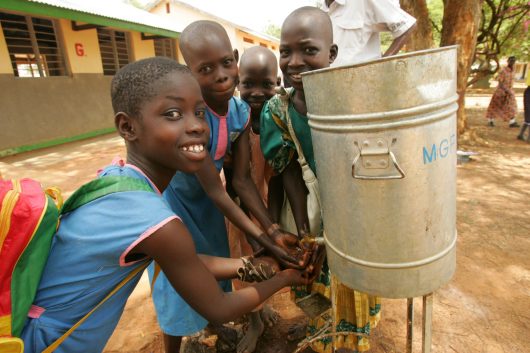
 Hygiene-related illnesses cause more than 1.8 million deaths worldwide and the Global Soap Project (GSP) is taking a stand to reduce this number by taking advantage of the 2.6 million bars of soap are thrown away in hotels daily.
Founder Derreck Kayongo was inspired to provide hope to refugees around the world with his own experience as a refugee when he fled a civil war in Uganda for the U.S. at age ten.” Ask any refugee anywhere in the world, they’ll tell you that they lose dignity right off the bat,” Kayongo stated in a passionate talk hosted by Keppler Speakers.
Since its inception in 2009, GSP has been improving the lives of people in 32 countries by distributing clean soap and educating communities on hygiene. The life-saving organization targets victims of disaster, refugees, the homeless and mothers and children living in extreme poverty. The goal? Making an impact on global health.
The Global Soap Project has implemented educational programs providing access to information otherwise unattainable, such as how and when to use soap and its importance to sanitation, hygiene and long-term health. The GSP and its partner, Clean the World, collects unused soap from hundreds of hotels that have united with the organization.
Then, GSP recycles and redistributes them, with help from organizations such as the Centers for Disease Control and Prevention (CDC), Partners in Health and CARE.
The organization has created a micro-loan program that offers financial and training support to local, small-scale soap makers. To support this initiative, hotels send boxes of unused soap to GSP, where they are recycled, inspected and given to NGO’s for shipment to affiliations in impoverished areas.
NGO’s are not charged for the provided soap. After distribution, NGO partners relay reports of successful dispersion and educational programs. In Kenya, the Global Soap Project has had a sizable impact. The organization distributed soap to more than 300 families in Lindi, located within one of the largest slums in Africa. GSP also allocated soap to 1,320 students in Kenya.
https://youtu.be/htSyaFAGY4U
According to the GSP, a head teacher from a receiving school, commented on the organization’s success and expressed gratefulness. He stated, “Most of my kids know how to use soap after toilet, after eating, after playing, after classes, and you will find them with soap in their hands and in school compound. So thank you HHRD and GSP for this so unique gift, because it has brought a big impact in our school.”
Within the international community, world health has been a topic of concern. The World Bank has worked with organizations such as WHO and UNICEF gathering the most recent information about hygiene in developing and impoverished areas.
According to the World Bank, hygiene and hand washing have an immense impact on the quality of health and the ability to avoid deadly sicknesses like diarrhea and pneumonia. With over 4 billion cases of diarrhea per year, about 1.6 million of those are found in children under the age of five.
The GSP’s ideals are solidified by the World Bank, as it is suggested that, “public health promotion and education strategies are needed to change behaviors.” School health programs are imperative in ensuring that students have sanitation standards that can be translated into community principals.
The organization promotes involvement by accepting donations and volunteers and makes it easy for hotels to contribute. It has grown exponentially, expanding as a global leader in health promotion and implementation and continues to serve around the world. “Our soap doesn’t just mean health,” Kayongo says, “it means hope.”
– Kimber Kraus
Photo: Flickr

UNICEF Education Campaigns Target Children in Crisis
A child’s right to education is threatened most during times of crisis — whether by natural disasters or war. Here are six facts explaining how crises affect education globally:
The Education Cannot Wait Fund and #EmergencyLessons education campaigns are leading the way to make education a priority, during and after crises. UNICEF launched Education Cannot Wait at the World Humanitarian Summit in May 2016. The fund is dedicated to supporting global education during emergencies.
Education Cannot Wait aims to close the $8.5 million funding gap and reach the 75 million children who are out of school by 2030.
In addition to The Education Cannot Wait Fund, the #EmergencyLessons education campaign was launched by UNICEF and the European Union on May 16, 2016, to stress the importance of childhood education during emergencies.
The campaign shares the personal stories and experiences of adolescents living in emergencies through social media. #EmergencyLessons targets young Europeans with the goal of inspiring awareness and support for the children whose education has been interrupted.
“Our message today is not that children need education even in emergencies, it’s that children need education especially in emergencies,” stated Queen Rania of Jordan at an Education Cannot Wait event.
Education Cannot Wait and #EmergencyLessons are working to make education a focus alongside food, water and shelter during and post periods of instability. Through these education campaigns, countries have the opportunity to empower young girls, promote economic growth and build more resilient communities.
– Erica Rawles
Photo: Flickr
How Laptops Are Helping Cooperatives in Rwanda
In today’s world, laptops are often taken for granted. To the members of farming cooperatives in Rwanda however, they are vital tools that are helping them better manage their business.
According to the National Cooperatives Confederation of Rwanda (NCCR), there are about 7,500 cooperatives in the country with a total of three million members as of 2016.
Despite their small scale, cooperatives have produced some successes. Smallholder farmers in Muko sector, located in the northern Rwandan district of Musanze, are one example.
A few years ago, with the help of ActionAid Rwanda and Faith Victory Association, individual farmers, and households that were working separately, came together to form cooperatives and savings groups.
Now, farmers in the district reported that they have tighter, improved food security. A maize milling factory, which cost 35 million Rwandan francs (Rwf) of NGO money to build and churns out 1.2 metric tons of maize flour each day, has generated a total profit of Rwf3.2 million, or about $4,000, for the cooperatives in the sector. Moreover, the savings groups have allowed families to construct houses and single mothers to pay for their children’s education.
Cooperatives demonstrate enormous poverty-reduction potential, but many suffer from mismanagement and a lack of engagement from members, who only contact managers occasionally.
According to Médiatrice Kibukayire, the head of a Kacyiru, Gasabo District-based ceramics cooperative, the problem is that everything is done by pen and paper. Among other things, this makes it harder for cooperatives to keep track of financial records and reach out to members for their input.
Indeed, in 2014, Augustin Katabarwa, the Chairman of the NCCR, stated that the biggest challenge facing cooperatives is gaps in technology.
This is why Africa Smart Initiative-Distribution (ASI-D) launched a new project called SMART Cooperative on June 14, 2016.
The initiative will enable laptops to be made locally in the Rwandan capital of Kigali by Positivo-BGH, a Latin American multinational tech company, and distributed to cooperatives in Rwanda.
According to Alleluya Iradukunda, ASI-D’s Chief Technology Officer, the software that comes with the devices will help managers coordinate with members, create websites to market their products and streamline their operations.
The initiative is not without difficulties, among which are equipment costs. While the base price of the laptop is Rwf230,000 (around $295) this rises to Rwf530,000 if a solar kit and an internet connection need to be installed. More IT education and training are also required to equip managers with the skills needed to run their cooperatives with the new software.
These problems, however, do not discount the benefits of improved technology for cooperatives in Rwanda. More initiatives like SMART Cooperative can help reduce the digital divide within the country and alleviate poverty in the process.
– Philip Katz
Photo: Flickr
How to Prevent the Zika Virus
According to the Center for Disease Control (CDC), the “Zika virus disease (Zika) is a disease caused by the Zika virus which is spread to people primarily through the bite of an infected Aedes species mosquito.” The disease can cause symptoms like fever, rash and joint pain, although most symptoms go unnoticed. Learning to prevent the Zika virus, then, is imperative.
The most severe symptom is microcephaly, which is a birth defect that causes babies to be born with smaller than average-sized heads. This is of grave concern to pregnant women or women who are trying to become pregnant who have traveled or have partners who have traveled to countries where the disease is present.
Although there are currently no vaccines for the disease, there are five easy steps you can take to prevent the Zika virus from reaching you or your loved ones:
The fight to eliminate the Zika virus has skyrocketed, resulting in incredible scientific innovations. For instance, scientists from the U.K. have released genetically modified male mosquitoes who cause populations of local mosquitoes to fall.
Another technique includes inserting a gene drive into mosquitoes to make them unable to host the Zika virus within their bodies.
Researchers are also utilizing cellphones to track and record people’s movements and use this data for documenting Zika hotspots throughout the world.
As more techniques on how to prevent the Zika virus are discovered, all hope that the spread of the disease can be contained effectively.
– Julia Hettiger
Photo: Flickr
The Importance of Data Analysis in Monitoring Global Poverty
While taking action is an important part of fighting global poverty, it is also critical that international organizations correctly assess the situation through different methods of data collection and analysis. Monitoring global poverty is crucial for ending it.
Since the World Bank’s first census in 1975, attempts to monitor global poverty levels have widened in both scope and methodology. The invention of PovcalNet in the 1980s enabled researchers to access the poverty distributions of 191 countries online. However, the diversification of research methods entailed as much inconsistency as convenience, as data collected by different teams seemed to suggest entirely different results.
Since one organization cannot survey all the households of the world, analysts often collect survey results from the governments of different countries. This introduces inconsistencies into investigation methods, including differing methods of selecting and interviewing sample populations.
When measuring qualitative measures such as household participation, patterns of consumption and perception towards poverty, long-term participatory observation can be more appropriate than surveys, as the wording of questions can manipulate the results.
After data is collected, it is classified and represented into charts or graphs, where more complications can occur. There exist many statistical methodologies, including parametric, non-parametric and lognormal, and countries differ on how to define poverty in various environments.
To standardize data collection and facilitate monitoring global poverty, the World Bank has been urging nations to adopt the National Strategies for the Development of Statistics (NSDS), emphasized at the Marrakech Action Plan for Statistics in 2004.
NSDS requires not only economic support, but political cohesion between departments and local communities in each country. The NSDS Knowledge Base will compile research techniques and provide 100 indicators to the progress of Sustainable Development Goals so that results from different countries can be comparable.
Difficulties of standardization often derive from insufficient infrastructure, such as the failure to register all citizens on census, and requires a long-term investment. In such cases, innovative measures can improve cost-benefit efficiency.
The UN’s Data for Development report from 2015 suggests using satellite imagery and mobile-phone-based data collection. Instead of designing a separate survey, data from social media and mobile call traffic can be repurposed as an indirect indicator. In East Africa, for example, mobile technology is expected to cut up to 60 percent of the cost of traditional paper surveys.
– Haena Chu
Photo: Flickr
Amnesty International, Kurdistan to Protect Human Rights
On May 4, Amnesty International’s Secretary-General Shalil Shetty met with the President and Prime Minister of the Kurdistani Regional Government, or KRG, to discuss the humanitarian crisis in the region and collaborate to prevent human rights abuses by all parties.
This meeting, taking place in Kurdish Iraq, came just months after Amnesty International published a report in January accusing the KRG of rights abuses. Amnesty International’s report earlier in the year accused Kurdish allied forces of demolishing Iraqi homes and preventing Arab Iraqis from returning to their communities after they were recaptured from the Islamic State.
The report argued that displacements without military justification could be considered a war crime, but also acknowledged that many of the territories had been disputed prior to the Islamic State, with many ethnically cleansed of Kurds by Saddam Hussein’s regime.
Amnesty International also acknowledged that the alleged abuses were occurring in the context of an unprecedented security, humanitarian and financial crisis for the Kurdistani Regional Government. Still, they asserted that the government cannot allow that to justify turning a blind eye to abuses within its territories.
More than a million foreign refugees and internally displaced persons are currently seeking shelter in Iraqi Kurdistan.
The KRG immediately responded to Amnesty International’s report, contending that it is the policy of its armed forces not to allow immediate return to recently recaptured territories for civilians of any ethnicity, due to proximity to continued conflict and due to the Islamic State’s tendency to leave IEDs behind when it withdraws.
In a further expression of concern for human rights, the KRG promised to conduct a full investigation into the reports compiled by Amnesty International. They granted AI and other rights groups full access to its territories in order to conduct their own independent investigations to ensure the protection of human rights.
Shetty thanked the KRG for its commitment to preventing abuses in the face of tremendous adversity, and acknowledged the long history of Kurdish cooperation with AI and other rights groups.
– Hayden Smith
Photo: Flickr
Five Movies About Hunger You Should Watch
Slumdog Millionaire tells the story of a young man named Jamal as he progresses through the Indian game show, “Who Wants to be a Millionaire.” Through flashbacks, Jamal recounts growing up as an orphan on the streets of Mumbai where he and his friends had to pull off elaborate schemes just to get enough money to survive.
Interstellar takes place in future where the world is plagued by food shortage and drought. Matthew McConaughey plays Cooper, a man who sets out into space in order to find a new planet for humans to inhabit. While trying to save his family and the human race, Cooper and his crew find more than they ever expected.
Panem is a land split into 12 districts ruled by a corrupt government. Every year, two children from each district are chosen to participate in a bloody competition called The Hunger Games as punishment from the government. Katniss Everdeen (Jennifer Lawrence) is from District 12, where the local population is forced to break the laws in order to supply her friends and family with food. Katniss volunteers to compete in The Hunger Games to save her sister, thus sparking her future as “The Mockingjay.”
Aliens arrive in South Africa looking for help, but after the dust settles, the South African government is responsible for hundreds of thousands of unruly aliens. The aliens are separated from humans and placed in slums where they must rummage through trash piles to find food and make shelters. When a government agent named Wikus is infected with a strange virus, he must make new allies in order to try and cure himself.
After his wife leaves him, Chris Gardner (Will Smith) and his son have to endure the ups and down of urban poverty. Even after Chris lands a promising internship, he must fight to provide food and shelter for his son.
While these movies about hunger remind viewers that hunger exists, they also show that hunger is a chief motivation factor for far more beyond curbing an appetite. Success, comfortable living and even the strength to live are directly related to the accessibility of food. The fight to provide food, the central plot element in the movies about hunger, is a very real experience for people all over the world.
– Weston Northrop
Photo: Flickr
Global Polio Vaccine Switch Successful
Monitors from the World Health Organization are following up in various countries to confirm that stocks of the old vaccine have been properly disposed of. The switch was the second phase of the WHO’s Polio Eradication and Endgame Strategic Plan 2013–2018.
Eventually, the WHO’s plan anticipates a complete withdrawal from oral polio vaccines in 2019 or 2020. In addition, it foresees a complete reliance on inactivated vaccines, which contain dead forms of the virus.
Health care providers use oral vaccines because they are cheap and easy to administer. These vaccines work by containing a weakened, but still live, form of poliovirus and exit in the stool shortly after vaccination. In areas with very inadequate sanitation, the viruses have an extremely small chance of spreading between children and redeveloping the ability to cause paralysis.
The switch is from a trivalent form of the polio vaccine that protected against three strains of the virus. The newer, bivalent form no longer contains the type 2 strain, which has been declared eradicated in its “wild” form with no new cases since 1999. Because the Type 2 vaccine viruses can reduce immunity to the other strains and increase the chance of redeveloping paralysis, removal of the type 2 component was the next step in the long-term polio eradication plan.
The global polio eradication has found success in all but two countries, Pakistan and Afghanistan, since it began in 1988. The U.S., which discontinued use of the oral vaccine since 1999, relies on the injectable polio vaccine and was not involved in the recent switch.
The slight possibility of a Type 2 poliovirus outbreak exists because of the switch. Therefore, a stockpile of monovalent oral polio vaccine containing only the type 2 virus will be kept. Synchronizing the switch across the globe was thus crucial in minimizing the risk of the Type 2 poliovirus reemergence.
Polio is at its lowest rates in history. Leaders of the eradication program foresee that if no additional cases occur in the next three years, polio could be declared fully eradicated by 2019. However, countries should continue vaccination for at least five years afterward. If success continues, polio will be only the second disease after smallpox to be eradicated by vaccines.
– Esmie Tseng
Global Soap Project: Changing the World with Suds
Founder Derreck Kayongo was inspired to provide hope to refugees around the world with his own experience as a refugee when he fled a civil war in Uganda for the U.S. at age ten.” Ask any refugee anywhere in the world, they’ll tell you that they lose dignity right off the bat,” Kayongo stated in a passionate talk hosted by Keppler Speakers.
Since its inception in 2009, GSP has been improving the lives of people in 32 countries by distributing clean soap and educating communities on hygiene. The life-saving organization targets victims of disaster, refugees, the homeless and mothers and children living in extreme poverty. The goal? Making an impact on global health.
The Global Soap Project has implemented educational programs providing access to information otherwise unattainable, such as how and when to use soap and its importance to sanitation, hygiene and long-term health. The GSP and its partner, Clean the World, collects unused soap from hundreds of hotels that have united with the organization.
Then, GSP recycles and redistributes them, with help from organizations such as the Centers for Disease Control and Prevention (CDC), Partners in Health and CARE.
The organization has created a micro-loan program that offers financial and training support to local, small-scale soap makers. To support this initiative, hotels send boxes of unused soap to GSP, where they are recycled, inspected and given to NGO’s for shipment to affiliations in impoverished areas.
NGO’s are not charged for the provided soap. After distribution, NGO partners relay reports of successful dispersion and educational programs. In Kenya, the Global Soap Project has had a sizable impact. The organization distributed soap to more than 300 families in Lindi, located within one of the largest slums in Africa. GSP also allocated soap to 1,320 students in Kenya.
https://youtu.be/htSyaFAGY4U
According to the GSP, a head teacher from a receiving school, commented on the organization’s success and expressed gratefulness. He stated, “Most of my kids know how to use soap after toilet, after eating, after playing, after classes, and you will find them with soap in their hands and in school compound. So thank you HHRD and GSP for this so unique gift, because it has brought a big impact in our school.”
Within the international community, world health has been a topic of concern. The World Bank has worked with organizations such as WHO and UNICEF gathering the most recent information about hygiene in developing and impoverished areas.
According to the World Bank, hygiene and hand washing have an immense impact on the quality of health and the ability to avoid deadly sicknesses like diarrhea and pneumonia. With over 4 billion cases of diarrhea per year, about 1.6 million of those are found in children under the age of five.
The GSP’s ideals are solidified by the World Bank, as it is suggested that, “public health promotion and education strategies are needed to change behaviors.” School health programs are imperative in ensuring that students have sanitation standards that can be translated into community principals.
The organization promotes involvement by accepting donations and volunteers and makes it easy for hotels to contribute. It has grown exponentially, expanding as a global leader in health promotion and implementation and continues to serve around the world. “Our soap doesn’t just mean health,” Kayongo says, “it means hope.”
– Kimber Kraus
Photo: Flickr
Afghanistan’s Sesame Street Debuts Female Muppet
According to PBS Newshour, although Afghanistan’s Sesame Street has been running for about five years, it has mostly included international versions dubbed into local languages, with only short sequences filmed locally.
The character is a six-year-old with multi-colored hair, wearing a headscarf with her school uniform, reported the New York Times. The debut of a female character is noteworthy for Afghanistan, where women’s rights are strictly curtailed.
Also notable is the extremely low rates of both education and literacy for girls in Afghanistan, with 85 percent of girls receiving now formal schooling, and a literacy rate of 24 percent, reported Newshour.
Under these circumstances, having a bright and curious female character like Zari debut to audiences in Afghanistan is a positive step. The Huffington Post reports that Afghanistan’s Sesame Street is the most watched show by young children in the country. Sesame Workshop, the non-profit that produces Sesame Street, recorded that 81 percent of children aged three to seven have seen it.
Sherrie Westin, Sesame Workshop’s executive vice president of global impact and philanthropy, spoke to Reuters about her excitement in introducing a female character. She thinks she may just have the power to change some minds, including fathers’ attitudes about educating daughters.
Westin told Reuters, “The exciting part about Zari is that she is modeling for young girls that it is wonderful to go to school and that it’s ok to dream about having a career.”
Specifically, Zari will appear in segments about health, exercise and well-being, reported the Huffington Post. One segment will feature Zari visiting her doctor for a check-up, and asking how she can become a doctor herself. Zari will interview various kinds of professionals for the show.
She will also speak directly to viewers and interact with kids in person on the show, said the New York Times.
According to Huffington Post, Sesame Workshop is working with the Afghan education ministry to try to reduce any resistance to the notion of an empowered female character on a popular children’s show.
Sesame Street changed attitudes in the U.S. when it debuted almost 40 years ago. As Westin told Reuters, “Part of the power of the broadcast and Zari’s potential as a role model is to reach children and parents where they may not have access to other educational content.”
– Katherine Hamblen
Photo: Flickr
Nations’ Plans To Prevent the Zika Virus from Spreading
Shortly after labelling the outbreak “a global health emergency,” WHO designed and implemented their Global Emergency Response Plan.
The plan focuses on mobilizing and coordinating with experts to aid in the surveillance of the Zika virus, its development and possibly linked disorders. It also emphasizes educating the public of the risks and proper protection measures.
Since May 2015, WHO’s Regional Office for the Americas has been closely working with affected nations. AMRO/PAHO and partner specialists were organized to assist health ministries in detecting and tracking to prevent the Zika virus from spreading. They also advise on clinical management of Zika and investigate the spikes in microcephaly and Guillain-Barré syndrome.
In a private, joint effort, the U.S. and Great Britain join a few nations taking the matter into their own hands.
The U.S. federal government is beginning to take action by permitting the release of genetically engineered mosquitoes, in the hope of slowing the spread of the virus.
The genetically engineered insects, containing a gene designed to kill their offspring, were developed by the British company Oxitec. The mutants have already shown effectiveness in small tests in Brazil and other countries in suppressing the populations of the mosquitoes that transmit both the Zika virus and dengue fever.
Under federal rules, genetically engineered animals are regulated as animal drugs, giving jurisdiction to the veterinary medicine division of the F.D.A.
The Zika virus was first identified in the Americas in March 2015, when an outbreak of an exanthematous illness occurred in Bahia, Brazil.
Brazil has also created their own initiatives to control mosquito populations and prevent the frequency of mosquito bites.
The Brazilian government created a task force designed to prevent the Zika virus from being transmitted for both short and long-term periods. Approximately 220,000 members from the army, navy and air force have united with 300,000 public agents and volunteers all over Brazil to exterminate breeding grounds.
Peru is also focusing on prevention. As of now, the nation only has one reported case. By fumigating areas from college campuses to bus terminals, government officials are hoping to prevent the establishment of the Zika virus inside their country. Percy Minaya, the Deputy Health Minister for Peru, visited Lima’s International Airport. Here booklets offering information on Zika prevention were handed out, as well as condoms, highlighting the important issue of sexual prevention when it comes to transmitting the virus.
– Veronica Ung-Kono