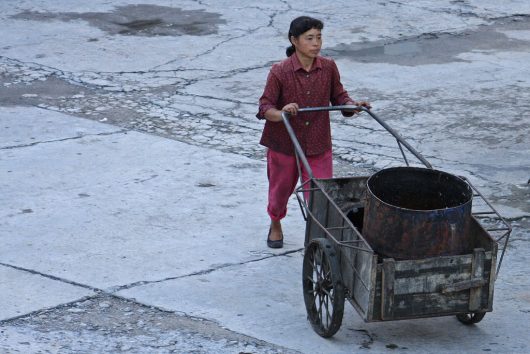
In 2012, speakers and screens worldwide played “Gangnam Style,” a song that illustrated the life of the city that contains seven percent of South Korea’s GDP in an area of 15 square miles. The hit surpassed two billion views on YouTube, but the opulence within the video is in no way representative of the true poverty in South Korea.
However, beneath the luxury, technology, and consumerism that characterize the nation is a forgotten and struggling generation largely responsible for transforming South Korea into a modern economy — the elderly.
Elderly Disproportionately Affected by Poverty in South Korea
Every Thursday, seniors line up for hours outside churches to receive the equivalent to 50 cents and a juice box or a banana. Organizers of this short-term relief program for poverty in South Korea report 300 to 500 seniors at each church every week.
“Half of the elderly is poor in [South] Korea. So it’s really a very serious problem,” Seoul National University professor Ku In-hoe told NPR. The country has the highest elderly poverty rate of the 34 developed nations.
The elderly living in poverty in South Korea earn 50% or less of the median household income, which amounts to U.S. $9,890 per year, according to the IB Times.
The government does provide alleviation with pensions of $200 per month for the retired, but the National Pension Research Institute Survey revealed this amounts to merely a quarter of the minimum income needed for single households. Furthermore, only an estimated 35% of seniors receive the pension.
While 7.9% of households with a retired senior describe their living expenses as “comfortable,” 41.7% rated them as “inadequate” and 20.4% as “extremely inadequate”.
Those living in poverty in South Korea increasingly rely on loans to survive. The national household debt recently topped US $971.6 billion, or 81% of the South Korean GDP.
“Before the 1990s, usually younger people supported their parents during their retirement so it was not that serious of a problem,” Ku added in his interview with the NPR. “But elderly people [now] live longer, and younger people also experience economic difficulty.”
In fact, the declining birth rate in South Korea will stymie the ability of the young to meet the demands of a growing population. The most recent Korean Census shows the elderly rose from seven percent of the population in 2000 to 12% in 2013. Experts expect a continued increase as more baby boomers age and retire.
An organizer of the church and mobile soup kitchen services, Pastor Choi Won, also cites the waning of Confucian traditions as a contributor to the elderly poor in an interview with Korea Portal.
“Gone are the days when children looked after their parents,” he said. One in three seniors lives alone in South Korea.
The South Korean government plans to provide more assistance in the future, as the pension system that began in 1988 evolves. Officials predict, “90 percent of people aged 64 and over will receive pension by 2060,” according to Korea Portal.
In the meantime, churches will continue to provide additional assistance to elders who experience poverty in South Korea.
– Ashley Leon
Photo: Flickr

Meet The Borgen Project’s Top Mobilizer
Ayusha Shrestha, an exchange student from Nepal is the winner of The Borgen Project’s Top Mobilizer Award. Ayusha attends Kennesaw State University and is a Political Affairs Intern for The Borgen Project in Georgia. In 15 days, Ayusha mobilized 67 people to email Congressional leaders in support of the Reach Every Mother and Child Act.
Chinese Teaching Methods Lead to Educational Success
China is known for having educational success. 70 United Kingdom (U.K.)-based teachers were sent to Shanghai in 2014 to study Chinese teaching methods. Surprised with what they found, they returned to the U.K. and reported China’s success in the classroom comes from the “chalk and talk” approach – a teaching method the West has been moving away from.
The “chalk and talk” approach is an example of direct instruction; it is when the teacher remains at the front of the classroom, directing learning, controlling classroom activities and ensuring a disciplined environment. This method has contributed to China’s great success in international tests such as the Programme for International Student Assessment (PISA), Trends in International Mathematics and Science Study (TIMSS) and Progress in International Reading Literacy Study (PIRLS).
Despite the technique’s proven success, the West strayed from direct instruction in the late 1960s and early 1970s. In an attempt to improve teaching methods, it developed what is referred to as discovery learning: basing learning on children’s interests, giving them more control over classroom activities and eliminating mental arithmetic.
Jun Yang-Williams, a teacher in English schools who previously taught in China said, “It seems… that British schools have almost dismissed the ‘teacher-led’ teaching style… Although the ‘teacher-led’ pedagogy is seen as passive, it does not necessarily jeopardize learning outcomes. Students are in fact more proactive and more responsible for their learning.”
Videoed lessons in both China and the U.K. revealed that whole-class teaching makes up 72 percent of Chinese lesson time, compared to only 24 percent in the U.K.
These supposedly innovative techniques were proven to do the opposite of what the West was trying to accomplish. A recent study of classrooms in the U.K. and China found increasing evidence that new-age teaching methods lead to under-performance.
Professor David Reynolds of Southampton University and postgraduate research student Zhenzhen Miao also conducted a test in 2014 on 562 students ages 9 and 10 from Southampton in the U.K. and from Nanjing in China using math tests from TIMSS. The average Chinese score was 83 percent, whereas the average English score was just 56 percent.
By establishing the basics and spending more time on teacher-led style, Chinese teaching methods lead to educational success. Teachers constantly ask and answer questions, invite students to demonstrate solutions on the board and quiz students about their thinking. The classroom is involved, but driven by the teacher rather than the students.
Even with teacher-driven classrooms, students are content with Chinese teaching methods. According to the 2012 PISA survey, 85 percent of Shanghai’s students agreed that they “feel happy at school” – a percentage much higher than the Organization for Economic Cooperation and Development (OECD) average.
Perhaps the West will consider reintroducing direct instruction to its teaching methods.
– Alice Gottesman
Photo: Flickr
New World Bank Chief Economist: Bold Ideas to Reduce Poverty
The World Bank Group (WBG) announced on July 18 that it had appointed Paul Romer as the next World Bank Chief Economist.
WBG President Jim Yong Kim has high hopes for Romer. “We’re most excited about his deep commitment to tackling poverty and inequality and finding innovative solutions that we can take to scale,” Kim said. Romer replaces Indian economist Kaushik Basu, who retired on July 31.
Romer is a professor of economics at the Stern School of Business at New York University (NYU). He also serves as Director of NYU’s Marron Institute of Urban Management and is a research associate at the National Bureau of Economic Research.
Several new organizations praised the pick for the new World Bank Chief Economist and predicted that Romer would bring about real change at the 72-year-old international financial institution.
The Economist described Romer as a formidable and often contrarian figure in the field of economics. He has criticized his profession for its obsession with obscure models and equations, which he terms “mathiness.”
“For me, the most exciting part about economics is going beyond knowledge that is only potentially useful to knowledge that is actually useful, and doing so on a scale that touches millions or billions of lives,” Romer explained in the World Bank press release.
Romer has also done impressive work both as an academic and an entrepreneur, according to Noah Smith of Bloomberg View. In the 1980s, he was one of the first economists to champion the endogenous growth theory. Technological change, according to his model, occurs as a result of investment in research and development, which creates growth within the economy at large (hence the term “endogenous growth”).
It is important to spend money on innovation because ideas, once created, are disseminated at little or no cost. Romer led by example through his education-technology start-up Aplia, which he founded in 2000.
Among one of Romer’s more unorthodox ideas is the concept of “charter cities.” In line with the endogenous growth theory, he believes developing countries should spend money to build new cities as sites for policy and economic experimentation. He cited Hong Kong and Shenzhen in China’s Pearl River Delta as success stories and a model for these charter cities to follow.
As World Bank Chief Economist, Romer will provide intellectual guidance to the President and the senior management. His staunch support for financing innovation and testing new approaches in order to reduce poverty brings new life to the World Bank’s development goals.
– Philip Katz
Photo: Flickr
Reducing Food Waste to Address Poverty and Climate Change
Reducing food waste could potentially prevent climate change and help end global poverty. In the first study of its kind, the Food and Agriculture Organization (FAO) calculated that the world’s population wastes 1.3 billion tons of food per year. That food waste also results in 3.3 billion tons of greenhouse gases entering the atmosphere.
Food waste also costs the world $750 billion annually. The United States alone wastes $161 billion a year. Another study calculated that $265 billion per year would end world poverty and hunger by 2030.
The FAO’s study, “Food Wastage Footprint: Impacts on Natural Resources,” focuses specifically on the environmental impacts of wasting food. A 54 percent majority of this waste occurs during the production phase, and developing nations struggle most during this part.
On the other hand, 46 percent of food waste occurs during the distribution and consumption of those products. Developed countries waste more during the consumption phase; they are responsible for 31 to 39 percent of total food waste.
Reducing food waste requires positive change in all phases of the food production and consumption chain. The FAO also suggested teaching more environmentally friendly farming practices and better analysis of the balance between supply and demand. As a result, the entire food production process would be more efficient and profitable during both phases.
Not only does reducing food waste affect the economy and environment, but it also has a positive social impact. If consumers in developed countries reduced their food waste, then farmers in developing nations would have more land and other resources. These farmers could use the extra water and space to grow the foodstuffs their countries (and other developing nations) need.
Both the Environmental Protection Agency (EPA) and FAO provide toolkits for reducing food waste. The EPA’s toolkit also provides a guide full of information specifically about the U.S. It also contains an implementation plan for starting a local advocacy movement. Here are just a few ways individuals can help reduce food waste:
Food waste clearly has a widespread impact in all avenues of human life. Better communication and balance between farmers and distributors would save both money and the environment. More thoughtful purchasing and consumption at the individual level would also contribute. If the world can cooperate and reduce food waste, then there is greater hope for the end of environmental destruction and global poverty.
– Taylor Hazan
Photo: Pixabay
The Plaguing Hunger in Cambodia
In 2011 heavy rain caused one of the worst floods in the history of Cambodia. The severe weather inundated 70 percent of the country leaving a lasting impression that is still felt today. In addition to the sheer destruction of communities and loss of human life, one of the worst backlashes was the wiping away of fields of crops resulting in widespread malnutrition and hunger.
According to the World Food Programme (WFP), “Cambodia produces a surplus of paddy rice for export, household access to sufficient and nutritious food remains a serious challenge.” This problem directly correlates to the high level of poverty in the country. About 90 percent of the poor population in Cambodia live in rural areas. These individuals are the most affected by hunger.
Currently, two-thirds of the country’s 1.6 million rural households face seasonal food shortages each year. The practice of farming in Cambodia is traditional and with that comes along the problem that productivity is very low because it takes longer and it’s a more tedious practice of farming.
The numbers in regards to rates of malnutrition in Cambodia are extremely high, almost 40 percent of children under five are chronically malnourished and suffer from stunting. Within that 40 percent over 28 percent are underweight. Children aren’t the only ones suffering from malnutrition and hunger as one in every five women is underweight.
Although the fact and figures on hunger in Cambodia are alarming, aid is being provided. In December 2015, Action against Hunger with the help of Google launched Nutritional Resilience, a project that takes an integrated, multi-dimensional approach to implementing sustainable solutions to undernutrition.
The WFP is also helping by working with the Royal Government of Cambodia reaching over 1 million food-insecure people annually in the rural areas through its 2011-2016 Country Program which includes providing food-based safety nets in the sectors of education, nutrition and livelihoods.
– Mariana Camacho
Photo: Flickr
How Poverty Exacerbates Illegal Organ Trading
Unfortunately, it is not uncommon for extremely poor families around the world to go through extreme measures in order to make money. Some households have resorted to the unusual tactic of organ trading on the black market to afford food and other necessities.
The issue also affects the Western world as a 2014 piece in the Sunday Post highlights the prevalence of black market organ selling in the United Kingdom. Though it is highly illegal, those desperate for both money and organs often turn to social media to plan their transactions.
Jeff Powell from the U.K.-based anti-poverty charity aptly named War on Want says, “It is shocking that people are so poor that they would be willing to sell a kidney for cash. This level of desperation is a direct result of governments… and the interests of the rich over the fight against poverty and inequality.” At the time of publication, 10,000 people in the U.K. were in need of an organ transplant, leaving many opportunities for potential sellers.
Multiple instances of illegal organ trades in Iraq have made the news recently. Since over 22 percent of the Iraqi population lives in poverty, families sometimes take desperate measures to make money. In Iraq, gangs offer up to $10,000 for a kidney on the black market.
In Iraq, it is only legal to donate organs to relatives, but illegal traders find ways (ie forging documents or signatures) around this rule. A surgeon in Baghdad explains that healthcare workers are not held responsible for illegal donations because “… in some cases, we have doubts, but this is not enough to stop the surgery because without it people will die.”
An Iraqi human rights lawyer feels sympathy for those who turn to selling organs saying, “Picture this scenario: an unemployed father who does not have any source of income to cater for his children. He sacrifices himself. I consider him a victim and I have to defend him.”
Illegal organ trading is also prevalent in Bangladesh, where many poor citizens are faced with repaying loans from non-governmental organizations that they cannot afford. Some individuals grow tired of dodging debt collectors and see the organ black market as their only option.
A University of Michigan anthropology professor explains that these exchanges are often done under sub-par conditions. “There is no safeguard as to where the organs are coming from and how safe they are, and on the other hand, the seller’s health deteriorates after the operation. That has a huge impact on their earning capacity because they cannot go back to their old physically demanding jobs.”
Although it is not foolproof, Iran seems to have found a possible solution to illegal organ trading: legalization. Iran has the only government-supported program involving trading organs for monetary compensation, but the terms vary by district. However, some Iranian markets favor the recipient, meaning that sellers may not be compensated as much as they would like. Those who do sell their organs also receive a free year of health insurance from the government and are not required to enlist in the usually mandatory military service.
Sigrid Fry-Revere, an American bioethicist is the president of the American Living Organ Donor Network and believes the US and other countries around the world should be following Iran’s example. Their arrangement allows those in poverty to make money and decreases those waiting for much-needed transplants.
Though Iran’s organ transplant programs are far from perfect, they seem to be one step ahead of many countries around the world. A legalized procedure almost guarantees safe surgery conditions for both recipients and sellers, and works to provide a mutually beneficial trade.
– Carrie Robinson
Photo: Flickr
Brick Kilns in Bangladesh Reduce Emissions and Poverty
Poor children who drop out of school to feed their families become a source of cheap labor for kiln owners in the northwestern Indian state of Jammu and Kashmir. These children often develop health problems as a result of long-term exposure to smoke and coal dust.
Along the same lines, an openDemocracy article published on July 21, 2016, revealed the cycle of debt and poverty generated by brick kilns in Pakistani Punjab.
Traditional fixed chimney kilns are also an environmental concern. According to the World Bank Group, an estimated 8,000 traditional kilns emit 10 million tons of carbon dioxide every year in Bangladesh alone.
The Bangladeshi HHK project, which began in 2008, has sought to address the many problems associated with traditional kilns. Thanks to financing and support from the World Bank Group and the Industrial and Infrastructure Development Finance Company Limited (IIDFC), there are now nine HHK brick kilns in Bangladesh.
HHK technology originated in Germany but has been modified to fit local needs. By recycling waste heat from the kiln and using a greener mix of coal and clay to burn the bricks, HHKs use only half as much coal as fixed chimney kilns, reducing pollution by 50 percent.
In addition to being environmentally friendly, the new brick kilns also have incredible economic benefits; their technology allows them to operate year-round. An HHK kiln can produce an average of 11 million more bricks per year than can a fixed chimney kiln. More efficient production means higher income for kiln workers.
Reduced pollution becomes an additional source of revenue for HHK kiln operators. By cutting carbon emissions, they receive certified carbon credits (CERs), which the World Bank Group’s Community Development Carbon Fund (CDCF) and the Danish government then purchase from them. Kiln owners must spend some of the money they earn from carbon credits on healthcare, better facilities and new safety measures.
The biggest problem with HHKs is the price tag. Building an HHK kiln costs 15 times as much as building a traditional one. It will take an estimated $3 billion to construct 1000 HHKs. However, their many environmental and economic benefits make these improved brick kilns a worthwhile investment.
– Philip Katz
Photo: Flickr
Education and Improving Sanitation in Developing Countries
Sanitation in developing countries is a very pressing issue. Globally, almost 2.5 billion people live without proper sanitation and almost 1 billion of these people practice open defecation. Poor sanitation not only leads to the rapid spread of disease, but can also affect education and the environment.
Though improper sanitation affects both rural and urban communities, open defecation is more common in rural communities, often resulting from traditional beliefs or a lack of education.
While traditional beliefs are important, some beliefs can be damaging in terms of sanitation. For instance, some communities in Madagascar believe that using an outhouse can cause an expecting mother to lose her child. There is also a common belief that defecating in the ground is disrespectful to those who have died and been buried.
These myths create an environment where poor sanitation practices like open defecation are commonplace. Unfortunately, these practices can lead to contaminated food and water sources. Consuming contaminated food or water causes high rates of bacterial diarrhea, which is the second largest killer of children under the age of five in the world.
To fight the effects of beliefs that lead to poor sanitation in developing countries, education programs must be implemented. In fact, in addition to avoiding deaths due to diarrhea, communities benefit in multiple ways from hygiene and sanitation education.
According to the World Health Organization, when educated about the link between sanitation, hygiene, health and economic development, communities have a higher demand for improved sanitation facilities. Additionally, when children are not sick from consuming contaminated food or water, they are able to attend school more often and focus on their studies.
For children in developing countries, every moment of schooling can have a large impact. It has even been found that one additional year of schooling can increase a woman’s income potential by up to 20 percent in developing countries.
Yet in order for education effectively improve sanitation in developing countries, it must be implemented correctly. Education has the largest impact on children, and they can take hygiene practices home and show them to their family members. When children eventually grow up to be parents, they can raise their children with the hygiene practices instilled in them.
Education is even possible in illiterate communities. One organization offers sanitation education in the form of puppet shows.
Global sanitation has a lot of room for improvement, but by implementing simple yet effective hygiene and sanitation education programs, the world could take an important step forward in the fight against not only poor sanitation in developing countries, but global poverty as a whole as well.
– Weston Northrop
Photo: Flickr
Bride Burning in India Becomes a Thing of the Past
The human rights tragedy of bride burning occurs when individuals drench and burn a female bride using flammable liquid after she has not procured enough dowry money for the groom’s family. Although bride burning occurs in several countries like Pakistan and Bangladesh, the practice is most common in India and has been one of the country’s major issues for decades.
Bride Burning
In India, bride burning accounts for the death of at least one woman every hour. According to data from the National Crime Records Bureau, over 8,000 reported cases of dowry deaths occurred in 2010. This travesty is related to the ancient tradition of dowry and society’s effects of poverty. A dowry is an exaction of money or material goods given to the groom’s family as a wedding token. Most families who require a high dowry do so to advance their economic situations.
Bride burning occurs when the groom’s family believes they have not received enough money for their son at the time of the wedding. The family of the groom may be from a higher caste, publicly known, or just want more money.
Parental Control
Syed, a man from Chennai, India, blames his family’s high dowry as the reason why he is still unmarried at age 35. When he asked his mother why she demands such a high dowry from the bride, she says, “We have spent so much on you, for your education, for raising you and now we will marry you off and most of the money you earn will go to your wife. So she will benefit from all the money we spent on you. For that, they can pay an amount to have our son.”
This story is an example of the views of many Indian parents. Some males are opposed to dowries but in the end, their parents are the determining factor.
Dowry Prohibition Act
In 1961, India established the Dowry Prohibition Act. The law banned paying and receiving dowries and set penalties for violators. Some amendments have been proposed or added in reference to the Act over the years. Additionally, the Indian Penal Code tailored their law in 1983 to specifically tackle dowry-related issues. The Code also added penalties for harassment of a woman by her marital family.
In 2014, the National Commission for Women in India proposed several amendments to the Dowry Act. These amendments would redefine the word “dowry” and included penalties and provisions for misuse of the act. Although these amendments did not prove favorable, they were a step in the right direction in bringing forward legislation to protect women.
Several women’s rights organizations in India help provide victims with places to stay and counseling sessions. The government also started numerous grass-roots organizations to provide family counseling. The incentive is to promote, mediate, and strengthen family ties.
With the help of global awareness and proposed legislation, India will be able to tackle its patriarchic and misogynistic perspective towards women and the poor. One way to prevent bride burning can be through education, narrowly tailored laws and greater public awareness.
– Needum Lekia
Photo: Flickr
Poverty in South Korea: Remembering a Forgotten Generation
In 2012, speakers and screens worldwide played “Gangnam Style,” a song that illustrated the life of the city that contains seven percent of South Korea’s GDP in an area of 15 square miles. The hit surpassed two billion views on YouTube, but the opulence within the video is in no way representative of the true poverty in South Korea.
However, beneath the luxury, technology, and consumerism that characterize the nation is a forgotten and struggling generation largely responsible for transforming South Korea into a modern economy — the elderly.
Elderly Disproportionately Affected by Poverty in South Korea
Every Thursday, seniors line up for hours outside churches to receive the equivalent to 50 cents and a juice box or a banana. Organizers of this short-term relief program for poverty in South Korea report 300 to 500 seniors at each church every week.
“Half of the elderly is poor in [South] Korea. So it’s really a very serious problem,” Seoul National University professor Ku In-hoe told NPR. The country has the highest elderly poverty rate of the 34 developed nations.
The elderly living in poverty in South Korea earn 50% or less of the median household income, which amounts to U.S. $9,890 per year, according to the IB Times.
The government does provide alleviation with pensions of $200 per month for the retired, but the National Pension Research Institute Survey revealed this amounts to merely a quarter of the minimum income needed for single households. Furthermore, only an estimated 35% of seniors receive the pension.
While 7.9% of households with a retired senior describe their living expenses as “comfortable,” 41.7% rated them as “inadequate” and 20.4% as “extremely inadequate”.
Those living in poverty in South Korea increasingly rely on loans to survive. The national household debt recently topped US $971.6 billion, or 81% of the South Korean GDP.
“Before the 1990s, usually younger people supported their parents during their retirement so it was not that serious of a problem,” Ku added in his interview with the NPR. “But elderly people [now] live longer, and younger people also experience economic difficulty.”
In fact, the declining birth rate in South Korea will stymie the ability of the young to meet the demands of a growing population. The most recent Korean Census shows the elderly rose from seven percent of the population in 2000 to 12% in 2013. Experts expect a continued increase as more baby boomers age and retire.
An organizer of the church and mobile soup kitchen services, Pastor Choi Won, also cites the waning of Confucian traditions as a contributor to the elderly poor in an interview with Korea Portal.
“Gone are the days when children looked after their parents,” he said. One in three seniors lives alone in South Korea.
The South Korean government plans to provide more assistance in the future, as the pension system that began in 1988 evolves. Officials predict, “90 percent of people aged 64 and over will receive pension by 2060,” according to Korea Portal.
In the meantime, churches will continue to provide additional assistance to elders who experience poverty in South Korea.
– Ashley Leon
Photo: Flickr