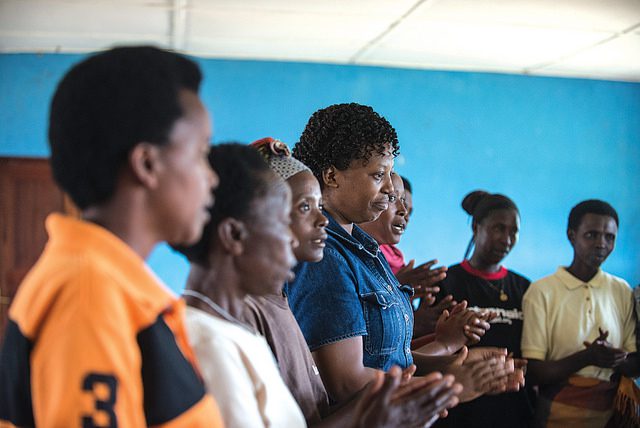
 After the three-month-long genocide in 1994 that claimed the lives of approximately 800,000 predominantly Tutsi and moderate-Hutu citizens, Rwanda has been working to rebuild, reconstruct and promote lasting peace and stability.
Poverty in the post-genocide years is still a prevalent issue, even after 23 years of reconstruction in Rwanda. More than 60 percent of the population lives on less than $1.25 a day, and the nation failed to meet the U.N. Millennium Development Goal of halving the 1990 poverty rate by 2015. However, the current state of poverty must be considered in the context of the conflict and upheaval Rwanda has experienced and the progress it has made since its brutal setback.
Between 2000 and 2010, there was a 23.8 percent reduction in poverty. Rwanda has also become one of the fastest-growing economies in Central Africa. It had four straight years, between 2011 and 2014, of GDP growth at eight percent. These are all positive signs for Rwanda’s future.
Since the genocide and the preceding civil war, under the leadership of former-RPF leader Paul Kagame, the government, local NGOs and the international community have worked toward reconstruction in Rwanda.
On the federal level, economic reform has led to rapid and sustainable economic growth which has lifted many people out of poverty. Privatization and liberalization have been the core tenets of this economic growth. More specifically, it has been achieved by increasing opportunities for employment outside of the agricultural sector, increasing agricultural productivity and increasing entrepreneurship and small business ownership.
Women have been central to reconstruction in Rwanda. Women make up 57 percent of the adult working population and they produce nearly 70 percent of the country’s overall agricultural output. Women have also organized themselves into socio-professional associations, development associations and cooperative groups, thereby taking control of and exercising agency over the reconstruction process.
Outside of the economy, gender equality has still been a focus, especially in politics. Women make up 64 percent of the Rwandan parliament, which is three times the worldwide average of 22 percent.
Interpersonal social reconstruction has also been a necessity, since the conflict exploited ethnic divides and hatreds. On the federal level, Rwanda adopted a policy of de-ethnicization wherein they “erased” ethnicity, stating that there were no longer Hutu and Tutsis, only unified Rwandans. On the local level, communities implemented Gacaca community courts to relieve the judicial burden of the International Criminal Tribunal of Rwanda and foster accountability and reconciliation.
Local organizations and initiatives have had a crucial role to play in reform and reconstruction. These groups have worked on both the community empowerment and economic empowerment levels, as well as on many other fronts.
The Pro-Femmes Twese Hamwe’s Action Peace Campaign works to empower women to realize the need to live in peace, give them the tools to live together peacefully and organize “dialogue clubs” to address underlying tensions. Another initiative, TO THE MARKET, is an online sales platform where genocide survivors can sell homemade goods globally. This harnesses local entrepreneurship and economically empowers the artisans.
Regarding the government, Kagame’s leadership has been strong and authoritative. While this has allowed him to mandate many economic reforms, it has also squashed political dissidence and limited freedom of the press.
The needs of women continually need to be met. The Rwandan Genocide was the first time in which mass rape was recognized as a tool of genocide. The prevalence of rape during the conflict means that today there are thousands of survivors who need unique support from the government and from society.
Finally, Rwanda is still very dependent on foreign aid. Approximately 35 percent of its budget comes from foreign aid. The next step in reconstruction should be to increase independence and make sustainable economic advancements so Rwanda can support itself with less support from the international community.
– Olivia Bradley
Photo: Flickr

Post-Genocide Reconstruction in Rwanda
Poverty in the post-genocide years is still a prevalent issue, even after 23 years of reconstruction in Rwanda. More than 60 percent of the population lives on less than $1.25 a day, and the nation failed to meet the U.N. Millennium Development Goal of halving the 1990 poverty rate by 2015. However, the current state of poverty must be considered in the context of the conflict and upheaval Rwanda has experienced and the progress it has made since its brutal setback.
Between 2000 and 2010, there was a 23.8 percent reduction in poverty. Rwanda has also become one of the fastest-growing economies in Central Africa. It had four straight years, between 2011 and 2014, of GDP growth at eight percent. These are all positive signs for Rwanda’s future.
Since the genocide and the preceding civil war, under the leadership of former-RPF leader Paul Kagame, the government, local NGOs and the international community have worked toward reconstruction in Rwanda.
On the federal level, economic reform has led to rapid and sustainable economic growth which has lifted many people out of poverty. Privatization and liberalization have been the core tenets of this economic growth. More specifically, it has been achieved by increasing opportunities for employment outside of the agricultural sector, increasing agricultural productivity and increasing entrepreneurship and small business ownership.
Women have been central to reconstruction in Rwanda. Women make up 57 percent of the adult working population and they produce nearly 70 percent of the country’s overall agricultural output. Women have also organized themselves into socio-professional associations, development associations and cooperative groups, thereby taking control of and exercising agency over the reconstruction process.
Outside of the economy, gender equality has still been a focus, especially in politics. Women make up 64 percent of the Rwandan parliament, which is three times the worldwide average of 22 percent.
Interpersonal social reconstruction has also been a necessity, since the conflict exploited ethnic divides and hatreds. On the federal level, Rwanda adopted a policy of de-ethnicization wherein they “erased” ethnicity, stating that there were no longer Hutu and Tutsis, only unified Rwandans. On the local level, communities implemented Gacaca community courts to relieve the judicial burden of the International Criminal Tribunal of Rwanda and foster accountability and reconciliation.
Local organizations and initiatives have had a crucial role to play in reform and reconstruction. These groups have worked on both the community empowerment and economic empowerment levels, as well as on many other fronts.
The Pro-Femmes Twese Hamwe’s Action Peace Campaign works to empower women to realize the need to live in peace, give them the tools to live together peacefully and organize “dialogue clubs” to address underlying tensions. Another initiative, TO THE MARKET, is an online sales platform where genocide survivors can sell homemade goods globally. This harnesses local entrepreneurship and economically empowers the artisans.
Regarding the government, Kagame’s leadership has been strong and authoritative. While this has allowed him to mandate many economic reforms, it has also squashed political dissidence and limited freedom of the press.
The needs of women continually need to be met. The Rwandan Genocide was the first time in which mass rape was recognized as a tool of genocide. The prevalence of rape during the conflict means that today there are thousands of survivors who need unique support from the government and from society.
Finally, Rwanda is still very dependent on foreign aid. Approximately 35 percent of its budget comes from foreign aid. The next step in reconstruction should be to increase independence and make sustainable economic advancements so Rwanda can support itself with less support from the international community.
– Olivia Bradley
Photo: Flickr
Five Active Development Projects in India
These are just five of the 121 active development projects in India which are being organized by the World Bank Group. Projects like these are bringing India closer to becoming a fully developed nation and improving the quality of life for all of the Indian people.
– Tyler Troped
Photo: Flickr
Billion-Dollar Investments in Development Projects in Turkey
The Istanbul New Airport
The first of these development projects is the construction of Turkey’s third international airport; its current name is the Istanbul New Airport. When completed, this airport will be the largest international airport in the world. As mentioned, since Turkey is a bridge between Asia and Europe, its airports receive a lot of traffic. In 2018, by the airport’s completion, it will have already provided business to 150 million people. This extensive project, with a projected cost of $11.3 billion, will not only hold 500 airplanes and rail-connected terminals but also provide the best security available. Security is a top concern, especially after the Atatürk Airport terrorist attack in 2016 that killed 40 and injured 250 more.
Three-Story Grand Istanbul Tunnel Project
Turkey was not satisfied with developing one record-breaking construction project, so they are also working on a second. The Three-Story Grand Istanbul Tunnel Project is a three-story subsea tunnel, consisting of two highways above and below a railway that will ride in the middle. This 6.5 kilometer tunnel will connect the two ends of Istanbul and will reduce travel times between Hasdal and Çamlık by about 14 minutes. This tunnel system is expected to cost $3.5 billion after completion, which is a modest cost for a transportation system that will service 6.5 million travelers a day.
Trans Anatolian Natural Gas Pipeline Project
The project to build the Trans Anatolian Natural Gas Pipeline Project began in March 2015, yet the project is still ongoing. The project is to develop a pipeline that will send natural gas from Azerbaijan to Europe and Turkey. 10 billion cubic meters of gas will be sent to Europe, and another 6 billion cubic meters will be sent to Turkey starting in 2018. This project will cost $11.7 billion and will provide 15,000 jobs.
Nuclear Power Plants
Along with receiving gas power, Turkey will also invest in developing its own nuclear power after having plans for one since 1970. The first of these plants, Akkuyu 1, will begin construction in 2018 and will begin operation in 2023. This $20 billion dollar plant will produce 1,200 megawatt reactors and will be the first of four reactors built by Rosatom. This is an important investment for Turkey since it spends $50 billion annually on importing energy, and this first plant will provide 5 percent of the country’s energy.
Etlik Integrated Healthcare Campus
The last of these five development projects in Turkey is the Etlik Integrated Healthcare Campus, which will be one of the world’s largest hospital campuses at more than one million square meters. This hospital will offer general care, as well as specialty units for neurological sciences, cardiovascular surgery, orthopedics, pediatrics and many more. These units are also separated into designated areas for diagnosis and treatment, with 3,577 beds for patients. The construction of this center will cost $1.3 billion, take three and a half years to construct, and will provide a 24-year operating term after completion.
Turkey is investing billions upon billions of dollars to ensure a successful and healthy environment for its people. By providing support for these five development projects in Turkey, the government is increasing its citizens’ standard of living with the best technology, convenience and security.
– Scott Kesselring
Photo: Flickr
Humanitarian Aid to Costa Rica Vital to Rural Areas
The most recent humanitarian aid to Costa Rica from the United States was a donation of $150,000 from the Office of Foreign Disaster Assistance to help with storm relief on October 12, 2017. Tropical Storm Nate caused destruction in its path through Costa Rica; 11 people were killed, thousands more were injured and 11,500 people had to use shelters. Costa Rica said that this money will be used to pay for helicopter flights to distribute food, transport and medical care to those in need. This is important since Costa Rica has many remote communities, which means air travel is required to provide the necessary personnel and materials.
This is the largest donation of humanitarian aid to Costa Rica since November 2016, when the United States Southern Command provided relief. The U.S. Southern Command is “responsible for providing contingency planning, operations and security cooperation in its assigned Area of Responsibility,” and one of these Areas of Responsibility is Costa Rica. This is the fifth time that the Southern Command has provided humanitarian aid to Costa Rica.
This project was named Operation Pura Vida, which translates to “simple life” and means a lot to the people of Costa Rica, since “pura vida” is a way of life for them. The Southern Command provided 16 doctors, nurses and dentists who work with 30 Costa Rican physicians to provide free medical care to the people of Telire. Telire is a remote community in the Talamanca mountain range, so helicopters are necessary to reach this area.
Costa Rica has faced some troubling times recently, but the United States has helped use its abundant resources to help those that need it most.
– Scott Kesselring
Photo: Flickr
Humanitarian Aid to Sierra Leone Helping Mothers and Children
Luckily, nongovernmental organizations like Concern Worldwide have implemented aid programs in Sierra Leone. From October 2011 to June 2017, Concern Worldwide implemented a USAID- and Irish Aid-funded Child Survival Project (CSP), also known as “Al Pikin fo Liv” (Life for Children). This program was designed to reduce maternal, infant and child deaths through the building of key foundations at 10 urban sites in the Freetown Western Urban Area District.
The main concern for completing the program was how to put into operation the national Community Health Worker Policy (CHWP). USAID and Concern Worldwide did this by working with individual health facilities to improve the quality of healthcare worker training, apply clinical protocols and providing on-the-job supervision and mentorship. Essentially, the CSP aimed to increase the number of healthcare workers per facility and improve the quality of care that is provided.
This might seem like it doesn’t have a solid correlation to solving maternal, infant, and child mortality. However, while it might be a simpler task to prevent death and offer treatment to an individual, it’s another matter to treat disease and prevent future deaths on a national level. The CSP and the implementation of the CHWP are strategies that are meant to carry on into the future.
It will take a number of years in order to determine the overall success of the humanitarian aid to Sierra Leone on maternal, infant and child health. But, in interviews completed after the program’s end date, many healthcare workers believed they were given the right training and resources in order to continue running efficient facilities and to improve care for patients. The community in general also felt more connected, because households were given increased knowledge about the importance of treatment and the health facilities were partnered with the Freetown City Council, Health Management Committees and Ward Development Committees at each project site.
This sense of unity and a more focused understanding of community-based health in urban settings is a powerful tool to have. It is important that humanitarian aid to Sierra Leone continues to be funded and implemented on the ground, in order to ensure an improved way of life and better futures for all citizens.
– Caysi Simpson
Photo: Flickr
Addressing the Issue of Children’s Human Rights in Saint Helena
In 2014, the Daily Mail published a series of three articles about the “culture of sexual abuse of children” in Saint Helena. Needless to say, these articles shocked the public. The articles detailed the brutality of the abuses. More importantly, the articles suggested that authorities needed to review the policing occurring on the island.
The articles criticized the authorities in great detail, particularly the Foreign Commonwealth Office, the local Government of Saint Helena and the Department for International Development. Other coincidental occurrences suggest that there is child abuse ongoing on the island as well, creating a grave concern for human rights in Saint Helena.
Claire Gannon and Martin Warsama are social workers from Britain who worked with Saint Helena residents. Gannon and Warsama reported the occurrence of rampant child abuse; later, both alleged they were threatened and forced to leave the island in retaliation for reporting such abuse.
After denying these accusations of abuse to the U.N., the Foreign Commonwealth Office (FCO) of Britain drafted a report in which it noted that child abuse was indeed a plague on the island. The report alleged that police officers assaulted a four-year old girl and mutilated a two-year old toddler. The FCO apologized for its “erroneous” original report. Gannon and Warsama were furious. In return, the social workers sued the FCO and the United Kingdom Department for International Development.
The FCO was faced with public outcry. As a result, it commissioned a report by a children’s charity, the Lucy Faithfull Foundation. The Foundation kept its report confidential. However, the contents were leaked to a website the social workers had created to help drum up support for their lawsuit. The report noted that there was a culture on the island of abusing teenage girls through “violent and brutal attacks.”
The two different reports generated by the FCO indicate that there is, at a minimum, some ongoing child abuse in a social pattern on the island. One of the reasons such abuse could potentially be taking place is because of the small population: there are just over 4,000 permanent residents of the island. It is well-established that abusers often become close to their victims.
The government of Saint Helena has been taking an active legislative and political interest in the welfare of children as a whole. Beginning in 2010, the Welfare of Children Regulations has been shaping the Safeguarding Children’s and Young People’s Board. To avoid undue political influence as much as possible, the Board is chaired independently, though it does report to the Governor of Saint Helena. Other members of the Board include those who work with children regularly: representatives from the different sectors of health, social services, education and nongovernmental organizations.
The Board is a sincere effort from the government to protect children’s interests; it meets every six weeks and when there is an urgent matter. The Board also strives to harmonize different elements of the government, so that various agencies can work for the betterment of children’s interests.
Saint Helena is a closed-off island. Besides being well-known for being Napoleon’s home during his last years, the island is generally not in the news. Still, different stories detailing possible child abuse yield concerns about the status of human rights in Saint Helena. The government’s efforts to restore these rights serve as an encouraging step forward in the fight to end child abuse.
– Smriti Krishnan
Photo: Flickr
Ten Facts About the Genocide of the Punic People
Below are 10 little-known facts about the genocide of the Punic people:
There are several aspects of the genocide of the Punic people that differ greatly from modern genocide. There are also aspects of the tragedy that resemble the thinking in the Holocaust and other genocides such as in Cambodia and Rwanda. In all of these instances, leaders were preoccupied with militaristic expansionism, the idealization of cultivation, notions of social hierarchy and racial or cultural prejudices.
– Jamie Enright
Photo: Flickr
Solar Power in Malawi Aids Health Facilities
Not only have the power outages affected Malawi’s healthcare facilities throughout the years, but they have also affected many businesses and factories. For manufacturing companies, most of the production has stopped due to the lack of electricity. This interruption of work has threatened the growth of these businesses. Further, the generators that some businesses and buildings use are expensive to run, which has resulted in an increase in the retail price of goods and has hurt the economy in Malawi.
The power outages have been reported to last up to 8 hours at a time. As such, many of the machines required to save lives in hospitals, such as oxygen machines, are unable to run. These machines require constant power and with an unstable power source, it can have detrimental effects on many lives of the Malawi people.
The Ministry of Health, along with the Global Fund Project Implementation Unit, has decided to ensure solar power in Malawi. With a focus on the health facilities, the Ministry is installing solar power units at 85 health facilities throughout the nation. Its goal is to save lives with solar power by preventing disruptions, especially in important areas of hospitals such as the maternity wing, intensive care unit and the area for children under five. The solar panels being installed will provide 100kW of power for the hospitals.
Healthcare centers in remote areas have been affected by power outages the worst. While being affected less by power outages, the hospitals in the larger cities have still had to rely on generators to keep the hospital running, which tends to be expensive.
Malawi’s power outages have cost the country a lot of money as a result of relying on generators to keep many hospitals working. With the installation of solar panels, the country hopes to use the saved money to develop its healthcare system and facilities in other ways.
– Chloe Turner
Photo: Flickr
Pneumonia Vaccine Saving Half a Million Lives
Although the numbers have now reached 41 percent from 2015’s 35 percent of receiver rates, millions of children are still not receiving the pneumonia vaccine. This is an issue because the disease is both treatable and preventable, but remains the leading cause of death in children throughout the world.
The pneumococcal vaccination protects the body against different types of the pneumococcal bacteria itself. The pneumonia disease is most common in children, and therefore the CDC recommends that all children be vaccinated. Although there are many different types of pneumococcal bacteria, there are only two types of the vaccination itself. The first vaccination to fight pneumonia is called Prevnar 13. This vaccination protects against 13 different types of the pneumococcal bacteria. The second type, Pneumovax 23, protects against 23 different types of the bacteria. Although this vaccine can save lives and prevent the disease, children in developing countries are nine times more likely to get the disease than people in developed countries.
Normally, children in developing countries receive vaccinations 10 years after children in wealthy countries do, but with the Advance Market Commitment, funded by Italy, Canada, Russia, Norway and the Bill and Melinda Gates Foundation, they were able to get the PCV vaccine as soon as a year after it was developed. The market legally binds commitment purchases of the vaccinations through preset terms. This concept has been around for a long time, but the Advanced Market Commitment’s tactics seem to be very effective. Gavi has reached 58 countries throughout Africa and Asia with their immunization programs. The continued push to immunize all children in developing countries will greatly affect these nations’ outcomes in the future.
– Chloe Turner
Photo: Flickr
10 Facts about Costa Rica Slums
With nearly 21 percent of Costa Rica’s population lived below the poverty line in 2016. In a July 2017 report, the U.S. Central Intelligence Agency reported that Costa Rica’s population was at 4,930,258 and over one million Costa Ricans currently live in poverty. The following 10 facts about Costa Rica slums focus on two of its major slums: Triángulo de Solidaridad and La Carpio. These 10 facts about Costa Rica slums also touch on the appearance of residents’ homes and the government’s role in their maintenance.
10 Facts about Costa Rica Slums
As evident in the preceding 10 facts about Costa Rica slums, slums may become tourist attractions that offer visitors a new perspective on living below the poverty threshold. Tourists that are exposed to poverty may seek further education on the subject in an attempt to eradicate it.
– Carolyn Gibson
Photo: Flickr