• Link to X
  • Link to Facebook
  • Link to Instagram
  • Link to TikTok
  • Link to Youtube
  • About
    • About Us
      • President
      • Board of Directors
      • Board of Advisors
      • Financials
      • Our Methodology
      • Success Tracker
      • Contact
  • Act Now
    • 30 Ways to Help
      • Email Congress
      • Call Congress
      • Volunteer
      • Courses & Certificates
      • Be a Donor
    • Internships
      • In-Office Internships
      • Remote Internships
    • Legislation
      • Politics 101
  • The Blog
  • The Podcast
  • Magazine
  • Donate
  • Click to open the search input field Click to open the search input field Search
  • Menu Menu

Tag Archive for: USAID

Information and news about mobile technology

Posts

Global Poverty

How USAID Helps the World’s Poor

USAIDOver the years, The United States Agency for International Development, or USAID, has supplied 46 million people with food and protected 1.5 million children from preventable diseases. They hold 87 missions around the world, and are partnered with 3,500 companies and organizations. However, they only use one percent of the federal budget. Regardless of the minimal support from the government, USAID continues to create better living conditions for the world’s poor. Four recent developments are taking place in Afghanistan, Nigeria, Manila and Mozambique.

USAID has funded $62 million on Tetra Tech, a company focused on engineering and program management. Tetra Tech will focus on helping to develop the government system in Afghanistan. According to Business Wire, the company will “strengthen the linkages between the central government and provincial levels for strategic planning, budgeting and service delivery.” With this investment, the state will better develop communication to help citizens.

In Nigeria, USAID is helping farmers increase cocoa production to compensate for the fall in oil prices. Cocoa is a key export for Nigeria, and with the education to grow more effectively, it will support and diversify the economy. AllAfrica has recognized Mathew Burton, Director of Economic Growth and Environment for USAID, who believes “there are obviously opportunities for Nigeria to explore in the development of her cocoa sector.” With the search for investors to further help boost production, this can be a tremendous help for Nigeria’s economy and development.

After the multiple natural disasters the Philippines has endured, USAID has announced a partnership with the “Education Governance Effectiveness Project, which will help elementary public schools in the target provinces get back on track towards improving learning outcomes.” The mission is focused on helping students in grade school to help implement a solid learning foundation for their future education. Since education correlates to the rate of poverty, this will be a stepping stone for the country’s further development.

Feed the Future is the U.S. government’s initiative to end world hunger. USAID is assisting in helping farmers in Mozambique use “more productive agriculture technologies, improving nutrition and health, and connecting farmers to markets.” This initiative not only helps decrease starvation, but also increase the economy by selling goods in markets. USAID has educated farmers on proper agricultural techniques and partnered with the Government of Mozambique.

The progress USAID has made gives more reason to why they deserve better funding from the government. With consistent efforts to make better living conditions for the world’s poor, they are a beacon of hope to ending world poverty. The more USAID works to create plans across the globe, the less we will see famine and disease in poor countries.

– Kimberly Quitzon

Sources: USAID 1, USAID 2, Business Wire, All Africa, Feed The Future
Photo: Flickr

April 3, 2015
https://borgenproject.org/wp-content/uploads/borgen-project-logo.svg 0 0 Borgen Project https://borgenproject.org/wp-content/uploads/borgen-project-logo.svg Borgen Project2015-04-03 12:00:132024-06-05 01:58:26How USAID Helps the World’s Poor
Global Poverty, USAID, Water

USAID’s Water Fund

USAID was one of many organizations to celebrate World Water Day on March 22. USAID’s Water and Development Strategy focuses on using water programs in developing countries to improve health and fight poverty.

In 2014, Senator Paul Simon created the Senator Paul Simon Water for the World Act, which passed unanimously in the House and Senate, and was signed into law by President Obama. The Act supports more targeted, effective and sustainable investments in water, sanitation and hygiene, known as WASH programs.

Both the Act and Water Strategy recognize that WASH programs need to be sustainable, designed to have lasting impact over time in order to better the lives of future generations. They also need to build stronger foundations for those countries.

Approximately 2.5 billion people live without access to sanitation every day, and another 748 million live without safe drinking water. Unsanitary environments and infected water increase the chances of lifelong illnesses, low incomes, malnourishment and fatalities. In fact, an estimated 622,000 children die each year from diarrheal diseases, which is most often water-related. Every minute, a child dies from a water-related disease.

For many, the closest access to a water source is miles away, requiring hours of walking in the hot sun. Water.org conducted a survey of 45 African countries, the majority answering that women and children bear the primary responsibility for water collection in the majority of households.

If every gallon of water was supplied, women and children would have more time to take care of their homes, loved ones, attend school and earn money. For every safe sanitation facility, another girl could spend more time in school during her menstruation, avoiding the risk of sexual assault when she does not have access to a facility.

The work to increase access to water and sanitation will reduce enormous suffering. In the 2013 Fiscal Year alone, USAID’s worldwide programs helped make sanitation facilities available to nearly 1.3 million people and improved access to drinking water for more than 3.5 million people.

– Alaina Grote

Sources: Water.org,  USAID 1,  USAID 2
Photo: USAID

April 2, 2015
https://borgenproject.org/wp-content/uploads/borgen-project-logo.svg 0 0 Borgen Project https://borgenproject.org/wp-content/uploads/borgen-project-logo.svg Borgen Project2015-04-02 12:00:292024-05-27 09:23:32USAID’s Water Fund
Education

Let Girls Learn: US Initiative for Global Education

Let Girls Learn is a new U.S. government initiative aiming to help young girls across the globe receive an education. It recruits Peace Corps Volunteers—American volunteers who spend two years in developing countries addressing such issues as health care, infrastructure, agriculture and education—to work on community-centered projects around the world. These projects are designed to facilitate adolescent girls’ access to educational opportunities with direct help from federal funds. They consist of things like girls’ leadership camps and mentoring programs.

The Let Girls Learn initiative was inspired by a 2013 meeting with Malala Yousafzai, the Pakistani teenager whose powerful activism for girls’ education recently won her a Nobel Peace Prize. With approximately 62 million girls out of school around the world, and educational access growing scarcer for older girls, the government initiative is aiming to help adolescent girls receive the education they deserve.

An important way that Let Girls Learn is improving girls’ educational access is by combating early marriage and child pregnancy. In the developing world, one out of seven girls are married before the age of 15. Early marriage and childbirth too often signal the end of an adolescent girl’s education. However, girls who have received secondary school training are up to six times less likely to marry at a young age compared to girls who have not received such schooling.

In keeping with the Let Girls Learn initiative, USAID campaigns like the Advancing Youth Project and Best Schools for Girls are helping individual girls in countries like Bangladesh and Liberia overcome obstacles that would otherwise hinder their schooling. USAID encourages students, parents, educators and government officials in communities with high child marriage rates to encourage community-wide pledges against child marriage, and to discourage students from dropping out of school in order to marry. The organization has also developed a mobile tool that helps girls acquire English language skills as a means of improving their employment opportunities within the garment sector, which employs more than 4 million people in Bangladesh—90 percent of whom are women.

First Lady Michelle Obama recently embarked on a five-day journey in Asia, without the president or her daughters, to promote the global education initiative. In Japan, she joined Mrs. Akie Abe, the wife of Japanese Prime Minister Shinzo Abe, in order to formally announce the partnership between the United States and Japan in promoting girls’ education throughout the world. The partnership is between the U.S. Peace Corps and Japan’s International Cooperation Agency. In Tokyo, the first lady described the problem as “truly a crisis” and cited attitudes toward women as a heavily contributing factor to the worldwide failure to educate young girls. She also traveled to Cambodia, where she met with a number of Peace Corps volunteers who are currently working on projects meant to increase girls’ educational access, and visited a special school that is encouraging notable progress.

Mrs. Obama plans to ask leaders in other countries around the world to stand up for the Let Girls Learn initiative, fostering an international environment that will ultimately prove more support for girls’ educational and personal successes.

– Shenel Ozisik

Sources: Bloomberg, NBC News, USAID
Photo: JetMag

March 30, 2015
https://borgenproject.org/wp-content/uploads/borgen-project-logo.svg 0 0 Borgen Project https://borgenproject.org/wp-content/uploads/borgen-project-logo.svg Borgen Project2015-03-30 04:00:072024-05-27 09:23:29Let Girls Learn: US Initiative for Global Education
Aid Effectiveness & Reform, Poverty Reduction, USAID

What is USAID?

Want to really know what the United States Agency for International Development (USAID) is doing? To learn more about USAID, go explore their official video channel. See videos about agriculture, development, health, war and famine relief, videos in the field, and on the ground showing their progress and impact.

The bigger overall question though: What is USAID, really?

USAID is the agency of the US government that handles all international affairs relating to diplomacy, development, and foreign policy. Started in 1961 by John F. Kennedy, USAID works in over 100 countries, creating markets and trade partners, protecting human rights, food security, and the environment, addressing health issues, prevention and recovery from conflicts, reduction of poverty, basic humanitarian response, and addressing US interests and security. While all of this is massively challenging and consuming work, USAID tries to do it all while working with less than 1% of the total federal budget.

One of their agendas is to make all governments more transparent, accessible, and accountable in order to build democracy worldwide and “make every voice count.”  In partnership with Sweden, the UK Department for International Development (DFID), and Omidyar Network (ON), they have launched an inclusive campaign for citizen involvement; a global fund to support innovation, scaling-up, and research that will harness new technologies to enable citizen engagement and government responsiveness.

Want to know more of the inside scoop about what they’re doing and what it all means? Click here.

– Mary Purcell

Source: You Tube, Makingallvoicescount.org, USAID


What is USAID

March 9, 2015
https://borgenproject.org/wp-content/uploads/borgen-project-logo.svg 0 0 Borgen Project https://borgenproject.org/wp-content/uploads/borgen-project-logo.svg Borgen Project2015-03-09 14:17:192016-02-04 10:34:45What is USAID?
Humanitarian Aid, USAID

USAID Fights Poverty, Addresses Criticism

For over fifty years, USAID has been addressing the needs of those living in extreme poverty overseas, promoting stable, self-sustaining democracies and advancing security and prosperity on a global scale.

Founded by President John F. Kennedy in 1961, USAID, or United States Agency for International Development, works in over 100 countries to address a wide array of prosperity goals. These include advancing food security and agriculture, improving global health, providing humanitarian assistance and protecting human rights, among other objectives.

Despite its humanitarian efforts, USAID has garnered some criticism over the past few years. First and foremost, critics and watchdogs have claimed that USAID policies and actions are often more focused on advancing U.S. policy interests than global humanitarian interests.

In particular, a 2010 study by two Harvard and Yale economics professors found that the size of U.S. food aid shipments are determined more by the size of U.S. crops than they are by recipient need. Moreover, the study found that about half of the funding for food aid was allocated for shipping, often for American cargo ships.

Additionally, a 2012 study by the Center for Economic and Policy Research examined contracts issued by USAID for the 2010 relief effort in Haiti. It found that only .02 percent of these contracts went directly to local Haitian firms, while over 75 percent of the contracts went to American firms. One of these firms has received up to $173.7 million from USAID since the Haitian earthquake. However, the data provided does not track local subcontracting and grant making, which may or may not be significant.

Amidst these and a variety of other allegations against USAID involving wasteful or misplaced spending, the U.S. government has made some concerted efforts in the past few years to reform USAID.

Beginning in 2010, President Obama and former Secretary of State Hillary Clinton launched USAID Forward, an ambitious reform effort aiming to increase USAID’s transparency and provide more efficient, effective service.

In particular, USAID Forward incorporates rigorous evaluations for each new program undertaken, investments in new innovations to aid in sustainable development, better risk assessment tools and transparent fiscal reports.

In addition, USAID Forward has significantly increased its public-private partnerships and is working more directly with local governments, the private sector, civil society and academia.

The Agricultural Reform, Food and Jobs Act of 2013, passed in early 2014, also included some major food aid reforms. Specifically, the bill placed greater emphasis on improving the nutritional quality of food aid products, ensured that sales of agricultural commodity donations do not adversely affect local markets and created a new local and regional purchase program, among other reforms.

The Obama Administration has additional food aid reform goals in mind, including reducing the volume of commodities subject to cargo preference legislation, increasing cash donations and “providing greater flexibility in procuring commodities in local and regional markets.”

– Katrina Beedy

Sources: USAID, Reuters 1, Reuters 2, FAS, Reuters 3, Hagstrom Report, CEPR, Business Week, GovTrack
Photo: Flickr

January 30, 2015
https://borgenproject.org/wp-content/uploads/borgen-project-logo.svg 0 0 Borgen Project https://borgenproject.org/wp-content/uploads/borgen-project-logo.svg Borgen Project2015-01-30 16:00:162024-05-27 09:23:15USAID Fights Poverty, Addresses Criticism
Global Poverty

Pakistan Mobile Bus Library Program

mobile bus library
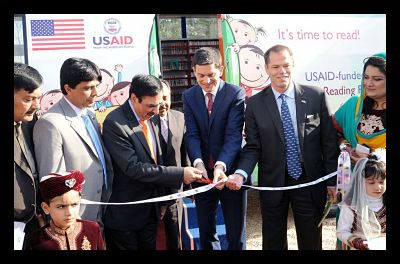
Last month, the Pakistan Reading Project launched its first mobile bus library program at a government secondary school to promote reading habits for young students.

The program is set to run over the next two years in Sindh and Islamabad Capital Territory with plans to bring reading materials directly to communities as part of a larger mission to improve the quality of education.

It’s all part of the USAID-funded Pakistan Reading Project, a five-year initiative that supports the country’s provincial and regional Departments of Education to improve the reading skills of four million children.

The project does this by improving the quality of primary education, teacher education, policy reforms and community engagement. This includes making supplemental instructional materials more widely available to primary school teachers as well as providing a model that ensures sustainability of the initiatives even through permanent policy changes.

The result? At least 2.5 million children who can read at levels commensurate with their grade standards.

The mobile bus library program is an effort to see this vision come true by bringing age-appropriate reading materials directly to communities that don’t have established libraries.

In addition, trained librarians will be aboard each bus, conducting storytelling sessions in each community that they visit. They will also issue books for students to take home to read. It’s an initiative to help reintroduce and reestablish a national culture of reading that once existed in Pakistan.

At the program’s official inauguration, the Assistant to the Administrator of USAID, Donald “Larry” Sampler, and the President of the International Rescue Committee (IRC), David Miliband, were present to speak on the occasion.

“The Mobile Library Programme is just one element of the USAID-funded Pakistan Reading Project which will help Pakistani children to start their own journeys in the world of books,” said Sampler. “Through this partnership between USAID, our implementing partner – the IRC and the Government of Pakistan, we are taking a multi-pronged approach to help increase literacy.”

The Pakistan Reading Project is a $165 million project that has launched several campaigns as well as television and radio episodes with complimentary print material that highlight the importance of reading to all communities.

With the addition of the mobile library bus program, this project anticipates that they will fulfill their vision in seeing improvement in classroom learning and the reestablishment of a national reading culture.

– Chelsee Yee

Sources: Pakistan Reading Project, USAID, Pakistan Today, Zee News
Photo: PBS

December 7, 2014
https://borgenproject.org/wp-content/uploads/borgen-project-logo.svg 0 0 Borgen Project https://borgenproject.org/wp-content/uploads/borgen-project-logo.svg Borgen Project2014-12-07 12:00:262020-07-18 04:37:54Pakistan Mobile Bus Library Program
Education, Women & Children, Women and Female Empowerment

Girl Rising: A Campaign to Educate Our Girls

Girl Rising
Breaking the cycle of poverty and creating the cycle of education, empowerment and uplifting out of poverty. “Girl Rising,” a feature-length documentary centers on these ideas, shining light on the importance of educating our girls around the world. Millions of girls across the globe are seen useful for one thing: reproduction. Girl Rising focuses on educating girls enabling them to use their voice that they were given to stand up for their rights, wait till they are stable to have their own family and educate their children, families and communities. By breaking those obstacles that girls face from the day that they are born.

Girl Rising focuses on removing those barriers that limit these girls such as young marriage, gender-based discrimination and violence, domestic slavery and sex trafficking. Removing these barriers will not only lead to stronger, healthier, safer and more vibrant girls, it will improve the outlook of the world as a whole.

Girl Rising, created in 2013, has since turned into a global movement and has been viewed by millions across the world in campuses, neighborhoods, communities and cities across the world in order to raise awareness and funds. You can bring Girl Rising to your classroom, campus, organization and community. There are so many opportunities to raise awareness. Join the community, host a screening, facilitate a fundraiser and invest in girls education. The options are limitless.

Girl Rising is also in partnership with USAID working on the Girl Rising’s Empowering Next Generations to Advance Girls Education (ENGAGE) project. Launched in 2014, the project focuses on teaching communities to value girls by understanding their worth and the benefits of educating and empowering them. Currently, the project works in India, the Democratic Republic of Congo and Nigeria, with hopes to grow and give all girls a chance to go and stay in school, and become healthy, functioning members of their communities and society as a whole.

The Girl Rising ENGAGE campaign works to create a better world for girls by:

  • Increasing public awareness of and attention to the importance of a good education and the barriers girls often face to accessing it.
  • Mobilizing men, women and youth to take concrete actions that create paths for girls to attain quality primary and secondary education.
  • Engaging corporate and government leaders to build an enabling environment for girls, promoting policy change for, and financial investment in their education.
  • Bringing the message to the source in the classroom.

Girl Rising has a teaching opportunity for educators to utilize the free Girl Rising Educator’s Edition and the Girl Rising curriculum. This can lead to engaging students in meaningful discussion and lessons that encourage them to think critically about the importance of educating girls.

The Girl Rising movement is on its way of establishing a name from its beginnings as a documentary to a force that is changing the educational climate for girls across the world. CNN International was so enraptured by the Girl Rising phenomena that the network continues to celebrate the world of girls in the series new “A Girl’s World.” The series chronicles the story of seven girls in seven different countries all writing unique stories of their own. Following their ambitions, dreams, adversaries, the seven girls may all be different but they can come together with their newfound voices. “Girl Rising” and “A Girl’s World” are reminders to value and honor your grandmothers, mothers, daughters, sisters and the girls of the world.

To become an advocate and learn more about Girl Rising follow here.

– Charisma Thapa

Sources: Girl Rising 1, Girl Rising 2, CNN
Photo: Scarlet Called Scout

November 23, 2014
https://borgenproject.org/wp-content/uploads/borgen-project-logo.svg 0 0 Borgen Project https://borgenproject.org/wp-content/uploads/borgen-project-logo.svg Borgen Project2014-11-23 04:00:582024-06-05 01:58:17Girl Rising: A Campaign to Educate Our Girls
Global Poverty, Technology, USAID

New Technology Can End Poverty

new_tech
As we near the 2015 deadline for the Millennium Development Goals, there needs to be something done to increase our progress towards ending poverty. Last month, the Frontiers in Development Forum had many visitors who had bright ideas about what would be best to try to achieve our main goal. Leaders like the Tanzanian President Jakaya Kikwete and Secretary of State John Kerry attended the forum, along with many different innovators, who have been creating mobile apps to combat human trafficking.

What was decided at the forum was that bringing new technologies into play and creating new partnerships is essential in the plan to end extreme poverty. In the U.S., many new technologies have changed the way Americans communicate, work and earn with one another. But there was something launched about two decades ago called the Leland Initiative, which was an effort to help increase access to information for 20 African countries.

To build more onto this idea, USAID has partnered with the U.K., Google.org and the Omidyar Network to create something new called the Alliance for Affordable Internet. This was created in an effort to reduce the cost of internet access and to bring to the table new opportunities for doctors, entrepreneurs and local leaders across the developing world.

Another way that USAID is trying to speed up the process of ending poverty is by using mTrac in Uganda. mTrac is a tool that helps local health workers send the government reports via text message. For example, the Ministry of Health used mTrac to survey 10,000 health workers on whether their health unit had a fridge that was used to keep perishable drugs and vaccines cold. The survey ended up costing only $150 and was done in just less than three days.

New technology is something that many in the Western World are used to and often take for granted, but in Senegal, rice millers are learning about how important technology can be for their community. For example, the rice millers buy expensive Asian imports, while local rice farmers are having a hard time selling their crops. USAID is helping to build the supply chains and improve the quality of the harvests by teaching the farmers to share their information through Excel and Dropbox. This allows the millers to track the local crops, schedule shipments and collect payments online.

This is just the start of what technology can do for the world in helping end poverty, and there is still a long way to go. USAID iterates that creating apps just for the sack of having them is not what will help the world achieve the overall objective of ending poverty. But by looking at the need in countries where technology is not overflowing and creating a solution for that will be the key component in ending extreme poverty.

– Brooke Smith

Sources: USAID Blog, USAID
Photo: Flickr

November 17, 2014
https://borgenproject.org/wp-content/uploads/borgen-project-logo.svg 0 0 Borgen Project https://borgenproject.org/wp-content/uploads/borgen-project-logo.svg Borgen Project2014-11-17 04:00:402024-05-24 23:52:49New Technology Can End Poverty
Global Poverty, Women and Female Empowerment

Livestock Production Brings Revenue for Women

revenue_for_women
Ethiopia is oftentimes seen as a place of extreme poverty and famine with no opportunities for the locals to improve their business. The situation is especially difficult for women, whose potential is limited by cultural and legal inequalities. However, there is an opportunity that is considered which could provide many women with a stable source of income. That opportunity is livestock. Although women still are not fully capable of making financial decisions in Ethiopia, the dairy sector is monopolized by small business farmers and processing the milk is mainly a women’s job.

This traditional role for women in the past could have been seen as disempowering, however recently there has been a fresh view and women are turning dairy into an economic opportunity for themselves and their families. With the help of training and financial assistance from USAID, these women are able to obtain the skills needed to empower themselves in spite of their obstacles. The main industries that employ women are livestock fattening and dairy production, however there are still areas in Ethiopia that women do not have access to the training and knowledge that others take for granted.

The USAID Agricultural Growth Program, Livestock Market Development, project is a part of the U.S. Government’s Feed the Future Initiative and it aims to improve nutrition and increase revenue for women. The way it plans on doing this is through training and investments in dairy, meat and live animals. Both men and women will benefit from this project but there will be special attention given to helping women become entrepreneurs with training designed specifically for their empowerment.

Strengthening Ethiopian organizations to build effective partnerships is one of the main objectives for the project as well. USAID funding is helping meet these needs with an advanced cattle cross-breeding program to create offspring that is 10 times more productive than the current cow. The project has a five year execution plan and so far there are significant results from it. About 100 women were able to receive training on entrepreneurship and leadership in one session in 2013. The same women now act as business role models within their own livestock market.

Although extreme poverty is still a major issue throughout Ethiopia, programs like this are making it easier for everyone, especially women to break the cycle and make their own business successful. Women finding success is something new to Ethiopia and this program looks to continue to empower them and help the whole country work itself out of poverty.

– Brooke Smith

Sources: USAID  Feed the Future
Photo: Flickr

November 1, 2014
https://borgenproject.org/wp-content/uploads/borgen-project-logo.svg 0 0 Borgen Project https://borgenproject.org/wp-content/uploads/borgen-project-logo.svg Borgen Project2014-11-01 04:00:572024-05-27 09:21:47Livestock Production Brings Revenue for Women
Family Planning and Contraception, Global Health

Pathfinder International Addresses Overpopulation

pathfinder_international
Clarence Gamble was born in 1894 in Cincinnati, Ohio and proceeded to attend a slew of universities including the likes of Princeton and Harvard University, where at the latter he received his M.D. degree. Following, he became heavily involved in birth control organizations and research. He worked alongside Planned Parenthood and initiated projects to study population growth in countries such as India and Japan.

In 1957, Gamble founded the Pathfinder Fund, an organization dedicated to providing a wider audience of people with access to safe, efficient and helpful reproductive health services. The fund is donation-based, which came into play as early as the 1960s. In fact in the 1960s the USAID and Office of Population donated $10 million to the organization, thus proving the government’s support of the discussed issues.

Pathfinder was already operating globally in the 60’s and 70’s opening offices in Latin America, Indonesia, Egypt, Chile, the Philippines and actively participating in population schemes in various African countries. Over the decades, the Pathfinder Fund continued to grow and, by the 90’s, it was the Pathfinder International.

In 1996, Pathfinder won the UN Population Award, an award given to someone who has raised awareness of population issues and solutions. And more recently in the 2000’s Pathfinder began the African Youth Alliance program aimed toward people 10-24 years of age in African countries like Botswana and Ghana. It was formed in order to assist with reproductive health.

Nowadays, Pathfinder International continues their hunt for better sexual and reproductive health care for all. They have six main focus areas: Adolescents, HIV/AIDS, Contraception and Family Planning, Advocacy, Abortion and Maternal and Newborn Health.

For example of their comprehensive care, as part of their abortion focus, Pathfinder not only supports a woman’s right to an abortion, but also advocates for safe abortions and rigorous post-abortion care. The organization accomplishes this in a number of ways one being through legislation, and another by funding an expanded number of professionals who can provide the medical and psychological services needed.

Another focus area, the Contraception and Family Planning focus, is also a worldwide project for Pathfinder. Over the years, Pathfinder has involved itself in over 100 countries attempting to integrate family planning concepts and to provide contraception to those in need of it. Above all people need to be educated, and Pathfinder does their best to also take on that responsibility.

Pathfinder International encourages the public to do its part as well. People can host fundraisers and events of that nature to provide contraceptives to people. One of the easiest ways to support the cause is for people to use their voices. People can become a part of their advocacy network or even start a conversation about reproductive health on a public forum. And lastly, Americans can vote for legislation to continue this type of focus. In an ever-growing population, it is important to be as conscious as possible of the world’s sexual and reproductive health.

– Kathleen Lee

Sources: Pathfinder International, Harvard Library

October 17, 2014
https://borgenproject.org/wp-content/uploads/borgen-project-logo.svg 0 0 Borgen Project https://borgenproject.org/wp-content/uploads/borgen-project-logo.svg Borgen Project2014-10-17 04:00:122024-06-05 01:53:30Pathfinder International Addresses Overpopulation
Page 81 of 92«‹7980818283›»

Get Smarter

  • Global Poverty 101
  • Global Poverty… The Good News
  • Global Poverty & U.S. Jobs
  • Global Poverty and National Security
  • Innovative Solutions to Poverty
  • Global Poverty & Aid FAQ’s
Search Search

Take Action

  • Call Congress
  • Email Congress
  • Donate
  • 30 Ways to Help
  • Volunteer Ops
  • Internships
  • Courses & Certificates
  • The Podcast
Borgen Project

“The Borgen Project is an incredible nonprofit organization that is addressing poverty and hunger and working towards ending them.”

-The Huffington Post

Inside The Borgen Project

  • Contact
  • About
  • Financials
  • President
  • Board of Directors
  • Board of Advisors

International Links

  • UK Email Parliament
  • UK Donate
  • Canada Email Parliament

Get Smarter

  • Global Poverty 101
  • Global Poverty… The Good News
  • Global Poverty & U.S. Jobs
  • Global Poverty and National Security
  • Innovative Solutions to Poverty
  • Global Poverty & Aid FAQ’s

Ways to Help

  • Call Congress
  • Email Congress
  • Donate
  • 30 Ways to Help
  • Volunteer Ops
  • Internships
  • Courses & Certificates
  • The Podcast
Scroll to top Scroll to top Scroll to top