• Link to X
  • Link to Facebook
  • Link to Instagram
  • Link to TikTok
  • Link to Youtube
  • About
    • About Us
      • President
      • Board of Directors
      • Board of Advisors
      • Financials
      • Our Methodology
      • Success Tracker
      • Contact
  • Act Now
    • 30 Ways to Help
      • Email Congress
      • Call Congress
      • Volunteer
      • Courses & Certificates
      • Be a Donor
    • Internships
      • In-Office Internships
      • Remote Internships
    • Legislation
      • Politics 101
  • The Blog
  • The Podcast
  • Magazine
  • Donate
  • Click to open the search input field Click to open the search input field Search
  • Menu Menu

Tag Archive for: Haiti

Posts

Global Poverty

Maternal Health in Haiti a Concern for UNFPA

Maternal Health in Haiti a Concern For UNFPA
The U.N. Population Fund has expressed concern over the effects that Hurricane Matthew will have on the more than 8,400 pregnant women in the country and those who will need cesarean sections or other maternal care. It has pledged to make maternal health in Haiti a key aspect of its response to Hurricane Matthew.

The organization has pledged to send 252 emergency reproductive health kits to 450,000 people in the next three months. These kits will include resources such as medicine and supplies for safe deliveries, rape treatment and voluntary family planning. The organization also plans to certify local midwives through their own UNFPA supported schools and to open clinics that these midwives will staff. In total, UNFPA hopes to raise $5 million for this project.

UNFPA Executive Director Dr. Babatunde Osotimehin explained the necessity for the project, stating, “Hurricane Matthew delivered a severe blow to Haiti’s health facilities, whether by flooding these centers or blowing off their roofs and putting them out of service. Our urgent task is to protect the health and rights of women and girls and to ensure that their basic needs, which are often overlooked in humanitarian situations, are quickly met. We will work to help women give birth and live, despite this tragedy.”

Maternal health in Haiti has been an issue in the country since well before Hurricane Matthew. Haiti has the highest maternal and infant death rates in the western hemisphere and, in light of Matthew’s aftermath, these rates are expected to rise. UNFPA warned in a press release that an estimated 13,650 women are expected to give birth in the next three months, and the storm’s destruction of many healthcare facilities on the island has raised serious concern among human rights groups.

According to the World Health Organization, approximately 830 women die each day from causes related to pregnancy and childbirth, and 99 percent of these deaths occur in the developing world.

Adolescent pregnancies are very common in Haiti, and since family planning has been interrupted by the storm, such pregnancies are expected to rise in the next few months. According to a 2012 survey, approximately 11 percent of adolescent girls in the country have at least one child.

Magdala Bourdeau, a midwife in Haiti told UNFPA, “Since November 3, we have carried out several deliveries and received several types of pathologies, such as pre-eclampsia, severe anemia, high blood pressure and premature pregnancies.”

Dr. Joanne Liu, the international president of Médecins Sans Frontières, reports that the five main causes of maternal death include hemorrhage, sepsis (infection), complications resulting from unsafe abortion, hypertensive disorders and obstructed labor. Such conditions are usually preventable with access to medical care, but maternal death rates remain high in areas where disaster or conflict has limited access to such care.

The U.N. Population Fund aims to protect maternal health in Haiti and hopes to raise the $5 million that it needs in time to do so.

– Eva Kennedy

Photo: Flickr
November 29, 2016
https://borgenproject.org/wp-content/uploads/borgen-project-logo.svg 0 0 Borgen Project https://borgenproject.org/wp-content/uploads/borgen-project-logo.svg Borgen Project2016-11-29 01:30:532024-12-13 17:56:19Maternal Health in Haiti a Concern for UNFPA
United Nations

The UN’s Role in the Haitian Cholera Outbreak of 2010

Haitian Cholera Outbreak
The Haitian cholera outbreak in 2010 became endemic, after at least a century of the disease not posing a threat.

Spread through contaminated water, the infectious disease causes dehydration and severe diarrhea. It can even lead to death if left untreated, sometimes in just a few hours. The outbreak transpired just after a fatal earthquake occurred in the country.

The United Nations (U.N.) sent peacekeepers to Haiti to help with the damage but failed to screen them for cholera or build them sufficient toilet facilities. As a result, cholera-infected wastewater flowed into Haiti’s main river — a main source for washing, cooking, cleaning and drinking. By 2011, over 470,000 cases of cholera were reported, with 6,631 connected deaths.

Immediate Response

Within days of the Haitian cholera outbreak, the Ministry of Public Health and Population (MSPP), along with the Centers for Disease Control and Prevention (CDC) and its partners, established a national surveillance system to track cases of the disease.

Treatment and prevention materials were also quickly developed, and thousands of healthcare workers were trained. Together, the organizations reduced the initial mortality rate of four percent to less than one percent, saving an estimated 7,000 lives.

However, thousands of people continue to become sickened each year by cholera. Haiti’s water and sanitation infrastructure require major improvement for any significant, long-term progress to be made.

The U.N.’s Reaction

After denying any responsibility for over five years, the U.N. has now officially admitted to a role in the Haitian cholera outbreak.

The deputy spokesman for the Secretary-General, Farhan Haq, recently sent out an email saying, “over the past year, the U.N. has become convinced that it needs to do much more regarding its own involvement in the initial outbreak and the suffering of those affected by cholera.” He wrote that a “new response will be presented publicly within the next two months, once it has been fully elaborated, agreed with the Haitian authorities and discussed with member states.”

Although this statement fails to put blame on the U.N. or to indicate a change in its legal position — that it is absolutely immune from legal actions — it does represent a significant step forward for the U.N.

Looking Forward

Haiti launched a National Plan to eliminate cholera from the country in 2013. The 10-year-long plan focuses on water and sanitation, health and preventing further infections.

However, the plan is terribly underfunded. The U.N. Office for the Coordination of Humanitarian Affairs (OCHA) pledged over $125 million toward this program, $19 million of which was received; the plan is anticipated to top a total of $2.2 billion in investments.

Nigel Fisher, Special Representative of the U.N. Secretary-General in Haiti said, “It’s a big challenge. We have to raise literally billions of dollars. And this requires sustained support and commitment. That’s what we are here for. We, all of us partners, have a moral obligation to stay the course with cholera. Not just to lower the incidence of cholera, but to eliminate it from Haiti.”

– Alice Gottesman

Photo: Flickr

October 19, 2016
https://borgenproject.org/wp-content/uploads/borgen-project-logo.svg 0 0 Borgen Project https://borgenproject.org/wp-content/uploads/borgen-project-logo.svg Borgen Project2016-10-19 11:14:092024-05-27 23:53:21The UN’s Role in the Haitian Cholera Outbreak of 2010
Children, Education, Global Poverty

Work in Progress: Reforming Education in Haiti

Education_Haiti

Although school attendance has increased within the past several years, education in Haiti remains a problem. More than 200,000 Haitian children do not go to school, and half of Haiti’s adult population is illiterate.

Because most schools in Haiti are privately operated without government regulation, the cost of tuition is taxing. In many cases, students are forced to take a year or more off between grades because they can’t afford to continue. Joseph Woaly, an alumni of the Haitian school system, said he completed primary school at age 17 and secondary school at 25.

Other challenges persist. Even some of the newest institutions are not up to code. School buildings lack basic necessities such as clean water and working lavatories. According to education officials, much more funding is needed to continue plans for reforming education in Haiti.

As in most impoverished countries, women receive fewer opportunities than do men in Haiti. The World Bank estimates that a 1 percent increase in the number of women receiving an education can increase a country’s financial growth by 0.3 percent.

In 2007, the World Bank and the Caribbean Development Bank started a tuition waiver program to help reform education in Haiti. The World Bank has allocated $24.1 million toward supporting the program from 2014 to 2017. The grant helps underprivileged families pay for the cost of primary school tuition and supplies.

This tuition supplementation program has enabled more children to enroll in school while simultaneously creating a need for more teachers, thus benefiting the Haitian job market. Unfortunately, most Haitian teachers are somewhat unqualified, having received little or no training.

Another effective initiative started in 2012. The Adolescent Girls Initiative (AGI) set out to reform education in Haiti by teaching young women the skills they need to obtain long-term employment. Technical trades are often geared toward males, but AGI challenged those stereotypes, training women in such trades as plumbing, construction, machinery and IT.

The development of soft skills like professionalism, self-esteem and leadership is also crucial to gaining and retaining a profession. AGI found that women who received training were more self-confident, developing better decision-making abilities and more optimistic outlooks for the future.

The United States Agency for International Development (USAID) has also taken a deep interest in reforming education in Haiti. The organization has actively worked with the Ministry of Education in Haiti to maximize donor resources and improve national literacy levels. Over the past five years, USAID has helped Haitian children learn how to read, providing them with 85,000 workbooks, 3,700 teacher guides and curricula meeting international standards. USAID also reformed 19 schools to cater to the needs of disabled children.

Last year the World Bank promoted the idea of transferring some private schools into the public sector, hoping to increase enrollment among children who still cannot afford school fees. No notable progress has been made toward this initiative. The Haitian government maintains that there is no funding available for the project now, nor will there be within the foreseeable future.

– Amy Whitman

Photo: Flickr

October 5, 2016
https://borgenproject.org/wp-content/uploads/borgen-project-logo.svg 0 0 Borgen Project https://borgenproject.org/wp-content/uploads/borgen-project-logo.svg Borgen Project2016-10-05 01:30:552024-12-13 17:55:45Work in Progress: Reforming Education in Haiti
Global Poverty, Refugees

Top Five Facts You Should Know about Haitian Refugees

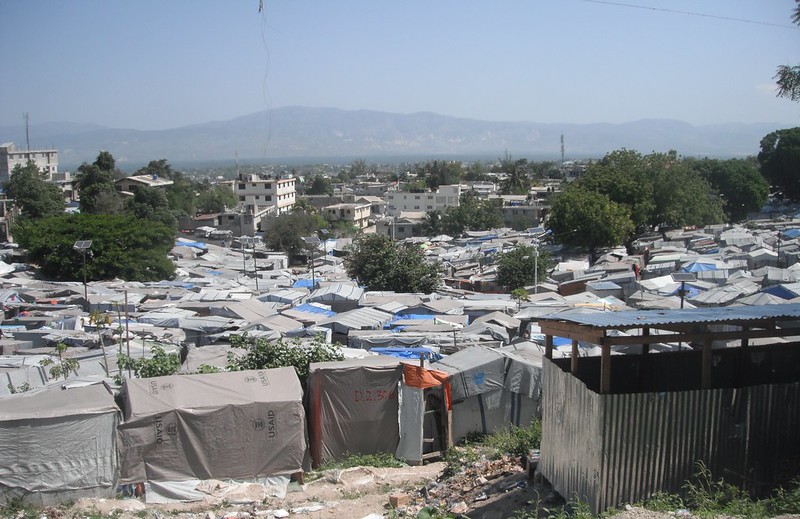
Haitian RefugeesAfter six years of recovering from the 7.0 magnitude earthquake that claimed the lives of more than 200,000 people and left 1.5 million Haitians homeless in 2010, Haitian refugees continue to face marginalization and poor living conditions. As a growing number of refugees from Haiti flock to the U.S. border seeking asylum, here are the top five current facts you should know about the Haitian refugee crisis and what is being done to alleviate it:
    1. An estimated 60,000 people live in Haitian refugee camps, according to Public Finance International (PFI). This is a 96% reduction from the initial number of refugees that moved to makeshift encampments after the earthquake that rocked Haiti’s foundation. The improvement can be largely attributed to the effectiveness of Haiti’s relocation programs.
    2. Food insecurity and cholera are on the rise in Haiti’s refugee camps after El Niño and three years of drought. The effects of the tropical storm and years of drought have left 3.6 million people in Haiti food insecure, according to the World Food Programme (WFP). To deal with the crisis, the UN Office for the Coordination of Humanitarian Affairs calls for increased medical treatment, access to clean water, and nutrition interventions in Haiti according to PFI.
    3. Tense ties with the neighboring Dominican Republic, threaten mass deportations of Haitians and Dominicans of Haitian descent. With the possible expulsion of nearly 200,000 stateless people, a new refugee crisis with devastating consequences looms in the distance, according to UN News. Last spring, the New York Times reported that an estimated 3,000 people had arrived in Haiti’s makeshift encampments after fleeing or being forced out of the Dominican Republic.
    4. Brazil is striving to improve immigration services on a community-level in order to decrease xenophobia and improve the living conditions of Haitian refugees. Brazilian organizations, such as the Association of Haitians in Balneário Camboriú, is filling in the gaps left by the government by managing work opportunities and improving integration services for refugees from Haiti, according to the Huffington Post.
    5. There has been a recent surge of Haitian refugees camping near the San Diego-Tijuana border as they await processing for asylum in the United States. Most of the refugees originally sought asylum in Brazil, but a worsening recession and lack of immigration support services drove refugees from Haiti to seek better living conditions elsewhere, according to the San Diego Union-Tribune.

As the poorest country in the northern hemisphere, Haiti continues to strive for economic and political stability years after the quake. While the Haitian government rebuilds Haiti’s economic and social infrastructure, the U.S. and other countries play a major role in supporting the integration and well-being of Haitian refugees abroad.

One way to ensure that the U.S. provides vital humanitarian support to refugees is by expanding the International Affairs Budget. The funds of the International Affairs Budget are imperative to helping refugees and the world’s poor but unfortunately, this resource is grossly underfunded.

To help alleviate the Haitian refugee crisis, call or email your congressional leaders in support of increased funding for the International Affairs Budget.

– Daniela Sarabia

Photo: Flickr

September 24, 2016
https://borgenproject.org/wp-content/uploads/borgen-project-logo.svg 0 0 Borgen Project https://borgenproject.org/wp-content/uploads/borgen-project-logo.svg Borgen Project2016-09-24 01:30:532024-12-13 17:55:33Top Five Facts You Should Know about Haitian Refugees
Global Poverty

Nine Shocking and Alarming Facts About Hunger in Haiti

Hunger_Haiti
Hunger in Haiti acts as one of the country’s largest ongoing problems. With two and a half million Haitians living in extreme poverty, Haiti is the poorest country in the northern hemisphere.

Though partly due to the series of severe natural disasters over the last two decades, the nation’s humanitarian and developmental challenges stem from numerous factors.

    1. The country faces its worst food insecurity crisis since 2001.
      The United Nations World Food Program appeals for $84 million to alleviate hunger in Haiti and the country’s increased suffering state. The organization hopes to aid one million Haitians battle extreme malnutrition and high death tolls.
    2. Two out of three Haitians live on less than $2 per day.
      Half of the population earns less than $1 per day. Many people lack access to electricity, water, sanitation and/or healthcare. With this level of extreme poverty, Haiti is in dire need of assistance to improve living conditions.
    3. Fifty percent of urban Haitians are unemployed.
      This statistic can serve as a stark contrast to urban America, where the unemployment rate is 4.7%, as of 2015. That’s 45.3% more of the Haitian population who are unable to provide for themselves and their families.
    4. Climate change is a growing issue that threatens over 500,000 Haitians every year.
      Global shifts in atmospheric conditions and weather patterns caused by human-induced climate change and increased carbon emissions leave a lasting negative impact on poor farmers and production.
    5. Although agriculture provides 50% of jobs in the country and accounts for 25% of GDP, this profession does not contribute to improving hunger rates in Haiti. 
      The country fails to produce enough food and imports 80% of its main staple, rice.
    6. Drought has had detrimental effects on the Haiti population.
      With only 10% of crops irrigated, 90% of farmers depend on rain for their harvest. Lack of rainfall and the rising cost of basic necessities act as the main reasons for the scarcity of local products on the domestic market.
    7. One hundred thousand children under the age of five suffer from acute malnutrition, while one in three children’s growth is stunted.
      The World Food Programme’s operations in Haiti work to end chronic malnutrition by providing nutritional meals to kids in schools and delivering supplementary food rations.
    8. A large portion of the Haitian population lacks access to clean water and adequate sanitation.
      Forty percent of the people in Haiti lack access to clean water and only one in five can access a sanitary toilet. Unfortunately, few water treatment facilities are properly functioning for the general public in the country. Soil erosion and deforestation also heavily contributed to diminished water quality.
    9. One-third of Haitian women and children are anemic.
      A result of poverty, the average Haitian child’s diet lacks many and most nutrients, including iron. The iron level in Haiti is also low because of intestinal blood loss due to worms and parasites.

The people of Haiti face a multitude of problems, and struggle to sustain a full, healthy life. Luckily, organizations like WFP, the Office for the Coordination of Human Affairs, the Food and Agriculture Organization and UNICEF work to end poverty and hunger in Haiti and help these communities rebuild their shattered lives.

– Mikaela Frigillana

Photo: Flickr

September 24, 2016
https://borgenproject.org/wp-content/uploads/borgen-project-logo.svg 0 0 Borgen Project https://borgenproject.org/wp-content/uploads/borgen-project-logo.svg Borgen Project2016-09-24 01:30:272024-12-13 17:55:34Nine Shocking and Alarming Facts About Hunger in Haiti
Global Poverty

Top 5 Facts About Poverty in Haiti

poverty in haiti poor
In 2010, Haiti was struck by what has been called the strongest earthquake since 1770. The 7.0 mW quake with aftershocks ranging from 4.2 to 5.9 affected at least three million people and increased poverty in Haiti. But in the last three years, the world at large has turned away from the struggle of the Haitian people to focus on newer problems. The fact remains, though, that aid is still needed. Below are leading facts you should know about poverty in Haiti.


Top 5 Facts About Poverty in Haiti


  1. Even before the earthquake hit, 1.9 million people were in need of food assistance. Around 60 percent of the population lives on less than $1.00 a day. As a result, malnutrition and anemia run rampant. Haiti is the third hungriest country in the world.
  2. Only 50 percent of the people have access to an improved water source, such as a hand pump or a well. This means that most of the population depends on lakes, streams and rivers for their water, regardless of the cleanliness. Even if some people can get to better water than others, a total of 80 percent do not have adequate sanitation available. So even if they run less risk of becoming ill from bad water, they are unable to clean themselves and are susceptible to disease and infection.
  3. Only fifty percent of children living in Haiti are able to go to school. Furthermore, only 30 percent of those progress to the fifth grade. As a result, half of Haitians are illiterate. Without a proper education, the people are unable to break free of the cycle of poverty.
  4. Haiti is the poorest country in the Americas, with 59 percent of the population living below the national poverty line. The World Bank estimates that the earthquake caused about $7.8 billion in damage.
  5. There is a large population of orphaned children in Haiti, many of whom are living on the streets. There were an estimated 380,000 prior to the earthquake and untold thousands added to that number after it. There are also about 250,000 restaveks, or children working as servants and often treated as slaves.

It is easy to put the continued suffering of Haiti out of one’s mind when other world disasters have since risen to the forefront, but that does not mean that Haiti stopped warranting the world’s attention. The earthquake may have happened almost four years ago, but the people there are still greatly in need of assistance and guidance.

– Chelsea Evans

Sources: Fox News, P81 Haiti Relief, Fox Business

Photo: Flickr

September 9, 2016
https://borgenproject.org/wp-content/uploads/borgen-project-logo.svg 0 0 Borgen Project https://borgenproject.org/wp-content/uploads/borgen-project-logo.svg Borgen Project2016-09-09 17:37:102020-06-06 07:26:55Top 5 Facts About Poverty in Haiti
Global Poverty, Health, Water

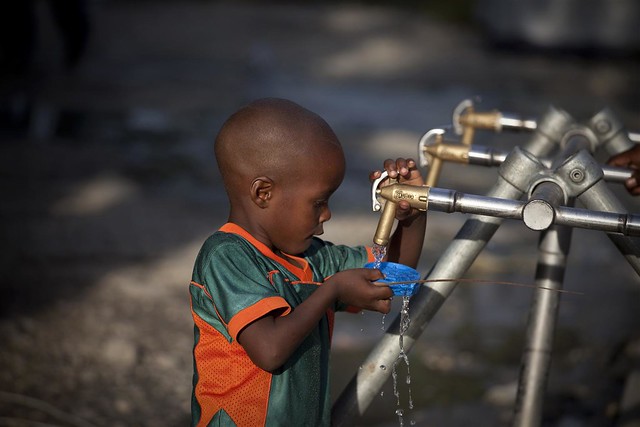
Improving Water Quality in Haiti Benefits Thousands

Water Quality in HaitiThe water quality in Haiti is in desperate need of improvement. The World Bank hopes to increase access to clean water because “[it] not only saves lives, but [it] also [helps] reduce poverty and improve the livelihood opportunities of these communities,”  reports Mary Barton-Dock of the World Bank Special Envoy.

The lack of proper sanitation and unsafe water quality in Haiti fosters the spread of disease. For example, a cholera epidemic ensued after the 2010 earthquake in Haiti, and 8,700 lives have been lost since. Although diagnosed cases of cholera have decreased, heavy rains in the early months of 2015 brought a surge of new cases.

Stand pipes or water points with hand pumps are the main systems used for water transportation in Haiti. Due to lack of funding, many of these water systems are no longer in service. Thankfully, the World Bank found a way to improve the situation by funding a program located in the southern region of Haiti. This global organization built professional operators whose main purpose is to maintain many of the water supply systems.

Over 60,000 people have benefited from these system improvements. The program also helped train community health workers and medical personnel, as well as strengthening the country by making it more self-sustaining.

The Board of Directors of the World Bank also authorized a $50 million grant from the International Development Association (IDA). “The Sustainable Rural and Small Towns Water and Sanitation project aims to save lives by preventing cholera and waterborne diseases in high prevalence zones, and strengthen the capacity of local agencies to deliver water and sanitation services in rural areas and small towns.” This grant will help nearly 300,000 people gain access to potable water and proper sanitation.

This project will also be linked to a ten-year, government-supported Cholera Elimination Plan. This long-term plan will save thousands of Haitian kids from waterborne, disease-related deaths. Benito Dumay, the Director General of the National Water and Sanitation Directorate, understands how essential healthy water quality is for Haiti, and is determined for the project to succeed.

Water is a catalyst for life, and now thousands of Haitians will be able to access this life-saving liquid for the first time. The World Bank reached out to the U.N., the U.N.’s development partners and the Haitian Government to collectively discuss the financing gap and what they learned about fighting cholera.

The Borgen Project has also done a great deal of work at the political level when it comes to advocating for clean water and sanitation. This nonprofit helped build support for the Water for the World Act. The organization also met with hundreds of Congressional offices, equating to 410 meetings, to discuss activism regarding water-quality programs.

Between 2009 and 2014, The Borgen Project helped mobilize thousands of Americans to email and call their congressional leaders in support of the Water for the World legislation. The bill was passed in December 2014, and millions of people gained first-time access to potable water and appropriate sanitation.

As numerous organizations fight the battle for water quality in Haiti and around the world, their tremendous progress makes the future of water quality that much clearer.

– Terry J. Halloran

Photo: Flickr

September 3, 2016
https://borgenproject.org/wp-content/uploads/borgen-project-logo.svg 0 0 Borgen Project https://borgenproject.org/wp-content/uploads/borgen-project-logo.svg Borgen Project2016-09-03 01:30:542020-06-17 17:15:18Improving Water Quality in Haiti Benefits Thousands
Global Poverty

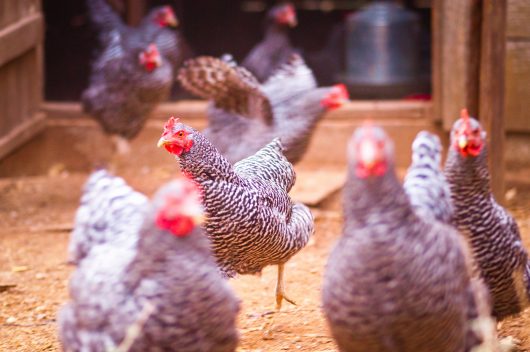
Chicken Farming: Combating Poverty in Haiti

Combating Poverty in Haiti

When the 2010 Earthquake left 1 million Haitians homeless and more than 600,000 injured or killed, the international community responded en masse. That response has continued over the years, as the effects of the earthquake continue to compound the preexisting battle with combating poverty in Haiti.

As that response evolves, many aid sources are focusing on entrepreneurial aid which produces business. Micro-loans for mobilizing small-scale chicken farms are one example of the business-aid model in action that exists to combat poverty in Haiti.

KORE Foundation supports impoverished Haitians by doing just that. Their investments enable families to establish chicken farms, with the generated business often increasing their annual income by 400 percent or more.

When these families are then able to repay the initial loan, the funds are reinvested in other Haitian families. In keeping with the foundation’s mission of going “beyond relief,” this model is combating poverty in Haiti by funding self-sufficiency. In addition, it keeps relief funds at work by promoting a cycle of reinvesting dollars into the community.

Supporting small-scale chicken farmers does more than allow Haitians to provide for their families as entrepreneurs. In a country where two-thirds of children are malnourished, the increased availability of poultry and eggs represents an invaluable source of dietary protein.

Organizations active in offering micro-loan aid in Haiti often provide business skills training as well, like the partnership between Love a Child and Open Hand. The duo provides micro-loans to other Haitian business owners interested in economic growth.

Through financial mentorship, the organization provides recipients management skills as they grow their businesses and repay their loans. These micro-loans support the average Haitian who would not otherwise qualify for bank loans, preventing them from having to turn to micro-loans that charge interest rates approaching 40 percent.

Combating poverty in Haiti represents no small task. As the poorest country in the Western Hemisphere, the need for investment in families’ ability to generate a stable income is dire. With 78 percent of the country’s inhabitants living on only $2 per day, generating sufficient income is an everyday difficulty. Two-thirds of the country’s labor force hold informal jobs, making stability an important goal for aspiring business owners.

In the six years following the earthquake in Haiti, many members of the international community have questioned how to offer effective humanitarian aid. Among the largest concerns are the well-meant actions (like rebuilding local schools and offering free health services) out-competing local laborers and unknowingly robbing these locals of an income.

Organizations offering micro-loans for sustainable business like chicken farming seek to circumvent these concerns. Investment in self-sufficiency enables local laborers and thus an entire community.

– Charlotte Bellomy

Photo: Flickr

June 26, 2016
https://borgenproject.org/wp-content/uploads/borgen-project-logo.svg 0 0 Borgen Project https://borgenproject.org/wp-content/uploads/borgen-project-logo.svg Borgen Project2016-06-26 01:30:252024-12-13 17:54:36Chicken Farming: Combating Poverty in Haiti
Food & Hunger, Global Poverty

US Donation of Surplus Peanuts to Haiti Causes Controversy

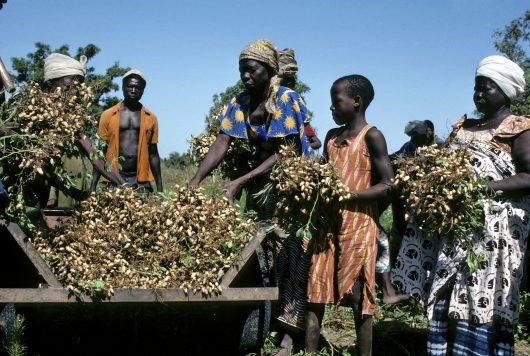
Surplus_PeanutsThe U.S. Department of Agriculture plans to ship 500 metric tons of surplus peanuts to Haiti to feed nearly 140,000 malnourished children before the fall school semester begins.

Its March 31st announcement has met criticism from Haitian peanut farmers, manufacturers, concerned citizens, and a variety of both Haitian and foreign NGOs.

Many have called the action “crop” or “peanut dumping” that will negatively impact the Haitian economy and its people, pointing to the example of the impact of subsidized rice on the Haitian market years ago. Others point to the need to feed thousands of malnourished children.

As the USDA describes, the action is a part of the “Stocks for food” federal program that sends surplus goods to feeding programs and food banks both in the United States and abroad. The specific Haitian project that targets primary schools struggling against poverty, malnutrition and disease receives its funding from the McGovern-Dole International Food for Education and Child Nutrition Program.

However, many believe that sending cheap stock like peanuts to Haiti could negatively impact the country’s ability to sustain its own food production and undermine the local economy.

Partners in Health released a statement urging the USDA to reverse its decision. A letter to the USDA from the Institute of Justice and Democracy in Haiti points out that peanuts are fundamental to the country’s economy as 150,000 local farmers produce 70,000 metric tons, much like rice was a staple of Haitian market in the mid-1990s.

Floods of foreign, mostly U.S.-produced rice drove the price of Haitian rice down, and many farmers were left without income and forced to leave to find work elsewhere.

The Haitian economy and food security depend strongly on peanuts, especially in their role in the production of a spicy peanut butter called Mamba, which provides income for a large number of Haitian women.

Bill Clinton has been repeatedly quoted acknowledging the export of rice to Haiti as a mistake and the “lost capacity” it caused. While it benefitted U.S. farmers, he said, it hurt Haitian ones.

Alexis Taylor, deputy undersecretary for farm and foreign agricultural services at the USDA, has defended the shipment of surplus peanuts as a source of much-needed relief for a poverty-stricken country in which one-third of all children’s deaths are caused by malnutrition.

The peanuts will be a supplement to Haitian school children’s morning snack as part of the U.N. World Food Program.

In contrast to the USDA’s action, the U.S. has funded other programs such as the World Food Programme that support locally sourced food production and procurement in Haiti.

These efforts to encourage Haiti’s self-sustainability and independence from foreign aid could be compromised by the USDA’s pending peanut program. Critics say it would be better to continue efforts to help Haitian peanut farmers produce better, bigger crops as programs like the Feed the Future Initiative, the Clinton Foundation, and Partners in Health aim to do.

However, the White House petition against the donation failed to receive enough signatures and closed.

USDA press secretary responded to NPR’s article stating that the USDA worked with the WFP to ensure the donation of surplus peanuts would have no negative impact on Haiti’s domestic peanut market by limiting the peanuts’ consumption to only be at school and closely monitoring the impact.

– Esmie Tseng

Photo: U.N. Multimedia

May 30, 2016
https://borgenproject.org/wp-content/uploads/borgen-project-logo.svg 0 0 Borgen Project https://borgenproject.org/wp-content/uploads/borgen-project-logo.svg Borgen Project2016-05-30 01:30:162024-12-13 18:06:08US Donation of Surplus Peanuts to Haiti Causes Controversy
Global Poverty

What is Happening with Haiti’s Delayed Presidential Elections?

What is Happening with Haiti’s Delayed Presidential ElectionsThe presidential election in Haiti was postponed indefinitely due to recent violent protests and government fraud. The election was originally set for Dec. 27, 2015, then pushed to Jan. 24, 2016 and finally canceled without a new date announced.

The eight Haitian presidential candidates refused to participate because of the irregularities that occurred in the first round of elections. An official audit including 78 tally sheets from the first round of presidential elections found irregularities in all sheets, the Hill reports. Haiti’s electoral council, the CEP, did not conduct a further investigation.

The irregularities in the electoral process include Jovenel Moise, President Michel Martelly’s chosen successor, being reported to the CEP as being in first place in the election but an exit poll found that only six percent of respondents voted for him, according to the Hill. This, along with many other examples of government-backed fraud has instigated Haitians to respond with violence.

In a poll executed in October 2015 by an independent research group in Brazil, 82 percent of Haitians agreed with the statement: “As far as I can see, this election is fair, there is no fraud,” the Hill reports. However, when the same poll was conducted after the irregularities came out, almost 90 percent of respondents disagreed with the statement.

According to the Hill, the United States, the U.N. and the Organization of American States are pushing for presidential elections to take place as soon as possible so that Haiti can reestablish order. Though filling the presidential position is desired, it could also be perceived as a positive that Haiti now has more time for the election. More time to select a proper candidate would allow Haiti to restore faith in the electoral process.

Fortunately, lawmakers chose the country’s Senate leader, Jocelerme Privert, as provisional President of Haiti on Feb. 14, 2016, as reported by the New York Times. Privert’s chief task will be to smooth political divisions that have left the people of Haiti without an elected president properly chosen by the voters themselves.

Privert is also working on how and when to go about the formal presidential election and has said they will be held as soon as possible. Former President Martelly departed from office as well, as he was barred from a consecutive term. Privert’s leadership and Martelly’s departure will hopefully help in easing violent outbreaks and tensions.

– Kerri Whelan

Sources: The Hill, NY Times
Photo: Flickr

March 14, 2016
https://borgenproject.org/wp-content/uploads/borgen-project-logo.svg 0 0 Borgen Project https://borgenproject.org/wp-content/uploads/borgen-project-logo.svg Borgen Project2016-03-14 01:30:592024-12-13 18:05:48What is Happening with Haiti’s Delayed Presidential Elections?
Page 3 of 8‹12345›»

Get Smarter

  • Global Poverty 101
  • Global Poverty… The Good News
  • Global Poverty & U.S. Jobs
  • Global Poverty and National Security
  • Innovative Solutions to Poverty
  • Global Poverty & Aid FAQ’s
Search Search

Take Action

  • Call Congress
  • Email Congress
  • Donate
  • 30 Ways to Help
  • Volunteer Ops
  • Internships
  • Courses & Certificates
  • The Podcast
Borgen Project

“The Borgen Project is an incredible nonprofit organization that is addressing poverty and hunger and working towards ending them.”

-The Huffington Post

Inside The Borgen Project

  • Contact
  • About
  • Financials
  • President
  • Board of Directors
  • Board of Advisors

International Links

  • UK Email Parliament
  • UK Donate
  • Canada Email Parliament

Get Smarter

  • Global Poverty 101
  • Global Poverty… The Good News
  • Global Poverty & U.S. Jobs
  • Global Poverty and National Security
  • Innovative Solutions to Poverty
  • Global Poverty & Aid FAQ’s

Ways to Help

  • Call Congress
  • Email Congress
  • Donate
  • 30 Ways to Help
  • Volunteer Ops
  • Internships
  • Courses & Certificates
  • The Podcast
Scroll to top Scroll to top Scroll to top