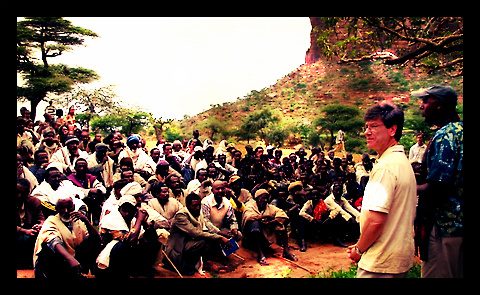
There are many ways to go about reducing and eventually ending world poverty. The Millennium Villages Project (MVP) has implemented several strategies that have proven to be effective at boosting economic independence in African villages. This is the “one village at a time” method. The pith of this method is agriculture reform.
The MVP works with African farmers to improve various aspects of agriculture techniques like what season to plant certain seeds and how to correctly use small scale irrigation, specifically a “gravity drip irrigation system” that is highly cost effective. Soil is also an important topic that farmers are educated about. They learn how to farm without stripping soil of vital nutrients, thus vastly increasing crop yields. Other aspects of soil health include organic farming, fertilizing, and soil conservation.
Education is a huge aspect of the Millennium Project. People working for the MVP train African farmers, and then these farmers can later educate other farmers about efficient agriculture methods. These farming organizations ensure that future generations will continue to produce higher crop yields. When farmers are successful, that means the entire village will flourish. The MVP encourages schools to provide locally grown, healthy foods for their students, especially young children.
Other key strategies being used around the world include: providing vaccines and building schools, shelters, wells, and medical clinics. These are some of the many approaches to help people lift themselves out of poverty. There is no one correct method; rather, it is often the combination of multiple techniques that proves to be the most effective. The Millennium Development Goals’ main objective is to end extreme global poverty by 2030 and with these many strategies will play a huge role in achieving this goal.
– Mary Penn
Source: Borgen Project
Photo: NY Times


 Last month, 400 International MBA students from the IE Business School in Madrid went to Pakistan to work on the “LettuceBee Kids” project, a “social enterprise aiming to provide a self-sufficient mechanism of survival to street children.” The IE Business program challenges its International MBA class by exposing students to extreme poverty-stricken areas and countries where they get to participate first-hand in poverty projects. Within the program, the Change in Action (CIA) module was formed in 2008 as a part of the International MBA agenda to fight global problems.

 Kenya has recently gained attention for its successful adaption of mobile money. A majority of its population, two-thirds of which live on less than $2 a day, are able to manage their finances using cell phones. Through this service, which does not require a bank account, millions of customers are able to send a text message to banks to pay bills, receive payment, and transfer money. Given that nearly 2.5 million people in the world do not have bank accounts and 2 billion people have cell phones, the program will make it easy to include a large number of people previously without access to finance management. As of now, there are 15 million mobile money customers in Kenya.
 Just in the last ten years in Rwanda, deaths from HIV, TB, and malaria have dropped by 80 percent, annual child deaths have fallen by 63 percent, maternal mortality has dropped by 60 percent, and life expectancy has doubled. All at an average annual healthcare cost of $55 per person.