• Link to X
  • Link to Facebook
  • Link to Instagram
  • Link to TikTok
  • Link to Youtube
  • About
    • About Us
      • President
      • Board of Directors
      • Board of Advisors
      • Financials
      • Our Methodology
      • Success Tracker
      • Contact
  • Act Now
    • 30 Ways to Help
      • Email Congress
      • Call Congress
      • Volunteer
      • Courses & Certificates
      • Be a Donor
    • Internships
      • In-Office Internships
      • Remote Internships
    • Legislation
      • Politics 101
  • The Blog
  • The Podcast
  • Magazine
  • Donate
  • Click to open the search input field Click to open the search input field Search
  • Menu Menu

Tag Archive for: Global Poverty

Inflammation and stories on global poverty

Posts

Global Poverty

The Social Costs of High Food Prices

The Social Costs of High Food Prices

The failure of wages to keep pace with rising food prices is putting a strain on families and communities worldwide, according to a report titled ‘Squeezed’ by OxFam and the International Development Studies. The food price spike of 2011 alone increased the numbers of people living in poverty by an estimated 44 million. The study focused on rural and urban consumers in 10 developing countries: Burkina Faso, Ethiopia, Kenya, Bangladesh, Guatemala, Zambia, Bolivia, Indonesia, Pakistan and Vietnam.

Leaders continue to disregard the specific impacts the food system has on low income households. The authors of the report write, “Many people are earning more, but this is often illusory: wage rises rarely match rises in the cost of living. People have to cope in time-honoured ways by cutting back, substituting, shopping around, and growing and gathering more. The impacts are felt in homes, relationships, communities and work places, changing the way people think about themselves and others.” More often households are being forced to resort to riskier ways of getting income, for example, gold mining in Burkina Faso; sex work in Kenya; and jungle fishing in Bangladesh, despite the risks posed by tigers and pirates. The numbers of migrants has also increased as people must travel to find work. And the stress to food insecurity often leads to increased levels of domestic violence, and alcohol and drug abuse.

The types of food that people consume represent the single best indicator of their well-being. The research from this report uncovered a familiar hierarchy of hardship whereby the poorest people eat too little and lose out on vital nutrients. Even some better-off urban communities are struggling to afford basics, and have begun eating less diverse diets and substituting foods. Latest estimates suggest one in eight of the world’s population suffer from undernourishment and that nearly one in five face food “inadequacy”.

The rising costs of fuel, rent, and agricultural inputs make it more difficult for people to become farmers, despite the need to produce cheaper food. Without relatively large land assets, capital and the capacity to store produce and hedge their cultivation decisions, contemporary farming in the 10 developing countries surveyed will remain very difficult. Furthermore, agriculture is less appealing for young people to enter into due to of unpredictable returns, high input costs, and high costs of living. Education is perceived as a ticket off the farm, and agricultural aspirations are rare.

Societies, too, are changing in response to the food price crisis. Customary cooperative labor arrangements are being replaced with wage labor. The urgent need for cash takes priority over collective social life and values. The high price of essentials translates into a decline in public social life, with families becoming more inwardly focused and people less willing or able to socialize or help each other.

The report recommends that national social protection policies aim to provide routine protection for the poorest and most vulnerable communities, with the understanding that it is too late to start developing schemes when a price spike occurs. Policymakers should design social assistance policies aimed at protecting against spikes in the form of temporary cash or food transfers, or by providing subsidies that are automatically triggered by price rises. And economic leaders should adjust to real changes in needs by linking social protection to inflation.

– Maria Caluag

Sources: Guardian, OxFam-IDS
Photo: Politico

June 15, 2013
https://borgenproject.org/wp-content/uploads/borgen-project-logo.svg 0 0 Borgen Project https://borgenproject.org/wp-content/uploads/borgen-project-logo.svg Borgen Project2013-06-15 05:29:232024-05-24 23:42:43The Social Costs of High Food Prices
Food & Hunger, Food Security

What a Waste

Food-waste-Surplus-tomato-global_poverty_world_hunger_opt
Here’s an interesting stat: one-third of all food grown globally is lost to spoilage and waste. Without any increases in crop yield or technology, 50% more people could be fed by the food already produced.

When faced with the realities of poverty and global hunger, the obvious fix is to produce more. Genetic modification, hybrid-seeds, increased fertilization… These are the solutions that come to mind and are being promoted throughout the world as well as being introduced to developing regions where food shortages are most acute. But in many cases, increased yields due to these methods won’t actually lead to any real gains in production. Not in areas where fruits already rot on the vine due to a lack of pickers to harvest them, or where a lack of serviceable infrastructure prevents farmers from efficiently transporting their product to market.

If this food spoilage and waste could be eliminated, or even reduced, the benefits could far outweigh those of slow, albeit persistent, methods of improving crops and yield. This change though will require a concerted effort. Currently, the majority of agricultural funding is channeled into research and development, with the focus being on production. The cynic could claim this is because the industry has an economic interest in increasing output, as it would lead to increased sales of seeds and other of their own products. But regardless of the reason, it is a route that needs exploring.

On February 19th, the U.S. State Department hosted a conference on ‘Food Security and Minimizing Post-harvest Loss: Markets, Applied Research, and Innovation.’ This conference was a positive step, as it demonstrated the administration’s acknowledging the seriousness of this issue, while also bringing together scientists and politicians from all over the world to address it. More steps like this need to be taken, and funding needs to be provided for research into food storage. If we can save even a portion of that lost third, the gains will be immediately apparent.

– David Wilson
Source: Mother Earth News
Photo: Guardian

June 13, 2013
https://borgenproject.org/wp-content/uploads/borgen-project-logo.svg 0 0 Borgen Project https://borgenproject.org/wp-content/uploads/borgen-project-logo.svg Borgen Project2013-06-13 04:00:382020-06-26 21:29:43What a Waste
Global Poverty

What is Davos? – The World Economic Forum

What is Davos? - The World Economic Forum
The World Economic Forum is colloquially coined as “Davos”, after Davos, Switzerland, the city in which the conference is housed annually. The WEF is an independent organization, dedicated to improving the economic state of the globe by incorporating leaders in business, politics, academics, and civil society to influence global, national, and industrial decisions.

Founded in 1971, the World Economic Forum started out as a humble group of business leaders, meeting under the umbrellas of the European Commission and the European Industrial Associations. The chair of the first gathering, Klaus Schwab, led 440 participants from over 30 countries in Davos to commemorate the finding of this non-profit organization, and created the building blocks to repeat the forum annually each January.

WEF is designed to be independent from any political, partisan, or national interest. This allows the participants in the forum to develop cross-cultural objectives to fighting economic weakness around the world.

A 1983 Forum document described the meetings as

“One of those increasingly rare international events where formality can be dispensed with, where personal contacts can be made, where new ideas can be tried out in complete freedom, where people are aware of the responsibilities involved in belonging to an international community, where we have time to look at the really important issues rather than everyday pressures. This is what we call the Spirit of Davos.”

The purpose of the WEF annual meetings varies from year to year, but all topics fall under the theme of ensuring that world leaders and attendees of the conference exercise their responsibilities “jointly, boldly, and strategically” to improve the economic state of the world for its future inhabitants.

WEF achieves this goal by collaborating with people, systems, and technologies to created indispensable leadership challenges to cultivate “new models, bold ideas, and personal courage to ensure that this century improves the human condition rather than capping its potential.”

In 1994, the World Economic Forum welcomed its 1,000th member, and decided to cap membership at that number, in order to ensure quality in member conversation and benefits.

– Kali Faulwetter
Source: Weforum, Weforum- Executive Summary
Photo: Business Week

June 12, 2013
https://borgenproject.org/wp-content/uploads/borgen-project-logo.svg 0 0 Borgen Project https://borgenproject.org/wp-content/uploads/borgen-project-logo.svg Borgen Project2013-06-12 04:00:502024-06-05 01:53:32What is Davos? – The World Economic Forum
Extreme Poverty

Capitalism Is Helping End Global Poverty

Capitalism Is Helping End Global Poverty
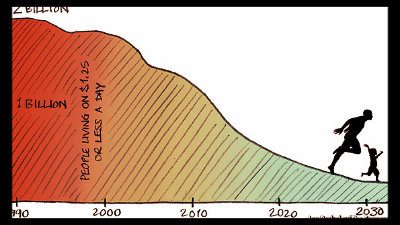
1.1 billion people in the world still live in extreme poverty, which means surviving on less than $1.25 per day. While that may seem like bad news, the good news is that that number is half of what it was 20 years ago. Between 1990 and 2010, 1 billion people were lifted out of extreme poverty, and now we need to do it again to wipe out extreme poverty by 2030 to reach the goal set by the World Bank.

So, who is to thank for helping curb poverty around the world? Certainly, the leaders who proposed the Millennium Development Goals have contributed by raising awareness about the problem of poverty and encouraging advocacy by creating goals. And without a doubt, the nonprofit organizations that have raised money and volunteered to help raise less than privileged people out of extreme poverty should be applauded. But, the most significant hero in this scenario maybe capitalism.

One of the best ways to help people is to teach them how to help themselves. Sending food, medical care, and other supplies to help the poor helps greatly, but not as much as helping a country grow so that they can create their own food, become doctors to care for the sick, and buy or make their own supplies. When a country’s entire economy grows, individuals’ financial outlooks begin to look brighter as well.

China is a prime example of how capitalism is helping to end global poverty. The country has one of the most impressive “rags to riches” stories, bringing 680 million people out of extreme poverty from 1981 to 2010. Furthermore, a staggering 84% of China’s massive population used to live in extreme poverty, and that number has now been reduced to 10%. Most of the reasoning behind this incredible transformation lies in the fact that China’s productivity level drastically increased towards the end of the 20th century, supplying people with jobs to bring them out of extreme poverty.

There is much more to global poverty and the methods of ending it than simply providing jobs through capitalism. There are major issues with inequality and government systems, for example, and there’s not always a simple answer. But, growth remains one of the most significant ways to help a nation lift and keep itself out of extreme poverty.

– Katie Brockman
Source: The Economist

June 11, 2013
https://borgenproject.org/wp-content/uploads/borgen-project-logo.svg 0 0 Borgen Project https://borgenproject.org/wp-content/uploads/borgen-project-logo.svg Borgen Project2013-06-11 04:00:372020-06-29 03:09:34Capitalism Is Helping End Global Poverty
Global Poverty

Break a Bad Habit for a Good Cause

good-habits-to-save-the-world
While there are some habits that should be broken, there are a few habits that may be worth making in the name of ending global poverty. For example, if the bad habit in question is spending money on a large, frivolous coffee every day, then a good habit that could replace it would be using the money spent to fund a program that fights global poverty.

Jeremy Dean, author and founder of PsyBlog, offers years of experience in how to break a bad habit, and in one particular post entitled How to Help Other People Change Their Habits. According to Dean, there are three simple steps to helping someone break a habit. Following the steps below can help break a habit and make room for good habits that could change the world.

Step 1: Acknowledge that the person in question wants to change a habit and is open to help in doing so. As long as they are open to change, then they are ready for step two.

Step 2: Avoid a judgmental attitude. Find a balance between a voice of support and encouragement and a tone of judgment. It is a habit in and of its self to remain non-judgmental, but when assisting another in achieving a difficult goal, even footing is a must.

Step 3: Increase self-awareness and identify the situation that encourages the bad habit. Many habits are performed unconsciously, repeatedly and in recurring situations. Identifying the situation or emotions that trigger the behavior help to break a habit and the reversal can begin.

Remember to work together when breaking a bad habit, and try not force someone to change if there is no desire to do so. Through his research, Dean says that it could take up to two months to break a habit, but with support and perseverance, it can be done. Try channeling bad habit energy into good causes like blogging for the Borgen Project, taking the Pledge, or trading in the cost of your daily coffee for a vaccination sponsored by UNICEF.

– Kira Maixner

Source: PsyBlog
Photo: Precision Nutrition

June 11, 2013
https://borgenproject.org/wp-content/uploads/borgen-project-logo.svg 0 0 Borgen Project https://borgenproject.org/wp-content/uploads/borgen-project-logo.svg Borgen Project2013-06-11 04:00:022024-06-04 01:17:30Break a Bad Habit for a Good Cause
Education, Global Poverty

Childhood Malnutrition Affects Literacy

literacy-and-malnutrition
A recent study by the organization Save the Children indicates that there is a direct  link between childhood malnutrition and literacy. The Food for Thought study followed 3,000 children in Ethiopia, India, Vietnam and Peru throughout their lives and interviewed them at key points to determine their educational abilities, confidence, hopes and aspirations. The results indicated that children malnourished from an early age are severely hindered in their ability to learn. In comparison to their healthy counterparts, malnourished children score 7% lower on math tests, are 19% less likely to be able to read a simple sentence at eight years old, are 12% less likely to be able to write a simple sentence, and are 13% less likely to be in the appropriate grade for their age at school.

The adverse effects of malnutrition carry over into later life, affecting a person’s chances for success. The Save the Children study showed that malnourished children are 20% less successful in later life, which could prove to be a barrier to ending global poverty, and a hindrance to economic growth.

A quarter of the world’s children are estimated to be malnourished, and that number is not expected to improve if more funding is not delegated to the cause. Currently, just 0.3% of global development spending funds nutrition programs.  On June 8 the G8 global nutrition summit in London will give attending leaders and leading authors a chance to address the issue of childhood malnutrition. Julia Donaldson, a bestselling author of children’s books, is urging world leaders to give attention to childhood malnutrition and its effects on literacy:  “The devastating impact of malnutrition shouldn’t be underestimated,” Donaldson says. “It stunts a child’s development, sapping the strength of their minds as well of their body, depriving them of the chance to be able to read or write a simple sentence.  Leaders attending this summit have a golden opportunity to stop this. They must invest more funding to tackle malnutrition if we are to stop a global literacy famine.”

– Kira Maixner
Source BBC , Save the Children
Photo VOA News

June 10, 2013
https://borgenproject.org/wp-content/uploads/borgen-project-logo.svg 0 0 Borgen Project https://borgenproject.org/wp-content/uploads/borgen-project-logo.svg Borgen Project2013-06-10 04:00:542024-12-13 17:49:24Childhood Malnutrition Affects Literacy
Advocacy, Global Poverty

Student Documentary Sheds Light On Poverty

chris_temple_Zach_ingrasci_claremont_mckenna_college_Economics_international_Development_college_documentary_opt

For Chris Temple and Zach Ingrasci, students at Claremont McKenna College studying economics and international development, the daily struggle that over a billion people living on one dollar per day face is more personal than it is for the average westerner. After a visit to Guatemala with a microfinance group, Temple began to lay the foundation for what some might call a radical experiment. Along with two filmmakers, Temple and Ingrasci set out to shine a light on global poverty in a bold way: by living it themselves.

For 56 days in the rural village of Pena Blanca, each of the four young men vowed to live on just one dollar per day. Because many people who live in such poverty must take work as it is given, the quartet paid itself random dollar amounts (often $0) each day to make the experience more realistic. The film even takes a pragmatic turn as the students investigate the powerful impact of microloans on the lives of people in the region. They do all of this while battling chronic hunger and parasitic infections.

Although the documentary, which was available on Hulu for a limited time, began as a small project with only four crew members, it eventually drew the attention of big names such as Jeff Klein, the former general manager for the L.A. Times, David Doss, the former executive producer of Anderson Cooper 360, and Mike Lange, who was the former CEO of Miremax.

Currently, the filmmakers are travelling to promote the film. Those interested in watching the film can find a screening in their area or even host one themselves via the organization’s website.

– Samantha Mauney

Source: Huffington Post
Photo: My Northwest

June 5, 2013
https://borgenproject.org/wp-content/uploads/borgen-project-logo.svg 0 0 Borgen Project https://borgenproject.org/wp-content/uploads/borgen-project-logo.svg Borgen Project2013-06-05 05:00:342020-06-27 02:54:15Student Documentary Sheds Light On Poverty
Global Poverty

2 Reasons Urbanization Helps Curb Poverty

2 Reasons Urbanization Helps Curb Poverty

In light of the U.N.’s Millenium Development Goals ending in two years and its own goal to end global poverty by 2030, the World Bank has published its annual report on the issue: the Global Monitoring Report 2013. In it, urbanization is strongly linked to alleviation of poverty. Jos Verbeek, the leading economist on the report, cites the following reasons.

  1.  “[Cities],” he says, “are centers of economic activity, growth and job creation; consequently, poverty is significantly lower in urban centers than in rural areas.”
  2. Due to their superior infrastructure, he says urban areas are also better at service delivery. For example, access to sanitation [such as toilets] is about 80 percent in urban areas and about 50 percent in rural ones. In Africa, about 40 percent of the population in urban areas have access to a toilet, while only half that amount have access in rural areas. Verbeek also states that due to their size, it is easier for urban areas to extend services such as health care, education, and clean water.

Verbeek does warn, however, that unchecked development can lead to slums. He implies that the institutions within a developing region are just as important as the cities themselves. For instance, urban planning is vital to increase the efficiency of buying and selling land. He says, “If there is uncertainty [over land ownership], then public providers will not come in and extend water pipes into the slums – because no one knows for sure if the slums will still be there a year from now. Government might [decide to] empty them out, which in certain countries has happened in the past.”

– Samantha Mauney

Source: Voice of America
Photo: Goway

June 4, 2013
https://borgenproject.org/wp-content/uploads/borgen-project-logo.svg 0 0 Borgen Project https://borgenproject.org/wp-content/uploads/borgen-project-logo.svg Borgen Project2013-06-04 07:30:072024-06-07 04:52:032 Reasons Urbanization Helps Curb Poverty
Global Poverty

Taxation Could End Global Poverty

taxation-could-end-global-poverty
Research released by Oxfam declared that global poverty could be solved entirely if taxes were applied to the offshore assets across the globe. At a rate of 3.5% taxation on the USD trillions of assets and capital held in hidden havens could generate USD 156 billion in extra tax revenue.

According to Oxfam, this taxation could end global poverty with room to spare. Oxfam research indicates that USD 66 billion per year is the cost of funding poverty reduction. If the taxation were to take place, it would ensure that every person in the world could be given a minimum income of USD 1.25 per day. This minimum income is the estimated amount of money needed to lift one person out of poverty.

Currently there are USD 18.5 billion in assets and capital in offshore jurisdictions with approximately USD 12 billion being held in European tax havens such as Luxembourg, Andorra, and Malta.

– Kira Maixner

Source: Taxation Info News
Photo: Jezebel

June 4, 2013
https://borgenproject.org/wp-content/uploads/borgen-project-logo.svg 0 0 Borgen Project https://borgenproject.org/wp-content/uploads/borgen-project-logo.svg Borgen Project2013-06-04 05:30:192024-12-13 17:49:22Taxation Could End Global Poverty
Developing Countries, Global Poverty

Neglecting Environment Prolongs Global Poverty

Neglecting Environment Prolongs Global Poverty

The actions and decisions of humans have had negative effects on the environment and the world’s natural resources. However, research suggests not all humans deplete resources unnecessarily; the poor are often best at sustaining the environment because they recognize its direct connection to their survival. According to The Centre for Science and Environment, wealthier nations are to blame. The Centre speculates that if impoverished nations developed and consumed at the rate of the West, two more planet Earths would be needed to produce enough resources and absorb the waste.

So, if wealthy nations are consuming at an alarming rate while poorer nations excel at sustaining their environment, why is the latter suffering economically?

The answer is simple, but sad; industry frequently exploits less developed countries. They send their most environmentally unfriendly ventures to the Third World to circumvent the high cost of doing such work in the developed world. As a result, large-scale deforestation occurs to make land available for lease to international companies. Prime agricultural land is damaged by harsh pesticides and fertilizers to produce cash crops for wealthier countries and ten times the amount of water a typical Indian family should consume in one day, if they get water at all, is used for meat breeding for richer nations.

Disregarding the environment when addressing poverty leads to an incomplete solution because the two are directly related. The natural resources needed to lift people out of poverty, though sustainable, are not unlimited. Thus the environment can only sustain us for as long as we sustain it.

– Dana Johnson

Source: Global Issues
Photo: UN

June 3, 2013
https://borgenproject.org/wp-content/uploads/borgen-project-logo.svg 0 0 Borgen Project https://borgenproject.org/wp-content/uploads/borgen-project-logo.svg Borgen Project2013-06-03 05:00:042020-06-27 02:47:31Neglecting Environment Prolongs Global Poverty
Page 35 of 40«‹3334353637›»

Get Smarter

  • Global Poverty 101
  • Global Poverty… The Good News
  • Global Poverty & U.S. Jobs
  • Global Poverty and National Security
  • Innovative Solutions to Poverty
  • Global Poverty & Aid FAQ’s
Search Search

Take Action

  • Call Congress
  • Email Congress
  • Donate
  • 30 Ways to Help
  • Volunteer Ops
  • Internships
  • Courses & Certificates
  • The Podcast
Borgen Project

“The Borgen Project is an incredible nonprofit organization that is addressing poverty and hunger and working towards ending them.”

-The Huffington Post

Inside The Borgen Project

  • Contact
  • About
  • Financials
  • President
  • Board of Directors
  • Board of Advisors

International Links

  • UK Email Parliament
  • UK Donate
  • Canada Email Parliament

Get Smarter

  • Global Poverty 101
  • Global Poverty… The Good News
  • Global Poverty & U.S. Jobs
  • Global Poverty and National Security
  • Innovative Solutions to Poverty
  • Global Poverty & Aid FAQ’s

Ways to Help

  • Call Congress
  • Email Congress
  • Donate
  • 30 Ways to Help
  • Volunteer Ops
  • Internships
  • Courses & Certificates
  • The Podcast
Scroll to top Scroll to top Scroll to top