• Link to X
  • Link to Facebook
  • Link to Instagram
  • Link to TikTok
  • Link to Youtube
  • About
    • About Us
      • President
      • Board of Directors
      • Board of Advisors
      • Financials
      • Our Methodology
      • Success Tracker
      • Contact
  • Act Now
    • 30 Ways to Help
      • Email Congress
      • Call Congress
      • Volunteer
      • Courses & Certificates
      • Be a Donor
    • Internships
      • In-Office Internships
      • Remote Internships
    • Legislation
      • Politics 101
  • The Blog
  • The Podcast
  • Magazine
  • Donate
  • Click to open the search input field Click to open the search input field Search
  • Menu Menu

Tag Archive for: Global Poverty

Inflammation and stories on global poverty

Posts

Activism, Advocacy, Global Poverty

Why Do We Ignore Global Poverty?

why_do_we_ignore_global_poverty
“Poverty in Africa,” “more than 500 million people live on less than $2 per day,” and “ every three seconds a child dies.” These messages appear every day across the globe on television and social media but they attract little to no attention from the viewers.

One common excuse that might make this so, is that viewers may assume they cannot make a difference because of their social status or income levels. Even when people do not have a high social status, there are opportunities where they are still able to make a difference by  influencing Congress.

Money is a major factor in reducing global poverty but it is not everything.

Others can even save their unused clothes or contribute a tiny portion of their income. With the exchange rate between United States currency and developing currency, every dollar helps.

Another common reason may not consider global poverty to be their problem. This concept is known as “Not In My Backyard” thinking. Since it may seem that global poverty does not affect people in developed countries directly, they are more likely to ignore the problem. However, global poverty indirectly affects people in developed countries.

When people are living in poverty, they have less access to education and limited livelihood options lending them to be prone to and easily convinced to join threatening groups such as terrorism, which is an international issue-a concern for developed countries.

In addition, farmers in developing countries lack proper knowledge or access to advanced farming equipment. The food supply has a high risk of being unhealthy and contains many toxic chemicals. The lack of health care in poverty regions can increase the risk of dangerous diseases spreading through other parts of the world.

Another possible excuse is that global poverty will disappear on its own. This perception is extremely misdirected. Global poverty, just like any other problem, will not disappear if nobody takes action to eradicate it. If no action is taken, global poverty will only going to get bigger and eventually reach its hand to developed countries.

The last and biggest problem is people assume global poverty is not a current issue because it would take a long time to erase global poverty. Even though it is true that global poverty is not going to disappear overnight, to speed up the process, help is always needed. The more help global poverty gets, the faster the world will eradicate it.

– Phong Pham

Sources: Productive Flourishing, Dear Bono, Global Issues
Photo: Tandem Post

January 24, 2014
https://borgenproject.org/wp-content/uploads/borgen-project-logo.svg 0 0 Borgen Project https://borgenproject.org/wp-content/uploads/borgen-project-logo.svg Borgen Project2014-01-24 11:58:092017-03-20 13:13:22Why Do We Ignore Global Poverty?
Children, Global Poverty

Motivation is Everything

business
Motivation is what causes people to act in certain given circumstances. For example, motivation causes children to stand up to bullies or causes citizens to stand up to a dictator. Motivation is extremely important in daily life. Motivation can be either internal or external. Internal motivation comes from within and external motivation comes from the external environment such as from money or compliments. If people are internally motivated, they will not easily lose focus of their goals. On the other hand, if people are externally motivated, they are more likely to lose their focus when the external motivational factors are removed.

To eradicate global poverty, intrinsic motivation is extremely important. Intrinsic motivation is the combination of activation, persistence, and intensity.

The activation component helps people recognizing the need to reduce global poverty because reducing poverty means having more equality, better environment and a better world. In addition, people are social creatures and they want to help other. This instinct is built inside each and every one to ensure the survival of the human race.

The persistence component involves people keeping focus on the goal ahead – erasing global poverty. Global poverty is a big issue and it is impossible to erase it in a short amount of time.  Persistence is essential. Understanding the time and effort it takes to end global poverty, one must prepare and devote oneself, because it is a life time commitment.

The last and most important component is intensity. Intensity allows people to act aggressively to  go above and beyond to ensure the success of the goal. This component pushes people to realize their full potential. Intensity about eradicating global poverty is contagious. People will listen and follow the examples and ideals that are given to them and embrace it even more.

Anyone can be intrinsically motivated to take good actions to reduce global poverty. The job of the representative in ending poverty is to activate the motivation sleeping deep inside others and bring it to the surface.

– Phong Pham

Sources: About.com Psychology, Sparknotes
Photo: Giphy.com

January 15, 2014
https://borgenproject.org/wp-content/uploads/borgen-project-logo.svg 0 0 Borgen Project https://borgenproject.org/wp-content/uploads/borgen-project-logo.svg Borgen Project2014-01-15 17:12:162024-06-04 03:01:13Motivation is Everything
Activism, Advocacy, Education, Global Poverty, Government, Human Rights, Philanthropy, Politics and Political Attention

Quotes from 15 World Leaders on Human Rights

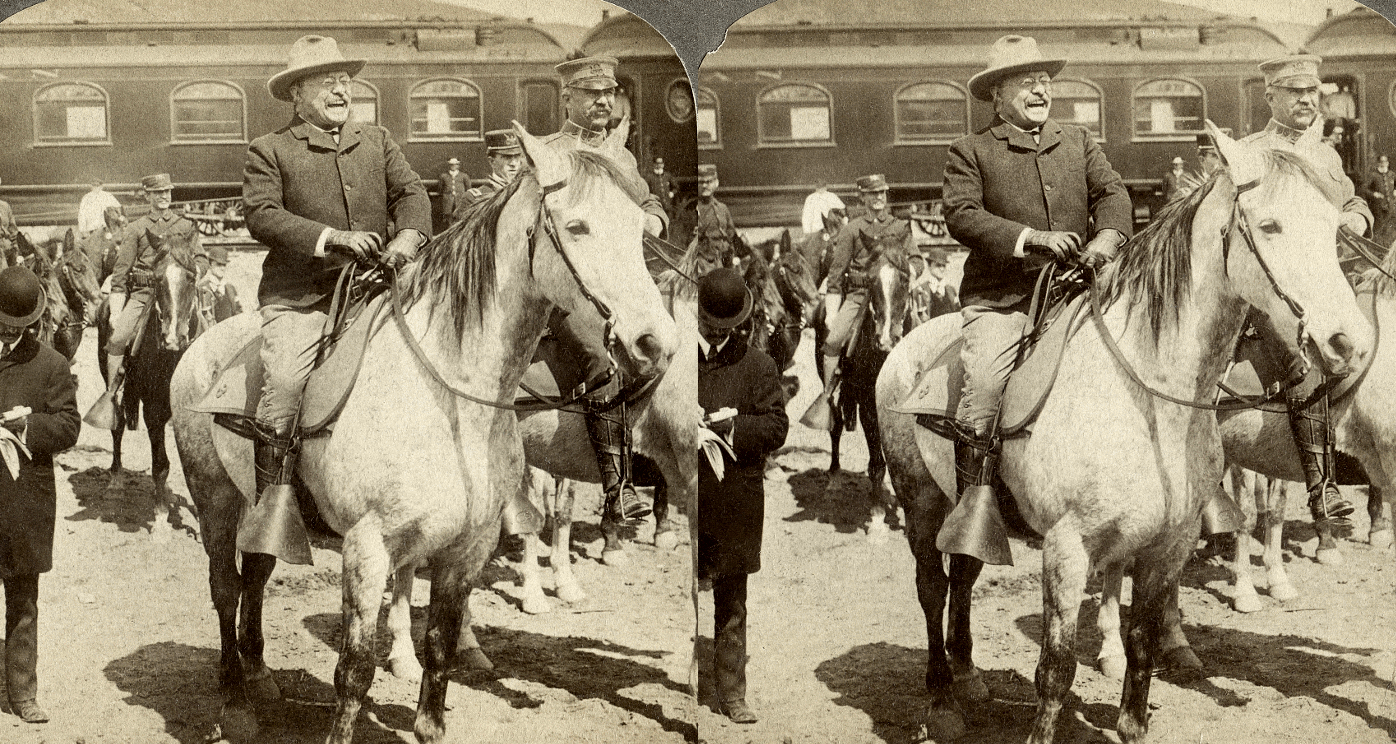
roosevelt Quotes from World Leaders on Human Rights
1. David Cameron, UK Prime Minister
“If we are going to try to get across to the poorest people in the world that we care about their plight and we want them to join one world with the rest of us, we have got to make promises and keep promises.”

2. Irene Khan, former Secretary-General of Amnesty International
“Poverty is not only about income poverty, it is about the deprivation of economic and social rights, insecurity, discrimination, exclusion and powerlessness. That is why human rights must not be ignored but given even greater prominence in times of economic crisis.”

3. Navanethem Pillay, UN High Commissioner for Human Rights

“Discrimination and multiple deprivations of human rights are also frequently part of the problem, sentencing entire populations to poverty… It is surely a matter of outrage that over half a million women die annually from complications related to pregnancy and childbirth. This is nearly half the annual global death toll, and arguably, a direct reflection of the disempowerment of women in social, economic and political life.”

4. Jesse Jackson, American Statesman and Civil Rights Activist
“The great responsibility that we have today is to put the poor and the near poor back on front of the American agenda.”

5. Pope Francis “A way has to be found to enable everyone to benefit from the fruits of the earth, and not simply to close the gap between the affluent and those who must be satisfied with the crumbs falling from the table, but above all to satisfy the demands of justice, fairness and respect for every human being.”

6. Dalai Lama XIV “No matter what part of the world we come from, we are all basically the same human beings. We all seek happiness and try to avoid suffering. We have the same basic human needs and concerns. All of us human beings want freedom and the right to determine our own destiny as individuals and as peoples. That is human nature.”

7. Malala Yousafzai, Pakistani Human Rights Activist
“I don’t know why people have divided the whole world into two groups, west and east. Education is neither eastern nor western. Education is education and it’s the right of every human being.”

8. Pranab Mukherjee, President of India 
“There is no humiliation more abusive than hunger.”

9. Kofi Annan, former Secretary-General of the United Nations
“Education is a human right with immense power to transform. On its foundation rest the cornerstones of freedom, democracy and sustainable human development.”

10. Barack Obama, President of the United States
“This is the moment when we must build on the wealth that open markets have created, and share its benefits more equitably. Trade has been a cornerstone of our growth and global development. But we will not be able to sustain this growth if it favors the few, and not the many.”

11. Desmond Tutu, Noble Peace Prize Laureate
“If you are neutral in situations of injustice, you have chosen the side of the oppressor. If an elephant has its foot on the tail of a mouse and you say that you are neutral, the mouse will not appreciate your neutrality.”

12. Vladimir Putin, President of Russia
“History proves that all dictatorships, all authoritarian forms of government are transient. Only democratic systems are not transient. Whatever the shortcomings, mankind has not devised anything superior.”

13. Mahmoud Ahmadinejad, Iranian President
“The world is in need of an encompassing and of course, just and humane order in the light of which the rights of all are preserved and peace and security are safeguarded.”

14. Bruno Rodriguez Parrilla, Cuban Foreign Minister
“This problem will knock on the doors of all of us, whether through uncontrolled and unmanageable migration flows, by means of diseases and epidemics, as a result of the conflicts generated by poverty and hunger, or as a result of events which are today unforeseeable.”

15. Warren Buffett, American Investor and Philanthropist
“Someone is sitting in the shade today, because someone planted a tree a long time ago.”

– Tyson Watkins

Sources: Office of High Commissioner for Human Rights: Quotes, Office of High Commissioner for Human Rights: Statement by Navenethem Pillay, Catholics Confront Global Poverty, Dalai Lama, Think Exist, Brainy Quote

Photo: Vintage 3D

January 13, 2014
https://borgenproject.org/wp-content/uploads/borgen-project-logo.svg 0 0 Borgen Project https://borgenproject.org/wp-content/uploads/borgen-project-logo.svg Borgen Project2014-01-13 22:30:312024-06-11 02:17:55Quotes from 15 World Leaders on Human Rights
Global Poverty

Global Poverty Threat to U.S. National Security

National_Security_In_Danger_from_Gloabl_Poverty
The volatile national security climate resonating throughout the United States is fickle, and at times hostile. Political partisanship clamors and clashes against the tide of uncertainty – an uncertainty that resides deep within the veins of the American people.

In the midst of this madness, where should efforts of national security be focused? Global poverty remains rampant and begs the question: does the cure for our own security begin with aiding in the security of others? According to the Pentagon’s “3Ds” highlighted by the Borgen Project – Defense, Development and Diplomacy – it is in the best interests of U.S. national security to focus energy on combating global poverty.

Vincent Ferraro, professor of international politics at Mount Holyoke College, spoke candidly on this issue in his publication, “Globalizing Weakness: Is Global Poverty a Threat to the Interests of States?”

“While there is no necessary trade-off between economic growth and environmental protection in the long run, a poor state needs significant outside resources to realize both objectives simultaneously,” Ferraro stated. “This situation will only worsen over time, as poorer and more populated states become more integrated into the global economy and adopt the industrial techniques of the richer states.”

The United States is an essential part to a whole interconnected entity. This is referred to simply as the international economic system. The dichotomy between poor and rich nations is linked to, but not directly responsible for, national security issues such as global terrorism.

Combating poverty may be the first step to begin building a more unified global network of national security, beginning with a more powerful nation such as the United States.

The Global Poverty Project quotes the National Security Strategy to describe the cost of this dichotomy: “America is now threatened less by conquering states than failing ones.”

Military personnel and international intelligence cooperation agrees that although combating global poverty may not be the outright solution to violent conflict, it can be a method by which to better utilize global diplomatic unity.

According to the Borgen Project, “84% of military officers said that strengthening non-military tools, such as diplomacy and development efforts, should be at least equal to strengthening military efforts.”

Global poverty is the antithesis to worldwide security and peace, specifically when rich and poorer nation-states are unfairly divided economically without a reasonable process of growth.

The Global Poverty Project encapsulated this idea in stating, “Violent conflict is development in reverse. It destroys societies and is a shortcut to extreme poverty.”

The ongoing concern of national security is not only a diplomatic issue but also a vulnerable look into the realm of the human condition. Perhaps it is in the providing basic necessities to those less fortunate where feeling safe can once again become a social truth.

– Lance Moore

Sources: ECSP, Borgen Project, State Department, Global Poverty Project
Photo: The Daily Mail

January 12, 2014
https://borgenproject.org/wp-content/uploads/borgen-project-logo.svg 0 0 Borgen Project https://borgenproject.org/wp-content/uploads/borgen-project-logo.svg Borgen Project2014-01-12 05:00:572024-05-25 00:51:40Global Poverty Threat to U.S. National Security
Global Poverty, Poverty Reduction

The Business Solution to Global Poverty

business solution
Almost three billion people live on less than $2 dollars per day. Paul Polak, one of the co-authors of the Business Solution to Poverty: Designing Products and Services for Three Billion New Customers (Berrett-Koehler Publishers 2013), believes that social entrepreneurship is the solution to ending global poverty.

From a marketing standpoint, those 2.8 billion people represent an enormous international market that is not being utilized in the economy. Innovation and technological advancements in the world of supply and demand could put products on the market that are affordable to those nearly three billion people. With a market of that size, anyone is bound to enjoy capital gain as well as improve the lives of countless people in need.

Author Paul Polak founded a business to sell cheap irrigation pumps to farmers in Bangladesh to increase their access to clean, healthy drinking water. The market for the water pumps raised the average income of the farmers by $150 million dollars a year. Contaminated water systems spread disease quickly to a massive amount of people, contributing to the ‘water crisis’ that plagues societies around the world.

What is the water crisis? Countries with no access to clean water are more heavily riddled with disease, rendering them unable to work and contribute to the economy. Medical treatment is expensive even for people who are working, so the inability to work combined with the need for disease treatment puts a heavy financial strain on a massive number of people- all because their drinking water is basically poisoning them. Unclean water spreads disease and consequently causes the economy to get stuck in a downward spiral deeper into poverty and distress. Of the 3.4 million water, sanitation, and hygiene-related deaths that occur annually, 99%  in the developing world.

Polak believes that selling affordable products that improve the lives of people in developing countries could benefit both the entrepreneurs marketing these products and the customers who are buying them. The Business Solution to Poverty outlines how companies focusing on the market in developing countries could bring an end to global poverty in approximately 30 years.

Another book called, “Thirty Years to Peace,” that more extensively details the business solution to global poverty timeline, is reported to be released in the next year. America has the wealth and manpower to launch these initiatives and the fact that it is a hugely profitable market should make it attractive to executives across the nation. There is no downside to ending global poverty through business ventures.

– Kaitlin Sutherby

Sources: Philstar, Project Humanity, Forbes
Photo: Giphy.com

January 5, 2014
https://borgenproject.org/wp-content/uploads/borgen-project-logo.svg 0 0 Borgen Project https://borgenproject.org/wp-content/uploads/borgen-project-logo.svg Borgen Project2014-01-05 04:00:362020-08-29 00:54:22The Business Solution to Global Poverty
Economy, Global Poverty

Global Unemployment

Global Unemployement
Many countries measure their unemployment rate differently. However, unemployed people are individuals who are actively seeking for job but could not obtain jobs. Reason for unemployment varies from economy downturn, and changes of particular industry to lack of required skills.

In third world countries, global unemployment is cause by overpopulation and lack of education. Unemployment rate is one of the biggest indicators of the economy, but it is also one of the biggest indicators of poverty. Countries with high unemployment rate normally have high level of poverty.

An example of the relationship between poverty and unemployment rate is Greece. In 2008, Greece unemployment rate was 7.7%, but after the economics crisis, the unemployment rate rose to 23.8% in 2012. The same situation is spotted in Spain. Spain’s unemployment rate in 2012 is 24.9%. Even though these numbers are high, but African countries are at alarming levels. Some high unemployment rates in Africa are: Kenya (40%), Congo (49.1%), and Djibouti (59.5%).

In the United States, the unemployment rate is only 7.7% in 2013, but it results in slow economic recovery and more people each day is living under poverty level. With only half of the population employed, these countries do not have enough income to distribute among all their citizens.

Half of the people are unable to support themselves with adequate shelters, food, and medical supply. In developed countries such as the United States, the government offers welfare for unemployed citizens to maintain the standard of living. However, in developing countries, welfare programs do not exist or are very limited. Unemployed individuals are struggling every for their basic needs.

When the world economy is recording due to the emerging market, many people are still suffering from the impact of the economic crisis.

– Phong Pham

Sources: Huffingtion Post, International Labour Organization, Trading Economics, Global Finance

December 21, 2013
https://borgenproject.org/wp-content/uploads/borgen-project-logo.svg 0 0 Borgen Project https://borgenproject.org/wp-content/uploads/borgen-project-logo.svg Borgen Project2013-12-21 13:28:272024-12-13 17:49:51Global Unemployment
Global Poverty

Cost Comparison: Coffee

Perhaps it’s time to start looking where your money goes, and even further where your money could be going. According to Accounting Principal’s 2012 survey, the average American worker spends more than $20 a week on coffee, adding up to a yearly average of around $1,092. For java-lovers, this may seem like a hard habit to kick. However, by even simply making your own coffee at home, you can both save calories and spend that money in a more useful way – combating global poverty.

If more Americans skipped their morning Starbucks and instead donated that money, two things could happen. 1. American obesity would significantly decline 2. Global poverty would significantly decline. Of the roughly 315 million people in the United States, if simply 30 million (about 1 out of 10 people) put their coffee money toward combating global poverty, it could be entirely eliminated.

You heard correctly. The United Nations estimates that it would take nearly $30 billion a year to put an end to world hunger. Therefore, this small and easy adjustment could save the lives of millions worldwide. Is your cup of coffee really worth more than the lives of people everywhere?

There are many ways to start taking steps to make a change toward combating world hunger. While going cold turkey and saving the money for donation is definitely an option, there are other alternatives as well. A basic Keurig Coffee Brewer costs about $120, and including the price of the coffee that goes in them (an extra $180 a year), you can still have your coffee and save the difference between buying coffee every day. While the total is slightly less, it gives coffee-lovers an option to still enjoy their brew but also fight for a good cause.

You may think your contribution won’t make a difference- but it does. Talk to friends, family and encourage them to give up buying a daily cup of java and instead save the money to donate to poverty-groups. This way, we can save the world, one coffee been at a time.

– Sonia Aviv

Sources: Consumerist, Borgen Project, LA Times
Photo: Consumer Channel Dynamics

December 2, 2013
https://borgenproject.org/wp-content/uploads/borgen-project-logo.svg 0 0 Borgen Project https://borgenproject.org/wp-content/uploads/borgen-project-logo.svg Borgen Project2013-12-02 04:39:502024-05-25 00:35:46Cost Comparison: Coffee
Activism, Children, Education, Global Poverty

Children’s Books on Poverty

In America, we often tend to live inside of a bubble, a comfortable space in which we utilize blissful ignorance to the outside world and its problems.

But this bubble has a negative impact on what’s beyond it – the rest of the world. By choosing to live in ignorance, people who need help are unable to receive it. Where that problem begins is in the home – with children.

Being privileged to a comfortable lifestyle as a child, I grew up typically getting what I wanted for Christmas and birthdays. My sister was given an iPod when they first came out, while I eventually came to be the owner of a Gameboy Color, a Nintendo 64 and a GameCube. Then again, sometimes there were disappointments – things I had asked for that were not wrapped up in brightly colored packages under the tree.

It was important to my parents to make sure that my sister and I got gifts we would actually use, but even more important was the lesson that we wouldn’t always get what we want.

That lesson applies in a large scale to the problem of global poverty, and authors are now tackling it. Not only do these lessons come in large, adult books, but they are now being offered in the pages of children’s books.

The following books educate and reinforce principles regarding economic differences, while also validating the emotions of the poor readers. The refreshing part is that these books do not intend to preach; they teach the values of resourcefulness and gratefulness.

  • The Can Man by Laura E. Williams, illustrated by Craig Orback: Tim’s parents can’t afford the skateboard he dreams of for his birthday, so he puts on rubber gloves and starts collecting cans in a quest for cash. Soon he finds himself racing a homeless can collector to the best spots in the neighborhood for cans. As he gets to know “The Can Man,” Tim learns there are things in life more valuable than any object.
  • Lucky Beans by Becky Birtha, illustrated by Nicole Tadgell: Marshall Loman is sick of beans because he has had to eat them every night since his father lost his job. In this Depression-era story, a bean counting contest at a local shop and one boy’s math-savvy help a family get back on their feet again.
  • The Hundred Dresses by Eleanor Estes, is a classic story about a Polish immigrant girl who is teased for saying she has one hundred dresses, when she wears the same faded old dress every day. It is told from the perspective of the teaser’s friend. I read this story aloud over the course of a week, engaging the children during and after each reading in a philosophical discussion about the ethical dilemma of being a silent bystander.
  • Si, Se Puede! by Diana Cohn, is a bilingual story about the Service Employees International Union organizing drive and janitors’ strike in Los Angeles. It is useful to discuss why and how workers form unions, what a strike is, the importance of community support, and connections between the story of the janitors’ organizing drive and local labor struggles.
  • The Streets Are Free by Karusa, is a bilingual story about children in a Venezuelan barrio who organize and protest about the lack of a playground in their neighborhood and the eventual community action which builds it. Children can retell and then make captioned drawings to illustrate a story of community organizing told by a “guest activist” visitor to the classroom. These can be displayed, then bound into a class book.
  • Shingebiss by Nancy Van Lann, is an Ojibwe legend about a merganser duck who demonstrates the values of persistence, conservation and resourcefulness in order to survive the northern winter. This is a favorite of my students and my own children. Shingebiss is an excellent role model to refer to when the going gets rough. I am often impressed by hearing my students exhort each other to be persistent or praise each other for being resourceful in their problem solving. I start to proudly think, “Wow! Did I teach them that vocabulary?” and then humbly remind myself, “no, they learned it from a duck.”
  • Tight Times by Barbara Shook Hazen, is about a boy in a financially stressed family who really wants a pet dog. Told from the child’s perspective, it describes the boy’s spontaneous adoption of a stray kitten against the backdrop of the father’s anger at his sudden job loss. Children can easily make text-to-self connections with the story as they discuss how a sudden change of circumstances can affect everyone in a family.
  • The Lady in the Box by Ann McGovern, is about two children who notice and then befriend a homeless woman living in their neighborhood.
  • Fly Away Home by Eve Bunting, is about a homeless boy and his father who live at an airport. I use both this book and The Lady in the Box to help children see beyond the “shopping bag lady” stereotype of homelessness, to recognize that people of all ages and circumstances can become homeless for a brief or longer period of time, for a variety of reasons, and that shelters are not solutions in themselves.

– Samantha Davis

Sources: Huffington Post, Scholastic
Photo: Georgina Public Libraries

December 2, 2013
https://borgenproject.org/wp-content/uploads/borgen-project-logo.svg 0 0 Borgen Project https://borgenproject.org/wp-content/uploads/borgen-project-logo.svg Borgen Project2013-12-02 04:29:512024-05-25 00:33:02Children’s Books on Poverty
Global Poverty

Krochet Kids International Fights Poverty

While still a high school kid, Kohl Crecelius never thought about that a small hobby could eventually make a big difference on many others’ lives.

Crecelius is the CEO and co-founder of the Krochet Kids International (KKI), a non-profit organization dedicated to empowering people to rise above poverty. When he was in high school, he loved sports on the mountain, like surfing, and was passionate about crocheting unique headwear for himself. Later on, to fund high school dances, he started his crochet business, a small crocheted hat company.

During summer breaks, Crecelius volunteered in various developing nations and saw people tired of living solely on the operating bodies for their every need. “They wanted to work and provide for their own families,” he said.

Not until that moment did he have an idea of helping these people break the cycle of poverty by teaching them crocheting. Crecelius believes high-quality, handmade products can serve as a vehicle for social change.

“The simplicity of crocheting is its most profound quality,” Crecelius said. “With hook and yarn people could make amazing products.Being paid a fair wage to do so would allow for them, for the first time, to provide for their families and begin planning for the future. By teaching these people to crochet, we would be empowering them to rise above poverty.”

Along with some close friends, Crecelius established the KKI in 2008 and began working with women in impoverished communities in Northern Uganda and Peru. By teaching those women, most are mothers and heads of households, how to crochet products, this organization has created an innovative approach to help the poor through job creation and education.

“Our goal is to poverty alleviation,” Crecelius said. “We are trying to empower women and families living in poverty to be in charge of the responsibilities to break that circle of poverty for them and forever.”

Currently, over150 people in Uganda and Peru are working and receiving education. The collaboration of KKI staff and beneficiaries around the world has created a sustainable cycle of employment and empowerment.

Crecelius noted the biggest difference between the KKI and other businesses with missions to provide aid to developing countries.Instead of providing one thing such as water, clothing or education and trying to help a broad range of people, KKI focuses on individuals, helps them with the skills they will need to address their circumstances and assists them to make a difference.

“We try to leverage the tools of business to launch the entrepreneurship and to make the best impact on people,” Crecelius said.

– Liying Qian 

Sources: KTLA, Kochet Kids International
Photo: Onboard Mag

December 2, 2013
https://borgenproject.org/wp-content/uploads/borgen-project-logo.svg 0 0 Borgen Project https://borgenproject.org/wp-content/uploads/borgen-project-logo.svg Borgen Project2013-12-02 04:12:002024-12-13 17:49:48Krochet Kids International Fights Poverty
Activism, Global Poverty

Germany’s 4 Policy Priorities to Reduce Global Poverty

German_Development_Cooperation
The German Development Cooperation is focused on reducing global poverty, ensuring peace and human security, and preserving the environment in an international framework. Its work is guided by four priority areas in the health sector:

1. Health as a Human Right
The German Development Cooperation’s efforts are guided by the Universal Declaration of Human Rights adopted by the United Nations in 1948:

“Everyone has the right to a standard of living adequate for the health and well-being of himself and of his family, including food, clothing, housing and medical care and necessary social services (…).”

Germany focuses on global poverty reduction through healthcare treatment as a means to ensuring human rights are upheld. This is pursued through strengthening health systems, investing in prevention and treatment of infectious diseases, mainly HIV/AIDS, and by working towards gender equality as a way of addressing maternity and child issues.

2.Working to Respond to HIV/AIDS
Germany is one of the largest donors to HIV response. Its efforts are concentrated on the prevention and further spreading of HIV. Currently, there are an estimated 34 million people with HIV. Most of these people live in sub-Saharan Africa.

Germany is following the internationally agreed upon goal formed through the United Nations to reverse the spread of HIV/AIDS by 2015.

3. Promoting Sexual Health and Making the Most of Population Dynamics
Through various programs, Germany addresses overpopulation concerns by facilitating activities that focus on sex education and HIV prevention, family planning, prenatal and perinatal care, prevention and treatment of sexually transmitted diseases, prevention of gender-specific violence, and action to eradicate female genital mutilation.

Furthermore, Germany pledged an additional 400 million euros towards maternal and child health at the G8 summit in Muskoka in 2010.

4. Strengthening Health Systems
The priorities of the German Development Cooperation in regard to establishing health systems involves health policy strategies, trainings, and personnel management. It includes public opinion in decision-making and establishing social protection systems such as health insurance.

Through the persistent work guided by these four goals, Germany continues to combat global poverty with its healthcare measures.

– Caressa Kruth

Sources: Healthy Developments, United Nations
Photo: Wikipedia

October 22, 2013
https://borgenproject.org/wp-content/uploads/borgen-project-logo.svg 0 0 Borgen Project https://borgenproject.org/wp-content/uploads/borgen-project-logo.svg Borgen Project2013-10-22 06:00:232024-05-25 00:27:06Germany’s 4 Policy Priorities to Reduce Global Poverty
Page 31 of 40«‹2930313233›»

Get Smarter

  • Global Poverty 101
  • Global Poverty… The Good News
  • Global Poverty & U.S. Jobs
  • Global Poverty and National Security
  • Innovative Solutions to Poverty
  • Global Poverty & Aid FAQ’s
Search Search

Take Action

  • Call Congress
  • Email Congress
  • Donate
  • 30 Ways to Help
  • Volunteer Ops
  • Internships
  • Courses & Certificates
  • The Podcast
Borgen Project

“The Borgen Project is an incredible nonprofit organization that is addressing poverty and hunger and working towards ending them.”

-The Huffington Post

Inside The Borgen Project

  • Contact
  • About
  • Financials
  • President
  • Board of Directors
  • Board of Advisors

International Links

  • UK Email Parliament
  • UK Donate
  • Canada Email Parliament

Get Smarter

  • Global Poverty 101
  • Global Poverty… The Good News
  • Global Poverty & U.S. Jobs
  • Global Poverty and National Security
  • Innovative Solutions to Poverty
  • Global Poverty & Aid FAQ’s

Ways to Help

  • Call Congress
  • Email Congress
  • Donate
  • 30 Ways to Help
  • Volunteer Ops
  • Internships
  • Courses & Certificates
  • The Podcast
Scroll to top Scroll to top Scroll to top