• Link to X
  • Link to Facebook
  • Link to Instagram
  • Link to TikTok
  • Link to Youtube
  • About
    • About Us
      • President
      • Board of Directors
      • Board of Advisors
      • Financials
      • Our Methodology
      • Success Tracker
      • Contact
  • Act Now
    • 30 Ways to Help
      • Email Congress
      • Call Congress
      • Volunteer
      • Courses & Certificates
      • Be a Donor
    • Internships
      • In-Office Internships
      • Remote Internships
    • Legislation
      • Politics 101
  • The Blog
  • The Podcast
  • Magazine
  • Donate
  • Click to open the search input field Click to open the search input field Search
  • Menu Menu

Tag Archive for: Education

Posts

Education, Global Poverty

Israel’s Early Childhood Development Education Program

Israel's Early Childhood Development Education Program
Israel’s Agency for International Development Cooperation (MASHAV) recently completed training forty Ghanaian teachers in an early childhood development course. Thanks to the Embassy of Israel, Accra Metropolitan Assembly (AMA) and the Ghana Education Service (GES), over a hundred teachers have now been trained to teach preschool and kindergarten in Ghana.

The extensive program lasted for two weeks and focused on early childhood education. Teachers left the program with a higher knowledge of children’s learning principles, the needs of young children, what curriculum to teach, and appropriate games. By giving special attention to young students, Ghana hopes to build a better foundation for its future workforce and overall societal well being.

This partnership between Israel and Ghana will likely produce hundreds more early education teachers, something for which Ghana is desperate. Not only will more teachers be trained in Israel, but those who completed the program will go on to spread their new knowledge to other teachers in Ghana, thus creating a web of well-educated preschool and kindergarten teachers throughout the country.

The Early Childhood Development Education program is now in its fourth year in Kumasi and its second year in Accra. Both countries expect to have a long relationship as they continue to see positive results in Ghana’s early education system.

– Mary Penn

Source: GBN
Photo: Flickr

May 4, 2013
https://borgenproject.org/wp-content/uploads/borgen-project-logo.svg 0 0 Borgen Project https://borgenproject.org/wp-content/uploads/borgen-project-logo.svg Borgen Project2013-05-04 08:25:222020-05-26 08:03:28Israel’s Early Childhood Development Education Program
Advocacy, Education, Philanthropy

John Legend: Singer, Songwriter, Humanitarian

johnlegend
As a nine-time Grammy award winner, John Legend is well known as a singer, songwriter, and humanitarian. His vocals have earned him a multitude of worldwide fans and a string of Top 10 platinum-selling albums. His most recent release, Wake Up! (2010) is a compilation of music from the 1960s and ’70s including songs with underlying themes of awareness, engagement, and social consciousness. Legend, while a talented musician, seeks to be an agent of change in society. He is a member of several boards including Teach for America, Stand for Children, and the Harlem Village Academies.

As he spoke to a crowd of interested attendees in Southern Indiana, Legend focused on education equality and social awareness. Legend was inspiring, motivating, and very real in his comments. Early in his career, Legend had the opportunity to travel to Africa and it forever changed his life. He realized that his position in life granted him a platform to spread awareness and raise the standard for education and community involvement. Legend tirelessly works to promote education equality, which he believes is key to raising people out of poverty. By providing access to quality education for all individuals, we can ensure that being poor is not a life sentence but that there are opportunities to escape poverty and improve one’s life.

Legend gave the audience several tips on how to get involved in fighting for education equality from right where they sit.
His ideas included:

1. Join local boards and organizations working to improve education

2. Tutor students in local schools.

3. Encourage others to invest in schools.

4. Choose political leaders who take meaningful action within education.

The evening ended with the challenge from Legend to go and do something. The time for sitting still has passed and now the call to the work for education equality and diminished global poverty has arrived.

– Amanda Kloeppel

Source: Evansville Courier and Press

April 29, 2013
https://borgenproject.org/wp-content/uploads/borgen-project-logo.svg 0 0 Borgen Project https://borgenproject.org/wp-content/uploads/borgen-project-logo.svg Borgen Project2013-04-29 11:05:302020-05-26 07:42:41John Legend: Singer, Songwriter, Humanitarian
Children, Education

Free Meals for Indian School Children

Free Meals for Indian School Children
Imagine what it’s like to have to choose between attending elementary school or harvesting wheat as a means of preventing starvation. Sadly, for many children in India where –according to UNICEF – upwards of 40 % of the population under five is underweight, this choice is one that many of their students have to make on a daily basis. However, thanks to the efforts of The Akshaya Patra Foundation and some assembly line ingenuity, free meals for Indian school children are now a reality for many elementary and middle school students.

The free meals for Indian school children program were incorporated following a 2001 Supreme Court Ruling institutionalizing free meals for all children under the age of 13. The Indian Government – in cooperation with The Akshaya Patra Foundation – has been able to feed 1.4 million children a day, resulting in greater attendance and a heightened ability to focus in class. The Foundation’s Vice Chairman, Chanchalapathi Dasa, remarked that “If a child is hungry in the classroom then he or she will not be able to receive all this education.”

But how does the government-run a program to provide that many free meals for Indian school children in one day? The answer is through an ingenious “gravity flow” kitchen that utilizes the technologies of mass production and efficiency. Basically, the kitchen is divided into 3 floors where food is prepped on the third floor, sent down –via a chute – to the cauldrons for cooking on the second floor, and sent down a final chute to be packaged and shipped to the schools on the first floor. Vice-Chairman Dasa added that the organization knew the scope of the problem that they were trying to address and “realized that in order to see a significant impact we have to do it in scale and that we have to use modern techniques of management and innovation” to make a difference.

Programs such as these serve as a much needed shot in the arm in combating global poverty and chronic undernourishment for much of India’s youth. By providing free meals for Indian schoolchildren, investments made by the government today will result in greater technological innovation through educational achievements in the future.

– Brian Turner

Source: CNN
Photo: UNICEF

April 17, 2013
https://borgenproject.org/wp-content/uploads/borgen-project-logo.svg 0 0 Borgen Project https://borgenproject.org/wp-content/uploads/borgen-project-logo.svg Borgen Project2013-04-17 08:34:542020-06-12 01:13:30Free Meals for Indian School Children
Education

USAID Helps Nicaraguan Students Graduate

USAID Helps Nicaraguan Students Graduate
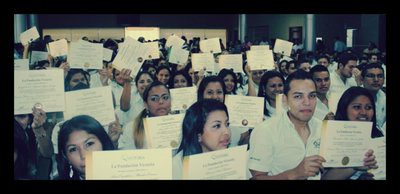
Universidad Centroamericana celebrated as 125 students graduated on April 5th. Many of these students had received scholarships from the USAID’s Enterprise and Employment program to study business and technical studies. Nicaragua’s Victoria Fountain, an organization that encourages young people to pursue technical degrees, also supported the students.

These graduates completed courses in “strategic planning, human resources, negotiation techniques, human relations and customer service” for business majors and technical majors took “mechanical drawing, electricity, mechanics, hydraulics and pneumatics.”

USAID and the Victoria Foundation each contributed $107,000 to the University. This money went towards providing books, uniforms, meals, and teachers’ salaries. The two organizations hope to team up to create a food technology degree. Students graduating with this degree would greatly contribute to Nicaragua’s effort to improve its food security. U.S. Ambassador Phyllis Powers, the head of USAID’s Enterprise and Employment Program, and several representatives from the Victoria Foundation attended the graduation celebration. These organization members were thrilled to see their financial contributions utilized to benefit these hard working students and the country of Nicaragua.

As more young people receive a higher education, Nicaragua’s economy and standards of living will begin to improve. Many of these students would not have had the financial means to attend Universidad Centroamericana without the help of USAID and the Victoria Foundation. Now, they have the opportunity to change their lives for the better.

– Mary Penn

Source: TND

April 15, 2013
https://borgenproject.org/wp-content/uploads/borgen-project-logo.svg 0 0 Borgen Project https://borgenproject.org/wp-content/uploads/borgen-project-logo.svg Borgen Project2013-04-15 11:03:082020-06-12 01:28:43USAID Helps Nicaraguan Students Graduate
Education, Foreign Aid

USAID to Expand Its Teacher Training Project in Pakistan

USAID to Expand Its Teacher Training Project in Pakistan
The USAID Teacher Education Project in Pakistan has expanded to provide teaching services to every province in the country. This $75 million project has been working since 2011 to modernize Pakistan’s education system. With the help of Pakistan’s Higher Education Commission (HEC), over 2,600 students have enrolled in 15 universities and 57 colleges across the country. USAID hopes to see this number increase as more teachers emerge from the Teacher Education Program.

In order to reach out to more potential teachers, USAID realized the need to enlarge its program. Not only will the Teacher Education Project offer more locations, it is also giving 1,900 scholarships to students based on merit and financial need.

This higher education program will be implementing suggestions from a study conducted in 2006 that found flaws in Pakistan’s current teacher training system. The study discovered a trend of the government setting unrealistic goals for its education system and then, when it fails to meet those goals, creating new, also idealistic targets that are never reached. By making its goals more realistic, USAID is confident in its ability to improve Pakistan’s education system by producing high quality teachers.

As Pakistan trains more well qualified teachers, the country will begin to experience higher quality of education for its younger students as well. Javaid Laghari, chair of the HEC, is optimistic about Pakistan’s future, “We hope for a good change, when today’s students become tomorrow’s teachers.”

– Mary Penn

Source: UWN
Photo: BarakatNews

April 14, 2013
https://borgenproject.org/wp-content/uploads/borgen-project-logo.svg 0 0 Borgen Project https://borgenproject.org/wp-content/uploads/borgen-project-logo.svg Borgen Project2013-04-14 09:00:472020-06-07 21:59:02USAID to Expand Its Teacher Training Project in Pakistan
Advocacy, Children, Human Rights, Nonprofit Organizations and NGOs

Child Marriage: A Promise of Poverty

Child Marriage: A Promise of Poverty

The average teenager worries about hanging out with friends, getting good grades, and fitting in with a group of people—not marrying a stranger and creating a home.

However, child marriage is a reality in the world’s 51 least-developed countries.  Half of all girls living in these countries are married before the age of 18, according to the United Nations. Parents arrange the marriage, and the groom can be more than twice the bride’s age.  Girls are ripped from their communities and forced into social isolation. These abrupt marriages sever a girl from her support network—a group of people necessary for helping the girl face the physical and emotional challenges of marriage.

Many cultures view girls as economic burdens, subservient individuals, or family mistakes. Marrying girls off as soon as possible alleviates the household expenses and restores the family’s reputation.

The UN Convention on the Rights of the Child (UNCRC) established that the minimum age of marriage is 18 years old. This is considered the upper limit of childhood, and the individual is fit to decide whether to be married.  Many countries continue to practice child marriage despite proven physical and psychological effects.

World Vision reported that child marriages are increasing due to the increase in global poverty crises. 14 million girls under the age of 18 are married each year.  Child marriages are most prevalent in rural, poor areas and are associated with areas of low education and healthcare.  Polygamy is common, and these marriages are bargaining chips between two parties.

South Asia (46%) and Central Africa (41%) are the top areas for child marriages.  These regions do not monitor the age of spouses carefully.  Girls who live in countries with humanitarian crises are most likely to be subjected to child marriages. Fear of rape, unwanted pre-marital pregnancies, family shame, and hunger are the main motivators for child marriage. Poverty, weak legislation, gender discrimination, and lack of alternative opportunities reinforce these motivations.

Anti-poverty organizations, such as CARE, are working in various countries to combat child marriage.  According to CARE, “As levels of education and economic opportunities increase, so does the average age of marriage.”  CARE mobilizes community organizers, parents, and tribal and religious leaders to lobby against the child marriage law in Ethiopia. Leaders are constructing savings and loans groups to empower families financially. Though child marriage still exists, this will eliminate one major cause of child marriage. Community forums now focus on the elimination of bride price, bride abduction, and child marriage.

– Whitney M. Wyszynski

Source: NBC News

April 10, 2013
https://borgenproject.org/wp-content/uploads/borgen-project-logo.svg 0 0 Borgen Project https://borgenproject.org/wp-content/uploads/borgen-project-logo.svg Borgen Project2013-04-10 10:00:092024-12-13 17:49:16Child Marriage: A Promise of Poverty
Education, USAID, Women and Female Empowerment

USAID Funds Partnerships for Women’s Leadership

USAID Funds Partnerships for Women's LeadershipUSAID funds partnerships with Higher Education for Development (HED) to encourage women’s leadership throughout a number of developing countries, including South Sudan, Rwanda, Paraguay, and Armenia. As part of the new Women’s Leadership Program, five American universities will partner with universities and colleges throughout the select countries.

The partnership between universities aims at encouraging women’s status in a number of vital sectors for economic development, including agriculture, business, and education. The goals of the program also fall in line with previous goals laid out by USAID as part of the Gender Equality and Female Empowerment Policy, which was released in 2012.

HED will be in charge of administering the programs, which will total one in each country and two in Rwanda. Funding for the program from USAID will total $8.75 million.

Some of the more specific goals of the Women’s Leadership Program will include increased access to higher education and advanced degrees for women, increases in foreign universities research on women’s leadership, and encourage women’s leadership through advocacy in struggling communities. The American universities that are participating in the program are Arizona State University, Michigan State, Indiana University, UCLA, and the University of Florida.

USAID Senior Coordinator for Gender Equality and Women’s Empowerment, Carla Koppell, said “USAID is very excited to be collaborating with academic institutions in the United States and abroad in advancing women’s leadership. These partnerships offer a meaningful and important opportunity to ensure women are empowered and advance in economies and societies globally.”

– Christina Kindlon

Source: USAID

March 27, 2013
https://borgenproject.org/wp-content/uploads/borgen-project-logo.svg 0 0 Borgen Project https://borgenproject.org/wp-content/uploads/borgen-project-logo.svg Borgen Project2013-03-27 09:00:532020-05-26 01:04:42USAID Funds Partnerships for Women’s Leadership
Education, USAID

USAID Fighting Terrorism With Wool

US AID Fighting Terrorism With WoolQuinoa seems to be on everyone’s mind lately, but for the district of Mastung – a district located on the border of Afghanistan and Pakistan– sheep and shepherding account for more than 40% of the economy. Unfortunately, many farmers in Mastung use outdated techniques which limit their production even though demand for wool is high.

To help with this dilemma, USAID has funded an agricultural project in which Australian shepherds, who are among the world’s finest, instruct a best-practices workshop which teaches Mastung farmers current techniques and educate the farmers on how to use current technologies. These new techniques have been combined with direct marketing practices and, with the two disciplines combined, the result is an 80% growth of income for farmers in the communities where these practices have been implemented.

While this type of growth does help border communities in Pakistan, the strengthening of these communities has an unforeseen effect on U.S. national security and global security as a whole. It is no secret that extremist groups target poor communities by offering financial assistance and other forms of aid. In a region that has been plagued with extremist groups such as the Taliban, contributing to the economic growth of communities and helping them remain stable prevents the spread of terrorism and extremist ideology. For the Mastung, fighting terrorism with wool production is a win-win situation.

Not only do these contributions help create a better life for those in the border communities of Afghanistan and Pakistan, but they also help these communities as a means to furthering global security as a whole.

– Pete Grapentien

Source: TheNews.com
Photo: Pakistan Today

March 5, 2013
https://borgenproject.org/wp-content/uploads/borgen-project-logo.svg 0 0 Borgen Project https://borgenproject.org/wp-content/uploads/borgen-project-logo.svg Borgen Project2013-03-05 21:17:252020-05-19 22:04:01USAID Fighting Terrorism With Wool
Education, Sanitation

The Importance of Sanitation to Education


The Importance of Sanitation to Education
Many people know the importance of clean water and basic sanitation for health, yet, hardly think of what not having these amenities means for schools and education. According to a program called Support My School, studies have shown that schools lacking “basic amenities like Toilets, Access to Water and Basic Infrastructure create[s] an unwelcome environment in schools, which leads to a higher rate of absenteeism, finally resulting into drop-outs.”

For rural India, this becomes an extremely large issue because an estimated 50 percent of schools here are without functioning toilets. This is why Coca-Cola India, NDTV and UN-Habitat have teamed up to start to Support My School, a program in India geared to revive schools in semi-urban and rural towns and improve their sanitary and water efforts.

Support My School does not just help get clean water and working toilets into school, it also builds awareness on just how important water and sanitation are too many aspects of life, including education, utilizes whole communities to find solutions for the schools, and raises money through donations from stakeholders, corporations, and the general public. The program believes that improved sanitation and the provision of other basic amenities will make schools and students happier, healthier, and more active.

As of today, Support My School has raised 13.6 crore, which is equivalent to 2.495 million dollars.  272 schools in India have been revitalized. And over 43,000 students have reaped the benefits of the campaign.

– Angela Hooks


Sources: Support My School, Coca-Cola India

February 26, 2013
https://borgenproject.org/wp-content/uploads/borgen-project-logo.svg 0 0 Borgen Project https://borgenproject.org/wp-content/uploads/borgen-project-logo.svg Borgen Project2013-02-26 09:00:222020-05-11 04:10:38The Importance of Sanitation to Education
Education

Political Crisis in Mali Affects Education

Political Crisis in Mali Affects Education
How does a political crisis or violent fighting within a country affect education?

For Mali, a political crisis has meant the displacement of over 700,000 students and teachers, the destruction and closing of at least 115 schools, and a large psychological impact on students from exposure to violence that must be addressed.

The political crisis in Mali began over a year ago. It puts the Mali government against Tuareg rebels and has resulted in the uprooting of a large number of residents from northern Mali and has pushed them southward, out of harms way. This uprooting has forced many children to find new schools to attend. It has also pushed teachers into finding new schools to teach in. While 500,000 out of the original 700,000 students have found new schools to attend since being displaced, there is still “an urgent need to rebuild schools, train teachers and provide learning supplies,” according to a statement made by UNICEF.  This is because many of these news schools were already facing issues with overcrowding are now operating beyond their capacities, and finding themselves unable to cope with the displayed northerners.

Malian educational authorities are working with UNICEF officials to quickly open up more schools in northern Mali. Over 1,100 Malian teachers have been trained to provide psychological support to students, as well as mine-risk education, since December. This is a big necessity because, as put by UNICEF Representative Françoise Ackermans, “when a teacher is afraid to teach and when a student is afraid to go to school, the whole education is at risk.”

Yet, education will continue to be negatively affected as long as violence progresses in the area. As of today, Mali is still highly volatile, making even walking to school dangerous. Political crises and violent fighting between two groups within a country have very serious effects on its citizens, creating far-reaching consequences. Ensuring children have access to schools ensures these children have access to knowledge, an important asset to all.

– Angela Hooks

Source: UN News Centre
Photo: Care

February 25, 2013
https://borgenproject.org/wp-content/uploads/borgen-project-logo.svg 0 0 Borgen Project https://borgenproject.org/wp-content/uploads/borgen-project-logo.svg Borgen Project2013-02-25 13:48:562024-06-10 02:52:59Political Crisis in Mali Affects Education
Page 66 of 67«‹64656667›

Get Smarter

  • Global Poverty 101
  • Global Poverty… The Good News
  • Global Poverty & U.S. Jobs
  • Global Poverty and National Security
  • Innovative Solutions to Poverty
  • Global Poverty & Aid FAQ’s
Search Search

Take Action

  • Call Congress
  • Email Congress
  • Donate
  • 30 Ways to Help
  • Volunteer Ops
  • Internships
  • Courses & Certificates
  • The Podcast
Borgen Project

“The Borgen Project is an incredible nonprofit organization that is addressing poverty and hunger and working towards ending them.”

-The Huffington Post

Inside The Borgen Project

  • Contact
  • About
  • Financials
  • President
  • Board of Directors
  • Board of Advisors

International Links

  • UK Email Parliament
  • UK Donate
  • Canada Email Parliament

Get Smarter

  • Global Poverty 101
  • Global Poverty… The Good News
  • Global Poverty & U.S. Jobs
  • Global Poverty and National Security
  • Innovative Solutions to Poverty
  • Global Poverty & Aid FAQ’s

Ways to Help

  • Call Congress
  • Email Congress
  • Donate
  • 30 Ways to Help
  • Volunteer Ops
  • Internships
  • Courses & Certificates
  • The Podcast
Scroll to top Scroll to top Scroll to top