• Link to X
  • Link to Facebook
  • Link to Instagram
  • Link to TikTok
  • Link to Youtube
  • About
    • About Us
      • President
      • Board of Directors
      • Board of Advisors
      • Financials
      • Our Methodology
      • Success Tracker
      • Contact
  • Act Now
    • 30 Ways to Help
      • Email Congress
      • Call Congress
      • Volunteer
      • Courses & Certificates
      • Be a Donor
    • Internships
      • In-Office Internships
      • Remote Internships
    • Legislation
      • Politics 101
  • The Blog
  • The Podcast
  • Magazine
  • Donate
  • Click to open the search input field Click to open the search input field Search
  • Menu Menu

Archive for category: Technology

Information and stories about technology news.

Technology

Solar Suitcase Saves Lives in Developing Countries

Childbirth can present risks anywhere in the world. However, in developing countries, giving birth can often be lethal for both mother and child. The most common causes of infant mortality include infections, premature birth, or birth asphyxia, while maternal deaths are usually the result of severe bleeding or high blood pressure during pregnancy. Effective care before, during, and after childbirth is necessary to treat such complications, but many areas lack the basic resources to provide such care.

In 2008, Dr. Laura Satchel traveled to Nigeria to research possible methods of lowering the country’s maternal death rate, which currently stands at 630 deaths per 100,000 births. Nigeria also has the 10th highest infant mortality rate in the world, with 74.09 deaths per 1,000 births. While working in state hospitals, Satchel realized that many of these deaths were not simply due to illness, but unreliable electricity interfering with the doctors’ ability to treat their patients. Nighttime deliveries were often illuminated only by candlelight, cesarean sections were frequently cancelled or conducted by flashlight, and patients were forced to wait days for life-saving procedures that could not be performed without electricity. This resulted in many deaths from treatable conditions.

Satchel’s goal was to come up with an affordable solution. She contacted her husband, Hal Aronson, a solar energy educator in Berkeley, California. Aronson began designing an off-grid solar electric system, specifically intended for use in maternity wards and labor rooms. This resulted in the development of the Solar Suitcase.

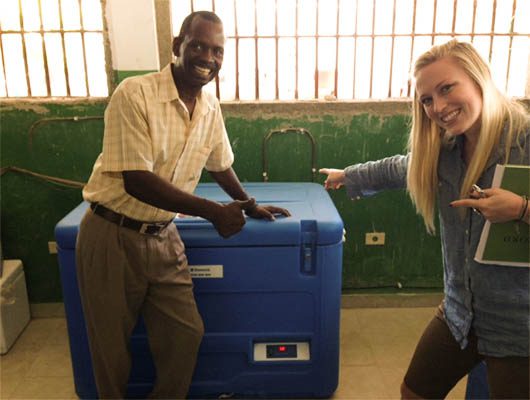
The Solar Suitcase is a bright yellow pack containing high efficiency LED medical lighting, a universal cell phone charger, a battery charger, and outlets for 12V DC devices. The maternity kit also includes a fetal Doppler. The suitcase is designed to last between 10 and 20 years, only requiring a battery change every two years. When Nigerian health clinics began receiving the suitcases, doctors were immediately able to charge headlamps and walkie-talkies while they waited for larger solar installations at their facilities.

In 2009, Satchel and Aronson founded the non-profit organization We Care Solar, aiming to improve the design of the Solar Suitcase and distribute them to more clinics in need. In 2014 alone, the suitcases are estimated to have served 256,800 mothers. As of November 2014, approximately 900 suitcases had been distributed to 25 countries worldwide, from Sierra Leone to Malawi.

Although the suitcases are primarily used in maternal health clinics, they have also saved lives in the wake of natural disasters. We Care Solar sent the device to Haiti after the 2010 earthquake at the request of medical relief teams.

Currently, the organization is in the process of sending 100 suitcases to Nepal, where thousands of pregnant women are in need of medical care following the recent string of earthquakes. In the coming months, We Care Solar plans on expanding its programs in Ethiopia, Tanzania and the Philippines. In a world where mothers and newborns die each day from preventable causes, devices like the Solar Suitcase provide doctors with the tools they need to give women and their children a chance at life.

– Jane Harkness

Sources: CIA 1, CIA 2, Huffington Post, Issuu, We Care Solar, WHO 1, WHO 2
Photo: Flickr

June 7, 2015
https://borgenproject.org/wp-content/uploads/borgen-project-logo.svg 0 0 Borgen Project https://borgenproject.org/wp-content/uploads/borgen-project-logo.svg Borgen Project2015-06-07 16:00:312024-05-27 09:24:04Solar Suitcase Saves Lives in Developing Countries
Technology, Water

Water Billboards: Turning Humidity Into Potable Water

Water-Billboards
Receiving only a half-inch of precipitation annually, the 7.6 million residents of Lima, Peru are in the midst of a serious water shortage. One point two million Limans do not have running water at all, and 700,000 people have no access to clean water for drinking or bathing. With advanced climate change affecting the natural water sources of the Andes, engineers from Peru’s University of Engineering and Technology (UTEC) have turned to science, and specifically water billboards, for an answer.

Like a magician pulls a rabbit from a hat, they’ve figured out a way to pull water from thin air.

The process of scientific magic occurs inside a billboard in Lima’s Bujama District, erected by a group of UTEC engineers in partnership with marketers from the Mayo Publicidad ad agency. The billboard takes advantage of Lima’s high degree of humidity, nearly 90 percent in the summer months, and transforms this moisture into usable water.

When moist air hits the billboard, five condensers cool it and convert it into liquid form. The newly created water goes through reverse-osmosis purification and then flows into a 20-liner storage tank at the billboard’s base. The filtration system is simple and straightforward, though not entirely self-sufficient, because it uses electricity from Lima’s power lines.

Active for 3 months, the billboard has had a significant effect. It has produced nearly 2,500 gallons of water, averaging 26 gallons a day. According to the UTEC engineers involved, this is equivalent to the water consumption of hundreds of families per month.

Efforts have been made in the past to magically pull water from the air. Most notably Eole, a French company, installed a wind turbine in Abu Dhabi that was said to generate more than 370 gallons of water a day. The commercial launch of this technology, however, came at too high of a price.

That’s the genius of UTEC’s water billboard – if the technology expands, it will be inexpensive to install thanks to funding from advertisers. The inaugural billboard costs only $1,200 to construct, and advertises both UTEC and the technology itself. UTEC has not gone unrewarded, since the erection of the billboard enrollment has substantially increased. It hopes that companies will see UTEC’s own results and seek to advertise on water billboards themselves.

It is unclear whether more billboards like this one will be installed throughout Lima, but UTEC’s water billboard has successfully started new discussions about providing clean water. Advertising can be more than a commercial tool; it has potential as an effective method of helping those in need.

– Katie Pickle

Sources: Popular Mechanics, Time
Photo: Fast Coexist

June 6, 2015
https://borgenproject.org/wp-content/uploads/borgen-project-logo.svg 0 0 Borgen Project https://borgenproject.org/wp-content/uploads/borgen-project-logo.svg Borgen Project2015-06-06 04:00:292020-07-17 20:39:11Water Billboards: Turning Humidity Into Potable Water
Technology

Tesla’s New Home Battery: The Powerwall

Tesla-Home-Battery-Powerwall
As we burn up some of our nonrenewable resources, we face a grim ultimatum: continue using the same resources until we’ve depleted them all (which could have catastrophic consequences) or find a way that everyone on Earth can benefit from electricity without burning our nonrenewable resources. Elon Musk, the CEO of Tesla Motors, is trying to find a way to solve this and he has recently created a battery that may do just that.

Powerwall is a home battery that uses solar power in order to provide the battery with a charge. The battery is capable of powering an entire house when utilities are low. When a storm comes rolling into town and knocks the power out, the Powerwall is capable of providing the emergency power.

The compact design of the battery allows you to mount it on any wall that is desired; it is also an aesthetically pleasing piece of equipment. The entire system that collects and distributes electricity through the Powerwall is relatively simple. There are three essential parts:the Solar Panel, the Home Battery (Powerwall) and the Inverter.

The solar panel, which is installed on the roof, collects and converts sunlight into electricity. That surplus electricity is stored in the Powerwall during the day or even when the rates of the utility grid are low. The Inverter converts the electricity from DC to AC. AC is the type of electricity used for household electronics.

Building an invention as groundbreaking as this has many benefits. The battery can provide financial savings to its owner by charging during low rate periods when demand for electricity is lower, and, conversely, discharging when the rates are high. Owning a Powerwall also increases the consumption of solar power generation, which is one of the cleanest, renewable energy sources around. This allows for reduced CO2 emissions.

As this technology progresses, it can be used to address poverty and help provide electricity to areas that aren’t near power plants. Once there is a way to produce these types of rechargeable lithium-ion batteries cheaply, then we will be able to see them popping up in developing, remote areas, such as sub-Saharan Africa. The U.S. Congress has made bringing electricity to remote areas in Africa a major goal. The U.S. Agency for International Development is headlining that mission under the Electrify Africa Act.

The Powerwall is considered the automobile of its industry; it is pioneering technology. Once there are even better ways to produce the Powerwall, the technology will become more accessible. Once more accessible, more people will be able to utilize renewable energy. This is the underlying purpose of this technology; to reduce the amount of nonrenewable energy used by burning fossil fuels by providing a renewable alternative.

– Erik Nelson

Sources: Congress, Tesla Motors 1, Tesla Motors 2
Photo: Wired

May 24, 2015
https://borgenproject.org/wp-content/uploads/borgen-project-logo.svg 0 0 Borgen Project https://borgenproject.org/wp-content/uploads/borgen-project-logo.svg Borgen Project2015-05-24 12:00:352020-07-18 02:14:34Tesla’s New Home Battery: The Powerwall
Development, Technology

The Importance of Technology for Development

Importance of Technology Development
Technology is constantly developing and with its exponential growth there is much to look forward to in its role in ending world poverty.

“The effect of the Internet in broadening and enhancing access to information and communication may be greatest in poorer nations,” according to Harvard University. If developing countries gain more access to the Internet it can be a driving force to lift families out of poverty. The knowledge provided through the internet can maintain health, educate families, and open doors for boys and girls who are unable to attend school.


Technology Sparks Development


Another benefit the Internet offers for the poor is the ability to get microloans. Microloans give people the chance to start a business who cannot typically afford it. Businesses like SamaSource and Regent Park’s Access Microloan program have helped women to start catering businesses and finish their education. “SamaSource is an innovative social business that connects women and youth living in poverty to work opportunities via the Internet from Africa,” according to The Huffington Post.

Microloans are helping families and communities come out of poverty. When women have the capabilities to start up their businesses, they have the opportunity to invest their money in other areas in their lives. Children and communities benefit from flourishing women who are lifted out of poverty. Microloans sustain development in poor countries and expand economic growth.

The U.N. recognizes the benefits that internet access offers to developing countries. “Through both simple and sophisticated techniques, the Internet can help eradicate poverty, educate people, sustain the environment and create healthier populations,” says the U.N. As developed countries continue to progress in the field of technology, developing nations are falling behind.

However, access to the Internet is improving. Google has recently invested $1 billion in satellites to provide Internet access to people in developing countries. Along with Internet acess, businesses are also investing in mobile technology. Mobile banking services allow families to monitor their and better spend their money.

Technology is the golden ticket to achieving the goal of ending poverty by 2030.

– Kimberly Quitzon

Sources: Harvard, The Huffington Post, United Nations
Photo: SAP:Business Innovation

May 24, 2015
https://borgenproject.org/wp-content/uploads/borgen-project-logo.svg 0 0 Borgen Project https://borgenproject.org/wp-content/uploads/borgen-project-logo.svg Borgen Project2015-05-24 04:00:372024-06-11 02:34:28The Importance of Technology for Development
Global Poverty, Technology

Outernet Delivers Information Equality

outernet
An estimated 60 percent of the world’s population has no Internet access. Of the people with regular Internet access, several million can only access censored information. Syed Karim, founder of Outernet, plans to change all that.

In 2012, Karim founded Outernet to bring the Internet to the remotest parts of the globe. To him, information is a human right as basic as food or water, and the Internet is the best information delivery system in history. Outernet is a datacasting company that could change the way isolated communities receive Internet. Using hardware of its own design, the company can bounce prepackaged streams of data off small satellites and onto Wi-Fi-enabled devices anywhere in the world.

Outernet’s hardware innovations come in three forms. The first is the durable 24-inch satellite dish that receives the data stream. Designed like a folding colander, the dish can expand and contract by unfolding a series of overlapping panels. It can fold down small enough to fit into a bucket, making it easy to transport. Instead of the small motor most satellite dishes use to rotate, the Outernet dish articulates on a threaded screw that makes it extra durable, especially under windy conditions. Outernet has also perfected a device called a Lantern that serves as both a data stream receiver and a portable Wi-Fi hot spot. Lanterns are about the size of water bottles and can receive almost any information on the Internet.

Perhaps the most impressive of Outernet’s accomplishments is its fleet of CubeSats, shoebox-sized satellites that bounce uni-directional data down to Earth’s surface. This past March, the U.K. Space Agency agreed to fund the fleet of CubeSats. By 2016, Outernet plans to have three of the tiny, inexpensive satellites in orbit, each delivered by piggybacking on launches for larger projects. “It costs about $100,000 per kilogram,” Karim said. “The cost of the launch is much more expensive than the satellite itself.”

The service Outernet provides is not the same as conventional Internet access. It works more like a conventional radio. The signal is one-way and generalized. As Syed Karim put it, “When you talk about the internet, you talk about two main functions: communication and information access… It’s the communication part that makes it so expensive.” Because the service is only information, not communication, it is also much harder to jam. The signal sent from Outernet’s CubeSats is almost impossible to censor.

If Outernet succeeds in its mission, basic information will become available to everyone, everywhere. Censorship will be, if not a thing of the past, then at least much more difficult to pull off. Farmers in rural India could request price predictions for the upcoming year before deciding what to plant. Schools in rural Africa could download the most up-to-date lessons and facts to learn from, and not rely on old, potentially inaccurate textbooks. Information could become as widely distributed as food or electricity, and the world could take one more step toward equality.

– Marina Middleton

Sources: World.Mic, Outernet, Gizmodo, Wired
Photo: Indie GoGo

May 11, 2015
https://borgenproject.org/wp-content/uploads/borgen-project-logo.svg 0 0 Borgen Project https://borgenproject.org/wp-content/uploads/borgen-project-logo.svg Borgen Project2015-05-11 12:00:002020-07-18 11:45:15Outernet Delivers Information Equality
Activism, Global Poverty, Technology

Google Plans to Bring Internet to Remote Areas

Google has partnered with the French space agency, the Centre National d’Etudes Spatiales, to provide rural and remote areas of the world with Internet access. The partnership aims to reach higher ground with the Project Loon initiative.

Project Loon is a Google research and development project with the mission of providing Internet access to rural and remote areas. The project uses high altitude balloons to create an aerial wireless network that project Wi-Fi signals.

The balloons are solar powered and each is coordinated to make movements in a complex formation to provide continuous service. Google’s new approach on these balloons involves using technology with powerful satellites. Powerful satellites will provide more responsive Internet for the balloons to harness and spread.

They rise more than 60,000 feet above the Earth’s surface, placing them far beyond the reach of airplanes and atmospheric storm systems.

Satellite Internet is already becoming faster and more inexpensive at a steady rate. About 1.5 billion people get home Internet through a satellite connection, though only 0.2 percent of people in developed countries are connected through satellite.

Google wants to launch 100,000 balloons into the stratosphere to offer free Internet access in remote and rural locations around the world, and retrieve them when they lose air and fall to the ground.

To date, there are 75 Google balloons airborne, hovering somewhere near the far reaches of the Southern Hemisphere. These balloons automatically regulate their altitudes according to the algorithms to catch wind drafts and keep them on path.

A majority of the world still lacks Internet access, even after the 1.8 billion people that joined the Internet in 2014. An astounding 4.4 billion people still have never been online.

Internet access can benefit those in developing countries, especially those in India, where the population has more mobile phones than sanitary toilets. In India, over 1 billion people are still offline.

Moreover, China’s massive population of 1.3 people may be iPhone-obsessed, but more than half of its population still remains disconnected.

The Internet can be a useful tool for farmers, as access to the Internet allows farmers to be updated on constant climate changes, and projected problems in the seasons that may affect crop growth. Moreover, Internet access can also be a useful education tool used in schools for learning, and it can improve literacy rates.

Google’s balloons may sound expensive, but research actually indicates that these balloons are cheaper than setting up and maintaining cell towers, and the balloons are also more effective to bring access to remote areas.

Although Google’s project has faced criticism and doubts along the process among Project Loon, Google notes that the next big step is testing how the balloons handle thousands of pounds of pressure.

Google’s engineers have spent weeks trying to isolate any problems they had in the past with the balloons that are already hovering over vast remote areas. Google has the potential to deliver its promise of Internet access across the world and to regions that have been without it with precise research and design.

– Sandy Phan

Sources: Google, NPR
Photo: Digital Trends

January 15, 2015
https://borgenproject.org/wp-content/uploads/borgen-project-logo.svg 0 0 Borgen Project https://borgenproject.org/wp-content/uploads/borgen-project-logo.svg Borgen Project2015-01-15 04:00:592024-06-05 01:58:21Google Plans to Bring Internet to Remote Areas
Poverty Reduction, Technology

Cell Phones Improve Literacy Rates

cell_phones
Out of the 7 billion people on the planet, 6 billion have a mobile phone. Cell phones have become widespread in developing countries, and that is not necessarily a bad thing. The mobile technology has become ubiquitous even in poverty-stricken areas and its impact on users is rapidly changing poor populations. Studies conducted in the past have shown that cell phones can provide literacy to the world’s poorest nations.

Literacy is known to be essential for economic development and fighting poverty. More than 1.2 billion people still live in extreme poverty, and nearly 2.5 billion people live on less than $2 a day. Studies have shown that literacy has a positive effect on GDP per capita. It is estimated that if all children from low-income nations could read, the poverty rate could drop by 12 percent.

Cell phones have been named the new important devices in the world. The mobile technology has even helped provide schools, teachers and parents with access to educational insights for success.

Moreover, cell phones help thousands of people in developing countries learn to read using their mobile phones. In fact, before the widespread use of cell phone technology, the adult literacy rate in all of Africa stood at 52 percent; by 2008, the literacy rate had increased to 63 percent.

Illiteracy is partially due to the lack of books in the developing world; an alternative solution to this problem is cell phones. Cell phones are inexpensive, convenient, cost-efficient and provide electronic books in the hands of developing nations.

Literacy not only empowers people, but it empowers the mind as well. When it comes to alleviating global poverty, literacy is important for development. Women who are involved in literacy programs and activities obtain a better knowledge of health and family planning. Additionally, children who have parents that are literate are more likely to be enrolled in an educational program and have extra support toward their studies.

Reports have also shown that low literacy costs the healthcare industry over $70 million each year. Children whose mothers can read are 50 percent more likely to survive past the age of five years old. To be able to read can be vital for survival; understanding medical guidelines or security instructions are crucial for a person’s health and safety.

Literacy also develops societies on a political level. People who are literate have the upper hand in becoming more educated, and therefore are more likely to become civically engaged. Whether they are involved in labor unions, politics, or community activities, they will have the opportunity to change the world. To be able to read, write and count contributes to an individual’s self-development, and allows each individual to have their own sense of personal freedom and better understand how to adapt to the constantly changing world.

– Sandy Phan

Sources: World Bank, Do Something, UNESCO
Photo: USA Today

December 30, 2014
https://borgenproject.org/wp-content/uploads/borgen-project-logo.svg 0 0 Borgen Project https://borgenproject.org/wp-content/uploads/borgen-project-logo.svg Borgen Project2014-12-30 04:00:382024-12-13 17:51:18Cell Phones Improve Literacy Rates
Education, Technology

Eneza: Kenya’s Mobile Education Platform

mobile_educationEneza is the Kiswahili word for “to reach” or “to spread.” The new education platform by the same name acts as a virtual tutor and teacher’s assistant for thousands of students living in rural Kenya.

Eneza’s mission is to reach 50 million children across rural Africa to help them gain access to information, allowing them to reach their full potential through the most common form of technology in Africa: the cell phone.

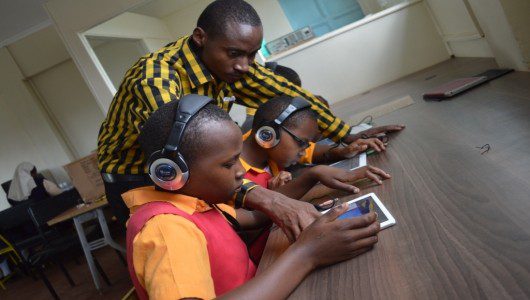
In its pilot program, students are provided with cell phones in school in order to be exposed to content that is aligned with its local context, ranging from textbook materials to unlimited quizzes and tutorials.

In addition, schools and parents are also given access to data and tips for helping these children, allowing Eneza to serve as a simple platform that still provides the same quality educational materials found in high-tech institutions.

The mobile software has found its way into 5,000 public schools and plans to expand to Ghana and Tanzania in the near future.

This year, Eneza Education was declared a winner of the 2014 ICT Innovation Awards at the Connected Kenya Summit, an event that celebrates Kenyans who have developed ICT solutions that drive economic and social growth.

Economic development and social growth are exactly what Eneza spurs with its SMS-based system that sends practice exams to students who can subscribe for the equivalent of 10 cents per week, narrowing the gap between those who can afford education and those who can’t.

Since its launch two years ago, this tiny Nairobi-based social enterprise has given children living in rural areas who can’t afford extra fees and courses the opportunity to reach high and broaden their knowledge base.

According to its co-founder Kago Kagichiri, the app has already processed more than 34,000 exams in September and holds a record of 2.5 million users. It has also proven to increase results within the country’s educational system.

“We’ve seen—from our impact study in 2012—that students increased five percent in their scores,” Kagichiri said. “We tested it out in 2013, last year, with teachers being the driving ends of the platform and working with students. That improvement went up to 11 percent.”

Eneza Education joins one of the many mobile innovations in Kenya that continue to boost the country’s economy and revolutionize the meaning of mobile education.

– Chelsee Yee

Sources: Eneza, Take Part, AFK Insider, All Africa
Photo: Flickr

December 1, 2014
https://borgenproject.org/wp-content/uploads/borgen-project-logo.svg 0 0 Borgen Project https://borgenproject.org/wp-content/uploads/borgen-project-logo.svg Borgen Project2014-12-01 12:00:232024-12-13 17:51:17Eneza: Kenya’s Mobile Education Platform
Global Poverty, Technology, USAID

New Technology Can End Poverty

new_tech
As we near the 2015 deadline for the Millennium Development Goals, there needs to be something done to increase our progress towards ending poverty. Last month, the Frontiers in Development Forum had many visitors who had bright ideas about what would be best to try to achieve our main goal. Leaders like the Tanzanian President Jakaya Kikwete and Secretary of State John Kerry attended the forum, along with many different innovators, who have been creating mobile apps to combat human trafficking.

What was decided at the forum was that bringing new technologies into play and creating new partnerships is essential in the plan to end extreme poverty. In the U.S., many new technologies have changed the way Americans communicate, work and earn with one another. But there was something launched about two decades ago called the Leland Initiative, which was an effort to help increase access to information for 20 African countries.

To build more onto this idea, USAID has partnered with the U.K., Google.org and the Omidyar Network to create something new called the Alliance for Affordable Internet. This was created in an effort to reduce the cost of internet access and to bring to the table new opportunities for doctors, entrepreneurs and local leaders across the developing world.

Another way that USAID is trying to speed up the process of ending poverty is by using mTrac in Uganda. mTrac is a tool that helps local health workers send the government reports via text message. For example, the Ministry of Health used mTrac to survey 10,000 health workers on whether their health unit had a fridge that was used to keep perishable drugs and vaccines cold. The survey ended up costing only $150 and was done in just less than three days.

New technology is something that many in the Western World are used to and often take for granted, but in Senegal, rice millers are learning about how important technology can be for their community. For example, the rice millers buy expensive Asian imports, while local rice farmers are having a hard time selling their crops. USAID is helping to build the supply chains and improve the quality of the harvests by teaching the farmers to share their information through Excel and Dropbox. This allows the millers to track the local crops, schedule shipments and collect payments online.

This is just the start of what technology can do for the world in helping end poverty, and there is still a long way to go. USAID iterates that creating apps just for the sack of having them is not what will help the world achieve the overall objective of ending poverty. But by looking at the need in countries where technology is not overflowing and creating a solution for that will be the key component in ending extreme poverty.

– Brooke Smith

Sources: USAID Blog, USAID
Photo: Flickr

November 17, 2014
https://borgenproject.org/wp-content/uploads/borgen-project-logo.svg 0 0 Borgen Project https://borgenproject.org/wp-content/uploads/borgen-project-logo.svg Borgen Project2014-11-17 04:00:402024-05-24 23:52:49New Technology Can End Poverty
Disease, Technology

Senegal Fights Ebola With Text Messages

ebola
In late August, Senegal’s first case of Ebola was confirmed in a man who had previous direct contact with a patient in Guinea and then traveled to Dakar, the capital city of Senegal. In collaboration with the World Health Organization, the Government of Senegal took immediate measures to stop the virus dead in its tracks.

Nearly 5,000 people have died from the Ebola virus and over 10,000 people have been infected. To prevent the spread of Ebola within Senegal, the Ministry of Health sent out over 4 million SMS messages to the general population warning of the new Ebola case and ways to individually prevent the contraction of the virus. The messages, based off a social campaign previously used for diabetes, were sent to citizens in Dakar and Saint-Louis, another heavily populated region in the country. The SMS campaign entailed multiple partnerships with local mobile phone companies and urged people to contact health authorities with news of anyone showing signs of fever and bleeding by calling the number provided. The messages received were then broadcast in large public events, such as sports games and rallies.

Dr. Mbayange Ndiaye Niang, a project leader at the Ministry of Health, says the “SMS campaign was part of a much larger national project in Senegal focused on awareness, prevention and care for people with Ebola.” Other awareness methods included flyers, radio announcements and messages posted on government websites. Washing hands regularly and avoiding contact with infected persons and animals was heavily reinforced.

The SMS campaign was extremely successful and, to date, there has only been one Ebola case in Senegal. The efficient and quick reaction by the Ministry of Health was possible due to the existing platform designed to help people manage their diabetes, called mDiabetes. The campaign began during the holy month of Ramadan, where fasting elevated risks associated with having diabetes. By registering with the program, persons with diabetes could receive free tips and advice via text messages on how to control problems associated with fasting. Thus, when Ebola reached Senegal, the government already had mechanisms in place to send text messages on a large scale.

The SMS campaign in Senegal proves that the technology platform can present an opportunity to target awareness on any disease, ranging from HIV/AIDS to the flu. In a world where phones and mobile devices have taken over all forms of paper, governments should invest in more technology-based initiatives.

– Leeda Jewayni

Sources: World Health Organization, UN Multimedia

Photo: Text Magic

November 14, 2014
https://borgenproject.org/wp-content/uploads/borgen-project-logo.svg 0 0 Borgen Project https://borgenproject.org/wp-content/uploads/borgen-project-logo.svg Borgen Project2014-11-14 12:00:482024-05-27 09:23:00Senegal Fights Ebola With Text Messages
Page 77 of 88«‹7576777879›»

Get Smarter

  • Global Poverty 101
  • Global Poverty… The Good News
  • Global Poverty & U.S. Jobs
  • Global Poverty and National Security
  • Innovative Solutions to Poverty
  • Global Poverty & Aid FAQ’s
Search Search

Take Action

  • Call Congress
  • Email Congress
  • Donate
  • 30 Ways to Help
  • Volunteer Ops
  • Internships
  • Courses & Certificates
  • The Podcast
Borgen Project

“The Borgen Project is an incredible nonprofit organization that is addressing poverty and hunger and working towards ending them.”

-The Huffington Post

Inside The Borgen Project

  • Contact
  • About
  • Financials
  • President
  • Board of Directors
  • Board of Advisors

International Links

  • UK Email Parliament
  • UK Donate
  • Canada Email Parliament

Get Smarter

  • Global Poverty 101
  • Global Poverty… The Good News
  • Global Poverty & U.S. Jobs
  • Global Poverty and National Security
  • Innovative Solutions to Poverty
  • Global Poverty & Aid FAQ’s

Ways to Help

  • Call Congress
  • Email Congress
  • Donate
  • 30 Ways to Help
  • Volunteer Ops
  • Internships
  • Courses & Certificates
  • The Podcast
Scroll to top Scroll to top Scroll to top