• Link to X
  • Link to Facebook
  • Link to Instagram
  • Link to TikTok
  • Link to Youtube
  • About
    • About Us
      • President
      • Board of Directors
      • Board of Advisors
      • Financials
      • Our Methodology
      • Success Tracker
      • Contact
  • Act Now
    • 30 Ways to Help
      • Email Congress
      • Call Congress
      • Volunteer
      • Courses & Certificates
      • Be a Donor
    • Internships
      • In-Office Internships
      • Remote Internships
    • Legislation
      • Politics 101
  • The Blog
  • The Podcast
  • Magazine
  • Donate
  • Click to open the search input field Click to open the search input field Search
  • Menu Menu

Archive for category: Philanthropy

Information and news about philanthropy

Activism, Advocacy, Education, Global Poverty, Government, Human Rights, Philanthropy, Politics and Political Attention

Quotes from 15 World Leaders on Human Rights

roosevelt Quotes from World Leaders on Human Rights
1. David Cameron, UK Prime Minister
“If we are going to try to get across to the poorest people in the world that we care about their plight and we want them to join one world with the rest of us, we have got to make promises and keep promises.”

2. Irene Khan, former Secretary-General of Amnesty International
“Poverty is not only about income poverty, it is about the deprivation of economic and social rights, insecurity, discrimination, exclusion and powerlessness. That is why human rights must not be ignored but given even greater prominence in times of economic crisis.”

3. Navanethem Pillay, UN High Commissioner for Human Rights

“Discrimination and multiple deprivations of human rights are also frequently part of the problem, sentencing entire populations to poverty… It is surely a matter of outrage that over half a million women die annually from complications related to pregnancy and childbirth. This is nearly half the annual global death toll, and arguably, a direct reflection of the disempowerment of women in social, economic and political life.”

4. Jesse Jackson, American Statesman and Civil Rights Activist
“The great responsibility that we have today is to put the poor and the near poor back on front of the American agenda.”

5. Pope Francis “A way has to be found to enable everyone to benefit from the fruits of the earth, and not simply to close the gap between the affluent and those who must be satisfied with the crumbs falling from the table, but above all to satisfy the demands of justice, fairness and respect for every human being.”

6. Dalai Lama XIV “No matter what part of the world we come from, we are all basically the same human beings. We all seek happiness and try to avoid suffering. We have the same basic human needs and concerns. All of us human beings want freedom and the right to determine our own destiny as individuals and as peoples. That is human nature.”

7. Malala Yousafzai, Pakistani Human Rights Activist
“I don’t know why people have divided the whole world into two groups, west and east. Education is neither eastern nor western. Education is education and it’s the right of every human being.”

8. Pranab Mukherjee, President of India 
“There is no humiliation more abusive than hunger.”

9. Kofi Annan, former Secretary-General of the United Nations
“Education is a human right with immense power to transform. On its foundation rest the cornerstones of freedom, democracy and sustainable human development.”

10. Barack Obama, President of the United States
“This is the moment when we must build on the wealth that open markets have created, and share its benefits more equitably. Trade has been a cornerstone of our growth and global development. But we will not be able to sustain this growth if it favors the few, and not the many.”

11. Desmond Tutu, Noble Peace Prize Laureate
“If you are neutral in situations of injustice, you have chosen the side of the oppressor. If an elephant has its foot on the tail of a mouse and you say that you are neutral, the mouse will not appreciate your neutrality.”

12. Vladimir Putin, President of Russia
“History proves that all dictatorships, all authoritarian forms of government are transient. Only democratic systems are not transient. Whatever the shortcomings, mankind has not devised anything superior.”

13. Mahmoud Ahmadinejad, Iranian President
“The world is in need of an encompassing and of course, just and humane order in the light of which the rights of all are preserved and peace and security are safeguarded.”

14. Bruno Rodriguez Parrilla, Cuban Foreign Minister
“This problem will knock on the doors of all of us, whether through uncontrolled and unmanageable migration flows, by means of diseases and epidemics, as a result of the conflicts generated by poverty and hunger, or as a result of events which are today unforeseeable.”

15. Warren Buffett, American Investor and Philanthropist
“Someone is sitting in the shade today, because someone planted a tree a long time ago.”

– Tyson Watkins

Sources: Office of High Commissioner for Human Rights: Quotes, Office of High Commissioner for Human Rights: Statement by Navenethem Pillay, Catholics Confront Global Poverty, Dalai Lama, Think Exist, Brainy Quote

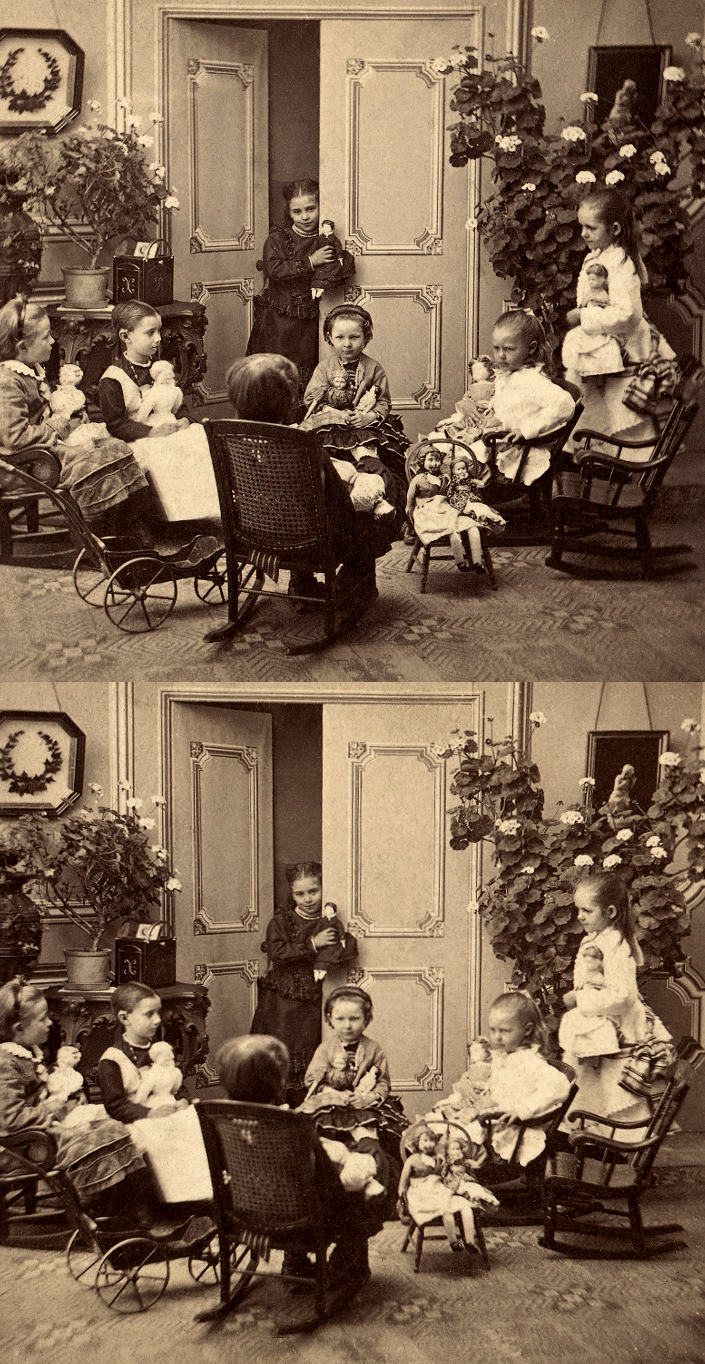
Photo: Vintage 3D

January 13, 2014
https://borgenproject.org/wp-content/uploads/borgen-project-logo.svg 0 0 Borgen Project https://borgenproject.org/wp-content/uploads/borgen-project-logo.svg Borgen Project2014-01-13 22:30:312024-06-11 02:17:55Quotes from 15 World Leaders on Human Rights
Global Poverty, Philanthropy

Heavy Charity: Incubus’ Make Yourself Foundation

Heavy Charity: Incubus Make Yourself Foundation
Interested in rocking out for a good cause?  American rock and metal band Incubus is.  Perhaps best known for their string of hits in the early 2000s, including “Drive” and “I Wish You Were Here,” Incubus has been an American rock staple for over twenty years.  The band has a massive following, and recognizing their fame as an effective platform to promote global and social change, Incubus founded the Make Yourself Foundation in 2003.

Since the Foundation’s beginning in 2003, it has raised over $1.6 million for various charitable organizations and causes.  Proceeds from the bands record sales, show tickets, and merchandise sales go directly to the Foundation.  In this way, Incubus connects its fans with the organization’s good deeds.  Going in further in connecting fans with charity, Incubus encourages fans to create their own profile on the Make Yourself Foundation’s website.  This profile acts as both a social networking tool for music lovers, as well as a fundraising campaign profile.

The Foundation has supported numerous charities over the years, including the American Red Cross, UNICEF, Music for Relief, and Carbon Neutral.  Its work with the Red Cross began in 2004, when in its early stages, fans involved with the Foundation raised over $100,000 for the Tsunami relief fund in Asia.

Incubus is an incredibly green and environmentally conscious band.  In 2007, the band partnered with Carbon Neutral to offset the carbon emissions let off by the tour.  This included planting trees and donating money for the research of alternative energy sources.  Current environmental causes supported by the Make Yourself Foundation include Carbon War Room’s “Ten Island Renewable Challenge” and the Ocean Conservancy.

Brandon Boyd, Incubus’s lead singer, states on the Foundation’s page that “It has always been my observation that to live by example is the most admirable way to walk the earth!”  The Make Yourself Foundation indeed sets an example of charity and advocacy for all to follow.

– Taylor Diamond

Sources: Make Yourself Foundation, Paste Magazine
Photo: Giphy.com

January 13, 2014
https://borgenproject.org/wp-content/uploads/borgen-project-logo.svg 0 0 Borgen Project https://borgenproject.org/wp-content/uploads/borgen-project-logo.svg Borgen Project2014-01-13 22:22:542024-05-26 23:02:46Heavy Charity: Incubus’ Make Yourself Foundation
Activism, Advocacy, Education, Global Health, Global Poverty, Nonprofit Organizations and NGOs, Philanthropy, Poverty Reduction

Catalysts for Change

catalysts_for_change_game
A first of its kind, Catalysts for Change, an innovative and interactive online game, was run by the Rockefeller Foundation and the Institute for the Future last year in the beginning of April. The game prompted participants worldwide to discuss and come up with ways to battle the plentiful issues of poverty. The game itself was designed around four catalysts: new evidence, new capacities, new rules and new stories, all of which contributed to the card-based gaming platform.

Players could share ideas through Positive/Critical imagination cards – these had the potential to be built on by others through Momentum, Antagonism, Investigation and Adaptation cards. Leaderboards were also created, displaying points players had earned through using and gaining said cards. These could furthermore be categorized as Scenario Fail, Common Knowledge or Super Interesting based on the players’ personal perception of presented ideas. Achievements spanning across seven levels, going from Inspired to Legend, were available for unlocking before being recorded in player profiles.  Each card played was then cataloged by category, available for public viewing on a special dashboard.

A game blog recorded all progress and presented new missions and challenges in real time. Two weeks before the actual game start, several preparations were made including social media advertising and buzz-building, recruitment, email exchange between coordinators across the world and various sponsor partnerships which led to further awareness among people. Most follow-up cards played were either Investigation or Momentum; of the top-tier, Critical versus Positive imagination were played, the latter being more than twice as frequent. Around 53% of all cards had follow-up cards attached, spanning overall very optimistic and fruitful discussions. As expected from discussions concerning poverty, themes such as education, work and community were amongst the most common. A few top innovative ideas that were brought up include:

–  Alternative economic systems or a universal currency
–  Empathy, i.e. teaching children from an early age to perceive worldly problems
–  Entrepreneurial education and new business funding as a common endorsement for all
–  Socially engineered ways around corruption
–  Sharing to eliminate waste

Although the aim of the game was not to implement any policy for actual poverty reduction, it managed to fulfill its purpose: to motivate and bring together people in their desire to make a change. Several of the players, engaged among one another, even discussed ways they could contribute beyond playing the game, such as starting a non-profit together centered chiefly around their ideas. The attention on social media (Facebook and Twitter) that Catalysts for Change received helped further spread the cause. Thoughts shared by players are still accessible on the website today, providing ‘food for thought’ for anyone hungry for making a difference. Although the game spanned for only 48 hours, it attracted 1,616 players from 79 different countries who used a total of 18,207 cards.

– Natalia Isaeva

Sources: The Rockefeller Foundation: Catalysts for Change, Institute for the Future
Photo: Vimeo

January 13, 2014
https://borgenproject.org/wp-content/uploads/borgen-project-logo.svg 0 0 Borgen Project https://borgenproject.org/wp-content/uploads/borgen-project-logo.svg Borgen Project2014-01-13 22:08:272016-02-16 12:04:43Catalysts for Change
Activism, Advocacy, Aid Effectiveness & Reform, Global Poverty, Philanthropy

The Case Against Gift Aid

The Case Against Gift Aid
Initiated less than forty years ago, the UK Gift Aid incentive aggrandizes donations received through select charities by providing tax deductions to the donor.

By means of Gift Aid, charities are able to reclaim the basic tax rate (20%) of the donation at no cost to the donor. For example, if an individual donates £10 using Gift Aid, the charity itself receives £12.50. With non-monetary contributions, the original tax is added back in to the overall value of the item. Thus, if a table valued at £100 is supplied, the charity is able to retain the item at £125.

However, before one is eligible to provide a Gift Aid donation, a form documenting basic personal information such as name, home address and information about the designated charity is required. Furthermore, this form is rather versatile in that it can be applied to future donations as well. On the surface, Gift Aid appears ingenious and innovative, and in many ways, it is. Yet, like many other programs wrought by good intentions, this incentive should be wary of also being susceptible to corruption.

For one, Gift Aid is plagued by complexity and ambiguity in its guidelines and operations.

Revenue and Customs declare that the donated items are in fact the possessions of the donor and the charity in question acts as a mere representative. Therefore, it is the donor — not the organization — who has the authority to not only give all or a portion of the sale’s proceeds but also to retain all or a portion of the profits. Meaning, an individual may decide to utilize Gift Aid out of greed and a personal, profit agenda rather than benevolence and an honest desire to give back to others.

The mandatory Gift Aid forms are composed in such a manner that donors are not held accountable for whether proceeds are bequeathed to the charity or not. Thus, an individual could legally sell his or her belongings using the Gift Aid incentive and keep all of the proceeds — leaving the charity, which handles the actual selling of the item, bereft of any profit.

According to the Institute of Fundraising, “the goods are the property of the owner until they are sold, and after they are sold, [the owner] has the right to keep some or all of the proceeds.” Although individuals who are initially willing to sell their personal belongings under Gift Aid may not initially expect to monetarily gain from the transaction.  Because this gaping loophole still exists, the incentive may be vulnerable, or opens an opportunity with the advantage, to misuse.

– Phoebe Pradhan

Sources: HM Revenue and Customs, The Guardian
Photo: Vintage 3D

January 12, 2014
https://borgenproject.org/wp-content/uploads/borgen-project-logo.svg 0 0 Borgen Project https://borgenproject.org/wp-content/uploads/borgen-project-logo.svg Borgen Project2014-01-12 13:34:242020-08-29 00:12:14The Case Against Gift Aid
Foreign Aid, Foreign Policy, Global Poverty, Philanthropy, Poverty Reduction

American Sentiment Toward Global Poverty

American sentiment global poverty
Though the United States is one of the wealthiest nations in the world, the country ranks poorly when it comes to aid and contributions to global poverty. In a ranked global list of 27 developed countries, the United States tied for 19. This gap in aid can be explained by the belief that Americans care more about helping people geographically near them than helping people who live further away.

A study conducted by the Center for Global Development established a “Commitment to Development” Index which measures the contributions of developed countries to less-developed nations around the world. The study also splits aid into 6 different sectors in order to account for every kind of assistance given by countries.

The security sector of the study, for example, deducts points from countries that give weapons to unstable or tyrannical governments. The study concluded that the United States does less than the average developed country to help underdeveloped nations, resulting from the lack of attention given to people residing in further countries.

Furthermore, a study conducted by a PhD student at Stanford found a clear correlation between citizens’ support for foreign aid and the amount of aid given by their country. In the United States, many people are very generous and give public and private donations at high levels; however, these donations are directed to fellow Americans. As it stands, a majority of Americans support donating to their fellow citizens and cutting aid in the form of food and money to foreigners.

Both studies go far in explaining the low levels of aid given by the United States of America to foreign nations. In order to increase the amount of aid given to foreign nations, the United States will have to change its attitude, thus allowing for a positive affect on the amount of aid donated overseas.

– Lienna Feleke-Eshete

Sources: Think Progress, Center for Global Development

January 5, 2014
https://borgenproject.org/wp-content/uploads/borgen-project-logo.svg 0 0 Borgen Project https://borgenproject.org/wp-content/uploads/borgen-project-logo.svg Borgen Project2014-01-05 12:50:012024-12-13 17:49:51American Sentiment Toward Global Poverty
Advocacy, Children, Education, Gender Equality, Global Poverty, Philanthropy, Poverty Reduction, United Nations, Women and Female Empowerment

Africa’s Philanthropic Billionaires

When it comes to international aid programs, everyone has heard of the Bill and Melinda Gates Foundation, as well as Warren Buffett’s astronomical donation track record, with last year’s donations reaching $1.87 billion. However, outside of the American audience, African billionaires are also stepping up and contributing to causes they care about. Here is a list of African philanthropic billionaires that lead programs in their own countries.

The wealthiest African, Aliko Dangote, worth an estimated $20.2 billion, donates millions of his wealth to education, health and social causes. Last year Dangote took part in the first ever Forbes 400 Summit on Philanthropy, where he discussed the benefits of donating, listing Gates and Buffett as inspirations.

Nathan Kirsh, a South African native, earned his $3.6 billion wealth by monopolizing the small goods market in New York City. According to Forbes, his philanthropic efforts focus on Swaziland, where he supplied approximately 10,000 people with starter capital for small businesses. Kirsh states that 70 percent of his recipients are women with a 70 percent success rate for his program overall. He also hopes to make Swazi schools the first in Africa to boast guaranteed computer literacy for all graduates.

Folorunsho Alakija hails from Lagos, Nigeria and is Africa’s richest woman thanks to her very profitable ownership of an oil block in the 1990’s. Since then, Alakija has expanded her $7.3 billion enterprise to real estate around the world, notably $200 million worth in the United Kingdom alone. With her money, Alakija founded the Rose of Sharon Foundation in 2008 which aids orphans and widows in her native country of Nigeria.

Mohamed Mansour has an estimated $2.3 billion fortune from his investment company the Mansour Group, which owns Egypt’s largest grocery store Metro and Egypt’s McDonald’s franchises, among other businesses. Mansour founded the Lead Foundation, a nonprofit that has provided over 1.3 million loans to small business endeavors and under-privileged women in Egypt. Mansour also chairs the Mansour Foundation for Development, which strives to eliminate illiteracy, poverty, and disease in order to expedite the development of Egyptian society.

– Emily Bajet

Sources: Daily Mail, Forbes, Rose of Sharon Foundation, Mansour Foundation For Development

December 16, 2013
https://borgenproject.org/wp-content/uploads/borgen-project-logo.svg 0 0 Borgen Project https://borgenproject.org/wp-content/uploads/borgen-project-logo.svg Borgen Project2013-12-16 04:00:062024-05-25 00:52:28Africa’s Philanthropic Billionaires
Philanthropy, Technology

History of the Nobel Peace Prize

Nobel peace price borgen project
The Nobel Peace Prize is the most distinguished prize in the world. Every year, one individual “who shall have done the most or the best work for fraternity between nations, for the abolition or reduction of standing armies and for the holding and promotion of peace congresses” is awarded the prize. The prize is the stuff of myth in terms of both prestige and mystery: how and why was it ever conceived? Why is the Peace Prize so legendary and illustrious?

In 1895, Swedish industrial magnate Alfred Bernhard Nobel hand-drafted the first conceptions of the prestigious Nobel Prizes in his will. Nobel left his vast wealth for the awarding of five annual prizes to five individuals in the fields of Physics, Chemistry, Physiology/Medicine, Literature, and, most prestigious of all, Peace.

The man behind the prize is a character steeped in paradox and enigma. Son of salt-of-the-earth inventor and builder Immanuel Nobel, Alfred Nobel’s childhood was filled with frequent moving and change from Stockholm to St. Petersburg, and from modest means to bourgeois status. Growing up, Nobel was a quiet intellectual who preferred the solitude of philosophy books and writing; his weak health surely contributed to his broody temperaments.

Alfred Nobel, along with his brothers, was tutored to become fluent in five languages, and taught fundamental mathematics, physics, and chemistry while in St. Petersburg. He eventually received training to become a chemist and engineer, leading to his invention of dynamite as well as other explosives used in modern warfare. Ironic, for the man who would become posthumously famous for the most famous prize in world peace, explosives was Nobel’s industry and base for wealth.

It is suggested by historians that his belated adjustments to his will to include the Prizes were inspired by a poignant but nevertheless strange occurrence. When his brother died in Cannes, France in 1888, the French papers mistook his brother for the Alfred Nobel. The headlines read: “Le marchand de la mort est mort” (“The Merchant of Death is dead”). His brother’s obituary was eerily a dress rehearsal for his own—one that he did not want for himself for when his time finally came. Historians conclude that Nobel, who was also a philosopher and pacifist, belatedly added the prizes to his will to ameliorate his fears of posthumous disrepute.

The curious case of Alfred Nobel aside, the prestige of the Nobel Peace Prize is an undeniable medium of both change and historic record. Reading the accomplishments of the award through its 110 years is to turn through the pages of Modern history.

For example, there were no prizes for award peace during the tumultuous First World War that ended with no victors—only a whimper. The only prize awarded during the war years was to the Red Cross. The same occurred during WWII.

In the 1990s, “Pluralist Globalization” seemed to be the theme of the prizes. In 1990 for example, Mikhail Gorbachev was controversially awarded the Peace Prize because The Norwegian Nobel Committee had seen that he had done the most to end the Cold War. In 1993 Nelson Mandela and Frederick Willem de Klerk were award the Peace Prize for their work towards ending the violence and oppression of Apartied in South Africa.

But above all controversy and politics, the prize paints an enduring narrative of the human desire for salvation from suffering and war.

– Malika Gumpangkum

Sources: Britannica, Nobel Prize, Sweden
Photo: ABC

October 23, 2013
https://borgenproject.org/wp-content/uploads/borgen-project-logo.svg 0 0 Borgen Project https://borgenproject.org/wp-content/uploads/borgen-project-logo.svg Borgen Project2013-10-23 15:20:152024-05-25 00:30:26History of the Nobel Peace Prize
Activism, Global Poverty, Philanthropy

The Legacy of Margaret A. Cargill

margaret_cargill
When Margaret A. Cargill, a low-profile philanthropist in California, died in 2006, she left behind a fortune that she hoped would help alleviate some of the world’s greatest problems. Thus was born the Margaret A. Cargill Philanthropies, which houses three grant-making entities: the Margaret A. Cargill Foundation (MACF), the Anne Ray Charitable Trust, and the Akaloa Resource Foundation.

Ms. Cargill envisioned her money helping the environment, the arts, families, children, and the elderly, as well as promoting tolerance and conflict resolution.

Before she died, Ms. Cargill asked her trustees “to support programs that address unmet needs; that give individuals and communities the tools to become self-sufficient; that will be sustainable after our support ends; and that build on and strengthen strong relationships within communities.” Ms. Cargill hoped to create lasting results through direct programs and continued financial support.

To this end, in its first full year of operation, the MACF awarded $136 million in grants, some of which went to environmental projects. In 2011, the Foundation awarded grants to assist flood victims in Pakistan, as well as children affected by a tornado in north Minneapolis. The Foundation’s future plans include launching additional programs to aid aging services and support Native arts in the Pacific Northwest.

– Yuliya Shokh

Sources: Margaret A. Cargill Philanthropies, Minnesota Council on Foundations, Philanthropy News Digest, Star Tribune
Photo: List 25

October 18, 2013
https://borgenproject.org/wp-content/uploads/borgen-project-logo.svg 0 0 Borgen Project https://borgenproject.org/wp-content/uploads/borgen-project-logo.svg Borgen Project2013-10-18 04:00:322024-05-25 00:26:28The Legacy of Margaret A. Cargill
Advocacy, Education, Gender Equality, Global Poverty, Philanthropy, Women & Children, Women and Female Empowerment

5 Great Female Writers on Giving Back

Anne_Frank_Giving_Back
This author’s previous post illuminated philanthropic quotes from five of the greatest male writers of our times. Here, we introduce to you five great female writers and what they have to say about giving back:

So many gods, so many creeds,
So many paths that wind and wind,
While just the art of being kind,
Is all this sad world needs

—Ella Wheeler Wilcox
Wilcox was an American poet whose style was simple, but the meanings therein were often profound. Some of her great works include Poems of Passion, A Woman of the World, and Poems of Peace.

I’ve learned that you shouldn’t go through life with a catcher’s mitt on both hands; you need to be able to throw something back.

—Maya Angelou, As a writer, poet, and a significant member of the Civil Rights Activists during the 1960s, Angelou is perhaps most known for her autobiographies, including I Know Why the Caged Bird Sings. Other famous works include Just Give Me a Cool Drink of Water ‘Fore I Die, The Heart of a Woman, and Letter to My Daughter.

As we work to create light for others, we naturally light our own way.

―Mary Anne Radmacher. Radmacher is a writer and artist, and teaches writing seminars. She is best known for Lean Forward into Your Life, and Live Boldly.

No one has ever become poor by giving.

—Anne Frank. While hiding with her family from the Nazis during World War II with another family in Amsterdam, she kept a diary which was discovered after her death in a Nazi concentration camp. Her diary, The Diary of a Young Girl, is well known across the world as the heartbreaking memoir of a young girl’s transition into adolescence and an attempt at understanding an adulthood she’d never reach.

Indifference and neglect often do much more damage than outright dislike.

—J.K. Rowling, a writer with a rags-to-riches story, is not one who needs to be convinced of the importance of giving back. After making it to the list of richest people in the world in 2011, Rowling managed to donate so much money that she failed to make it to the list in 2012. Along with her multi-faceted fantasy Harry Potter novels, JKR is known for The Casual Vacancy, and The Cuckoo’s Calling, which was written under the pseudonym Robert Galbraith.

– Aalekhya Malladi

Sources: GoodReads, Poetry Foundation, Telegraph
Photo: HTML Giant

October 16, 2013
https://borgenproject.org/wp-content/uploads/borgen-project-logo.svg 0 0 Borgen Project https://borgenproject.org/wp-content/uploads/borgen-project-logo.svg Borgen Project2013-10-16 09:27:522024-12-13 17:49:435 Great Female Writers on Giving Back
Global Poverty, Philanthropy, Politics and Political Attention

Is Big Philanthropy Democratic?

washington_dc
In an article in Dissent magazine, Joanne Barkan observes that big philanthropy “aims to solve the world’s problems–with foundation trustees deciding what is a problem and how to fix it. They may act with good intentions, but they define ‘good.’” For Barkan, the implication of this system is that the powerful and wealthy define the problem and how to solve it with little or no democratic controls. The article raises an interesting question: is big philanthropy democratic? It answers that question with a resounding “No.”

Barkan is quick to dismiss the laws and regulations that purportedly govern philanthropic organizations. These rules include restrictions on self-dealing, lobbying, and endorsing or supporting candidates for political office. Due to a variety of factors such as loopholes, deregulation, and lack of resources, these rules have been rendered ineffective in governing the operation of these organizations. And, of course, what has become something of a mantra in our society, the wealthier are able to get away with more indiscretion.

With little public oversight, these mega-organizations are free to govern themselves and raise tax-exempt funds from other wealthy donors. What is done with the money, of course, is up to the board of trustees that governs the organization. Although there is a 5 percent payout rule, which requires foundations pay out at least 5 percent of their endowment’s value each year, Barkan points out that this payout rule includes all reasonable expenses of administering the foundation, including salaries, trustee’s fees, travel, and receptions.  Salaries for philanthropic-executives can sometimes reach seven figures, allowing for something of a lavish lifestyle.

Another issue is the type of people that trustees choose to hire for their organizations. Traditionally, management consists of “insider” individuals that come from a business background–management consultants, businesspeople, lobbyists or scientists. Kavita Ramdas, Executive Director of the Program on Social Entrepreneurship at the Freeman Spogli Institute for International Studies at Stanford University, has pointed out that these hiring decisions are reflective of a metrics-driven and efficiency-seeking approach to social change—an approach that is not effective in handling, “the nuance and inherent humility of the social sciences.”

As government resources continue to shrink, those services once considered public will be controlled by private organizations. Philanthrocapitalism is filling the public void and its proving to be big business. In America today, there are 67 grant-awarding foundations with assets totaling more than $1 billion. Many will argue that these actors are using the money they have earned to fund humane endeavors. Others, like Barkan, see mega-philanthropies as another way for the wealthy to decide how to improve humanity and promote an agenda that serves their interests and ideas.

– Daniel Bonasso

Sources: Dissent Magazine, Reuters, Stanford Social Innovation Review
Photo: The Emily Dickinson International Society

October 12, 2013
https://borgenproject.org/wp-content/uploads/borgen-project-logo.svg 0 0 Borgen Project https://borgenproject.org/wp-content/uploads/borgen-project-logo.svg Borgen Project2013-10-12 22:15:082024-06-05 01:53:40Is Big Philanthropy Democratic?
Page 11 of 14«‹910111213›»

Get Smarter

  • Global Poverty 101
  • Global Poverty… The Good News
  • Global Poverty & U.S. Jobs
  • Global Poverty and National Security
  • Innovative Solutions to Poverty
  • Global Poverty & Aid FAQ’s
Search Search

Take Action

  • Call Congress
  • Email Congress
  • Donate
  • 30 Ways to Help
  • Volunteer Ops
  • Internships
  • Courses & Certificates
  • The Podcast
Borgen Project

“The Borgen Project is an incredible nonprofit organization that is addressing poverty and hunger and working towards ending them.”

-The Huffington Post

Inside The Borgen Project

  • Contact
  • About
  • Financials
  • President
  • Board of Directors
  • Board of Advisors

International Links

  • UK Email Parliament
  • UK Donate
  • Canada Email Parliament

Get Smarter

  • Global Poverty 101
  • Global Poverty… The Good News
  • Global Poverty & U.S. Jobs
  • Global Poverty and National Security
  • Innovative Solutions to Poverty
  • Global Poverty & Aid FAQ’s

Ways to Help

  • Call Congress
  • Email Congress
  • Donate
  • 30 Ways to Help
  • Volunteer Ops
  • Internships
  • Courses & Certificates
  • The Podcast
Scroll to top Scroll to top Scroll to top