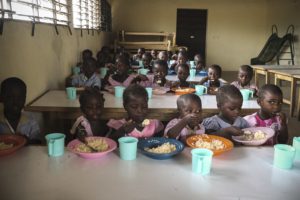
 According to the United Nations Children’s Fund (UNICEF), an estimated 122 million girls of primary and secondary school age are not enrolled in school worldwide. Many are pulled out to take on domestic roles or are married off as young as 14 to alleviate financial pressures on their families, such as food. Girls are particularly disadvantaged in impoverished countries and regions affected by fragility, conflict and violence (FCV), where they are 2.5 times more likely than boys to be out of school.
School Meal Programs
School meal programs in countries where girls face disproportionate barriers provide a strong incentive for families to send their daughters to school and keep them enrolled. This will, in turn, delay marriage and pregnancy as well as empower young women. A study conducted by the Frontiers of Public Health proved this, finding that completing ninth grade considerably increases the chances of girls delaying marriage until 18 and pregnancy until 20.
The strong correlation between education and child marriage stresses the urgency of prioritizing female education and enrollment in low- and middle-income countries. Implementing school meal programs is a sustainable and effective way to do so. It has been shown to cause a significant increase in female enrollment and school completion. Addressing the issue of child pregnancy is imperative, as the leading cause of death among adolescent girls is maternal mortality.
In developing countries where women and girls are often last to eat, many experience malnourishment, which is exacerbated by the intense physical and nutritional demands of breastfeeding and pregnancy. This malnutrition, combined with the fact that their bodies are not fully developed to endure the stress of pregnancy, puts pregnant adolescents at a higher risk of having low-birthweight babies and facing maternal mortality. However, this cycle can be broken by keeping girls in school and improving their nutrition through school meal programs.
Further Benefits
Moreover, students better focus in class when getting the nutrition they need; thus, eating at school boosts their academic performance and motivates them to go to school and participate. With the improvement of children’s physical health through school meal programs, they are less likely to miss school due to illness. A study in South Africa found that among the many positive spillover effects of school meal programs, families of students benefiting from them recorded less health spending than of the latter. In addition, the study found that the programs had a more pronounced impact on girls and rural communities.
School meal programs also stimulate local economies by creating business opportunities for smallholder farmers who source the meals and by creating jobs for those organizing and distributing them. They also reduce the financial stress on vulnerable families, allowing them to save about 10% of their income. In fact, according to an analysis done by the World Food Programme (WFP), communities saw a $9 economic return for every $1 allocated to school meals. Similarly, it found that 1,400 jobs were created with every 100,000 children fed, which translates to around four million jobs spanning 85 countries.
Solely through school meals, we can not only encourage families to prioritize education for their children, especially daughters but indirectly strengthen local economies and contribute to the fight against global poverty.
Progress
Figures from the WFP have shown that globally, school meal programs can boost enrollment rates by an average of 9%, with a 12% increase specifically for girls. These programs have also been linked to an 8% improvement in attendance. Notably, in Pakistan, before school meal programs were implemented, 48% of households did not send any girls to school. Five years after the program started, the WFP found that all households educated at least one daughter.
Currently, there are school meal programs in 161 countries and daily meals are provided to more than 418 million children worldwide. The WFP allocates $48 billion annually to support these programs and hopes to transition the ownership of such programs to national governments. To date, 50 countries have made this transition. More than 80% of all programs have been encompassed into national policies in some way and others are expected to follow.
With school meal programs operating in almost every country, the scale of impact varies by region. For instance, India has immense coverage, feeding 130 million children daily. Similarly, Brazil feeds 50 million. Even in impoverished countries with smaller budgets, these programs are making a meaningful difference by prioritizing children from the most vulnerable families.
Looking Forward
With 73 million children in 60 different countries still left vulnerable and with no access to school meals, there is still work to be done. The WFP continues to work with governments globally, especially in regions where girls are more vulnerable, to support school meal programs and reaffirm its commitments as per the School Meals Coalition. Its goal is for “every child to have access to a daily, healthy meal in school by 2030.”
– Rebecca Aziz
Rebecca is based in Middleton, WI, USA and focuses on Business and Global Health for The Borgen Project.
Photo: Flickr

Children in Poverty: 5 Stories From La Esperanza Granada
Vision Exams
Sept. 2024 marks the second year that La Esperanza Granada has provided vision exams for children in its organization, offering free glasses to those who could not afford them. This initiative aims to enhance the children’s quality of life by prioritizing their health and functional development. It also boosts their confidence and self-esteem, as they can now fully participate in school activities with new, stylish glasses they selected themselves.
Musical Performances
Younger children from Escudo Learning Centre and a sister organization collaborated on an artistic performance, captivating an audience with their newly developed skills. Under the guidance of instructors from Fundación LO CREO, these young learners participated in singing and flute lessons, honing their artistic abilities and creativity. After months of preparation, they showcased their talents in a musical performance, which fostered essential developmental skills such as discipline, cooperation and self-confidence.
Entrepreneurial Workshops
La Esperanza Granada organized an entrepreneurial workshop for university students to foster innovation and offer a platform for their entrepreneurial ideas. Business owners from diverse fields, including honey production, handicraft creation, fruit liqueur production, leather-based safety products and wildlife breeding, led the workshop. They shared their successes and failures, providing students with realistic business insights and stimulating creative entrepreneurial thinking. These personal stories from business owners not only motivated the students but also facilitated networking. Furthermore, the students were encouraged to seek advice and make connections with experienced entrepreneurs.
Engaging Lessons
At La Esperanza Granada’s learning centers, young children engage with English lessons through Duolingo. The interactive app enhances reading, writing and speaking skills. This approach not only makes learning enjoyable but also equips students with language skills that can improve their educational and employment prospects. The centers provide tablets for these lessons, offering students essential technological skills and making classes more dynamic. Such engaging educational experiences help retain children in schools where they benefit from strong support and a sense of community.
Pulps and Nectars
On August 7, 2024, young educators from La Esperanza Granada attended skill workshops at the Sabaneta Learning Centre. The workshops focused on creating fruit-based nectars and pulps. Led by MEFCA, the workshop provided practical education on extracting pulps and nectars. Additionally, the workshops include specific procedures for pollutant elimination and cutting techniques to ensure product quality. This training enriched students with entrepreneurial ideas and practical knowledge, enhancing their collaboration skills. Such initiatives are crucial as they provide valuable skills that can generate income, helping to break down barriers of poverty.
Looking Ahead
La Esperanza Granada continues to make significant strides in supporting the youth in Nicaragua. The organization provides crucial resources and skills to break the cycle of poverty. Indeed, their diverse programs, from vision exams to entrepreneurial workshops, not only enhance educational opportunities but also empower children and young adults to improve their futures. These ongoing efforts highlight the charity’s commitment to fostering a more equitable environment for the communities on the outskirts of Granada.
– Chelsey Saya McLeod
Photo: Flickr
IT Supporting Rural Livelihood in India
Mission 2007: Every Village a Knowledge Center
IT supporting rural livelihood in India has been expected to act as a viable option. IT can be used for various purposes like predicting weather conditions and market prices for farming along with gaining useful knowledge and skills. To materialize this, Mission 2007 was initiated in 2003 by an alliance of 150 organizations to avail the benefits of Information and Communication Technologies (ICTs) dedicated to human well-being in rural areas.
The Jamsetji Tata National Virtual Academy (NVA) for Rural Prosperity and the Jamsetji Tata Training School (JTS) for Leadership in Rural Knowledge Connectivity were established to support and fuel this IT revolution. They aim to provide IT access and training to more than a million rural people and encourage them by enabling them to enhance their livelihood with the help of IT skills.
The National Virtual Academy
Established in 2003 under the M S Swaminathan Research Foundation (MSSRF), the NVA aims to train “grassroots workers” to use ICTs to enable them to be responsible for their development and “to build skills and capacities relevant to enhancing opportunities for sustainable livelihoods.” Alongside providing training in ICTs, the NVA also facilitates the recognition of rural people who have mastered ICTs and are using their skills to guide the betterment of villages.
The NVA aims to materialize access to “work, income and health security” like e-governance, e-commerce, e-literacy and e-health in rural areas. The initiative seeks to establish a “two-way linkage” communication system, where scientists share information on agriculture and technological advancements with rural communities while rural people provide insights into traditional farming methods. This exchange helps scientists develop sustainable farming practices that integrate both modern and traditional knowledge.
The NVA also facilitates “lateral communication” to enable people within rural areas to share their knowledge and expertise with other rural people through technological means. It, therefore, functions as a “participatory knowledge hub,” tying traditional wisdom with modern science. In 2006, the initiative recognized the achievements of 77 people from across 11 states in India, highlighting its impact in rural areas.
Jamsetji Tata Training School
The JTS aims to provide training on computer applications to rural workers at the grassroots level. It also aims to create virtual platforms to develop learning environments where rural people can learn need-based skills and competencies to gain knowledge specific to their area of work. The JTS is similar to the NVA in its primary aims and objectives and helps further build NVA’s initiatives by equipping people with Village Knowledge Centers (VKCs), Village Resource Centers (VRCs) and Knowledge Hub Consortiums (KHCs) to encourage centralized learning environments.
Some other efforts by JTS include organizing workshops between scientists and NVA fellows, addressing issues at the grassroots level with government agencies, providing training on computer applications and developing virtual platforms for learning.
Conclusion
In 2019, 41% of India’s population, amounting to approximately 574 million people, had access to the internet. Among this, 307 million internet users belonged to the urban population and 264 million people belonged to the rural population. As of 2023, 55% of India’s population, amounting to 821 million people, have access to the internet. Among these, a higher percentage of internet users come from rural areas (442 million) than urban areas (378 million). As a result of initiatives like those mentioned above, India has experienced significant growth in IT access across the country, particularly in rural areas. IT supporting rural livelihood in India is now not only a dream but a reality.
– Adya Umesh
Photo: Flickr
The Gardener Combating Famine in Gaza
Famine in Gaza
In the face of food insecurity, foreign aid is crucial for survival and restoration. However, the unrelenting cruelty of the conflict in Gaza has caused barriers “for humanitarian agencies to safely get aid to affected populations.” According to the International Rescue Committee (IRC), “The danger extends to humanitarian workers. More than 260 aid workers have been killed, more than 190 of whom worked for the United Nations.” Considering that Palestinians no longer have their resources or land available to them due to the destruction of the war, this lack of foreign aid has significantly worsened the reality of hunger in Gaza. The U.N. experts report that “famine has spread across the entire Gaza strip.”
Gardening in the Face of Famine
Despite these bleak prospects, Mohammed Qomssan with the support of his family remains hopeful, unwilling to let the conflict take away their livelihood. Returning to their home in mid-June after facing displacement twice, the family found just two rooms of their house in a habitable condition. This was the moment that sparked Qomssan’s desire to reclaim what the conflict had taken from him and his loved ones, focusing on “survival, in a part of Gaza that most others have left.”
With the knowledge that the majority of the region’s farmers have been displaced and “an estimated 80% of cropland has been destroyed in some areas,” according to IRC, Qomssan and his family set to work to utilize the ruins of their home, clearing as much rubble and installing tarpaulin to create a temporary living room and garden. Qomssan’s innovative thinking saw the potential in objects such as a bathtub, buckets, tin cans, and various other containers found amongst the debris to grow vegetables in. Vegetables grown so far include aubergines, jute, rocket, and peppers, all now considered rare luxuries in Gaza.
Although the food markets in Gaza have a limited stock, especially fresh stock, they occasionally sell seeds which Qomssan looks out for to continue growing his food supply. Qomssan documents this journey on his social media accounts to encourage others and raise awareness of famine in Gaza, The Guardian reports.
Amongst the chaos and destruction, this family’s horticultural efforts in what Qomssan describes as a decision that would allow them “to live like ordinary people,” spreads a message to Gaza’s most vulnerable that in the face of crisis, there is hope and potential for restoration.
– Imogen Prince
Photo: Flickr
5 Effects of Water Pollution in Pakistan
5 Effects of Water Pollution in Pakistan
The Paani Project
The Paani Project, headquartered in Ann Arbor, Michigan, is actively enhancing water quality in Pakistan. Founded by four Pakistani Americans seeking to address the water crisis, the nonprofit has developed more than 20,000 water systems since its inception. Additional projects include deepwater wells, solar wells and reverse osmosis plants. As of June 2024, Paani collaborates closely with local partners to identify the most suitable water solutions for each rural community, maximizing the impact of donations. The organization emphasizes transparency, providing donors with approximately 30 photos of the construction process, a video of the completed water system and a comprehensive water quality report.
Looking Ahead
Pakistan’s water crisis poses significant challenges, from waterborne diseases to agricultural damage, impacting millions of lives. Efforts by organizations like the Paani Project offer hope. Their tailored water solutions work to improve access and quality across the country. With a focus on addressing the immediate needs of affected communities, these ongoing initiatives contribute to mitigating the long-term effects of water pollution and ensuring a more sustainable future for Pakistan.
– Sophia Kharal
Photo: Pexels
How International Aid Is Helping the Victims of Typhoon Yagi
Aid in Vietnam
Vietnam has been one of the nations most severely affected by Typhoon Yagi, with more than 300 deaths being recorded and more than 50,000 people being forced to evacuate their homes. As a result, international aid for Typhoon Yagi has focused on Vietnamese reconstruction. The U.K. government has given more than $1 million to the country. In contrast, the EU has given about $720,000 of the $2.4 million total promised to Southeast Asia. These have helped supply emergency resources such as food and health care items.
Alongside government aid, Vietnam has also received water sanitizing resources from UNICEF, as widespread flooding has limited the supply of clean water and left 400,000 households in the country without access to it. UNICEF has provided 80,000 water purification tablets and 4,000 liters of clean water to the country’s three worst-hit provinces, alongside other health care items such as hand sanitizers and soap. With many schools damaged or destroyed in the flooding, along with the roads and bridges leading to them, UNICEF has supplied temporary learning materials for children who have lost access to education.
Similarly, the WHO has also supplied one million water purification tablets and 500 water containers to the Vietnamese Ministry of Health. It has also worked alongside the U.S. Agency for International Development (USAID) to broadcast radio messages in several ethnic minority languages in order to ensure that various communities receive relevant safety information.
Political Difficulties in Myanmar
Myanmar, further West in the region, has also suffered severe damage as a result of the storm, affecting an estimated 630,000 people and killing more than 200. Heavy rainfall has caused flooding and mudslides, which in turn have damaged and blocked many of the nation’s roads and bridges. Furthermore, the civil war that has gripped the country since 2021 has made it difficult to assess the damage caused in rebel-controlled regions, as their communication with central military powers is limited.
As a result of such difficulties, the EU has dedicated the largest share of its aid to nations affected by Typhoon Yagi, while the U.N. World Food Programme (WFP) dedicated emergency food supplies to around 500,000 people affected by flooding in Myanmar. However, some difficulties remain for aid agencies trying to access rebel-controlled areas, both due to political instability and the damage caused to roads and bridges by excessive flooding.
Funding for Other Nations
International aid for Typhoon Yagi victims has also been provided to nations that sustained slightly less damage due to flooding. The EU allocated more than $200,000 to the Philippines and about $166,000 to Laos, while the WFP has distributed shipments of rice in some of the worst affected regions of Laos in order to aid those whose land and crops were damaged due to flooding.
Final Note
Typhoon Yagi has caused destruction across Southeast Asia, severely damaging infrastructure and leaving hundreds of thousands in precarious positions. Through providing clean water, health care and educational supplies, these organizations have demonstrated the importance of international aid in providing relief to those affected by natural disasters and helping nations recover from widespread damage. International aid for Typhoon Yagi victims, from both governments and NGOs, has proved key in providing stability and security for regions impacted by widespread flooding.
– Izzy Tompkins
Photo: Wikimedia Commons
Projects in Tunisia Combat Food Insecurity and Boost the Economy
The Emergency Food Security Support Project (PAUSAT) will have a range of objectives that will help combat the food insecurity problem while also strengthening Tunisia’s economy and self-sufficiency. Meanwhile, the second loan will focus on the Tunisia Economic Development Corridor Project. This will address the urban infrastructure along the Kasserine – Sidi Bouzid – Sfax corridor.
PAUSAT
This project will help to strengthen Tunisia’s economy by increasing resilience to future food crises. This is by supplying short-term agricultural inputs for farmers to guarantee the next cropping season. A difficult cereal harvest of 2023 contributes to the string of droughts that Tunisia has suffered. By focusing on long-term solutions, this project will also provide barley and climate-resilient seeds to small-scale farmers and milk producers.
This assistance will help to rebuild Tunisia’s economy as it aims to prevent future agricultural challenges. With 30% of children aged less than 5 and 32% of pregnant and breastfeeding women having been affected by malnutrition, the economy is not Tunisia’s only focus. Ensuring access to bread for impoverished and vulnerable households is one of PAUSAT’s short-term objectives.
PAUSAT also aims to combat food insecurity in the short term by offering the vulnerable percentage of the population bare necessities such as bread. With women making up 46%-51% of the family farm labor force and are also 50% of Tunisia’s rural population, PAUSAT’s supply of soft wheat and barley to local markets will also help reduce food insecurity and prevent malnutrition among children and pregnant women.
Tunisia Economic Development Corridor Project
The Kasserine–Sidi Bouzid–Sfax corridor faces regional economic disparities that this project seeks to address. By adding 65 km of new roads and 117 km of feeder roads, the initiative aims to enhance accessibility to inter-regional areas, facilitate business financing and improve mobility for Tunisia’s rural population. The creation of these feeder roads and roadworks will benefit small and medium-sized enterprises (SMEs) and encourage small businesses to open up further.
The Tunisia Economic Development Corridor Project also benefits households that depend on roads. By improving mobility and expanding access to more regions, the enhanced rural infrastructure enables isolated households in the countryside to reach nearby towns and cities more easily. Significantly, this connectivity opens up new employment opportunities, allowing access to businesses and fostering the growth of new SMEs.
Toward a More Connected, Well-Fed Future
Tunisia continues to face extremely challenging conditions regarding cereal harvests, droughts and rural mobility. These two new loans bring new hope as they commit to two projects dedicated to fighting food insecurity and strengthening the economy of Tunisia. By addressing important issues with these two projects, Tunisia will be able to provide both long and short-term solutions for a more sustainable and self-sufficient future.
– Chelsey Saya McCloud
Photo: Pixabay
Vocational Education Centers in South Korea
Vocational High School
Vocational high schools provide specialized education specialized to youths, typically aged 15-18, following middle school general education. The making of vocational high schools was driven by the surging need for workers during South Korea’s industrialization period in the ’60s-’80s. To supply the labor force to industries, the government used a centralized national strategy, the “Five-Year Economic Development Plan,” to establish and support vocational high schools.
Nowadays, vocational high schools come in two forms: specialized high schools and Meister high schools. There are 464 specialized high schools which account for 80% of vocational education. The schools teach topics of agriculture, industry, information and business. Furthermore, 12% are general high schools that provide vocational education. Finally, 8% are Meister high schools driven to provide specific industrial needs by training technical experts in fields of AI and digital technology.
Colleges and Private Training Centers
For colleges, there is the Junior college under the Ministry of Education. Polytechnic college falls under the Ministry of Employment and Labor. While both provide vocational education, Junior colleges run on the basis of acquiring a certain number of credits to graduate with courses lasting 2-4 years. This is a form of higher education. On the other hand, the Polytechnic college education is between 6 months and 2 years, with less strict conditions to meet. It provides not only an opportunity to earn a bachelor’s degree in a certain industry but also prepares students to get the National Technical Qualification.
Their subject fields include machinery, design, architecture, electronic engineering, information and communication, media and biology. Private institutions and academies also provide a wide range of vocational education. Without the burden of following a set curriculum and acquiring credits, private institutes give a variety of options and freedom to match the student’s needs. While some courses can be covered through government subsidies, for some, it could be not very easy to afford private education.
Lifelong Education
Lifelong education came to being with the critique of traditional academic learning and the rise of topics of social change and life course theory. Korea acknowledged the importance of lifelong education in the ’70s and has included it in the constitution as a basic right for everyone to seek education at any stage of life. It has also been made the country’s duty to provide educational opportunities to the people. The government, therefore, established the National Institute For Lifelong Education (NILE). NILE offers programs such as adult literacy, online lifelong learning and an academic credit bank system, which lowers the barrier to acquiring a degree.
Stigma and Sacrifice
While South Korea managed to establish a strong social system of vocational education training centers for every stage of life through nation-led policymaking, problems prevail on a pragmatic level. These include labor exploitation, industrial incidents and more. Numerous tragic incidents happened to vocational high school students undergoing apprenticeships. In between being a student and an adult, these apprentices were thrown into labor without safeguards. Due to the high stigma and indifference toward vocational education and apprentice students, these problems only started to get acknowledged in 2016 after a tragic incident.
A 19-year-old apprentice was repairing safety screen doors at Guui subway station between the railway and the platform when the train came in and hit the young worker. The safety manual was set for two workers to be in teams to prevent safety hazards, but at that time, the 19-year-old was working alone. After this news was reported in the media, the topic of vocationally educated students and unsafe, exploitative labor of the apprenticeship gained attention from the public.
Conclusion
Vocational education challenges in South Korea are significant, rooted in social stigma and pressure on institutions to demonstrate their value. However, there is hope for change. As awareness of the importance of skilled trades and their vital role in the economy grows, attitudes are shifting. By fostering a greater appreciation for vocational education and the experienced workers it produces, South Korea could create a more inclusive society that values all forms of education and work. Embracing this change can lead to a brighter future for individuals and the economy.
– Minji L. Kim
Photo: Pixabay
LIF: UK-Mexico Relations and Medical Innovation
What Is the LIF program?
The Royal Academy of Engineering (RAEng) began the LIF program more than 10 years ago to promote global entrepreneurship through the use of technological innovation. Alongside Mexico, the program has partners in 16 countries, including Brazil, Vietnam, and Romania. The LIF was launched thanks to funding from the Newton Fund, which is part of the U.K.’s official development assistance and fosters international science and innovation partnerships.
Health Care in Mexico
The Mexican health care system operates on a combination of public, private, and employer-funded schemes. Prior to the introduction of Seguro Popular in 2004, a government program that ensured universal access to health care, three-quarters of the population could not access health care through the Ministry of Health. However, high poverty rates in rural areas of Mexico often leave these populations without adequate access to health care. Services are typically concentrated in the country’s largest cities.
In fact, 88% of dentists in Mexico are located in urban centers. Despite multiple reforms, health care infrastructure in rural municipalities remains insufficient, forcing locals to rely on out-of-pocket expenses. These areas also represent two-thirds of Mexico’s extremely poor. The removal of Seguro Popular in 2020 further increased out-of-pocket health care costs, which indicates the need for further health care security and reform to aid the most inadequate.
The LIF Program in Mexico
In February 2024, LIF joined efforts with technological innovators in Mexico to help the Xicotepec, one of the municipalities that make up the Puebla state. The program funded the use of these medical inventions and services in the communities of Xicotepec. The team operating there organized a Community Health Services (CHS) Week, where 265 people received medical care.
The program covered a variety of training and medical care. Indeed, 90 mothers attended breast cancer screenings, 40 doctors were trained in wound healing, and more than 200 people were trained in disease prevention. The program was well received by its beneficiaries: “The service was very good and necessary. The truth is that we don’t go to the doctor often because we can’t afford it.”
Final Note
Positive partnerships like the LIF program enable medical innovation and treatment to reach the communities that need it most. They can help resolve the negative effects of recent changes in Mexico’s health care system. The capacity of the RAEng to reach remote communities like Xicotepec shows how far-reaching international collaboration is.
– Sofia Brooke
Photo: Pexels
How School Meal Programs Keep Girls in School
School Meal Programs
School meal programs in countries where girls face disproportionate barriers provide a strong incentive for families to send their daughters to school and keep them enrolled. This will, in turn, delay marriage and pregnancy as well as empower young women. A study conducted by the Frontiers of Public Health proved this, finding that completing ninth grade considerably increases the chances of girls delaying marriage until 18 and pregnancy until 20.
The strong correlation between education and child marriage stresses the urgency of prioritizing female education and enrollment in low- and middle-income countries. Implementing school meal programs is a sustainable and effective way to do so. It has been shown to cause a significant increase in female enrollment and school completion. Addressing the issue of child pregnancy is imperative, as the leading cause of death among adolescent girls is maternal mortality.
In developing countries where women and girls are often last to eat, many experience malnourishment, which is exacerbated by the intense physical and nutritional demands of breastfeeding and pregnancy. This malnutrition, combined with the fact that their bodies are not fully developed to endure the stress of pregnancy, puts pregnant adolescents at a higher risk of having low-birthweight babies and facing maternal mortality. However, this cycle can be broken by keeping girls in school and improving their nutrition through school meal programs.
Further Benefits
Moreover, students better focus in class when getting the nutrition they need; thus, eating at school boosts their academic performance and motivates them to go to school and participate. With the improvement of children’s physical health through school meal programs, they are less likely to miss school due to illness. A study in South Africa found that among the many positive spillover effects of school meal programs, families of students benefiting from them recorded less health spending than of the latter. In addition, the study found that the programs had a more pronounced impact on girls and rural communities.
School meal programs also stimulate local economies by creating business opportunities for smallholder farmers who source the meals and by creating jobs for those organizing and distributing them. They also reduce the financial stress on vulnerable families, allowing them to save about 10% of their income. In fact, according to an analysis done by the World Food Programme (WFP), communities saw a $9 economic return for every $1 allocated to school meals. Similarly, it found that 1,400 jobs were created with every 100,000 children fed, which translates to around four million jobs spanning 85 countries.
Solely through school meals, we can not only encourage families to prioritize education for their children, especially daughters but indirectly strengthen local economies and contribute to the fight against global poverty.
Progress
Figures from the WFP have shown that globally, school meal programs can boost enrollment rates by an average of 9%, with a 12% increase specifically for girls. These programs have also been linked to an 8% improvement in attendance. Notably, in Pakistan, before school meal programs were implemented, 48% of households did not send any girls to school. Five years after the program started, the WFP found that all households educated at least one daughter.
Currently, there are school meal programs in 161 countries and daily meals are provided to more than 418 million children worldwide. The WFP allocates $48 billion annually to support these programs and hopes to transition the ownership of such programs to national governments. To date, 50 countries have made this transition. More than 80% of all programs have been encompassed into national policies in some way and others are expected to follow.
With school meal programs operating in almost every country, the scale of impact varies by region. For instance, India has immense coverage, feeding 130 million children daily. Similarly, Brazil feeds 50 million. Even in impoverished countries with smaller budgets, these programs are making a meaningful difference by prioritizing children from the most vulnerable families.
Looking Forward
With 73 million children in 60 different countries still left vulnerable and with no access to school meals, there is still work to be done. The WFP continues to work with governments globally, especially in regions where girls are more vulnerable, to support school meal programs and reaffirm its commitments as per the School Meals Coalition. Its goal is for “every child to have access to a daily, healthy meal in school by 2030.”
– Rebecca Aziz
Photo: Flickr
Mpox in India: Understanding the Outbreak and Response
The Spread of Mpox in India
Mpox, previously known as monkeypox, is an infectious disease caused by the monkeypox virus (MPXV), a double-stranded DNA virus from the Orthopoxvirus genus in the Poxviridae family. A global outbreak of the clade IIb strain occurred between 2022 and 2023. As of now, the mpox outbreak in India has primarily affected urban areas, especially New Delhi. Although the number of cases has not reached critical levels, there is concern about potential widespread transmission in densely populated regions. Public health officials are closely monitoring the situation, tracking cases and ensuring containment measures are in place.
India’s Public Health Response
India’s public health response to the mpox outbreak has been swift and coordinated. The central government has urged all states and Union territories to identify facilities and train personnel to manage both suspected and confirmed mpox cases. Union Health Secretary Apurva Chandra has emphasized the importance of timely sample testing, isolating cases and conducting genome sequencing through the Indian Council of Medical Research (ICMR) to determine the virus clade.
States have received instructions to boost public health preparedness at state and district levels, establish isolation facilities and enforce strict infection control measures. Public awareness campaigns are underway to educate communities about the disease, its transmission and the importance of early reporting. Additionally, diagnostic capabilities are robust, with 36 labs supported by the Indian Council of Medical Research (ICMR) and three commercial PCR kits approved by the Central Drugs Standard Control Organisation (CDSCO) to facilitate testing. These ongoing efforts aim to control the spread of mpox and protect public health.
Prime Minister Narendra Modi has intensified India’s response and preparedness for the mpox outbreak following the World Health Organization’s (WHO) declaration of the disease as a Public Health Emergency of International Concern. Guidance from WHO has significantly shaped India’s response to mpox, providing best practices from other countries and offering frameworks to manage the disease within a broader public health context.
Looking Ahead
India has responded swiftly and proactively to the mpox outbreak, demonstrating a strong commitment to controlling the virus’s spread. Coordinated efforts at both national and state levels have enhanced diagnostic capabilities, established isolation facilities and promoted public awareness.
– Aneela Agha
Photo: Flickr