How School Meal Programs Keep Girls in School
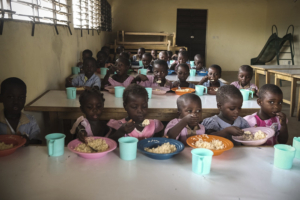 According to the United Nations Children’s Fund (UNICEF), an estimated 122 million girls of primary and secondary school age are not enrolled in school worldwide. Many are pulled out to take on domestic roles or are married off as young as 14 to alleviate financial pressures on their families, such as food. Girls are particularly disadvantaged in impoverished countries and regions affected by fragility, conflict and violence (FCV), where they are 2.5 times more likely than boys to be out of school.
School Meal Programs
School meal programs in countries where girls face disproportionate barriers provide a strong incentive for families to send their daughters to school and keep them enrolled. This will, in turn, delay marriage and pregnancy as well as empower young women. A study conducted by the Frontiers of Public Health proved this, finding that completing ninth grade considerably increases the chances of girls delaying marriage until 18 and pregnancy until 20.
The strong correlation between education and child marriage stresses the urgency of prioritizing female education and enrollment in low- and middle-income countries. Implementing school meal programs is a sustainable and effective way to do so. It has been shown to cause a significant increase in female enrollment and school completion. Addressing the issue of child pregnancy is imperative, as the leading cause of death among adolescent girls is maternal mortality.
In developing countries where women and girls are often last to eat, many experience malnourishment, which is exacerbated by the intense physical and nutritional demands of breastfeeding and pregnancy. This malnutrition, combined with the fact that their bodies are not fully developed to endure the stress of pregnancy, puts pregnant adolescents at a higher risk of having low-birthweight babies and facing maternal mortality. However, this cycle can be broken by keeping girls in school and improving their nutrition through school meal programs.
Further Benefits
Moreover, students better focus in class when getting the nutrition they need; thus, eating at school boosts their academic performance and motivates them to go to school and participate. With the improvement of children’s physical health through school meal programs, they are less likely to miss school due to illness. A study in South Africa found that among the many positive spillover effects of school meal programs, families of students benefiting from them recorded less health spending than of the latter. In addition, the study found that the programs had a more pronounced impact on girls and rural communities.
School meal programs also stimulate local economies by creating business opportunities for smallholder farmers who source the meals and by creating jobs for those organizing and distributing them. They also reduce the financial stress on vulnerable families, allowing them to save about 10% of their income. In fact, according to an analysis done by the World Food Programme (WFP), communities saw a $9 economic return for every $1 allocated to school meals. Similarly, it found that 1,400 jobs were created with every 100,000 children fed, which translates to around four million jobs spanning 85 countries.
Solely through school meals, we can not only encourage families to prioritize education for their children, especially daughters but indirectly strengthen local economies and contribute to the fight against global poverty.
Progress
Figures from the WFP have shown that globally, school meal programs can boost enrollment rates by an average of 9%, with a 12% increase specifically for girls. These programs have also been linked to an 8% improvement in attendance. Notably, in Pakistan, before school meal programs were implemented, 48% of households did not send any girls to school. Five years after the program started, the WFP found that all households educated at least one daughter.
Currently, there are school meal programs in 161 countries and daily meals are provided to more than 418 million children worldwide. The WFP allocates $48 billion annually to support these programs and hopes to transition the ownership of such programs to national governments. To date, 50 countries have made this transition. More than 80% of all programs have been encompassed into national policies in some way and others are expected to follow.
With school meal programs operating in almost every country, the scale of impact varies by region. For instance, India has immense coverage, feeding 130 million children daily. Similarly, Brazil feeds 50 million. Even in impoverished countries with smaller budgets, these programs are making a meaningful difference by prioritizing children from the most vulnerable families.
Looking Forward
With 73 million children in 60 different countries still left vulnerable and with no access to school meals, there is still work to be done. The WFP continues to work with governments globally, especially in regions where girls are more vulnerable, to support school meal programs and reaffirm its commitments as per the School Meals Coalition. Its goal is for “every child to have access to a daily, healthy meal in school by 2030.”
– Rebecca Aziz
Rebecca is based in Middleton, WI, USA and focuses on Business and Global Health for The Borgen Project.
Photo: Flickr
