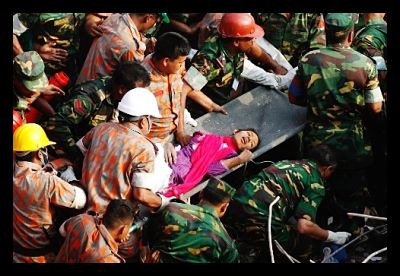
Until now, more than 1000 people are estimated to have been killed in the collapse of the Bangladesh garment factory. Statistics make this accident one of the worst garment factory disasters in modern history. As governments, organizations, and conscientious consumers look for solutions and ways to prevent another catastrophic loss of life, some are considering the role a company or consumer boycott of clothing made in Bangladesh would have. But how should consumers respond? Is pushing for a boycott of Bangladeshi products really the solution? Experts differ on the possible effects of such a move.
Professor Linda Scott at Oxford University says no:
The most obvious thing to do is to take away shopping dollars, and I do appreciate that stopping power, but I am just afraid that moves the problem someplace else. There is always another country that is happy to take on garment manufacturing. That is why it moves around so much. If the factories move elsewhere, it does not really solve the problem. It just moves misery somewhere else. And it takes away work from the people in Bangladesh.
Paul Collins of the British Anti-poverty Group War on Want also hesitates to endorse such a move:
We take our lead from our partner, the National Garment Workers’ Federation in Bangladesh, and they take their lead from the trade union members they support – mainly women – who say that these jobs should be decent jobs that are safe, pay a living wage and do not force them to work excessive hours. But they fear that a boycott campaign would mean they would lose their jobs. They come from rural areas and abject poverty, so they have not asked us to mount a boycott campaign.
Jamie Terzi, Bangladesh Country Director for CARE International, offered the following perspective:
I think for an incident of this magnitude to occur, we are talking about a systemic failure, where there are multiple responsibilities and, more strongly, culpabilities. It is not particularly helpful to pick one person or group, the problem is simply too large and too complex. It is absolutely the government; it is absolutely the people of Bangladesh calling on their government to be more accountable; it is up to the factory owners; it is up to the buyers and it absolutely is up to the consumers in Western countries.
Elizabeth L. Cline, author of Over-Dressed: The Shockingly High Cost of Cheap Fashion emphasizes the same point made by Terzi:
Bangladesh is a very poor country so even if they wanted to implement changes there is not a lot of money to do so. We’re talking about a $500,000 (£320,000) investment per factory to get some of these changes implemented and the brands can afford it. The factories can’t. Consumers are ready for ethical fashion. They want to see fair labor standards implemented and abided by, and they would support it if the brands made headway on that.
For consumers, particularly those in the west, who decide to respond to the tragedy, all of these experts agree that there are a number of complex and interlocking issues to be considered here. Everyone, from governments to multi-nationals, to consumers will have a role to play in developing a solution to save lives in the future.
– Délice Williams
Source: BBC, CBS
Photo: CNN

Tragedy at Bangladesh Garment Factory
Until now, more than 1000 people are estimated to have been killed in the collapse of the Bangladesh garment factory. Statistics make this accident one of the worst garment factory disasters in modern history. As governments, organizations, and conscientious consumers look for solutions and ways to prevent another catastrophic loss of life, some are considering the role a company or consumer boycott of clothing made in Bangladesh would have. But how should consumers respond? Is pushing for a boycott of Bangladeshi products really the solution? Experts differ on the possible effects of such a move.
Professor Linda Scott at Oxford University says no:
The most obvious thing to do is to take away shopping dollars, and I do appreciate that stopping power, but I am just afraid that moves the problem someplace else. There is always another country that is happy to take on garment manufacturing. That is why it moves around so much. If the factories move elsewhere, it does not really solve the problem. It just moves misery somewhere else. And it takes away work from the people in Bangladesh.
Paul Collins of the British Anti-poverty Group War on Want also hesitates to endorse such a move:
We take our lead from our partner, the National Garment Workers’ Federation in Bangladesh, and they take their lead from the trade union members they support – mainly women – who say that these jobs should be decent jobs that are safe, pay a living wage and do not force them to work excessive hours. But they fear that a boycott campaign would mean they would lose their jobs. They come from rural areas and abject poverty, so they have not asked us to mount a boycott campaign.
Jamie Terzi, Bangladesh Country Director for CARE International, offered the following perspective:
I think for an incident of this magnitude to occur, we are talking about a systemic failure, where there are multiple responsibilities and, more strongly, culpabilities. It is not particularly helpful to pick one person or group, the problem is simply too large and too complex. It is absolutely the government; it is absolutely the people of Bangladesh calling on their government to be more accountable; it is up to the factory owners; it is up to the buyers and it absolutely is up to the consumers in Western countries.
Elizabeth L. Cline, author of Over-Dressed: The Shockingly High Cost of Cheap Fashion emphasizes the same point made by Terzi:
Bangladesh is a very poor country so even if they wanted to implement changes there is not a lot of money to do so. We’re talking about a $500,000 (£320,000) investment per factory to get some of these changes implemented and the brands can afford it. The factories can’t. Consumers are ready for ethical fashion. They want to see fair labor standards implemented and abided by, and they would support it if the brands made headway on that.
For consumers, particularly those in the west, who decide to respond to the tragedy, all of these experts agree that there are a number of complex and interlocking issues to be considered here. Everyone, from governments to multi-nationals, to consumers will have a role to play in developing a solution to save lives in the future.
– Délice Williams
Source: BBC, CBS
Photo: CNN
Boeing’s Dreamliner Does Africa
Ethiopian Airlines has become the first airline outside of Japan to own a Boeing 787 Dreamliner. Ethiopian Airlines has managed to maintain an impressive business record in the face of a harsh economic crisis. The airline has seen substantial economic growth over the last seven years.
Airline CEO Tewolde GebreMariam is helping his company use its impressive economic growth and its strategic location to its advantage. Ethiopia is located in the middle of the developing world. However, if the airline is to be successful with their Boeing endeavor, they will need to deal with the economic stress of being an airliner in Africa.
The airline needs to combat a poor African airline infrastructure. Additionally, Ethiopian airlines will need to invest in the education and training of their pilots and technicians. GebreMariam has answers for these problems. He says Ethiopian Airlines is working with African governments to improve airport infrastructure. Ethiopia, he says, is building a huge aviation academy that has grown to 1000 graduates a year. He is confident that the airline can give an opportunity for the country.
GebreMariam believes the new airliner has a great deal to offer passengers as well. He boasts the more humid air on the aircraft, wider windows allowing passengers to take in more scenery, and better fuel efficiency, all of which he hopes will increase business to the airline.
GebreMariam believes the airline can generate over ten billion dollars annually in revenue citing Ethiopia’s growing GDP as one of the world’s fastest-growing economies. He expects its growth to continue because of its strategic location. Economies such as China, African economies, India and Brazil are all growing economies, and GebreMariam believes he can use the Boeing Dreamliner to help boost Ethiopian Airlines’ profits with customers from those countries.
The Boeing Dreamliner will fly in Africa for the time being. When they are able to purchase a second Dreamliner, GebreMariam says Ethiopian Airlines will utilize it on the Washington route. They have already ordered ten Boeing Dreamliners and are expecting to have four of them delivered by year-end.
– Caitlin Zusy
Source: CNN
Photo: Ethios Sport
Nicole Kidman: Ambassador for UNIFEM
Nicole Kidman has a history of being involved in philanthropic endeavors with dual citizenship in the United States and Australia. In January of 2006, Kidman took on the role of goodwill ambassador of the United Nations Development Fund for Women, also known as UNIFEM, and now called UN Women.
Kidman works primarily towards raising awareness on the infringement of women’s human rights around the world with her main focus on violence against women. According to the UN, violence affects nearly one in three women around the world.
Kidman has been particularly involved in UN Women’s Say NO- Unite to End Violence Against Women Initiative. This initiative has become a global advocacy effort that has galvanized millions on the issue. Additionally, she has worked to make the voices of women survivors of violence heard in the media and has helped to raise funds for programs addressing violence against women.
Kidman’s philanthropic work does not stop with UN Women. She has also done a great deal for UNICEF serving as the UNICEF ambassador for Australia. Kidman has also served as a patron of the Australian Theatre for Young People in Sydney, Australia. Over the past three years, she has also served as an honorary patron of FARA, an organization working to help orphaned children in Africa. In the United States, Kidman has also advocated for women’s cancer research, recently becoming the first chair of the Women’s Health Fund at UCLA.
– Caitlin Zusy
Source UNIFEM
Photo M&C
Beyoncé Takes on Global Poverty
Beyoncé has joined the Global Citizen Tickets Initiative alongside artists such as Pearl Jam, Foo Fighters, Bruce Springsteen, Kanye West, Jay-Z and more. Beyoncé’s involvement comes as a part of the Global Poverty Project. Global Citizen Tickets are designed to provide incentives to concertgoers and fans to take social action to combat poverty.
The website encourages individuals to raise awareness about poverty by signing petitions and calling their representatives to discuss these issues. Pearl Jam’s manager, Kelly Curtis, started the initiative alongside Global Poverty Project CEO Hugh Evans. The organizers knew that star power like Beyoncé, Jay-Z, and other superstars would give the cause real drive, and get people involved.
The initiative works through a points system. Individuals participating in social actions will be rewarded with points which in turn can be used to win free concert tickets from the Global Citizen Tickets Initiative “pool.” The tickets have been donated by the artists for each concert throughout their concert circuit.
The project is connected with several other organizations including ONE, Malaria No More, Living on One, and The ISIS Foundation. The Global Citizen Ticket Initiative is hoping to make impacts in the areas of polio, malaria, women’s empowerment, food security, academic success, and others.
The chairwoman of the Global Citizen’s Ticket Initiative, Michele Anthony, believes the universal appeal and non-partisan nature of poverty-related issues make the attraction to these events so strong. Issues like poverty and women’s empowerment are no brainers for music stars to back.
Beyoncé has donated tickets for over twenty-five shows between now and the beginning of August. Individuals are invited to take social action in the hopes of winning tickets to see Ms. Knowles perform songs from her recent album “4”.
– Caitlin Zusy
Source Global Citizen, Global Citizen
Surgery in a Bubble Could Save Lives
Horrific injuries caused by tank shelling, aerial bombardment and shrapnel are taking the lives of hundreds of Syrians every day. As cities are destroyed, hospitals and the valuable, lifesaving equipment they house are dwindling. In December 2012, Paul Jawor, a civil engineer working with Engineers Without Borders in Spain, presented a simple, safe, sanitary option for surgery on the battlefield of Syria. If plastic altitude chambers, or “plastic bubbles”, are utilized on the field and in bombed cities, surgeons could save multiple lives by simply having a safe place to operate.
Plastic altitude chambers are used to help athletes train by introducing specially formulated oxygen into the chamber. By using the same concept, the bubbles are filled with specifically filtered air to give doctors and surgeons the sterile environments that are essential for performing surgery. The bubbles are just big enough for a gurney, lights and a few doctors. Two bubbles can be connected to create a chamber to scrub in and a chamber to operate in to ensure optimal sanitation.
However, with its great benefits, surgery in a bubble has its drawbacks. As the walls of the bubble are fragile, the risk of destruction in a war zone is high. The bubble is also an easy target and at times cannot be camouflaged well. These simple drawbacks have prevented the use of the bubble in areas and war zones in the past. Engineers Without Borders must ensure that the bubble will work before they use it in Syria.
The alternative use of the plastic altitude chamber is not the only innovation that has as much use for saving lives as setbacks. Another innovation, the Rigid Inflatable Boat Ambulance, would be used in areas such as Cambodia and The Democratic Republic of Congo where river access is easier than road access. The ambulance would be used to transport injured people to hospitals. Due to the high speeds that the RIB travels at, the nature of the contents of the boat must be considered and whether or not carrying something like an oxygen tank is worth the risk. If the tank were to fall off the boat and land near a fire it would result in an explosion.
As technology continues to move forward, Engineers Without Borders will continue to create safe, life-saving equipment. “You often have to adapt new equipment to fit a new situation,” says Jawor in hopes that the bubble and the RIB Ambulance will soon ensure safe medical alternatives in any war-torn country.
– Kira Maixner
Source: The Engineer
Photo: Redr UK
10 Ways To Be Involved in Foreign Affairs
Directly from the Department of State Official Blog (yes, they have a blog), here are 10 ways to be involved in foreign affairs – how the average U.S. citizen can engage in international issues:
1. Travel. Nothing is better for understanding the world than travelling in it. Apply for a passport and download the free “Smart Traveler” App.
2. Study abroad. The U.S. Department of State offers programs for U.S. citizens to go abroad for cultural, educational and professional exchanges. Get truly immersed in another culture – go to exchanges.state.gov to find a program that’s right for you.
3. Host an international student, scholar, or professional. There are a variety of hosting opportunities where you can invite an international visitor to your home for a meal, a place to stay during a week-long training program, or a semester of academic study.
4. Export. The Dept. of State encourages and supports any business looking to begin or expand their exporting. Find information online to assist and participate in the State Department’s Direct Line Program — a unique opportunity for American businesses to speak directly with U.S. Ambassadors overseas.
5. End hunger. Almost one billion people suffer from chronic hunger, and, astonishingly, more than 3.5 million children die each year from under nutrition. Visit feedthefuture.gov to find out how you can partner with the U.S. government’s global hunger and food security initiative by donating products, services, or resources.
6. Stop wildlife crime. Take the online pledge to learn more about wildlife trafficking, inform others and commit to become a more responsible consumer in order to help save the planet’s wildlife.
7. Fight modern slavery. Twenty-seven million people worldwide are victims of human trafficking, or modern slavery. There are many ways you can help stop it; read the full list.
8. Partner with the Dept. of State. The U.S. Department of State has entered a new era of collaboration and partnership with non-governmental groups. Find out how your organization can promote economic growth and opportunity by investing in the welfare of people around the world.
9. Invest in women and girls worldwide. The Secretary’s International Fund for Women and Girls helps combat violence, improve education and health, and creates economic and political opportunities for women worldwide. Or be a mentor with TechWomen, matching mentors with emerging female technologies in the Middle East and North Africa.
10. Follow the Dept. of State on social media – and engage. More than 25 million people around the world follow the U.S. Department of State and U.S. diplomatic missions on social media. People are contributing their ideas to a global online conversation; join in!
– Mary Purcell
Source: Department of State Blog
8 Steps To Start a Charitable Foundation
Have you ever considered starting your own charitable foundation to give back to your community? Charitable foundations are a great way to contribute lasting and meaningful social change in a community, and can be a much-needed resource to those in need. Creating and running a charity is very similar to creating and running a business, except for a couple differences. It requires much more financial support to keep a non-profit organization going, because most, if not all, of the proceeds are naturally not retained by the organization. There are also different laws that founders must be aware of when starting their own foundation, which can often be quite complex.
Here are 8 steps to take that will get you on your way to creating your own charitable foundation:
1. Make (and keep) your commitment to the foundation.
2. Get advice from an experienced attorney who is familiar with non-profit laws and regulations.
3. Create bylaws to govern your organization.
4. Develop criteria to determine which organizations or programs you will support with your funding.
5. Find an experienced group of people for your organization’s board.
6. Create a plan to keep your foundation alive as long as possible, which includes how you will fund the organization’s day-to-day needs and pay salaries, as well as how you will raise money for the programs you support.
7. Avoid conflicts that could turn your charitable foundation into a profitable business.
8. Know how to manage your funds and be sure that the money you use to run your organization is not the money you receive from donors.
– Katie Brockman
Source Entrepreneur
UK Cuts Aid to South Africa
The U.K. International Development Secretary, Justine Greening, announced the U.K. will stop giving direct aid to South Africa in 2015. Currently, the U.K. gives South Africa £19 million or $29.5 million or 250,000 Rands a year. Greening commented on South Africa’s momentous progress that has been made over the past twenty years, emphasizing that it is the economic powerhouse of its continent and serves as the area’s biggest trading partner to Britain, adding that, “I have agreed with my South African counterparts that South Africa is now in a position to fund its own development.”
However, the South Africa African Department of International Relations and Co-operation described the decision as being made “unilaterally” and stated that the aid was “tantamount to redefining our relationship.” The Department further criticized the decision because it was not made through the proper diplomatic channels.
Finance Minister Pravin Gordhan said of Greening’s statement that he does not condone Britain’s decision to reduce aid, as was claimed by Secretary Greening. He also stated that statements and facts surrounding the decision were “deliberately distorted.”
– Essee Oruma
Sources: allAfrica
Photo: The Guardian
David Beckham, Award Winning Philanthropist
David Beckham can now add award-winning philanthropist to his long list of accomplishments.
On May 13th, the world-renowned athlete will be presented the Global Gift Gala Philanthropist Award at the Global Gift Gala in Paris. He is being recognized for his work with various charities, particularly the Malaria No More UK Leadership Council, UNICEF, and the Elton John AIDS Foundation. The soccer player/spokesperson/philanthropist has also contributed to charities through large donations, including donating part of his salary to a children’s charity in Paris.
The Global Gift Gala honorary chair is Eva Longoria, who will present Beckham with his award. She explains that the Global Gift Gala Philanthropist Award has been established to recognize the contributions and efforts made by prominent social figures, adding that Beckham’s philanthropy and humanitarian work will be particularly honored at the event.
Longoria will also host the award ceremony and all of the proceeds will benefit both the Eva Longoria Foundation and the GREAT Initiative.
– Katie Brockman
Source: Female First, The Guardian
Photo: The Guardian
End to Extreme Poverty is Within Grasp
On April 2, President of the World Bank Group Jim Yong Kim gave a speech at Georgetown University outlining the goals and actions the world must to take to reach the 2030 Millennial Development Goals and eliminate global poverty. The President encouraged listeners to “seize the opportunity to end extreme poverty” because the goal is “within our grasp.”
Amid various challenges that threaten the elimination of poverty, such as inequality, global climate change, and an increasing number of natural disasters, Kim remains hopeful. However, to ensure that progress continues, he believes that we must change the way we work together. Kim outlined two lessons learned in the last decades of poverty reduction. By accelerating the end of extreme poverty and boosting shared prosperity, he believes that poverty can be reduced below 3% within the next generation of activists. The role of the World Bank Group becomes critical in reducing and eliminating world poverty as it encourages the cohesion of these two lessons through its mission and focuses on equity. “We must collectively work to help all vulnerable people everywhere lift themselves well above the poverty line,” said Kim.
While working together is essential, Kim outlined four roles that the World Bank Group will play in reducing poverty. Identifying worthy projects, closely monitoring these projects, conveying advocacy to policymakers, and working with partners to share knowledge are essential aspects to making progress and meeting the Millennial Development Goals.
In closing, Kim noted that April 5 marked 1,000 days to execute the Millennial Development Goals. While he acknowledged the challenges that poverty reduction faces, he remained confident that these goals and the ultimate elimination of poverty are within grasp. To view the transcript of Kim’s speech, visit The World Bank website.
– Kira Maixner
Source: The World Bank
Photo: The Guardian