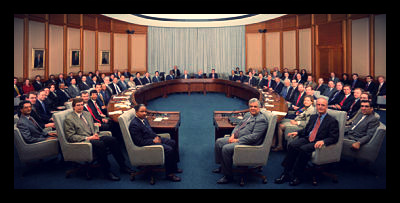
The IMF, or International Monetary Fund, was founded in July of 1944 at the International Monetary and Financial Conference, in New Hampshire. The organization was entered into force in 1945, and the laws were adopted in March of 1946. In the months following the organization’s creation, executive directors and the first managing director, Camille Gutt of Belgium, were elected.
The harsh economic circumstances of the 1930’s and 40’s led the founders of the IMF to plan an institution charged with overseeing the international monetary system in order to prevent self-defeating financial policies. The formation of the IMF would ensure that exchange rate stability was maintained and encourage its member countries to eliminate exchange restrictions that could potentially hinder or complicate trade. In March of 1947, France became the first country to borrow from the IMF.
The IMF: A Cornerstone of the Global Economy
Between 1945 and 1971, member nations of the IMF agreed to keep their exchange rates at a level that could be adjusted only to correct disequilibrium in the balance of payments and only with the IMF’s consent. This system, known as the Bretton Woods system, remained in place until 1971 when the US suspended the convertibility of USD into gold.
After the collapse of the Bretton Woods system, IMF members have been free to choose any form of exchange agreement they wish, other than pegging their currency on gold. Countries are free to allow their currency to float freely, peg it to a different currency, adopt another country’s currency, or other methods. The IMF’s transition to floating exchange rates made it easier for economies to adjust to external shocks.
The IMF has since been redefined by the major global economic crises around the world. Since the mid-1970s, the IMF has helped many of the world’s poorest countries by providing concessional loan programs. These programs came during the oil crisis of the 1970s. The oil crisis forced many countries to borrow from commercial banks, which led to interest rate increases, and subsequently, an international debt crisis. The soaring interest rates caused poorer, developing, and non-oil-producing countries to pay roughly $22 billion dollars between 1978-81.
The financial crisis continued to worsen into 1982, when the IMF coordinated global response, realizing that nobody would benefit if the country after the country failed to repay its debts. This strategy calmed the initial panic; however, it also highlighted the long road needed to eliminate the problem.
After the fall of the Berlin wall in 1989, the organization witnessed its greatest influx of member states since the 1960s. The IMF was essential in assisting countries from the Soviet Bloc transition from central planning to market-driven policies. After several years of intense reform and IMF guidance, most economies had transitioned to market economy status.
In 1997, the Asian financial crisis taught the IMF several important things. First, they would need to pay a great deal more attention to weaknesses in countries’ banking sectors and to the effects those weaknesses had on their macroeconomic stability. The IMF also realized that the institutional prerequisites for successful liberalization of international capital flows were more daunting than they had realized. And finally, the IMF realized that they needed to re-evaluate how fiscal policy should be adjusted in a time of economic crisis.
The global economic crisis of 2008 was preceded by large imbalances in global capital flows. This financial crisis uncovered fragility in advanced markets. In response to the recognition that the IMF would be strained during this financial crisis, the fund lending capacity was tripled to $750 billion. They implemented a variety of lending policies and flexible credit lines to countries with strong economic fundamentals, while also assisting poorer, less developed nations.
The IMF has been and continues to be a quintessentially important monetary cornerstone of the international global economy. The IMF is responsible for many of the world’s most comprehensive and influential economic decisions of the 20th and 21st centuries. Without the IMF the global economy would be a drastically different place.
– Caitlin Zusy
Source IMF

How to Find Your Members of Congress
Democracy is a wonderful thing. Any U.S. citizen, no matter their level of education, age, race, or social standing can call up their members of Congress and request that they vote in favor of or against specific legislation or simply a topic they feel is important.
So why don’t more people contact their representatives? Excellent question. Skepticism? The intangibility of the benefits perhaps? Whatever the reason, it remains clear that not enough people are taking advantage of this excellent tool of democracy. We at The Borgen Project think that needs to change. And that change starts with you. So, to help you get started, here’s a breakdown of how the U.S Congress works.
So What Exactly Is Congress?
Congress is composed of two chambers, the Senate and the House of Representatives. 100 senators make up the Senate, 2 from each state. The House of Representatives currently has 435 members and the population determines the number of representatives per state. For example, Alaska has only 1 representative while the state of Texas has over 30.
This means that 3 people represent you in congress, 2 state senators and 1 representative.
And, There’s an App for That
Contacting your representatives seriously can’t get any easier if you have a smartphone. A free app is available for the iPhone called “Contact Congress”. Once you’ve downloaded the app, open it up and hit the “use my location button”. Your 3 representatives will pop up on your screen. You can call each one from the app without ever looking anything up or dialing the numbers. You can also share your activity on Facebook and Twitter so everyone will know how gosh darn cool you are for calling your reps. You know you want to.
If you don’t have an iPhone, never fear. Check out The Borgen Project website to find your representatives via your area code.
Once you’ve figured out who your reps are, Congratulations! You’ve taken the first step towards making sure those who represent you are in fact, representing how you feel about certain issues and bills.
Great, so now what?
Call them! Yes, pick up that thing that plays music and updates your twitter and….(gasp) dial some digits. (or tap on the faces if you have the app) It will feel strange to talk to a real human but don’t be dismayed. All you have to say is, “I’m a Borgen Project supporter. Please increase funding for USAID.” Or, “Please vote to increase funding for global poverty-related legislation”. That’s it. You can call anytime you want, just be sure to leave a message if it’s after business hours.
The person taking the call will make note of your call. This is the important part! The aide will tally the number of calls on certain issues and often times the representative will decide how they vote based on the calls they get from people like you and me. If constituents don’t call requesting global poverty be on their radar, it probably won’t be, particularly in our current political environment. For example, some of the issues currently listed on my representatives’ web pages include the following- jobs, fiscal responsibility, immigration reform and healthcare. Not ONE mention of global poverty from any of my 3 reps. Where my BP supporters at?
Still not convinced? It’s simple. One 30-second phone call a week is the easiest way to make a difference in fighting global poverty. It takes almost no time and costs next to nothing (much less than donating to a cause or volunteering your time).
For more detailed information regarding your leaders in Congress, this website is a pretty handy tool. You can look up your members of Congress and their voting records as well as bills that are on the docket for the coming week. Stalk your congressional leaders with ease! And don’t forget to call them.
– Erin Ponsonby
Sources: The Borgen Project, U.S. Senate,
Photo:America Bikes
Global Partnership Develops New Vaccine for TB, Malaria, HIV
The Bill & Melinda Gates Foundation has provided a $2.9 million grant for the development of vaccines against tuberculosis, HIV, and malaria. The grant was issued to Aeras, a nonprofit biotech advancing TB vaccines for the world, the University of Oxford, and Okairos, a biopharmaceutical company specializing in T-cell vaccines. The three groups will work together to develop scalable methods to enable large-scale production of multiple novel chimpanzee adenovirus vector constructs.
The Interim CEO of Aeras, Tom Evans, said the “effort to improve optimization and scale-up under current good manufacturing practices could also potentially benefit our peers in HIV and malaria vaccine development.”
The University of Oxford is currently developing multiple vaccines, including vaccines against HIV, malaria, and TB in clinical trials in the UK and Africa. Aeras has focused primarily on tuberculosis vaccine research and development.
This construct will be Okairos’ proprietary technology platform that uses potent chimpanzee adenovirus vectors to stimulate robust T-cell and antibody responses against selected antigens.
Chimpanzee adenovirus-based vaccines have been shown to safely induce exceptionally potent cellular immunity in adults, children and infants, and are in clinical trials involving over 1,000 vaccinees in seven countries.
– Essee Oruma
Source: allAfrica
Source: Bill & Melinda Gates Foundation
Prince Harry Visits the US
Much to the excitement of American women, Prince Harry was in the US from May 9th through the 15th of 2013. While Prince Harry was here he visited Capital Hill. He spent time at an anti-landmine photography exhibition that was put on by HALO Trust. Prince Harry is a patron of HALO Trust at the Russell Senate Office Building. He toured the exhibit with US Senator John McCain. The exhibit was overtaken by female congressional staffers who were eager to catch a glimpse of Prince Harry. Many women snapped a picture of him, on their cell phones, eager to share them with their friends.
Prince Harry’s visit to the United States is aimed at undertaking engagements on behalf of charities the prince is closely associated with. Additionally, the trip’s central theme is to support injured service personnel from the UK and US forces. Prince Harry’s agenda also includes The Warrior Games in Colorado Springs, which benefit veterans from the US and Britain, areas of New Jersey that suffered from Hurricane Sandy, Arlington National Cemetery in Virginia, and Greenwich, Connecticut for a Polo match. In Connecticut he will participate in the Sentebale Polo Cup, which is a match that was started by his charity of the same name, to raise money for Lesotho and other African regions struggling with poverty.
– Caitlin Zusy
History of the UNHCR
Over the 63-year history of the UNHCR, the staff, budget, legal framework, NGO network, geographic scope and expertise of the UN High Commissioner for Refugees has expanded. Despite the initially ambitious goal of solving all refugee problems in three years, the extended mandate of the UNHCR speaks to the consistent problem of refugees, internally displaced persons, asylum seekers, and stateless peoples.
WWII left around 400,000 people homeless refugees strewn across Europe. In 1950, the ambitious new global institution, the UN, created the UN High Commissioner for Refugees (UNHCR) under a three-year mandate to complete its work and then disband. With only 34 staff members and a $300,000 first-year budget, the UN quickly realized the magnitude of the problem far outweighed the resources of the body. A year after its inception, a legal foundation for assisting refugees was set up to establish a legal framework under which refugees can claim international rights. In recognition of the innovative humanitarianism the UNHCR performed, the new organization won the 1954 Nobel Peace Prize.
When the Soviets put down the Hungarian revolution in 1956, an outpouring of refugees into neighboring countries was a humanitarian emergency. The decolonization of Africa in the 1960s and pursuant demarcation of sovereign state boundaries “produced the first of that continent’s numerous refugee crises needing UNHCR intervention.” Through the 1970s and 1980s, the UNHCR advocated and assisted refugees in Asia and Latin America. In 1981 the UNHCR again won the Nobel Peace Prize for “assistance to refugees, with the citation noting the political obstacles facing the organization.”
When the Berlin Wall fell and proxy wars ended, governments previously ‘shored up’ by foreign assistance were weakened. This allowed the “proliferation of identity-based conflicts” causing new refugee problems. The 1990s brought the refugee emergencies full circle back to Africa and Europe with the wars in the Balkans. Throughout the 21st century, the UNHCR has been assisting refugees in the extremely sensitive crises of the Democratic Republic of the Congo and Somalia.
The UNHCR also expanded to assist internally displaced persons and stateless peoples—a politically divisive issue. Stateless peoples are frequently overlooked and denied basic human rights because they do not have citizenship. Fortunately, in some regions, regional agreements have strengthened the 1951 mandate.
As population movement becomes more complex so does the refugee situation. Approximately 150 million people live outside their country of birth. 10% of these people are refugees. This amounts to about 1 out of 400 people worldwide. Most often, refugees are created from violent conflict and recent research and practitioners’ experiences show humanitarian aid can no longer be considered independent of a conflict. Often, conflicting factions see the humanitarian body as supporting one side or the other making the aid workers and aid vulnerable to attack and manipulation.
Fortunately, the UNHCR has reflected the growing problem by growing size, scope, and depth of action. In 2012, the UNHCR had a budget of $3.59 billion and a staff of 7,685 based in the Geneva headquarters, 126 countries within which 135 main offices operate and 279 remote field offices function. Of the 43 million people uprooted worldwide, the UNHCR supports 33.9 million ‘people of concern.’ The two largest groups are internally displaced persons (14.7 million people) and refugees (10.5 million persons). The remaining group’s returnees (3.1 million), stateless people (3.5 million), asylum seekers (837,000) and ‘other’ (1.3 million).
– Katherine Zobre
Sources: UNHCR History , The State of the World’s Refugees 2000
Photo: UNHCR
Boghuma Kabisen Titanji’s TED Talk on Ethical Riddles in HIV Research
Medical doctor and PhD candidate at University College London, Boghuma Kabisen Titanji, is dedicated to the study of HIV drug resistant viruses and seeks to better understand the mechanisms of drug resistance. When she did the research in Africa, she found that there are so much we need to do to protect participants who are in HIV research.
In Titanji’s TED Talk, she mentions a story about a HIV research participant and how this gave her ideas to think about what we need to protect participants’ rights and how it is important that we should talk about ethical riddles in HIV research. Titanji also brought up four areas that need to be improved in the clinical trial in developing countries to protect participants and to be more ethically acceptable.
The first point is informed consent which means participants must be given relevant information. The second area is the standard of care provided by any clinical trials. After the research ends, they should take responsibility for their participants. What happens to participants once the clinical trial is completed needs to be decided before the clinical trial. Thirdly, local governments should pay more attention to the ethical review of research even before the trial has started. And the final point is that all clinical trials should have clear plans about what happens to all the participants when research is completed.
-Caiqing Jin(Kelly)
Source: TED Talks
Top 10 Global Health Blogs
Interested in global health? Check out this list of global health blogs!
1. https://blogs.plos.org/globalhealth/
PLOS Blogs covers a wide range of science and health topics but has a particular blog devoted to global health. Their Translational Global Health blog gathers knowledge and blogs from emerging knowledge leaders around the world. Most recently they highlighted the TEDMED 2013 conference. This blog is full of interesting information and is updated regularly which is why it took a spot on the top 10 list.
2. https://www.cgdev.org//globalhealth
The Center for Global Development has a blog specifically dedicated to Global Health Policy. Writers post on issues related to global health policy and changes going on within that arena. The articles are relevant and contain solid, evidence-based research and topics.
3. https://www.who.int/mediacentre/en/
This is the media center for the World Health Organization. While not exactly a blog in the truest sense of the word, the media center offers news, events, features, stories, and resources on world health. It is comprehensive and contains a wealth of knowledge on global health which is why it made the list.
4. https://blogs.cdc.gov/global/
The official CDC blog contains all things related to global health. The blog has a nice list of categories on the side and provides interesting and relevant information for the public relating to global health. The CDC blog is a well-rounded source of global health information and resources.
5. https://capsules.kaiserhealthnews.org/
The Henry J. Kaiser Family Foundation is another excellent resource for world health. They work through advocacy and policy to help change global health. Within their health news section, they have a blog with short posts on news and events in both national and global health.
6. https://ghcorps.org/fellows/blog/
The Global Health Corps works with activists and leaders under the common vision that health is a human right. Fellows in the program work all over the world in various global health fields and blog about their experiences. The blog provides both information and a personal component highlighting the experience of the fellows as they work in global healthcare.
7. https://www.publichealthnewswire.org/
The American Public Health Association blog was chosen for its focus on advocacy and change. While the focus on global health is small, the organization has some great tips on advocating for change and activities one can do to get involved in advocacy and policy change.
8. https://www.unfoundation.org/blog/
The United Nations Foundation plays a significant role in global health. From eradicating polio to providing mosquito nets, the UN works hard in the arena of global health. The blog is not especially focused on global health but covers an array of UN topics. It can be narrowed down to global health topics and is a great resource for global development in general.
9. https://globalhealtheducation.org/SitePages/Home.aspx
The Global Health Education Consortium made the list because of the extensive list of resources available to educators. The resources tab under the home pages has units, PowerPoint presentations, and handouts on global health geared towards the classroom. It is a great place to get students started in advocacy and awareness of global health issues and ways to get involved in global action.
10. https://www.ghi.gov/
Closing out the Top 10 list is the U.S. Global Health Initiative blog. The GHI works to engage in global health through strategic engagement with foreign countries. Sustainability is key in the programs the GHI funds as well as the overall impact on global health. The blog provides updates on key programs and initiatives as well as news relating to global health.
– Amanda Kloeppel
Photo: Twitter
History of the IMF
The IMF, or International Monetary Fund, was founded in July of 1944 at the International Monetary and Financial Conference, in New Hampshire. The organization was entered into force in 1945, and the laws were adopted in March of 1946. In the months following the organization’s creation, executive directors and the first managing director, Camille Gutt of Belgium, were elected.
The harsh economic circumstances of the 1930’s and 40’s led the founders of the IMF to plan an institution charged with overseeing the international monetary system in order to prevent self-defeating financial policies. The formation of the IMF would ensure that exchange rate stability was maintained and encourage its member countries to eliminate exchange restrictions that could potentially hinder or complicate trade. In March of 1947, France became the first country to borrow from the IMF.
The IMF: A Cornerstone of the Global Economy
Between 1945 and 1971, member nations of the IMF agreed to keep their exchange rates at a level that could be adjusted only to correct disequilibrium in the balance of payments and only with the IMF’s consent. This system, known as the Bretton Woods system, remained in place until 1971 when the US suspended the convertibility of USD into gold.
After the collapse of the Bretton Woods system, IMF members have been free to choose any form of exchange agreement they wish, other than pegging their currency on gold. Countries are free to allow their currency to float freely, peg it to a different currency, adopt another country’s currency, or other methods. The IMF’s transition to floating exchange rates made it easier for economies to adjust to external shocks.
The IMF has since been redefined by the major global economic crises around the world. Since the mid-1970s, the IMF has helped many of the world’s poorest countries by providing concessional loan programs. These programs came during the oil crisis of the 1970s. The oil crisis forced many countries to borrow from commercial banks, which led to interest rate increases, and subsequently, an international debt crisis. The soaring interest rates caused poorer, developing, and non-oil-producing countries to pay roughly $22 billion dollars between 1978-81.
The financial crisis continued to worsen into 1982, when the IMF coordinated global response, realizing that nobody would benefit if the country after the country failed to repay its debts. This strategy calmed the initial panic; however, it also highlighted the long road needed to eliminate the problem.
After the fall of the Berlin wall in 1989, the organization witnessed its greatest influx of member states since the 1960s. The IMF was essential in assisting countries from the Soviet Bloc transition from central planning to market-driven policies. After several years of intense reform and IMF guidance, most economies had transitioned to market economy status.
In 1997, the Asian financial crisis taught the IMF several important things. First, they would need to pay a great deal more attention to weaknesses in countries’ banking sectors and to the effects those weaknesses had on their macroeconomic stability. The IMF also realized that the institutional prerequisites for successful liberalization of international capital flows were more daunting than they had realized. And finally, the IMF realized that they needed to re-evaluate how fiscal policy should be adjusted in a time of economic crisis.
The global economic crisis of 2008 was preceded by large imbalances in global capital flows. This financial crisis uncovered fragility in advanced markets. In response to the recognition that the IMF would be strained during this financial crisis, the fund lending capacity was tripled to $750 billion. They implemented a variety of lending policies and flexible credit lines to countries with strong economic fundamentals, while also assisting poorer, less developed nations.
The IMF has been and continues to be a quintessentially important monetary cornerstone of the international global economy. The IMF is responsible for many of the world’s most comprehensive and influential economic decisions of the 20th and 21st centuries. Without the IMF the global economy would be a drastically different place.
– Caitlin Zusy
Source IMF
5 Global Poverty Quotes From Business Leaders
When it comes to deciding how and where to spend money, business leaders can give some of the best advice. Their experience in the business world can also help when it comes to determining if the U.S. should increase foreign aid to decrease global poverty. Here are 5 quotes and kernels of wisdom about global poverty from some of the most significant business leaders.
1. “Looking at these issues as a businessman, I believe that investing in the world’s poorest people is the smartest way our government spends money.”
– Bill Gates, Former CEO and Chairman of Microsoft, Co-Founder of the Bill & Melinda Gates Foundation
2. “…It’s nonsense to think we can balance the budget by ‘ending foreign aid.’ In fact, the International Affairs budget is just over one percent of the federal budget. The Chamber supports a robust International Affairs budget for the State Department and other agencies. It funds critical efforts to boost exports and jobs, protect our national security, and promote our humanitarian values.”
– Thomas J. Donahue, President and CEO of the U.S. Chamber of Commerce
3. “The world is getting to be a smaller place every day, and from an economic perspective, what happens in one country has ripple effects throughout the world. Funding from the International Affairs Budget, which is just 1 percent of the federal budget, helps to strengthen the economies of developing nations around the world.”
– Chris Policinski, CEO of Land O’Lakes
4. “As a business person, I understand the value of an investment – and the importance of getting a good return on your dollar. And that’s what we get when we fund our diplomatic efforts and international programs. Yes, it means needed humanitarian relief. Yes, it means more security for the American people in these troubled times. But from years of our company’s experience, it also means jobs right here at home.”
– James W. Owens, Chairman and CEO of Caterpillar
5. “Given the fact that MDBs focus more on middle- and low-income countries and not the United States, the temptation of some might be to cut back on our contributions and to refocus those resources elsewhere. And yet such a decision would be extremely short-sighted, in my judgment, because it would negatively impact job creation at the very time when we’re trying to rebuild our economy.”
– Robert Mosbacher Jr., Chairman of Mosbacher Energy Company, Past-President and CEO, Overseas Private Investment Corporation
– Katie Brockman
Source: U.S. Global Leadership Coalition
Photo: Marketplace Leaders
Read Global Poverty and Humanitarian quotes.
Oprah Winfrey Leadership Academy for Girls
Oprah Winfrey opened a school in South Africa for girls. The school is called the Oprah Winfrey Leadership Academy for Girls. The school’s mission is to provide a nurturing educational background for academically gifted girls who come from disadvantaged backgrounds. The school is for girls in Grades 8-12. The school strives to give their girls the skills to assume positions of leadership in South Africa, as well as internationally. The school would like to see their graduates lead the transformation of their communities and country.
The school is centered on the Ubunti and Botho belief system. They teach the ideals of humanity, compassion, and service to others. Additionally, the school’s core values include respect, honor, service, and compassion.
The school was born in 2000 when Oprah visited Nelson Mandela where she promised to build a world-class school for girls. The school was later opened in 2007 with 7th and 8th-grade girls. Ms. Winfrey donated more than $40 million toward the academy’s creation.
The leadership academy integrates academic, leadership, and pedagogy curriculums. The academic curriculum includes courses in languages, mathematics, science, arts, physical education, and individuals and societies.
As a part of the school’s philosophy, each student also has an individual advisor. The advisor is responsible for monitoring the girl’s growth and progress in all aspects of school life. Each advisor has three main roles including knowing and being personally available to the student, sharing in her problems and successes, keeping in touch with the student’s teachers and residential staff, and finally acting as a contact and resource person for parents, guardians, or caregivers.
The leadership academy is a competitive entrance school. Ms. Winfrey believes that education is the right of every girl but her academy is to be seen as a privilege. Students are invited to attend the academy, and these girls have proven that they have the ability to excel and move beyond challenging circumstances. The Oprah Winfrey Leadership Academy for Girls has provided and will continue to provide many African Women an incredible opportunity to succeed.
– Caitlin Zusy
Source Oprah Winfrey Leadership Academy
Photo Oprah
Tragedy at Bangladesh Garment Factory
Until now, more than 1000 people are estimated to have been killed in the collapse of the Bangladesh garment factory. Statistics make this accident one of the worst garment factory disasters in modern history. As governments, organizations, and conscientious consumers look for solutions and ways to prevent another catastrophic loss of life, some are considering the role a company or consumer boycott of clothing made in Bangladesh would have. But how should consumers respond? Is pushing for a boycott of Bangladeshi products really the solution? Experts differ on the possible effects of such a move.
Professor Linda Scott at Oxford University says no:
The most obvious thing to do is to take away shopping dollars, and I do appreciate that stopping power, but I am just afraid that moves the problem someplace else. There is always another country that is happy to take on garment manufacturing. That is why it moves around so much. If the factories move elsewhere, it does not really solve the problem. It just moves misery somewhere else. And it takes away work from the people in Bangladesh.
Paul Collins of the British Anti-poverty Group War on Want also hesitates to endorse such a move:
We take our lead from our partner, the National Garment Workers’ Federation in Bangladesh, and they take their lead from the trade union members they support – mainly women – who say that these jobs should be decent jobs that are safe, pay a living wage and do not force them to work excessive hours. But they fear that a boycott campaign would mean they would lose their jobs. They come from rural areas and abject poverty, so they have not asked us to mount a boycott campaign.
Jamie Terzi, Bangladesh Country Director for CARE International, offered the following perspective:
I think for an incident of this magnitude to occur, we are talking about a systemic failure, where there are multiple responsibilities and, more strongly, culpabilities. It is not particularly helpful to pick one person or group, the problem is simply too large and too complex. It is absolutely the government; it is absolutely the people of Bangladesh calling on their government to be more accountable; it is up to the factory owners; it is up to the buyers and it absolutely is up to the consumers in Western countries.
Elizabeth L. Cline, author of Over-Dressed: The Shockingly High Cost of Cheap Fashion emphasizes the same point made by Terzi:
Bangladesh is a very poor country so even if they wanted to implement changes there is not a lot of money to do so. We’re talking about a $500,000 (£320,000) investment per factory to get some of these changes implemented and the brands can afford it. The factories can’t. Consumers are ready for ethical fashion. They want to see fair labor standards implemented and abided by, and they would support it if the brands made headway on that.
For consumers, particularly those in the west, who decide to respond to the tragedy, all of these experts agree that there are a number of complex and interlocking issues to be considered here. Everyone, from governments to multi-nationals, to consumers will have a role to play in developing a solution to save lives in the future.
– Délice Williams
Source: BBC, CBS
Photo: CNN