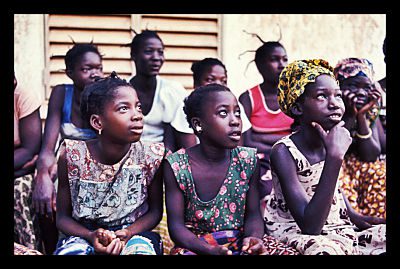
A group of 20 girls from low-income areas of Monrovia, Liberia’s capital city, gather to listen to Divine Anderson. “We are going to help you make a short film about an accountability issue in your community,” she tells them.
“We don’t need to be politicians to push for the kind of country we want; our films can create change,” Anderson assures her audience.
She works for the Accountability Film School set up last year by the Accountability Lab and the girls she’s speaking to are 2014’s first class of pupils. The under-served girls will receive four weeks of instruction on low-budget film making and accountability issues. The girls will also complete self-directed film projects addressing problems of their own choosing.
Accountability Lab terms itself “an independent, non-profit organization that acts as a catalyst to make power-holders responsible in the developing world.” The organization achieves this through a three-prong approach, acting as: a sounding board on issues related to accountability and corruption, an “independent interface” engaging citizens all around the world, and an “operational hub” by supporting innovative accountability tools and communities.
And in the formerly war-torn Liberia, the lab saw much work to be done. Despite having the first female president in Africa, Liberia remains a male-dominated society in which power and resources are often skewed toward men. Its population is largely desperately poor, especially its female population, with soaring rates of illiteracy.
Sexual exploitation is also a huge issue, an issue tackled by Dorcas Pewee in her film “Say It.”
Pewee was one of the first graduates of the Accountability Film School back in the fall. Having lost her family in Liberia’s civil war, she had turned to hustling on the streets of Monrovia to survive. That is, until Anderson found her and brought her to the film school.
In September 2013, Anderson’s film, addressing the pressing issue of sexual exploitation in schools, won viewer’s choice at the first Liberian Film Festival. Pewee followed up her first film with another one on the unfulfilled promises made by Liberian politicians. And she’s found a job- helping Divine lead the current film school class.
On her experiences with the film school, Pewee is empowered. “I saw the light,” she reports.
Other students have addressed issues ranging from the lack of clean drinking water and electricity in cities to the absence of job opportunities for Liberian youth to injustices committed during the civil war.
The films are screened to activists, government employees, university representatives, and civil society members at festivals and are also distributed to local “video clubs” throughout Liberia. They function to create a dialogue about various issues within communities and to work as advocacy tools.
More than 50 students have now graduated from the film school and Anderson aims to train an additional 150 in 2014.
The sustainability of the program and its good work is evidenced by the existence of the Liberia Film Institute recently formed by graduates of the film school. Through the institute, they hope to further hone their skills and earn money through film making grants and contracts with Liberian companies and NGOs.
– Kelley Calkins
Sources: ONE, Accountability Lab Blog, Stanford Social Innovation Review
Photo: The World Bank

The Role of Music in Economic Development in Africa
Music exists everywhere in daily activities. People listen to music when driving, studying, or relaxing as well as in commercial. Music has the ability to move people in many mysterious ways. The purpose of this article is to discuss the role of music in economic development.
Music is one of the biggest industries in the world. According to International Federation of the Phonography Industry, the music industry sales was $5.8 billion, and performance rights revenue is growing the fastest to $943 million( up from $862 million in 2011). In the emerging world, people are exploring different kinds of music to fit their taste.
In addition, with the increasing use of the internet, it is easier to spread and create a new movement in music. Africa music can get bigger and gain more popularity around the world. Apart from record sales for African music, music can draw other kind of revenue such as concerts, tourist, and sales of band merchandise. The growth in these sectors will create more jobs in the local job market and in Africa as a whole.
Besides, the monetary effect of music on the economy, music can also have an effect on people’s mindset.
Music is the way for people to express and share themselves with others. When people are able to share their opinion with others, African musicians can encourage people to try harder and overcome daily life challenges and reach for higher goals.
Music can also draw attention to African countries and show citizens in developed countries that African is a growing continent not just a sad story for the world.
Nowadays, in Africa, many people are creating labs so that locals can produce music to spread the music effect to others. With low marketing cost, music can produce a steady stream of revenue for the economy and represent Africa in the eyes of people globally.
– Phong Pham
Sources: SXSW, Billboard, EthPress
Photo: USAID
Empowering Girls: Film in Liberia
A group of 20 girls from low-income areas of Monrovia, Liberia’s capital city, gather to listen to Divine Anderson. “We are going to help you make a short film about an accountability issue in your community,” she tells them.
“We don’t need to be politicians to push for the kind of country we want; our films can create change,” Anderson assures her audience.
She works for the Accountability Film School set up last year by the Accountability Lab and the girls she’s speaking to are 2014’s first class of pupils. The under-served girls will receive four weeks of instruction on low-budget film making and accountability issues. The girls will also complete self-directed film projects addressing problems of their own choosing.
Accountability Lab terms itself “an independent, non-profit organization that acts as a catalyst to make power-holders responsible in the developing world.” The organization achieves this through a three-prong approach, acting as: a sounding board on issues related to accountability and corruption, an “independent interface” engaging citizens all around the world, and an “operational hub” by supporting innovative accountability tools and communities.
And in the formerly war-torn Liberia, the lab saw much work to be done. Despite having the first female president in Africa, Liberia remains a male-dominated society in which power and resources are often skewed toward men. Its population is largely desperately poor, especially its female population, with soaring rates of illiteracy.
Sexual exploitation is also a huge issue, an issue tackled by Dorcas Pewee in her film “Say It.”
Pewee was one of the first graduates of the Accountability Film School back in the fall. Having lost her family in Liberia’s civil war, she had turned to hustling on the streets of Monrovia to survive. That is, until Anderson found her and brought her to the film school.
In September 2013, Anderson’s film, addressing the pressing issue of sexual exploitation in schools, won viewer’s choice at the first Liberian Film Festival. Pewee followed up her first film with another one on the unfulfilled promises made by Liberian politicians. And she’s found a job- helping Divine lead the current film school class.
On her experiences with the film school, Pewee is empowered. “I saw the light,” she reports.
Other students have addressed issues ranging from the lack of clean drinking water and electricity in cities to the absence of job opportunities for Liberian youth to injustices committed during the civil war.
The films are screened to activists, government employees, university representatives, and civil society members at festivals and are also distributed to local “video clubs” throughout Liberia. They function to create a dialogue about various issues within communities and to work as advocacy tools.
More than 50 students have now graduated from the film school and Anderson aims to train an additional 150 in 2014.
The sustainability of the program and its good work is evidenced by the existence of the Liberia Film Institute recently formed by graduates of the film school. Through the institute, they hope to further hone their skills and earn money through film making grants and contracts with Liberian companies and NGOs.
– Kelley Calkins
Sources: ONE, Accountability Lab Blog, Stanford Social Innovation Review
Photo: The World Bank
Fundraising Ideas for School
This year marks the 50th anniversary of former United States President Lyndon B. Johnson’s State of the Union address where he boldly declared a war on poverty.
His New Deal created many welfare programs and provided millions of Americans with a social safety net. If the U.S. wants to keep this tradition of helping the nation’s less fortunate population, it must continue to instill humanitarian values in our young generations.
Schools can help foster this sense of care and compassion by teaching lessons and engaging students in a variety of techniques that connect them to their communities and the world around them. Many schools organize various activities that help raise funds that can be donated to worthy causes that combat poverty around the world.
Here are four fundraising ideas of activities one implement in their school so students, teachers, family and friends can join in the battle against poverty:
1. Walk-a-thon The idea here is simple: Organize an event at the school track. Participants will run or walk a predetermined distance, for example, five kilometers, and sign up sponsors that are willing to pledge money for an agreed upon distance traveled. The non-competitive nature of this event attracts people from all backgrounds and is a great way to meet community members and raise money for a worthy cause.
2. Penny Wars This contest works great in a high school setting. For each school class (freshmen, sophomore, junior and senior), set up a container near the school’s cafeteria or other common areas. Over a predetermined period, say, two weeks, students will dump pennies and other coins into the jars. The idea is to see which student class can dump the most coins in the jars. The winning class can receive a day off, can participate in a “fun day” such as wearing pajamas to school or receive a prize or certificate.
3. Car Wash The car wash has become one of the easiest and fun ways to raise money for a worthy cause. Students can designate certain weekends during the school year or summer to wash their fellow community member’s cars. In this do-it-yourself car wash, the school can provide soap, water, and towels for students. Promote the car wash by posting signs throughout the town and have groups of students standing on corners attracting customers.
4. Raffle Attracting various business’s throughout the town to donate prizes for the raffle in exchange for advertising, students can hold a prize raffle by selling tickets to students during lunch breaks. Proceeds can be donated to a worthy cause of the school’s choice.
– Sunny Bhatt
Sources: Scholastic, Brain Child
Photo: Eventish
Zach Braff’s Wish I Was Here
“I can’t do this all on my own” are the familiar musical lyrics that introduced each episode of “Scrubs” during it’s nine season run. Though “Scrubs“ turned actor Zach Braff into a television and indie star, his new film project certainly shows how Braff cannot achieve his artistic goals “on [his] own.”
“Wish I Was Here” is a film written, directed and starring Zach Braff, picking up on the themes he first explored in his well-received debut film “Garden State” back in 2004. The film follows a thirty-something actor, played by Braff, searching for a purpose in life and struggling to make ends meet for his two young children.
Other actors featured in the film include Kate Hudson, Anna Kendrick, Jim Parsons and “Scrubs” co-star Donald Faison. The film premiered to a standing ovation at the 2014 Sundance Film Festival.
What makes “Wish I Was Here” unique, however, is the fact that fans independently financed the film. Braff, moreover, launched a Kickstarter campaign with a stated goal of $2 million since, according to the film’s Kickstarter page, Braff rejected traditional funding methods to avoid “signing away all artistic control.”
Braff also saw an opportunity for his fans to have a direct impact on the filmmaking process.
Incentives for donating to the film range from a production diary at $10 and a meet and greet with Braff for $600 to being cast in the film as a featured extra for $7,500. These incentives, matched with the originality of the fundraiser, led to a final total of $3,105,473 donated by 46,520 individuals.
Though a $10 donation to Zach Braff’s film garners a production diary, 80% of the world’s population live off of less than $10 a day, with 660 million living on less than $2 a day.
What could you buy for the fight against global poverty with a $10 donation?
With $3, you could buy a bed net to protect one of the 18,000 children who die daily from mosquitos carrying deadly diseases while for $8.50, you could feed an entire family in a developing nation. Though Braff’s film is no doubt an artistic achievement, it is easy to wonder what kind of impact his 46,520 backers could have made for global development.
– Taylor Diamond
Sources: Kickstarter, UNICEF, Global Issues
Photo: Bustle
The Selfless Selfie
Social networking sites have created platforms for individuals to engineer an online version of themselves, editing bits and pieces of their lives to portray to their friends or even to the world. Users are armed with an array of tools that give them an unending soundboard to voice everything under the sun relating to their lives, thoughts or opinions.
Along with this focus on ones self comes the infamous #selfie.
The Oxford Dictionary recently even deemed “selfie” as the word of the year, defining it as “a photograph that one has taken of oneself, typically with a smartphone or webcam and uploaded to a social media website.” The dictionary’s word monitor indicated a 17,000% increase in the usage of the word “selfie” since last year.
Selfies have been used by a whole gamut of people, from everyday individuals to celebrities and politicians alike. Even United States President Barack Obama was caught posing for a selfie during Nelson Mandela’s memorial service, an image which the photographer says “seemed to get more attention than the event itself.”
While much focus on “selfies” seems a bit “selfish,” a couple of college students from Brigham Young University took the initiative to turn this popular craze into a force for good. Chas Barton and Dustin Locke developed the “Selfie Police” Initiative last year as part of a 24-hour creativity competition.
When discussing how they came up with the concept, Barton said, “It’s tricky because we’re such a selfish generation, so the question we asked was not how do we make our generation charitable, but how do we turn selfishness into charity.”
The way the initiative works is by “selfie violators” voluntarily turning themselves in and donating a dollar for each photo, or by friends of violators tagging the selfies on Instagram or Facebook with Selfiepolice.org or #selfiepolice and urging their friends to pay up. Since their launch a few weeks ago, the Selfie Police have raised $1,609.
According to their website, “one-hundred percent of funds raised by the #selfiepolice will be contributed to Vittana, an innovative organization dedicated to fighting world poverty by providing student loans to college aged kids in third world countries.”
In light of the self-absorbed tendencies cultivated by social networking, the founders hope that they can “create a culture of people who think of others, even when obsessing over themselves.”
– Rifk Ebeid
Sources: The Selfie Police, The Huffington Post, The New York Times, TIME
Martin Luther King Quotes on Poverty
Dr. Martin Luther King Jr will forever hold a place in the hearts of millions of people around the world. The immediate need for freedom from racism, discrimination and flat out brutality toward African Americans will forever be King’s message. However, Dr. King also used his platform to shed light on global poverty.
He expressed the need for poverty to be abolished and the need for nations to come together to combat this growing problem. Here are excerpts of Dr. King’s written documents concerning the dire need to end poverty.
Excerpts from Dr. King’s Nobel Peace Prize address in 1964:
“A second evil which plagues the modern world is that of poverty. Like a monstrous octopus, it projects it’s nagging, prehensile tentacles in lands and villages all over the world. Almost two thirds of the peoples of the world go to bed hungry at night. They are undernourished, ill-housed, and shabbily clad. Many of them have no houses or beds to sleep in. Their only beds are the sidewalks of the cities and the dusty roads of the villages. Most of these poverty-stricken children of God have never seen a physician or a dentist.”
“So it is obvious that if a man is to redeem his spiritual and moral ‘lag,’ he must go all out to bridge the social and economic gulf between the ‘haves’ and ‘have not’s’ of the world. Poverty is one of the most urgent items on the agenda of modern life.”
“There is nothing new about poverty. What is new, however, is that we have the resources to get rid of it.”
“The time has come for an all- out world war against poverty.”
“The rich nations must use their vast resources of wealth to develop the underdeveloped, school the unschooled, and feed the unfed. Ultimately a great nation is a compassionate nation. No individual or nation can be great if it does not have a concern for ‘the least of these.'”
Excerpts from Dr. King’s “Let My People Go” speech. Human Rights Day December 10, 1965:
“Africa does have spectacular savages and brutes today, but they are not black. They are the sophisticated white rulers of South Africa who profess to be cultured, religious and civilized, but whose conduct and philosophy stamp them unmistakably as modern-day barbarians.
We are in an era in which the issue of human rights is the central question confronting all nations. In this complex struggle an obvious but little appreciated fact has gained attention-the large majority of the human race is non-white-yet it is that large majority which lives in hideous poverty. While millions enjoy an unexampled opulence in developed nations, ten thousand people die of hunger each and every day of the year in the undeveloped world.”
An excerpt from “Where do we go from Here: Chaos or Community” written in 1967:
Sadly this is Dr. King’s last book before he was tragically assassinated.
“I am now convinced that the simplest approach will prove to be the most effective – the solution to poverty is to abolish it directly by a now widely discussed matter: the guaranteed income.”
“The curse of poverty has no justification in our age. It is socially as cruel and blind as the practice of cannibalism at the dawn of civilization, when men ate each other because they had not yet learned to take food from the soil or to consume the abundant animal life around them. The time has come for us to civilize ourselves by the total, direct and immediate abolition of poverty.”
Nearly fifty years after these words were breathed, they still reign true; especially since poverty continues to be a problem for millions of people in 2013. Let us not allow Dr. King‘s words to remain in the past. We must give them life again and continue to make this world a better place, as Dr. Martin Luther King did nearly fifty years ago.
– Amy Robinson
Sources: Nobleprize, RFKSA Film, Progress,
Photo: BAR Photography
White House Releases Strategic Human Trafficking Plan
On January 14, the United States government took a strong step toward combating modern-day slavery. The White House released its Federal Strategic Action Plan on Services for Victims of Human Trafficking 2013-2017 in the United States — the first of its kind — on Monday. The Plan’s release is a timely one, as January marks National Slavery and Human Trafficking Prevention Month.
According to White House blog writer Cecilia Munoz, the Plan “describes the steps that federal agencies will take to ensure that all victims of human trafficking in the United States are identified and have access to the services they need to recover and to rebuild their lives.” The federal government anticipates increased coordination, collaboration and capacity across multiple agencies over the span of five years.
More than 15 federal agencies were involved in developing the Plan, with public feedback from concerned stakeholders; the Departments of Justice, Health and Human Services and Homeland Security spearhead the efforts.
While the ultimate aspiration – identification of and access to services for all trafficking victims – is ambitious, the Plan is broken down into four more succinct goals: align efforts at the federal, regional, state and local levels, improve understanding through amplified research and data evaluation, expand access to services via outreach and training and improve both short- and long-term outcomes for victims.
Concise methods and action steps for achieving these goals are delineated throughout the document.
Victim sensitivity and empowerment are the cornerstone of the government’s action plan. “Meaningful engagement with survivors,” states to the Plan’s core values, “in all aspects of program development, implementation, and evaluation is critical in order to develop effective service networks.”
Furthermore, the Plan will focus on increased public awareness and sustainable solutions for trafficking survivors.
Reiterating the importance of a victim-centered approach, President Obama offers an encouraging and personal sentiment in the opening pages of the release: “To those who are suffering and have suffered the horrors of human trafficking, our message remains: We hear you. We insist on your dignity.” This statement sets the tone for the goals of the Federal Strategic Action Plan and carries a message of justice to activists, advocates, victims and survivors across the country and the globe.
– Mallory Thayer
Sources: White House Blog, Office for Victims of Crime
Photo: News One
Poverty in Mexico City Persists
Although Mexico has the 13th largest economy in the world, poverty in Mexico City remains commons.
According to an article by The Huffington Post, poor people in Mexico make up half of the country’s population. “While the number of people living in extreme poverty fell… many more Mexicans are now worse off than they were when former President Felipe Calderon entered the last two years of a six-year term in which poverty swelled by nearly 3 percent”, the article states.
On the other hand, despite Mexico City being home to historical monuments and rich neighborhoods, another reality exists in which almost half of the city’s inhabitants are poor. Another article published by the BBC in 2006 argues that 40 percent of the city’s population lives below the line of poverty.
“This is a place of homeless street kids, piracy, pollution, crime, and 100,000 street vendors. At the same time, the rich live in a world of gated communities, rooftop swimming pools, and commuting by helicopter,” stated the author.
It is estimated that approximately 15,000 children live on the streets of Mexico City. Many children prefer such a lifestyle due to family disintegration and physical abuse, which are symptoms of poverty itself. Poverty in Mexico City causes devastation at home and cause arguments. But, sometimes these arguments become violent.
To make some pesos here and there, children would dress like clowns and entertain traffic at stoplights.
If drivers were impressed they would give them some money. Most of the time, however, drivers tend to ignore these children. With 15,000 children living in the streets, the working class in Mexico City has probably become desensitized to such an image.
On the national level, the number of Mexican children living in poverty is more absurd. According to a report by Fusion, the United Nations Children’s Fund “estimates that more than 20 million children and adolescents live in poverty in Mexico with more than five million living in extreme poverty.”
Whether people live in the streets or not, the BBC states, “at least 40% of the economy in the city is informal – people who do not pay taxes, and who make a living based on selling small amounts of things, from children’s books to luminous stars.”
These articles combined serve to show that despite Mexico’s progress throughout history, poverty is one of the many social issues that the country struggles to defeat. They also suggest that the poverty in Mexico City is bad, but not as bad as the poverty on the national level.
– Juan Campos
Sources: BBC, The Huffington Post
Photo: Nick Rain
10 Facts about Poverty in Italy
Poverty in Italy remains a problem. The ongoing economic recession, affecting many countries around the globe, has hit Italy especially hard. For the first time in 16 years, poverty rates have risen, along with the general jobless and youth unemployment rate. Overall, the number of full-time contract workers declined to 10.2 million in 2013, a 1.3 percent reduction from 2012.
The news was even worse for younger generations as youth unemployment reached an all-time high of 41.2 percent.
Although the first month of the New Year has yet to end, Italy remains hopeful to see results and move on from past adversities. Listed below are 10 facts about some of those adversities, as well the consequential effects the economic crisis has had on Italy over time.
Poverty in Italy Facts
– Jeffrey Scott Haley
Sources: Financial Express, ANSAmed
Photo: Kay Kanat
Not Impossible Foundation
The impetus for the trail-blazing Not Impossible Foundation took place when Mick Ebeling befriended the gifted street artist Tony “Tempt One” Quan, who was suffering from the onset of Lou Gehrig’s disease. Lou Gehrig’s would eventually paralyze his entire body, stripping Tempt of his ability to communicate through artistic expression or any other means of expression other than the careful movement of his eyes.
Moved by the tragedy of Tempt’s situation, Ebeling recruited a team of talented individuals from Graffiti Research Lab, Free Art and Technology Lab and other hackers to create a device that would enable Tempt to create artwork again. In April 2009, after seven years of laborious research, experimentation and refinement, Ebeling and his team presented Tempt with their creation, the EyeWriter. The EyeWriter is an astonishingly innovative device that allows paralyzed individuals to communicate using only his or her eyes.
Recounting his perseverance in creating the EyeWriter, Ebeling said, “When I feel a spark, I commit wholly to the idea, without necessarily having a sense of how, or if, I will be able to complete it…when presented with a challenge, I find it incredibly hard to back down.”
Not surprisingly, after the launch of the EyeWriter, Ebeling and his team were soon the recipients of multiple honors in the technological world. For instance, Time Magazine honored the device by declaring the EyeWriter as one of the 50 best inventions of 2010. The recognition that Ebeling and his team received after Time’s illustrious title enabled the launch of Ebeling’s next endeavor, the Not Impossible Foundation.
The Not Impossible Foundation provides a self-description so to-the-point and succinct that it is composed of a mere six words. The Foundation Having establishes itself as a technology-oriented lab by breezily describing itself as “technology for the sake of humanity.”
Adhering to the standard of innovation and promise of the 2009’s EyeWriter, Ebeling and his team is tackling the previously impossible by working to create smart canes for the blind along with 3D-printed prosthetic limbs for amputees. The Not Impossible Foundation strives to construct new yet affordable technology to revolutionize healthcare.
– Phoebe Pradhan
Sources: Atlantic Meets Pacific, Not Impossible Labs, Mick Ebeling, BBC
Photo: Facebook: Not Impossible Fund