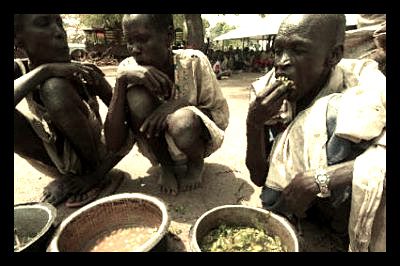
On July 9, 2011, the Republic of South Sudan gained independence from Sudan. Since then, the newly formed nation has been engulfed in internal conflicts, claiming the lives of up to 10,000 people. The violence has caused over 870,000 South Sudanese to flea their homes, of which over 140,000 have escaped to neighboring countries.
Meanwhile, the South Sudan food crisis continues to grow, prompting international organizations to come together for a solution.
The displacement has disrupted the nations already unstable agriculture sector.
Markets have been disrupted as the food supply chain is broken and foreign investors try to avoid the conflict. According to United Nations estimates, 3.7 million people were already facing food insecurity, but the new wave of violence that erupted in December of 2013 has raised this figure to almost 7 million.
The timing of the conflict could not have been worse as local farmers are gearing up to plant their crops for the incoming season. Constant relocation is forcing millions to rely on scarce food aid. In some cities like Malakal, desperate populations have begun raiding aid supply stored in warehouses. The UN Food and Agriculture Organization (FAO) warned that if farmers miss the planting season, it would compound food insecurity issues for this year and 2015.
Farmers that remain tied to their land are facing a shortage of agriculture inputs such as seeds and tools to cultivate their crops. The FAO is seeking $77 million to assist the Republic of South Sudan in implementing an emergency response plan. Their aim is to deliver farming tools, seeds and fishing equipment to 545,000 households in some of the more war-torn states of the country.
The FAO has collected just 6 percent of its total donation goal.
To complicate matters further, migrant animal herds are now intermingling with displaced human populations and their livestock. These unvaccinated animals have potential to transmit disease and cause further complications for public health and food safety initiatives. To combat the collapse of the vaccine supply chain, the FAO is working to build capacity within local communities and deliver basic health support.
The UN mission in South Sudan is increasing its support with 266 peacekeepers being flown in on February 4, 2014. In total, the UN has over 12,500 peacekeepers and 1,323 police on the ground. The UN through the FAO and the World Food Program have teamed up with ACTED, OXFAM, Save the Children, Concern Worldwide, Mercy Corps, and Joint Aid Management to provide much needed assistance throughout the country.
For anyone seeking to volunteer or donate to the South Sudan food crisis, please visit the World Food Programme.
– Sunny Bhatt
Sources: The New York Times, United Nations, BBC
Photo: Africa Review

Kenya Charity Seeks End to ‘Sex for Fish’ Trade
A charity associated with the US Peace Corps works hard in Kenya to end the ‘sex for fish’ trade, a common practice in which the risk of contracting the HIV virus is high.
Known the locals as “jaboya,” the transaction literally involves the act of trading sex for fish. Fishermen daily compete for business in Lake Victoria at the western end of the country to sell the fish they caught. Most of their clients, however, are women who are willing to pay with more than just money.
According to a fishermen interviewed by the BBC, a female customer will sometimes “pay 500 Kenyan shillings ($6) in cash and another 500 shillings with their body.” Despite being ashamed, he said that the women were tempting and couldn’t resist having sex with them. He promised his father, who also practiced jaboya, to always wear a condom.
However, statistics show that not everyone involved in jaboya is wearing a condom. The BBC claims that the HIV infection rate around the Lake Victoria area is at 15% and is “double the national average.”
But, why would people risk getting such disease? Lucy Odhiambo, a mother of five who was left widowed told the BBC that she is forced to purchase fish by pleasing men because that is the only option she has.
“Usually I sleep with one or two fishermen a week,” she said. “I could get diseases but I have no other choice: I have my children to send to school.”
Fortunately, the charity supported by the US Peace Corps is finally beginning to make a scene in the area. Although 19 women currently run it, the organization called Vired helps females look for their own catch instead of depending on men to do the fishing.
Managed by Agnes Auma – who practiced jaboya but quit after realizing how dangerous it was – Vired is a project that sells fish and uses the money to pay its staff. With more money, people like Odhiambo would less likely depend on men and risk getting a disease to support their children.
According to Avert, a UK-based organization, “Kenya is home to one of the word’s harshest HIV and AIDS epidemics.”
“An estimated 1.6 million people are living with HIV, around 1.1 million children have been orphaned by AIDS and in 2011 nearly 62,000 people died from AIDS-related illnesses,” states Avert in its website.
To prevent the HIV epidemic in Kenya from getting worse, the world community needs to focus on putting an end to poverty within the country. However, attention is also needed in other African countries with a high HIV infection rate. Poverty results in the lack of material and health resources that makes contracting infectious diseases possible.
– Juan Campos
Sources: Avert, BBC
Photo: PeaceCorps
Quotes about Strength for Social Justice Advocates
True strength can be found beyond the confines of its traditional definition, which focuses primarily on the physical. Strength of mind, instead, is the crucial virtue for any successful activist.
In the fight for social justice, activists are pitched into a wide array of situations that require them to serve as leaders, amplifying the voices of those most in need. Activists must be prepared to take on a variety of roles that require a mix of strong leadership, writing, and organizing skills.
They must also have strong communication skills and be prepared to gracefully face the gamut of reactions and opponents that accompany the plethora of people they will meet along their journey to justice.
The skills required for a life of activism all thrive on one’s mental strength. Such strength is developed through the way we allow our minds to perceive the world around us. In order to strengthen your mind, you must consciously change and adapt your thought process in a positive manner.
Research abounds correlating positive psychological principles with behaviors that lead to success and the strength to pursue one’s goals. It has been discovered that positivity is associated with “increased success, better relationships, better jobs, more altruism, improved health, being more open-minded, and many other personality traits and behaviors that help us to achieve goals and meet the kind of people that are positive and influential in our lives.”
People often turn to quotes for motivation or inspiration to influence their mindset and gain the strength to pursue a certain path. Below is a list of ten quotes about strength and success, which both rest upon the underlying principle of having a positive attitude:
Becoming an advocate for social justice rests upon a strong conviction in the cause you are fighting for. Such conviction is transformed into successful action through maintaining a positive outlook, which is the foundation of mental strength. The fight against world poverty, in particular, takes enormous mental strength to work through the difficult economic, social, and political factors that all play a role in perpetuating the problem.
It is easy for activists to get discouraged by the many uphill battles they will face along their journey, but the above quotes about strength should help to serve as inspiration and a reminder that maintaining strength of mind and a positive outlook are the keys to success.
– Rifk Ebeid
Sources: Epreneur TV, Addicted2Success, Forbes, HuffPost “100 Motivational Quotes”, HuffPost “GPS Guide”, HuffPost “50 Awesome Quotes on Risk Taking”, Psychology Today
Photo: Chattablogs
Syrian Peace Talks Bring Ceasefire to City of Homs
The Syrian peace talks in Switzerland at the start of 2014 have had little success. Members of the West insist on a transitory government away from the present Assad regime, yet that is a non-starter for negotiators from the regime. In the meantime, the Syrian people are still being killed, starved and stuck in the midst of battlefields. Relief organizations looking to bring in goods to the region have had repeated difficulties in doing so.
The one major development from the talks has been the agreement for a ceasefire at the city of Homs.
The city has been besieged for the greater part of the war, and while it is currently held by rebel groups, the people remaining in the city were still subject the whims of Assad’s forces. The city had been under siege by Syrian Army troops for 600 days. This city where such horror has taken place was the one area where peace was actually achieved during the Switzerland peace talks.
During the week of evacuations, at least 1,400 Syrians were evacuated from the city.There were projected to be about 3,000 people in the city at the start of the conflict, with many women and children involved.
The effort was focused on getting those groups out of the city, yet some men aged between 16 years old and 54 years old were included as well.Issues arose around these men, who were detained and interviewed by the regime. Some were allowed to leave after declaring their allegiance to the Assad government, bu the evacuation was not extended in part due to the detainment of some.
Even with the ceasefire, there were reports of violence in the war-torn city. Belying the difficulties of administering relief during a time of war, some convoys were fired upon by unknown sources. The United Nations reported that 10 people were killed during the operation, though none were relief workers.
Despite the difficulties, a U.N. team leader said food supplies sustainable for 2,500 people for up to a month were delivered to the city.
The evacuation of Homs is an important first step for the Syrian peace talks, though it is not nearly enough for the international community to deserve praise.
The work that relief organizations did during the operation shows what can be achieved if these groups are given the chance. However, there is not enough work being done by governing bodies to give the people of Syria a fighting chance; it is up to advocacy groups to push governing bodies to do this work.
Despite obvious tensions on both sides, the soldiers on either side were operating in close proximity and there were no blows exchanged for the time of the evacuation. While fighting raged on in other parts of the embattled nation, in Homs there was at least peace for a week. This week showed that these two sides can at least peacefully coexist for a time, and hopefully is an example that could be used to better the situation of all Syrians soon.
– Eric Gustafsson
Sources: Los Angeles Times, International Business Times, CBS News
Photo: Daily Mail
Korean Artist Uses Chocolate to Protest Inequality
The art of Jin Joo Chae, a native of South Korea living in New York, is unique in many respects, but none more so than her chosen medium: chocolate.
For Chae, the chocolate is not just a sweet confection—it is also representative of a difference in pay between the factory workers of her native South Korea and the communist North.
Among other, more drastic differences in the quality of life between North and South, North Korean workers in Kaesong were paid bonuses in small cake-like pastries known as Choco Pies.
ABC News reports these Choco Pies were extremely valuable on North Korea’s black market due to widespread food shortage and malnourishment. Some sources claim that individual pies can sell for as much as $10 each when average monthly income is as little as $100 to $200.
The Daily North Korean has called these figures into question. However, the figures confirm that the prices of the cakes are still rather high and are often replaced with Chinese equivalents.
Prices aside, Chae’s work hopes to call attention to North Korea’s inequalities by working in chocolate-based paints.
North Korean newspapers act as canvas in Chae’s work, where prints Choco Pie logos appear in the style of Coca-Cola ads. Several of these prints are followed with text that reads “with capitalist cream.” Chae points to the “taste” of capitalism North Korean workers receive in the South Korean operated Kaesong district.
Beyond malnourishment, a recent report by the United Nations points to more grievous issues in the North. This report focuses on crimes against humanity, including the torture and imprisonment of hundreds of thousands of “political prisoners.”
Chae’s installation, “The Choco Pie-ization of North Korea,” may be focused on chocolate, but it is making national news as North Korea’s problems have raised international concern. The U.N. is now demanding that the international community hold North Korean officials responsible for human rights abuses.
Chae’s unique and poignant work is on display in New York City through the end of February at the Julie Meneret Contemporary Art gallery.
– Chase Colton
Sources: ABC News, Washington Times, DailyNK
Photo: Columbia
South Sudan Food Crisis Grows
On July 9, 2011, the Republic of South Sudan gained independence from Sudan. Since then, the newly formed nation has been engulfed in internal conflicts, claiming the lives of up to 10,000 people. The violence has caused over 870,000 South Sudanese to flea their homes, of which over 140,000 have escaped to neighboring countries.
Meanwhile, the South Sudan food crisis continues to grow, prompting international organizations to come together for a solution.
The displacement has disrupted the nations already unstable agriculture sector.
Markets have been disrupted as the food supply chain is broken and foreign investors try to avoid the conflict. According to United Nations estimates, 3.7 million people were already facing food insecurity, but the new wave of violence that erupted in December of 2013 has raised this figure to almost 7 million.
The timing of the conflict could not have been worse as local farmers are gearing up to plant their crops for the incoming season. Constant relocation is forcing millions to rely on scarce food aid. In some cities like Malakal, desperate populations have begun raiding aid supply stored in warehouses. The UN Food and Agriculture Organization (FAO) warned that if farmers miss the planting season, it would compound food insecurity issues for this year and 2015.
Farmers that remain tied to their land are facing a shortage of agriculture inputs such as seeds and tools to cultivate their crops. The FAO is seeking $77 million to assist the Republic of South Sudan in implementing an emergency response plan. Their aim is to deliver farming tools, seeds and fishing equipment to 545,000 households in some of the more war-torn states of the country.
The FAO has collected just 6 percent of its total donation goal.
To complicate matters further, migrant animal herds are now intermingling with displaced human populations and their livestock. These unvaccinated animals have potential to transmit disease and cause further complications for public health and food safety initiatives. To combat the collapse of the vaccine supply chain, the FAO is working to build capacity within local communities and deliver basic health support.
The UN mission in South Sudan is increasing its support with 266 peacekeepers being flown in on February 4, 2014. In total, the UN has over 12,500 peacekeepers and 1,323 police on the ground. The UN through the FAO and the World Food Program have teamed up with ACTED, OXFAM, Save the Children, Concern Worldwide, Mercy Corps, and Joint Aid Management to provide much needed assistance throughout the country.
For anyone seeking to volunteer or donate to the South Sudan food crisis, please visit the World Food Programme.
– Sunny Bhatt
Sources: The New York Times, United Nations, BBC
Photo: Africa Review
USAID Working to Prevent Illiterate Generation
As recently indicated by a global monitoring report on education, there are 250 million illiterate children in the world, 130 million of them at the primary school level. The United States Agency for International Development (USAID) has identified the development impacts on the illiterate generation and has made plans to lead efforts in contributing to universal education.
Human capital is at the foundation of improving the third world. However, providing access to the resources necessary for improving it is a difficult task for nations with weak economies to address.
In addition to the generation of millions of illiterate children, there are also 57 million primary school-aged children that do not have the opportunity to receive an education. Moreover, the areas that contain rampant illiteracy and a lack of educational resources will continue to face problems in the future, thus perpetuating their process of development.
In conjunction with achieving United Nations Millennium Development Goals of alleviating the international issues along the likes of climate change, hunger, poverty and illiteracy, the U.S. has joined the U.N. Global Education First Initiative. The USAID has already targeted Malawi, Zambia, Kenya and the Philippines for areas to implement programs that would supplement access to quality education.
The USAID has sponsored initiatives to improve literacy rates by establishing reading programs and introducing training programs for teachers as well. Additionally, the USAID has made efforts to improve educational infrastructure in multiple areas. For instance, it has done so by strengthening communication and feedback between teachers and the Department of Education administrators.
Assuming the role of an international leader, the U.S. is mobilizing resources through USAID to promote education as an investment. Its goals are well aligned with the U.N. Millennium Development goals to improve the third world; investment in human capital is a practice that results in a win for everyone.
– Jugal Patel
Sources: DIPNOTE, DIPNOTE U.S. Department of the State Official Blog
Photo: RT
Facts About U.S. Aid to Israel
Since 1997, Israel has received $3.1 billion annually in foreign aid from the United States. The agreement began almost two decades ago, after Israeli Prime Minister Benjamin Netanyahu spoke before a join session of congress to establish a goal for economic independence.
“Israel’s gross domestic product is at about $250 billion a year, and its per capita income is about $33,000 a year.”
Considering the nation’s level of economic development, the aid could be much more beneficial in other areas. The United Nations Human Development Index currently ranks Israel at 16th in the world and life expectancy at birth is at 81 years—two years higher than the United States itself. Israel has also been the top recipient of United States foreign aid for over the past 30 years.
The question therefore arises, how does a developed nation with per capita gross domestic product on the same level as the European Union average, receive the most amount of aid from the United States?
The answer is riddled with politics and is primarily concerned with influence in the Middle East region. The vast majority of U.S. aid to Israel actually goes to supporting Israel’s military.
The U.S. presently funds about one quarter of Israel’s defense budget.
Much of this aid ends up going to the Israel’s weapons industries. Accordingly, it is not the people of Israel who receive the majority of the aid. In fact, “replacing all American aid would cost Israelis about 1 percent of their income per year,” which is a modest figure considering that the funds could be going to developing nations.
Recent polls show that when asked about the U.S. federal budget, U.S. citizens believe that 28 percent of the budget goes to foreign aid and that the percentage ought to be reduced to 10%. In actuality, less than 1 percent of the U.S. budget goes to foreign aid.Tweet this fact
Considering that much of that 1 percent goes to the economically stable nation of Israel, other programs or nations could use the money much more efficiently.
The U.S. and Israel have had a longstanding alliance, which has contributed to their agreement in military funding. However, considering the purpose of foreign aid, contemporary third world nations facing popular suffering and instability have a far greater need for the help.
– Jugal Patel
Sources: Economonitor, Le Monde
Photo: IMEMC
Why Edward Norton is Fighting for Global Development
Edward Norton has had some intense roles during his career. He garnered an Academy Award nomination for his role as reformed Neo-Nazi Derek Vinyard in 1998’s “American History X.” The following year, Norton starred in the critically acclaimed film version of Chuck Palahniuk’s Fight Club. However, Norton may be seen at his most intense when he is fighting to promote global development.
Norton comes from a long line of charitable voices. Norton’s father, Edward Mower Norton, was an environmental lawyer and proponent of conservationism. The elder Edward Norton co-founded Enterprise Community Partners. Enterprise is an organization that seeks to fund and provide housing for low-income communities. The younger Edward Norton is now a key member of Enterprise’s Board of Directors and is responsible for helping the organization invest an eye-popping $9 billion total for affordable housing.
A key tenant of Norton’s advocacy is environmental consciousness. Norton is the president of the American chapter of the Maasai Wilderness Conservation Trust. The Trust works to preserve the ecosystems and landscape of East Africa, which in turn provides essential resources for the Maasai people.
To garner larger support for his cause, Norton founded an online fundraising platform called CrowdRise. To date, Norton has raised close to $70,000 for the Maasai Wilderness Conservation Trust while creating an innovative social media site for various charitable causes.
In 2010, the United Nations nominated Norton as a U.N. Goodwill Ambassador for Biodiversity. In this capacity, Norton spoke at the U.N. Conference on Sustainable Development in Rio de Janeiro, Brazil in 2012.
“I think that it really is true that local efforts are critical,” said Norton in an interview with the U.N. News Centre. “At the end of the day, no big national agency, no huge NGO, for all the good they do…they cannot do all the work in a specific community.” Norton’s words and his incredible charitable background are a testament to the power an individual advocate can hold.
– Taylor Diamond
Sources: United Nations, Fast Company, Maasai Wilderness Conservation, Crowdrise
Photo: Hot Secretz
Amy Poehler Delivers Hope and Laughter
Saturday Night Live (SNL) alumna and comedienne Amy Poehler has a knack for keeping audiences on their toes. Alongside Tina Fey’s portrayal of Sarah Palin, She delivered one of the greatest moments in SNL history with her spot-on impersonation of Hilary Clinton during the 2008 presidential election. Poehler also served as a co-anchor for SNL’s “Weekend Update” for four years.
Now most well known for her starring role on NBC comedy “Parks and Recreation,” Poehler is considered to be female comedic royalty. However, Poehler is creating a legacy of charity to rival her acting resume.
Poehler serves as the Ambassador of Arts for the Worldwide Orphans Foundation (WWO.) The WWO is dedicated to supporting orphaned children and assisting at-risk children in becoming healthy and successful world citizens. Poehler has been a crucial propent of WWO since 2010. During this time, Poehler has hosted numerous fundraising events for the organization, including auctioning off a tour of the Parks and Recreation set; all proceeds went to the WWO.
In 2012, Poehler traveled to Haiti with WWO founder Dr. Jane Aronson to help at-risk children in the rural community of Kenscoff. While in Haiti, Poehler helped to build new soccer and recreation fields, implement a library of toys for children in the community, and promote a youth training program to prepare young people of the community for future opportunities.
During the 2013 Emmy Awards, Poehler hosted a “Losers Party” for those passed over for an award at the ceremony. Hosting the event alongside Mad Men star Jon Hamm, Poehler raised $20,000 for the WWO.
In addition to her constant advocacy for children across the globe, Poehler also runs her own non-profit organization, Amy Poehler’s Smart Girls. Smart Girls encourages women to achieve self-acceptance and empowerment by making charity and kindness a cornerstone in their lives.
“Giving to charity is good for your skin, and it makes your butt smaller,” Poehler teased at Variety’s Power of Women Banquet in 2013. Touching on a more emotional note, Poehler stated, “There are so many children living in the world who have nothing. Who are we to be in this room and be living this life without helping them?” Her words are a striking example of Poehler’s unparalleled ability to inspire through both laughter and charity.
– Taylor Diamond
Sources: Bustle, Amy Poehler’s Smart Girls
Photo: UPI
Russia’s LGBT Community Fighting for Equality
Russia has been in the spotlight recently for its part in playing host to the Winter Olympics. Hosting the games is an opportunity in which a country can reap the benefits of great publicity and a surge in business from all the people that flock there for the historic event. Russia, however, has had more negative press than positive because of its blatant disregard for ethical treatment of the lesbian, gay, bisexual and transgender (LGBT) community, causing recent uproar among many.
Many are quick to point fingers and blame President Vladimir Putin for not implementing laws to protect them. While Putin deserves some of the blame, Russia has had a long history of homophobia.
Homophobic laws have been enacted as early as the 17th century, with Peter the Great’s punishing homosexuals by flogging or by male rape. As the years progressed, the law extended to punish any adult man that voluntarily participated in sodomy-like behavior.
In 1835, Tsar Nicholas made sure that ban was still being withheld against homosexuals with them being stripped of their Russian citizenship and exiled to Siberia.
Of all the Tsars and rulers, Joseph Stalin was the most intolerant of the LGBT community. Homosexuals were sentenced to hard labor prison camps for 4 years to 5 years under his reign and made-up propaganda had run rampant. Stalin was a huge proprietor and believer that homosexuals were pedophiles who were constantly lurking for young boys. His paranoia that homosexuals were praying on children and that they had “politically demoralized various social layers of young men, including young workers, and even attempted to penetrate the army and navy” compelled him to have his secret police spy and arrest anyone that was perceived to be gay.
Violence against Russia’s LGBT community has only worsened. Putin endorses violence against the community not only because he sees them as “foreign agents” or as a danger to the well-being of children, but as a political tactic as well. Milene Larson, a United Kingdom-based journalist, states, “Putin is looking for enemies. In Russia, homosexuals and gay rights activists are labeled as foreign agents… You have such a vast majority of people who are Orthodox who potentially feel this way, those are his voters…he is not going to step back and say ‘actually gay people are ok.’”
For anti-gay groups like Occupy Paedophilia, Putin’s views on the LGBT community are green light for vicious mob attacks to try and “cure” them. These mobs upload their videos using WhatsApp (a YouTube like clip-sharing application) to humiliate their victims even further. These groups will pose as a homosexual on an Internet dating site or go to gay clubs where they can find someone that falls under the impression that the perpetrator is interested; the victim is then ambushed or kidnapped.
One horrifying account was of a teenage student from Uzbekistan who was lured by the mob group, kidnapped, beaten, stripped and raped. All of these atrocious acts were being filmed while they were being done, with the group telling the victim that they were punishing him for his own good. Another account tells the story of a 23-year-old man who was killed for coming out to his friends while they were drinking.
Russia’s LGBT community faces physical and verbal harassment every single day. For such a large and diverse country, the LGBT community has few allies. With a leader that will not speak out and condemn these attacks, they have nobody to whom they can turn. They cannot turn to the police for help because police officers often commit the crimes and do not report the issues. While the fight rages on for activists to achieve equal rights for the LGBT community, this is going to be an uphill battle for a long time to come.
– Kenneth W. Kliesner
Sources: The Moscow Times, The Star, Human Rights Watch, Russia Today
Photo: Peter T. Atchell Foundation