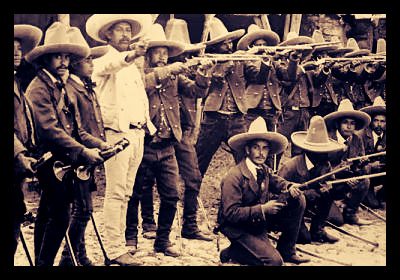
The cancerous effect of drug-related violence over the past six years has nearly stripped Mexico’s resources to the bone. Drug lords and cartel members have continued to control the better part of the region by striking fear into residents through brutal extortions, kidnappings, and murders.
This has all but halted the local economy, as many business owners are afraid to open up shop out of fear of reprisal. With more than 70,000 lives already lost to gang and drug-related violence, a recently approved initiative by the Mexican government has started to build its foundation in an effort to put an affirmative end to the war.
“Guys from the self-defense groups are moving around the city, co-operating in certain ways with the federal government. Many, many people have been detained,” said Hipolito Mora, the leader of an unlikely group of vigilantes who have arrested approximately 200 gang members.
These arrests come at the heels of a recently passed initiative allowing “self-defense” movements to assimilate and work with federal forces to combat violence and gang activities. These quasi-military units have sprouted up around Michoacan and have seen their membership grow into 20,000 strong.
The agreement was formed between the leaders of the Mexican vigilantes, army and police officers; President Enrique Pena Nieto’s envoy to Michoacan, Alfredo Castillo. Wearing white-T-shirts as a symbol of identification, the Rural Defense Corps, as referred to by government officials, recently breached the central square of Apatzingan, a stronghold and command base for the Knights Templar drug cartel.
Working with governmental forces, the Rural Defense Corps cleared the area out of cartel gunman who notoriously fired upon them in October 2013, when they entered the city unarmed in a convoy of hundreds. The recent presence of vigilante forces is a much needed boost for residents who have been forced to live under viscous rule for several years.
“We need to enter Apatzingan, which is the heart of the whole region and, as we all know, of vital importance for the criminal organization,” Mora said. Currently, the Knights Templar survives off a steady supply of methamphetamine and marijuana smuggling in addition to extortion and a controlling thumb over the local economy.
Since the beginning of January, these “self-defense” vigilante groups have launched a series of attacks against the Knights Templar gang in order to take back several overthrown municipalities in Michoaca in hopes of liberating communities. Many offenders have been arrested and detained through roadblocks around western Mexico in addition to door to door searches.
While such news is encouraging, atrocities and violence continue to remain a looming factor for rising forces. Recently, a mass grave with approximately 20 bodies was discovered in the Michoacan town of Tinguindin as well as four other murders in the nearby village of Zacan. While Mora believes these acts of violence to be retaliation for his group’s recent triumphs, he remains determined. “There can’t be any further delay, as that would put under risk the lives of so many people who are supporting our movement.”
– Jeffrey Scott Haley
Feature Writer
Sources: The Guardian, BBC, Daily Mail
Photo: Borderland Beat

Starvation War Strategy in Syria
It is hunger, more than traditional warfare, that is taking the most lives and causing people to flee from Syria. Several parts of Syria have been cut off from food for several months and the World Food Programme (WFP) estimates that three million people are hungry. The WFP has been able to deliver food aid to two million people, but over one million people are trapped in areas where no food is getting in and people cannot get out. Civilians who are in areas under siege are starving; hunger is being used as a weapon of war.
Hunger in Homs
In the city Homs, which has been under siege for the 18 months people are surviving on olives, “water soup” made of water and spices and grass and weeds picked from the street. As of mid-February, 1,300 people, including 500 children as well as and many women, elderly, and disabled persons fled the city with the help of Red Crescent and United Nations workers.
Men between the ages of 15 years old to 55 years old were forced to stay and fight. A temporary evacuation was allowed, but many evacuees and aid workers were wounded and many civilians were too afraid to try and leave.
Hunger forced the people to leave; food has dwindled down to nothing in the city and a one kilogram bag of rice costs $50. People were fighting over the small amount of food the U.N. was able to get into the city. Gerard Araud, France’s U.N. Ambassador was quoted saying “We are facing the worst humanitarian tragedy since the genocide in Rwanda in 1994…starvation is used as a weapon by the regime.'”
Children Starving to Death
CNN broadcasted video footage of an emaciated one-year girl at the National Hospital in suburbs of Damascus. The child’s organs were slowly deteriorating due to hunger and she reportedly died in hospital after her heart stopped. Her distraught mother reported that she had nothing to feed her child.
Doctors have told activists and journalists that this horror story is now happening frequently here. Starvation is being used as a weapon and infants are dying as their mother’s breast milk runs dry. The elderly, the sick and pregnant women are also especially vulnerable.
Parents are risking death by leaving their homes to look for food for their children. A nurse told Amnesty International that at least four people a day suffer gunshot wounds while picking plants and shrubs in the fields nearby the Yarmouk Palestinian Refugee Camp in Damascus.
Starvation War Strategy is a War Crime
Amnesty International Secretary General Salil Shetty says Syrian President Bashar al-Assad has been starving his citizens and blocking access to humanitarian aid as a war strategy and this is considered a war crime. Reuters reports that one Syrian security official called the situation the “Starvation Until Submission Campaign.”
Save the Child recently released a report stating that parts of Homs, Aleppo, Idlib and Damascus have been besieged. Talks between the U.N. and large humanitarian organizations are underway to negotiate a way to end the suffering of civilians.
The chief of Amnesty International said that European nations are not doing their part by taking in refugees. The five countries surrounding Syria are taking in 97 percent of the refugees and they are collapsing and now in need of help themselves. Wealthy European nations with space and resources need to step up to the plate.
– Elizabeth Brown
Sources: CNN, BBC, Arutz Sheva, Reuters, Al Arabiya
Photo: Spillers of Soup
Action Plan to 2014 Improves South African Education
At about seven percent of gross domestic product and 20 percent of total state expenditure, South Africa has one of the highest rates of public investments in education in the world. The South African Schools Act of 1996 makes education compulsory for all South Africans from the age of 7 to the age of 15.
President Jacob Zuma told Parliament on February 13 that the country’s matric pass rate went up from about 61 percent in 2009 to 78 percent last year. The matric pass rate is calculated by annual national assessments.
South Africa has 23 state-funded post-secondary institutions, 11 universities, six universities of technology and six comprehensive institutions.
As a result of education inequalities during apartheid, 18 percent of adults are illiterate. Today, almost 59 percent of whites attend higher education institutions; only 14 percent of blacks attend. The disparate percentage is a consequence of inadequate primary and secondary schooling due to apartheid.
The Accelerated Schools Infrastructure Delivery Initiative has delivered 370 new schools throughout the country. The program replaces unsuitable infrastructure with schools.
Meanwhile, enrollment at universities has increased 13 percent since 2009 and Further Education and Training (FET) college enrollments have increased by 90 percent.
South Africa has implemented a plan for schools called Action Plan to 2014, a part of a larger vision called Schooling 2025, which aims to improve learning and teacher training. By 2025, South Africa wants to see students attend school every day and are on time. The country aims for schools to be accessible, clean and safe learning environments.
The program also includes teacher training, which will improve their capabilities and confidence. The focus of the program is on literacy and numeracy. This curriculum is known as the national Curriculum and Assessment Policy Statement (CAPS,) which provides specific guidelines for what is taught in schools.
Improving educational opportunities helps create tomorrow’s leaders. By giving students the opportunity to learn in a safe, clean and accessible environment, South Africa is helping to alleviate poverty, one step at a time.
Sources: All Africa, South Africa Info
Photo: YWC Project
Violence Against Polio Workers in Pakistan Escalates
In the most recent attack against health workers, one doctor, three guards and two local employees of the World Health Organization (WHO) were kidnapped while administering polio vaccine in Khyber Pakhtunkhwa, a north western region of Pakistan.
Although no group has yet claimed responsibility, militants in the area have a history of inflicting violence against polio vaccinators, whom they accuse of sterilizing their children and being United States spies.
This attack follows a bombing in Peshawar, where a bomb targeting another polio vaccination team killed a policeman.
Polio workers have encountered violence in Pakistan since late 2006, when Taliban officials took control of Swat in the Himalayan region. They prohibited polio vaccination campaigns and vilified Lady Health Workers, many of whom stopped working due to direct threats to their lives.
Matters escalated even further after the assassination of Osama bin Laden in 2011. Under the ruse of a vaccination-campaign, CIA operatives infiltrated Bin Laden’s compound in Abbottabad, which allowed them to test his children’s blood and guarantee his presence at the complex.
Since then, Taliban violence against polio workers has continued unabated, with more than 40 people, including health workers, the police teams guarding them and bystanders having been killed in Pakistan. Torture is also not unheard of, as experienced by three members of a polio vaccination team late last year.
After a particularly violent week against workers in December of 2012, UNICEF and the WHO issued a joint statement condemning polio attacks.
“Those killed or injured, many of whom are women, are among hundreds of thousands of heroes who work selflessly to eradicate polio and provide other health services to children in Pakistan,” said the statement. “Such attacks deprive children in Pakistan of their right to basic life-saving health interventions and place them at risk for a disease that causes lifelong disability.”
Typically affected children under the age of 5, the virus may result in paralysis and death.
Polio remains endemic only three countries in the world, including Pakistan, but if left untreated, officials warn it could trigger as many as 200,000 new cases every year.
– Emily Bajet
Sources: UNICEF, The Express Tribune, The Guardian, Newsweek Pakistan, Open Democracy
Photo: Washington Post
Mexican Vigilantes Battle Cartels
The cancerous effect of drug-related violence over the past six years has nearly stripped Mexico’s resources to the bone. Drug lords and cartel members have continued to control the better part of the region by striking fear into residents through brutal extortions, kidnappings, and murders.
This has all but halted the local economy, as many business owners are afraid to open up shop out of fear of reprisal. With more than 70,000 lives already lost to gang and drug-related violence, a recently approved initiative by the Mexican government has started to build its foundation in an effort to put an affirmative end to the war.
“Guys from the self-defense groups are moving around the city, co-operating in certain ways with the federal government. Many, many people have been detained,” said Hipolito Mora, the leader of an unlikely group of vigilantes who have arrested approximately 200 gang members.
These arrests come at the heels of a recently passed initiative allowing “self-defense” movements to assimilate and work with federal forces to combat violence and gang activities. These quasi-military units have sprouted up around Michoacan and have seen their membership grow into 20,000 strong.
The agreement was formed between the leaders of the Mexican vigilantes, army and police officers; President Enrique Pena Nieto’s envoy to Michoacan, Alfredo Castillo. Wearing white-T-shirts as a symbol of identification, the Rural Defense Corps, as referred to by government officials, recently breached the central square of Apatzingan, a stronghold and command base for the Knights Templar drug cartel.
Working with governmental forces, the Rural Defense Corps cleared the area out of cartel gunman who notoriously fired upon them in October 2013, when they entered the city unarmed in a convoy of hundreds. The recent presence of vigilante forces is a much needed boost for residents who have been forced to live under viscous rule for several years.
“We need to enter Apatzingan, which is the heart of the whole region and, as we all know, of vital importance for the criminal organization,” Mora said. Currently, the Knights Templar survives off a steady supply of methamphetamine and marijuana smuggling in addition to extortion and a controlling thumb over the local economy.
Since the beginning of January, these “self-defense” vigilante groups have launched a series of attacks against the Knights Templar gang in order to take back several overthrown municipalities in Michoaca in hopes of liberating communities. Many offenders have been arrested and detained through roadblocks around western Mexico in addition to door to door searches.
While such news is encouraging, atrocities and violence continue to remain a looming factor for rising forces. Recently, a mass grave with approximately 20 bodies was discovered in the Michoacan town of Tinguindin as well as four other murders in the nearby village of Zacan. While Mora believes these acts of violence to be retaliation for his group’s recent triumphs, he remains determined. “There can’t be any further delay, as that would put under risk the lives of so many people who are supporting our movement.”
– Jeffrey Scott Haley
Feature Writer
Sources: The Guardian, BBC, Daily Mail
Photo: Borderland Beat
ChildFund International Tackles World Hunger
The United States Census Bureau has forecasted the population of the world to reach eight billion by the year 2025. In terms of hunger this can be considered an extremely daunting statistic. How will eight billion people eat in the future when people cannot even adequately feed everyone living on Earth today? Eliminating global poverty and giving children necessary skills to survive and thrive in the coming years are crucial parts of the world hunger solution.
ChildFund International is one organization that focuses mainly on children and improving their quality of life in order to sustain a better future. It is known for sponsoring children in over 50 countries. Giving to countries in need with specific guidelines involving nutrition and social development have been proven effective in comparison with unspecific cash donations.
Focusing on making sure children and families have access to food and health living environments is a great strategy for charities to implement. Once starvation is off the table, kids can go to school and parents to work. Eventually they can become self-sufficient, disbarring the notion of welfare dependency.
Supporting children with food, water, school supplies, and access to decent medical care is all part of the sponsorship benefits that ChildFund International distributes. A recent article on their website notes how population increases are only exacerbating the problem of widespread hunger. Developing countries are becoming more urban; building cities means destroying farmland. Farmland is necessary for agricultural production, and the less natural farmland there is, the more difficult it becomes to produce food.
Solving global poverty and solving world hunger are interrelated goals. Providing access to clean drinking water, food and medical care boosts the economy by increasing the number of healthy learning and working children in a community. The more educated the children are, the more likely they are to grow up and secure sustainable employment.
Having a stable job will mean having a stable income and the ability to break the vicious cycle of poverty. Studies have shown that poverty in the United States has decreased significantly over the past 50 years and the goal of eradicating poverty altogether is very possible with governmental assistance and appropriate policy implementation. However, poverty is still a huge issue in foreign nations and every effort is needed to help resolve it.
There are still billions of people living on barely $2 per day and suffering from hunger and the absence of clean water. Foundations like ChildFund International and everyone who gets involved can make sure everyone has the chance at a better tomorrow.
– Kaitlin Sutherby
Sources: The Economist, The Huffington Post
Photo: TriCounty Sentry
Promoting Liberian Education System Essential
Liberia has a unique connection to the United States. African Americans immigrating from the U.S. to the West African Coast officially founded the nation in 1847. While the country has struggled to achieve prosperity and economic stability for its citizens, the Liberian education system has made considerable recent progress.
Liberia is still recovering from the civil wars that began in 1980 and lasted until 2003. As a result, Liberia ranks near the bottom of the United Nations Development Program Human Development Index at 174th out of 187. Correspondingly, nearly 36 percent of the Liberian population suffers from malnutrition.
During the years of civil car, educational systems were almost nonexistent. This leaves a massive gap in skilled workers entering the job market and by extension, extreme unemployment (close to 80 percent) and poverty. Liberia has a literacy rate of 60.8 percent, and an education system described as “a mess” by Liberian President Ellen Johnson Sirleaf.
Not all news about the Liberian education system is bleak, however. In 2011, President Sirleaf signed into law the Education Reform Act, which seeks to decentralize the education system and help create a new educational management structure more locally focused. The U.S. Agency for International Development (USAID) has also instituted the Liberia Teacher Training Program to help train, develop and recruit more teachers for the nation.
An additional component of USAID’s work in Liberia is encouraging participation in education by girls and women. The Girls’ Opportunities Access Learning Program hopes to increase school enrollment and retention for girls by identifying key policy issues with Liberia’s Ministry of Education.
According to the U.N. Educational, Scientific and Corporal Organization’s Education for All Initiative, at least 15 percent of a nation’s budget should be allocated for education. Currently, Liberia only spends around 3 percent of its national budget on education. In order to fully jumpstart educational progress in Liberia, there is much more to be done.
– Taylor Diamond
Sources: The Guardian, USAID, WFP, Liberian Education Trust
Photo: International Book Bank
Poverty and Violence in Honduras
Birthplace of the term “banana republic” and victim of the brutal fruit companies-led coup, Honduras is among the countries with the lowest incomes in Latin America, poverty is very pronounced problem in this Central American nation. Despite an economic growth of around 3 percent per annum, the gross domestic product (GDP) per capita of the country remains stagnant.
This discrepancy could indicate that there is a widening disparity gap.
In fact, since the coup d’état in 2009, Honduras witnesses the most rapid rise in inequality in Latin America, a factor that contributes to prevailing climate of violence. Equally frustrating, the top 10 percent of the population also earns virtually all of the republic’s real income gains.
Furthermore, the 2009 coup d’état had increased the overall rates of poverty and extreme poverty. This climate of political crisis had reverted the economic advances that took place in the country. In addition, the government of President Porfirio Lobo, who came into power after the post-coup elections of 2010, had reduced social spending despite the boost in public spending.
It is estimated that 71 percent of the 8.3 million Hondurans live in poverty, a major problem that contributes to the frequent instances of violence that plague the nation. Because of this astronomic number of people living in poverty, a large sector of Honduras’ population is also deprived of education.
Only a lucky few can afford any education beyond sixth grade.
What’s more, Honduras has the highest rate of homicide in the world, with the average of 20 people murdered daily, 90 percent of whom are male victims. This frightening data stem from the burgeoning narcotic business, which has given rise to many organized crimes. This epidemic problem of homicides also takes away from the country’s meager income by necessitating the Honduran government to spend 10.5 percent of the national GDP in the combat of violence.
Due to Honduras’ constant history of political instability, there has always been very little opportunity for Honduras to develop democratic institutions to impose the rule of law. Instead, centuries of colonialism and decades of dictatorship have marginalized the poor, leaving them with minimal choices to make a living.
This scarcity of upward economic mobility and grinding poverty have driven many towards illicit ways of earning money.
In its attempt to encourage Honduras to alleviate poverty, the World Bank has suggested the country to support the stability and the growth of its macro-economy as well as to improve the quality of its education. But, these key options to improve the situation of the country are easier said (or suggested) than done. Development and democracy are not phenomena whose advent can be brought about at an instant.
Instead, they require years of institutional and systematic reforms for a society to have a functional democracy and a sustainable development.
– Peewara Sapsuwan
Sources: El Pais Internacional, El Heraldo, El Heraldo, Los Angeles Times, World Bank, World Bank
Photo: Zimbio
World Bank Increases Lending by $100 Billion
The World Bank will increase its lending for poverty reduction and infrastructure projects by $100 billion, a 50 percent increase that will occur gradually over the next 10 years. The World Bank plans to finance the initiative through a combination of higher service fees for rich countries, substantial administrative cuts and a loosening of lending restrictions.
The International Bank for Reconstruction and Development (IBRD,) the World Bank’s branch for middle-income and developing countries, will execute the majority of the increased lending. Therefore, while all of the World Bank’s member countries will receive increased benefits, middle-income countries have the most to gain.
The IBRD serves the World Bank’s largest borrowers, including China, India, Brazil, Indonesia and Turkey. All five of these countries have growing and vibrant economies; yet still experience mass poverty within their borders. For instance, 76 percent of India and 36 percent of China still live on less than $2 per day. In other words, over one billion people live in abject poverty in these two countries alone.
By targeting these countries, with their high growth potential and their large impoverished populations, the World Bank can make serious gains on its mission to end extreme poverty within a generation. Two-thirds of the world’s poor live in middle-income countries and IRBD sees investment in infrastructure projects and development as key to helping them.
The United Nations Food and Agriculture Organization (UNFAO) estimates that $30 billion per year in aid can end extreme hunger throughout the world. The increased lending by the World Bank follows the UNFAO’s prescription of increasing aid as a means to eradicate poverty. It allows middle-income countries to experiment with small local projects, expand currently successful poverty initiatives, and offers developing government’s advise and services to build better legal and institutional frameworks to manage their economies.
The World Bank’s lending to middle income countries has helped 100 million people in the last decade gain better access to clean water and reduced the impact of floods and pollution on agriculture. It also played a key role in stabilizing middle-income countries after the 2009 financial crisis by providing a record $33 billion in loans in 2009 alone. Continuing these sort of initiatives with increased lending will accelerate the World Bank’s mission of eliminating poverty and improve the lives of many throughout the world.
– Martin Levy
Sources: Reuters, World Bank, FAO, Population Reference Bureau
Photo: Social Velocity
IKEA Brighter Lives for Refugees Campaign
The devastating Syrian refugee crisis has brought to the forefront the plight of millions of refugees around the world. It is estimated that today there are 10.5 million refugees globally, nearly half of whom are children. United Nations High Commissioner for Refugees (UNHCR) Antonio Guterres has noted that in 2013 alone, over two million refugees were registered, a record number not seen in 20 years.
In response to the dire conditions faced in refugee camps, the Swedish megastore IKEA, most popular for its range of modern and ready-to-assemble furniture and home accessories, recently launched their ‘Brighter Lives for Refugees’ Campaign, where they will donate one euro (roughly $1.38) to UNHCR for each LED light bulb sold in IKEA stores between February 3 and March 29, 2014.
Funds raised through the Brighter Lives for Refugees Campaign will provide a variety of renewable energy technologies to hundreds of thousands of refugees in Jordan, Chad, Sudan and Ethiopia. Such technologies include solar streetlights, indoor solar lanterns, and fuel-efficient cooking stoves.
It is estimated that a refugee family will spend, on average, 12 years in a camp. This would make it more like a home rather than a temporary refuge. Life in a camp usually stops when the sun goes down, making even the simplest activities a dangerous endeavor. The goal of providing lighting and renewable energy technologies is to make camp life more humane, where using the toilet, collecting water or working inside the home is no longer an impossible feat.
It is important to take note of the IKEA campaign because it does not simply seek to provide temporary assistance to refugees. The idea behind providing sustainable lighting is to transform the refugees’ quality of life, thereby allowing them to be active forces, rather than passive receivers, in improving their lives. The Brighter Lives for Refugees Campaign website lists a number of positive effects that access to lighting will have on quality of life for refugees:
The IKEA Foundation has been partnering with UNHCR since 2010 to address the fundamental needs of children, including shelter, care, and education. While the Foundation has committed 73 million euros ($100.448 million) to support UNHCR activities, it has also supported dozens of other organizations, donating 82 million euros ($112.832 million) in 2012 alone.
– Rifk Ebeid
Sources: IKEA Foundation, UNHCR, IKEA, AbuDhabi Week, IKEA Family Live Magazine
Photo: Humanosphere
Fortress Europe: Ceuta and Melilla
The term Fortress Europe refers to the European Union’s obstructive policies towards immigrants. It is a term that critics employ to highlight many member states’ reluctance and outright unwillingness to welcome migrants seeking a better life within the European Union.
Nowhere is this Euro-jargon more literal in than the Spanish enclaves of Ceuta and Melilla in North Africa. These two cities are where the E.U. borders the African; the cities are located only a few yards apart, they are also where modern day fortresses have been erected.
Heavily patrolled and surrounded with three rows of 20-foot-high barbed wire fences and infrared cameras, the borders of Ceuta and Melilla bare resemblances to the Berlin Wall. In 2005, 11,000 Africans forced their way across the borders in hope of entering the E.U. via Spain since these two cities are politically European despite not being on the continent.
Since then, the Spanish government has invested heavily in fortifying the EU’s southern most land frontiers (more than 30 million Euros, or approximately $41,238,000.)
In 2010, these two enclaves, both relying on resources from their immediate neighbor, Morocco, caused a political ruffling when the Moroccan government accused Spain of racism and boycotted produces going into the two Spanish territories.
What is the most direct effect of these European fortresses in Africa? Since the revamp of the fences, immigrants—many being refugees—have to cross into Europe via the Mediterranean, often in makeshift and unseaworthy boats.
The Arab Spring that sprung across North Africa and into the Levant unleashed waves of asylum seekers and refugees dire to get into the E.U. However, due to the difficulties of crossing into these two enclaves people have been going via the sea to reach another nearby EU territory—the Italian island of Lampedusa. These journeys frequently prove to be perilous.
A Syrian refugee and his family who had traveled through five countries with six forged passport across the Levant and North Africa hoping entering Europe via Melilla claims this European fortress is nothing less than an open-air prison.
Not only is the condition inside the refugee camp less than optimal, in February, Spain took the decision to close the border of Melilla after a group of around 200 to 300 Syrian refugees tried to enter.
After the Moroccan authorities warned the Spanish authorities of the presence of “uncontrolled people,” the gates of Europe quickly flung closed before these desperate people who found themselves stranded in Moroccan territory. Earlier in February, at least 12 people died outside of Ceuta’s fences; 23 others were handed to the Moroccan authorities to be returned to Syria, a human right violation and a contradiction of the terms laid out in the Convention for Refugees of 1951.
If the E.U. would like to live up to the terms set out in the Europe Convention on Human Rights of the Council of Europe and other treaties and conventions to which it and its member states are party, the unofficial Fortress Europe policies of its frontier member states must not continue. These policies are unjustifiable disregard of ongoing ordeals that many refugees are facing in their homeland as well as the value of their lives.
– Peewara Sapsuwan
Sources: CEA(R), 20 Minutos, Spiegel Online International, Reuters
Photo: 20 Minutos