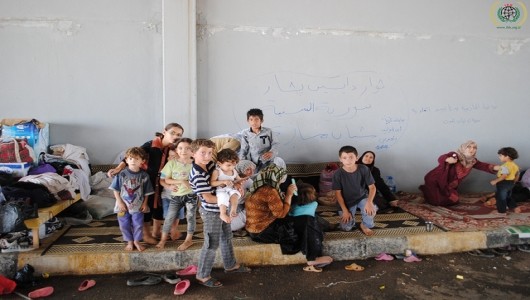
 When there is an influx of people to a new area, in an effort to escape the horrors of war, disaster and other hardships, local economies can be significantly strained. A humanitarian effort to help those in need is beneficial, but oftentimes the number of people in need can create circumstances where it is extremely difficult to provide everyone with their basic needs.
Normally, local economies are structured to provide for a relatively stable amount of people. The equilibrium of local supply and demand is stable, however, when an influx of people grows the demand for all types of goods at once, it creates a supply vacuum. This increase in demand and lack of supply creates a whole host of problems.
Turkey has absorbed about 200,000 Syrians. Many have become beggars, wandering in traffic, looking for spare change and unable to find employment. Others take up trades on the street, taking customers from existing Turkish vendors and businesses. These two cases are examples of the lack of supply and the increase in demand. The beggars along with the increased competition for some small Turkish businesses have created a hostile atmosphere against the Syrian refugees.
Lebanon is a more extreme example of the strain that refugees can put on an economy. One in 10 of Lebanon’s residents is now a Syrian refugee, escaping the war and famine that has eviscerated their homeland. This has created a range of problems similar to those seen in Turkey, however, the magnitude of the number of refugees seen in Lebanon is much worse.
Lebanon is a much smaller country than Turkey, and it is also taking in many more refugees than Turkey. Food prices in Lebanon have skyrocketed due to the increased demand from more than a half-million refugees entering the country in the span of a few years. Electricity was already faulty and has now been hit with a 27 percent increase in demand due to the housing of many of the new refugees. Again, similar patterns are immerging within Lebanon as they did in Turkey.
Just as Turkey experienced similar economic disruptions, the social aspect of the new population has put social tensions on the list of concerns for government officials in Lebanon. Some economists argue that the new populace has actually been beneficial to the local economies of rural areas in Lebanon because of an increase in spending in the local area.
In places like Canada, the effects of refugees are somewhat different. Typically, when developed nations accept refugees from other countries they are not accepting hundreds of thousands at a time. This difference is important because it means that local economies are not strained to the same extent.
A study by the Institute for the Study of Labor found that employed refugees in Canada were no worse off than average. However, the study also showed that the unemployed did end up needing significant government assistance.
The study concluded that refugees were not damaging to the economy and identified discrimination and lack of credential recognition as potential factors in unemployment rates amongst refugees. Better job training programs could help refugees adjust to a new economic landscape and help them integrate into the economic system.
The case of the Syrian refugees is one of the best modern-day examples of how massive amounts of refugees can disrupt local economies. In the case of Canada and other developed nations, it exemplifies how a smaller amount of refugees entering the country does not affect the economic and social situation in ways that are comparable to Turkey and Lebanon.
Context is important to see how refugees can affect local economics, but it is clear is that events that create massive migrations can be harmful to neighboring economies. Perhaps programs that help disperse refugees across more countries could be improved or expanded to reduce the impact that refugees have when overwhelming local areas. Nonetheless, it is important to recognize that it is in everyone’s interest to take in those in need and help them adjust to their own new realities.
– Martin Yim
Sources: New York Times, Reuters, Institute for the Study of Labor
Photo: Flickr

Health Experts Call for Public Breastfeeding Areas in India
Health experts and activists are calling for the government in the Indian state of Assam to create public breastfeeding areas in India.
Assam, a state in northeast India, has a bad record when it comes to maternal and infant mortality rates.
With Aug. 1-7 being World Breastfeeding Week, the spotlight has shifted to Assam, where there are no public facilities available for women to breastfeed. As a result, mothers who are lactating often have a difficult time comfortably attending to their infants.
The difficulty is greater for mothers in rural areas, where malnutrition rates in infants are higher. Additionally, mothers who are working do not have the ability to meet their babies’ needs in a timely matter.
To avoid malnutrition, the need for public breastfeeding areas in India, specifically Assam, is high. Creating designated areas, such as in buses and railway stations, would help avoid malnutrition.
Those engaged in World Breastfeeding Week are also asking for uniformity when it comes to maternity leave. Organizations such as the Association of Promotion of Child Nutrition (APCN) and Breastfeeding Promotion Network of India (BPNI) are calling on the state government to implement consistent leave in both the public and private sectors for working mothers.
Currently, women working in the public sector are granted a leave of six months, but most are unaware they can take a leave to care for their babies, as the parameter is not implemented uniformly in the sector.
While women are granted a leave of between three and four and a half months in the private sector, most workplaces in the public and private sectors lack the proper facilities to allow women to breastfeed, leading to problems for mothers.
– Matt Wotus
Sources: Encyclopedia Britannica, The Times of India, World Breastfeeding Week
Photo: Healthy Newborn Network
Refugees in Calais See Hope In Britain
Many refugees in Calais, France are using any means possible — most of them using rather dangerous means — to make their way to Britain in hopes of a new life.
Hundreds of thousands of immigrants sit in refugee camps in Calais waiting to make their next attempt into the United Kingdom. Many of these individuals have traveled all the way from Africa, the Middle East and some from even further away. For most, sanctuary in Britain is the last stop on a very long journey that may have lasted for months, with hopes that a better life and more opportunities await them on the other side of the English Channel.
In France, where many migrants await the next move, which may potentially land them in Britain, lie refugee camps filled with hundreds of thousands of migrants from all around the world. Many have fled injustice and corruption within their native countries, such as that of Sudan, Eritrea and other crime-ridden and infamously violent nations.
Within the camps are volunteers and medical staff to help those who have been injured or have fallen ill throughout their long journeys. Nurses in the camps have recounted a number of cases where individuals have even been hit by trains and fallen off moving trains while trying to make their way across the Channel. This is a horrific image to imagine, but it is the reality of the extent people in these circumstances are willing to go to make it to their final destination. The legitimacy of their travels is backed by the success of others. An estimated 40 people actually make it across each day, though the numbers have varied greatly. Those who have been successful give those still struggling the hope they need to keep going.
With all these people from around the world flooding the entrance to the United Kingdom, both Britain and France have asked for more intervention, particularly from other members of the European Union. The French government has upped its security measures by increasing the number of police officers at the French side of the Channel as well as implementing other new security means. However, with the number of migrants in the hundreds of thousands at least, and a handful of migrants making their way to the UK each day, there obviously is a need for more assistance in order for the two countries to maintain border security.
This issue has been going on since the beginning of June, and a recorded 10 migrants have died in the journey specifically from Calais to the other end of the Channel. This is an issue of international security for which no clear solution has been found thus far, neither the migrants seeking refuge nor the European nations themselves.
– Alexandrea Jacinto
Sources: The New York Times, BBC
Photo: The New York Times
Opening Opportunities for Mayan Girls
The Population Council, along with partner organizations, created a program entitled Abriendo Oportunidades (Opening Opportunities) in order to support the development of young Mayan girls. To date, it has reached 8,000 young girls.
These young girls often live in more rural, isolated regions where access to school and health services is limited. This particular subset of the population in Guatemala tends to marry early without finishing their education.
Abriendo Oportunidades was designed to connect Mayan girls with mentors and provide them with leadership training and life skills. Locally trained professionals often facilitate the program in community girls’ clubs. Gender-based violence is also discussed in a safe setting to provide young girls with the knowledge and tools to stay safe.
An evaluation of the program in 2007 has demonstrated great success in opening opportunities for Mayan girls. All girls in the program have completed sixth grade, 97 percent of the girls did not become pregnant and 88 percent of the girls were able to open bank accounts. These achievements are important because these girls will have greater opportunities open to them in the future. For example, with financial security and education, they can better plan for the timing of children if they wish to have them later in life.
The program results also reveal a change in the attitudes of these young girls. Over half of the girls now wish to complete university and over 90 percent want to wait until later in life to have children. With greater confidence and leadership, these Mayan girls feel an increase in freedom and respect from their fellow community levels. The confidence these girls now have is one of the most important indicators of success. If young girls believe they can achieve education and important careers, they are more likely to be able to do so.
Abriendo Oportunidades has been adapted for communities in Costa Rica, El Salvador, Haiti, Honduras and Nicaragua. Researchers have also further developed the program to be used with adolescent boys who need to learn just as much about gender-based violence and female empowerment.
– Iliana Lang
Sources: The Population Council, CNN
Photo: The Population Council
Top 10 Employers that Practice Corporate Matching
What is corporate matching? When a company recognizes the charitable actions of their employees and decides to match that same altruistic nature through financial means. The following companies practice corporate matching (and are in no particular order).
1. General Electric
Today, the GE Foundation matches over 35 million dollars annually to nonprofit and educational institutions.
2. Google
Matching up to over $12,000 in donations per employee each year, Google has been highlighted as a company that not only matches charitable giving, but also matches funds employees personally raise for charities.
3. CarMax
Matching to nearly every nonprofit organization, CarMax’s 1:1 match policy on all donations applies to not only all employees, but all of the employees’ dependents until the age of 26.
4. Soros Fund Management
This company has the highest matching gift ratio (3:1 match for employees and 2:1 match for partners) of any corporation, creating a high incentive for Soros families to give.
5. Boeing
Boeing matches both employee and retiree donations. In addition, they provide a $100 grant to a nonprofit every time an employee participates in a charitable event (run/walk/bike type events).
6. BP
This company offers every type of employee giving with their generous giving programs. BP allows for the public to track all of its charitable spending in addition to the standard 1:1 matching.
7. Gap Corporation
Including many of the Gap subsidiaries, Gap employees can request matches made to majority of nonprofit based organizations. They also offer the most comprehensive and user-friendly online match system. Gifts made within the company can range from $1,000 to $10,000.
8. Microsoft
Through employee giving within the company, more that $1 billion was donated to charitable organizations within the match program.
9. Johnson & Johnson
All company employees, including retirees, are eligible to request up to $10,000 in donation matching. They also have a 2:1 matching ratio for current employees, and a 1:1 rate for all retirees.
10. Bank of America
With a 1:1 matching for all family members, including those of part-time employees, Bank of America has a $5,000 matching cap and has a longer period of acceptance for those matches than other companies.
– Alysha Biemolt
Sources: Double the Donation 1, Double the Donation 2, Double the Donation 3,
Changing Migration Patterns in Latin America
Although immigration is a major concern for policymakers in the United States, immigration and emigration have a significant impact on the economy and communities throughout Latin America.
Over the last 25 years, in particular, migration patterns in Latin America show that immigrants have moved from unstable economies and governments into bordering states that have greater economic stability and prosperity. This continues to be the case in Chile, with migrants flowing in from neighboring countries.
The Southern Cone of Latin America is famous for its continued movement of people across country borders. This region includes Chile, Peru, Argentina and Uruguay. Chile has seen an influx of immigrants, particularly from Peru, since the 1990s. This was the turning point in the Chilean economy and government, transitioning over from a military regime to a more stable, democratic system.
This change in government led to more overall economic stability in Chile, creating more job opportunities and more money per household. Neighboring countries, such as Peru, have not seen such success.
This influx of immigrants has been accompanied by its own issues, particularly with regard to security concerns. Large groups of immigrants easily travel across state borders, because of geographic proximity, as well as insufficient border policies. For example, Peruvian immigrants that have migrated to Chile have created cultural enclaves within cities and populated areas of the country. These transnational communities as they are described have created a concern for not only governments of receiving nations, but also the citizens of said countries.
Social marginalization is one of the biggest obstacles many immigrants of said transnational communities report facing, forcing such cultural enclaves to emerge. This, in a way, defeats the purpose of many immigrants, in search of new opportunities, as they are almost forced to stay within the confines of communities that are primarily made up of other immigrants.
Though this is the case, many immigrants in Latin America continue to migrate to neighboring countries, because despite social and cultural obstacles, many do find more economic potential and opportunities for jobs that they have the qualifications and skillsets for.
Immigration is a concern that faces not only the United States and its borders but also persists as an issue throughout intraregional Latin America. Not only that, but the circumstances in which Latin Americans find themselves make immigration that much more appealing and feasible.
– Alexandrea Jacinto
Sources: Migration Policy Institute, Money Market, Bloomberg,
Photo: Flickr
How Technological Innovation Has Impacted Emergency Response Efforts
We live in a technological age, aptly called the information age. One of the staples of the information age is the inclusion of technology into our daily lives. The majority of our lives are structured around the technological advancements we have accomplished, from where to how we communicate. While these advancements are significant in our everyday tasks, their great significance extends during times of crisis and emergency response efforts.
One of the most significant ways in which technology has revolutionized disaster relief is the ability to get information to those in need of aid. The greatest technological advancement that achieves this goal is mobile phones.
In a Q&A regarding the utilization of technology in fighting the Ebola outbreak, Eric King, an innovation specialist who worked on the USAID’s Disaster Assistance Response Team in Liberia during the Ebola outbreak had this to say: “A decade ago, a small percentage of West Africans had access to cellphones. Now, mobile phones allow us to connect those in need with those who can help. Families of the sick can call emergency Ebola hotlines, social mobilizers can share tips for community engagement, individuals can resolve Ebola rumors by texting local radio stations, health workers can be paid electronically, and clinics can flag when they’re low on supplies.”
Technological advancements are not limited to those in need of aid. Another prime instance of technological advancements revolutionizing emergency response efforts comes from the manner in which response efforts can mobilize.
There are numerous examples of advancements in communications technologies that have made the mobilization of relief efforts drastically faster and more efficient; during disaster events, speed and efficiency can literally save lives.
One such example comes from the relief efforts performed when Super-typhoon Haiyan struck the Philippines in 2013. Due to weather tracking technology, the storm was seen well enough in advance to allow early warning to those areas that would be affected. Furthermore, due to this advanced warning, the United Nations Office for the Coordination of Humanitarian Affairs (UNOCHA) was able to reach out to the Digital Humanitarian Network (DHN) for assistance. The DHN volunteers utilized social media, as well as other online platforms, to help create a digital map of the aftereffects of Super-typhoon Haiyan. This map was then used to help coordinate relief efforts in the area.
More than just coordinating relief efforts, social media plays another vital role in aiding emergency response efforts, as does technological advancement in general. Technological advancements, particularly those centered on the Internet, allow information regarding disaster relief efforts to be spread much more rapidly to the public. This has numerous benefits, but the most significant is the capacity for organizations to gain public support and assistance during disasters. Many organizations that aid in disaster relief rely heavily on public support, particularly for volunteers.
With the advent of the Internet, these organizations can get more attention and recognition, which in turn garnishes a significant amount of support. These are but a few of the ways in which technological advancement has advanced emergency response efforts.
– James Miller
Sources: USAID, Time
Photo: EECU
Global Financing Conference Looks to End Poverty
A topic of discussion at this summit will be on how to expand on the Millennium Development Goals, a set of eight target goals set in 2000 to combat poverty. These goals were set to expire after fifteen years, when a new summit would meet to establish new goals moving forward. The upcoming summit in Addis Ababa will spend time creating what will be known as the Sustainable Development Goals (SDGs).
The SDGs will be designed to reflect the changes in the global economy that have occurred since the initial MDGs were created. An excerpt from the World Bank’s website says, “The global development landscape has changed since the MDGs were adopted in 2000. Middle-income countries now account for a much larger share of global GDP. At the same time, inequality within many countries is on the rise and the gap between the rich and the poor is growing.” World leaders will assess a variety of new data to develop effective plans to reduce future poverty.
In order to make the eradication of poverty a reality, nations participating in this summit are preparing to raise the amount of money contributed to fighting poverty from billions to trillions of dollars. The funds necessary to achieving this goal will come “from private investment and domestic tax revenues. Foreign aid is already dwarfed by private financial flows, but it is still a precious resource, important because it reaches people and challenges that private finance alone cannot,” as reported by The Guardian.
This summit may be key in setting the stage for an entirely new era in our planet. The results of this summit and the ones that follow might be the pivotal step for stepping out of the overbearing shadow of poverty and into a bright future for generations to come.
– Diego Catala
Sources: The Guardian, World Bank
Photo: UN
Water in Rio May Pose Health Threat to Athletes
Previous evaluations of the water only checked for bacteria, not viruses, which is what WHO wants to change.
An AP investigation into Rio’s waterways found that pollution levels are still high in places where canoeists, sailors, swimmers and triathletes will compete in the 2016 Summer Olympics.
The AP reported that some athletes training in Rio have fallen ill with symptoms including fever, vomiting and diarrhea because of dangerous levels of viruses and bacteria in the waterways.
The results of the investigation are disappointing for Rio, as being chosen to host the Olympics was supposed to motivate the city to clean its waterways. A newly installed sewage system was thought to be able to handle 80 percent of raw sewage, but as of March, the treatment rate was only 49 percent.
Still, the results aren’t necessarily a surprise, as Rio mayor Eduardo Paes confirmed to Brazil’s SporTV in March that Guanabara Bay, the waterway that is supposed to host the sailing events, would not be clean by the time the games start.
The waterway has become a place where some of the untreated sewage from the city’s 12 million residents ends up.
Rodrigo de Freitas Lake in Central Rio, a second venue for rowing, canoeing, triathlon and open-water events, also poses a health threat to athletes, with tests showing high levels of viruses in the water.
In response to the results of the investigation, the world sailing governing body said it would conduct its own independent testing of Rio’s waterways.
– Matt Wotus
Sources: The Washington Post 1, The Washington Post 2, The Washington Post 3
Photo: The Guardian
Economics and Refugees
Normally, local economies are structured to provide for a relatively stable amount of people. The equilibrium of local supply and demand is stable, however, when an influx of people grows the demand for all types of goods at once, it creates a supply vacuum. This increase in demand and lack of supply creates a whole host of problems.
Turkey has absorbed about 200,000 Syrians. Many have become beggars, wandering in traffic, looking for spare change and unable to find employment. Others take up trades on the street, taking customers from existing Turkish vendors and businesses. These two cases are examples of the lack of supply and the increase in demand. The beggars along with the increased competition for some small Turkish businesses have created a hostile atmosphere against the Syrian refugees.
Lebanon is a more extreme example of the strain that refugees can put on an economy. One in 10 of Lebanon’s residents is now a Syrian refugee, escaping the war and famine that has eviscerated their homeland. This has created a range of problems similar to those seen in Turkey, however, the magnitude of the number of refugees seen in Lebanon is much worse.
Lebanon is a much smaller country than Turkey, and it is also taking in many more refugees than Turkey. Food prices in Lebanon have skyrocketed due to the increased demand from more than a half-million refugees entering the country in the span of a few years. Electricity was already faulty and has now been hit with a 27 percent increase in demand due to the housing of many of the new refugees. Again, similar patterns are immerging within Lebanon as they did in Turkey.
Just as Turkey experienced similar economic disruptions, the social aspect of the new population has put social tensions on the list of concerns for government officials in Lebanon. Some economists argue that the new populace has actually been beneficial to the local economies of rural areas in Lebanon because of an increase in spending in the local area.
In places like Canada, the effects of refugees are somewhat different. Typically, when developed nations accept refugees from other countries they are not accepting hundreds of thousands at a time. This difference is important because it means that local economies are not strained to the same extent.
A study by the Institute for the Study of Labor found that employed refugees in Canada were no worse off than average. However, the study also showed that the unemployed did end up needing significant government assistance.
The study concluded that refugees were not damaging to the economy and identified discrimination and lack of credential recognition as potential factors in unemployment rates amongst refugees. Better job training programs could help refugees adjust to a new economic landscape and help them integrate into the economic system.
The case of the Syrian refugees is one of the best modern-day examples of how massive amounts of refugees can disrupt local economies. In the case of Canada and other developed nations, it exemplifies how a smaller amount of refugees entering the country does not affect the economic and social situation in ways that are comparable to Turkey and Lebanon.
Context is important to see how refugees can affect local economics, but it is clear is that events that create massive migrations can be harmful to neighboring economies. Perhaps programs that help disperse refugees across more countries could be improved or expanded to reduce the impact that refugees have when overwhelming local areas. Nonetheless, it is important to recognize that it is in everyone’s interest to take in those in need and help them adjust to their own new realities.
– Martin Yim
Sources: New York Times, Reuters, Institute for the Study of Labor
Photo: Flickr
Maternal Health Improved by Mobile Technology Campaign
One-half of all deaths associated with childbirth, whether it be the infant or the mother, occurs in Sub-Saharan Africa. Health workers in the area cite old habits as one of the major roadblocks to alleviating childbirth deaths. In Cameroon, a service called GiftedMom sends SMS alerts to mothers, notifying them when to receive antenatal care and also keeping them updated on when to get their infants vaccinated. The simple and free messages help build a solid schedule to break old habits and come to a climate of proper healthcare. GiftedMom works with local hospitals and clinics throughout Cameroon to collect phone numbers of mothers and encourage them to use the service.
Rwanda has also seen a steep decline in maternal health complications and deaths due to the use of mobile technology. The system is called RapidSMS, and rural health providers and clinics use the service to communicate with the greater connected health system. RapidSMS has defined certain common complications involving childbirth, maternity and infancy. Each is designated with a code. A local health worker sends the code to the system and receives near-instant feedback as to what to do. RapidSMS significantly cuts treatment delay times.
Like GiftedMom, RapidSMS also helps break old habits. Health providers are the ones using the service and thus are encouraged to accompany mothers and infants if outside treatment is needed. Communities are made stronger and healthier as a result.
– Joe Kitaj
Sources: BBC, Huffington Post, Voice of America
Photo: Northeastern University Political Review