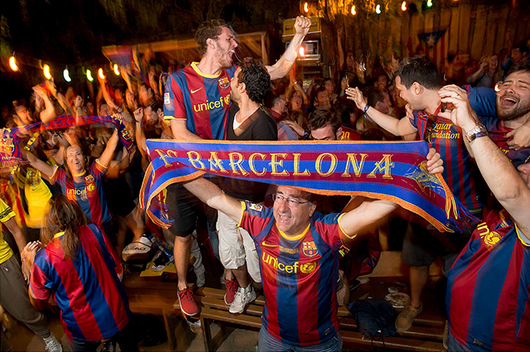
 At an event presented by FC Barcelona and UNICEF, soccer players Andrés Iniesta and Marc-André Ter Stegen met with Los Angeles kids to discuss the importance of children’s education.
The FC Barcelona players shared with the kids their thoughts and memories of playing soccer during their school days. Iniesta and Ter Stegen donned their red, yellow and blue team colors during the meeting and answered questions after their initial comments.
On the players’ jerseys, the UNICEF logo can be seen, signifying FC Barcelona’s involvement and association with the organization. Iniesta, FC Barcelona’s midfielder, said that he is proud to be linked with an important organization like UNICEF.
“For us as individuals, and as a club, it’s an honor to wear the jersey because of the values that UNICEF represents,” he said.
In addition, Iniesta voiced his and UNICEF’s similar opinions about the value of education in children’s lives.
“Alongside UNICEF, we want to reinforce the importance of providing the most vulnerable children with access to education,” Iniesta said. “Especially as parents, we are aware that children are the most precious things in our lives. It’s difficult knowing that there are children in other countries who don’t have the same opportunities.”
In agreement with his teammate, Ter Stegen, the team’s goalkeeper, noted the significance of education with his personal testimony.
“I had a lot of coaches and each of them advised me how to reach my goals,” he said. “But it’s not enough to have coaches or just to play soccer: education has been really important for me.”
UNICEF’s choice to partner with FC Barcelona was a strategic one. According to Quora, a question and answer website, soccer is the most popular sport in the world. An estimated 3.5 billion people are either fans of the sport or watch the sport.
By teaming up with one of the most popular clubs in professional soccer, UNICEF gains an unfathomable amount of notoriety by people who have the ability to make a change.
UNICEF and FC Barcelona first began their partnership in September 2006, and since then, the FC Barcelona Foundation has donated more than 12 thousand euros, or a little over $13,000.
The programs put in place by the organizations have aided in improvements in health for several countries in Africa and South America where sports are an integral part of a child’s physical and mental development. UNICEF and FC Barcelona have helped create better education systems for children and greater training programs for teachers.
Albert Soler, Director of Professional Sports of FC Barcelona, said that these projects have created a monumental amount of educational opportunity.
“Through these programs, more than 300,000 children are being reached,” Soler said.
According to a New York Times article, students who play sports in school tend to perform better later in life.
“Participating in sports, like playing in the school band or competing on the debate team, are cognitively and organizationally demanding activities that help convey self-discipline and leadership skills,” the article said.
In agreement with The New York Times, U.S. Fund for UNICEF Regional Managing Director, Amber Hill, said that the power of sports has helped children all over the world receive an education that fosters the skills needed to succeed.
“All children have the right to learn,” Hill said. “The focus of the FC Barcelona and UNICEF partnership is creating a world inspired by the power of quality education, where sports and play are key elements in the development of all children.”
With the help of Iniesta, Ter Stegen and all of the UNICEF and FC Barcelona supporters, thousands of children are receiving a quality education. Sports have always played an important role in a child’s development. Now it can be said that sports, like soccer, have helped children succeed in education and in life.
– Fallon Lineberger
Sources: FC Barcelona, Look to the Stars, The New York Times, Quora
Photo: Flickr

FC Barcelona Players Talk Education And Sports For UNICEF
The FC Barcelona players shared with the kids their thoughts and memories of playing soccer during their school days. Iniesta and Ter Stegen donned their red, yellow and blue team colors during the meeting and answered questions after their initial comments.
On the players’ jerseys, the UNICEF logo can be seen, signifying FC Barcelona’s involvement and association with the organization. Iniesta, FC Barcelona’s midfielder, said that he is proud to be linked with an important organization like UNICEF.
“For us as individuals, and as a club, it’s an honor to wear the jersey because of the values that UNICEF represents,” he said.
In addition, Iniesta voiced his and UNICEF’s similar opinions about the value of education in children’s lives.
“Alongside UNICEF, we want to reinforce the importance of providing the most vulnerable children with access to education,” Iniesta said. “Especially as parents, we are aware that children are the most precious things in our lives. It’s difficult knowing that there are children in other countries who don’t have the same opportunities.”
In agreement with his teammate, Ter Stegen, the team’s goalkeeper, noted the significance of education with his personal testimony.
“I had a lot of coaches and each of them advised me how to reach my goals,” he said. “But it’s not enough to have coaches or just to play soccer: education has been really important for me.”
UNICEF’s choice to partner with FC Barcelona was a strategic one. According to Quora, a question and answer website, soccer is the most popular sport in the world. An estimated 3.5 billion people are either fans of the sport or watch the sport.
By teaming up with one of the most popular clubs in professional soccer, UNICEF gains an unfathomable amount of notoriety by people who have the ability to make a change.
UNICEF and FC Barcelona first began their partnership in September 2006, and since then, the FC Barcelona Foundation has donated more than 12 thousand euros, or a little over $13,000.
The programs put in place by the organizations have aided in improvements in health for several countries in Africa and South America where sports are an integral part of a child’s physical and mental development. UNICEF and FC Barcelona have helped create better education systems for children and greater training programs for teachers.
Albert Soler, Director of Professional Sports of FC Barcelona, said that these projects have created a monumental amount of educational opportunity.
“Through these programs, more than 300,000 children are being reached,” Soler said.
According to a New York Times article, students who play sports in school tend to perform better later in life.
“Participating in sports, like playing in the school band or competing on the debate team, are cognitively and organizationally demanding activities that help convey self-discipline and leadership skills,” the article said.
In agreement with The New York Times, U.S. Fund for UNICEF Regional Managing Director, Amber Hill, said that the power of sports has helped children all over the world receive an education that fosters the skills needed to succeed.
“All children have the right to learn,” Hill said. “The focus of the FC Barcelona and UNICEF partnership is creating a world inspired by the power of quality education, where sports and play are key elements in the development of all children.”
With the help of Iniesta, Ter Stegen and all of the UNICEF and FC Barcelona supporters, thousands of children are receiving a quality education. Sports have always played an important role in a child’s development. Now it can be said that sports, like soccer, have helped children succeed in education and in life.
– Fallon Lineberger
Sources: FC Barcelona, Look to the Stars, The New York Times, Quora
Photo: Flickr
How Wood Stoves Can Save Lives
Potential Energy is a nonprofit dedicated to making and adapting life-changing technologies to be used in the developing world. With this goal in mind, they created the Berkeley-Darfur Stoves to improve the lives of women and their families.
Potential Energy first designed the stove in the Lawrence Berkeley National Laboratory. The stoves are low-cost and high-efficiency. They reduce the amount of fuel used by 50 percent, saving the women and families time and money. In addition, they asked for input from Darfuri women to maximize usage.
Some of the modifications that arose from the Darfuri women’s suggestions were a tapered wind color to maintain efficiency in the windy Darfur environment. The stove itself has feet for stability and stakes in case additional stability is needed. Most importantly, there is a small firebox, which prevents the user from putting in more wood than is absolutely necessary.
Once the designing and production processes were set in place, Potential Energy opened up local workshops where they now produce about 100 stoves per day, creating jobs and local business. There are two facets to the business, sales and distribution, and both of these bring a steady income to the employees, all of who are from the area.
Potential Energy teams up with local community and women’s organizations to distribute the stoves to those most in need. As of 2014, 42,000 stoves have been distributed to areas in Sudan and Ethiopia.
– Hannah Resnick
Sources: Cookstoves, Potential Energy, Smithsonian
Photo: Wikimedia Commons
Exploring a Fun, Medieval Charity in Portugal
Over the course of the past week, I have had the pleasure of exploring the beautiful country of Portugal. From the vast beaches to the incredible countryside to the upbeat city of Lisbon, there is so much to do and experience. As my family and I ventured through the country, we came across one particular event that seemed to be getting a lot of attention.
In the old countryside town of Obidos stands a beautiful medieval castle that has been restored and maintained over the years. As you enter the castle, as in many medieval-themed towns and cities throughout Europe, there are plenty of people dressed up for the occasion as well as vendors and artisans selling their handmade foods and goods.
Although this may seem like many other festivals and markets around the world, this one was unique because of the charitable aspect that tied into it. As you enter the market, you pay a small fee depending on the experience you wish to have, which can include things like walking around the castle, seeing parades, watching reenactments of battles and having an authentic medieval meal. Most things are very reasonably priced and the people are very friendly; many of them get into the spirit and dress up as well!
When my family and I were dining, we spoke to some of the vendors and realized that the majority of the people working at the festival were volunteers. Each food stand, for example, had a particular charity in Portugal that they were raising money for, and all the proceeds would go towards that charity of their choosing. Although not all of the vendors were volunteers, many of them were.
Thus, the fun and entertaining experience was not only for good times and a lesson in the country’s history, but was also for helping out a good cause! It was wonderful to see how people came together and used an event such as this to do some good for the community. The festival ends on August 2; however, it is an annual event that lasts for a few weeks, from July through early August.
To learn more about this event and the different charities that it benefits, visit their website.
– Alexandrea Jacinto
Sources: Obidos Mercado Medieval
Photo: Wikimedia Commons
Natural Disaster in Myanmar Displaces Thousands
Flooding and extremely heavy rains have accounted for about 150,000 displaced people in Myanmar and the death of 27 people thus far. These extreme conditions were initially attributed to Cyclone Komen, which hit the region of southeast Asia, followed by intense rain.
These rains have lead to flooding, landslides and other disasters, which have completely destroyed specific regions in Myanmar. Heavy rains that have plagued the region in past weeks are unfortunately expected to continue over the next few weeks, furthering the disaster and mess that fills the region. There are images and videos of people using rafts and boats to maneuver through city streets, where cars were meant to be driven.
This is an issue of security for the government of Myanmar as well as private actors that are trying to assist displaced people in the region. Though the disaster occurred a few days ago, both government officials and members of other organizations such as the Red Cross predict that they will not able to reach any people caught in the disaster for days. Because the flooding and landslides are so intense and extreme, it is difficult for anyone on the outside to make their way into the disaster efficiently or safely. This also means it is near impossible for those stuck in the floods to make their way out to safety.
The extent of damage varies throughout the region. Not only have homes been washed away and roads completely submerged in water, but even bridges have been washed away and large buildings have collapsed. The United Nations has said there are about 140,000 people left from the flood and disaster currently living in camps in the region’s capital after managing to escape the horrible conditions.
These floods will have a detrimental long-term impact as well. Numerous crop fields, including about half a million rice paddy fields, have been flooded and destroyed. The economic toll of such destruction has yet to be determined.
There is hope that the extreme weather conditions will ease soon, thus making relief aid more readily available and able to enter the region to help those who are trapped.
– Alexandrea Jacinto
Sources: CNN, BBC
Photo: BBC
Kyoto’s Homeless: Hidden or “Passing”
The streets of Kyoto are immaculate, decorated by vending machines every 100 feet or so. There are no trashcans, or at least the trashcans are incredibly hard to find. The majority of people walking along the road or biking all appear to be wearing clothes bought in the past year. When I grumbled about the lack of a trashcan while carrying around an empty bottle and a piece of paper that had once wrapped a steamed bun, my dad simply said that even at tea ceremonies, the Japanese are expected to take care of their own trash.
In all of this cleanliness, and apparent economic comfort, it appears that the poor do not exist. When in fact, the truth is that they are hidden.
Kyoto has no homeless shelters, or at least none that the homeless do not make themselves.
To find the homeless, one cannot simply walk on the streets, for in Kyoto they live under the bridges or in Internet cafés. Underneath the bridges of the Kamo River are small homes made of cardboard, plastic and cloth. Walking under these bridges is the only way that you would ever know that anyone in Kyoto is homeless.
The rest of Kyoto’s homeless is much more invisible. I talked to a boy in Kyoto who mentioned sleeping in an Internet café in passing, but I did not know what he meant at the time. Japan Talk comments, “there are a considerable number of Japanese youth who are living on the edge−sleeping in Internet cafés and working temporary or part-time jobs.”
The Internet cafés stay open 24 hours and sometimes offer rooms for $15 to $25 a night. They serve free drinks and are a good option for those who do not have much money. Alternatively, some of Japan’s poor live in the 6.5-by- 5 foot capsule hotels. According to Tofugu, even though the capsule hotels were meant for drunk salary men, when the hotel owners realized that people were living in the capsules, “they gave people discounts for paying for a month at a time, and the government even gave the okay to use these hotels as physical addresses, which helps the jobless living here land interviews.”
Because these cheap “housing” options exist, it is easy for Japan to present a much smaller homeless problem than it really has. Japan’s homeless are hidden in cafés and under bridges. The ones in the cafés almost pass as part of the middle class population, since they walk among them and are working some sort of job.
It is much harder to deal with a problem if it cannot be seen. Japan treats its homeless well in terms of human rights. According to Japan Talk, Japanese “courts ruled that homeless tents on public land can’t be arbitrarily dismantled by police. Police must follow the same due process as an eviction from a regular rental apartment.” On the other hand, the courts are not doing much to make fewer Japanese homeless in the first place.
A few small efforts are starting in Kyoto to help the homeless, like the X Café. In addition, the photojournalist Shiho Fukada is doing work to document the lives and existence of the homeless in Japan. Perhaps if journalists continue to give Japan’s poor a face, story, and acknowledgement, then more will be done to help them.
– Clare Holtzman
Sources: Christo Geoghegan, Flickr, Japan Talk, Kyoto Journal, Life in Kyoto, Ten Thousand Things
Photo: Japan Crush
Lights in the Darkness: Ordinary People Doing Good
“There is a light in this world… more powerful than any darkness we may encounter…. [This] spirit will emerge through the lives of ordinary people who hear a call and answer in extraordinary ways.”
Mother Teresa, who would not be considered an “ordinary” person, said this once, and there are people who are proving her point every day, serving as lights in the darkness. Even in the midst of devastating circumstances, there are individuals who shine like beacons of light with the efforts they make to make their little corner of the world better. In the fight against global poverty, resources like resilience and joy are all too often underestimated.
For example, 67-year-old Gangadhara Katnam has been filling potholes in Hyderabad, the Indian city where he lives. His effort to tidy up the streets does not only keep clothes from getting ruined–it can save lives. People in cars, on bicycles and on foot all have been seriously injured due to driving or falling into these massive potholes. Katnam says that if he and his peers wanted such problems to get better, they would have to step up and do it themselves. And so he took the initiative to make his sphere of the world a better place and help those around him.
Another one of the lights in the darkness is McArthur Krishna, a volunteer for the Krishna Kumar Charitable Foundation (KKCF). She works to provide employment opportunities and education for young women, which is no small task to take on in the Indian culture of dowries and strict gender roles. As Krishna states plainly, “these girls have one option. They are going to get married to someone, and what they bring to that marriage will determine how the rest of their life goes.” The opportunity for women to take on responsibilities expands their horizons as they find personal fulfillment and their communities watch them succeed. The opportunity to contribute increases self-worth and the way young women are valued by others.
In Ban Naphia, a village in Laos, a man called Phet Napia melts down metal that he collects from ammunition shells and unexploded bombs that litter the countryside and then molds them into key rings and eating utensils. Laos is climbing out of poverty—it was ravaged by bombings during the Vietnam War, which is why this scrap metal is so plentiful. Phet Napia is a testament to the resilience of the country’s population, making something useful and beautiful out of something that was originally harmful and ugly.
It is simple, but all too often forgotten: there is so much good being done in the world. Sometimes the goodness comes in massive strides, as in the successful implementation of the Millennium Development Goals. Sometimes it comes in inspiring milestones, as on July 24, 2015, which marked one year of Nigeria being polio-free. And sometimes, the most influential acts of goodness shine through in a retiree filling potholes or a young woman being given a sense of purpose or in a villager’s resourceful spoon engineering. And for a pedestrian who avoided a pothole, a young woman who finally feels valued or a man making lemonade out of lemons, perhaps this is the sort of goodness that has the biggest impact.
– Emily Dieckman
Sources: Gates Foundation, GB Tribune, KKCF, National Geographic, NPR, UN
Photo: Scoop Whoop
TechnoServe: Serving Promising Agri-business
TechnoServe works in places that are low in conflict and high in potential.
To be on TechnoServe’s radar, local market systems must have a specific unmet demand for a product or service, a potential for inclusive growth that promotes positive development for poor populations and a potential for significant impact.
Since TechnoServe works in high-potential places, it avoids regions prone to conflict, where market systems are at a point of nonexistence and, subsequently, of little promise for change.
The international nonprofit is a “catalyst” for improving competitive markets beyond current capacities.
In partnership with local entrepreneurs and businesses, TechnoServe identifies poor market behaviors both internally and externally. More specifically, it addresses weaknesses in “skills, technologies, availability of information, market linkages, access to finance, infrastructure and governance or policies.”
Furthermore, its target goals are to develop capacity, strengthen market connections and improve the business environment of self-sustaining economic progress. This three-piece system leads to a “cycle of development that helps people lift themselves and their communities out of poverty.”
In order to create a successful market system, there needs to be a network of mutually cooperative buyers and sellers. The TechnoServe website lists the participants needed: direct market plays like producers, buyers and consumers; suppliers that provide the tradable goods and services; and entities that mold the business environment, such as regulatory agencies, infrastructure providers and business associations.
In 2014 alone, TechnoServe reached 1.7 million people across 29 countries. Projects aimed at improving farms, businesses and industries.
To be more precise, 325,200 farmers were helped by TechnoServe, amounting to a $37.9 million increase in farmer revenues. Likewise, 3,000 businesses were reached, amounting to a $16.5 million increase in business revenues. TechnoServe also created 5,610 new jobs, leading to a $7 million increase in wages paid. TechnoServe impacted approximately 1.7 million total men, women and children with its good work.
By 2017, TechnoServe hopes to double its impact. To achieve this goal, it set goals to be accomplished within five years. Staring in 2013, TechnoServe began to reach one million people with an entrepreneurial drive to improve their surroundings. Of these one million, approximately 35% will be women.
Goal two is to generate $500 million in net financial worth by adopting efficient farming and business practices. The expected results are widespread and significant wage increases as well as lasting economic growth.
With its partners, TechnoServe develops projects around the globe. In Nicaragua, the Ganadería Empresarial Project supports livestock production by reinforcing producer organizations and introducing local agri-markets to higher-value markets.
Similarly, the cotton trade in Uganda, dairy trade in East Africa and coffee trade in Eastern Guatemala receive developmental assistance from TechnoServe.
The Haiti Hope Project alone enrolled 27,000 new farmers into the agricultural sector, 47% of which were women. It also produced a market where 43% of business advisers were women, and of the 269 new producer business groups made, 31% of the leadership roles were held by women. Of the $2.3 million in loans disbursed, a majority 52% of loans issued were given to women.
TechnoServe promotes self-sufficient business development in places of greatest impact. The company’s training programs cover how to create and compete in planning businesses and how to become a successful entrepreneur. In the developing world, these skills are often overlooked, so TechnoServe develops responsible business environments that, in effect, help other developing regions rise out of poverty too.
– Lin Sabones
Sources: Technoserve 1, Technoserve 2, Technoserve 3, Technoserve 4, Bloomberg
Photo: Technoserve
Obama Focuses on African Reform
In a recent landmark visit to Africa, President Obama pledged to all African nations that the United States was planning on reaffirming its efforts to bolster all aspects of African reform, ranging from economic to social reforms. Obama’s visit bared a theme of hope for the future of all African nations, as the President visited extensively with the African Union in their headquarters located in Ethiopia.
“Africa is on the move,” was the slogan repeatedly used by President Obama throughout his time on the African continent. The ideology behind this phrase comes from the recognition of African reform in taking steps forward regarding technological improvements as well as economic developments. An article by the Guardian stated, “Politicians and entrepreneurs love to point out that the old stereotypes of war, famine and hopelessness have been replaced by some of the fastest growing economies in the world, as if they are the first to discover it.” Obama was quick to shed light on Africa’s new image in the 21st century during his time on the continent.
Homophobia across Africa was a big issue of conversation for Obama during his visit to Africa. The President made it a point to relate the topic of homosexuality in a social context to the African Union. According to the same article by the Guardian, “The president compared homophobia in Africa with racism in America.” Obama’s stance was one of progressiveness towards a typically close-minded group, but the President used his immense popularity in Africa due to his Kenyan roots to connect with the people. The media response to Obama’s message was extremely positive with many outlets beginning to call for reform on their own.
In addition to speaking out against homophobia, Obama also spent time championing for women’s rights. An article by All Africa was quoted as saying, “[Obama] added that Africa has to attach due emphasis to women and girls because unless girls are educated and given opportunity to be innovators, engineers, doctors, business women, it will be difficult to the continent to bring about change.” The President arrived in Africa to push an agenda that would help Africa as a whole rise up to a new level of social reform and is walking away with satisfaction.
– Diego Catala
Sources: All Africa, The Guardian
Photo: Flickr
Do Bilinguals Have Increased Executive Control Skills?
Charlemagne once said, “To have another language is to possess a second soul.” Learning a language is something most of us strive to do. Whether it’s travel, business, new friends or even literature, learning a new language is something that appeals to people for a wide variety of reasons. At its core, language learning is kind of like finding a key that unlocks new countries, cultures, and people.
However, recent studies have shown that there’s an advantage to being bilingual beyond the ability to immerse oneself in new places. Researchers have found that those who learn a second (or third, or fourth) language have more gray matter in the “executive control areas” of their brains in the frontal and parietal regions. This extra tissue supports memory management, reasoning, planning and problem-solving. The cognitive control required to determine which language is spoken in what context requires increased tissue growth that leads to better control over other brain functions as well.
The study, led by Dr. Olumide Olulade, found that this advantage was only present in individuals who spoke both languages out loud. English-American Sign Language bilinguals did not have increased brain matter while English-Spanish bilinguals did. Communication, the greatest part of language learning, is key to increased development.
Beyond enforced executive control skills, people who speak more than one language have been shown to have improved listening skills, multi-tasking abilities, attention spans and vocabulary in their mother tongue. Beyond this, they learn to perceive the world in a whole different way and come into contact on a deeper level with a greater number of people.
And the fastest, easiest way to learn a new language? Visit a new country. Live amongst new people, visit local haunts, read books in the new language. Fully immerse yourself not only in a new language, but a new way of life. That way, when you become proficient enough to speak to your new friends, you’ll be a true inhabitant of this new place. Becoming a global citizen not only means being able to interact with people from around the world, but also sharing their mindsets, cultural references and perspectives. Global citizens are knowledgeable and, more importantly, compassionate about people in all corners of the world.
– Jenny Wheeler
Sources: PsyBlog 1, PsyBlog 2
Photo: ZDNet
Vital Voices: Projecting the Voices of Notable Women
Vital Voices aims to foster growth in the developing world. How? They partner with prominent women leaders in places such as Latin America, the Middle East and Africa. According to the organization, women leaders have helped and educated more than 500,000 other women and girls in their communities with the knowledge that they gained during their partnership.
A Unique Approach
Vital Voices invests in leaders. These women know what they need and what their communities need. The organization encourages their fellows to help their communities and other women leaders in their communities.
The organization focuses on three key aspects: human rights, economic development and political participation. Through these areas of focus, women can obtain fellowships, education and influence.
Human Rights
According to UNICEF, there were 3.7 million victims of human trafficking in Africa in 2014. Vital Voices wants to improve the justice system’s responses and victim protection responses. Partnering with legal and criminal justice experts in Cameroon and Uganda, the organization desires to combat this issue.
In Uganda, Voices partners with AEquitas and Law and Advocacy for Women in Uganda. In Cameroon, Vital Voices partners with AEquitas and Vital Voices network members.
Economic Development
Women business owners face disadvantages that male business owners do not. Voices provides fellowships in Latin America, the Middle East and Africa. Women can learn how to grow their businesses and help their communities.
The fellowships allow businesswomen to learn more about leadership, finances and networking. This not only helps the businesswoman, but it also helps foster economic growth in her community.
Political Participation
According to Vital Voices, women only hold 19% of government positions internationally.
The organization is trying to strengthen women’s representation in the Pacific Islands. Partnering with New Zealand Ministry of Foreign Affairs and Trade and AusAID PLP, Voices empowers women to influence policy change that would increase women’s presence in the workforce.
The Impact
According to U.N. Women, an increase in women in the labor force increases overall economic growth. Vital Voices wants to help women help themselves. In addition, the organization realizes that women have a great impact on the growth of developing countries. Women’s empowerment is now recognized as a way to decrease global poverty.
– Ella Cady
Sources: UNICEF, UN Women, Vital Voices
Photo: Pop Sugar