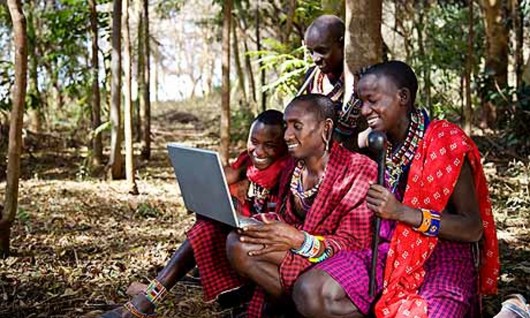
The Wi-Fi networks we use at home or in cafés have a limited signal reach of about 100 square feet.
To manage the problem of Internet connection, IT companies and Microsoft Corp. are utilizing TV white space. The technology is a spectrum of broadcast frequencies, typically used to transmit TV channels from one location to another, harnessed for wireless networks.
Through the 4Afrika initiative, Microsoft collaborates with local universities and IT companies including those in Namibia, Kenya, Ghana, South Africa and Tanzania, to bring the internet to unconnected parts of Africa. Microsoft launched the initiative in February 2013, with the latest project this year in Botswana.
TV white space makes broadband internet access in Africa affordable for most users in isolated parts of Namibia that could not otherwise access using typical café Wi-Fi. The distance of the frequency waves from the TV towers is much farther than a basic modem signal radius.
Namibia is an example of a large-scale white space project that covers a 38.5 by 94-mile area. The regions of Oshana, Ohangwena, Omusati and 28 schools in Northern Namibia are now connected to a broadband network.
One of the purposes of connecting secluded areas is to ensure that schools can communicate with other schools, businesses and nations.
Namibia is not an exceptional country grappling with access to the internet. Many African schools and hospitals outside of urban areas require the internet to provide learners and patients with the best education and health care.
In Ghana, tablets and other electronics are used to connect students to a broader academic and business community. Orlando Ayala is chairman of emerging markets at Microsoft.
He says that “We have to be an active participant in ensuring that by empowering this young human resource, that translates into innovation and creation of jobs. Hopefully, Tech Start-ups come from not only Africa but beyond Africa.”
Broadband Internet connection in Limpopo, South Africa also links secondary schools to a larger education community. Mountain View secondary school teacher Simon Matlebjame says that “We will be able to interact with other countries. Learners will be marketable and employable.”
The Internet gap between some parts of Africa and other communities is often referred to as the “digital divide,” or Africa’s economic and technological relationship to the rest of the world.
Another one of 4Afrika initiative incentives is to enhance Africa’s global economic value.
Microsoft looks at Africa as an investment in the future of technology. The company’s message is that the “Microsoft 4Afrika Initiative is built on the dual beliefs that technology can accelerate growth for Africa, and Africa can also accelerate technology for the world.”
By focusing on world-class skills, innovation and access, the company aims to provide the tools for success in the global market. Beyond economic opportunity, the initiative brings quality health care to African countries.
Project Kgolagano connects hospitals and clinics to allow easy transmission of medical records and patient access to specialized medicine through telemedicine. In partnership with the University of Pennsylvania, Botswana government and other IT companies, Microsoft helps join specialized health care and hospitals.
Director of the Botswana Innovation Hub Marketing, ICT and Registration, Dr. Geoffrey Seleka says that “there is currently a lack of specialized care in remote hospitals and clinics in Botswana.” The specialized care using photo and video transmissions between hospitals will make quality health care realistic.
A 2012 U.N. Human Rights Council resolution declared that Internet access is a basic human right.
Hospitals all over Botswana and Africa are, or are in the process of being, connected. By the efforts of local educators, IT companies and the 4Afrika Initiative, hospitals will have easier access to crucial medical records and students will have easier time learning.
The overarching goal is that people in Africa will share medical, educational and technological innovations with the rest of the world.
– Michael Hopek
Sources: Penn Medicine, Microsoft, UW Electrical Engineering, 4Afrika Microsoft 1, 4Afrika Microsoft 2, 4Afrika Microsoft 3, 4Afrika Microsoft 4
Photo: The Guardian

How the Growing Youth Population Can End Extreme Poverty
It is common knowledge that the world’s population is growing. Less so, but still well known is the fact that the majority of this growth takes place in developing countries. This fact can either increase or reduce global poverty, depending upon what actions are made in response.
Looking at the Stats
In a recent article on USAID’s blog entitled, “How to End Extreme Poverty in 3 Easy Steps,” they stated that, “The bulge in young populations seen in places like Africa offers an opportunity to bolster the economic growth of the continent and, in turn, lift more people out of poverty.”
When looking at youth statistics though, it is hard to find much that is positive. The UN’s statistics on youth in 2011 showed that unemployment rates for young people are significantly higher than adults in every region of the world.
Then, in 2012 stated, “Nearly 75 million youth are unemployed around the world, an increase of more than 4 million since 2007. By 2016, the youth unemployment rate is projected to remain at the same high level.” And remain at the same high levels it has.
That leaves around 75 million individuals that could be fighting poverty as an untapped resource.
If change is to happen, the youth need to be reached in order to reduce poverty.
According to the Global Partnership for Education organization, “If all students in low-income countries left school with basic reading skills, 171 million people could be lifted out of poverty.”
How can youth reduce poverty by this much though? And why is education so vital to success?
6 Ways Education Combats Poverty
These are only six of the many ways that education combats and reduces poverty. By focusing on youth education programs, global poverty would be dramatically changed.
Obstacles Despite Aid
Many governments, programs and organizations such as USAID and the Global Partnership for Education are currently making improvements in this area, but much more remains to be changed.
USAID alone has trained almost 4,000 teachers and enrolled 336,000 more children in school over the last five years.
Even with this kind of success though, there are many barriers that keep the youth from educational opportunities.
These issues range from gender inequality, political unrest/war, lack of resources, disabilities, climate change and more.
The youth of the world are the hope for a better future. By investing in them, hope for poverty reduction increases. Effective, quality education is the key that brings it all together.
The USAID article on ending extreme poverty stated, “To be free of poverty is to have access to the basics in life — enough nutritious meals a day, good health and well-being, training to build skills and knowledge, and freedom and independence in a peaceful environment.”
With the youth being targeted as a resource, reducing, and possibly even ending, extreme global poverty is a goal that is within reach.
– Katherine Martin
Sources: Medium, UNESCO 1, Global Partnership, UNESCO 2
Photo: Pixabay
Trees for the Future: Fighting Global Poverty
Dave and Grace Deppner founded the organization in 1989 after an eye-opening experience in the Philippines. It was there that they discovered they could restore communities while saving degraded land.
Roughly 80% of the developing world has health and nutritional needs met by non-wood forest products and there are approximately 100,000 acres of forest lost each day in the world. The Deppners were determined to help reverse to statistics.
One country Trees for the Future works in is Senegal. Senegal’s increased deforestation has led to the loss of more than half of the forests. They have helped farmers plant more than half a million trees and develop forest gardens.
Trees for the Future has also partnered with the Peace Corps and the Senegalese Ministries of Agriculture and Forestry throughout their time there.
Brazil is another country where Trees for the Future’s impact can be seen. The organization has helped rebuild communities through the development of education programs on effective agroforestry. The main purposes of reforesting in Brazil are to bring back the nutrition in soil as well as to provide a source of food for the livestock.
One tree in particular, has proved invaluable to the Brazilian communities that the organization works with. The moringa oleifera tree produces edible pods, leaves and flowers. These are high in calcium and Vitamin A. The powder that comes from ground seeds has also helped improve the quality of water due to its purifying qualities.
The trees planted in these countries are unifying communities as well as creating sustainable agriculture. Trees for the Future has planted more than 50 million trees in various parts of Africa, Asia and Latin America. Their influence has reached 58 different countries and 12,000 villages.
– Iona Brannon
Sources: Food and Agriculture Organization, Trees for the Future, Trees for the Future: Senegal, Trees for the Future: Brazil,
Photo: Google Images
How Fortified Ingredients Can Stop Hidden Hunger
With one in three affected by malnutrition globally, hidden hunger is a prevalent but treatable epidemic. Africa is currently home to the highest levels of hidden hunger.
The UN stated in a report that, “of the 34 countries that account for 90% of the global burden of malnutrition, 22 are in Africa,” with 56 million children suffering stunted growth as a result.
But the good news is that an affordable solution appears to be on the horizon.
Marie Konaté, founder of Protein Kissèe-La (PKL), has created a key vitamin and mineral fortified cereal for children. Sourced locally from Côte d’Ivoire, the children’s cereal is targeted at the group most susceptible to hidden hunger: children under the age of 5.
As 46% of the African staple-based diet is composed of cereals, according to the Food and Agriculture Organization (FAO), Marie’s cereal is an affordable and delicious way to fight micro-malnutrition.
The Global Alliance for Improved Nutrition (GAIN) has teamed up with PKL to provide the powdered supplements that are added to the cereal, thus keeping the costs even lower to consumers.
The fortification of food staples has already been implemented in a variety of products, from Nestlé’s bouillon cubes with added iron and iodine in Western and Central Africa to cooking oil with iron and vitamin A in Senegal.
Yet, one of the simplest ingredients used globally could be one of the most effective in fighting hidden hunger: iodized salt.
Commonly used in developed nations, iodized salt looks, smells and tastes the same as non-iodized, costing only 5 to 10 cents per person per year, reports Aljazeera America.
Iodine Deficiency Disorders (IDDs), including goiter, hypothyroidism, reproductive problems in adults and mental and structural defects in infants, can all be combated through the simple consumption of iodized salt.
GAIN estimates that the number of children dying under the age of 5 could be halved if they received better nutrition.
Given that a whole host of staple ingredients, including salt, grain and oil are able to be fortified without compromising the taste and appearance of the product, it’s only a matter of funding to drastically reduce the numbers of micronutrient deficient people globally.
At the 2015 Future Fortified summit in Tanzania, GAIN, the African Union, the Bill and Melinda Gates Foundation, the World Health Organization, UNICEF, the World Food Program and USAID hashed out a viable global plan to put an end to hidden hunger.
They estimated that for every dollar spent on ending malnutrition, $138 would be saved on healthcare and previously lost productivity.
Since then, the African Union has requested $150 million in donations to fund food fortification and progress analytics in 25 nations.
Going forward, as more countries commit to mandating fortification, hidden hunger is closer than ever to being a problem of the past.
– Claire Colby
Sources: Aljazeera America, Associated Press, EurActive, Food and Agriculture Organization, GAIN, Global Post, New York Times, UN, UNICEF
Photo: LinkedIn
Poverty and Mental Health: How are They Connected?
Most people have encountered something like it: When you spend a long period under high stress, you wind up with a cold because your immune system is down. And vice versa: when you’re sick for a long period, you start to feel down in the dumps.
They’re both examples of the interplay between mental and physical health, something that scientists are learning more and more about. In terms of global poverty, there are many possibilities that could arise from an increased focus on the mental health of those living in the third world. Poverty becomes a third factor in this cyclical relationship.
Those who have mental disorders are more likely to be sick, and also to be impoverished (because they can’t find jobs due to feelings of inadequacy, discrimination or inability to function.) When a person is impoverished, they are less able to afford health care and are also more vulnerable to mental disorders such as depression. And the convoluted cycle continues.
In fact, way back in 1963, in a study by Langner and Michael, it was conceded that generally there is a cause and effect relationship between poverty and mental health.
The link between all three is almost inextricable. The World Health Organization (WHO) offers a few statistics that make this point all too clear.
Furthermore, according to WHO, 31 percent of countries don’t have a specific budget dedicated to health. Seventy-six to 85 percent of people with serious mental health conditions do not receive treatment in developing countries.
But this isn’t a depressing indicator that the doom of the world is coming quickly and imminently. On the contrary, understanding the nature of the cycle means that aid can enter into it at any point to keep it from perpetuating itself.
Aid for physical health and economic disparity are most commonly offered to those in the developing world. Perhaps, by taking a look at poverty from a new angle – through the lens of mental health – huge strides could be made towards improving all three areas on a global scale.
WHO’s website states, “Mental health issues cannot be considered in isolation from other areas of development, such as education, employment, emergency responses and human rights capacity building.”
Knowing that that is not what is being done gives humanitarians the perfect opportunity to reconsider what to prioritize in the fight against global poverty and chronic diseases, whether physical or mental.
– Emily Dieckman
Sources: Journals of The Royal College of Psychiatrists, Europa, WHO 1, WHO 2
Photo: Google Images
Social Safety Nets Save Malnourished Children in Togo
A large number of children in Nadjote, a small village located 18 km from the city of Dapaong, suffer from serious malnutrition. In order to combat this suffering, the Togolese government has established a safety net program aiming to financially help the most vulnerable households.
Specifically, the government set up a cash transfer program to provide financial assistance to households with malnutrition-suffering children in Togo.
This program is intended to provide a brighter future for children from the most disadvantaged families. Moreover, this program encourages households to obtain birth certificates for their children, offer them with education and health care.
Abna Kolani is one of the beneficiaries. She gave birth to seven children, but three of them died of malnutrition. As a beneficiary, during the past 12 months, she has received monthly financial assistance of 5,000 CFAF—around $9—for the children’s feeding and education.
According to the World Bank article, Abna noted that “With the money I receive each month to provide my youngest child with better nutrition, I can provide healthier food for all my children. I see a big change in their physical condition— their health and hygiene conditions are much better than before.”
“When they are sick, I can take them to the health center to receive care. In addition, the program has allowed me to send my eldest child to school and now all four have birth certificates.” Abna continued.
The project was launched by the Togolese government in 2013 and supported by the World Bank and the Japanese government.
Cooperating with the United Nations International Children’s Emergency Fund (UNICEF), the program is aimed for parents with children between the ages of 0 and 24 months in the Kara and Savanes regions where malnutrition rates are extremely high.
Nanifei Lardja is another mother living in Nadjote mentioned in the World Bank article. Naniferi has five children, and she says, “I buy corn for 2,000 francs, soap for 1,000 francs, and small fish for 1,000 francs. I have my small plot for the vegetables I need and put aside the remaining 1,000 francs for other possible expenses.”
The program gives her not only material support but also confidence for a better future with her children.
“We are very pleased to note that the support activities organized, in particular the educational talks on the rights of children, nutrition, health and basic family practices have produced largely positive effects,” said Joachim Boko, a Social Protection Specialist at the World Bank.
According to Pounpouni Koumaï Tchadarou, the Regional Director for Social Action in the Savanes region and Program Coordinator, this program offers much more than mere financial assistance. Besides the 5,000 francs supplement, this program also provides a range of services, such as reminders of regular prenatal care and children’s register.
“We do everything to ensure that school-age children attend school. We also do home visits to heighten the awareness of the beneficiaries regarding the role played by good hygiene in improving the health of their children,” said Tchadarou.
“One day, you will come back here and see that the children you have helped have become teachers, nurses, and doctors,” said Yom Kouloukitibe, one of the 14,016 recipients to date of this financial assistance.
– Shengyu Wang
Sources: World Bank 1, UNICEF, World Bank 2
Photo: Flickr
Overcoming Extreme Poverty by Addressing Income Inequality
While world leaders have agreed to end global poverty by 2030, more than 200 million people worldwide will be trapped unnecessarily by income inequality unless governments find solutions.
Oxfam, an international organization that works to find solutions for poverty have reported that income inequality will continue to increase with the addition of the newly approved Sustainable Development Goals.
Research conducted by the Overseas Development Institute found that 79 percent of people in developing countries live in a nation where the incomes of the bottom 40 percent grew slower than the average during the period of the Millennial Development Goals.
The slow growth of income is due to the richest one percent’s fast earning potential. If trends continue, the richest one percent will own more wealth than the rest of the world’s population combined.
“Wealth does not automatically trickle down to those who need it most. It’s up to politicians to ensure everyone gets a fair share of the benefits of growth,” said Winnie Byanyima, Executive Director of Oxfam International.
While the past 15 years have seen the fastest reduction of poverty in human history, world leaders must act.
Some solutions to income inequality include:
Through government actions and the eradication of income inequality, the Sustainable Development Goals have a better shot of completion by 2030.
– Alexandra Korman
Sources: InfoZine, OxFam, Voice of America
Photo: Wikemedia
Can We Help Children Reach Their Fifth Birthday?
While this number demonstrates a significant achievement towards global progress for the United Nations, this 53% decrease has not met the Millennium Development Goal of a two-thirds reduction set to occur between 1990-2015.
With 16,000 children under 5 still dying each day, UNICEF Deputy Executive Director Geeta Rao Gupta believes the challenges to saving these children must be met full-force.
“But the far too large number of children still dying from preventable causes before their fifth birthday – and indeed within their first month of life – should impel us to redouble our efforts to do what we know needs to be done. We cannot continue to fail them,” said Gupta in a World Health Organization (WHO) article.
Recognizing when children are most vulnerable is a necessary means of counteracting the cycle. This time of vulnerability has been determined to occur within the period at or around birth, with 45% of under-5 deaths happening within the neonatal period, which is the first 28 days of life.
Issues such as prematurity, pneumonia, complications during labor and delivery, diarrhea, sepsis and malaria are all leading causes of death for children under 5 years old, and it is here where improvements can begin.
In fact, nearly half of all under-5 deaths are associated with undernutrition. However, with the appropriate interventions, most of these occurrences are preventable.
For example, just by focusing on sub-Saharan regions which experience the highest levels of under-5 mortality rates in the world (with 1 in 12 children dying before their fifth birthday), these numbers can be vastly reduced.
Dr. Flavia Bustreo, Assistant Director-General at WHO, ensures we possess the knowledge to reduce newborn mortality.
“We know how to prevent unnecessary newborn mortality. Quality care around the time of childbirth including simple affordable steps like ensuring early skin-to-skin contact, exclusive breastfeeding and extra care for small and sick babies can save thousands of lives every year,” she said.
Although many countries have already made incredible progress in reducing their number of child mortality rates, further progress must be made in the hopes of making sure all mothers and their children are ensured proper care by 2030.
Fortunately, it is through initiatives like the Global Financing Facility, in Support of Every Woman Every Child, which focus on “smarter, scaled and sustainable financing” that the UN is able to support and enable countries with the resources they need to “deliver essential health services and accelerate reductions in child mortality.”
With these programs in place, there is great potential for many more fifth birthdays to come.
– Nikki Schaffer
Sources: Child Mortality World Health Organization
Photo: Flickr
10 Top Philanthropists in Asia
The United Nations, the World Health Organization and other aid groups estimate that almost one-third of people in Asia live on less than $1.51 per day. Here are some of the most successful philanthropists in Asia who are fighting to end poverty and hunger by 2030.
10 Significant Philanthropists in Asia
– Joe Kitaj
Sources: Forbes 1, Forbes 2, Forbes 3
Photo: Flickr
Microsoft: Internet Access in Africa Using TV White Space
The Wi-Fi networks we use at home or in cafés have a limited signal reach of about 100 square feet.
To manage the problem of Internet connection, IT companies and Microsoft Corp. are utilizing TV white space. The technology is a spectrum of broadcast frequencies, typically used to transmit TV channels from one location to another, harnessed for wireless networks.
Through the 4Afrika initiative, Microsoft collaborates with local universities and IT companies including those in Namibia, Kenya, Ghana, South Africa and Tanzania, to bring the internet to unconnected parts of Africa. Microsoft launched the initiative in February 2013, with the latest project this year in Botswana.
TV white space makes broadband internet access in Africa affordable for most users in isolated parts of Namibia that could not otherwise access using typical café Wi-Fi. The distance of the frequency waves from the TV towers is much farther than a basic modem signal radius.
Namibia is an example of a large-scale white space project that covers a 38.5 by 94-mile area. The regions of Oshana, Ohangwena, Omusati and 28 schools in Northern Namibia are now connected to a broadband network.
One of the purposes of connecting secluded areas is to ensure that schools can communicate with other schools, businesses and nations.
Namibia is not an exceptional country grappling with access to the internet. Many African schools and hospitals outside of urban areas require the internet to provide learners and patients with the best education and health care.
In Ghana, tablets and other electronics are used to connect students to a broader academic and business community. Orlando Ayala is chairman of emerging markets at Microsoft.
He says that “We have to be an active participant in ensuring that by empowering this young human resource, that translates into innovation and creation of jobs. Hopefully, Tech Start-ups come from not only Africa but beyond Africa.”
Broadband Internet connection in Limpopo, South Africa also links secondary schools to a larger education community. Mountain View secondary school teacher Simon Matlebjame says that “We will be able to interact with other countries. Learners will be marketable and employable.”
The Internet gap between some parts of Africa and other communities is often referred to as the “digital divide,” or Africa’s economic and technological relationship to the rest of the world.
Another one of 4Afrika initiative incentives is to enhance Africa’s global economic value.
Microsoft looks at Africa as an investment in the future of technology. The company’s message is that the “Microsoft 4Afrika Initiative is built on the dual beliefs that technology can accelerate growth for Africa, and Africa can also accelerate technology for the world.”
By focusing on world-class skills, innovation and access, the company aims to provide the tools for success in the global market. Beyond economic opportunity, the initiative brings quality health care to African countries.
Project Kgolagano connects hospitals and clinics to allow easy transmission of medical records and patient access to specialized medicine through telemedicine. In partnership with the University of Pennsylvania, Botswana government and other IT companies, Microsoft helps join specialized health care and hospitals.
Director of the Botswana Innovation Hub Marketing, ICT and Registration, Dr. Geoffrey Seleka says that “there is currently a lack of specialized care in remote hospitals and clinics in Botswana.” The specialized care using photo and video transmissions between hospitals will make quality health care realistic.
A 2012 U.N. Human Rights Council resolution declared that Internet access is a basic human right.
Hospitals all over Botswana and Africa are, or are in the process of being, connected. By the efforts of local educators, IT companies and the 4Afrika Initiative, hospitals will have easier access to crucial medical records and students will have easier time learning.
The overarching goal is that people in Africa will share medical, educational and technological innovations with the rest of the world.
– Michael Hopek
Sources: Penn Medicine, Microsoft, UW Electrical Engineering, 4Afrika Microsoft 1, 4Afrika Microsoft 2, 4Afrika Microsoft 3, 4Afrika Microsoft 4
Photo: The Guardian
Former Vietnamese Refugees Reach Out to Fleeing Syrians
As Syria’s civil war worsens, thousands of Syrians are compelled to abandon their lives and relocate to other countries. Their journeys often include the daunting task of crossing oceans in small vessels that are barely sea-worthy. However, safety does not always await them on the other side.
The mass exodus from Syria has caused no small amount of strife among political leaders as they discuss how to accommodate so many refugees.
Working citizens eye the situation warily, anticipating the incoming Syrians as a threat to their livelihoods. Settling in can be very difficult for refugees when their new community is unwelcoming. Such situations can result in refugees living in squalor and becoming a burden to their new country.
The U.S. agreed to take in 10,000 Syrians in the upcoming year, but the Vietnamese American population has decided that more can be done to ensure the newcomers receive a hospitable welcome. After all, only a few short decades separate the Vietnamese from their own experience as refugees.
When the Vietnam War ended in 1975, roughly 125,000 Vietnamese refugees entered the U.S. by boat, much like the Syrians. If they were lucky, they found housing and a source of income. The unlucky spent years in refugee camps or searched the country for separated loved ones.
Now, as they see their own history playing out before their eyes, Vietnamese Americans strive to generate compassion for the fleeing Syrians.
In California, home to the largest population of former Vietnamese refugees, individuals have organized a 4-mile walk-a-thon to raise money for refugee accommodation. A Twitter campaign has also been established to allow U.S. citizens to voice their support for the Syrian refugees.
Other ways that U.S. citizens can assist in the accommodation and acculturalization of refugees are by volunteering at local resettlement agencies, donating funds and household items, becoming an English tutor and spreading the word about refugee aid.
“I want to see what we can do to help the Syrians because that is us,” says Tom Q. Nguyen, who lost his mother and sister when his family fled Vietnam in the 80’s.
Nguyen and fellow campaigners hope that their efforts will inspire others to take part as well. Perhaps the actions of these former Vietnamese refugees mark a new outlook on refugee accommodation.
According to the UNHCR’s 2015 report, nearly 60 million forcibly displaced persons exist in the world today. Half of these are victims of the turmoil in Syria, Afghanistan and Somalia, and all are in need of a new home.
– Sarah Prellwitz
Sources: Migration Policy 1, Migration Policy 2, NY Daily News, Rescue
Photo: Google Image