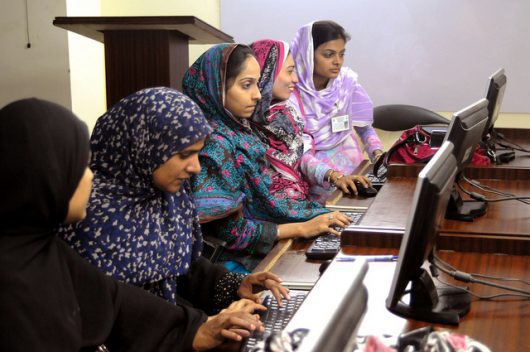
Over the past 25 years, developing Asia has annually created 30 million jobs in industry and services. Job creation improves productivity, raises earnings for workers and largely reduces poverty.
The Impact of Technological Progress
Shifts in employment from sectors with low productivity and pay, typically subsistence agriculture, to sectors with higher productivity and pay in the modern industry are contributing to this process of raising wages. Productivity improvements come from technological progress within sectors, such as diverse high-yielding crops, innovative machine tools in manufacturing, information and communication technology in the service industries.
A common concern with technological progress affecting the economy is the predicted accompanying job displacement; However, recent studies invite a more optimistic prediction of productivity gains that will generate a positive feedback effect of creating more jobs than are being lost. Furthermore, industries that improve productivity with new technology will lower production costs in industries that depend on them, creating a ripple of higher demand and employment in other industries.
The Asian Development Bank (ADB) supports the power of rising demand with data from 90 percent of the region’s total employment spanning 12 developing Asian economies between 2005-2015. The analysis predicts an 88 percent increase in employment, which is equal to an annual addition of 134 million jobs with rising incomes.
The ADB has also reported that jobs that necessitate cognitive and social skills and use information and communications technology have increased 2.6 percent faster than the total employment rate annually over the last decade. The wages associated with these jobs also increase faster than those of manual jobs.
Reasons For an Optimistic Outlook for Technological Progress in Developing Asia
The ADB emphasizes that most new technologies are implemented in only some aspects of a job, usually routine tasks, so that they create more time for complex tasks for workers. For instance, ATMs allow bank tellers to prioritize customer relationship management. The more obvious benefit entails the job creation to manage these new technologies.
In the last decade, 43 percent to 57 percent of jobs in India, Malaysia and the Philippines were in informational and communication technologies. The category of India’s craft and related workers is expanding to include specialized technicians who manage machines. Moreover, job sectors that would incorporate technological progress have a large capacity for growth.
Healthcare and education jobs make up 15 percent of jobs in The U.S. In lower and middle-income economies in developing Asia, healthcare and education jobs make up 3.5 to 6 percent of jobs, and business services jobs make up 1.5 to 6 percent of jobs, indicating a high potential for expansion.
Technology in the farming industry can have a positive impact on agriculture. In developed countries, waiters tend to receive the poorest wages; whereas in developing Asia, the agricultural workers receive the poorest wages. Technological progress can help farmers the most directly.
Mobile applications such as phone apps or text messages can assist farmers with tracking agricultural inputs. The Food and Agricultural Organization (FAO) and The International Telecommunication Union (ITU) have been supporting farmers in Afghanistan, Bhutan, Fiji, Laos, Myanmar, Papua New Guinea, the Philippines and Sri Lanka to implement emerging technologies.
The Necessity of Job Creation
Pakistan’s Khyber Pakhtunkhwa province (KP) has suffered from instability and militancy for several decades with increasing out-migration and shrinking private industries. Since 2014, the government, in partnership with The World Bank, has recognized the demand for job creation, especially for the half its population of 30.5 million that are under the age of 30.
Turning to the opportunities of the digital revolution in 2018, the government created a program, Digital KP, that directly addressed this youth unemployment issue by preparing the younger generation for occupations in the technology sector. By supporting the youth with advancing technology, the region is on its way to stability and success.
Many educational programs are being implemented to provide foundations for learning necessary skills. Another strategy involves increasing local IT and digital businesses and attracting investment for them through tax relief programs, promoting co-working spaces and sponsoring annual tech events such as The Digital Youth Summit.
Addressing the Potential Issues
As developing Asia is expected to grow by 6 percent in 2018 and by another 5.9 percent in 2019, governments are aware of the potential challenges presented by increasing new technologies. Some businesses might not overcome the displacement of jobs.
“ADB’s latest research shows that, on the whole, countries in Asia will fare well as new technology is introduced into the workplace, improving productivity, lowering production costs, and rising demand,” said Yasuyuki Sawada, ADB’s Chief Economist.
“To ensure that everyone can benefit from new technologies, policymakers will need to pursue education reforms that promote lifelong learning, maintain labor market flexibility, strengthen social protection systems, and reduce income inequality.”
Benefits of the ADB
The ADB offers different strategies, such as tax policies that will fight against income inequality. The same technological progress that may cause issues to workers could also foster skills, job-match and provide social protection. For the unemployed, the government can create programs that support them as they navigate the new labor market.
Developing Asia also benefits from the technological progress as it allows older workers to continue participating in the labor force past current retirement age. Artificial intelligence can either substitute or complement physically demanding tasks.
To maximize the benefits of technological progress while compensating for any losses, governments must adapt to the situation with policy changes. Technological progress can then become an optimistic gateway to reducing poverty in developing Asia.
– Alice Lieu
Photo: Flickr

Ending Period Poverty in Scotland
Scotland is a high-income country and is among the richest countries in the world. However, poverty has been increasing over the past several years. It has especially impacted women leading to period poverty in Scotland.
What is Period Poverty?
Period poverty is when women do not have access to sanitary products that are essential for day-to-day use like tampons and pads. Women living in poverty often have to make a choice between other necessities and sanitary products. Because of this, despite being a high-income country, many women in Scotland are still unable to afford basic sanitary products.
Period Poverty Surveys
In 2017, the Free Period Scotland campaign launched a survey with twelve questions in order to determine the scope of period poverty in Scotland. Though the pool was limited, of 747 respondents, 8 percent stated that they had limited access to sanitary supplies, 20 percent said that periods had impacted their day-to-day life such as affecting their education as well as other activities, and 4 percent said that they did not have access to any sanitary products.
Other surveys have indicated that the problem may be even greater. According to a survey of more than 2,000 people, conducted by the organization called Young Scot, that included people in varying levels of educational institutions, one in four women have difficulty accessing necessary sanitary products. Of those who participated in the survey, 70 percent have had to use alternatives such as toilet paper in place of sanitary products.
Initiatives to End Period Poverty in Scotland
Last year, the Scottish government established a six-month trial program in the city of Aberdeen. This program was run by the Community Food Initiatives North East. The goal of this trial was to find improved methods of providing free sanitary products to people living on lower incomes. After the pilot had begun, it was expanded to include several educational institutions in order to provide access for students, as well. Through this trial, more than 1,000 women were given free sanitary products.
Due to the success of the trial in Aberdeen, the government is funding an initiative to fight period poverty in Scotland and provide sanitary supplies to women from lower-income households. More than 500,000 euros will be given to the charity FareShare in the hopes of helping essential sanitary products become available to more than 18,000 people. Scotland will be the first country to create a program that gives free sanitary products to women.
The government’s new initiative will not only fight period poverty in Scotland but also represents the first step toward eliminating the stigma and difficulties that accompany menstruation. By providing access to sanitary products to those living on low income and to students in educational institutions, Scotland is changing the lives of thousands of women.
In the coming years, this new program may provide an example to other countries and other programs that will help women of all socioeconomic levels across the world.
– Lindabeth Doby
Photo: Flickr
The Relationship Between the Military and Global Poverty
It is shocking how much governments spend on the military, and how much more are weapons prioritized compared to human lives, In fact, only 10 percent of world military spending could eliminate global poverty. But why is it that countries allocate their resources in expanding their military, rather than fighting poverty, home or abroad? What is the relationship between the military and global poverty? This article will provide a few different aspects of militarization, and help understand the dilemma that countries face regarding this issue.
The Numbers
According to statistics provided by the Stockholm International Peace Research Institute (SIPRI), 2017 saw a total of $1.74 trillion spent on the military globally. This entails an approximately 3.1 percent increase compared to 2016.
Sources of military spending around the globe are concentrated on these top ten countries, order by the size of military expenditure: the U.S. ($609,758 million), China ($228,231 million), Saudi Arabia ($69,413 million), Russia ($66,335 million), followed by India, France, U.K., Japan, Germany, and South Korea. As seen, the U.S. spent more than the next seven countries on the list combined.
More than 2 percent of global GDP goes to military expenditure. The Middle East is the sole region around the globe that exceeds this number, having 5.2 percent of its GDP spent on the military. Oman, most notably, spent 12 percent of GDP on the military.
The Military and Global Poverty Efforts
Many point out that the relationship between the military and global poverty is not always a negative one: the military could often provide humanitarian assistance at times of crisis, technologies from the military could often help alleviate poverty, especially in dire, emergent situations. Furthermore, planes, other transport tools, food, construction materials and skills, medical assistance and communication could all be vital to civilians in regions suffering from conflicts or natural disaster.
The specific roles played by the military vary in different scenarios. The military could simply be a provider of resources such as food items and other needed commodities. It could also send soldiers to assist with humanitarian tasks on the ground. The military could also play the role of the police to maintain peace, though this is a much more controversial use.
There have been arguments, however, regarding the defects of such deployment of the military. It has been pointed out that aircraft is not usually the fastest and most reliable way to distribute food in adverse environments, since planes are also vulnerable to weather conditions, while other transportation means could be cheaper, more effective and more sustainable. Whether humanitarian assistance is offered from a neutral party could also influence the accessibility of poverty alleviating efforts.
The Military: A Cause of Poverty
The amount of humanitarian aid that the military could implement or help provide, sadly, is meager compared to the huge drain of resources needed to maintain a military, the destruction of existing social and economic institutions, or the elimination of potentials for development. Ultimately, conflicts and wars fought by the military are a leading cause of poverty, instead of a solution. Out of 10 poorest nations in the world, eight have recently been in or are still facing significant violent conflicts.
Compared to peaceful developing countries, countries suffering from wars and coups see have a twofold increase in the risk of malnutrition for their people and a threefold increase in the chance of infant death.
The military sometimes takes away what is essential for a nation’s future. An extreme example is that, instead of sending children to school, some nations send children to war to assist with operations, fight as soldiers, or even act as human bombs. The United Nations’ 2018 Children and Armed Conflict report listed seven countries and 56 armed groups that recruit and use children in war.
How Necessary is the Military for National Security?
Despite the unfavorable relationship between the military and global poverty, some still support large military expenditures due to concerns over national security.
However, according to researchers, an increased military presence does not decrease the potential of conflict in the case of civil war. Good policies and administrations are often much better at preventing rebellion.
War causes poverty, and in turn, poverty and inequality lead to conflict. According to surveys, some young people join militant groups because they face unemployment otherwise. Other researches find that, historically, inequality has been an important factor leading to civil war.
Poverty also significantly contributes to terrorism. It is unclear whether poverty drives individuals towards terrorist causes, but historical data shows that regions with high unemployment and poverty are more prone to the rise of radicalism.
The relationship between the military and global poverty is a complicated one, but it is obvious that funding economic development and durable physical and social infrastructure are more sustainable and reliable long-term solutions to reduce poverty and resolve security problems. It is time for nations to consider whether large militaries are really worth the cost.
– Feng Ye
Photo: Flickr
Developing Asia and Technological Progress
Over the past 25 years, developing Asia has annually created 30 million jobs in industry and services. Job creation improves productivity, raises earnings for workers and largely reduces poverty.
The Impact of Technological Progress
Shifts in employment from sectors with low productivity and pay, typically subsistence agriculture, to sectors with higher productivity and pay in the modern industry are contributing to this process of raising wages. Productivity improvements come from technological progress within sectors, such as diverse high-yielding crops, innovative machine tools in manufacturing, information and communication technology in the service industries.
A common concern with technological progress affecting the economy is the predicted accompanying job displacement; However, recent studies invite a more optimistic prediction of productivity gains that will generate a positive feedback effect of creating more jobs than are being lost. Furthermore, industries that improve productivity with new technology will lower production costs in industries that depend on them, creating a ripple of higher demand and employment in other industries.
The Asian Development Bank (ADB) supports the power of rising demand with data from 90 percent of the region’s total employment spanning 12 developing Asian economies between 2005-2015. The analysis predicts an 88 percent increase in employment, which is equal to an annual addition of 134 million jobs with rising incomes.
The ADB has also reported that jobs that necessitate cognitive and social skills and use information and communications technology have increased 2.6 percent faster than the total employment rate annually over the last decade. The wages associated with these jobs also increase faster than those of manual jobs.
Reasons For an Optimistic Outlook for Technological Progress in Developing Asia
The ADB emphasizes that most new technologies are implemented in only some aspects of a job, usually routine tasks, so that they create more time for complex tasks for workers. For instance, ATMs allow bank tellers to prioritize customer relationship management. The more obvious benefit entails the job creation to manage these new technologies.
In the last decade, 43 percent to 57 percent of jobs in India, Malaysia and the Philippines were in informational and communication technologies. The category of India’s craft and related workers is expanding to include specialized technicians who manage machines. Moreover, job sectors that would incorporate technological progress have a large capacity for growth.
Healthcare and education jobs make up 15 percent of jobs in The U.S. In lower and middle-income economies in developing Asia, healthcare and education jobs make up 3.5 to 6 percent of jobs, and business services jobs make up 1.5 to 6 percent of jobs, indicating a high potential for expansion.
Technology in the farming industry can have a positive impact on agriculture. In developed countries, waiters tend to receive the poorest wages; whereas in developing Asia, the agricultural workers receive the poorest wages. Technological progress can help farmers the most directly.
Mobile applications such as phone apps or text messages can assist farmers with tracking agricultural inputs. The Food and Agricultural Organization (FAO) and The International Telecommunication Union (ITU) have been supporting farmers in Afghanistan, Bhutan, Fiji, Laos, Myanmar, Papua New Guinea, the Philippines and Sri Lanka to implement emerging technologies.
The Necessity of Job Creation
Pakistan’s Khyber Pakhtunkhwa province (KP) has suffered from instability and militancy for several decades with increasing out-migration and shrinking private industries. Since 2014, the government, in partnership with The World Bank, has recognized the demand for job creation, especially for the half its population of 30.5 million that are under the age of 30.
Turning to the opportunities of the digital revolution in 2018, the government created a program, Digital KP, that directly addressed this youth unemployment issue by preparing the younger generation for occupations in the technology sector. By supporting the youth with advancing technology, the region is on its way to stability and success.
Many educational programs are being implemented to provide foundations for learning necessary skills. Another strategy involves increasing local IT and digital businesses and attracting investment for them through tax relief programs, promoting co-working spaces and sponsoring annual tech events such as The Digital Youth Summit.
Addressing the Potential Issues
As developing Asia is expected to grow by 6 percent in 2018 and by another 5.9 percent in 2019, governments are aware of the potential challenges presented by increasing new technologies. Some businesses might not overcome the displacement of jobs.
“ADB’s latest research shows that, on the whole, countries in Asia will fare well as new technology is introduced into the workplace, improving productivity, lowering production costs, and rising demand,” said Yasuyuki Sawada, ADB’s Chief Economist.
“To ensure that everyone can benefit from new technologies, policymakers will need to pursue education reforms that promote lifelong learning, maintain labor market flexibility, strengthen social protection systems, and reduce income inequality.”
Benefits of the ADB
The ADB offers different strategies, such as tax policies that will fight against income inequality. The same technological progress that may cause issues to workers could also foster skills, job-match and provide social protection. For the unemployed, the government can create programs that support them as they navigate the new labor market.
Developing Asia also benefits from the technological progress as it allows older workers to continue participating in the labor force past current retirement age. Artificial intelligence can either substitute or complement physically demanding tasks.
To maximize the benefits of technological progress while compensating for any losses, governments must adapt to the situation with policy changes. Technological progress can then become an optimistic gateway to reducing poverty in developing Asia.
– Alice Lieu
Photo: Flickr
How Hydropower Projects in Bhutan Boost Economy
Bhutan, despite its infinitesimal size, has recently found itself developing at breakneck speed. Regarded as Asia’s fastest growing economy, Bhutan is on the upswing with its GDP expected to grow by 11.1 percent between 2017 and 2019 — much more than its neighboring nations are presumed to expand in the same bracket of time, such as Ethiopia (8.7 percent) and India (7.73 percent). These projections beg the question: what is the driving force behind the betterment of the economy in Bhutan?
Hydropower Projects in Bhutan
Hydropower has proven to be at a climacteric point in the Bhutanese economy; the Prime Minister, Tshering Tobgay, listed it as one of Bhutan’s “Five Jewels” in 2014 specifically for this reason. “Indeed, the past fiscal year saw hydropower accounting for 32.4 percent of the country’s total exports and 8 percent of its GDP,” reported Alexander Jones of the International Banker, “with the construction of three projects, in particular, helping to push GDP growth to 6.5 percent last year.”
Similar projects have helped trim the nation’s trade deficit, in turn greatly benefit the economy of Bhutan.
Diplomacy with India
Two times, once in 2006 and again in 2009 (a renewal, of sorts, of the original accord), Bhutan and India co-signed an agreement regarding the hydroelectric industry. This agreement called for Indian assistance in the development of hydropower projects.
Three of these projects, developed under an intergovernmental model, have come to fruition: Punatsangchhu HEP I and II, and Mangdechhu HEP. The projects that began beneath this intergovernmental system are entirely financed by the Indian government.
Projects Working for Change
Six more similar tasks were born of a joint venture model, though only one — Kholongchhu HEP — has seen the light of day, as of now. These developments are part of the larger scheme outlined in the agreement: to establish 10,000 megawatts worth of hydropower by the year 2020.
The consummation of these projects is expected to double Bhutan’s hydropower generation from 1,600 megawatts to over 5,200 megawatts in the span of a decade. An estimated 80 percent of this power would be sent to India, with the remainder being consumed domestically.
Soon enough, India may not be Bhutan’s only partner in the field of hydropower. Bangladesh has offered $1 billion to establish a hydropower project of their own in Bhutan’s Lhuentse district, worth 1,125 megawatts. This power would be channeled to Bangladesh through India.
Teamwork Makes the Dream Work
This trilateral effort was sent to both India and Bangladesh by Bhutan in early 2016. While Bangladesh accepted the memorandum, although making slight amendments, it took India a year to agree, eventually returning the agreement in early 2017.
India is also Bhutan’s “largest trading partner” according to the Economic Times, with exports making up 90 percent of the country’s trade, and imports similarly constituting 82 percent. Besides hydropower, the economy in Bhutan thrives in exporting metals, chemical products, food, wood and rubber.
“Hydropower projects in Bhutan are an example of win-win cooperation,” wrote S.K. Sinha for the Kootneeti. As long as nations work together, clean and inexpensive energy in India can help all peoples and economies involved.
– Jordan De La Fuente
Photo: Flickr
How the Creative Arts Help the Poor in Palestine
In 2000, the second intifada erupted in West Bank and The Gaza Strip. The conflict resulted in 4,300 fatalities over the course of five years. Located in the heart of the conflict, Palestinian refugees residing in Aida Camp were subjected to frequent military attacks and their inexpensively built houses were exposed to land and air raids.
Israeli forces occupied their houses and commandeered their camp for military purposes all while schools were destroyed and roads were severely damaged. In the midst of this chaos, 11 young refugees of the Aida Camp assembled a group where creative arts help the poor in Palestine.
Starting The Lajee Center
Within the year, these creative members secured a 70 square meter garage for their place of operation. Their goal was to create a space in which Palestinians could creatively address their enduring struggle to secure their rights. They called this space The Lajee Center, a place where the creative arts help the poor on a daily basis.
Today, The Lajee Center is a cultural center that provides “refugee youth with cultural, educational, social and developmental opportunities.” It services not only the roughly 39 percent of Aida Camp residents living on less than $2 a day but is also open to all Palestinians.
According to the organization’s website, “activities are organized with the goal of fostering in participants a wider understanding of the world in which they live, focusing on issues relating specifically to their own society, culture and history, as well as the global context.”
Lajee Center Programs
The programs of Lajee Center reflect the increasing reliance on the creative arts in order to address situations of extreme poverty. In fact, UNESCO has launched several initiatives in which the creative arts help the poor in various impoverished communities.
The organization recognizes that publishing, music, cinema, crafts and design play a role in allowing for freedom of expression, cultural diversity and economic development. The group also recognizes that the arts have the ability to address emerging inequalities that have resulted from the development of new technologies and international trade.
A Therapeutic Escape
The therapeutic benefits of creative outlets are well-known — children in the camp are guided in arts and crafts in which they are encouraged to visually express their greatest aspirations. Some partake in weekly dance lessons in the traditional Palestinian folk dance while others participate in the camp’s choral group or individual music lessons. The children report that the music not only connects them to their history but it also provides them with welcomed escapes from their harsh surroundings.
Perhaps, most importantly, the creative arts are a source of identity formation. The residents of the Aida Camp continue to be subjected to military violence as a result of the Israeli occupation. Members of the dance troupe have been injured and detained while others have been banned from travel.
Healing Powers of Art
A group of 50 was once detained in a building without ventilation and then targeted with tear gas grenades; however, the troupe has continued dancing because they value how dance is a part of their identity. It instills them with a sense of belonging and strengthens their claim as a distinct people deserving of basic human rights.
The Lajee Center has earned international acclaim for its many artistic endeavors. The Lajee’s Center’s Palestinian folk dance troupe has performed not only around West Bank but has also toured to both The U.K. and Syria on several occasions. The organization has also participated in two cultural tours around The U.K. which exposed members’ photography, film and dance to over 3,000 members of the British public.
Global Renown
Furthermore, Lajee Center has organized 30 international photography exhibits showcasing the work of the camp’s youth. These exhibits took place in 9 different countries covering 4 different continents. In addition, 4 books written by Aida camps residents have been published internationally in both Arabic and English.
When attempting to find solutions to cases of extreme poverty in the world, it is easy to focus on economic barriers, access to education and lack of basic utilities.
Humanitarian Aid
Humanitarian groups readily assist in building wells, providing new agricultural technology and renovating schools. In all the frenzy, the cultural and artistic components are oftentimes overlooked; however, in order to most effectively implement these developmental measures, it is essential to understand the daily lives and beliefs of the people’s expected to adopt these new measures.
It is essential to address not only physical needs but also the emotional ones. Recognizing this importance, the Lajee Center has put culture and the arts at the heart of its grassroots humanitarian efforts and recognizes how creative arts help the poor in ways that traditional relief efforts cannot.
– Joanna Dooley
Photo: Flickr
Amazon Watch Is Protecting the Indigenous Lands of the Amazon
The Amazon Rainforest is the largest rainforest in the world, covering 1.7 billion acres in the heart of Brazil. It is also the ancestral home of an estimated one million indigenous people who are apart of around 400 tribes. Each of these tribes has its own individual language, culture, and territory. Yet, these tribes and their homes are being threatened due to deforestation. At the current rates, The Amazon Rainforest will be severely degraded by the year 2020.
Amazon Watch
Amazon Watch is protecting the indigenous lands of the Amazon. Founded in 1996, this nonprofit not only protects the rainforest but to also campaigns for the indigenous human rights of the people living in the Amazon. According to their website, Amazon Watch strives “for a world in which governments, corporations and civil society respect the collective rights of indigenous peoples to free, prior and informed consent over any activity affecting their territories and resources.”
Amazon Watch is protecting the indigenous lands of the Amazon by advancing solutions, including green development and autonomous solar power. The organization has launched an indigenous solar communications project with Empowered By Light. This project provides clean energy for lights and communication systems for indigenous people in Brazil, Colombia, and Ecuador. Amazon Watch will continue to install these solar and communication systems while providing training about their uses and upkeep.
Sending a Message to Large Corporations
Amazon Watch is protecting the indigenous lands of the Amazon one campaign at a time. Its current campaign, #EndAmazonCrude, is educating others on the dangers of oil drilling in the Amazon. Oil drilling threatens the survival of indigenous people as well as the land and indigenous species that live there. Each day, around ten million gallons of Amazon crude is delivered to The USA.
One of the biggest consumers of this fuel is Amazon.com, due to their transport operations. Many consider it unacceptable to be profiting off the name “Amazon” while destroying the real Amazon Rainforest. Amazon Watch is helping people spread the #EndAmazonCrude message via social media and sending emails Amazon CEO Jeff Bezos about this issue.
Amazon Watch has also called out big companies, such as JPMorgan Chase and BlackRock, for funding the destruction of The Amazon Rainforest and violating indigenous rights. The organization’s petition demands that the CEOs stop financing oil and gas producers in the Amazon. The petition states, “Oil and gas operations that you invest in are actively violating indigenous rights and worsening our climate crisis. Stop financing Amazon destruction!” Over 12,000 people have signed it thus far.
Encouraging People to Act
Amazon Watch is protecting the indigenous lands of the Amazon by educating others on how to take action for the Earth and for the indigenous people. Their website provides information on how to take action to help protect the Amazon through email and/or social media.
The organization is also asking others to stand in solidarity with Brazil’s indigenous rights agency. Indigenous people in Brazil are suffering under the country’s agribusiness industry. The National Indigenous Foundation (FUNAI) is a key target of the Brazilian government, which has undermined its critical role in protecting indigenous territories and severely cut its budget.
In 2017, Amazon Watch began working with Brazilian allies and international communities in order to fight environmental and human rights threats from Brazil’s “ruralista government leaders. Amazon Watch started a petition to reject President Temer and the Attorney General’s attacks on the rights and advocates of the Amazon’s indigenous people. Over 16,000 people have signed the petition so far.
Amazon Watch is protecting the indigenous lands of the Amazon by encouraging the public to get involved with their events. Every year in San Francisco, Amazon Watch holds its annual gala called “Amplify! A Celebration of Voices from the Amazon”. The special guests this year will be Achuar leaders from the Peruvian Amazon.
The government leaders in Brazil must start doing their part to protect the Amazon as well as the indigenous population within. By partnering with indigenous and environmental organizations, Amazon Watch is protecting the indigenous lands of the Amazon while campaigning for human rights and preservation of the Amazon’s ecosystem before it is too late. Hopefully, their work, plus the voices of those signing petitions to strengthen protections and rights, will also inspire the government to take action.
– Ariane Komyati
Photo: Flickr
Internet Access in Developing Countries: A Tool for Sustainability
A large percentage of people in the developed world take technologies such as computers and smartphones for granted.
The average American spends nearly 24 hours a week on the internet, which is an increase of 250 percent from internet usage in the year 2000. In contrast, over 4 billion people in the world are without internet access. Out of this number, 20 countries account for 75 percent of the people without internet access.
The internet can have positive effects on those living in developing countries. However, it is often not the first thing on the list of necessary improvements. Many communities look to more immediate requirements, such as increased access to health care and basic necessities like food and clean water.
In 2000, the Asia-Pacific Economic Cooperation (APEC), held a forum to discuss the changes beginning to occur in the world, including the increasing prevalence of the internet in many countries. Since then, the usefulness, and what is often viewed as a necessity, of the internet has spread across the globe but still fails to reach the world’s population in its entirety.
Barriers to Internet Implementation
It is estimated that 90 percent of people who live in the Least Developed Countries (categorized by U.N.) are without internet access. In many developing countries, a large portion of the population lives in rural areas, where the cost for internet providers to provide access has not always outweighed the potential benefits to the provider.
Beyond the logistical difficulties with providing internet access in developing countries is the task of breaching the language barrier present in technology and online communications.
As the majority of the world using the internet on a daily basis are speakers of only a small number of languages, those in developing countries, particularly Asian and African countries that often have incredible linguistic diversity within the countries themselves, are often unable to fully benefit from the information and communication provided by internet access.
In fact, it is estimated that only 5 percent of worldwide languages are used on the internet. National languages with many speakers such as Hindi and Swahili are used by less than 0.1 percent of the world’s 10 million most popular websites.
Positive Aspects of the Internet
However, the goal of internet access in developing countries remains extremely important. Those in the developing world with internet access are given an essential tool for sustainable economic growth. The educational and social benefits, as well as general information provided by internet access in developing countries, assists in decision making that has to potential to positively impact the entire community.
Internet access in developing countries can specifically benefit women in those countries, as educating girls and women has a great impact on poverty eradication and overall development. The education young women receive, not only in terms of technical schooling but on their bodies and health care, results in more healthy, independent and confident women that can contribute to the local and global economy in a more efficient way.
Additionally, internet access in developing countries promotes education for both men and women concerning technology, a field that has vast potential for professional and economic advancements. Studies suggest that women across the developing world are disproportionately affected by a digital gap and that bringing an additional 600 million women online would contribute from $13 to $18 billion to annual GDP across 144 developing countries.
Internet Kiosks
In 2006, one solution for addressing the digital gap in developing countries was implemented. In India, internet kiosks were set up in rural locations, providing those previously without internet access a low-cost opportunity. This provides community access rather than individual internet access.
One key aspect of internet kiosks are the services they offer. Since they are tailored for rural areas, the needs of the rural population are reflected in their services: providing access to land records, government services and related forms and health, as well as the educational and agricultural information that allow users assistance which is more prevalent in their location and livelihoods.
These kiosks also provide connections between communities through online communication, giving those who previously did not have access to a large portion of the world the ability to engage and be included in the social and educational aspects of today’s world.
The U.S. is well aware of the problem with the lack of internet access in developing countries. For this reason, Digital Global Access Policy Act of 2018 was presented for a goal of promoting internet access in developing countries and update foreign policy toward the Internet. This Act has yet to pass the Senate and the President before officially implemented.
For the direct contact of the Congress regarding this and many other topics, readers can always use the official site of The Borgen Project, more specifically this link.
– Anna Lally
Photo: Flickr
How the Media Misrepresents Argentina
Most of the media coverage surrounding Argentina has dealt with the country’s economic struggles, its crime rate, and, following the recent World Cup, its soccer team. The misrepresentation of Argentina by the media is evident due to the fact that negative coverage far outweighs the positive, giving the public a one-dimensional perception of this South American country.
More than a Soccer Nation
Beyond the financial crisis, much of the recent media coverage regarding Argentina has centered around the country’s World Cup run. Soccer is an immense source of national pride and a beacon of hope for many Argentinian fans, particularly during hard economic times. But soccer, while deeply engrained within the national fabric and heavily covered by the media, represents just one aspect of the diverse nation.
Portraying Economic Crisis in the Country
Argentina’s economy has far from met the expectations associated with market-friendly President Mauricio Macri. The value of the Argentine peso plummeted in April, resulting in a $50 billion loan from the International Monetary Fund. This, coupled with high inflation, has brought persistent economic hardship to the country and poses a serious threat to Macri’s “zero poverty” campaign promise.
Much of the media coverage surrounding Argentina has focused heavily on the economic crisis and the crime associated with it. While the crisis is prevalent and a resolution is much needed, the rampant and disproportionate coverage of the crisis goes to show just how the media misrepresents Argentina. In doing so, the media taint the perception of the country and fails to portray the true image of Argentina, one of an improving economic and social condition.
Economic and Social Progress
In 2017, poverty in Argentina decreased by 4.6 percent and is currently at 25.7 percent, according to official estimates. Prior to the Macri presidency, transparency about Argentina’s poverty was scarce. The publishing of official statistics only began in 2016, after being halted by the former populist government in 2013. Macri has not only strived for zero poverty, but he has established the proper balances to hold his administration accountable, something that was not the case for Argentina’s recent past.
Macri has faced the delicate task of reducing Argentina’s poverty rate while also working to alleviate a large budget deficit incurred by prior administrations. Macri’s administration has focused on reducing this deficit with the help of the International Monetary Fund and the implementation of public-private partnerships. With private companies financing long-term infrastructure contracts, Argentina expects to attract $26.5 billion in investment by 2022, reducing pressure on the budget but also contributing to the fall in poverty through the creation of thousands of steady jobs.
The citizens of Argentina have also exhibited a strong commitment to social progress, pushing landmark legislation to the floor of Congress, the Senate and the offices of President Macri. However, media coverage of these events is brief if existing at all, failing to show a highly positive dimension of Argentina.
Justina’s Law
News that the Chamber of Deputies (lower house of National Congress) passed a grassroots piece of legislation that makes 44 million citizens organ donors was seldom reported. The official increase in donors will depend on how many citizens choose to opt out, but this legislation will undoubtedly ensure the survival of thousands of patients that are in need of organ transplantation. With the approval of this law, also called the Justina’s Law, Argentina would join the ranks of France and Netherlands in this landmark legislation.
While it is typical to hear for the negative aspects of Argentina’s economy and crime, the work being done to solve these issues or the positive impacts that the Argentine people themselves are having on their country is rarely discussed.
Though it may seem that the misrepresentation of Argentina in the media has little effect on the country’s economic and social outlook, this is far from the truth. Macri’s plan for foreign investment depends heavily on the perception of Argentina as a viable place for growth. The current administration’s commitment to accountability and poverty reduction, as well as social progress, show the world that the country is trending in the right direction.
– Julius Long
Photo: Flickr
Top 10 Facts About Girls’ Education in Nepal
Nepal is one of nine Asian countries carrying the status of “least developed.” Any instability the country faced was intensified by the 2015 earthquake that killed over 6,000 people. One of the sectors tied to country’s much-needed development is, of course, education. To get a sense of the status of the education system in the country, in the text below the top 10 facts about girls’ education in Nepal are presented.
Top 10 Facts about Girls’ Education in Nepal
In recent years, Nepal has faced great hardship. After the 2015 earthquake, the country faced the unwieldy challenge of rebuilding much of its infrastructure, including education facilities. Organizations like USAID supported this effort by helping the government establish temporary learning centers across the country.
Though Nepal faces great challenges, many are encouraged by some of the country’s efforts toward bettering its education system and promoting gender equity.
These 10 facts about girls’ education in Nepal suggest that though the country has a long way to go before being considered as well-developed, progress is being made in the education sector.
– Julia Bloechl
Photo: Flickr
Top 10 Facts About Poverty in Myanmar
Myanmar, a small Southeast Asian country formerly known as Burma, is one of the three poorest countries in Asia. In the text below, top 10 facts about poverty in Myanmar are presented.
Top 10 Facts About Poverty in Myanmar
In conclusion, although Myanmar has made significant strides in the process of eradicating poverty, it still has a long way to go before achieving parity with other developed and even developing nations in the region.
– Maneesha Khalae
Photo: Flickr