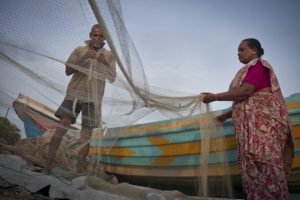
 The Indian Ocean tsunami tore through Sri Lanka’s coast in 2004, destroying not only boats and nets but also the very social safety nets that kept the economy afloat. During the loss, women in fisheries in Sri Lanka stepped up. They organized a framework to provide mutual aid circles that transformed into cooperatives that process dried fish, market shellfish and advocate for the waters that feed their families.
Only two decades later, many of these groups are now stable, central businesses that have become anchors in the community. These women didn’t just survive; they changed who held power in coastal life. According to Sri Lanka’s Secretary of the Ministry of Disaster Management, S.S. Miyanawala, “Therefore, it is necessary to change the way we ‘invest.’ We need to focus not only on addressing the consequences of disasters but on reducing the underlying causes of vulnerabilities and enhancing the preparedness and resilience of people and communities.”
Mutual Aid To Market Power
In the early days of Sri Lanka, women traditionally leveraged skills such as salting, sun-drying and selling items to support household incomes. A comparative study from Ambalangoda shows households with women in fisheries in Sri Lanka differed significantly from those who chose not to, showing increased income and access to credit.
By formalizing into cooperatives, these networks evolved into small enterprises and some partnered with NGOs to reach better markets. After the war and tsunami, initiatives in Jaffna educated widows, showing them how to produce higher-quality dried fish for fair-trade outlets, turning a coping strategy into dignified work with a generous return. Today, dried fish remains a crucial, affordable protein for low-income households, stabilizing local demand while co-ops experiment with better processing and quality control.
Measurable Advances in Gender Equity
Women in fisheries in Sri Lanka have become symbols of economic resilience and their leadership has brought new skills, leverage and measurable gains in gender equity. WorldFish’s synthesis on women’s empowerment in small-scale fisheries outlines four pathways: embedding gender in every innovation stage, strengthening agency and leadership, improving resource access and transforming norms through collective action. These are the levers Sri Lankan co-ops pull, from leadership training to negotiating landing-site space and prices.
Sri Lanka’s dried-fish sector adds a vital dimension: well-being. Women’s control over processing and trade shapes income, social dignity, mobility and decision-making. Outcomes ripple into children’s education and household resilience. In a system still marked by informality and gendered barriers, collective organizing is the difference between uncertainty and progress. These cooperatives aren’t only about sales and personal growth.
They’re also about cultivating and repairing reefs, lagoons and mangroves. In Puttalam District and beyond, women’s groups tied micro-enterprises to ecosystem repair, focused on replanting mangroves, monitoring nurseries and campaigning for local protections. That work reduces storm surge, improves water quality and shelters juvenile fish, all classic “nature as infrastructure” benefits that make both catches and communities more resilient to the next shock.
Why It Matters Now
With supply chains evolving and climate extremes intensifying, Sri Lanka offers a living lab for community-first recovery. U.N. and national analyses of post-tsunami reconstruction emphasize community decision-making and moving recovery efforts locally. Women’s cooperatives became durable nodes in that local governance fabric because they knit income, care work and conservation.
International guidance has caught up with what these fishers practiced out of necessity. The FAO’s handbook on gender-equitable small-scale fisheries governance urges countries to center women in rules, markets and services. This approach is reflected in Sri Lankan co-ops that negotiate access to space, credit and training while advocating for better post-harvest infrastructure and quality standards.
What Success Looks Like
On the ground, success is pragmatic, not flashy. In Sri-Lanka, this success looks like predictable cash from a cooperative drying shed, a microloan that upgrades a smoker or a daughter who stays in school because fees are paid on time. Success also looks like a mangrove belt that blunts the next cyclone or a woman who chairs the meeting where the landing schedule is set. In places where formal jobs are scarce, these wins matter.
And the women who succeed scale their rewards out to the community. When collectives share methods such as pricing, grading, hygiene, bookkeeping and performance spreads horizontally. Partnerships with groups like the Small Fishers Federation (Sudeesa), international NGOs and university programs bring training and research to community doorsteps. At the same time, co-ops carry data and lived expertise back up the chain to policy tables. That two-way flow is how “pilot projects” become norms.
The Unfinished Work
Though there has been much progress, such as improved access to cold storage, challenges remain, including exposure to price shocks, credit terms that penalize informality and co-op bylaws that can still marginalize women at the harvest end of the chain. However, the evidence base is clear and growing: when women organize across the fish value chain, households diversify their income, nutrition improves and communities invest in the ecosystems that sustain them.
This policy isn’t charity; it funds what already works, including women’s collective enterprise tied to coastal stewardship. The lesson from Sri Lanka’s shores is simple: resilience is built locally by the people with the most at stake. When those people are women in fisheries who run the books, manage the drying racks, negotiate prices and plant mangroves, the result is more than just recovery. It’s a fairer, more durable coastal economy.
– Nicole Fernandez
Nicole is based in Reno, NV, USA and focuses on Business and Technology for The Borgen Project.
Photo: Wikimedia Commons

Facing Poverty in El Salvador: The Continuous Problem
Beauty and Change
El Salvador is the smallest country in Central America, about 32 times smaller than the state of Texas. It is bordered by Guatemala, Honduras and the Pacific Ocean and is known for its volcanoes, surfing spots and national dish, the pupusa. Beyond the multi-colored scenery, crashing waves and popular cuisine, El Salvador is also known for its positive development since Bukele entered office in 2019.
The country faced gang violence for decades, with a total of 2,398 homicides in 2019 before Bukele stepped into office. After five years of presidency, the number of homicides has dropped to 114 in 2024. This was due to his Territorial Control Plan and implementation of the Exception Regime. Bukele has tried to offer safety and peace to Salvadoran citizens; however, poverty remains a barrier to peace and safety for many.
The Daily Struggle
Facing poverty in El Salvador means a lack of potable water and education. El Salvador faced a major drought in 2016 and declared a water crisis shortly after. Since then, citizens living in or vulnerable to poverty have suffered from a lack of proper potable water. Families also face the risk of malnutrition as a result of living in poverty.
Poverty affects families beyond inadequate food and water. A lack of access to education is considered one of the leading causes of poverty in El Salvador. According to the National TPS Alliance, in 2023, the illiteracy rate among Salvadorans aged 10 and older was 9.7%, with an average educational level of 7.2 years and just 5.6 years for families in rural areas. Without sufficient funding, families cannot provide their children with proper education.
COVID-19 and Job Opportunities
El Salvador was not spared when the global pandemic hit in late 2019 and early 2020. The poverty rate rose by 6.5 percentage points and more than 20% of Salvadoran workers lost their jobs. Although the pandemic is no longer as widespread as in 2019 and 2020, El Salvador still grapples with its lasting impacts.
In 2022, soaring inflation kept the poverty rate at nearly 27%. Combined with limited access to education, hundreds of Salvadorans face a severe shortage of job opportunities. Even those who pursue higher education are often met with unemployment, as the Salvadoran economy has not created enough jobs to meet demand.
Solutions
Despite the effects of poverty continuing to affect Salvadoran communities, organizations and charities are working to help address the persistent issue. Charities such as the Salvadoran American Humanitarian Foundation (SAHF) and the Center for Exchange and Solidarity (CIS) work toward assisting families battling poverty.
SAHF has a program called the Early Childhood Development Program that helps families and children younger than 5 years old suffering from malnutrition. The Foundation also has a program that teaches English to primary school children in the educational complex at Residencial Libertad. The Foundation also offers a “life plan” to high school students within the program, allowing them to find job opportunities following their high school journey.
The CIS offers aid to families and communities without access to potable water and to youth who do not have a proper education. The CIS has partnered with other organizations and businesses to provide households, schools and businesses with water filters, wells, tanks and hand pumps. It has helped 3,000 families since 2011.
The organization also enables underprivileged youth at the primary, secondary and university levels to a leadership development program that leads them to a defined career. Children and young adults are selected for the program based on their economic need, educational standing and commitment to social change.
El Salvador may be experiencing a decline in job opportunities and continuing to face the harsh effects of poverty. However, organizations like SAHF and CIS are working to ease these challenges.
– Keyly Rios
Photo: Flickr
The Potential Impact of the Together for Palestine Fundraiser
According to a recent article by ABC, since October 7, Israel’s attacks have killed 67,160 people, with an additional 2,000 dead in Israel. Simply put, something needs to be done. On September 17, in Wembley Arena, some of the biggest celebrities in the world held the Together for Palestine Fundraiser. Here’s a look at the Together for Palestine Fundraiser and the impacts it could have.
What Is the Together for Palestine Fundraiser?
The Together for Palestine fundraiser aims to raise £2 million (approximately $2.7 million) for aid in Gaza and it has raised £1.8 million (about $2.4 million) so far. Together for Palestine’s big event was the aforementioned concert in Wembley Arena. According to the BBC, more than 12,000 people attended the event and an additional 200,000 people streamed it.
The event featured British artist Brian Eno, who organized it and prominent figures such as Benedict Cumberbatch and Florence Pugh, musicians Bastille and James Blake and Palestinian artists Sama’ Abdulhadi, Saint Levant and actor Bilal Ali Hasna. Hasna stated that he believes what Israel is doing in Gaza could be classified as genocide, a stance Israel’s foreign ministry has vehemently rejected.
It’s worth noting, however, that his position aligns with a U.N. report released the same week as the Wembley fundraiser, underscoring the urgency of drawing attention to the horrific conditions in Gaza.
What Are the Impacts of the Together for Palestine Fundraiser?
The Together for Palestine Fundraiser is donating all its proceeds to organizations on the ground and providing aid in Gaza. According to the Together for Palestine website, the organizations involved include:
These three organizations provide vital services in Gaza. With the donations from the Together for Palestine fundraiser, they can expand their reach and continue delivering high-quality care to those who need it most.
Conclusion
The Israel–Palestine conflict is one of the defining crises of our time. The Together for Palestine fundraiser is a major campaign to raise money for those carrying out essential work in a region desperately needing support.
– Charlie Means
Photo: Pixabay
Addressing Disability and Poverty in Saint Lucia
Throughout the island, many people with disabilities run into the same problems. In the 2014-15 school year, of students enrolled in special education or mainstreamed into the public system (361 students total), 77% were diagnosed with learning disabilities, intellectual disability or autism; multiple handicaps comprised about 12%. Limited access to medical care, lack of assistive devices and very few job opportunities are some of the barriers they face.
The Link Between Disability and Poverty in Saint Lucia
The 2010 Population Census measured that approximately 12% of Saint Lucia’s population had a disability; physical disability is among the most common types, with accident-related causes rising. Disability often worsens poverty. Data from Saint Lucia’s Central Statistical Office indicates that 4.6% of persons surveyed in 2019-2021 report at least one disability. Females make up 53.1% of that group and those aged 60 and older account for 57%.
According to the World Bank, less than one in 10 Saint Lucians lives below the poverty line and people with disabilities are particularly vulnerable to unemployment and exclusion. Families with a disabled member face higher living costs for care, equipment and health needs as well. This cycle makes targeted policies essential for breaking barriers.
Government Action
Saint Lucia’s government has worked with the World Bank to start projects to improve opportunities for people with disabilities. In 2020, Saint Lucia launched the Human Capital Resistance Project, focusing on strengthening social protection programs and helping the most vulnerable groups to find jobs.
The project focuses on providing training, financial support and community services to improve overall living conditions. By 2021, the project had reached at least 3,000 people and programs linked to it, including skills training for the youth and people with disabilities.
The Role of NGOs
Nonprofit groups also play a central role. The Saint Lucia National Council of and for Persons with Disabilities (NCOPD) has advocated for infrastructure, education and job opportunities to be more available.
NCOPD organized many awareness campaigns and even partnered with schools to promote inclusive learning. In recent years, the group worked with international donors to supply assistive devices such as wheelchairs and hearing aids.
The World Bank reports that investing more into disability-friendly education and/or job training helps minimize dependency and continues to support economic growth in Saint Lucia. Poverty levels will decrease when more people get on board and can work, contribute and act entirely in society.
Future of Disability and Poverty in Saint Lucia
Progress now shows slowly but clearly. With the establishment of the Prosthetic Rehabilitation and Repairs Center, 10 Saint Lucians who urgently needed prosthetic legs received them free of cost in 2022. This development highlights how focused action can ultimately change lives through government policy and grassroots leadership.
While challenges remain, Saint Lucia’s growing mix of local initiatives and international support offers a model of how small nations can tackle disability and poverty together.
– Tiana Hermes
Photo: Flickr
Data Harvest: Predictive Famine Modeling
The Urgency: Hunger on the Rise
Globally, more than 343 million people face severe food insecurity, a surge driven by climate shocks, conflict and economic instability. Behind those numbers are families skipping meals, parents who go hungry so their children can eat and communities forced to make impossible choices. In 2025, the World Food Program (WFP) warned that 58 million people risk losing food assistance unless emergency funding is secured.
For those on the ground, this doesn’t just mean smaller rations—it can mean no rations. In places already strained by drought or conflict, the absence of aid can tip households from hardship into catastrophe. Donor contributions have dropped by 40% compared to the previous year, leaving many relief programs strained and at risk of collapse.
This funding shortfall comes at the worst possible time: wars and weather extremes are multiplying, food prices are volatile and the world’s most vulnerable are bearing the brunt. The humanitarian community has described it as a “perfect storm,” where shrinking resources collide with rising needs.
In this context, predictive famine modeling is of critical importance. If the world cannot guarantee more food aid today, it can at least sharpen its ability to see where tomorrow’s hunger will strike. The question is whether we can turn foresight into action—moving from a cycle of crisis response to one of prevention.
The Data Revolution
Researchers are combining data streams that once seemed unrelated to forecast hunger more effectively. Every signal tells part of the story, from satellites watching rainfall and crop growth to mobile phone surveys capturing what families eat each week. Remote sensing provides a broad view of land and weather patterns that hint at failing harvests. At the same time, phone interviews and household surveys show how people cope—whether meals are being skipped or diets are being cut back.
To bring this information together, new tools such as the Harmonized Food Insecurity Dataset (HFID) now integrate multiple indicators into one monthly, subnational series. It gives analysts a clearer picture of when and where food stress worsens. Even unconventional sources are being tapped: the AI model HungerGist, for example, scans thousands of news reports to detect signals of looming food crises that traditional surveys may miss.
The result is a new way of seeing hunger. Instead of reacting once famine takes hold, analysts can detect trouble months in advance and pinpoint specific regions at risk. By weaving together these diverse sources, predictive famine modeling moves humanitarian response from hindsight to foresight.
Case Study: Zimbabwe’s Survey Fusion
One of the most promising real-world examples comes from Zimbabwe. Researchers developed a joint Multilevel Regression & Poststratification (jMRP) model that fuses high-frequency mobile survey data from WFP’s mVAM with annual face-to-face surveys conducted by ZimVAC. Mobile phone data alone is fast but imprecise, while in-person surveys are accurate but slow. The fused model corrects for bias, narrows uncertainty and produces monthly, district-level estimates of food insecurity.
It allowed agencies to detect worsening conditions in specific regions before new survey rounds arrived—a major step toward real-time hunger monitoring. This illustrates how predictive famine modeling can combine imperfect but frequent data with slower, more accurate surveys to produce actionable insights.
Challenges and Blind Spots
However, predictive famine modeling is not a silver bullet. Conflict zones and remote areas often remain invisible because reliable surveys cannot be conducted there. Bias is another issue: phone surveys exclude people without access to mobile technology and news-based models can be distorted by unequal media coverage.
Proxy data also have limitations—crop stress or rainfall deficits do not always translate into hunger if aid, markets or remittances intervene. And even the best predictions cannot guarantee action: humanitarian actors face funding shortfalls, logistics challenges and political barriers that can prevent aid from reaching people on time.
Looking Ahead: From Bytes To Bites
Despite these challenges, the potential of predictive models is clear. With climate shocks, conflict and economic crises overlapping, early warnings are more necessary than ever. Experts argue three steps are critical: expanding data coverage through community surveys, integrating forecasts directly into aid planning to trigger cash transfers or prepositioned supplies and securing reliable funding so warnings are acted upon rather than ignored.
Ultimately, the goal is to turn “bytes into bites.” Predictive famine modeling is not the same as preventing hunger. However, with better data and stronger response systems, famine need not arrive silently. If early warnings can be matched with early action, the world could finally begin to stop famine before it strikes.
– Diane Dunlop
Photo: Unsplash
ECook: How Induction Stoves Make Cooking Less Deadly
The pollution is responsible for an estimated 3.2 million deaths per year, three times more deaths annually worldwide than traffic accidents. However, one company is working to change that. ATEC’s eCook induction stove offers a clean cooking alternative to smoky, dangerous methods. By combining affordable financing, digital technology and economic incentives, eCook is showing how modern cooking can be practical and life‑changing in low‑income settings.
How eCook Works and Why It Matters
The eCook stove functions through induction technology. When the pot is placed on the surface, heat is generated. Without exposed flames, smoke or choking soot, the indoor air stays cleaner. The device includes safety features like automatic shut-off, precise temperature control and a child lock, which makes a difference in homes where children are around. In Cambodia, a user says it helps them have “confidence and feel safer, especially for my kids who cook at home.”
In Nepal’s Madhesh region, where traditional stoves fueled by firewood or cow dung dominate, feedback about eCook’s clean cooking praises the impact on quality of life. Pandey, a local health worker, observes women with fewer eye and respiratory complaints since electric induction stoves were introduced. Cleaner homes, less time spent collecting fuel and tending fires and more time for other tasks are becoming the norm.
What also sets eCook apart is its financing model. In Bangladesh, households can obtain the stove on a pay‑as‑you‑go basis, often paying as little as $5 per month. The company subsidizes part of the up‑front cost through carbon credits earned via verified usage of the stove. These credits are gold‑standard, meaning there’s an international verification of data tied to each household’s usage.
In Practice
Saleha, a 25‑year‑old homemaker in Dhaka, Bangladesh, describes how the eCook stove is both a cost- and time-saving option: “I can pay for the stove easily with the app. It did not require me to have a bank account to buy this product in a pay-as-you-go system. The stove cooks fast and the cost has been dropped to half since I no longer need to buy expensive LPG for cooking.”
This model helps not only make what might otherwise be unaffordable technology accessible to low‑income families but also becomes an income generator itself, particularly for women. Through ATEC’s Cook-to-Earn initiative, users, particularly women, receive direct carbon payments based on their usage. In the same way that ATEC uses certified carbon credits to keep costs low, women using the stove can measure, verify and convert their emissions reductions into carbon credits.
These credits can then be sold to decarbonization partners, empowering women in the Global South to turn climate action into income.
Facing the Gaps and Looking Ahead
Despite early success, challenges remain. In Madhesh, not every pot fits the induction stove; large vessels or specific cooking styles still depend on open fires or mud stoves. Electricity supply is still unreliable in some areas, which raises questions about consistency. But behavior change is gradual. Many families still keep a mix of stoves for different uses (a practice known as fuel stacking) rather than switching entirely.
Yet momentum in clean cooking is building. In September 2025, ATEC raised $15.5 million led by investors including Lightrock and TRIREC. It aims to roll out up to 200,000 more eCook stoves in Bangladesh, Cambodia, Malawi and Nepal over the next three years.
“Every family deserves a kitchen free from smoke that damages lungs, shortens lives and keeps people in poverty,” said ATEC CEO and co-founder, Ben Jefferys. “To achieve this, we must provide households with the right technology that unlocks their carbon assets to transact directly with decarbonisation partners at scale, backed by real-time data from every stove in every home.”
– Jannah Khalil
Photo: Flickr
Homelessness in Norway Eliminated Through “Housing First” Policy
Homelessness in Norway
Norway defines homeless people quite broadly. It widens the group to include people without permanent accommodation under many circumstances beyond simply living on the streets. This includes individuals who do not own or rent a home, those temporarily staying with friends or family and people about to be released from a facility or institution within the next two months who have nowhere to stay or go.
In 2020, 3,325 people were homeless in Norway, representing 0.06% of the country’s population. This is one of the lowest homelessness rates in Europe and nearly a 50% reduction compared to 1996. This result is a phenomenon on an international scale, matched only by Finland.
Norway and its fellow Scandinavian neighbors are pioneers of the Housing First approach. However, comparisons are challenging, as there is no generally accepted definition of homelessness and statistical methodologies differ between countries.
Plan, Divide and Conquer
In Norway, housing policies and homelessness reduction programs are a shared responsibility of the central and local governments, the private sector and nongovernmental organizations (NGOs). The state provides the legal framework and financial resources, while municipalities and NGOs implement the policies. Social and health services also play a key role in supporting people experiencing homelessness.
Such cooperation is crucial in addressing homelessness, as individuals affected by it often face complex challenges in multiple areas of their lives. The first homelessness survey in Norway was conducted in 1996. Since then, the country has implemented five projects aimed at eliminating homelessness.
The latest program, the National Strategy for Social Housing Policies (2021–2024), titled “Everyone Needs a Safe Home,” also incorporates the Housing First approach. The government focused on two groups that are especially disadvantaged in the current housing market: children and young people and people with disabilities.
Provide Housing First
The philosophy behind Housing First is simple: a safe and stable place to call home is the foundation for everything else. Indeed, once housing is secured, pursuing employment or addressing substance use becomes much more manageable.
Beneficiaries of the policy only need to be experiencing a housing crisis to receive support—there are no additional requirements. Participation in other programs is voluntary. The initiative recognizes housing as one of the four pillars of well-being, alongside health, education and work.
This is a significant difference in Norway’s approach compared to other solutions. Every action, plan and program is designed to provide a solid foundation to build. Like a house, a person needs a stable base to grow and become self-reliant.
– Patrycja Pietrzak
Photo: Unsplash
Low-Cost Satellite Internet in Remote Areas
Starlink and Project Kuiper: Bridging the Digital Divide
SpaceX operates Starlink and “utilizes a constellation of low-Earth orbit satellites to provide service worldwide.” It is designed to deliver “faster speeds and lower latency.” Its key purpose is to provide satellite internet to remote areas where accessibility is a constant barrier to connectivity.
While the operation seems promising, it is at a higher price than other rural internet providers due to the required purchase or lease of proprietary equipment. Another drawback is that the service tends to be affected by extreme weather conditions, common in remote areas with unpredictable climates.
Amazon Project Kuiper is an upcoming satellite internet service that provides high-speed internet to remote and underserved areas. Amazon plans to provide “widespread coverage which includes hard-to-reach rural communities.” However, prices are not yet available to the public, making it difficult to assess the potential success of this new project. Despite this uncertainty, it is expected to be competitive with other satellite internet providers.
Benefits of Satellites
Unlike most other satellite services, there is no required reliance on telephone lines. Amazon plans to “deploy thousands of satellites in low-Earth orbit linked to a global network of antennas, fiber and internet connection points.” These satellites orbit closer to Earth than traditional ones, reducing signal delay and improving speed. The satellites will communicate with a network of ground stations, including antennas, fiber-optic cables and internet hubs, that connect to the broader internet.
Satellites beam data to and from user terminals (like dishes or receivers) and route it through ground infrastructure to reach the internet. Unlike older satellite services, this enables Amazon to provide broadband access in rural, underserved regions without phone lines.
Amazon Project Kuiper plans to “bridge a digital divide” and offer direct support, such as customer service, to ensure technology integration. Although the performance metrics are not yet known until actual deployment, Amazon’s inclusion of a direct support team appears promising.
GSMA: Driving Mobile Innovation
GMSA is a global organization unifying the mobile ecosystem to provide innovative solutions for businesses and to encourage societal change. Its vision is to “unlock the full power of connectivity so that people, industry and society thrive.” It shapes mobile-related policies, supports technology that keeps mobile networks running and creates significant events to target global problems. Events such as MWC and M360 mobilize mobile industry leaders to share ideas and collaborate.
Millions of people depend on connectivity for their livelihoods and basic needs. “In 2022, 36 countries with the largest mobile coverage gap hosted 46% of internally displaced people and 18% of refugees.” Low-cost satellite services could be the answer to target the weaker areas of infrastructure in developing countries, particularly in health care, education and humanitarian protection.
Connectivity for Refugees Initiative
However, there are barriers to usage due to “lack of affordability of devices and data, lack of literacy and language or social barriers.” Due to this accessibility problem, a coalition of organizations and governments, including the UNHCR, International Telecommunication Union (ITU), GSMA and the Government of Luxembourg, created the Connectivity for Refugees initiative in 2023.
The initiative aims to connect 20 million displaced people and their hosts by 2030, helping them stay connected, access global services and build a livelihood. It will involve the private sector, governments, international organizations and forcibly displaced communities to ensure connectivity in underserved areas. Consequently, this will “open pathways for greater access to information, education and livelihoods and enhanced humanitarian protection.”
Connecting Rwanda
The Rwandan government has created the Kigali Innovation City initiative, focusing on “expanding connectivity” through government-led efforts to “develop robust digital infrastructure and initiatives.”
According to GSMA research, “MTN Rwanda has the widest network coverage in the country, with coverage available in remote areas and refugee camps.” Mobile phones are widely used in Rwanda, with “31% of the population reported to be using a mobile money account.”
There are four active mobile money services in operation: MTN Mobile Money, Airtel Tigo, Dau Pesa and MCash. Through a partnership with KCB Bank, MTN Mobile Money users can access loans and savings products. This partnership also provides additional benefits, including access to health care and educational platforms.
In addition, NGOs such as UNHCR and the U.N. Refugee Agency are supporting connectivity projects in refugee camps like Mahama and Kiziba. These projects establish “community centers with internet access, mobile charging stations, digital literacy programmes and solar power solutions,” helping expand digital access in underserved communities.
Low-cost satellite connectivity is not just access; it’s a lifeline for resilience and opportunity.
– Gabriela E Silva
Photo: Pixabay
Women in Fisheries in Sri Lanka: From Wreckage to Renewal
Only two decades later, many of these groups are now stable, central businesses that have become anchors in the community. These women didn’t just survive; they changed who held power in coastal life. According to Sri Lanka’s Secretary of the Ministry of Disaster Management, S.S. Miyanawala, “Therefore, it is necessary to change the way we ‘invest.’ We need to focus not only on addressing the consequences of disasters but on reducing the underlying causes of vulnerabilities and enhancing the preparedness and resilience of people and communities.”
Mutual Aid To Market Power
In the early days of Sri Lanka, women traditionally leveraged skills such as salting, sun-drying and selling items to support household incomes. A comparative study from Ambalangoda shows households with women in fisheries in Sri Lanka differed significantly from those who chose not to, showing increased income and access to credit.
By formalizing into cooperatives, these networks evolved into small enterprises and some partnered with NGOs to reach better markets. After the war and tsunami, initiatives in Jaffna educated widows, showing them how to produce higher-quality dried fish for fair-trade outlets, turning a coping strategy into dignified work with a generous return. Today, dried fish remains a crucial, affordable protein for low-income households, stabilizing local demand while co-ops experiment with better processing and quality control.
Measurable Advances in Gender Equity
Women in fisheries in Sri Lanka have become symbols of economic resilience and their leadership has brought new skills, leverage and measurable gains in gender equity. WorldFish’s synthesis on women’s empowerment in small-scale fisheries outlines four pathways: embedding gender in every innovation stage, strengthening agency and leadership, improving resource access and transforming norms through collective action. These are the levers Sri Lankan co-ops pull, from leadership training to negotiating landing-site space and prices.
Sri Lanka’s dried-fish sector adds a vital dimension: well-being. Women’s control over processing and trade shapes income, social dignity, mobility and decision-making. Outcomes ripple into children’s education and household resilience. In a system still marked by informality and gendered barriers, collective organizing is the difference between uncertainty and progress. These cooperatives aren’t only about sales and personal growth.
They’re also about cultivating and repairing reefs, lagoons and mangroves. In Puttalam District and beyond, women’s groups tied micro-enterprises to ecosystem repair, focused on replanting mangroves, monitoring nurseries and campaigning for local protections. That work reduces storm surge, improves water quality and shelters juvenile fish, all classic “nature as infrastructure” benefits that make both catches and communities more resilient to the next shock.
Why It Matters Now
With supply chains evolving and climate extremes intensifying, Sri Lanka offers a living lab for community-first recovery. U.N. and national analyses of post-tsunami reconstruction emphasize community decision-making and moving recovery efforts locally. Women’s cooperatives became durable nodes in that local governance fabric because they knit income, care work and conservation.
International guidance has caught up with what these fishers practiced out of necessity. The FAO’s handbook on gender-equitable small-scale fisheries governance urges countries to center women in rules, markets and services. This approach is reflected in Sri Lankan co-ops that negotiate access to space, credit and training while advocating for better post-harvest infrastructure and quality standards.
What Success Looks Like
On the ground, success is pragmatic, not flashy. In Sri-Lanka, this success looks like predictable cash from a cooperative drying shed, a microloan that upgrades a smoker or a daughter who stays in school because fees are paid on time. Success also looks like a mangrove belt that blunts the next cyclone or a woman who chairs the meeting where the landing schedule is set. In places where formal jobs are scarce, these wins matter.
And the women who succeed scale their rewards out to the community. When collectives share methods such as pricing, grading, hygiene, bookkeeping and performance spreads horizontally. Partnerships with groups like the Small Fishers Federation (Sudeesa), international NGOs and university programs bring training and research to community doorsteps. At the same time, co-ops carry data and lived expertise back up the chain to policy tables. That two-way flow is how “pilot projects” become norms.
The Unfinished Work
Though there has been much progress, such as improved access to cold storage, challenges remain, including exposure to price shocks, credit terms that penalize informality and co-op bylaws that can still marginalize women at the harvest end of the chain. However, the evidence base is clear and growing: when women organize across the fish value chain, households diversify their income, nutrition improves and communities invest in the ecosystems that sustain them.
This policy isn’t charity; it funds what already works, including women’s collective enterprise tied to coastal stewardship. The lesson from Sri Lanka’s shores is simple: resilience is built locally by the people with the most at stake. When those people are women in fisheries who run the books, manage the drying racks, negotiate prices and plant mangroves, the result is more than just recovery. It’s a fairer, more durable coastal economy.
– Nicole Fernandez
Photo: Wikimedia Commons
Fighting Poverty through Radio Education in Sierra Leone
Background
Thousands of children grow up unable to read and write because school is inaccessible for them: perhaps the journey is too long, or their families require them to work. Crises only deepen the gap. During emergencies- health crises, natural disasters or conflict-schools often have to close, and families face displacement.
Yet from these forced closures emerged an unexpected opportunity. During the Ebola outbreak, radio education in Sierra Leone kept children learning at home. When COVID-19 hit, this innovation returned stronger than before- expanding across the country and making education more accessible than ever before.
During school closures, radio education initiatives became a lifeline and, seeing their effectiveness, the nation made a decision to continue running them as a means of combating illiteracy rates, particularly benefiting those children who are unable to attend school. Here are two such radio education initiatives in Sierra Leone.
Rising On Air
In 2020, Rising Academy Network launched Rising on Air (ROA), a free educational resource aiming to keep education alive in places where school access is fragile or interrupted. Foreign donors and international nonprofits provide funding for it, and it operates under a Creative Commons license, allowing partner organizations to freely use, adapt and broadcast its curricula via radio or phone, UNESCO reports. For families who do not own either a phone or a radio, ROA broadcasts the content on radios in local community centres.
ROA serves learners aged 3-23, covering early childhood, primary and secondary levels across subjects like literacy, mathematics, arts and health education. ROA content is modular and it delivers it in 20-week units, designing it to reach youths who struggle with marginalization the most in traditional schooling systems: women and girls, refugees and young people from rural communities, according to UNESCO.
Development Modules
ROA does not ignore the needs of teachers: it includes professional development modules for educators delivered in audio format. Importantly, ROA built the program deliberately for settings where reliable internet is weak or absent and digital infrastructure is scarce. Additionally, the scripts and audio lessons that ROA provides can be adapted, rerecorded in local languages and used flexibly.
The initiative operates at an extremely low cost-around $0.03 per learner annually, making it a scalable model for reaching children in crisis or hard-to-reach communities. Despite ROA’s several challenges (program awareness and reaching extremely rural areas), this adaptive, low-cost model is evolving and equipping Sierra Leone’s youth with vital literacy and numeracy skills.
Every Adolescent Girl Empowered and Resilient
In Sierra Leone, young girls are much more likely than boys to drop out of school, or never attend in the first place. Funded by the U.K.’s Foreign, Commonwealth and Development Office, the Every Adolescent Girl Empowered and Resilient (EAGER) initiative is helping to transform the lives of out-of-school girls aged 13-17 who face barriers to education such as early marriage, teenage pregnancy and gender-based violence.
At the heart of the project is Wae Gyal Pikin Tinap (“When the Girl Child Stands”), a weekly radio program. Launched in 2020 and broadcast in the Krio language, the show aims to challenge negative attitudes that prevent girls from accessing, or remaining in, education. It educates young girls on sex, menstrual hygiene and family planning and encourages the belief that education is a pathway to opportunity.
The Story of Aminata
One episode shared the journey of Aminata, a young woman who uses a wheelchair and has built a thriving business selling toiletries and hygiene products. Hearing personal stories of accomplishment from girls their age in similar situations inspires and motivates the girls. Stories like Aminata’s have resonated across communities and sparked family discussions about girls’ education and potential.
EAGER believes that it is vital to teach young girls that they are deserving of opportunity and by encouraging them to tap into their talents and learn new skills, their self-belief becomes the foundation for success. Their message is simple but powerful: when girls stand tall, entire communities rise with them.
The Future
Across Sierra Leone, initiatives like Rising on Air and EAGER demonstrate how a simple, household item can become a powerful engine for change. By delivering free, accessible education to children and adolescents who might otherwise be excluded, these programmes equip young people with the skills needed to pursue employment and generate income.
Beyond that, EAGER demonstrates the ability to transform community attitudes: encouraging parents to value education, empowering girls to delay early marriage and inspiring families to invest in learning as a path to stability. Radio education in Sierra Leone has the potential to break the cycle of poverty by widening opportunity. In places where poverty once silenced potential, radio waves now carry a new sound of hope and possibility.
– Elysha Din
Photo: Flickr
How Lush Is Fighting Global Poverty One Soap at a Time
A Small but Mighty Hand Cream
One of the cornerstone products in Lush’s fight against global poverty has been its Charity Pots, a vanilla and floral-scented hand and body lotion. This product was created to raise money for grassroots groups, campaigns and nonprofits doing humanitarian groundwork protecting human rights and ensuring environmental justice. In 2024, Lush made more than $130 million in charitable donations since the launch of its giving initiatives back in 2007. The Charity Pot made up 75% of these donations.
Despite recently removing the product from its shelves, Lush remains committed to campaigning. The organization has produced a new line of Giving Products, which allows it greater flexibility in targeting and responding to global emergencies, directing money to where it is needed. Lush’s Charity Pots proved to be a small but mighty force in the fight against global poverty.
Lush’s Giving Products
Replacing the Charity Pots, Lush’s Giving Products hit the shelves with the Watermelon Slice soap as the first launch. Originally a regular product, it was turned into a Giving Product after a staff member highlighted the symbol’s significance in the movement to support a free Palestine. With each sale, 75% of the proceeds are donated to childhood mental health and medical services in Gaza, including charities providing prosthetic limb support to adults and children.
Since launching the Watermelon Slice soap, Lush has used its Giving Products to support various causes. These include aiding Indigenous volunteer fire brigades in the Amazon, backing lawyers and human rights activists in Mexico and supporting “She Should Run,” an organization working to increase diverse political participation.
The Use of Fairtrade Ingredients
One of the main selling points for Lush products is its use of Fairtrade ingredients. The Fairtrade Foundation seeks to address the root causes of poverty directly by ensuring farmers and workers in developing countries receive better prices, working conditions and more power over their products. Cheap products often come at the exploitation of those who grow them.
So by ensuring a minimum price, the Fairtrade Foundation ensures that farmers and workers can cover the costs of sustainable production and have a safety net for when the market falls below a sustainable level. Farmers whose products are Fairtrade certified also receive a Fairtrade Premium, a lump sum which members of Producer Organizations democratically decide how to spend. This money is typically invested in community development.
By choosing Fairtrade products, Lush is helping to break the cycle of poverty in developing countries, enhance the well-being and resilience of these communities and enable individuals a greater level of dignity.
Uplifting Communities Through Knot Wraps
Lush’s venture into reusable packaging has also proved significant in fighting global poverty. While sifting through bundles of vintage scarves, the Lush buying team discovered an abundant supply. In 2009, the company began stocking more than 40,000 wraps as part of its shift to knot wrapping, a sustainable, reusable packaging alternative.
From there, Lush began partnering with re-wrap, a nonprofit organization in India that produces 100% organic cotton knot wraps. Crafted by highly skilled female artisans, re-wrap makes a range of products, including tote bags, gift wraps, pouches and aprons and is dedicated to uplifting rural women and farming communities.
During production, local women are trained in the skills needed to make these wraps, enabling them to earn an income and empowering them to leave unsafe relationships. By working directly with re-wrap, Lush ensures that producers receive fair wages, further helping to alleviate poverty in rural communities.
A Lush Future
From its Watermelon Soap funding aid in Gaza to partnering with organizations that empower women in India through artisanal skills, Lush is building an impressive track record of fighting global poverty. Its unwavering advocacy and campaigning should serve as a blueprint for other companies. We can only hope this vital work continues and that others follow.
– Libby Foxwell
Photo: Flickr