Data Harvest: Predictive Famine Modeling
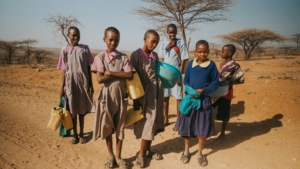 Famine rarely arrives without warning. Yet in many cases, the signs go unnoticed until people are already on the brink. A new wave of data-driven tools and predictive famine modeling seeks to change that. Satellites, mobile surveys, artificial intelligence (AI) and harmonized datasets are being used to forecast hunger months in advance—and whether those predictions can be turned into action.
The Urgency: Hunger on the Rise
Globally, more than 343 million people face severe food insecurity, a surge driven by climate shocks, conflict and economic instability. Behind those numbers are families skipping meals, parents who go hungry so their children can eat and communities forced to make impossible choices. In 2025, the World Food Program (WFP) warned that 58 million people risk losing food assistance unless emergency funding is secured.
For those on the ground, this doesn’t just mean smaller rations—it can mean no rations. In places already strained by drought or conflict, the absence of aid can tip households from hardship into catastrophe. Donor contributions have dropped by 40% compared to the previous year, leaving many relief programs strained and at risk of collapse.
This funding shortfall comes at the worst possible time: wars and weather extremes are multiplying, food prices are volatile and the world’s most vulnerable are bearing the brunt. The humanitarian community has described it as a “perfect storm,” where shrinking resources collide with rising needs.
In this context, predictive famine modeling is of critical importance. If the world cannot guarantee more food aid today, it can at least sharpen its ability to see where tomorrow’s hunger will strike. The question is whether we can turn foresight into action—moving from a cycle of crisis response to one of prevention.
The Data Revolution
Researchers are combining data streams that once seemed unrelated to forecast hunger more effectively. Every signal tells part of the story, from satellites watching rainfall and crop growth to mobile phone surveys capturing what families eat each week. Remote sensing provides a broad view of land and weather patterns that hint at failing harvests. At the same time, phone interviews and household surveys show how people cope—whether meals are being skipped or diets are being cut back.
To bring this information together, new tools such as the Harmonized Food Insecurity Dataset (HFID) now integrate multiple indicators into one monthly, subnational series. It gives analysts a clearer picture of when and where food stress worsens. Even unconventional sources are being tapped: the AI model HungerGist, for example, scans thousands of news reports to detect signals of looming food crises that traditional surveys may miss.
The result is a new way of seeing hunger. Instead of reacting once famine takes hold, analysts can detect trouble months in advance and pinpoint specific regions at risk. By weaving together these diverse sources, predictive famine modeling moves humanitarian response from hindsight to foresight.
Case Study: Zimbabwe’s Survey Fusion
One of the most promising real-world examples comes from Zimbabwe. Researchers developed a joint Multilevel Regression & Poststratification (jMRP) model that fuses high-frequency mobile survey data from WFP’s mVAM with annual face-to-face surveys conducted by ZimVAC. Mobile phone data alone is fast but imprecise, while in-person surveys are accurate but slow. The fused model corrects for bias, narrows uncertainty and produces monthly, district-level estimates of food insecurity.
It allowed agencies to detect worsening conditions in specific regions before new survey rounds arrived—a major step toward real-time hunger monitoring. This illustrates how predictive famine modeling can combine imperfect but frequent data with slower, more accurate surveys to produce actionable insights.
Challenges and Blind Spots
However, predictive famine modeling is not a silver bullet. Conflict zones and remote areas often remain invisible because reliable surveys cannot be conducted there. Bias is another issue: phone surveys exclude people without access to mobile technology and news-based models can be distorted by unequal media coverage.
Proxy data also have limitations—crop stress or rainfall deficits do not always translate into hunger if aid, markets or remittances intervene. And even the best predictions cannot guarantee action: humanitarian actors face funding shortfalls, logistics challenges and political barriers that can prevent aid from reaching people on time.
Looking Ahead: From Bytes To Bites
Despite these challenges, the potential of predictive models is clear. With climate shocks, conflict and economic crises overlapping, early warnings are more necessary than ever. Experts argue three steps are critical: expanding data coverage through community surveys, integrating forecasts directly into aid planning to trigger cash transfers or prepositioned supplies and securing reliable funding so warnings are acted upon rather than ignored.
Ultimately, the goal is to turn “bytes into bites.” Predictive famine modeling is not the same as preventing hunger. However, with better data and stronger response systems, famine need not arrive silently. If early warnings can be matched with early action, the world could finally begin to stop famine before it strikes.
– Diane Dunlop
Diane is based in Edmonton, Alberta, Canada and focuses on Good News and Technology for The Borgen Project.
Photo: Unsplash
