• Link to X
  • Link to Facebook
  • Link to Instagram
  • Link to TikTok
  • Link to Youtube
  • About
    • About Us
      • President
      • Board of Directors
      • Board of Advisors
      • Financials
      • Our Methodology
      • Success Tracker
      • Contact
  • Act Now
    • 30 Ways to Help
      • Email Congress
      • Call Congress
      • Volunteer
      • Courses & Certificates
      • Be a Donor
    • Internships
      • In-Office Internships
      • Remote Internships
    • Legislation
      • Politics 101
  • The Blog
  • The Podcast
  • Magazine
  • Donate
  • Click to open the search input field Click to open the search input field Search
  • Menu Menu

Tag Archive for: Tourism

Posts

Global Poverty

Reducing the Poverty Rate in Jamaica: Obstacles and Successes

Poverty Rate in Jamaica
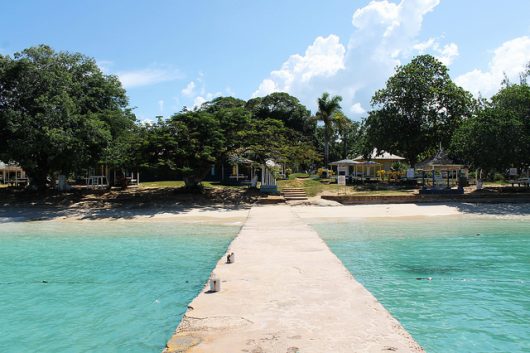
The poverty rate in Jamaica is decreasing due to economic growth. The government wants this trend to continue. It is stated in the December 2016 National Poverty Eradication Programme (NPEP) that its vision for every Jamaican is to consume goods and services above minimum acceptable national standards. The government envisions a state where everyone has equal opportunities and support to achieve and maintain income security and improved quality of life.

As with any dream, there are several obstacles to attaining this vision. There are also successes that signal the vision is possible. Here are eight facts about efforts to further reduce the poverty rate in Jamaica.

  1. According to the government’s NPEP, in 2012, 19.9% of the population was living at or below the poverty line.
  2. Unemployment rates have fallen in the country. According to the Statistical Institute of Jamaica, the unemployment rate in Jamaica in January 2017 was 12.7%, compared to 13.3% in January 2016.
  3. While unemployment rates have gone down for the population as a whole, unemployment rates remain high for youth. According to the World Bank, the unemployment rate for youth is 28.6%. This is leading to high levels of crime and violence.
  4. According to the World Bank, Jamaica is considered to be an upper-middle-income country. The United Nations Development Programme states that Jamaica received this classification in 2010 due to being on track to eradicating extreme hunger and ensuring environmental sustainability.
  5. Even though Jamaica is viewed as an upper-middle-income country, it faces many obstacles in economic growth. The World Factbook reports that Jamaica’s economy has grown on average less than one percent per year for the last three decades. Economic growth has been slow due to a high debt-to-GDP ratio and high rates of crime and corruption.
  6. Focus Economics highlights that tourism is helping the Jamaican economy. The island welcomed its one-millionth tourist in mid-June 2017, two weeks before receiving a private investment of $1 billion for a chain of hotels and resorts.
  7. According to the World Factbook, Jamaica has made progress in reducing its high debt-to-GDP ratio. In 2012 it was at 150%. It is now at 115%. Collaboration with the International Monetary Fund made this achievement possible.
  8. Poverty programs are being instituted in Jamaica. Most of these are state-led. In its NPEP, Jamaica outlines its goals for eradicating poverty. Its first goal is to eliminate extreme food poverty by 2022. Its second goal is to get the national poverty line reduced significantly below 10 percent by 2030.

There are several poverty reduction programs currently in place in Jamaica. Further reducing the poverty rate in Jamaica is feasible due to the government’s thorough NPEP. If the government reaches the goals outlined in the policy, poverty reduction will be systemic and all Jamaicans will be able to realize the dream of equitable opportunities. While there are significant challenges, Jamaica’s economic future is promising.

– Jeanine Thomas

Photo: Flickr

August 8, 2017
https://borgenproject.org/wp-content/uploads/borgen-project-logo.svg 0 0 Kim Thelwell https://borgenproject.org/wp-content/uploads/borgen-project-logo.svg Kim Thelwell2017-08-08 07:30:382024-05-28 00:15:13Reducing the Poverty Rate in Jamaica: Obstacles and Successes
Water

Water Quality in Seychelles

Water Quality in Seychelles
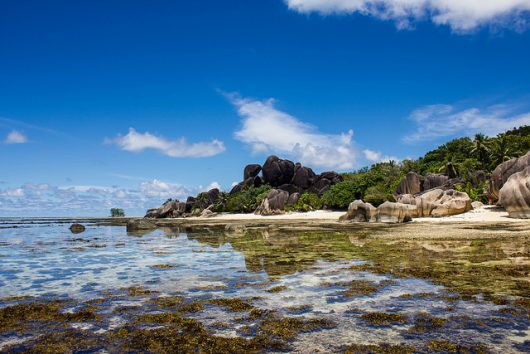
The Republic of Seychelles is an archipelago of 115 low-lying, granitic islands in the western Indian Ocean. This sovereign country is a popular holiday getaway for tourists wishing to lounge on its stunning beaches; discover its diverse ecological system; and visit ancient volcanos. Water quality in Seychelles remains a major issue, however.

Though the Republic’s 1993 Constitution defines access to potable water as a basic right to all Seychellois, water shortage and pollution is a defining factor of the archipelago.

While local tap water meets World Health Organization’s specifications, the Seychelles Islands official tourism website advises visitors to drink bottled water because the chlorinated tap water may not be safe to drink. Furthermore, because water quality in Seychelles is variable in undeveloped areas, it is recommended that tap water be boiled, filtered or chemically disinfected before consumption.

The islands’ groundwater resources are extremely limited, and the terrain makes it even harder to procure fresh water. Due to the country’s prevailing granitic landscape, water that is available is often too hard and salty to consume.

Of course, rapid change in weather and rainfall patterns is a global phenomenon and is not uncommon to Seychelles. Shifting weather patterns directly affect the water supply and reduce the precious steam flow, making it difficult for groundwater to recharge.

Most of the water in Seychelles comes from hills and streams from the mountainside, flowing more freely during monsoon and rain seasons. As a result of heavy rainfall, storm surge, flooding and poor sanitation, the presence of water-related bacterial infections—including Campylobacter jejuni, small strains of E.coli, cholera and other contaminants—in the country’s water supply can cause traveler’s diarrhea, a term used to describe gastrointestinal infections caused by ingesting bacteria, viruses and protozoa.

Four desalination plants compensate for the water shortage during drier seasons and produce potable water. They help enhance water reliability of the three main islands. The country is not only managing its scarce water resources, but it is also searching for more water. Of course, water quality in Seychelles remains an accompanying concern.

Options such as drilling for underground water are currently being explored to supplement the existing surface water (usually accumulating on slippery rock fissures if not running off to sea) and add to the water supply of dams and desalination plants.

In November 2009, the Seychelles National Climate Change Committee embarked on an ambitious vision to engage all levels of the Seychellois society in combating the potentially disastrous effects of climate change.

The committee recognized that water resources in islands as small as Seychelles were “likely to be seriously compromised”—both due to growing demand and climate change —and predicted that Seychelles would be facing “serious water shortages in the near future.”

This was despite the presence of extensive water distribution networks that served about 87% of the population with treated water. Furthermore, an increase in surface air temperatures would result in reduced streamflow due to water evaporation and further exacerbate the problem of water supply.

By 2030, the water demand on the main island of Mahé is expected to grow by 130%. Currently, Seychelles can only meet 60% of its residents’ water.

Earlier this month, a ban on manufacturing, distribution and commercial usage of common plastic items—such as Styrofoam containers, utensils and cups—went into effect in an attempt to make Seychelles cleaner and more beautiful.

The Environmental Protection Regulations of 2017 restrict the importation of certain types of plastic bags and authorize importation permits for biodegradable bags. Treatment of wastewater is being upgraded through renovations of existing sewerage pumping stations and construction of five new ones, with a Sanitation Master Plan currently in the works.

Furthermore, a new Center for Ocean Restoration, Awareness and Learning (CORAL) opened in May 2017 on the island of Praslin to study, brainstorm ideas and increase awareness of the ocean-conservation efforts by bringing scientists and students together from all over the world.

Seychelles is the smallest African state, with only about 84,000 people. Its sustainable tourism model remains an example for the rest of the world. As the archipelago comes to terms with its water shortage and pollution problems, reliable and sustainable water supply remains as essential as ever. If the water quality in Seychelles can be improved, the quality of life of residents and tourists—and their future generations—will only become better.

– Mohammed Khalid

Photo: Flickr
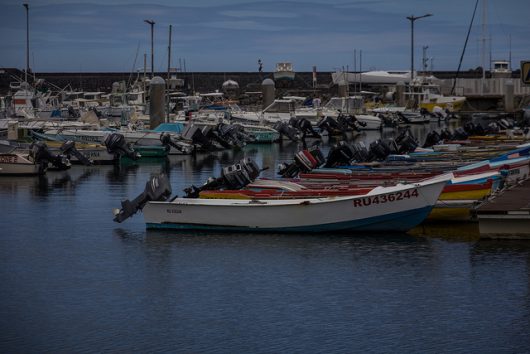
August 5, 2017
https://borgenproject.org/wp-content/uploads/borgen-project-logo.svg 0 0 Kim Thelwell https://borgenproject.org/wp-content/uploads/borgen-project-logo.svg Kim Thelwell2017-08-05 07:30:112024-05-28 00:15:12Water Quality in Seychelles
Global Poverty

Increasing Tourism in Nigeria Could Strengthen Economy


In a meeting on June 23, the Nigerian Tourism Development Corporation (NTDC) announced a partnership with the Niger Delta Development Commission (NDDC).  The establishment of this association hopes to bolster tourism in Nigeria. The project seeks to completely rebrand the tourism industry, all while creating a multitude of new jobs and strengthening Nigeria’s economy. According to the assistant director of NTDC’s press unit, Mrs. Adamma Afanga: “we need to start within our domain, focusing on consumption of our assets, promotion, and development of domestic tourism.”

In recent years, the Nigerian government and people have faced unemployment, the devaluation of Nigerian currency, terrorist activity and political instability. While this has made it difficult to attract foreign visitors, there is a significant opportunity for a turnaround. Inflation has slightly decreased, and Nigeria’s GDP recently saw its best quarter performance in the past year. Additionally, President Muhammadu Buhari has received positive marks in the international community for his humanitarian efforts and economic policies.

Because of these reasons, attracting foreign visitors has been difficult in recent years.  As a result tourism in Nigeria has been particularly affected by political and financial instability. Most notably, terrorism and economic recession have made many international visitors less likely to visit Nigeria. However, by promoting investment and rebranding the tourism industry, there is the potential for significant economic growth in the country.

Currently, tourism in Nigeria is a relatively small industry with much room for growth but many challenges to overcome. In 2016, the hospitality industry comprised 4.8 percent of the Nigerian GDP. Despite the fact that many new hotels were created in the last few years, the number of foreign visitors to Nigeria declined significantly. The majority of clientele in the hospitality industry were domestic, corporate guests looking to travel in the cheapest way possible, which is readily achievable given the vast supply of accommodations.

The primary challenge of this partnership is synergizing the different aspects of tourism in Nigeria. According to Folorunso Coker, Director-General of the NTDC, the ultimate goal of this partnership is to create an all-inclusive tour package for Nigerians. This would not only capitalize on the country’s existing domestic travel industry but would create many new jobs. This is because building the necessary infrastructure, security and technology for attracting tourists will require skilled laborers.

As stated by Coker, strengthening tourism in Nigeria “will have multiple effects on job creation and poverty alleviation while strengthening GDP and [Nigeria’s] currency. Everyone in the value chain of tourism must work together and be ready to drive the market.”

– Julia Morrison

Photo: Flickr

July 11, 2017
https://borgenproject.org/wp-content/uploads/borgen-project-logo.svg 0 0 Borgen Project https://borgenproject.org/wp-content/uploads/borgen-project-logo.svg Borgen Project2017-07-11 01:30:222024-06-05 02:36:39Increasing Tourism in Nigeria Could Strengthen Economy
Global Poverty

How Tourism Could Alleviate Poverty in Saint Pierre and Miquelon

Off the coast of Newfoundland in North America lie the islands of Saint Pierre and Miquelon, a French territory with a rich history and a poor economy. The island is home to around 5,000 people, of which 78% are of working age.

Poverty in Saint Pierre and Miquelon

Poverty in Saint Pierre and Miquelon has increased due to the islands’ reliance on a fishing industry affected by overfishing and changing global climatic conditions. The fishing economy downturn, which has caused the present state of poverty in Saint Pierre and Miquelon, threatens to prevent the expansion of clean water infrastructure and, by extension, sanitation.

Once bustling epicenters notorious for their pivotal role in illegal alcohol importation into the United States (U.S.) during prohibition, these islands are now faced with a severe lack of economic stimulus, causing a certain level of stagnation in the territory.

Poverty in Saint Pierre and Miquelon can largely be attributed to its suffering fishing industry, which is under pressure from competing for Canadian commercial fishing, changing climatic conditions and general overfishing. Fishing, on both the commercial and local scale, provides the livelihoods of 41% of the territory’s population. This means that any fluctuation in fishing profits directly influences the standard of living for almost half the territory’s population.

Economic Struggles

Although the islands of Saint Pierre and Miquelon are a territory of France, a country with one of the highest nominal gross domestic products (GDPs) in Europe, the islands are far away from entertaining the standard of living enjoyed by the landlocked French. France is responsible for much of the existing infrastructure and development on Saint Pierre and Miquelon. However, France lacks the fiscal budget or political interest to fully incorporate the islands, forcing it to find new ways to expand its economy to accommodate its growing population and standard of living.

The Impact of Tourism

Tourism is one sector Saint Pierre and Miquelon could potentially utilize as a respite from the fishing industry’s contracting revenues. With the territory’s intriguing smuggling history and its arguable position as the last true French outpost in North America, the potential for a thriving tourism economy is present.

Tourism can alleviate poverty in Saint Pierre and Miquelon by creating new jobs and opportunities for its working population, resulting in the country’s overall economic growth. Tourism can also lead to the development and establishment of new infrastructures, including health care centers and schools, which could ultimately benefit the nation’s population.

Final Remark

According to the World Bank, the tourism industry can assist developing nations like Saint Pierre and Miquelon in diversifying their economies and markets, creating new opportunities for their citizens. Therefore, by developing its tourism sector, the government of Saint Pierre and Miquelon can create new opportunities for its population, ultimately lifting them out of poverty.

– Spencer Linford

Photo: Flickr
Updated: June 01, 2024

May 29, 2017
https://borgenproject.org/wp-content/uploads/borgen-project-logo.svg 0 0 Borgen Project https://borgenproject.org/wp-content/uploads/borgen-project-logo.svg Borgen Project2017-05-29 01:30:142024-07-14 01:51:31How Tourism Could Alleviate Poverty in Saint Pierre and Miquelon
Global Poverty

Tourism in Kenya: International Hotel Chain Investments

Touirism in Kenya
An international hotel chain is investing in tourism in Kenya. Tune Hotels, based in Malaysia, opened a hotel in Nairobi, Kenya last July. The hotel chain is focused on giving travelers the bare necessities in exchange for a reasonable price, similar to low-cost airlines such as Spirit Airlines.

Nairobi, in particular, has become an attractive site for foreign direct investment as opposed to simply development aid. Tune Hotel is just one example of foreign direct investment, another of which is China’s investment in infrastructure in Kenya.

The target market for this hotel chain is business travelers since they normally do not use all the services they pay for at a normal hotel. Business travelers, both local and foreign, make up about 70 percent of Tune Hotel’s guests.

In addition, business travelers comprise about 95 percent of hotel bookings in Kenya. Business travel spending accounted for 37.5 percent of all tourism spending in Kenya in 2015 and is expected to rise due to increased flights between Nairobi, China and the Middle East.

Kenya has a growing middle class, which has led to a rise in domestic tourism. Kenyan tourists make up around 60 percent of the guests at Tune Hotels, and about a third of Africans have entered the middle class over the last 10 years. The Kenyan Tourism Board launched a campaign in 2013 called “Tembea Kenya” or “Tour Kenya,” which is a campaign targeted at the nation’s own middle class.

The tourism industry, which consists of hotel jobs, travel agents and leisure activities, is expected to create around 275,000 jobs in Kenya by 2025. Tourism in Kenya makes up about four percent of the gross domestic product. Thus, foreign investment in this sector is crucial to its growth.

– Jennifer Taggart

Photo: Flickr

April 25, 2017
https://borgenproject.org/wp-content/uploads/borgen-project-logo.svg 0 0 Borgen Project https://borgenproject.org/wp-content/uploads/borgen-project-logo.svg Borgen Project2017-04-25 01:30:382024-12-13 17:56:43Tourism in Kenya: International Hotel Chain Investments
Global Poverty

Poverty in Monaco: A Dream Come True

Poverty in Monaco
Poverty in Monaco? The nation is a sovereign city-state that lies along the southern border of France with its toes in the French Riviera. It is the second smallest sovereign nation on earth being only slightly larger than the Vatican. The population is only about 38,000 people. With the size being only about 0.78 square miles, it is possible to walk the width of the country within an hour.

Monaco has two major sources of income: tourism and millionaires purchasing properties. As a result, the poverty line has been all but erased, with everyone being above it. According to the World Health Organization (WHO) in 2009, Monaco is “NA [not-applicable]” for statistics on the national population below the poverty line because there are none.

One-third of the population is made up of millionaires. Monaco’s population is only 16% Monegasque in origin while the other 84% are wealthy outsiders. With 47% French nationals, and the other 37% a combination of Italians, Britons, Belgians, Germans and Americans (and recognizing that Monaco is only 38,000 people strong), the imposition of foreigners is unusual.

Monaco does not charge income tax on its residents. This hefty tax break attracts many of the globe’s rich and famous to its shores. According to WealthInsight, one-third of the population of Monaco is made up of millionaires. That means that if 12 people were walking down the streets of Monaco, at least four of them would have platinum cards in their pockets and millions of dollars in their bank accounts.

Monaco began its tradition of no income tax in 1869 after the creation of the Grand Casino de Monte Carlo. In 1858, when the Casino had its grand opening, it “[had] been so successful in bringing in profits that the government decided to stop collecting income taxes from residents,” according to Eric Goldschien in Business Insider Magazine.

Tourism is a big income earner. One of Monaco’s only income-earning industries is tourism and with its beautiful climate and crowd-drawing sites like the Grand Prix and five major casinos, three of which being in Monte Carlo, it is an easy means for capital. In Professor Michael Porter’s paper Monaco’s Tourism Cluster, he states that “Monaco has, for over a century, successfully made tourism…its biggest income earner…”

The many areas of tourism in Monaco include hotels/spas, restaurants/bars, gambling, conferences, sports, tour operators, health/medical and culture/leisure activities. With all of these major tourism sectors hard at work, the income turnover for Monaco totals 100 billion euros, which is roughly equivalent to 105,775,000,000 dollars.

A Monegasque family’s monthly budget averages higher than global comparisons. Paul Nayakazeya in The Financial Gazette compared the average consumer basket of a family in Zimbabwe to that of a family in Monaco.

A consumer basket explains the way a family spends its money by monitoring the most commonly bought foods, household items and services that are offered in the consumer market. Anything a person can buy, be it a sandwich or a haircut, is included in the consumer market and examined in a family’s basket, i.e. the purchased commodities.

A family of six in Zimbabwe will spend roughly 561 dollars in one month, while a family of five in Monaco will spend an average of 12,000 dollars.

The government reinvests tourism earnings and other capital gains back into the community to improve the quality of life and to entice the wealthy to continue traveling and buying properties. Even though these improvements are meant to attract foreigners with money, the natives benefit from it as well, effectively creating a virtually nonexistent poverty line within their tiny, proud and sovereign nation.

– Karyn Adams

Photo: Flickr

March 4, 2017
https://borgenproject.org/wp-content/uploads/borgen-project-logo.svg 0 0 Borgen Project https://borgenproject.org/wp-content/uploads/borgen-project-logo.svg Borgen Project2017-03-04 01:30:472024-12-13 17:56:41Poverty in Monaco: A Dream Come True
Global Poverty

Poverty Alleviation in Maldives

Poverty Alleviation in Maldives
The Maldives is located in the Indian Ocean. The country is comprised of 26 ring-shaped atolls, which are made up of about 1,190 islands — 198 are inhabited. The tropical country is known for its beautiful beaches, lagoons and reefs and is largely economically driven by tourism. The country has also become known in recent years for its rapid economic advancement to a middle-income country. A dedication to poverty alleviation in the Maldives has come hand-in-hand with its growing economy.

In the 1980s, Maldives was one of the 20 poorest countries in the world. The leaders of the country dedicated funding and resources to creating a nationwide transportation system, affordable living and housing costs, quality universal health care and the prevention of narcotics abuse and trafficking.

Maldives capital city, Male, has been one of the most densely populated cities in the world for many years. The transportation system and diversifying economy has taken some pressure off of the capital to sustain the majority of economic activities.

The Maldives have also demonstrated a commitment to democracy and fairness in politics. Multi-party democracy was implemented for the first time in 2005 and in 2008, a new constitution embodying democratic principles was ratified. This was quickly followed by the country’s first free elections. The new democratic movement in the Maldives has guaranteed separation of powers and election of a new Parliament, president and an independent judiciary.

Both tourism and the fishing industry have boosted the Maldives economy and provided steady jobs and incomes for thousands of citizens.

According to the World Bank, the number of people living below the poverty line shrunk from 23 percent in 2002 to 15.7 percent in 2009. The life expectancy of the average Maldivian also increased by 20 years between 1977 and 1995. Although the growth rate has slowed slightly in recent years due to things like the 2004 tsunami and the ups and downs of the global economy, it is expected to pick back up again before 2017.

The average GDP growth rate for the Maldives was close to six percent between 2000 and 2009, making it one of the highest in all of Asia. It has rapidly advanced to a middle-income country and due to this, has been able to make tangible progress in reaching the Millennium Development Goals.

Despite the impressive advancements made by the Maldives in recent years, the country still faces several challenges on its way to prosperity. Rising sea levels and climate change are a huge threat to the nation, as 80 percent of the land area of its islands is less than one meter about sea level. The new constitution outlines the protection of the environment as a key human right, and tourism outlets and fisheries have begun to develop eco-friendly policies.

Economic growth and poverty alleviation in the Maldives has allowed it to become one of the fastest developing nations in South Asia.

– Peyton Jacobsen

Photo: Flickr

October 30, 2016
https://borgenproject.org/wp-content/uploads/borgen-project-logo.svg 0 0 Borgen Project https://borgenproject.org/wp-content/uploads/borgen-project-logo.svg Borgen Project2016-10-30 01:30:022024-05-27 23:54:08Poverty Alleviation in Maldives
Global Poverty, Technology

Mapping Startup Helps Identify Unmapped Areas

mapillaryIn spite of modern digital services like Google Street View, many locations in developing countries, such as Dar es Salaam in Tanzania, remain inaccessible to much of the world.

Swedish startup Mapillary and the World Bank have teamed up to solve this problem. Mapillary enables individuals to map their own streets by collecting street level photos simply by using their smartphones.

Such maps can help cities anticipate and recover from natural disasters, track traffic congestion, distribute resources to the impoverished communities that need them and build public transportation systems.

Mapillary CEO Jan Erik Solem told NPR News, “Dar es Salaam has really poor map data. The reason is that the mapping companies need people on the ground or in the local area to create the actual map.”

Maps that detail roads, homes, rivers and terrain may help kickstart city planning.

“In order for it to flourish into the metropolitan city [Dar es Salaam] has the potential to become, we began a community-based mapping project called Dar Ramani Huria (Swahili for “Dar Open Map”),” states a blog post from the World Bank, “to bring disaster prevention and response to previously unmapped areas, training the local community to create highly-accurate maps by the residents who know their city best.”

25 wards have been charted so far in Dar es Salaam with Mapillary. The task was accomplished by attaching a camera to a local Tanzanian rickshaw and by using photos taken by a motorist. These photos were then uploaded to Mapillary and constructed in 3D. A blog post by the World Bank on Mapillary’s website says that this information allows them to “pinpoint troubled areas” and to map out the routes locals often use.

As these maps are developed, they are run through software that develops natural disaster scenarios to help citizens improve planning and preventive efforts.

NPR reports that more than 260 citizens have volunteered to take photos for the mapping project. Locals have taken around 23,000 photos, which will map 300 miles of road.

“Sparking the community’s interest in mapping has the potential to truly transform Dar es Salaam into a prosperous city with the infrastructure to prevent floods, bring awareness to the need for flood prevention and risk reduction, and arm its citizens with the right tools and skills to build a better city,” states the same blog post.

– Kaitlyn Arford

Sources: NPR, Mapillary, World Bank
Photo: Flickr

March 26, 2016
https://borgenproject.org/wp-content/uploads/borgen-project-logo.svg 0 0 Borgen Project https://borgenproject.org/wp-content/uploads/borgen-project-logo.svg Borgen Project2016-03-26 01:30:012024-06-04 01:03:14Mapping Startup Helps Identify Unmapped Areas
Global Poverty

Obama’s Visit to Cuba: An Opportunity for Development

Obama Visit to CubaPresident Obama’s visit to Cuba this month will mark the first visit to the Caribbean island by a sitting American president in 88 years.

The trip is part of a series of efforts by Cuba and the U.S., begun in December 2014, to ease restrictions and pave the way for greater cultural and economic exchange.

After announcing his plans, President Obama drew criticism from some American politicians who believe that his administration’s Cuba policy is not sufficiently punitive, according to the New York Times. Others, however, have applauded the president, arguing his diplomacy could spur a period of progress with regard to human rights improvements and poverty alleviation.

Though Cuba’s communist government has long been censured by the international community for human rights violations, the country has made some notable achievements in the past half-century.

According to the Guardian, Cuba has had 100 percent literacy for a long time, and “its health statistics are the envy of many far richer countries.”

Devex, a media platform for the global development community, has also applauded Cuba for its success in lifting many of its poorer citizens out of poverty.

The island’s state-run economy, however, does not seem capable of solving all its problems, according to Devex. Inequality runs rampant despite decades of socialist programming.

This disparity of wealth, along with a growing older population, closed markets and limited availability of advanced technologies and quality food for farmers and other low-income people has begun to overwhelm Cuba’s social protection programs.

Some see Obama’s visit to Cuba as an opportunity to influence President Raul Castro to make necessary changes in addressing these problems.

The New York Times Editorial Board has called on the president to push Castro to “set the stage for a political transition in which all Cubans are given a voice and a vote” as a pretext for liberalizing the economy and respecting human rights.

The editorial adds that the U.S.’s failed efforts to bring about regime change have only hurt Cuba and that more peaceful gestures geared toward self-determination would be more helpful.

Specifically, Obama could negotiate the lifting of trade embargoes as a way of easing the burden on Cuba to supply its citizens with adequate food and other resources.

The United Nations already has a development action framework for the island, which focuses on food security, energy, social services, climate change and disaster response, according to Devex.

These efforts, along with those of big players in the development community, like the World Food Program, would be significantly bolstered by the normalizing of relations between Cuba and the U.S., since freer trade would make the island less dependent on essential goods from more distant nations.

The exact program of President Obama’s visit to Cuba is still open to speculation but the topics most likely to be discussed are trade and tourism. Opening up relations with regard to these areas could be mutually beneficial to both nations.

– Joe D’Amore

Sources: BNA, Devex, NY Times 1, NY Times 2, The Guardian

March 15, 2016
https://borgenproject.org/wp-content/uploads/borgen-project-logo.svg 0 0 Borgen Project https://borgenproject.org/wp-content/uploads/borgen-project-logo.svg Borgen Project2016-03-15 01:30:582024-12-13 18:05:49Obama’s Visit to Cuba: An Opportunity for Development
Global Poverty

Pack for a Purpose: Doing Some Good on Your Next Vacation

Pack for a Purpose
It is becoming easier than ever to positively impact a community in which you are vacationing thanks to Pack for a Purpose. The organization, founded in 2009, lists supplies needed for community projects around the world that travelers can bring with them.

Pack for a Purpose has partnered with more than 475 accommodations and tour companies to supply community projects in more than 60 countries, according to their website. Community projects are broken down into education, health, child welfare, animal welfare and socio-economic development.

“Everyone’s mother told them when you go to someone’s house to eat a meal, you take a gift – candy, flowers, whatever – to say thank you for your hospitality,” said Rebecca Rothney, Pack for a Purpose’s founder and chairperson, to the PBS News Hour.

“So when you go to somebody’s country, it’s my belief you should also say ‘thank you for your hospitality’ by bringing people in that country something they could actually use. And hopefully, that’s where our website comes in,” added Rothney.

Packing for a purpose comes down to five easy steps: selecting a destination, finding accommodation or a tour company and a project it supports, picking items from the project’s requested items list and dropping off supplies at the accommodation or tour company. From there, the company delivers the supplies you have contributed.

Travelers have shown how simple the process is and have shared their stories on Pack for a Purpose’s website. Additionally, travelers may have the option to go with the accommodation or tour company to meet the communities and personally deliver their supplies. Some incredibly heartwarming stories have come from the staff that work and live in these communities.

https://www.youtube.com/watch?v=afXhN0EbnFQ

Suzan Kruger, who works at the Kwa Maritane accommodation in South Africa, shared a story about the many supplies they’ve received for the Borite Primary School, which serves children who come from low to no-income families.

“This morning I walked in to an incredible mountain of school supplies, puzzles, board games, books, sporting equipment and wall charts. Incredibly this weighed in at an amazing 73.23 kilos [161.44 pounds],” said Kruger in October 2015. “Over the past 2.5 months, we have been able to pass on an incredible 174.85 kilos [385.47 pounds] of donations to the school.”

Travelers are encouraged to check Pack for a Purpose’s website prior to their next adventure for an updated list of participating accommodation and tour companies and the supplies needed. Small donations can quickly add up and make a big difference.

– Summer Jackson

Sources: Pack for a Purpose 1, Pack for a Purpose 2, PBS

March 5, 2016
https://borgenproject.org/wp-content/uploads/borgen-project-logo.svg 0 0 Borgen Project https://borgenproject.org/wp-content/uploads/borgen-project-logo.svg Borgen Project2016-03-05 01:30:552024-12-13 18:05:48Pack for a Purpose: Doing Some Good on Your Next Vacation
Page 8 of 10«‹678910›»

Get Smarter

  • Global Poverty 101
  • Global Poverty… The Good News
  • Global Poverty & U.S. Jobs
  • Global Poverty and National Security
  • Innovative Solutions to Poverty
  • Global Poverty & Aid FAQ’s
Search Search

Take Action

  • Call Congress
  • Email Congress
  • Donate
  • 30 Ways to Help
  • Volunteer Ops
  • Internships
  • Courses & Certificates
  • The Podcast
Borgen Project

“The Borgen Project is an incredible nonprofit organization that is addressing poverty and hunger and working towards ending them.”

-The Huffington Post

Inside The Borgen Project

  • Contact
  • About
  • Financials
  • President
  • Board of Directors
  • Board of Advisors

International Links

  • UK Email Parliament
  • UK Donate
  • Canada Email Parliament

Get Smarter

  • Global Poverty 101
  • Global Poverty… The Good News
  • Global Poverty & U.S. Jobs
  • Global Poverty and National Security
  • Innovative Solutions to Poverty
  • Global Poverty & Aid FAQ’s

Ways to Help

  • Call Congress
  • Email Congress
  • Donate
  • 30 Ways to Help
  • Volunteer Ops
  • Internships
  • Courses & Certificates
  • The Podcast
Scroll to top Scroll to top Scroll to top