• Link to X
  • Link to Facebook
  • Link to Instagram
  • Link to TikTok
  • Link to Youtube
  • About
    • About Us
      • President
      • Board of Directors
      • Board of Advisors
      • Financials
      • Our Methodology
      • Success Tracker
      • Contact
  • Act Now
    • 30 Ways to Help
      • Email Congress
      • Call Congress
      • Volunteer
      • Courses & Certificates
      • Be a Donor
    • Internships
      • In-Office Internships
      • Remote Internships
    • Legislation
      • Politics 101
  • The Blog
  • The Podcast
  • Magazine
  • Donate
  • Click to open the search input field Click to open the search input field Search
  • Menu Menu

Tag Archive for: Refugees

Posts

Education, Refugees and Displaced Persons

Makeshift School Serves Calais Refugees

Makeshift school serves Calais refugees
When refugees imagine the amount of time they will be living in an encampment, they probably do not anticipate staying long — their minds already drift to a possible future beyond the camp’s makeshift walls.

However, as more refugees flee from conflicted countries such as Syria, Afghanistan and Africa, these supposedly temporary living arrangements are beginning to become communities of their own. For a camp in Calais, France, mosques, churches, shops, a barber and, as of last month, a school can be found in the encampment for those passing through.

According to an article by the global campaign A World at School, the largest camp in the northern part of Calais and Western Europe is known as “the Jungle,” housing as many as 3,000 immigrants who wait in the hopes of gaining entrance into the United Kingdom.

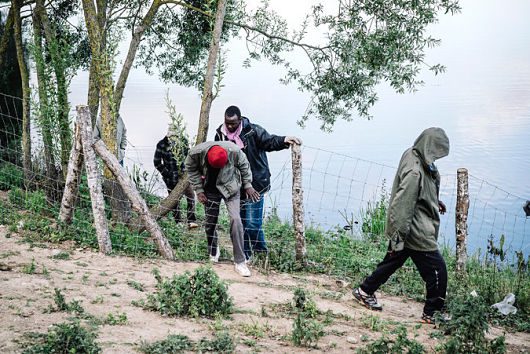
Near the Jungle is the English Channel tunnel, known for its connection between France and England, which serves as a potential point of entry for migrants. Despite the danger and increased security around the border zones, migrants are willing to risk everything for the chance to jump on trains and lorries bound for the UK.

Meanwhile, refugees attempt to include aspects of normalcy into their everyday schedules by attending school or passing the time playing a game of dominoes. Makeshift tents and poorly constructed buildings make up the encampment, which is filled with people who have already survived the dangerous trek from their homes in the Middle East and Africa.

Today, it is not uncommon to see a school inside of a refugee camp, so when refugees started asking how to say French words or numbers, a makeshift school was created by Nigerian Zimarco Jones. It was soon up and running, staffed with the help of French volunteers.

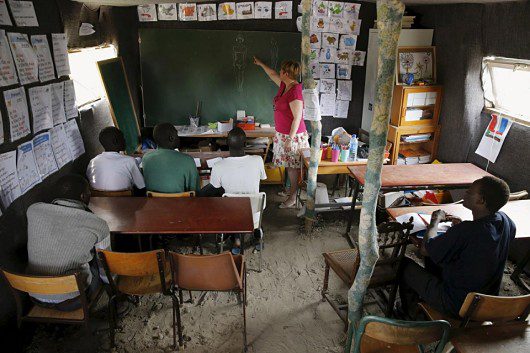
Constructed from materials such as branches and wood panels, the makeshift school seats 20 students and faces a blackboard. Since its establishment in July, it has been given the name L’Ecole Laïque du Chemin des Dunes, which translates to The Secular School of Dune Way.

Mostly young men attend the school to learn both English and French and other subjects, but Jones plans to build an additional school for the more than 20 children and 200 women who live in the camp.

The current state of conflict in the world has displaced an astronomical number of children from their homes, wreaking havoc on their childhoods and robbing them of their education. Fortunately, there are opportunities that can be found in those temporary homes and stops along the way to their final destination — some place they earnestly look forward to one day calling home.

– Nikki Schaffer

Sources: A World at School, The Guardian 1, The Guardian 2
Photo: Al Jazeera America

August 23, 2015
https://borgenproject.org/wp-content/uploads/borgen-project-logo.svg 0 0 Borgen Project https://borgenproject.org/wp-content/uploads/borgen-project-logo.svg Borgen Project2015-08-23 01:30:192024-06-04 04:33:48Makeshift School Serves Calais Refugees
Global Poverty, Refugees and Displaced Persons

Refugees in Calais See Hope In Britain

refugees_in_calais
Many refugees in Calais, France are using any means possible — most of them using rather dangerous means — to make their way to Britain in hopes of a new life.

Hundreds of thousands of immigrants sit in refugee camps in Calais waiting to make their next attempt into the United Kingdom. Many of these individuals have traveled all the way from Africa, the Middle East and some from even further away. For most, sanctuary in Britain is the last stop on a very long journey that may have lasted for months, with hopes that a better life and more opportunities await them on the other side of the English Channel.

In France, where many migrants await the next move, which may potentially land them in Britain, lie refugee camps filled with hundreds of thousands of migrants from all around the world. Many have fled injustice and corruption within their native countries, such as that of Sudan, Eritrea and other crime-ridden and infamously violent nations.

Within the camps are volunteers and medical staff to help those who have been injured or have fallen ill throughout their long journeys. Nurses in the camps have recounted a number of cases where individuals have even been hit by trains and fallen off moving trains while trying to make their way across the Channel. This is a horrific image to imagine, but it is the reality of the extent people in these circumstances are willing to go to make it to their final destination. The legitimacy of their travels is backed by the success of others. An estimated 40 people actually make it across each day, though the numbers have varied greatly. Those who have been successful give those still struggling the hope they need to keep going.

With all these people from around the world flooding the entrance to the United Kingdom, both Britain and France have asked for more intervention, particularly from other members of the European Union. The French government has upped its security measures by increasing the number of police officers at the French side of the Channel as well as implementing other new security means. However, with the number of migrants in the hundreds of thousands at least, and a handful of migrants making their way to the UK each day, there obviously is a need for more assistance in order for the two countries to maintain border security.

This issue has been going on since the beginning of June, and a recorded 10 migrants have died in the journey specifically from Calais to the other end of the Channel. This is an issue of international security for which no clear solution has been found thus far, neither the migrants seeking refuge nor the European nations themselves.

– Alexandrea Jacinto

Sources: The New York Times, BBC
Photo: The New York Times

August 6, 2015
https://borgenproject.org/wp-content/uploads/borgen-project-logo.svg 0 0 Borgen Project https://borgenproject.org/wp-content/uploads/borgen-project-logo.svg Borgen Project2015-08-06 01:30:172020-07-10 08:35:07Refugees in Calais See Hope In Britain
Economy, Global Poverty, Refugees and Displaced Persons

Economics and Refugees

Economics and Refugees-TBPWhen there is an influx of people to a new area, in an effort to escape the horrors of war, disaster and other hardships, local economies can be significantly strained. A humanitarian effort to help those in need is beneficial, but oftentimes the number of people in need can create circumstances where it is extremely difficult to provide everyone with their basic needs.
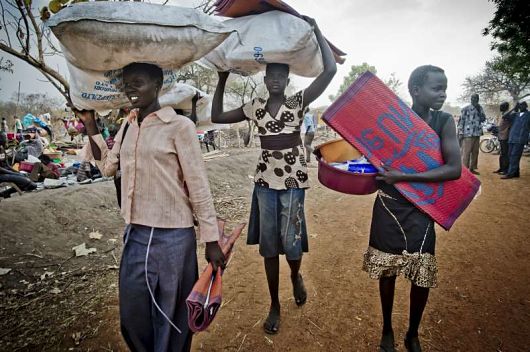
Normally, local economies are structured to provide for a relatively stable amount of people. The equilibrium of local supply and demand is stable, however, when an influx of people grows the demand for all types of goods at once, it creates a supply vacuum. This increase in demand and lack of supply creates a whole host of problems.

Turkey has absorbed about 200,000 Syrians. Many have become beggars, wandering in traffic, looking for spare change and unable to find employment. Others take up trades on the street, taking customers from existing Turkish vendors and businesses. These two cases are examples of the lack of supply and the increase in demand. The beggars along with the increased competition for some small Turkish businesses have created a hostile atmosphere against the Syrian refugees.

Lebanon is a more extreme example of the strain that refugees can put on an economy. One in 10 of Lebanon’s residents is now a Syrian refugee, escaping the war and famine that has eviscerated their homeland. This has created a range of problems similar to those seen in Turkey, however, the magnitude of the number of refugees seen in Lebanon is much worse.

Lebanon is a much smaller country than Turkey, and it is also taking in many more refugees than Turkey. Food prices in Lebanon have skyrocketed due to the increased demand from more than a half-million refugees entering the country in the span of a few years. Electricity was already faulty and has now been hit with a 27 percent increase in demand due to the housing of many of the new refugees. Again, similar patterns are immerging within Lebanon as they did in Turkey.

Just as Turkey experienced similar economic disruptions, the social aspect of the new population has put social tensions on the list of concerns for government officials in Lebanon. Some economists argue that the new populace has actually been beneficial to the local economies of rural areas in Lebanon because of an increase in spending in the local area.

In places like Canada, the effects of refugees are somewhat different. Typically, when developed nations accept refugees from other countries they are not accepting hundreds of thousands at a time. This difference is important because it means that local economies are not strained to the same extent.

A study by the Institute for the Study of Labor found that employed refugees in Canada were no worse off than average. However, the study also showed that the unemployed did end up needing significant government assistance.

The study concluded that refugees were not damaging to the economy and identified discrimination and lack of credential recognition as potential factors in unemployment rates amongst refugees. Better job training programs could help refugees adjust to a new economic landscape and help them integrate into the economic system.

The case of the Syrian refugees is one of the best modern-day examples of how massive amounts of refugees can disrupt local economies. In the case of Canada and other developed nations, it exemplifies how a smaller amount of refugees entering the country does not affect the economic and social situation in ways that are comparable to Turkey and Lebanon.

Context is important to see how refugees can affect local economics, but it is clear is that events that create massive migrations can be harmful to neighboring economies. Perhaps programs that help disperse refugees across more countries could be improved or expanded to reduce the impact that refugees have when overwhelming local areas. Nonetheless, it is important to recognize that it is in everyone’s interest to take in those in need and help them adjust to their own new realities.

– Martin Yim

Sources: New York Times, Reuters, Institute for the Study of Labor
Photo: Flickr

August 5, 2015
https://borgenproject.org/wp-content/uploads/borgen-project-logo.svg 0 0 Borgen Project https://borgenproject.org/wp-content/uploads/borgen-project-logo.svg Borgen Project2015-08-05 01:30:532020-07-02 13:14:51Economics and Refugees
Refugees and Displaced Persons

South Sudanese Refugees Warmly Welcomed by Uganda

South-Sudanese-Refugees-Warmly-Welcomed-by-UgandaSince the onset of ethnically-motivated conflict within South Sudan in December 2013, an estimated 150,000 South Sudanese civilians have fled the violence to neighboring Uganda. Government officials and civilians alike have cited the remarkably acceptant refugee policies exercised by Uganda as catalysts for these migrations.
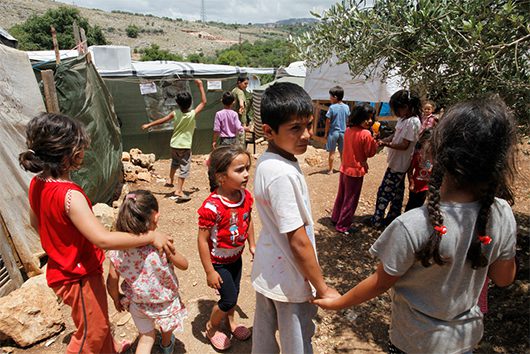
Refugees who travel to Uganda for asylum are met with an abundance of economic and social opportunities upon their arrival. Unlike many other nations currently experiencing heightened influxes of refugees due to the persistence of several regional conflicts, Uganda does not place newly arrived migrants into refugee camps operated by the UN and other foreign aid organizations.

Instead, refugees who successfully escape their conflict-ravaged homelands for the peace and security of Uganda are presented with the opportunity to move into permanent settlements where they are provided with their own plot of land. Additionally, various UN agencies provide access to food, water, and home construction resources for newly arrived refugees. Localized primary schools and health clinics are commonly accessible in these areas of Uganda, and are responsible for providing valuable resources to newly settled migrant populations.

Titus Jogo, Refugee Desk Officer for the Adjumani District in Northern Uganda, stated in a recent interview regarding the legal statuses of South Sudanese refugees seeking asylum, “They have all the rights that are attributed to any human being, irrespective of their status as refugees.”

The conflict within South Sudan, the newest nation in the world after its founding in 2012, was initially caused by political disputes between President Salva Kiir and his former Deputy Minister Riek Machar. The conflict is largely consistent of multiple tribal factions which include the Neur Tribe, loyal to Machar, and the Dinka group, loyal to President Kiir; both of these tribal groups have been accused by international monitoring groups of committing war crimes and human rights violations, including ethnically targeted massacres and sexual assaults.

The most recent report provided by the UNHCR estimates that over 730,000 people have fled the conflict in South Sudan to neighboring nations such as Uganda, Sudan, Ethiopia, and Kenya. This report also estimates that an additional 1.5 million South Sudanese civilians are currently suffering from internal displacement due to the escalation in ethnic violence. Many of these displaced civilians experience frequent relocations to areas known as ‘protection-of-civilians’ sites, which are coordinated by the UN Mission in South Sudan and provide secure refugee camps for civilians who have fled their homes.

Secretary General of the UN Ban Ki-moon recently explained in a statement regarding conditions within South Sudan, “The violence that has ravaged South Sudan over the past 18 months proves that there can never be a military solution to this conflict. I therefore call on all leaders of South Sudan – particularly President Kiir and former Vice-President Riek Machar – to prove their leadership by investing in a political solution and immediately concluding a comprehensive peace agreement. At the same time, the international community must take decisive steps to help end the fighting.”

The UNHCR recently released an international appeal for increased foreign aid designated for the current mission within South Sudan, noting the mounting number of refugees traveling to neighboring countries has depleted financial resources. While the organization estimates that $99 million US is necessary to continue funding this operation, only 9% of this goal has been raised to date.

The report explained that “Current resources remain insufficient to provide vital life- saving assistance and services, particularly in the areas of health, education and livelihoods and environment. Many South Sudanese refugee children, their country’s hope for the future, face key barriers to education including overcrowding in classrooms, a lack of teachers, and a lack of recreational activities to support constructive social engagement.”

– James Miller Thornton

Sources: The Guardian, Shanghai Daily, UN
Photo: UNHCR

July 28, 2015
https://borgenproject.org/wp-content/uploads/borgen-project-logo.svg 0 0 Borgen Project https://borgenproject.org/wp-content/uploads/borgen-project-logo.svg Borgen Project2015-07-28 15:26:482024-12-13 17:52:07South Sudanese Refugees Warmly Welcomed by Uganda
Children, Education, Global Poverty, Refugees and Displaced Persons

The Young Syrian Refugees

Young_Syrian_Refugees
Since the civil war in Syria broke out just three years ago, four million people have sought refuge in the neighboring countries of Lebanon, Turkey, Jordan, Iraq and Egypt. So far, 100,000 have been killed. 7,000 of them are children.

The Middle East’s biggest refugee camp, Zaatari, lies in Jordan. It shelters 120,000 Syrians in a community divided into 12 districts. It costs $500,000 to run the camp. Camp workers dole out 500,000 pieces of bread and 3.5 million liters of water a day. Three-fourths of residents are women and children.

Of the 650,000 people that fled Syria to arrive in Turkey, one-third are allowed into refugee camps. There is no room for the res; they have to fend for themselves. Nizar Najjar is the assistant director of Camp Bab al-Salameh. He explains, “Sometimes we do not have the capacity to receive new refugees. Some people (are forced to) just put up their tents in fields.”

Those in camps do not have it much better. Dr. Al-Naser is a part of a group called “Medical Relief for Syria”. He says that the spread of disease is a big concern. “It’s a problem with sanitation, how to dispose of bathing water and used toilet water. There are lakes of waste in some areas.” Trucks bring in the camp’s only source of freshwater.

Young Syrian refugees are often traumatized. They have faced the horrors of being under siege, losing their homes and being separated from their families. Groups that flee travel by night and hide during the day. Some are shot at by fighter jets. Even once they reach the border, shelling still echoes in the distance.

Sara* is a 12-year old girl who fled Syria with her mother and brother along with her aunt, uncle and grandmother one year ago. She does not know the whereabouts of her father, who was kidnapped in 2013. The family was forced to leave once they lost touch with a brother-in-law that was providing them with money and resources.

Sara’s family arrived at a camp in Lebanon run by activists. They managed to find a simple apartment. It gives them a safe place to stay, but it is not insulated and floods as soon as it rains. Rent and electricity cost $230 each month. Back in Syria, they were a middle-class family, and now charities help them with essentials like food, rent and medical expenses. Sara’s grandmother has diabetes and high blood pressure.

It also costs money to renew visas, which is now mandated every six months. Many times, families are forced to return to Syria because they cannot afford it. It is difficult for refugees to find jobs and earn money. Sara’s 14 year-old brother makes $30 each week working for a nearby mechanic.

Affording school is nearly out of the question with high costs of transportation, books and other fees. Sara loved school back in peace-time Syria and completed grade five. She has not been in school for over three years now but is able to take French and English language classes that are offered by aid agencies in the area.

Antonio Guterres is the UN commissioner for refugees. He asks countries around the world do more to help these displaced people, including raising money to support them and their host countries. The president of the World Bank, Jim Yong Kim, makes a similar request. He also hopes to rebuild Syria and add more access to basic public services.

Sara dreams of becoming a doctor and for her country’s healing. “I want this war to end. I expect the world is so much bigger, with so many more people. With time, the world changes. I hope the war will be over one day.”

*Names has been changed to protect her identity

– Lillian Sickler

Sources: Care, Daily Mail, The Guardian, CBS News, World Vison, The Daily Beast, MIC, NPR
Photo: Flickr

July 28, 2015
https://borgenproject.org/wp-content/uploads/borgen-project-logo.svg 0 0 Borgen Project https://borgenproject.org/wp-content/uploads/borgen-project-logo.svg Borgen Project2015-07-28 06:23:442024-12-13 17:52:09The Young Syrian Refugees
Global Poverty, Refugees and Displaced Persons

Jordan: A Refugee Haven

Jordan

The Middle East—in the north, Syria’s civil war between rebel forces trying to overthrow the dictator Bashar al-Assad rages. To the west, the perpetual conflict between Israel and Palestine continues. And with the rise of ISIS in Iraq to the east, there is no shortage of refugees.

Caught in the middle of this chaos is Jordan. The country has opened its borders for floods of refugees since the Syrian civil war broke out in 2011. An estimated 1.4 million Syrians have crossed into Jordan during the war, making it the highest concentration of refugees globally. In an interview with 60 Minutes last September, Jordan’s King Abdullah said that welcoming the refugees is the right thing to do: “Where else can the Syrians go? They are in dire straits.”

The situation in Jordan is a microcosm of a troubling trend. There are approximately 60 million refugees globally, averages that have not been seen since the end of World War II. Whether it is war, like in the Middle East, or a changing climate, people seek normalcy where there is food security and educational opportunity.

Unfortunately, assimilating refugees into a host country’s culture so that they may become working members of society is very costly. King Abdullah says that absorbing so many people has put a tremendous economic strain on his country. He does not know how long Jordan can continue.

The World Food Programme (WFP) has been an essential cog in the machine supplying Syrian refugees. Formed by the United Nations in the early 1960s, the program feeds 80 million people in 75 countries annually. The United States pays a third of its $4 billion annual budget.

Their largest operation ever has been at a United Nations refugee camp just inside Jordan. Housing an estimated 130,000 people, this city in the desert has become home to many.

The WFP has set up grocery stores in the camp. Instead of receiving three meals a day, each refugee gets a voucher of $29 dollars a month. This gives them the dignity of cooking for themselves, said WFP Executive Director Ertharin Cousin. In an interview with 60 Minutes last Thanksgiving, Cousin explained that this is a gesture of respect. “Many of these people had led normal, working lives,” she said. “The war took that from them.”

The organization has also been active in Syria. A portion of the 45,000 metric tons of food that is devoted to Jordanian refugee camps goes into Syria as well. Throughout the war, Assad’s forces have blockaded Syrian cities suspected of supporting the rebels. In Homs, the encirclement lasted more than 600 days before the WFP was able to negotiate a ceasefire with both sides to bring in vital food supplies.

The embattled civilians requested that the children, women and sick be evacuated before food was brought in. The WFP left Homs with 1,300 refugees and took them to the safety of Jordan. They left with a month’s worth of food supplies.

It is estimated that 6 million Syrians do not know where their next meal will come from. In the interview with 60 Minutes, an anonymous Syrian described how dire food shortages have become. His hometown just outside Damascus was sealed off. Despite the continued shelling and the exposure to nerve gas, he said hunger broke the town.

“No one thought we could starve to death in 21st century Syria,” he said. “The sad thing is that people are starving when food and aid is just minutes away, outside the blockades.” As the Syrian civil war continues and instability steadily dots every other corner of the region, Jordan has become the only option for refuge for many people.

Expanding humanitarian aid will allow Jordan and the WFP to help the millions who are still displaced today.

– Kevin Meyers

Sources: USAID, Business Insider, CBS 1, CBS 2
Photo: Flickr

July 20, 2015
https://borgenproject.org/wp-content/uploads/borgen-project-logo.svg 0 0 Borgen Project https://borgenproject.org/wp-content/uploads/borgen-project-logo.svg Borgen Project2015-07-20 09:39:412020-07-14 12:08:29Jordan: A Refugee Haven
Global Poverty, Refugees and Displaced Persons, United Nations

Angelina Jolie and Daughter Visit Turkey for World Refugee Day

Angelina-Jolie-and-Shiloh-World-Refugee-DayAccording to the UN Refugee Agency, Turkey is the top refugee-hosting country in the world with just under 2 million asylum seekers. A vast majority of the refugees are Syrians, Kurds and Iraqis fleeing the violence of the Syrian Civil War and ongoing crisis involving the Islamic State.

In an effort to bring awareness to one of the largest refugee crises in history, Angelina Jolie embarked on a UN tour of the affected region. The movie star and long-time humanitarian was joined by her daughter, Shiloh, and stopped at the Midyat Refugee Camp in Turkey on June 20th to commemorate World Refugee Day. Jolie was also accompanied by UN Special Envoy Antonio Guterres. The group met with Turkish officials, including President Recep Tayyip Erdoğan to discuss the challenges that Turkey faces given an unprecedented number of refugees.

Jolie issued a statement at the camp in which she calls on the world to act. She said, “We are here for a simple reason: This region is at the epicenter of a global crisis. Nearly 60 million people are displaced from their homes. That is one in every 122 people on our planet. Our world has never been richer or healthier or more advanced. Yet never before have so many people been dispossessed and stripped of their basic human rights.”

Later in her speech Jolie stressed the impact that refugee camps have on the people that house them. While providing more security than war torn cities and villages, the camps more often than not make the poor even worse off. Jolie stated, “Families like the six young people I met yesterday, living in Lebanon without parents, on half food rations and paying US$100 a month to live in a tent because UNHCR does not have the funds or capability to take full care of everyone.” Already with limited resources and away from home, refugees have the burden of coming up with funds to keep their temporary shelter even though, as refugees, they “cannot legally work in their host-countries.”

There is hope, however. Jolie made her speech on a key day, a day dedicated to bringing light to the very issues at the core of her delivery. Her celebrity status will ensure that more people listen to her message, and in turn act to help. Jolie and other media figures have even inspired governments to act. Jolie thanked the governments of Turkey and other refugee hosting nations for taking in millions. To finish, the actress wished all the families she spoke to, and by extension the refugee families across the globe, a good Ramadan with “Ramadan Kareem.”

– Joe Kitaj

Sources: UNHCR, US Magazine
Photo: Flickr

July 15, 2015
https://borgenproject.org/wp-content/uploads/borgen-project-logo.svg 0 0 Borgen Project https://borgenproject.org/wp-content/uploads/borgen-project-logo.svg Borgen Project2015-07-15 11:00:082024-12-13 17:51:55Angelina Jolie and Daughter Visit Turkey for World Refugee Day
Global Poverty, Refugees and Displaced Persons

Acehnese Fishermen Save Stranded Refugees

stranded_refugees
In late May 2015, thousands of Rohingya and Bangladeshi refugees were stranded on the open ocean. The governments of nearby countries didn’t want them. Amidst this humanitarian crisis and fatal government hesitation, local Acehnese Indonesian fishermen saved thousands of refugees.

Hundreds of thousands of Rohingyas and Bangladeshi’s have fled their native homeland; the Rohingyas face political persecution that mirrors Apartheid South Africa, and Bangladeshis face seemingly inescapable poverty. Over 120,000 Rohingyas have left in the past three years, and just this year, 25,000 Rohingyas have fled.

In Buddhist-majority Myanmar, the Rohingyas are persecuted, and have been since the 1970s. They are not recognized as citizens and are “subjected to forced labour, have no land rights, and are heavily restricted,” says BBC. This March, the government took away the Rohingya’s right to vote.

The Rohingyas are an Islamic ethnic group. They are said to be descended from Muslim traders who settled in the region over 1,000 years ago, but the Myanmar government persists the Rohingyas are actually Bengali migrants— subjecting them to severe inequality.

It is due to this severe oppression that thousands of Rohingyas have fled Myanmar via boat. Rohingyas have paid smugglers in the past few years to transport them to safer countries, like Indonesia or Malaysia.

This year, Indonesia, Malaysia and other countries that Rohingyas flee to cracked down on the influx of refugees, refusing to admit them.

For this reason, many refugees were left stranded by smugglers in the middle of the ocean. Other smugglers turned out to be traffickers, who held the migrants hostage in the ocean, attempting to pressure impoverished family members into paying for their stranded loved ones.

None of the countries in the region were willing to help them, and governments told local fishermen not to help stranded refugees.

“The focus should be on saving lives, not further endangering them,” said UN High Commissioner for Human Rights spokesman Zeid Ra’ad Al Hussein.

Thailand and Indonesia turned away boats from their shores. Malaysia ordered its navy to keep the boats away. The United Nations has issued a statement that it is “appalled” by the foreign policy of these nations.

Chris Lewa, an advocate for the Rohingya activist group, described the attitude of neighboring countries as “extremely unwelcoming. Unlike European countries – who at least make an effort to stop North African migrants from drowning in the Mediterranean – Myanmar’s neighbours are reluctant to provide any assistance.”

Human Rights Watch accused Malaysia, Thailand and Indonesia of playing “human ping pong” with boats by refusing to let people in and by pushing boats back out to international waters.

Thousands of boat people were stranded at sea with little food and water and no place to land. “For more than two months we were in the boat, we were only given little food and we were beaten when we asked for more,” said Mohamad Ali, a Bangladeshi migrant to BBC.

Mohammad Idiris, a 25-year-old from Myanmar was held on a crowded ship for 6 months, said he was “beaten regularly by human traffickers who demanded a ransom from his parents that they couldn’t pay,” reported the IRIN. “I didn’t know it was going to be like this. If I had known, I would have stayed in Myanmar. We feel happy here, because the Acehnese people are treating us as brothers, but we are still worried about our families in Myanmar.”

Despite government wishes, Indonesians from the Aceh region rescued around 2,000 stranded boat people. “We helped them because they needed help. What is more human than that?” said Mansur, a Acehnese fisherman, in an interview with The Guardian.

The people of Aceh themselves have suffered intense violence and devastation in the past; they were caught in violence between the Indonesian government and separatist rebels, as well as the tsunami of 2004 in the early 2000s. For this reason, the Aceh people were very welcoming.

The fishermen worked together, pulling refugees from boat to boat, taking multiple trips and providing food and water on shore. Suryadi, an Aceh fisherman, told The Guardian, “We helped out of solidarity. If we find someone in the ocean we have to help them no matter who they are. The police did not like us helping but we could not avoid it. Our sense of humanity was higher. So we just helped with the limited resources that we had at the time.”

Aceh even put on a concert to raise money for the refugees. Rafly, a popular local singer, performed “Pemulia Jamee,” a traditional Acehnese ceremony, to honor guests. Rafly is also a senator, and plans to advocate for the refugees to stay in Aceh in the future.

“I really wish they will stay permanently in Aceh. I have lobbied the governor of Aceh on this matter and will raise it with the head of the senate,” he tells IRIN.

The future for the Bangladeshi and Rohingya refugees is uncertain. Bangladeshis may be returned to Bangladesh once they are identified, though they return to an unwelcome government. Bangladeshi Prime Minister Sheikh Hasina called the stranded boat people “mentally sick” for leaving, and claimed they are “tainting the image of the country.”

Myanmar recently created a program to give citizenship back to the Rohyingas; however, it forces the Rohingyas to list their ethnicity as Bengali, so it is heavily opposed. The Rohingyas are not welcome in Myanmar. Today around 140,000 Rohingyas in Myanmar live in camps; they cannot return to their villages, which were burned by Rakhine Buddhists in 2012 violence that killed over 200 people.

After a large amount of chaos, conflict and devastating waiting, Malaysia and Indonesia finally agreed to let refugees shelter on their shores, as long as they are relocated within a year. However, this was only after local Indonesian fishermen went directly against the wishes of their government to help save extremely vulnerable refugees.

– Margaret Mary Anderson

Sources: BBC, IRIN News , The Guardian
Photo: IRIN News

July 6, 2015
https://borgenproject.org/wp-content/uploads/borgen-project-logo.svg 0 0 Borgen Project https://borgenproject.org/wp-content/uploads/borgen-project-logo.svg Borgen Project2015-07-06 09:01:362024-05-27 09:25:26Acehnese Fishermen Save Stranded Refugees
Global Poverty, Refugees and Displaced Persons, Sanitation, Water

Cholera Outbreak Among Burundian Refugees Contained

cholera_outbreak
A cholera outbreak in Tanzania that claimed the lives of 30 Burundian refugees and local Tanzanians has been curbed.

The epidemic occurred in western Tanzania near Lake Tanganyika, in a remote village that is overcrowded with refugees. Authorities estimate refugees consumed contaminated lake water, which facilitated the spread of cholera. A total of 4,408 cases have been reported.

A UN Refugee Agency (UNHCR) spokesman, Adrian Edwards, said that no new deaths have been reported since last Thursday, and the number of new daily cases has fallen from around 915 per day at the height of the outbreak on May 18 to less than one hundred per day. According to Edwards, the situation is improving but it still could take several weeks to see cholera completely eradicated among this population.

The majority of the cholera victims are refugees of Burundi who are fleeing to avoid violence stemming from a failed political coup in Burundi’s capital, Bujumbura.

The influx of refugees from Burundi to surrounding countries has not stopped. The UNHCR estimates that over 100,000 Burundian refugees have escaped, leaving over 64,000 Burundians in Tanzania, and the remaining in Rwanda, Uganda and the Democratic Republic of the Congo. About 100 Burundians per day arrive to each of these surrounding countries.

The refugees that arrive in Tanzania must walk four hours through the mountains to reach the border. Some immediately are bussed to the camp called Nyarugusu, and some wait for boats that will take them to a camp called Kigoma. Tens of thousands wait by Lake Tanganyika, a tiny beach area that is only 800 meters by 500 meters. The overcrowding and high density of refugees on the move has facilitated the quick spread of cholera.

Many refugees are being moved from Lake Tanganyika because it is overcrowded and unsanitary. Kahindo Maina, a public health officer of the UNHCR, said, ”Our priority is to get all the refugees out of Kagunga because the situation is dire. We have built latrines and brought supplies to provide clean water but the terrain and the crowded situation does not allow for a good sanitary situation there.”

Refugees have been moved to the Tanganyika stadium in Kigoma where there are better facilities, and cleaner water and sanitation. Tanzanian health authorities, the UNHCR, the World Health Organization and other partners have helped stem the spread of cholera by the promotion of hygiene, treatment of patients, implementation of effective prevention measures and the creation of access to sanitation and safe water.

Other preventative measures provided by the Ministry of Health, the UN and NGO partners include airlifting medicine and providing medical supplies and protective gear. UNHCR spokesman Edwards explained that “together with the government and our UN and NGO partners, we are providing oral rehydration solutions, soap and water purification tablets, and increasing hand-washing facilities.”

Around 30,000 refugees have also been moved from the lake area to Nyarugusu. Here, they receive vaccinations for childhood illnesses, get dewormed and have nutritional assessments done. New latrine and sanitation facilities are being built.

– Margaret Anderson
Sources: AllAfrica, Humanosphere, UNHCR 1, UNHCR 2
Photo: UNHCR

June 15, 2015
https://borgenproject.org/wp-content/uploads/borgen-project-logo.svg 0 0 Borgen Project https://borgenproject.org/wp-content/uploads/borgen-project-logo.svg Borgen Project2015-06-15 14:46:242024-12-13 17:51:27Cholera Outbreak Among Burundian Refugees Contained
Global Poverty, Refugees and Displaced Persons, United Nations, War and Violence

Jobs for Refugees at a Socially-Minded Business

Jobs_for_Refugees_at_a_Socially-Minded_BusinessIn 2013, 69,926 people were admitted into the United States as refugees, according to the 2014 Fiscal Year Refugee Admissions Statistics published by the U.S. State Department.

That number is increasing and will continue to grow in the coming year. In February 2015, the Office of Refugee Resettlement reported that 69,986 refugees came to the U.S. in 2014. The U.S., though, often does not have enough jobs for refugees that come into the country.

The reason for the rise in refugee amount is largely due to the crisis in Syria, which has displaced thousands. So far, about 647,000 people have been forced to flee the region.

The Syrian conflict has been called the largest migration by a single group of people since 1999 when war in Kosovo resulted in the displacement of more than 867,000 people.

The United Nations’ High Commission for Refugees releases an annual report on the total amount of people driven from their homeland. In June 2013, it was at 45.2 million people. This was the highest ever in recorded history.

The five countries most impacted by wars are Afghanistan, Somalia, Iraq, Syria and Sudan. In fact, these countries were the source of 55% of all refugees in 2013.

In the 2012 report, nearly half of the population of refugees were female, and about 46% were children aged 18 or younger.

In Lancaster, Pennsylvania, Srirupa Dasgupta owns a socially-minded restaurant. Beginning at first as a catering company in 2010, the restaurant opened in April 2014. Dasgupta wanted to create a place where refugees and other marginalized people could find jobs.

“I realized that Lancaster has a large refugee population,” says Dasgupta, “These women had the skills to get a job and had jobs in their country but they couldn’t get past the language barrier in this country.”

She saw that, hired as cooks, women did not have to read the recipes because they had curated them on their own. Currently, she has three regular employees that are each paid $14.50 per hour, which is twice the amount of minimum wage in Pennsylvania.

Dasgupta came to the U.S. from India to attend college in Massachusetts. Her grandparents fled Bangladesh in 1947 and their struggle, along with many others she has come across, inspired her to start her business.

“Upohar’s lead chef is Rachel Bunkete who grew up in the Democratic Republic of the Congo. She left her home in order to escape political, ethnic and religious conflicts in 2008, but was forced to do so without her husband and three children. Ever since she was allowed to come to the U.S., she has been working toward being reunited with her family.

Another chef, Tulsha Chauwan, fled Bhutan with her family and lived in refugee camps in Nepal for year before they were allowed to settle in the U.S.

Upohar, the name of the restaurant, is the Bengali word for ‘gift’.

So far, Dasgupta has yet to yield any profit from her restaurant, but she is thrilled just knowing that she has made a difference in the lives of those involved.

– Lillian Sickler

Sources: NPR, Upohar, Lancaster Online, International Rescue Committee, U.S. Department of State, The Guardian, Office of Refugee Settlement
Photo: Flickr

June 12, 2015
https://borgenproject.org/wp-content/uploads/borgen-project-logo.svg 0 0 Borgen Project https://borgenproject.org/wp-content/uploads/borgen-project-logo.svg Borgen Project2015-06-12 01:29:422024-12-13 17:51:27Jobs for Refugees at a Socially-Minded Business
Page 27 of 32«‹2526272829›»

Get Smarter

  • Global Poverty 101
  • Global Poverty… The Good News
  • Global Poverty & U.S. Jobs
  • Global Poverty and National Security
  • Innovative Solutions to Poverty
  • Global Poverty & Aid FAQ’s
Search Search

Take Action

  • Call Congress
  • Email Congress
  • Donate
  • 30 Ways to Help
  • Volunteer Ops
  • Internships
  • Courses & Certificates
  • The Podcast
Borgen Project

“The Borgen Project is an incredible nonprofit organization that is addressing poverty and hunger and working towards ending them.”

-The Huffington Post

Inside The Borgen Project

  • Contact
  • About
  • Financials
  • President
  • Board of Directors
  • Board of Advisors

International Links

  • UK Email Parliament
  • UK Donate
  • Canada Email Parliament

Get Smarter

  • Global Poverty 101
  • Global Poverty… The Good News
  • Global Poverty & U.S. Jobs
  • Global Poverty and National Security
  • Innovative Solutions to Poverty
  • Global Poverty & Aid FAQ’s

Ways to Help

  • Call Congress
  • Email Congress
  • Donate
  • 30 Ways to Help
  • Volunteer Ops
  • Internships
  • Courses & Certificates
  • The Podcast
Scroll to top Scroll to top Scroll to top