• Link to X
  • Link to Facebook
  • Link to Instagram
  • Link to TikTok
  • Link to Youtube
  • About
    • About Us
      • President
      • Board of Directors
      • Board of Advisors
      • Financials
      • Our Methodology
      • Success Tracker
      • Contact
  • Act Now
    • 30 Ways to Help
      • Email Congress
      • Call Congress
      • Volunteer
      • Courses & Certificates
      • Be a Donor
    • Internships
      • In-Office Internships
      • Remote Internships
    • Legislation
      • Politics 101
  • The Blog
  • The Podcast
  • Magazine
  • Donate
  • Click to open the search input field Click to open the search input field Search
  • Menu Menu

Tag Archive for: Education

Posts

Activism, Charity

George Lucas and Charitable Giving

George_Lucas_Charitable_Giving_Star_Wars_Chewbacca
Star Wars emporium creator, George Lucas, generated a worldwide cult following after his creation of the renowned sci-fi series. But he is not all lightsabers and robots: after selling the franchise behind the hit movies – Lucasfilm – to Disney last year, Lucas pledged to donate at least half of the earnings to charity. Considering that he was heftily reimbursed with over $4 billion USD, Lucas will be able to make quite the impact after making that donation.

Producer Lucas has a specific cause in mind: he will use most of the acquired funds to endorse his own charitable foundation, Edutopia, which focuses on revolutionizing and improving K-12 education.

A contribution of this size will place George Lucas among the world’s most generous donors, being surpassed only by a select few, such as for example Bill Gates. Coincidentally, both billionaires – together with Mark Zuckerberg, Diane von Furstenberg, Eli Broad and dozens of others – have made the Giving Pledge, committing through such to donate the majority of their fortunes to charity.

On December 4, 2013 Lucas announced his intention to provide $25 million to the Chicago After School Matters project, which focuses on aiding teenagers in building specific skillsets through late afternoon apprenticeships.

As stated by Lucas himself, education is “the key to the survival of the human race” – his support of this campaign is set to provide thousands of children with improved education and better future opportunities in the job market. Also, the city of Chicago has agreed to add $11 million USD for this cause, vastly increasing the impact of this philanthropic gesture.

Last year, few attempted to conceal their utter disapproval of the decision to sell Lucasfilm to Disney. However, the director himself sees this as a purely positive thing: Star Wars is in safe hands, he claims, noting also that the sale provides an excellent opportunity for him to work on his retirement fund.

Lucas has, during the course of his career, accumulated enough money to put him on the Forbes 400 list and gained him enough recognition to be a globally recognized public character. His efforts in reforming education may prove to expand and provide countless new opportunities for children in America as well as other, less fortunate countries.

– Natalia Isaeva

Sources: The Daily Mail, Forbes, Edutopia, Look to the Stars, The Giving Pledge, The Hollywood Reporter
Photo: Global Post

December 13, 2013
https://borgenproject.org/wp-content/uploads/borgen-project-logo.svg 0 0 Borgen Project https://borgenproject.org/wp-content/uploads/borgen-project-logo.svg Borgen Project2013-12-13 15:49:462020-07-17 13:43:36George Lucas and Charitable Giving
Education

Education in Latin America

latin_america_education
There are many challenges facing education in Latin America.  Many schools are not properly equipped with current textbooks or any lab equipment.  Even worse, some schools do not even have proper infrastructure, and students are forced to attend a schoolhouse with a leaky roof or holes in the wall.

These physical problems are directly responsible to the startling statistics about students in the region of Latin America.  According to the Inter-American Development Bank, only 10% of the region’s poorest students are performing at their grade level.  Only 40% percent of students graduate from secondary school, and according to the Brookings Institution’s Center for Universal Education, international comparisons have Latin America ranked near the bottom in education.

What is being done to combat these trends?

One method of change to education in Latin America are initiatives to upgrade outdated curriculum models.  Docente al Dia is an online platform that seeks to give teachers access to new curriculums and lesson plans.  It also acts as a social media community, a Facebook for teachers.  This will allow Latin American educators to collaborate on ideas, and connect the education system in a way not previously possible.

The Central America Foundation for Rural Education Development (CAFRED) is an organization that identifies rural communities lacking proper schooling facilities and builds healthy, safe, and sustainable schoolhouses.  CAFRED also sponsors a variety of education initiatives to create an environment of learning often denied to rural communities in Latin America.  One example is the “Professional Teacher Development Program” which provides much needed professional development for rural teachers by giving lessons in sensitivity and Individual Education Programs.

A positive statistic for Latin American students is that by 2015, 30 million students should have access to an electronic device to support learning.  This is one of the many projects and topics championed by the Inter-American Development Bank.  The Bank endorses five ‘dimensions of success’ in education: high expectations for student learning, students should enter the system ready to learn, all students having access to effective teachers, schools having adequate resources, and all graduates having the skills necessary to contribute to the labor market.

Access toeducation is a necessary component for producing global citizens and engaged consumers.  Stimulating education in Latin America should therefore be a top priority for world leaders.

– Taylor Diamond

Sources: Inter-American Development Bank, Brookings Institution

December 13, 2013
https://borgenproject.org/wp-content/uploads/borgen-project-logo.svg 0 0 Borgen Project https://borgenproject.org/wp-content/uploads/borgen-project-logo.svg Borgen Project2013-12-13 04:00:072018-01-16 13:30:41Education in Latin America
Human Rights

5 Ongoing Human Rights Battles

Human Rights
After all the progress we’ve made in terms of human rights over the years, you’d think we’d be living in a world without discrimination by now. Sadly this isn’t the case. Here are just 5 ongoing human rights battles that are still being fought today:

1. Rights of Women

This includes fair pay, participation in decision-making positions and positive portrayal in the media.  Issues such as rape, sex-based elimination, violence against women and access to education are also at the forefront of the campaign for women’s rights.  The Women’s International League for Peace and Freedom, the UN Commission on the Status of Women and other NGOs are actively working to make sure women are protected, empowered and represented.

2. Rights of Minorities

Minority groups include ethnic peoples, those who prefer alternative sexual identities and orientations, various religious groups, citizens from various nations, linguistic minorities and disabled peoples.  In International Law it is illegal for any group to be actively marginalized.  Other protections include the International Covenant on Civil and Political Rights, the UN Declaration on the Rights of Persons Belonging to National or Ethnic, Religious and Linguistic Minorities, the European Charter for Regional or Minority languages and the Yogyakarta Principles.

3. Rights of Indigenous Populations

The UN recognized the rights of indigenous people as the preservation of their land, language, religion and cultural heritage.  Colonialism and modern-day imperialism have overlooked the claims indigenous populations have to these rights.

4. Right to Education

The right to primary education is recognized by the International Covenant on Economic, Social, and Cultural Rights.  Research shows that education lifts people out of poverty by teaching them how to provide for themselves, increase their earning power and become economically stable.

5. Right to Housing

People in impoverished communities often lack adequate housing.  This is a health and safety hazard that can stop a family from rising out of poverty.  The Universal Declaration of Human rights recognizes that “everyone has the right to a standard of living adequate for the health and well-being of himself and of his family.”

– Stephanie Lamm

Sources: The Nation, FoR, UN

December 12, 2013
https://borgenproject.org/wp-content/uploads/borgen-project-logo.svg 0 0 Borgen Project https://borgenproject.org/wp-content/uploads/borgen-project-logo.svg Borgen Project2013-12-12 12:45:192024-05-25 00:54:395 Ongoing Human Rights Battles
Global Poverty

5 Ways Art Can Help Alleviate Poverty

Poverty Art
Art is a frequent medium for human expression and resistance, and within that space of creation and possibility is the opportunity to find ways to fight poverty and alleviate the suffering of the global poor.

1. Art can help impoverished children increase their chances of going on to college and obtaining employment by developing fundamental cognitive capacities, critical analytical skills, and providing learning experiences that have a significant impact on children’s educational achievement and social development.

A recent report published last year by the presidentially appointed Committee on the Arts and Humanities showed results stating that low-income students who were highly involved in the arts performed better, stayed in school longer, scored higher in math assessments, and were more likely to graduate high school, attend college, find stable employment, perform volunteer work in their communities, and vote.

2. Art programs can focus on entire communities faced with poverty and provide multiple services and opportunities in terms of gainful employment, a platform of expression for the voiceless, creating beauty and hope amidst poverty and blight, provide awareness to suffering, galvanizing donors and philanthropists, and can allow others to advocate for those who cannot advocate for themselves.

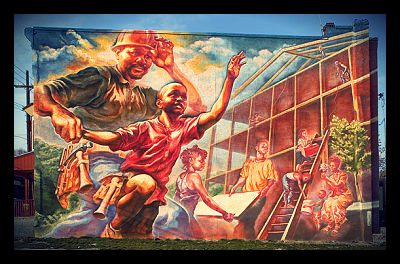
Programs like the Philadelphia Mural Arts Program target at-risk children, juveniles, and adults and provide them with opportunities and spaces of expression they would not otherwise have access to. The program has even taken a leading role in criminal and restorative justice by offering education programs in prisons and rehabilitation centers, helping to effectively reduce crime, violence, and the poverty and misery associated with it.

3. Art and creative expression can help provide employment and income to those who are impoverished. Having non-profit programs that help develop artists by providing a more equitable share of profits from sold work, and investing in opportunities for those who are poor to create and thrive as artists, means a larger return than one individual’s income and the chance to influence poverty in an entire community or area.

4. Art can advocate for the impoverished, provide visibility to issues of poverty, and be a platform for agency to effect change and eradicate this form of human suffering. Organizations like 2015 use art and creativity to change perceptions about poverty by raising awareness so that greater actions can be taken to fight poverty in the Middle East. By linking an art movement to the United Nations Millennium Goals, the public sphere and shared space of art becomes a political platform to support larger movements, fight poverty locally, and challenge the failings that allow for three billion people to remain trapped in poverty.

5. Art can help fund projects and utilize creativity to find measures to help end the suffering of the billions of the world’s poor. Artistic endeavors and the art community can be organized and motivated to provide fundraising and resources for essential programs and serve as the appropriate community to build connections of supporters. Art naturally involves innovation, and creative minds can be utilized to find solutions to problems like substandard housing or the effective use of public space. Those suffering in poverty need all the resources we have available, and art has the capacity to take its own form and be that of another, so when used to fight poverty, it becomes an instrument of justice.

– Nina Verfaillie
Feature Writer 

Sources: Techo, TNW News, MinnPost, Astep, Mural Arts Program

December 10, 2013
https://borgenproject.org/wp-content/uploads/borgen-project-logo.svg 0 0 Borgen Project https://borgenproject.org/wp-content/uploads/borgen-project-logo.svg Borgen Project2013-12-10 04:00:452024-05-25 00:33:415 Ways Art Can Help Alleviate Poverty
Education, United Nations

Global Education Motivators

Global_Education_Motivators_UN_in_the_Classroom_United_Nations_Day
What do Mr. Rogers, Jane Goodall, and the United Nations all have in common?  They are all close supporters of Global Education Motivators (GEM) one of the oldest initiatives for advocating the importance of global education in American schools.

Founded in 1981, GEM has worked tirelessly to promote global issues in the American classroom through engagement with UN educational programs, leadership conferences, and workshops. One of the initiative’s foremost programs is “United Nations Day,” where young students work together, mock UN style, to provide solutions for issues such as human rights, environmental sustainability, education, and food security.

“Believing that international communication exchange is the key to future world peace, the inclusion of cross cultural perspectives has become an integral part of GEM’s global learning programs,” according to GEM’s mission statement.  “Global awareness is closely tied to global responsibility.”  This commitment to cross cultural perspectives is evident in the initiative’s distance learning courses. These courses are geared for K-12 students. African Folk Tales, Conflict in Sudan and Nuclear Awareness are some of the highlights of the courses available.

GEM also boasts partnerships with the African Studies Center at the University of Pennsylvania and the project for Nuclear Awareness. Additionally, the group has a presence with the United Nations’ education initiative, UN Academic Impact.  At UN Academic Impact’s Third Annual Conference, youth members of GEM presented about the program and the importance of empowering other youth to stand up for global issues through community involvement, arts and education.

While the organization most certainly embraces the mantra of “think global,” acting local is just as important for GEM. Based out of Chestnut Hill College in Philadelphia, GEM is a close partner with local Philadelphia schools and Philadelphia-based programs, like the Greater Philadelphia Global Education Network. Involving local communities and schools with issues of global development is an important part of inspiring larger movements for global education.

– Taylor Diamond

Sources: United Nations, Global Education Motivators
Photo: Dreamstime

December 10, 2013
https://borgenproject.org/wp-content/uploads/borgen-project-logo.svg 0 0 Borgen Project https://borgenproject.org/wp-content/uploads/borgen-project-logo.svg Borgen Project2013-12-10 04:00:012024-06-11 02:09:19Global Education Motivators
Activism, Children, Education, Global Poverty

4 Children’s Books on Global Issues

Clean_Water__for_Elirose_Good_Books_For_Children
Children are the future. Today, our youngest generation has the ability to learn about global issues through reading. Check out the educational books below:

1. Clean Water for Elirose by Ariah Fine

This book tells the story of Maria and her friends who love all kinds of different drinks. When they learn about a girl their age who doesn’t have clean water to drink they set out to help her find access to what she lacks. Literature review site goodreads.com describes it as a “[…] children’s picture book about the lack of clean drinking water in the world and how we can help.” All profits from this book go to support clean water projects.

2. Little Things Make Big Differences: A Story About Malaria by John Nunes and Monique Nunes

Little Things Make Big Differences: A Story about Malaria, is a story about a young Tanzanian girl named Rehema. The story focuses on Rehema’s battle with one of the world’s most fatal diseases, malaria. When she was a baby, Rehema was infected with the disease but survived because her parents were able to get treatment for her. In the book, Rehema describes what children in rich countries can do to help fight malaria.

3. The Secret River by Marjorie Kinnan Rawlings

This book depicts how poverty affects families, with a focus on kids. Rawlings’ children’s book tells the story of a girl poet named Calpurnia and her family who worry that they will go hungry because there are no fish left in the river. Luckily, Calpurnia meets a medicine woman in the forest who helps her find the way to a secret river, teeming with catfish, which appears only when desperately needed and disappears when the heart and belly are full. The ending teaches kids that there is always a way to help aid those in need.

4. The Can Man by Laura E. Williams

Laura E. Williams provides a sweet but direct lesson about poverty in today’s society. Williams tells the story of a young boy named Tim who fantasizes about getting the skateboard of his dreams. But Tim’s parents can’t afford to buy him the skateboard for his birthday, so he puts on rubber gloves and starts collecting cans in a quest for cash. Soon he finds himself racing a homeless can collector to gain access to the best spots in the neighborhood for cans. As he gets to know “The Can Man,” Tim learns there are things in life more valuable than any object.

– Stephanie Olaya

Sources: Good Reads: Clean Water for Elirose, Good Reads: Global Issues for Kids, One, Huffington Post
Photo: Clean Water for Elirose

December 3, 2013
https://borgenproject.org/wp-content/uploads/borgen-project-logo.svg 0 0 Borgen Project https://borgenproject.org/wp-content/uploads/borgen-project-logo.svg Borgen Project2013-12-03 05:44:482017-12-07 04:24:044 Children’s Books on Global Issues
Activism, Children, Education, Global Poverty

Children’s Books on Poverty

In America, we often tend to live inside of a bubble, a comfortable space in which we utilize blissful ignorance to the outside world and its problems.

But this bubble has a negative impact on what’s beyond it – the rest of the world. By choosing to live in ignorance, people who need help are unable to receive it. Where that problem begins is in the home – with children.

Being privileged to a comfortable lifestyle as a child, I grew up typically getting what I wanted for Christmas and birthdays. My sister was given an iPod when they first came out, while I eventually came to be the owner of a Gameboy Color, a Nintendo 64 and a GameCube. Then again, sometimes there were disappointments – things I had asked for that were not wrapped up in brightly colored packages under the tree.

It was important to my parents to make sure that my sister and I got gifts we would actually use, but even more important was the lesson that we wouldn’t always get what we want.

That lesson applies in a large scale to the problem of global poverty, and authors are now tackling it. Not only do these lessons come in large, adult books, but they are now being offered in the pages of children’s books.

The following books educate and reinforce principles regarding economic differences, while also validating the emotions of the poor readers. The refreshing part is that these books do not intend to preach; they teach the values of resourcefulness and gratefulness.

  • The Can Man by Laura E. Williams, illustrated by Craig Orback: Tim’s parents can’t afford the skateboard he dreams of for his birthday, so he puts on rubber gloves and starts collecting cans in a quest for cash. Soon he finds himself racing a homeless can collector to the best spots in the neighborhood for cans. As he gets to know “The Can Man,” Tim learns there are things in life more valuable than any object.
  • Lucky Beans by Becky Birtha, illustrated by Nicole Tadgell: Marshall Loman is sick of beans because he has had to eat them every night since his father lost his job. In this Depression-era story, a bean counting contest at a local shop and one boy’s math-savvy help a family get back on their feet again.
  • The Hundred Dresses by Eleanor Estes, is a classic story about a Polish immigrant girl who is teased for saying she has one hundred dresses, when she wears the same faded old dress every day. It is told from the perspective of the teaser’s friend. I read this story aloud over the course of a week, engaging the children during and after each reading in a philosophical discussion about the ethical dilemma of being a silent bystander.
  • Si, Se Puede! by Diana Cohn, is a bilingual story about the Service Employees International Union organizing drive and janitors’ strike in Los Angeles. It is useful to discuss why and how workers form unions, what a strike is, the importance of community support, and connections between the story of the janitors’ organizing drive and local labor struggles.
  • The Streets Are Free by Karusa, is a bilingual story about children in a Venezuelan barrio who organize and protest about the lack of a playground in their neighborhood and the eventual community action which builds it. Children can retell and then make captioned drawings to illustrate a story of community organizing told by a “guest activist” visitor to the classroom. These can be displayed, then bound into a class book.
  • Shingebiss by Nancy Van Lann, is an Ojibwe legend about a merganser duck who demonstrates the values of persistence, conservation and resourcefulness in order to survive the northern winter. This is a favorite of my students and my own children. Shingebiss is an excellent role model to refer to when the going gets rough. I am often impressed by hearing my students exhort each other to be persistent or praise each other for being resourceful in their problem solving. I start to proudly think, “Wow! Did I teach them that vocabulary?” and then humbly remind myself, “no, they learned it from a duck.”
  • Tight Times by Barbara Shook Hazen, is about a boy in a financially stressed family who really wants a pet dog. Told from the child’s perspective, it describes the boy’s spontaneous adoption of a stray kitten against the backdrop of the father’s anger at his sudden job loss. Children can easily make text-to-self connections with the story as they discuss how a sudden change of circumstances can affect everyone in a family.
  • The Lady in the Box by Ann McGovern, is about two children who notice and then befriend a homeless woman living in their neighborhood.
  • Fly Away Home by Eve Bunting, is about a homeless boy and his father who live at an airport. I use both this book and The Lady in the Box to help children see beyond the “shopping bag lady” stereotype of homelessness, to recognize that people of all ages and circumstances can become homeless for a brief or longer period of time, for a variety of reasons, and that shelters are not solutions in themselves.

– Samantha Davis

Sources: Huffington Post, Scholastic
Photo: Georgina Public Libraries

December 2, 2013
https://borgenproject.org/wp-content/uploads/borgen-project-logo.svg 0 0 Borgen Project https://borgenproject.org/wp-content/uploads/borgen-project-logo.svg Borgen Project2013-12-02 04:29:512024-05-25 00:33:02Children’s Books on Poverty
Education, Global Poverty

Education in Pakistan and Why it Matters

education_in_pakistan
Poverty in Pakistan has allowed the Taliban to flourish.  By promising food security, shelter, protection, and education, the Taliban has been able to gain support in this region. But the Taliban’s presence has had a detrimental effect on Pakistani schools, a strategy that has kept the region impoverished and under Taliban control.  “Education is a prerequisite for development,” said Shakil Ahmad, author of “The Taliban and Girl’s Education in Pakistan and Afghanistan.”

Education is also the key to releasing Pakistan from the grips of the Taliban. When a population does not understand basic politics or economics, it is easy to manipulate them. As a result, most Pakistani schools have either been bombed or taken over by Taliban members, who turn the schools into recruitment programs, where students are taught extremism and trained for terrorism.

For women, the Taliban’s crusade against education is especially damaging. Taliban rule means a strict interpretation of Islamic and Pashtun customary law, which states that women are not allowed to work outside the home, go unveiled, or leave the house without a male family member.  Religious police roam the streets, handing out harsh punishments for anyone in violation of Pashtun.  All girls’ schools were outlawed in January 2009, and  the Taliban threatened that anyone caught educating a girl or any girl receiving an education would be blown up or attacked with acid.

By now, most of the world knows of Malala Yousafazi, the teenage girl who was shot in the head by the Taliban while on her way to school.  This was not a random incident; she was targeted for speaking out in favor of girls’ education.  Today she has fully recovered, and now leads the Malala Fund, an organization to improve education for girls in the developing world.  The mission is a simple one with seemingly insurmountable challenges—educate girls where education is outlawed.  However, Malala believes in taking small steps: her mantra is “One child, one teacher, one book, one pen can change the world.”

– Stephanie Lamm

Sources: Lund University Department of Sociology, Malala Fund
Photo: Center for Economic Research in Pakistan

October 26, 2013
https://borgenproject.org/wp-content/uploads/borgen-project-logo.svg 0 0 Borgen Project https://borgenproject.org/wp-content/uploads/borgen-project-logo.svg Borgen Project2013-10-26 04:00:472024-05-25 00:30:39Education in Pakistan and Why it Matters
Activism, Global Poverty

November 20 Marks Universal Children’s Day

universal_childrens_day
Universal Children’s Day, celebrated on November 20, promotes the well-being of children everywhere. Nations worldwide celebrate the day to support children’s rights and interests. Universal Children’s Day is celebrated upon principles put forth by the General Assembly on December 14, 1954, by Resolution 836(IX). Since then, the day is used to promote objectives the General Assembly puts in place to enhance the welfare of children around the world.

November 20 was chosen as the day because of two other historical adoptions the General Assembly declared on this day. First, in 1959, the Assembly adopted the Declaration of the Rights of the Child. Secondly, the Assembly adopted the Convention on the Rights of a Child in 1989.

In more recent times, world leaders drew out the Millennium Development Goals (MDGs) in the year 2000, designed to reduce poverty dramatically. These goals are directly related to children in multiple ways. In 2012, The Secretary General launched a new program called Education First, which will raise awareness about education, as well as produce additional funds through advocacy work.

Several officials commend Universal Children’s Day and its purpose. According to David Anthony, co-author of UNICEF’s study, Generation 2025 and beyond: The critical importance of understanding demographic trends for children of the 21st century, “ the world needs to be prepared for the post-2015 agenda and take account of this fundamental and unprecedented shift.” He also states, “we must do everything possible, so these children get an equal chance to survive, develop and reach their full potential.”

Overall, by spreading awareness and boosting advocacy efforts regarding children’s well-being in the world and by incorporating the UN standard into national legal frameworks, we can ensure the rights of the world’s children. Wrapping up the vision of Universal Children’s day is this statement by the Report of the Secretary General in 2001, “We were all children once. And we all share the desire for the well-being of our children, which has always been and will continue to be the most universally cherished aspiration of humankind.”

– Laura Reinacher

Sources: United Nations, UNICEF

October 25, 2013
https://borgenproject.org/wp-content/uploads/borgen-project-logo.svg 0 0 Borgen Project https://borgenproject.org/wp-content/uploads/borgen-project-logo.svg Borgen Project2013-10-25 07:32:312024-05-25 00:29:48November 20 Marks Universal Children’s Day
Activism, Advocacy, Education, Food & Hunger, Global Poverty

10 Ways to End Hunger

madagascar_children
There are an estimated 852 million hungry people in the world – an astounding number. However, with some simple ideas, the number of hungry people in the world can easily be reduced.

1. Education

Even if hunger was eradicated right now, it would only be temporarily so if education is not a priority. Educated children are prepared children. A good education equips children to provide for themselves, as well as their communities, in the future. Education ensures that the steps taken in the fight against hunger are sustainable.

2. School meals 

School meal programs are one of the easiest ways to feed lots of children, since the children are all gathered in one place. It is also very cost-effective. For 25 cents per meal, the World Food Program feeds 24 million school children annually.

3. Food security programs

The World Food Program defines food security as “when all people, at all times, have physical, social and economic access to sufficient, safe and nutritious food which meets their dietary needs and food preferences for an active and healthy life.” Food security programs aim to meet these needs by training farmers in developing nations through agricultural methods that will provide their communities with food – both now and long-term. The World Food Program reports that it has provided 200,000 farmers with agricultural training since the beginning of its food security programs.

4. Focus on women

It is estimated that women account for 60 percent of the hungry worldwide. If a mother is not able to provide for herself, she will most likely not be able to provide for her children either. This means that hunger is continuously being inherited by children. When women are helped, entire communities are helped.

5. Raise awareness

The simple act of bringing attention to the problem of hunger goes a long way in fighting it. People can’t contribute to a cause they aren’t informed of, and as more people become aware of how hunger affects the poor around the world, more people will engage in the fight against it. It’s that simple.

6. Donate

This is one that tends to be taken for granted. Many people talk about the importance of monetary donations, but relatively few actually donate. This is unfortunate, because donations of any amount can go a long way. There are billions of people in the world that do not suffer from chronic hunger. If all of these people contribute even the tiniest amount that they can afford, hunger will be exponentially closer to being eradicated.

7. Live simply

People in developed nations put so much money towards things they don’t need, while people in the developing world struggle just to get by on a daily basis. Practicing some restraint in spending would free up money that could then be used towards eradicating hunger. This could be as simple as forgoing a cup of coffee each day.

8. Reduce food waste

Excess waste ties up resources that could be used elsewhere in the fight against hunger. It is important for people in developed countries to be mindful of those in developing nations by doing their best to consume only what they need.

9. Be involved in government

Exercise the privileges that come with living in a democratic society in the fight against hunger. Elected officials are in place to represent the voice of the people. If enough people express their concern about global hunger to elected officials, the collective voice cannot be ignored, and action must be taken.

10. Fight for livable wages

It is not enough to simply provide the world’s hungry with food. They must be equipped to provide for themselves. Otherwise, the problem of hunger is not actually solved. Many workers in developing nations are exploited by employers and are not paid nearly enough to provide food for themselves, much less their families. If global hunger is to be defeated, all people must be provided with opportunity to earn livable wages.

– Matt Berg

Sources: YSA, WFPUSA, Huffington Post, World Hunger

Photo: World Food Programme

October 25, 2013
https://borgenproject.org/wp-content/uploads/borgen-project-logo.svg 0 0 Borgen Project https://borgenproject.org/wp-content/uploads/borgen-project-logo.svg Borgen Project2013-10-25 07:32:032024-05-25 00:30:0310 Ways to End Hunger
Page 60 of 67«‹5859606162›»

Get Smarter

  • Global Poverty 101
  • Global Poverty… The Good News
  • Global Poverty & U.S. Jobs
  • Global Poverty and National Security
  • Innovative Solutions to Poverty
  • Global Poverty & Aid FAQ’s
Search Search

Take Action

  • Call Congress
  • Email Congress
  • Donate
  • 30 Ways to Help
  • Volunteer Ops
  • Internships
  • Courses & Certificates
  • The Podcast
Borgen Project

“The Borgen Project is an incredible nonprofit organization that is addressing poverty and hunger and working towards ending them.”

-The Huffington Post

Inside The Borgen Project

  • Contact
  • About
  • Financials
  • President
  • Board of Directors
  • Board of Advisors

International Links

  • UK Email Parliament
  • UK Donate
  • Canada Email Parliament

Get Smarter

  • Global Poverty 101
  • Global Poverty… The Good News
  • Global Poverty & U.S. Jobs
  • Global Poverty and National Security
  • Innovative Solutions to Poverty
  • Global Poverty & Aid FAQ’s

Ways to Help

  • Call Congress
  • Email Congress
  • Donate
  • 30 Ways to Help
  • Volunteer Ops
  • Internships
  • Courses & Certificates
  • The Podcast
Scroll to top Scroll to top Scroll to top