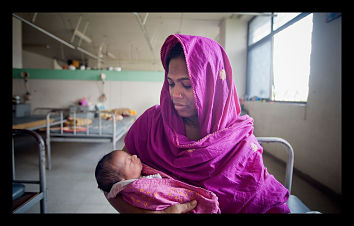
Considering that the reduction of the child mortality rate is one of the Millennium Development Goals (MDGs), it seems that with recent awareness towards public health concerns in India growing, this goal may actually become a reality in the country. India boasts the highest child mortality rate in the world, as well as the highest rate of maternal deaths globally, with the latter standing at one death every 10 minutes. Because of this, Acumen Fund, a U.S. nonprofit organization, and Indian multi-product company HLL Lifecare Limited have teamed up to create LifeSpring, a network of maternity and child healthcare hospitals that provide maternal health services to lower-income Indian families at affordable prices. In April 2010, LifeSpring became the first chain of healthcare providers to join the Business Call to Action, a global leadership effort for companies with core business initiatives to commit to meeting the MDGs. LifeSpring specifically has committed to the fifth and least progressive MDG, which focuses on decreasing the maternal death rate by 75 percent. LifeSpring opened up their first hospital in 2005, just outside the southern Indian city of Hyderabad in Moula Ali, and since then has grown to become the largest chain of maternity hospitals in South India. The hospital chain boasts nine small hospitals throughout Hyderabad with plans to expand to 30 hospitals located in Delhi, Mumbai and Ahmedabad by 2017. Due to poor health, unsafe home births, and scarce access to quality healthcare, lower-income Indian women often face damaging risks during pregnancy. In fact, more than 100,000 pregnancy-related deaths occur annually in India. Most of these deaths are preventable if a sufficient and standardized level of care is given. However, finding quality healthcare in India can be difficult for poorer individuals. The free healthcare provided to pregnant women and newborns in public hospitals lacks efficiency, transparency, and quality services. For these reasons, many Indian women choose to deliver at private hospitals, but often have to take out loans to finance the delivery. LifeSpring has become a successful alternative to this double-edged sword that exists in the public health system in India. Using a market-based approach of keeping healthcare prices low by cutting costs on infrastructure and using midwives instead of doctors, LifeSpring has been able to provide quality and affordable services to expectant mothers and newborn babies in India. The small chain of hospitals actually offers lower-income mothers the same healthcare and delivery services found at private hospitals at rates 30 to 50 percent lower than market prices. In addition to caring for the mothers during their deliveries, LifeSpring also offers prenatal and postnatal healthcare services, along with offering free vaccinations to babies at its Moula Ali hospital. The organization also engages in community outreach programs in which outreach workers and nurses go door to door within LifeSpring communities and follow up with new mothers and their newborns. – Elisha-Kim Desmangles Sources: LifeSpring, UNDP, India Today, Acumen, Forbes India Photo: Acumen
Posts

This is the fourth in a series of posts exploring the UN’s Millennium Development Goals. The MDGs are a series of eight interconnected goals agreed upon by almost every country in the world, based on a shared commitment to improving the social, political, and economic lives of all people. These goals are to met by 2015 and, two years out from this deadline, it is time to recognize both the incredible progress we have made and the work we have left to do.
The fourth MDG is to reduce the mortality rate for children under five by at least two thirds from 1990 to 2015. The world has made amazing progress on this front. Despite population growth, the number of deaths in children under five worldwide has decreased significantly from 12.4 million in 1990 to 6.9 million in 2011. This represents 14,000 fewer child deaths every day.
This improvement has been made possible by a wide variety of programs. Vaccines are an excellent way to avoid easily preventable deaths. According to the World Health Organization, vaccine-preventable diseases accounted for roughly 17% of deaths of children under five in 2008, representing 1.5 million deaths. This figure can be diminished fairly easily by providing vaccines for diseases such meningitis, tuberculosis, and rotavirus. The measles vaccine alone has prevented more than 10 million child deaths since 2000.
Another reliable method for reducing child mortality is the education of women. Even minimal education for a mother can significantly improve her children’s likelihood of survival. A UNDP program in Malaysia is capitalizing on this opportunity by surveying 2500 single mothers. These women are faced with incredible challenges, including poverty, lack of education and job opportunities, and social stigmatization. The results of the survey will be used to better understand how best to work with these women, enabling them to find enjoyable work and care for their children.
Another successful UNDP program is taking place in Canelones, a populous and impoverished area of Uruguay where roughly 35,000 citizens are raising children in extreme poverty. As a result of a UNDP study in the area that revealed severe health risks for children in poorer areas, several organizations teamed up to create “Canelones Grows with You”. This program provides the most vulnerable families in Canelones with comprehensive training on care for young children, including nutritional supplements and information on how to use them, as well as regular pregnancy check-ups. The program also encourages a sense of community that encompasses even the poorest families, who are often unaware of or feel excluded from public health clinics, schools, and eateries. “Canelones Grows with You” was so successful in reducing rates of malnutrition, low height, low birth weight, and prematurity that it has been adopted as official government policy with a program called “Uruguay Grows with You”.
Between 1990 and 2011, child mortality has almost been cut in half, decreasing in every region. This is an incredible achievement. However, with the goal set at a two-thirds reduction of the 1990 figure by 2015, we definitely have our work cut out for us. One of every nine children in sub-Saharan Africa still dies before they reach the age of five. In Southern Asia, this figure is one of every sixteen. Children from poorer families are almost twice as likely to die before their fifth birthday than those from wealthier families. Any preventable child deaths are unacceptable, but these figures are horrifyingly so.
Every child deserves a chance to live, and all parents deserve the opportunity to provide for their child. Significant progress has been made towards this ideal, and we must continue this important work if we hope to achieve the fourth Millennium Development Goal.
– Katie Fullerton
Sources: UN Development Program, United Nations, World Health Organization

Though poverty is measured according to dimensions that include mortality, morbidity, hunger, sickness, illiteracy, homelessness and powerlessness, these measures do not fully encompass the conditions of children living in poverty. Rarely differentiated from poverty in general, child poverty affects individuals at the most crucial stage of their lives, hindering not only their physical development but also their emotional development. Listed below are five statistics about child poverty.
- 1 billion children – more than half of those living in developing countries – suffer from one or more forms of severe deprivation, according to a study performed by the University of Bristol and the London School of Economics. Every second child suffers from deprivation of at least one of the following: nutrition, safe drinking water, sanitation, health, shelter, education and information. Furthermore, deprivation in one area often causes deprivation in another area – an estimated 700 million children suffer from two or more deprivations.
- 180 million children are currently engaged in child labor. Material deprivation often forces desperate children, including those subjected to war, orphaned or weakened by a condition such as HIV/AIDS, into dangerous forms of labor in order to support themselves and their families. Once engaged in child labor, children are deprived of an education and regularly abused. Many of them do not survive until adulthood.
- Roughly 1.2 children fall victim to human trafficking each year, and more than 2 million children are sexually exploited in the commercial sex industry each year. Material deprivation leads children to search for additional sources of income, and traffickers capitalize upon their vulnerability. Exploitation exacerbates conditions of poverty, preventing children from attending school and further deteriorating their mental and physical health.
- 400 million children (1 in 5) lack access to safe water, and 640 million (1 in 3) live without adequate shelter. Each year 1.4 million children die because of unsafe drinking water or inadequate sanitation.
- 22,000 children under the age of five die each day as a result of poverty, amounting to more than 8 million deaths per year.
– Katie Bandera
Sources: UNICEF DoSomething.org Global Issues
Photo: Flickr

Happy Mother’s Day? Well, maybe not in the Democratic Republic of Congo (DRC), which was recently named the worst place to be a mom according to a report done by Save the Children. The DRC took the unwanted ranking from Niger and for the first time in the 14 years since the report has been published, sub-Saharan Africa took up the bottom ten places.
The London-based charity’s “State of the World’s Mothers” report compared 176 countries in terms of maternal health, child mortality, education and levels of women’s income and political status. The results were staggering and showed massive gaps in maternal health. A woman or girl in the DRC has a 1 in 3o chance of dying from maternal causes, including childbirth, whereas a women in Finland faces a 1 in 12,200 risk. The report cited the poor health of mothers as well as low access to health care as possible causes for the high rates of infant mortality in sub-Saharan Africa.
Save the Children is calling for an investment to close the gap. They cite the need for nations to invest in mothers and children and to provide better and more accessible maternal care. Women must have access to education and political standing as well as high quality health and child care.
Much progress is being made in developing countries and sub-Saharan Africa; the study pointed to four life-saving products that could drastically change the current state of affairs. Those four products are:
1. Corticosteroid injections to women in preterm labor.
2. Resuscitation devices to save babies who do not breathe at birth.
3. Chlorhexidine cord cleansing to prevent umbilical cord infections.
4. Injectable antibiotics to treat newborn sepsis and pneumonia.
Simple devices and measures like these have the potential to give mothers and infants in countries like the DRC a better chance at a full, healthy life. It is time to continue the progress being made and even the odds for mothers in the DRC and all across sub-Saharan Africa.
– Amanda Kloeppel
Source: Global Post

Imagine what it’s like to have to choose between attending elementary school or harvesting wheat as a means of preventing starvation. Sadly, for many children in India where –according to UNICEF – upwards of 40 % of the population under five is underweight, this choice is one that many of their students have to make on a daily basis. However, thanks to the efforts of The Akshaya Patra Foundation and some assembly line ingenuity, free meals for Indian school children are now a reality for many elementary and middle school students.
The free meals for Indian school children program were incorporated following a 2001 Supreme Court Ruling institutionalizing free meals for all children under the age of 13. The Indian Government – in cooperation with The Akshaya Patra Foundation – has been able to feed 1.4 million children a day, resulting in greater attendance and a heightened ability to focus in class. The Foundation’s Vice Chairman, Chanchalapathi Dasa, remarked that “If a child is hungry in the classroom then he or she will not be able to receive all this education.”
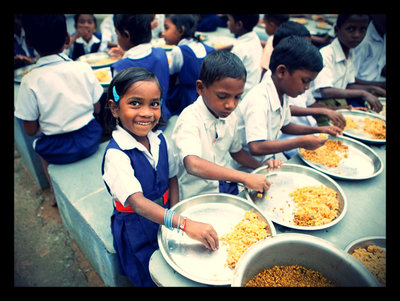
But how does the government-run a program to provide that many free meals for Indian school children in one day? The answer is through an ingenious “gravity flow” kitchen that utilizes the technologies of mass production and efficiency. Basically, the kitchen is divided into 3 floors where food is prepped on the third floor, sent down –via a chute – to the cauldrons for cooking on the second floor, and sent down a final chute to be packaged and shipped to the schools on the first floor. Vice-Chairman Dasa added that the organization knew the scope of the problem that they were trying to address and “realized that in order to see a significant impact we have to do it in scale and that we have to use modern techniques of management and innovation” to make a difference.
Programs such as these serve as a much needed shot in the arm in combating global poverty and chronic undernourishment for much of India’s youth. By providing free meals for Indian schoolchildren, investments made by the government today will result in greater technological innovation through educational achievements in the future.
– Brian Turner
Source: CNN
Photo: UNICEF

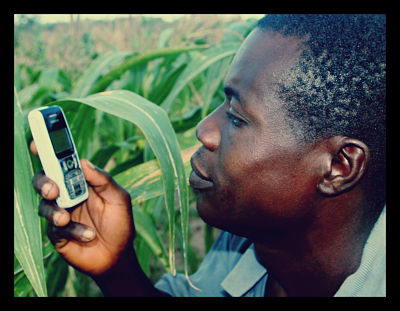
The problem of disseminating health-related information to impoverished communities is consistently at the forefront of humanitarian aid. On March 27, Mcel, a mobile telecommunications provider in Mozambique, along with UNICEF and the Ministry of Health signed a partnership which enables all Mcel customers to receive educational text messages.
This project, dubbed “SMS for Life,” spreads information to all Mcel users free of charge. The topics addressed in the text messages go over disease prevention, injuries, violence against children, and the importance of using health facilities. The program is scheduled to last three years and contributes to the national effort to achieve Millennium Development Goals four and five established by the UN. These goals focus on reducing child mortality rates and improving maternal health.
While the use of mobile phones in Mozambique isn’t as common as in the United States, Mcel’s subscribers cover all social groups – this project alone is predicted to reach nearly five million people.
One of the interesting aspects of this partnership is the use of the private sector in contributing its resources and support to public health and national goals. This type of success includes low involvement from external countries and simply aids the nation’s own companies and people in addressing national problems.
-Pete Grapentien
Source: UNICEF

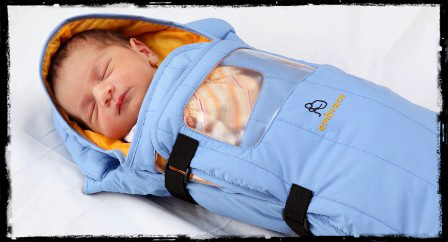
The Embrace infant health “sleeping bag” is an innovative, low-cost baby warmer, engineered for at-risk babies in developing countries. Around the world over 20 million low-birth-weight and premature babies are born every year, in the right environment, these babies can still thrive. However, in impoverished areas without resources or in turmoil, these babies are at risk of dying – and over four million will die within their first month of life. Amazingly, just keeping these newborns at the right temperature can be the difference between life and death.
The design of the Embrace incorporates materials that will stay a constant 98.6F, the critical temperature for a newborn’s survival. After being heated via any AC power source, the “WarmPak” inside the wrap traps the heat and then slowly releases it for up to 6 hours, keeping the “microclimate” inside the Embrace perfect for healthy development. Under normal conditions, a baby’s body temperature can be maintained through basic contact with the mother, but sometimes this is not always an option. Particularly for women who are working and/or caring for other children, who may be recovering from a traumatic birth, and those in disaster-relief and post-conflict settings.
The biggest problem these pre-mature babies face is hypothermia, when they cannot regulate their own body temperature and cannot stay warm. Average room temperature for these tiny bodies actually feels freezing to them. Those that can survive even without proper care will often develop life-long problems like diabetes, heart disease, and low IQ. Simply keeping a baby warm can save its life immediately and allow proper development in the long term.
– Mary Purcell
Source: Embraceglobal.org

India has organized a national summit on Call to Action for Child Survival and Development from February 7th to 9th. Held in Mahabalipuram, the summit brought together both national and international experts, policymakers, as well as representatives of developmental agencies including the U.N., to assess challenges and work toward achieving India’s development goals.
India is the regional front-runner when it comes to social entrepreneurship and its rapid advances in the health sector, specifically in dealing with maternal and child mortality rates. The summit additionally presents the need to build upon this great momentum both locally and globally. Since the 1990s, India’s maternal mortality rate has dropped by more than 50 percent, while its child mortality rate has reduced by 45 percent.
The United States government has pledged its support for India’s Call to Action initiative. USAID has been actively working with the government of India in its development undertakings, especially eradicating preventable child deaths. USAID is now initiating the Country Development Cooperation Strategy, which will focus on fostering partnerships locally and work towards co-funding rather than fully funding agreements in support of the efforts for finding solutions for child survival.
USAID expressed its commitment to this effort voicing, “An investment in India’s children is an investment in India’s future.”
– Pimrapee Thungkasemvathana
Source: USAID
Photo: UNICEF India

“The Borgen Project is an incredible nonprofit organization that is addressing poverty and hunger and working towards ending them.”