• Link to X
  • Link to Facebook
  • Link to Instagram
  • Link to TikTok
  • Link to Youtube
  • About
    • About Us
      • President
      • Board of Directors
      • Board of Advisors
      • Financials
      • Our Methodology
      • Success Tracker
      • Contact
  • Act Now
    • 30 Ways to Help
      • Email Congress
      • Call Congress
      • Volunteer
      • Courses & Certificates
      • Be a Donor
    • Internships
      • In-Office Internships
      • Remote Internships
    • Legislation
      • Politics 101
  • The Blog
  • The Podcast
  • Magazine
  • Donate
  • Click to open the search input field Click to open the search input field Search
  • Menu Menu

Archive for category: Hunger

Food & Hunger, Global Poverty, Health, Hunger

6 Reasons Breadfruit Can Solve World Hunger

Breadfruit Could Solve World Hunger
What is breadfruit? Although it sounds fictitious, it is actually a real food with the potential to contribute to the eradication of world hunger.

Breadfruit is shaped like a football and has a prickly texture. The fruit grows on trees and is highly nutritious. It is not well known because many people find it bland and tasteless.

However, there are 6 reasons why food critics should stop turning up their noses at this fruit and they all pertain to helping starving people.

  1. Breadfruit is native to the Pacific Islands and grows best in sunny and humid climates. About 80 percent of the world’s hungry live in tropical and subtropical regions. Because these regions are best for these trees, the fruit has the potential to feed thousands of hungry people.
  2. Breadfruit trees grow easily and begin to bear fruit within three to five years. They are not high maintenance and continue to produce fruit for decades. On average, larger trees can produce between 400-600 fruits while smaller trees can produce approximately 100 fruits.
  3. Breadfruit is nutritious. It is high in fiber, carbohydrates, calcium, copper, iron, magnesium, potassium, thiamine, and niacin.
  4. Breadfruit can be prepared in a variety of ways including fried, frozen, fermented, pickled, boiled, baked, and roasted. It can also be ground into flour.
  5. Currently, there are pilot projects working to distribute the fruit to places in need such as Honduras and the Caribbean. The Breadfruit Institute in Hawaii is a member of the Alliance to End Hunger. With their hard work and the work of other organizations such as Trees That Feed Foundation, breadfruit has fed people in Jamaica, Kenya, and Haiti.
  6. There are many fans advocating for the fruit. Olelo pa’a Faith Ogawa, a private chef says, “I feel it’s the food of the future. If I were to speak to the breadfruit spirit, it would tell me: ‘Grow me! Eat me! It can feed villages!’”

– Kelsey Parrotte

Sources: Business Insider, National Tropical Botanical Garden, Wall Street Journal, Huffington Post

September 22, 2015
https://borgenproject.org/wp-content/uploads/borgen-project-logo.svg 0 0 Borgen Project https://borgenproject.org/wp-content/uploads/borgen-project-logo.svg Borgen Project2015-09-22 01:30:082024-05-27 09:27:356 Reasons Breadfruit Can Solve World Hunger
Aid, Global Poverty, Hunger, Nonprofit Organizations and NGOs

Bangladesh Nonprofit Wins World Food Prize

Bangladesh_Nonprofit
In early November of 1970 a category-3 tropical cyclone made landfall over what was then called Eastern Pakistan. It was the single deadliest tropical storm in human history with a death toll reaching over 500,000. The next year, in 1971, the region would fight a war to form the independent nation of Bangladesh.

Due to so much devastation in so little time, Bangladesh would go on to become the second poorest country on the planet. That’s where one man, Fazle Hasan Abed, felt something had to be done.

Abed formed BRAC, or the Bangladesh Rural Advancement Committee, in the early 1970s as a temporary organization dedicated to providing aid to individuals and their families who were affected by the catastrophes. But after providing immediate relief Abed realized the need for round the clock, global aid.

Since its creation, the Bangladesh nonprofit has evolved into one of the largest organizations fighting to end global poverty and hunger. As a result, Abed was announced as the recipient of the 2015 World Food Prize on September 2 in Des Moines, Iowa.

Estimates on the scope of BRAC’s now 40-year impact show that the organization has helped nearly 150 million people across Africa and Asia. The organization has plans to expand its reach into 10 additional countries.

The World Food Prize was created in 1986 to recognize individuals who contribute to the production, innovation and availability of global food supplies. The prize is a donation of $250,000. The award ceremony will take place in October.

Initially, Abed and BRAC worked to combat the incredibly high childhood mortality rates in Bangladesh before seeing the need to combat poverty on an even grander scale. In 2010, Abed was knighted by Queen Elizabeth II for his efforts to empower women through STEAM and agricultural education.

Most recently, BRAC has begun a self-sufficiency and financial training program in 9 different countries. The program gives participants a weekly stipend to discourage begging and menial labor.

A bank account is set up in their name so as to teach financial and practical skills. Participants may also receive a grant to buy a computer, a cow, or a chicken coop to begin their own business.

On the program Abed said, “In many countries, poor people are not seen as a solution to the problem but the problem. Poor people can be organized and become the solution to the poverty themselves…All we need to do is provide them opportunities and conditions and give them the tools.”

Sir Abed, who recently celebrated his 79th birthday, now has yet another trophy to add to his collection that shows his undying desire to end global poverty, suffering and hunger.

– Joe Kitaj

Sources: Fortune, Huffington Post, BRAC, Word Food Prize
Photo: Globalhand

September 20, 2015
https://borgenproject.org/wp-content/uploads/borgen-project-logo.svg 0 0 Borgen Project https://borgenproject.org/wp-content/uploads/borgen-project-logo.svg Borgen Project2015-09-20 01:30:342020-06-25 10:34:52Bangladesh Nonprofit Wins World Food Prize
Children, Global Poverty, Health, Hunger

Eva Longoria and LG Raise Money For No Kid Hungry

eva_longoria
Last week, Eva Longoria hosted an LG Electronics USA product launch in Hollywood for the company’s new ranges with ProBake Convection technology to benefit the No Kid Hungry Campaign.

A-list celebrities and VIP guests like actress Kaley Cuoco-Sweeting, chef Angel Estrada and actor Jesse Metcalfe, gathered for a family oriented event sponsored by LG. The occasion featured cooking activities and games, as well as interactive culinary demonstrations highlighting the new cooking technology.

The fun-filled afternoon also served to raise awareness and support for the No Kid Hungry campaign that is sponsored by Share Our Strength, an organization that helps to provide food for children and families in need. Fittingly, the charity also empowers families to cook healthy meals together.

The Desperate Housewives star said that she really values the importance of family and passing down recipes to loved ones.

“I come from a tight-knit family where we value the importance of gathering for meals and celebrations, and I’m thrilled to join LG to encourage families to do the same, all while benefitting such a fantastic cause,” Longoria said.

Longoria supports a worthy cause — malnutrition is a continuing problem. According to Action Against Hunger, 3.5 million children die each year from malnutrition.

To help eradicate this problem, the No Kid Hungry campaign asks for donations for hungry children and lists ways for people to improve the lives of the impoverished. The campaign’s website focuses on using food as a tool to create a better value of life, stating that “another kid falls behind and never catches up” without proper nourishment.

The campaign also seeks to provide parents the tools to create and offer nutritious meals to their children. Supporting No Kid Hungry, LG encouraged the community to start their own “PostBake sales” in their neighborhoods using kits gifted by the event to all attendees.

Longoria hosted her own bake sale at the LG event. The award-winning cookbook author and co-restaurateur shared her cooking expertise during her live demonstrations. Her culinary creations were all recipes from her New York Times bestselling cookbook, “Eva’s Kitchen: Cooking with Love for Family and Friends.”

In addition, she helped organize pizza and flatbread baking, cake and cookie decorating, a themed photo booth and more.

Since the event, LG and Longoria have helped connect struggling kids with more than 345 million meals. The benefit also helped to launch school breakfast programs, recruit summer meals sites, and helped to provide grants to the most effective hunger-fighting organizations to help end child hunger in their communities, according to the No Kid Hungry website.

Not only is the campaign feeding kids, but it is also making their dreams come true.
Straight-A students and sisters, Jeane and Jahnique love to run, dance and cheerlead, and with the help of No Kid Hungry, they are able to do these activities with more energy.

“When I eat, it makes me run faster,” one sister said.

No Kid Hungry has helped many more kids in different areas. The operation’s website shows several more stories like this one. To read these stories and to learn how to support these kids, visit the No Kid Hungry website.

– Fallon Lineberger

Sources: Action Against Hunger, Look to the Stars, No Kid Hungry 1, No Kid Hungry 2, Vimeo
Photo: Homemade Mimi

September 18, 2015
https://borgenproject.org/wp-content/uploads/borgen-project-logo.svg 0 0 Borgen Project https://borgenproject.org/wp-content/uploads/borgen-project-logo.svg Borgen Project2015-09-18 01:30:452020-06-26 12:46:01Eva Longoria and LG Raise Money For No Kid Hungry
Children, Global Poverty, Health, Hunger

New Zealand Gang Feeds Children

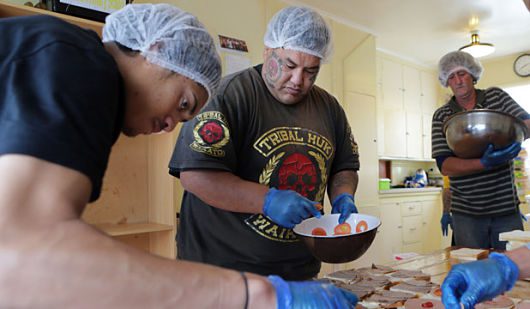
new_zealandThe Tribal Huk gang of Ngaruawahia, in New Zealand, has been working for the last four years to help feed the country’s poor children. Every day, the gang has been making and delivering sandwiches to thirty-one schools in the area and putting food in more than four hundred hungry children’s mouths.

Jamie Pink, the president of the organization, called Kai 4 the Future, knows what it is like to grow up in poverty. As a child, he barely ever had enough food for himself. When he grew to be an adult, he knew he wanted to do something about it. Although he does admit he likes violence, he says he liked helping people even more.

Now, Tribal Huk leases fifty acres of farmland around Horotiu and Ngaruawahia, and owns dozens of beef, sheep and pigs. Some animals are sold to finance the foundation while the rest go in the sandwiches.

In New Zealand, 270,000 children live below the poverty line, according to the country’s Children’s Commissioner. Although the government has implemented a $9.5 million program in the last couple of years to help solve the problem, children remain hungry.

Pink laments that New Zealand has enough water, food and other resources- sheep even outnumber people ten to one- to support their population, but children are still going hungry. He hopes to get government assistance so the gang can make even more sandwiches every day.

He is also hoping to start a new trust in which people donate just $5 a week to the Foundation. If 50,000 people pay this amount for a year, they would collect $30 million – enough to feed every hungry child in the country.

– Radhika Singh

Sources: Stuff, RadioNZ
Photo: Stuff

September 5, 2015
https://borgenproject.org/wp-content/uploads/borgen-project-logo.svg 0 0 Borgen Project https://borgenproject.org/wp-content/uploads/borgen-project-logo.svg Borgen Project2015-09-05 07:06:322024-05-24 23:56:18New Zealand Gang Feeds Children
Food & Hunger, Food Aid, Global Poverty, Hunger

Town Installs Outdoor Refrigerator to Feed the Hungry in Spain

Town Installs Outdoor Refrigerator to Feed the Hungry in Spain
There are 795 million people worldwide who do not have the resources available to them in order to lead a healthy lifestyle. That means that one in nine people in the world do not have enough food and often live in hunger.

UNICEF estimates that 20 percent of the children in Spain are living below the poverty line and hunger is becoming a more relevant problem in the country. In 2013, Spain distributed breakfast and snacks for 50,000 kids at risk of exclusion.

Seventeen percent of Spanish children are obese and living below the poverty line and do not have access to fresh food, fruit or vegetables.

Unemployment has been climbing since the 2008 financial crisis and Spain was one of the hardest-hit countries. People who once held regular jobs are out of unemployment benefits and are turning to squatting and collecting food from the garbage outside of stores.

In Galdakao, Spain, people are putting leftovers in a fridge on the street in order to feed the hungry.

The city has a population of 30,000 and created a communal refrigerator to help eradicate hunger in their town. After Alvaro Saiz, who ran a food bank in Galdakao, saw starving people digging through trash outside of stores and restaurants he decided there was a better way to not waste unused food through a new organization called Solidarity Fridge.

People in homes, people on the streets, and restaurant owners now take their unused food and put it in the communal fridge for the people who need it most to eat.

The project cost $5,500 and they had to change the law to prevent any legal action against the city if someone got sick. However, no raw meat or eggs are allowed in the fridge and anything in the refrigerator after four days must be thrown out. Solidarity Fridge says no food remains more than a few hours before it is taken by someone who is hungry.

Solidarity Fridge has become a learning experience for children as well. Schools organize field trips to visit the fridge and teach children about sharing and not wasting food.

One-third of food produced is wasted or lost every year, which is 1.3 billion tons. The entire net production of food in sub-Saharan Africa is 230 million tons. Solidarity Fridge may be a future model for other cities around the world wanting to feed the hungry while cutting down on wasting food.

– Donald Gering

Sources: Good News Network, New York Times, Revolting Europe, UNEP, WFP
Photo:  Flickr

September 1, 2015
https://borgenproject.org/wp-content/uploads/borgen-project-logo.svg 0 0 Borgen Project https://borgenproject.org/wp-content/uploads/borgen-project-logo.svg Borgen Project2015-09-01 02:06:102020-07-01 12:00:06Town Installs Outdoor Refrigerator to Feed the Hungry in Spain
Food & Hunger, Global Poverty, Hunger, Volunteer

Golden Temple in India Feeds 100,000 Per Day

Golden Temple in India Feeds 100,000 People Per Day
Every year, thousands of tourists line up to see the Taj Mahal in India, which is the most popular tourist destination in the country. In Amritsar, India, a Golden Temple serves 100,000 meals to the hungry every day, which is more people than the Taj Mahal attracts in a day.

The Sikhs believe the langar is a symbol of equality and not just a place for people to come eat for free. The kitchen needs an extensive number of ingredients each day, including 12,000 kilos of flour and 13,000 kilos of lentils. Most of the food is paid for up to two years in advance through donations.

At the langar, everyone gets a free hot meal regardless of their socioeconomic status or their religion. There are 450 people running the kitchen with the help of hundreds of volunteers. Over 300,000 plates, spoons and bowls are washed each day.

“There are only three things in our religion,” says a Sikh volunteer from California. “Chant the name of God, sing religious hymns and volunteer. I work as long as my legs allow me to stand.”

About 15 percent of the people in India are undernourished and 194 million people are hungry. This means a quarter of the undernourished people in the world belong to India. Also, India’s population is one of the fastest-growing populations in the world; it will one day become the most populous country.

More than 3,000 children in India die every day from illnesses related to poor nutrition. Hunger in India remains an alarming issue due to rising food prices and available agricultural land. While food grain production is increasing, it hasn’t been sufficient enough to feed the entire population.

Volunteering goes beyond the Golden Temple: donations from around the world help reduce hunger for thousands of people in India. Akshaya Patra, an NGO in India, feeds 1.4 million schoolchildren every day.

India hosts a large number of mega kitchens that feed people all over the country. Despite the rapidly growing population, the percentage of people who are undernourished and hungry is declining.

– Donald Gering

Sources: Al Jazeera, Good News Network, India Food Banking, India Times, Social Progress Imperative, UNDP, WFP
Photo: SkitHub

August 19, 2015
https://borgenproject.org/wp-content/uploads/borgen-project-logo.svg 0 0 Borgen Project https://borgenproject.org/wp-content/uploads/borgen-project-logo.svg Borgen Project2015-08-19 01:30:442024-05-27 09:27:31Golden Temple in India Feeds 100,000 Per Day
Hunger

The World Food Programme: 6 Hunger Hot Spots

world_food_program
The World Food Programme is waging war on hunger and fighting an uphill battle in six of the world’s hunger hot spots; Syria, Iraq, Yemen, South Sudan, Nepal and the Ebola-affected regions in Guinea, Liberia and Sierra Leone.

Most of the world’s population lives in developing countries. Many of them are mired in extreme poverty, with little hope of access to clean water and often reduced to scavenging for food in trash heaps lining their decrepit shanty town streets, just to feed their children. But in these six emergencies, the situation is even more urgent.

The World Food Programme (WFP), the world’s largest humanitarian aid agency fighting hunger, is the food aid branch of the United Nations, working to address hunger across the globe and promoting food security. Workers are on the ground in these areas trying to ease the crisis by providing needy families with life-saving food.

In Syria, the WFP is struggling to meet food need demands, as nearly six million people have been displaced. The ongoing armed conflict in Syria has been growing worse and the situation steadily deteriorating. Although the WFP has been reaching approximately four million people using hand to mouth operations, funding is running low and the need is increasing drastically.

Iraq has been in crisis for years and continues to be. The recent upsurge in violence has left 1.8 million displaced without access to water or food. The WFP reports having reached out to about a million people since June, providing assistance.

Yemen is a rapidly deteriorating humanitarian emergency. With around half of all children under five being stunted (too short for their age), Yemen already stands as having one of the highest child malnutrition rates in the world. Millions of people are being cut off from basic human needs such as food, water and electricity as fighting persists and fuel shortages continue.

Although the food security threat in South Sudan has been stabilized for now, sustainable assistance is essential in the region as the situation remains extremely fragile. The WFP has been able to reach more than 2.5 million people this year but if fighting continues, the situation in South Sudan could turn into a full-blown catastrophe.

The 7.8 magnitude earthquake that hit Nepal on April 25th, 2015 devastated the region, leaving approximately eight million people affected and living without access to food, water or shelter. With the epicenter being just outside of Kathmandu, large populations were displaced and 30 out of 75 districts in the country were ruined. The Nepalese government issued a state of emergency and the WFP is currently in the country providing assistance.

The WFP has responded in force to the Ebola emergency plaguing West Africa and has met the needs of people affected by the outbreak since April in Guinea, Liberia and Sierra Leone. Along with food assistance, the WFP is also helping get the humanitarian staff and equipment into the crisis zones.

According to www.worldhunger.org, the United Nations Food and Agriculture Organization estimates that about 805 million people of the 7.3 billion people in the world, or one in nine, were suffering from chronic undernourishment in 2012 to 2014. Almost all the hungry people, 791 million, live in developing countries, representing 13.5 percent, or one in eight, of the population of developing counties.

When disaster strikes or when war tears through a nation, humanity can be taken to the breaking point. With help from organizations like the World Food Programme, families fighting for survival can find some relief and possibly some hope.

– Jason Zimmerman

Sources: WFP, World Hunger
Photo: Action Against Hunger

August 15, 2015
https://borgenproject.org/wp-content/uploads/borgen-project-logo.svg 0 0 Borgen Project https://borgenproject.org/wp-content/uploads/borgen-project-logo.svg Borgen Project2015-08-15 01:30:022020-03-25 15:54:21The World Food Programme: 6 Hunger Hot Spots
Charity, Global Poverty, Hunger

Viola Davis Talks About Her Childhood Struggles in Poverty

Viola_Davis
In the August/September 2015 issue of AARP The Magazine, Viola Davis of ABC’s hit series, “How to Get Away with Murder,” talks about growing up in poverty and why giving back is important to her.

Now the star of a drama that has 9 million viewers on the edge of their seats, Davis said she is living her dream by just being able to afford a house. “When you grow up poor, you dream of just having a home and a bed that’s clean — that’s a sanctuary,” Davis said.

In her interview with AARP, the actress said that she grew up in a household with five siblings in an old building in Central Falls, Rhode Island. Her mother worked in a factory and her father groomed racehorses. “But grooms don’t make money,” Davis said. “Definitely not enough to feed a family of eight.”

Her family received food stamps that paid for groceries which did not last the entire month. Occasionally, Davis had to resort to garbage dumps for scraps and sometimes she had to steal from a store. When she was caught, she felt so ashamed that she forced herself to stop. Davis then had to count on other means to eat.

“Most of the time, the school lunch was the only meal I had. I would befriend kids whose mothers cooked three meals a day and go to their homes when I could,” Davis said.

The summers were difficult because she did not have school to feed her, but the winters were not much easier. The pipes in the building where she lived sometimes froze over, so the family did not have water to clean with or drink. The furnace broke, and the family would have to use each other’s body heat to stay warm.

Despite her hunger and unstable home life, Davis performed well in school. She and her siblings wanted to make sure they did not live in those conditions in the future.

“School was their haven,” Sara Davidson, AARP The Magazine writer, said. “And they stayed late, participating in sports, music, drama and student government.”

School was not only Davis’ means for nourishment but also where she found her calling. She entered the Upward Bound program, which funded her education at Rhode Island College. After graduating, she attended Juilliard for their drama program.

Continuing in her success, Davis won two Tony awards and later received two Oscar nominations.

Though it seemed as if Davis’ rise to fame was only increasing, she still had her doubts about being cast in a lead role. In her childhood years, she had experienced racism every day.

“People would throw things out of their cars and call us the N-word,” Davis said.

Because of this, she thought she was too dark-skinned to earn a big part in a Hollywood movie. “That notion was upended when, in 2014, she was offered the starring role in How to Get Away with Murder,” Davidson said.

In addition, although Davis was more than pleased with her life as a professional actress, wife and mother, she yearned for something more. She was asked to be the spokesperson for Hunger Is, and now she is dedicated to giving back.

Hunger Is was formed by the Safeway Foundation and the Entertainment Industry Foundation. The campaign seeks to end childhood hunger. With her own experience in the matter, Davis gave a touching speech about her childhood struggles. The two non-profits then donated $100,000 to the causes of her choice.

Davis divided this contribution between many organizations in her hometown including Central Falls High School’s Thespian Society.

Helping kids achieve their dreams, or even getting them meals, has brought Davis more happiness than acting. Although she had a difficult childhood, Davis is still looking up.

“There’s buoyancy and lightness in me. I’m not angry about my life. I’m not bitter at all. I’m happy,” Davis said.

To read more about Davis’ interview, visit the AARP website.

– Fallon Lineberger

Sources: AARP, Entertainment Weekly, Hunger Is
Photo: Flickr

August 14, 2015
https://borgenproject.org/wp-content/uploads/borgen-project-logo.svg 0 0 Borgen Project https://borgenproject.org/wp-content/uploads/borgen-project-logo.svg Borgen Project2015-08-14 09:30:442024-06-05 23:35:37Viola Davis Talks About Her Childhood Struggles in Poverty
Activism, Children, Global Poverty, Hunger

Celebrities Team Up with Feeding America

Feeding America
As part of a series by the organization Feeding America, “Say No to Summer Hunger” is teaming up with local food banks to serve much-needed summer meals to kids facing hunger.

In an event that was in partnership with the Los Angeles Regional Food Bank, Jennie Garth famous from the television show 90210 and actress Samantha Harris served free and nutritious lunches to dozens of kids and teens.

The event was located in a library is located in Los Angeles County, where the number of children living in food-insecure households ranks highest in the nation, with 591,000 children who may not know where they will find their next meal.

“Child hunger exists in communities all across America,” said Garth. “There should be no reason that a child in this country is allowed to go hungry.”

Nationally, upwards of 22 million children rely on free or reduced-priced meals to nourish them during the school year. However, during the summer months, only 2.7 million children have access to free or reduced-price meals through summer feeding programs. This creates a huge deficit in the amount of nutrition these children are receiving during a crucial period of their development.

As Samantha Harris said during the event, “Summer should be spent outside playing with friends, not worrying where or if you will eat lunch that day. Kids need energy, and food is fuel!”

This is why organizations like Feeding America exist: to feed America’s hungry through a nationwide network. Having celebrity members spread awareness by using their name, real change can be made, along with hopefully inspiring a call to action from other members of the community.

Feeding America’s “Say No to Summer Hunger” has and will hold events across the country for the duration of the summer months.

– Alysha Biemolt

Sources: Look to the Stars, Feeding America, Think Progress
Photo: Look to the Stars

August 9, 2015
https://borgenproject.org/wp-content/uploads/borgen-project-logo.svg 0 0 Borgen Project https://borgenproject.org/wp-content/uploads/borgen-project-logo.svg Borgen Project2015-08-09 01:30:002024-12-13 18:04:38Celebrities Team Up with Feeding America
Advocacy, Global Poverty, Hunger, Refugees and Displaced Persons

Jessica Watson Visits Syrian Refugees

Syrian_Refugees
Jessica Watson would like to see children around the world pursue their dreams. In order for that to happen, she must first tackle world hunger.

The 22-year-old is a Youth Ambassador for the United Nations World Food Programme (WFP). Hailing from Queensland, Australia and awarded Young Australian of the Year in 2011, Watson is the youngest person to ever sail around the world solo and unassisted, having completed the global voyage when she was 16 years old.

Watson’s most recent expedition, however, brought her to Lebanon and Jordan, where she visited Syrian refugees. Her “Sail with WFP” initiative recognizes the intimidating journey made by young Syrians who have left their homes for Lebanon or Jordan. As WFP’s Youth Ambassador, Watson provided food and support for suffering families.

Founded in 1961, WFP is the largest hunger-fighting organization in the world, supplying food in times of emergency and working with communities to create sustainability. The goal of the organization is to end world hunger and eliminate global poverty. Funded by governments, companies and private individuals, WFP provides annual assistance to more than 80 million people in 75 countries.

In Lebanon, Watson sailed with five Syrian and Lebanese youths from Beirut, Lebanon’s capital, to a northern port. In Jordan, she spent time in the Azraq refugee camp. There, Watson met a single Syrian mother Manal and her eight children. She accompanied the family to the camp’s only grocery store, where refugees buy food with electronic food cards from WFP.

Earlier this year, however, WFP had to reduce refugee stipends due to a lack of funding. As a result, the refugee program is 81 percent underfunded and many Syrian families are struggling to stay alive. The organization requires $138 million to continue helping refugees in Jordan, Lebanon, Egypt, Turkey and Iraq through September.

Watson also visited a Save the Children International youth center in Amman, Jordan’s capital, and hopes her journey will bring attention to the hardships faced by the Syrian people. A WFP Youth Ambassador since her young global voyage, Watson sails towards a new, hunger-free future.

– Sarah Sheppard

Sources: WFP 1, WFP 2, WFP 3
Photo: News Pronto

August 8, 2015
https://borgenproject.org/wp-content/uploads/borgen-project-logo.svg 0 0 Borgen Project https://borgenproject.org/wp-content/uploads/borgen-project-logo.svg Borgen Project2015-08-08 01:30:072024-05-26 23:05:29Jessica Watson Visits Syrian Refugees
Page 64 of 71«‹6263646566›»

Get Smarter

  • Global Poverty 101
  • Global Poverty… The Good News
  • Global Poverty & U.S. Jobs
  • Global Poverty and National Security
  • Innovative Solutions to Poverty
  • Global Poverty & Aid FAQ’s
Search Search

Take Action

  • Call Congress
  • Email Congress
  • Donate
  • 30 Ways to Help
  • Volunteer Ops
  • Internships
  • Courses & Certificates
  • The Podcast
Borgen Project

“The Borgen Project is an incredible nonprofit organization that is addressing poverty and hunger and working towards ending them.”

-The Huffington Post

Inside The Borgen Project

  • Contact
  • About
  • Financials
  • President
  • Board of Directors
  • Board of Advisors

International Links

  • UK Email Parliament
  • UK Donate
  • Canada Email Parliament

Get Smarter

  • Global Poverty 101
  • Global Poverty… The Good News
  • Global Poverty & U.S. Jobs
  • Global Poverty and National Security
  • Innovative Solutions to Poverty
  • Global Poverty & Aid FAQ’s

Ways to Help

  • Call Congress
  • Email Congress
  • Donate
  • 30 Ways to Help
  • Volunteer Ops
  • Internships
  • Courses & Certificates
  • The Podcast
Scroll to top Scroll to top Scroll to top