• Link to X
  • Link to Facebook
  • Link to Instagram
  • Link to TikTok
  • Link to Youtube
  • About
    • About Us
      • President
      • Board of Directors
      • Board of Advisors
      • Financials
      • Our Methodology
      • Success Tracker
      • Contact
  • Act Now
    • 30 Ways to Help
      • Email Congress
      • Call Congress
      • Volunteer
      • Courses & Certificates
      • Be a Donor
    • Internships
      • In-Office Internships
      • Remote Internships
    • Legislation
      • Politics 101
  • The Blog
  • The Podcast
  • Magazine
  • Donate
  • Click to open the search input field Click to open the search input field Search
  • Menu Menu

Archive for category: Food Aid

Information and news about food aid

Food & Hunger, Food Aid, Food Security, Global Poverty, Hunger

How Many People Go Hungry?

how many people go hungry?
Hunger and malnutrition plague millions of people globally, but just how many people go hungry?

Statistics show that 842 million people in the world do not have enough to eat. The vast majority of these hungry people, about 827 million, live in developing countries, where 14 percent of the population is undernourished. Asia currently has the largest number of hungry people, over 500 million, but it is Sub-Saharan Africa that has the highest prevalence of hunger and malnutrition. One out of six children, 100 million children in developing countries, is underweight. Throughout the world, one in four children’s growth is stunted from malnutrition, particularly in these developing countries. Poor nutrition causes nearly half of deaths under the age of five, totaling 3.1 million children a year.

Since 1990, global hunger has been reduced by more than 34 percent, but roughly one billion men, women, and children are still food-insecure. Since the federal government began Food for Peace in 1954, more than three billion people in over 150 countries have benefited directly from U.S. food aid. An increase in this assistance would make substantial changes throughout the world. WFP calculates that $3.2 billion is needed per year to reach all 66 million hungry school-age children.

The world produces enough calories for every person on earth to eat around 2700 per day for each human. Millions of people go hungry not because food is lacking. Rather, many of these calories are not used to feed humans. One-third is used to feed animals, 5 percent is used in the production of biofuels, and up to a third is simply wasted. The current system in place allows the wealthy half of the planet to eat well while the rest of the world struggles to eat at all.

Many organizations and programs aim to reduce global hunger. Supporting peasant farming is one key factor in this goal, but it is equally important to rein in Western-style culture and the standard the American diet creates.

-Elizabeth Malfaro

Sources: World Food Programme, Bread for the World
Photo: USAID

July 3, 2014
https://borgenproject.org/wp-content/uploads/borgen-project-logo.svg 0 0 Borgen Project https://borgenproject.org/wp-content/uploads/borgen-project-logo.svg Borgen Project2014-07-03 04:00:562024-12-13 17:49:34How Many People Go Hungry?
Food & Hunger, Food Aid, Politics and Political Attention

Agriculture Appropriations Bill Bolsters US Food Aid

The House of Representatives recently passed an amendment to the Agriculture Appropriations Bill which will improve the United States’ international food aid. The amendment, authored by U.S. Representative and Chairman of the House Foreign Affairs Committee Ed Royce (R-CA), provides funds for the Local and Regional Purchase Program. This program allows the U.S. to buy food closer to afflicted areas and reduce transit time and costs as a result. Representative Royce’s amendment provides $10 million for the program and reduces fundraising for the Agricultural Marketing Services which utilizes taxpayer money to administer food advertising campaigns. In a statement about the amendment’s passage, Royce stated, “It is crucial that the United States has the tools to respond to humanitarian crises while stretching our food aid dollars further.”

It is estimated that 925 million people globally suffer from malnutrition and hunger. That number is roughly three times the size of the U.S. population and a strong indication that hunger is a global health risk. The World Bank estimates that 44 million people have been impoverished since mid-2010 due to recent increases in food prices. This estimation coincides with shrinking foreign aid budgets among developed countries — a result of both fiscal conservatism and slow recovery from the 2008 financial crisis.

Goal one of the eight United Nations Millennium Development Goals established in 2000 is the eradication of extreme poverty and hunger. This goal came after the Food Aid Convention of 1999 which served as a formal agreement among donor countries to contribute to world food security. It also established minimum annual commitments among member countries. The U.S., with an annual commitment of 2,500,000 metric tons, has the largest commitment.

In fiscal year 2009 alone the U.S. provided $2.9 billion in food assistance to developing countries, which included approximately 2.8 million metric tons of food which reached 70 million people.

The recently-passed amendment to the Agriculture Appropriations Bill is a strong indicator that many of the leading political figures in the U.S. are willing to maintain this level of international support. However, as the global economy continues its slow recovery, foreign aid will continue to be a source of contentious debate both at home and abroad.

– Taylor Dow

Sources: House Committee on Foreign Affairs, Food Aid, Bread.org, USAID
Photo: Newsela

July 1, 2014
https://borgenproject.org/wp-content/uploads/borgen-project-logo.svg 0 0 Borgen Project https://borgenproject.org/wp-content/uploads/borgen-project-logo.svg Borgen Project2014-07-01 16:00:392024-05-26 23:51:54Agriculture Appropriations Bill Bolsters US Food Aid
Food Aid, Foreign Aid, Global Poverty, Hunger

World Food Program USA: What it Does

In the ever-evolving global fight against hunger, the World Food Program USA, an ally of the United Nations World Food Programme (WFP,) is leading the charge against the humanitarian issue.

With its headquarters in Washington D.C., WFP USA is thought of as the American arm of WFP. While WFP is the largest humanitarian agency fighting hunger throughout the world, World Food Program USA “builds support for WFP through fundraising, advocacy and education in the United States.”

Through its work to connect American businesses, organizations and philanthropists, WFP USA seeks to “transform the lives of hungry people across the planet.” The organization views its relationship with American citizens as key to solving world hunger.  

WFP USA releases an annual report each year detailing the state of hunger throughout the world. Its most recent report noted how the effects of conflicts in certain countries, including Syria, the Philippines, the Central African Republic and South Sudan, destabilize the ability for each nation to combat hunger and food security.

WFP has recently collaborated with such organizations as Yum! Brands, India Charitable Foundation and a bracelet line called The Brave Connection. These collaborations are sought to strengthen ties with different organizations.

Moreover, WFP seeks to alleviate the hardships caused by natural disasters or other emergencies, including a lack of adequate school meals and inadequate food security. The organization also strives to make a difference for women throughout the world.

A non-governmental agency, WFP received over $20 million last year through a combination of grants and fundraising. Both WFP and WFP USA rely upon contributions made by everyday individuals in order to continue to fight against global hunger and its related issues.

Through its relationship with WFP, WFP USA is one of the foremost leaders in the fight against world hunger. By working with businesses large and small and Americans of all socioeconomic classes, WFP USA is able to make an impact worldwide.

— Ethan Safran

Sources: World Food Program 1, World Food Program 2, Franchising, Huff Post
Photo: WFP USA

June 27, 2014
https://borgenproject.org/wp-content/uploads/borgen-project-logo.svg 0 0 Borgen Project https://borgenproject.org/wp-content/uploads/borgen-project-logo.svg Borgen Project2014-06-27 04:00:372024-05-26 23:50:43World Food Program USA: What it Does
Food & Hunger, Food Aid, Nonprofit Organizations and NGOs

The Hunger Project 101

While many poverty-reduction organizations implement a variety of different strategies to combat poverty and hunger, The Hunger Project’s methodology differentiates it from other nonprofit organizations.

Founded in 1977, The Hunger Project (THP) is a nonprofit, strategic organization with a focus on ending world hunger. With a global staff of over 300 people, the organization focuses its efforts in Africa, South Asia and Latin America. It seeks to end hunger and poverty by “empowering people to lead lives of self-reliance, meet their own basic needs and build better futures for their children.” This includes sustainable, grassroots strategies in numerous countries throughout the world.

The Hunger Project also places a special emphasis on women and gender equality. “Women bear the major responsibility for meeting basic needs, yet are systematically denied the resources, freedom of action and voice in decision-making to fulfill that responsibility,” the organization states.

With its headquarters located in New York City, THP operates in 11 different countries, including a number of African countries, as well as Bangladesh, India and Mexico. The organization maintains a number of partnerships with developed countries, including Australia, Canada, Germany, Japan, Switzerland and the United Kingdom.

Over the years, the organization has had to reinvent itself as a result of the shifting state of world hunger. In 2009, THP set a new strategic direction with an emphasis on partnerships, advocacy and impact.

THP’s board of directors, consisting of over a dozen people, includes a former president of Mozambique, a former vice president of Uganda, a Harvard economics professor and a former Secretary General of the U.N.

Recently, Anytime Fitness co-founder Jacinta McDonell Jimenez committed to raising $100,000 for THP. The money will provide 200 communities with the necessary funds to purchase food-processing equipment. Additionally, the money will train nearly 50,000 rural inhabitants in farming techniques as well as provide 2,000 people with loans to purchase seeds and fertilizer.

Through its mission to put an end to world hunger, THP maintains a set of 10 principles that it considers to be fundamental to its organization. Among them are human dignity, gender equality, sustainability and transformative leadership. Because it believes hunger is a human issue, THP states its principles are “consistent with our shared humanity.”

— Ethan Safran

Sources: The Hunger Project, Business Franchise Australia
Photo: Zander Bergen

June 26, 2014
https://borgenproject.org/wp-content/uploads/borgen-project-logo.svg 0 0 Borgen Project https://borgenproject.org/wp-content/uploads/borgen-project-logo.svg Borgen Project2014-06-26 18:37:592024-05-26 23:53:00The Hunger Project 101
Children, Food & Hunger, Food Aid, Global Poverty

10 Facts About Malnutrition in Children

Child hunger is a very significant issue today. World Hunger defines hunger as protein-energy malnutrition, or a lack of calories and protein. UNICEF estimates state that malnutrition in children affects nearly 195 million worldwide. Discussed below are the leading facts about malnutrition in children and its implications.


Top 10 Facts on Malnutrition in Children


  1. Malnutrition can begin as early as conception. If a mother does not receive proper nutrition during pregnancy, her child will already be at risk of developmental problems. This means that early intervention is crucial.
  2. Children have a two-year period, beginning at conception and continuing into infancy, known as the “window of opportunity.” During this time, a child can be guarded against the most devastating effects of malnutrition.
  3. Malnutrition presents itself in three ways: stunting (shorter-than-average height), wasting (having a low weight for one’s height) and being underweight (having a low weight for one’s age.)
  4. A malnourished child can suffer neurological damage. Brain damage is one of many health issues caused by malnutrition, and it can lower IQ, even resulting in mental retardation for some children.
  5. Children are affected in more areas than their brains — their immune systems are at risk, too. Children who are malnourished are more likely to die from common childhood ailments, like diarrhea and respiratory illnesses.
  6. Malnutrition is more than just a lack of food, it’s a lack of nutrients. Malnourished children often suffer from vitamin and mineral deficiencies, which have the most negative effects on their health. Recall that children suffering from hunger can develop brain damage. This is due in part to iron deficiency; so is the decreased ability to fight off common infections.
  7. Child hunger kills in colossal numbers. It contributes one-third of the 8 million deaths each year of children younger than 5 years old.
  8. The main cause of child malnutrition is poverty. Conversely, hunger contributes to poverty, creating a vicious cycle. Another factor contributing to malnutrition is conflict: years of civil war in Libya have put parents in a difficult position without access to food for their families. Natural disasters, particularly droughts and floods, are also contributors to child malnutrition.
  9. North Korea had the highest percentage of children under 5 years old who were underweight between the years of 1995 and 2000, and 60 percent of children under 5 were underweight during this time.
  10. As of 2000, more than half of the world’s underweight children lived in southern Asia.

Unfortunately, many of today’s food aid programs are not targeting malnutrition. The programs are relying heavily on a corn-soy cereal blend that simply does not contain the required nutrients to keep children from becoming malnourished. While these programs are relieving hunger, many children receiving aid are still deprived of valuable nutrients that they will need to grow into successful, healthy adults.

 — Rachel Davis

Sources: ChildFund, Starved for Attention, UNICEF, World Hunger
Photo: U.N.

June 18, 2014
https://borgenproject.org/wp-content/uploads/borgen-project-logo.svg 0 0 Borgen Project https://borgenproject.org/wp-content/uploads/borgen-project-logo.svg Borgen Project2014-06-18 20:11:272024-06-04 03:01:2010 Facts About Malnutrition in Children
Food & Hunger, Food Aid

Child Malnutrition in Cote d’Ivoire

For the past six years, the rate of chronic child malnutrition in Cote d’Ivoire has remained at a whopping 40 percent. This is slightly higher than the overall population’s malnutrition rate, which is a solid 30 percent. The Ivory Coast, located on the coastal edge of Western Africa, experiences high malnutrition rates due to a multitude of factors including high food prices and inadequate food access, which is a consequence of hot, dry weather.

Tumultuous political circumstances from the early to late 2000s divided Cote d’Ivoire into North and South; rebels then controlled its northern region. As a result, government and public services in the north were wrecked, the economy collapsed and food access was scarcer than ever. Health and food distribution services were no longer functional. Thankfully, in 2008 its government created nutrition centers in the north and east, of which there are now 14.

Yet, the regions exhibiting the highest chronic rate of malnutrition in Cote d’Ivoire are Bafing, Worodougou and Montagnes. Additionally, the Savanes, Worodougou and Montagnes regions exhibit the highest concentrated rates of consequent stunted growth. Widespread national poverty as well as thousands of displaced peoples further complicate the dire circumstances.

It is evident that Cote d’Ivoire’s government lacks the funds necessary to effectively combat its malnutrition problems. A few humanitarian organizations have assisted, most notably Action Against Hunger (ACF) from 2002 to 2011. ACF’s aid ceased abruptly when its funds were depleted. The organization retracted much of its aid and missionaries, a circumstance that somewhat reversed the critical progress it had contributed.

Diarrassouba Issouf, an official at the Family Protection Unit in Korhogo, said that the humanitarian organizations’ exits left primary areas without food and resulted in fewer women visiting nutrition sites.

Cote d’Ivoire’s stagnating and critical malnutrition levels, especially in young children, demands immediate attention. With more international humanitarian assistance and aid, more lasting improvement may be on Cote d’Ivoire’s horizon.

– Arielle Swett

Sources: All Africa, Action Against Hunger, UNICEF
Photo: News Wire

June 16, 2014
https://borgenproject.org/wp-content/uploads/borgen-project-logo.svg 0 0 Borgen Project https://borgenproject.org/wp-content/uploads/borgen-project-logo.svg Borgen Project2014-06-16 04:00:232024-05-26 23:44:04Child Malnutrition in Cote d’Ivoire
Food & Hunger, Food Aid, Food Security

5 World Hunger Solutions

World Hunger Solutions
Approximately 1 billion people worldwide live in hunger, despite the fact that there is enough food on the planet to feed all 7 billion of the world’s living humans. Here are five world hunger solutions:

1. Feeding Programs and Food Aid Donations

Probably the most obvious of the five solutions, the most immediate, if not the most sustainable, way to end hunger is to put food directly in the hands of those who are hungry. Feeding programs and efficient food aid donations have proven to be an extremely effective way of doing so.

Getting food to the hungry until they are able to produce it themselves is not a matter of implementing feeding programs and donating food – it’s about making the programs that already exist more effective. For instance, the Food for Peace Reform Act of 2014 that was introduced in Congress on June 3 strives to greatly increase the economic effectiveness of U.S. food aid by ending requirements that food aid must be purchased domestically rather than locally, a requirement that significantly drives up the price of food.

By turning a careful eye to the programs that are in place today and making slight reforms to them where necessary, it is possible to feed millions more people around the world.

2. Education and School Meals

Providing all school-aged children with a proper education is one of the most effective ways of ensuring that they don’t face hunger as adults. By providing kids with the knowledge and skills to procure jobs, education prepares them to be self-sufficient in the real world.

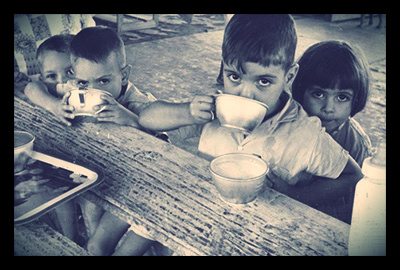
It’s important, though, to make sure that children are fed while they’re in school. Not only does this encourage them (especially those children who do not receive enough to eat at home) to come to school, but it also increases their focus and improves their performance while they’re in the classroom.

3. Sustainable, Practical and Dependable Agriculture

Implementing sustainable, practical and dependable agriculture is a three-fold task: international aid organizations must work with farmers and communities to promote vegetarian diets, embrace GMOs and adopt urban farming practices. Only by accomplishing each of these tasks will hungry communities be able to produce enough food to sustain themselves in the immediate future.

Why vegetarian? It can be a hard sell, it’s true – especially in places where meat is already a large portion of the local cuisine or plays a role in a cultural tradition. While we certainly don’t want to interfere in local cultures, reducing the global demand for meat is an important step toward making more food available for the hungry. It is estimated that for every 100 calories fed to a cow, a human will reap only 2.5 calories from eating its beef. Calorically, raising livestock for the sole purpose of eventually consuming them is extremely expensive. By decreasing the size of the meat industry, we could simultaneously decrease worldwide hunger.

Genetically-modified organisms, or GMOs, are another controversial topic. GMOs indisputably play a large role in helping the hungry, especially in nations where meteorological events are wreaking havoc on the agricultural yield. Some GMOs are specifically modified to be more resistant to droughts or floods than are conventional organisms, making them especially hardy in tropical and arid regions of the world. Planting GMOs in nations with extreme climates makes their populations less vulnerable to hunger. Better yet, many GMOs are nutritionally-enriched.

Urban farming has also captured headlines recently, but is usually cast in a positive light. That’s because the practice makes efficient use of urban space that is often overlooked and underused. Poverty is becoming an increasingly-urbanized affliction, with over 28 percent of poverty worldwide occurring in cities. In Asia, a staggering 50 percent of the impoverished live in urban areas. In order to get food into urban areas, it’s time we start producing food in urban areas. Urban farming is the answer to increasing food security in cities. It’s already proven to be extremely effective at reducing hunger for those living in Indian slums.

These agricultural adaptations certainly won’t come easy in many parts of the world, but implementing these changes even over a period of time is sure to yield major results.

4. Women

Despite making up more than half of the world’s population, women often exercise less agency when it comes to decision-making and have less access to resources such as education than do their male counterparts. These inequalities are just part of the reason why women experience hunger at higher rates than men do. Ironically, it’s women who do most of the world’s agricultural work. In Africa, 80 percent of farm workers are women; unfortunately, though they work with food all day, many of them don’t have enough of their own to keep themselves and their families well-nourished.

Investing in these women, however, is an unexpected way of bringing world hunger to an end. Typically, food goes farther in the hands of women than in the hands of men – it is more likely to nourish more members of the family, especially children. In regards to children, pregnant women are particularly in need of adequate nutrients – healthy mothers bear healthy kids.

Giving a woman food and the power to afford and obtain her own food in the future is the best way of ensuring that she and her family do not suffer from hunger. In Brazil, children are 20 percent more likely to survive to adulthood when their mothers control the family’s income. It’s time to invest in women – investing in them is investing in ending hunger.

Another way the U.S. can invest in women is by making contraception affordable, accessible and understandable to them worldwide. Globally, we’re facing a crisis of overpopulation, and more mouths are more difficult to feed. Lowering worldwide fertility rates is a key part of solving hunger.

5. Infants

Babies are particularly vulnerable to disease and infection, and hunger and malnutrition only exaggerate that weakness. By giving babies a healthy, well-nourished start to life, we give them a greater chance at making it to adulthood.

How does this end world hunger? Healthy children can attend school, grow up to find employment and make better lives for their own children. A healthy populace begins at birth.

World hunger isn’t going to end tomorrow. But by understanding some of the tactics we can use to end it, we might sooner bring about a world where everyone is well-fed, healthy and happy.

– Elise L. Riley

Sources: The Guardian 1, The Guardian 2, Food for Life, Borgen Project, World Watch, WFP
June 13, 2014
https://borgenproject.org/wp-content/uploads/borgen-project-logo.svg 0 0 Borgen Project https://borgenproject.org/wp-content/uploads/borgen-project-logo.svg Borgen Project2014-06-13 15:44:102024-06-04 03:01:205 World Hunger Solutions
Food & Hunger, Food Aid, Food Security

UN to Provide Food Aid to Yemen

Food Aid to Yemen
Nearly 54 percent of Yemen’s population remains below the country’s poverty line. The rate of unemployment among young people in Yemen has grown to be around 60 percent of the population.

“Preliminary studies show that between March 2011 and March 2013, Yemen’s economy saw a loss of about $4.75 billion as a result of oil pipeline bombings and acts of sabotage targeting some installations,” said Yemeni Minster of Oil and Minerals, Ahmed Abdullah Daris.

Recently, the United Nations food agency has stated that they are scaling up their food aid to Yemen as nearly half of the population is going hungry. More than 10 million of Yemen’s 25 million inhabitants either require food aid due to an inability to find enough food for themselves, or are teetering on the edge.

In 1996, the World Health Organization defined food security as “when all people at all times have access to sufficient, safe, nutritious food to maintain a healthy and active life.”

Food security is built on three pillars: (1) food availability, or the opportunity to have sufficient quantities of food available on a consistent basis; (2) food access, having sufficient resources to obtain appropriate foods for a nutritious diet; (3) and food use, appropriate use based on knowledge of basic nutrition and care, as well as adequate water and sanitation.

“The country has one of the world’s highest levels of malnutrition among children,” said World Food Programme spokeswoman Elisabeth Byrs, “with nearly half of all kids under the age of 5—a full 2 million of them—stunted. A million of those kids are acutely malnourished.”

The problem is difficult to tackle. Yemen, one of the poorest countries in the world, has been going through a difficult political transition since the removal of president Ali Abdullah Saleh after a year of deadly protests against his 33-year rule.

At the same time, Yemen is also vulnerable to international hikes in food prices, since it imports around 90 percent of its main staple foods like wheat and sugar. The price hikes, according to the U.N., affect around 90 percent of Yemeni households and may be the reason why nearly 50 percent of children under the age of 5 suffer from chronic malnutrition.

Starting in July, the U.N. agency plans to launch a special two-year “Recovery Operation” aimed at addressing long-term hunger in the region. The Recovery Operation will help to ensure food stability for around 6 million people. Under the program, the U.N. will provide malnutrition prevention and treatment, give 200,000 girls in school take-home rations and will help create rural jobs, improve farms and water supplies.

The program aims to safeguard Yemeni lives and boost food security and nutrition in poverty-stricken areas. The program seeks to reach 6 million Yemeni people from mid-2014 to mid-2016, and will aim to provide solutions for long-term relief instead of short term. The U.N. has announced that their efforts would only offer temporary relief.

The U.N. warns, however, that the aid increase will be costly, with the agency estimating that the two-year program will cost around $491 million.

– Monica Newell

Sources: Gulf News, Press TV, Al-Monitor, Yemen Post
Photo: Care

June 13, 2014
https://borgenproject.org/wp-content/uploads/borgen-project-logo.svg 0 0 Borgen Project https://borgenproject.org/wp-content/uploads/borgen-project-logo.svg Borgen Project2014-06-13 13:22:372024-06-04 01:08:04UN to Provide Food Aid to Yemen
Children, Food & Hunger, Food Aid

Food Alone Not Enough for Malnourished Children

Researchers studying malnourished children in Bangladesh have concluded that current therapeutic food interventions, while effective in saving lives, is not enough to reverse damage done in formative years.

Doctors have been trying to address problems that formerly malnourished children now in treatment still face such as stunted growth, immune deficiencies and slow intellectual growth. It is now becoming apparent that these development challenges are due to an immature system of microbial organisms that inhabit the digestive tracts of healthy children.

In the study, researchers compared fecal samples of 64 malnourished children to samples from 50 healthy Bangladeshi children that had been collected monthly over the first two years of their lives. In the healthy samples, 24 species of bacteria were found and used to predict the maturity of a child’s microbial system.

The study showed that when these children were afflicted with diarrhea, their microbial systems quickly recovered. The malnourished children hospitalized for diarrhea showed little recovery in the maturity of these systems after treatment with antibiotics and therapeutic foods, as they were lacking in healthy microbes to begin with.

This deficiency likely stems from undernourishment in the first two years of life, a formative period that is essential to developing a healthy brain, immune system and microbial system.

“Perhaps healthy growth and attainment of our full potential requires healthy development of our microbial organ, and also microbes living in other parts of our bodies,” said researcher Jeffrey I. Gordon of Washington University in St. Louis.

Current treatment for undernourishment includes rehydration, a liquid diet of milk suji (whole milk powder, rice powder, sugar and soya oil) and a series of multivitamins and antibiotics to help fight infection. This method has decreased the mortality rate in malnourished children by 47 percent and reduced risk of hypoglycemia.

Researchers in the recent study questioned the long-term results of such treatment protocols and the extent to which they restore normal growth and development. Gordon stated that the current methods should be adjusted to include probiotic supplements, as well as prolonged consumption of therapeutic foods.

“We need to think of food as interacting with this microbial organ,” he said.

Ed Yong, a science writer for Discover Magazine, writes that roughly 1,000 species of bacteria reside in the human bowel, though the makeup of these species varies from person to person. Each individual carries about 160 different bacterial species; it is estimated that 57 exist in the majority of the population. These microbes serve functions such as breaking down complex sugars, producing vitamins and fatty acids and converting chemicals into useful substances.

Factors that impact the development of healthy bacteria include diet, genetics and locale. Research has shown that even the method of delivery can impact the bacterial makeup of an infant; those that are delivered via C-section show less diversity in microbial systems than those delivered naturally. These differences can affect other facets of daily life including susceptibility to disease, predisposition to obesity and the ease with which certain foods are digested.

– Kristen Bezner

Sources: Discover, Science Direct, National Geographic 1, National Geographic 2, Nature
Photo: Chai Counselors

June 9, 2014
https://borgenproject.org/wp-content/uploads/borgen-project-logo.svg 0 0 Borgen Project https://borgenproject.org/wp-content/uploads/borgen-project-logo.svg Borgen Project2014-06-09 07:51:522024-06-05 01:57:30Food Alone Not Enough for Malnourished Children
Food Aid, Foreign Aid

10 Photos of US Foreign Aid in Action

In theory, foreign aid is a great concept that many citizens support in the United States. But how often do we actually get to see our heart-felt donations, activism and support of U.S. foreign aid in action? Here’s to all of you who want to see some concrete results of your efforts. All of the work and investment going into U.S. foreign policy is making a difference, and here are some real life examples to prove it!


1. U.S. Actor, Matt Damon, and Haitian Singer, Wyclef Jean, Distribute U.S. Food Aid to Haitian Flood Victims

US Foreign Aid

2. USAID’s Nutrition Programs

US Foreign Aid

3. Haitians Waving to a Departing U.S. Helicopter After Delivering Food and Water to Port au Prince

US Foreign Aid

4. USAID’s Decrease in Maternal Mortality Rates

US Foreign Aid

5. USAID Funds’ Replacement of 187 CDA Tubewell Pumps in Islamabad, Pakistan

US Foreign Aid

6. USAID‘s Female Health Workers

US Foreign Aid

7. USAID Delivers Deworming Medication to Kindergartners in Nam Dinh Province, Vietnam

US Foreign Aid

8. USAID’s Increases in Life Expectancy and Decreases in Maternal & Child Mortality Rates

US Foreign Aid

9. Emergency Food Distribution by USAID in Agok, Sudan

US Foreign Aid

10. USAID’s  Tropical Disease Treatments

US Foreign Aid

Photo: USAID Flickr Slideshow , U.N. , Flickr

June 8, 2014
https://borgenproject.org/wp-content/uploads/borgen-project-logo.svg 0 0 Borgen Project https://borgenproject.org/wp-content/uploads/borgen-project-logo.svg Borgen Project2014-06-08 19:12:162014-08-08 08:15:2610 Photos of US Foreign Aid in Action
Page 8 of 13«‹678910›»

Get Smarter

  • Global Poverty 101
  • Global Poverty… The Good News
  • Global Poverty & U.S. Jobs
  • Global Poverty and National Security
  • Innovative Solutions to Poverty
  • Global Poverty & Aid FAQ’s
Search Search

Take Action

  • Call Congress
  • Email Congress
  • Donate
  • 30 Ways to Help
  • Volunteer Ops
  • Internships
  • Courses & Certificates
  • The Podcast
Borgen Project

“The Borgen Project is an incredible nonprofit organization that is addressing poverty and hunger and working towards ending them.”

-The Huffington Post

Inside The Borgen Project

  • Contact
  • About
  • Financials
  • President
  • Board of Directors
  • Board of Advisors

International Links

  • UK Email Parliament
  • UK Donate
  • Canada Email Parliament

Get Smarter

  • Global Poverty 101
  • Global Poverty… The Good News
  • Global Poverty & U.S. Jobs
  • Global Poverty and National Security
  • Innovative Solutions to Poverty
  • Global Poverty & Aid FAQ’s

Ways to Help

  • Call Congress
  • Email Congress
  • Donate
  • 30 Ways to Help
  • Volunteer Ops
  • Internships
  • Courses & Certificates
  • The Podcast
Scroll to top Scroll to top Scroll to top