• Link to X
  • Link to Facebook
  • Link to Instagram
  • Link to TikTok
  • Link to Youtube
  • About
    • About Us
      • President
      • Board of Directors
      • Board of Advisors
      • Financials
      • Our Methodology
      • Success Tracker
      • Contact
  • Act Now
    • 30 Ways to Help
      • Email Congress
      • Call Congress
      • Volunteer
      • Courses & Certificates
      • Be a Donor
    • Internships
      • In-Office Internships
      • Remote Internships
    • Legislation
      • Politics 101
  • The Blog
  • The Podcast
  • Magazine
  • Donate
  • Click to open the search input field Click to open the search input field Search
  • Menu Menu

Archive for category: Development

Information and stories on development news.

Development, Global Poverty

Dutch Government Encourages Development

dutch_government
The Dutch government has given entrepreneurs a way to do business in developing countries, without jumping through hoops to do so. The Dutch Good Growth Fund offers a source of financing for development-related businesses to improve the economies of developing countries, create jobs and increase production capacity locally.

The Dutch Good Growth Fund (DGGF) is seeking win-win situations: helping locally and fixing globally. The DGGF is divided into three subsections:

  1. Financing small to medium businesses looking to make development-related investments in low-income countries. These are companies located in the Netherlands, investing in business in other countries.
  2. Financing enterprises within low-income countries. These are small businesses in other countries that a Dutch company will support.
  3. Financing small to medium businesses wanting to export to low-income countries. These are Dutch companies exporting to other countries.

This Netherlands based loan fund is comprised of 700 million Euros from the Ministry of Foreign Affairs. Out of the total loans, 20 percent of the funding goes towards businesses in fragile states, and another 20 percent goes to women entrepreneurs.  The funding applies to 66 countries throughout the globe, all of which have emerging markets and low incomes.

The program was launched in 2014, and has yet to make any significant progress. The idea is promising—helping us while helping others—but it does not seem to be working as efficiently as the Ministry of Foreign Affairs had hoped. By targeting small businesses, the waves of success are inherently smaller.

These small waves of success, however, could amount to something big. The Dutch Good Fun Program is still only in its second year and it has already reached out to over 66 countries, helping their own local economy and boosting the morale of small business entrepreneurs. This is a program to watch out for.

– Hannah Resnick

Sources: Agripro Focus, Berenschot, Centre of Research on Multinational Corporations, Government of Netherlands
Photo: GNBCC

June 15, 2015
https://borgenproject.org/wp-content/uploads/borgen-project-logo.svg 0 0 Borgen Project https://borgenproject.org/wp-content/uploads/borgen-project-logo.svg Borgen Project2015-06-15 16:00:042024-06-04 03:53:02Dutch Government Encourages Development
Development, Global Poverty, Nonprofit Organizations and NGOs, Water

Sand Dam Construction Brings Water to Driest Areas

sand_dam
Dryland ecosystems are classified as having long periods of drought with very short seasons of intense, heavy rainfall. They cover approximately 40 percent of the earth’s surface, particularly in developing countries, where 1/3 of the global population lives.

Drylands have extremely limited access to clean drinking water. However, there has been a recent surge in the construction of sand dams, currently the most cost-effective technology in water collection.

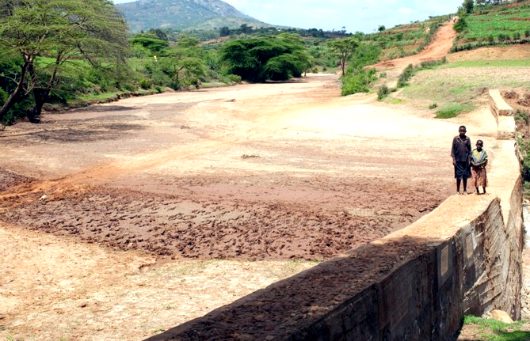
Sand dams combine ancient rainwater collecting techniques, everyday building materials and local manpower to collect clean water that would otherwise become runoff, carrying away fertile topsoil essential to subsistence farming. A moderately sized dam can supply over 1,000 people with a consistent supply of filtered water, even during the year’s driest seasons.

According to reporter and producer Russell Beard, “A sand dam is a reinforced concrete wall built across a seasonal riverbed. Over three or four rainy seasons, sand is washed downstream and deposited in the reservoir behind the dam wall, which stores up to 40 percent of its volume as water. The sand slows evaporation, filters the water, and protects it from contamination by livestock or disease-carrying mosquitoes.”

Timber, rocks, cement, sand and water are the only raw materials needed to build a sand dam, all of which are supplied by donor funding. Local community members work together to build the dam structures and the women and girls are usually deemed responsible for water collection.

Excellent Development, a UK based nonprofit organization, has devoted its entire efforts to distributing sand dam technology to dryland areas, in hopes of providing stable water security to poor, rural populations all over Africa.

Excellent Development published a report, Sand Dams: The World’s Most Cost-Effective Method of Conserving Rainwater, which outlines the desperate need for sand dam construction.

The report states, “Drylands cover approximately 40% of the world’s land area and support 80% of the world’s poorest people, mostly in the rural areas of Africa and Asia. Approximately 10% of drylands display symptoms of land degradation: Water scarcity, sparse vegetation, soil erosion and nutrient depletion; further diminishing the ability of ecosystems to absorb and store rainwater.”

Sand dam construction not only provides clean drinking water, but also replenishes local ecosystems, increases food security and promotes community cooperation.

Executive Director of Excellent Development Simon Maddrell said, “Sand dams are the most cost-effective method of rainwater harvesting known. They have the potential to provide communities living in dryland areas with a clean local water supply for life, even during periods of drought. We know how much this is needed, especially in dryland areas of the world – where 80% of the world’s poorest people live. We also know that access to water in these areas is likely to worsen: Climate change is already altering rain patterns, creating more droughts, more floods and shorter, more intense rains.”

To date, Excellent Development has pioneered the construction of 838 sand dams, planted 935,000 trees, dug 1.5 million meters of terraces, built 43 community seed banks, built 51 school water tanks and brought fresh, filtered water to nearly one million people.

– Hanna Darroll

Sources: UNDP, The Water Project, Excellent Development
Photo: Excellent Development

June 15, 2015
https://borgenproject.org/wp-content/uploads/borgen-project-logo.svg 0 0 Borgen Project https://borgenproject.org/wp-content/uploads/borgen-project-logo.svg Borgen Project2015-06-15 08:17:472024-06-04 01:08:10Sand Dam Construction Brings Water to Driest Areas
Activism, Advocacy, Development

Crowdfunding for Development

crowdfunding
In 2014, the space-based video game ‘Star Citizen’ raised almost 40 million dollars via crowdsourcing, earning it a Guinness World Record for the largest single amount ever raised through crowdfunding. To put this in context, funding for all of the specialized agencies of the U.N., including WHO, UNICEF and UNDP, totalled about 20 billion dollars in 2011, only 500 times the amount raised for a single video game.

Crowdfunding, the raising of funds for a particular venture or project directly from the population through the internet, has been gaining considerable steam in recent years. Worldwide crowdfunding volume in 2011 was over one billion dollars. In the U.S. alone, there are over 190 platforms for crowdsourcing.

In 2012, social causes made up 30 percent of all crowdfunded projects. This statistic reveals that it is possible to enthuse the public about socially beneficial projects, consequently reducing the burden on the government.

Floating Doctors is just one example of such a project. The organization aims to provide free medical care and deliver medical supplies to isolated populations of Central America. The unique approach of this project is that they voyage by ships to reach these populations and their ships are completely self-sustained in their ability to serve as a doctor’s office. They do not require the existence of a permanent hospital building in the locations they serve. In 30 days, they have been able to raise 3,000 U.S. dollars on KickStarter, a crowdfunding platform.

Another example is Energy for Old Fadama. It is trying to provide solar energy to a large urban slum in Ghana. In 18 months, the organization has equipped 20 community buildings with solar energy and are also trying to empower women in the community by providing them the opportunity to be small solar system entrepreneurs. So far, Energy for Old Fadama has raised 17,000 euros from 59 backers.

Several platforms dedicated specifically to civic projects are starting to appear. According to Deutsche Welle, one such platform, Germany-based nonprofit BetterPlace.org, has collected 10 million euros for 5,000 projects in 147 countries since its launch in 2007.

StartSomeGood is another example. This platform, as the name suggests, supports projects focussed on social good. The platform generates revenue for itself only if a project on its platform meets its fundraising goal. Start Some Good also asks fundraisers to decide on a “tipping-point goal”, an amount required to launch all projects. Donations are only processed if a campaign raises enough to meet its tipping-point. In this way, donors are assured that their money is going toward a goal that will be realized.

Like any good investor, a donor should also be able to evaluate a project for its merit. BetterPlace accommodates this by allowing donors to rate projects and ask questions to project organizers. Incorporating more approaches like donor questions and tipping-point goals will give crowdfunding campaigns more credibility.

Crowdfunding allows for innovations for development to be realized. As it grows, crowdfunding might well become another mainstream approach, just like aid from governmental and intergovernmental sources, to secure funding for civic projects.

– Mithila Rajagopal

Sources: Daily Crowd Source, Deutsche Welle, Guinness World Records, Statista, Start Some Good, World Watch
Photo: Flickr

May 30, 2015
https://borgenproject.org/wp-content/uploads/borgen-project-logo.svg 0 0 Borgen Project https://borgenproject.org/wp-content/uploads/borgen-project-logo.svg Borgen Project2015-05-30 12:00:222024-12-13 17:51:24Crowdfunding for Development
Aid Effectiveness & Reform, Development, Global Poverty

Does Global Aid Really Work?

global_aid
People living in extreme poverty see an improvement in their living conditions when they earn just a little extra money from farming or raising livestock.

This is according to Dean Karlan, founder of Innovations for Poverty Action, or IPA. The nonprofit researches and evaluates different programs fighting world poverty so as to inform its own poverty-combating program initiatives.

Karlan studied economics in graduate school at the Massachusetts Institute of Technology and is now a professor at Yale. He began researching poverty and started IPA in order to answer the question, “Does global aid work?”

Prior to starting IPA, Karlan was displeased with how little research existed on global aid programs and their effects. It was impossible to know precisely how much people’s lives were improving due to aid.

This is an ongoing debate, and today, two polarizing views on global aid prevail. Some believe that the U.S. and other nations need to invest more, while others think that enough money has already been wasted on a fruitless cause. Through IPA, Karlan is working to produce tangible evidence about global aid to dispel the second view and, in turn, combat poverty.

Karlan and his colleagues ran a five-year-long experiment with the poorest families they could find in six developing countries. The team divided the families into two groups. The control group received nothing, while the other group was given a hefty aid package for up to two years. The package included livestock (for raising), livestock training, food or cash, a savings account and physical and mental health aid.

After observing both groups for the duration of the study, Karlan and his colleagues concluded that families who were given aid, made a little more money and had more food to eat than the control group. Moreover, families continued to generate more income a year after they stopped receiving aid.

Karlan reports, “We see mental health go up. Happiness go up. We even saw things like female power increase.”

The measured effect of aid was quite slim. Incomes and food consumption rates in the study increased only by about five percent in comparison to the control group. It is hard to forecast the long-term impact since the families were only observed for a year following the experiment.

Nonetheless, the aid package still has an impact in the short term for the participating families and appears to have promising long-term effects. Giving families an extra boost is exactly what may enable them to begin climbing out of extreme poverty, albeit slowly.

“Moving poverty is hard,” explains Sarah Baird, an economist at George Washington University. “[But] the fact that [Karlan and his colleagues] were able to move it, and it was sustainable after a year, I think is important.” The study supports the conclusion that aid from charities and governmental programs do have a positive impact.

A little bit of money can go a long way for those in extreme poverty. At the very least, it offers hope, and makes a difference for the families who receive it.

– Lillian Sickler

Sources: NPR, American Program Bureau, Innovations for Poverty Action
Photo: Flickr

May 29, 2015
https://borgenproject.org/wp-content/uploads/borgen-project-logo.svg 0 0 Borgen Project https://borgenproject.org/wp-content/uploads/borgen-project-logo.svg Borgen Project2015-05-29 04:00:552020-07-18 02:03:19Does Global Aid Really Work?
Development, Technology

The Importance of Technology for Development

Importance of Technology Development
Technology is constantly developing and with its exponential growth there is much to look forward to in its role in ending world poverty.

“The effect of the Internet in broadening and enhancing access to information and communication may be greatest in poorer nations,” according to Harvard University. If developing countries gain more access to the Internet it can be a driving force to lift families out of poverty. The knowledge provided through the internet can maintain health, educate families, and open doors for boys and girls who are unable to attend school.


Technology Sparks Development


Another benefit the Internet offers for the poor is the ability to get microloans. Microloans give people the chance to start a business who cannot typically afford it. Businesses like SamaSource and Regent Park’s Access Microloan program have helped women to start catering businesses and finish their education. “SamaSource is an innovative social business that connects women and youth living in poverty to work opportunities via the Internet from Africa,” according to The Huffington Post.

Microloans are helping families and communities come out of poverty. When women have the capabilities to start up their businesses, they have the opportunity to invest their money in other areas in their lives. Children and communities benefit from flourishing women who are lifted out of poverty. Microloans sustain development in poor countries and expand economic growth.

The U.N. recognizes the benefits that internet access offers to developing countries. “Through both simple and sophisticated techniques, the Internet can help eradicate poverty, educate people, sustain the environment and create healthier populations,” says the U.N. As developed countries continue to progress in the field of technology, developing nations are falling behind.

However, access to the Internet is improving. Google has recently invested $1 billion in satellites to provide Internet access to people in developing countries. Along with Internet acess, businesses are also investing in mobile technology. Mobile banking services allow families to monitor their and better spend their money.

Technology is the golden ticket to achieving the goal of ending poverty by 2030.

– Kimberly Quitzon

Sources: Harvard, The Huffington Post, United Nations
Photo: SAP:Business Innovation

May 24, 2015
https://borgenproject.org/wp-content/uploads/borgen-project-logo.svg 0 0 Borgen Project https://borgenproject.org/wp-content/uploads/borgen-project-logo.svg Borgen Project2015-05-24 04:00:372024-06-11 02:34:28The Importance of Technology for Development
Developing Countries, Development, Global Poverty

How Megacities Can Hurt Development

Megacities
Mumbai, like Jakarta, Dhaka, Kinshasa and many others, is facing a population explosion of unprecedented size. These rapidly expanding ‘megacities’ are raising concerns from economists, urban planners and other experts.

A ‘megacity’ is any city with a population greater than 10 million. In 1990, there were only 10 megacities in the world, and combined, they housed about seven percent of the global population.

By 2014, the number of megacities had grown to 28, and 12 percent of the global population lives in one.

It is projected that by 2030, there will be 41 megacities. Today, just over half of the world’s population lives in cities or urban areas, but by 2050, that proportion is expected to swell to 66 percent. Most of that growth is expected to happen in Asia and Africa, specifically in lower-income countries. India, China and Nigeria will together account for 37 percent of all urbanization growth.

John Wilmoth, director of U.N. DESA’s Population Division, stated that “Managing urban areas has become one of the most important development challenges of the 21st century. Our success or failure in building sustainable cities will be a major factor in the success of the post-2015 UN development agenda.”

The recent increase in the rate of urbanization is unprecedented, but the causes are fairly clear. People flock to cities for jobs, amenities, healthcare, education and security. Cities often have better public transportation, better-paying jobs and a more resilient job market than rural areas. In some countries, cities are more likely to have a working sanitation system, electricity and Internet access.

Unfortunately, not all who move into megacities find what they are looking for. Many megacities are in developing countries, and their governments have been unwilling or unable to match the expansion of public services to the expansion of population these megacities have faced.

The result is living conditions that might politely be called ‘Dickensian.’ Currently, one in every thirty city dwellers lacks clean water. One in fifteen lack adequate sanitation, and one in six lives in a city with unhealthy air quality. Sexually transmitted diseases like AIDs are an ever-present threat, as is urban violence and theft. Many areas in megacities are structurally unsound, having been built quickly and sloppily, or having been assembled out of refuse by its inhabitants.

Megacities are also facing an ‘invisible epidemic’ of road-related injuries. As the number of cars and drivers grows faster than the infrastructure can support, more and more people are suffering from serious accidents. By one estimate, developing countries account for 85 percent of the world’s traffic fatalities.

Residents of the megacities themselves are not the only ones suffering negative consequences for their inefficiencies. Most megacities are growing so fast that infrastructure, when it is considered, must take precedence over the environment. This means that megacities usually have enormous carbon footprints. Traffic congestion, inadequate waste management and poor regulation make megacities huge sources of greenhouse gases, toxic chemicals and garbage.

Megacities will not stop growing, but perhaps if people invested more in infrastructure and services, they could grow into places that are pleasant to live in.

– Marina Middleton

Sources: National Academy of Engineering, Forbes, Utne, U.N., The Moscow Times, City Mayors
Photo: Flickr

May 3, 2015
https://borgenproject.org/wp-content/uploads/borgen-project-logo.svg 0 0 Borgen Project https://borgenproject.org/wp-content/uploads/borgen-project-logo.svg Borgen Project2015-05-03 12:00:232020-07-22 09:55:51How Megacities Can Hurt Development
Development, Education, Global Poverty

Poverty in Sao Tome and Principe

Free Photo of People Walking Outdoors Stock PhotoTwo small islands off the coast of West Africa, Sao Tome and Principe, are known for their lush vegetation, Portuguese influences and warm island weather year-round. Guadalupe, a small town on the northern coast of Sao Tome and Principe, has become one of Africa’s premier vacation spots.

As one of Africa’s smallest countries, Sao Tome and Principe has experienced periods of dramatic growth and economic and political decline. However, about 45% of the country’s 223,561 residents face poverty, with those in rural areas with dense populations particularly affected.

Causes of Poverty in Sao Tome and Principe

The leading causes of poverty in Sao Tome and Principe are low income, lack of productive assets and means of production, lack of infrastructure and lack of social capital. Most of the country’s citizens depend on subsistence agriculture and farming; many work on cacao plantations, harvesting Sao Tome and Principe’s number one export. Approximately 80% of the country’s cacao production is sent abroad.

Since gaining independence from Portugal in 1975, the country has depended mainly on cacao production to generate national profit. However, due to poor agricultural practices and mismanagement, the quality of cacao coming from Sao Tome and Principe has decreased substantially, as has the quality of life for those who depend on its harvesting to survive.

Sao Tome and Principe also relies heavily on imports, possibly due to its lack of a skilled workforce and high national debt. This reliance on imports makes the country susceptible to fluctuations in global market prices. Similarly, it has a gross domestic product (GDP) of only $542.7 million and a vast amount goes to imported goods. Moreover, according to the African Development Bank (ADB), Sao Tome and Principe imports 50% of its goods and 100% of its oil. Hence, there is little room for emergency funding or poverty reduction spending.

According to the World Factbook, 55.5% (2017 estimate) of Sao Tome and Principe’s population lives below the poverty line. Furthermore, around 11.7% of its children aged less than 5 are suffering from stunting and 4.5% are suffering from being overweight.

Looking Ahead

Despite its lack of economic resources and small population, there are bright prospects for Sao Tome and Principe. In the last decade, the nation has made significant progress. In the education sector, nearly 100% of its children, including boys and girls, complete primary education. Overall, more than 90% of Sao Tome and Principe’s population is literate, leading to better job opportunities, higher productivity and economic growth. Though the country’s residents face poverty, illness and economic hardship, Sao Tome and Principe’s governing body places the utmost importance on education and finding better ways to sustain its integrity.

In the health care sector, Sao Tome and Principe has achieved a significant milestone against HIV/AIDS prevalence, reducing it to less than 1.5% from around 3% to 4% in 2005. The country is also on course to reduce stunting and wasting among its children. Like every other country, Sao Tome and Principe is facing its own challenges. However, it is working to improve the lives of its citizens.

– Candice Hughes

Photo: Pexels
Updated: May 27, 2024

April 27, 2015
https://borgenproject.org/wp-content/uploads/borgen-project-logo.svg 0 0 Borgen Project https://borgenproject.org/wp-content/uploads/borgen-project-logo.svg Borgen Project2015-04-27 12:00:392024-06-24 07:43:49Poverty in Sao Tome and Principe
Developing Countries, Development, Global Poverty

People Working Toward Ending Global Poverty

Although the fight to end global poverty is still an uphill battle, there are a lot of people who are making a difference. From celebrities to CEOs, a variety of influential leaders have created organizations to bring more awareness to poverty around the globe. While some of these organizations work together to create a larger impact, it is the founders who have made it possible in coming closer to create better living conditions for people around the globe.

Bill and Melinda Gates are both influential leaders in the movement to end world poverty. The Gates Foundation tackles issues from global health to global development, focusing on creating the best living conditions in the most efficient ways possible. Bill Gates has recently partnered with engineer Peter Janicki, where they have developed a machine that turns human feces into clean water and electricity. “The machine’s purpose is to help the 783 million people living without clean water and the nearly 2.5 billion who don’t have adequate sanitation,” according to NPR’s Linda Poon. With Bill Gates’ technological knowledge, developments in better hygiene will further help people in poor countries.

Ten years ago, Bono’s organization ONE utilized the status of famous celebrities to raise awareness about the developing world. Its focus is in Africa, but the organization is passionate about ending poverty and preventable disease around the globe. The most popular accomplishment the organization has achieved is the (RED) campaign. By partnering with multibillion-dollar corporations they have “generated more than $300 million for The Global Fund to support HIV/AIDS grants.”

In May 2013, Mark Goldring was appointed chief executive of Oxfam International. The organization focuses on six key issues to help the developing world. Equality, sustainability and giving voices to the voiceless are some of the topics the organization has tackled. The organization works around the world with 17 congregations to maximize its progress. “Oxfam is determined to change [the] world by mobilizing the power of people against poverty,” according to the organization’s website.

These are only a few of the people taking a stand against world poverty. Organizations like The Hunger Project, UNICEF and Care are bringing the world closer to a poverty-free world. As more developments and strategies are created, these organizations will be able to generate awareness in ending global poverty.

– Kimberly Quitzon

Sources: NPR, ONE, Oxfam
Photo: Flickr

April 25, 2015
https://borgenproject.org/wp-content/uploads/borgen-project-logo.svg 0 0 Borgen Project https://borgenproject.org/wp-content/uploads/borgen-project-logo.svg Borgen Project2015-04-25 08:00:192024-05-27 09:23:47People Working Toward Ending Global Poverty
Activism, Development, Education

Pencils of Promise

Pencils of Promise
Pencils of Promise’s programs have impacted more than 300,000 lives. Its schools have served more than 31,240 students and its scholarship recipients are two times more likely to progress to secondary school than the regional average.

Founder Adam Braun was a college student backpacking across the globe when he asked a small boy begging on the streets of India what he wanted most in the world—the answer? A pencil. Braun reached in his backpack and handed him his pencil as ‘a wave of possibility washed over him.’ Over the next five years, Braun backpacked through more than 50 countries handing out thousands of pens and pencils across six continents.

These pencils led to powerful conversations with local parents and children across numerous cultures and languages. In October 2008, PoP was founded. What began with a mere $25 deposit has now built more than 200 schools, breaking ground on a new school every 90 hours.

“We’ve learned that education is a living, breathing entity that with the right nurturing, evolves into something spectacular,” Braun writes on the website.

“We’ve learned that every piece of its growth is a challenge and that each pencil, each dollar, each supporter is essential. Pencils of Promise is now a global movement of passionate individuals, many of which are the most dynamic and impactful leaders we have ever seen. They are committed to supporting a world with greater educational opportunity for all. Thousands have joined us, making contributions through acts both large and small.”

There are three main things that set PoP apart from other organizations. PoP is 100 percent for-purpose, 100 percent direct giving and has a 100 percent success rate. It is a unique organization  because it blends the head of a for-profit business with the heart of a humanitarian nonprofit— by covering operational costs through private donors, events and companies, 100 percent of every dollar donated online goes directly into its programs to educate more children. Furthermore, it does not just “build a school and move on.” PoP monitors and evaluates every project it undertakes— ensuring that every school it opens is fully operational and educating students daily.

On its website, one can donate various amounts of money, each detailing exactly how much of an impact it would make— $100 to keep children healthy, $250 to educate a child, $500 to train a teacher and $25,000 to build a school.

Pencils of Promise is true to its word in terms of a functioning education system. PoP’s students score three times higher on language literacy tests than their peers and the teachers enrolled in PoP’s teacher training program attend school with 97 percent frequency. Additionally, 85 percent of PoP’s teachers report student literacy increases, 88 percent of the teachers report student numeracy increases and an astonishing 90 percent of the teachers report increases in student engagement due to its programs.

PoP can also be credited with being extraordinarily innovative. PoP works to provide schools with smartphones, e-readers, long-range radio and creative materials in order to reach the most under-served communities in the countries where PoP works. One e-reader provides a student with 50 books in both English and the local language. Smartphones deliver interactive audio lessons to provide expanded access to learning and a mobile learning kit contains books, phonic games and creative educational tools for teachers.

This  organization not only trains teachers, but also teaches and trains students about WASH (water, sanitation and hygiene). Students miss 272 million school days due to preventable illness and the international WASH program has allowed PoP to train more than 5,040 students since 2009. Pop does this via a three-step approach: building bathrooms and hand washing stations, teaching students and tracking behavior change.

The Huffington Post reported that the program has brought hope to children around the world in the form of 10 million hours of education as of March 2014.

As Braun writes in his book, “Take the first small step, and chase the footprints you aspire to leave behind.” To take this first small step, visit https://pencilsofpromise.org/.

– Eastin Shipman

Sources: Pencils of Promise 1, Pencils of Promise 2, Pencils of Promise 3, Pencils of Promise 4, Huffington Post,
Photo: Pac For Kids

April 1, 2015
https://borgenproject.org/wp-content/uploads/borgen-project-logo.svg 0 0 Borgen Project https://borgenproject.org/wp-content/uploads/borgen-project-logo.svg Borgen Project2015-04-01 08:00:382024-12-13 17:51:21Pencils of Promise
Children, Development, Education

Education in Tuvalu: Past & Present

education_in_tuvalu
Tuvalu is one of the smallest and most remote countries on Earth. The total land area of the country is approximately 26 square kilometers, or comparatively 0.1 times the size of Washington, DC. Located in Oceania, the country is an island group consisting of nine coral atolls in the South Pacific Ocean with a population of 10,782.

Education System Restructure: Late 1990s

Prior to the restructuring of the education system in 1998, communities operated early childhood education and  had no support from the government. Preschools were operated under a voluntary basis and teachers were poorly appointed and often untrained. Tuvalu also did not have the proper infrastructure to support schools.

When education in Tuvalu was restructured, the following five strategies were put in place: the government would provide financial assistance to all preschools; formal training would be offered to preschool teachers; new salaries would be granted to preschool teachers; funds for building preschool classrooms were secured by the government; and preschool education linked with the primary section would be provided for three year olds.

Tuvalu’s education system at the primary level was also restructured and revamped. Goals and targets contained in the Tuvalu National Education Policy Document included compulsory education for all Tuvaluan children between the ages of six and 15, redesigning and strengthening the administration of the education system, access to education and training for all, development of a national curriculum, as well as improvements to school buildings, teacher training and programs for students with special needs.

Many other improvements and goals were to be met following the restructuring of the system. Children were not the only focus of the reform—education for survival with reference to community life skills was also made available. The skills that adults were offered included secretarial skills (typing, computing, office skills, etc.), carpentry, pluming, engineering and home economics.

Additionally, strategies were put in place to improve the overall quality of life and standards of living. Basic housing, clothing, water, food and nutrition, access to health and education as well as the ability to participate in community life and cultural pursuits strengthened the communities of Tuvalu.

Tuvalu Today

Many of the strategies and Millennium Development Goals have improved conditions in Tuvalu. For example, Tuvalu’s youth literacy rate (ages 15-24) rose from 95 percent in 1991 to 98.6 percent in 2007. The percentage of cohorts reaching grade five also rose dramatically from 72.7 percent in 2000 to 91.2 percent in 2004.

According to the IMF, although cases of extreme poverty are rare, poverty in Tuvalu has risen in the last few years despite improvements in education. Given Tuvalu’s limited land area, poor soil and geographic isolation, it is difficult to create large private-sector employment opportunities domestically. Therefore, citizens of Tuvalu will need to better utilize overseas job opportunities, including seafarer employment and the temporary labor migration scheme in New Zealand.

Vocational training will need to be strengthened in order to enhance the competitiveness of Tuvaluans for these important sources of foreign exchange earnings and to reduce poverty.

– Eastin Shipman

Sources: International Council for Open and Distance Education, UNESCO 1, UNESCO 2, UNESCO 3, CIA Factbook,
IMF

Photo: UNESCO

March 24, 2015
https://borgenproject.org/wp-content/uploads/borgen-project-logo.svg 0 0 Borgen Project https://borgenproject.org/wp-content/uploads/borgen-project-logo.svg Borgen Project2015-03-24 04:00:012024-06-04 03:53:00Education in Tuvalu: Past & Present
Page 135 of 163«‹133134135136137›»

Get Smarter

  • Global Poverty 101
  • Global Poverty… The Good News
  • Global Poverty & U.S. Jobs
  • Global Poverty and National Security
  • Innovative Solutions to Poverty
  • Global Poverty & Aid FAQ’s
Search Search

Take Action

  • Call Congress
  • Email Congress
  • Donate
  • 30 Ways to Help
  • Volunteer Ops
  • Internships
  • Courses & Certificates
  • The Podcast
Borgen Project

“The Borgen Project is an incredible nonprofit organization that is addressing poverty and hunger and working towards ending them.”

-The Huffington Post

Inside The Borgen Project

  • Contact
  • About
  • Financials
  • President
  • Board of Directors
  • Board of Advisors

International Links

  • UK Email Parliament
  • UK Donate
  • Canada Email Parliament

Get Smarter

  • Global Poverty 101
  • Global Poverty… The Good News
  • Global Poverty & U.S. Jobs
  • Global Poverty and National Security
  • Innovative Solutions to Poverty
  • Global Poverty & Aid FAQ’s

Ways to Help

  • Call Congress
  • Email Congress
  • Donate
  • 30 Ways to Help
  • Volunteer Ops
  • Internships
  • Courses & Certificates
  • The Podcast
Scroll to top Scroll to top Scroll to top