• Link to X
  • Link to Facebook
  • Link to Instagram
  • Link to TikTok
  • Link to Youtube
  • About
    • About Us
      • President
      • Board of Directors
      • Board of Advisors
      • Financials
      • Our Methodology
      • Success Tracker
      • Contact
  • Act Now
    • 30 Ways to Help
      • Email Congress
      • Call Congress
      • Volunteer
      • Courses & Certificates
      • Be a Donor
    • Internships
      • In-Office Internships
      • Remote Internships
    • Legislation
      • Politics 101
  • The Blog
  • The Podcast
  • Magazine
  • Donate
  • Click to open the search input field Click to open the search input field Search
  • Menu Menu

Archive for category: Development

Information and stories on development news.

Advocacy, Development, Global Poverty

5 Countries Committed to Ending Extreme Poverty

extreme_poverty
The end to extreme poverty will not occur solely as a result of charities, businesses or governments. Defeating extreme poverty entails changing the rules, systems and structures that are designed to keep people poor. Change must occur through a country’s specific policies and practices that contribute to keeping people in extreme poverty.

Countries should ensure that governments, businesses and individuals act to establish alignment in the vested interests of the world’s poor. If executed progressively and strategically, such systems, structures, policies and processes can make a change. Five countries have made a boisterous and public commitment to ending poverty – Brazil, Colombia, Malawi, the United Kingdom and the United States.

Brazil – The Bolsa Familia Program

Efforts to end extreme poverty in Brazil originated from Bolsa Familia. The program directly transfers cash to pre-designated households deemed impoverished. The decisions about allocation are based on assessments of the depth of poverty rather than household composition. Over 45 million people are currently enrolled in the program. As a direct result of Bolsa Familia, the number of those living in extreme poverty in Brazil has dropped from 20.4 million to 11.9 million.

Colombia – Oxford Poverty and Human Development Initiative

In 2010, Colombia created a poverty reduction plan and multidimensional solution to address poverty. Their national development plan has three pillars: employment, poverty reduction and security. Due to a lack of successful poverty reduction results by the original program, adoption of a new poverty reduction strategy called the GOC occurred. According to the Oxford Poverty and Human Development Initiative, the strategy outlines the poverty index designed to monitor and measure different indicators of multidimensional poverty. This initiative will reflect the multiple deprivations that people suffer by identifying disparities across health, education and living standards. It will indicate the number of people who are poor on a multidimensional level and assist in allocating funds and determining efforts to eliminate extreme poverty.

Malawi – Malawi Growth and Development Strategy and the Farm Input Subsidy Programme

In 2002, the Malawian government launched the Malawi Poverty Reduction Strategy (MPRS), which had the express purpose of achieving “sustainable poverty reduction through empowerment of the poor.” In 2005, the MPRS was reorganized as the Malawi Growth and Development Strategy (MGDS). Currently, the MGDS comprises the overarching policy framework for social and economic development to reduce extreme poverty. In 2005, the Farm Input Subsidy Programme was introduced as a measure to increase agricultural production. In an effort to ensure food security, the government provides subsidized agricultural inputs to farmers with smaller land holdings. This has matured into agricultural policy. An estimated 50 percent of the Ministry of Agriculture’s budget is spent on methods to reduce expenditures of research and extension. The subsidy program is now a firmly established pillar of Malawian agricultural policy.

The United Kingdom – The Department for International Development

In the United Kingdom, The Department for International Development (DFID) leads national efforts to end extreme poverty. Their primary areas of focus are creating jobs, empowering girls and women and saving lives. The DFID honors the international commitments and purpose to achieve the United Nations Millennium Development Goals. Their objectives are achieved through the effective improvement of governmental transparency, openness and value of money and policy development on economic growth and wealth creation.

The United States – USAID

In the United States, the USAID is the leading agency that works to end extreme global poverty. Their philosophy suggests an interconnected world in which instability anywhere around the world can impact us domestically. Thus, the focus is on military collaboration in active conflicts, efforts to stabilize countries and the building of responsive local governance. Essentially, the main objective is to utilize the transition period between conflict and long-term development by investing in agriculture, health systems and democratic institutions.

In order to end global extreme poverty, we must invest in common solutions. If all countries make the pledge commitment to end 0.7 percent of poverty, we can end extreme poverty by 2030.

– Erika Wright

Sources: Global Citizen, Global Humanitarian Assistance, Global Poverty Project, UK GOV Rural Poverty Portal, World Bank USAID
Photo: The Atlantic

June 30, 2015
https://borgenproject.org/wp-content/uploads/borgen-project-logo.svg 0 0 Borgen Project https://borgenproject.org/wp-content/uploads/borgen-project-logo.svg Borgen Project2015-06-30 01:30:502024-05-27 09:25:185 Countries Committed to Ending Extreme Poverty
Development, Health, Women & Children

World Bank Funding Lao PDR to Improve Women’s Health and Nutrition

World Bank Funding
In an effort to improve conditions for the Lao governments’ maternal and health services, The World Bank Funding has gone to Lao People’s Democratic Republic’s (PDR) Health Governance and Nutrition Development Project on June 23. The International Development Association gave $26.4 million to Lao PDR with the approval of the World Bank’s Board of Executive Directors. The World Bank expects the fund to affect 1 million women and children in the next 5 years.

Free maternal health was initiated in Lao PDR to open financial gateways. Around 60% of women are not inclined to have more children. Now, with the project’s increase in funding, the number of women receiving family planning, care visits, and birth attendants is likely to increase.

Women need to be educated and consult healthcare workers in order to protect their bodies from disease and diminish the probability of birth mortality or miscarriages. With Lao PDR’s Health Governance and Nutrition Development Project funded by World Bank, health care services will be made more available and survival rates are expected to excel.

A report by Lancet Commission on Women and Health has tracked the consequences of women’s low socioeconomic status. With the input of social science professionals, program managers, policy innovators and advocates, connections between the role of women in systems, homes and communities have been founded to be most beneficial when they are given value and proper compensation. Women create sustainable nations when they are inclined to contribute to the well-being of all.

Additionally, the development of nutritional strategies is underway. Almost half of the children in the country, under the age of 5, are underweight. The Health Governance and Nutrition Development Project is determined to utilize its funding in services to children under the age of 14 by providing adequate nutrition and target infant feeding practices to improve behaviors in regards to nutritional intake.

The country’s economy has experienced vast progress thanks to foreign aid. In addition to $26.4 million, $11.6 million was also implemented into Lao PDR’s Poverty Reduction Fund (PRF) on June 23.

In financing PRF, a program started by Lao PDR in 2002, about 200 particular plans are in place to enhance education and health. The additional funding approved by The Word Bank helps prolong nutritional pilot projects and governmental sanitation programs.

PRF’s overall goal is to improve mobility and the use of public services among poverty-stricken populations in Lao PDR. The further development of roads and water resources is also a focus.

The poverty rates for Lao PDR fell from 46% in 1992 to 27.6% in 2008. This is a drastic feat towards satisfying the millennium goal of halving poverty by 2015. Life expectancy has also increased by 19 years. Since October 2011, PRF has improved conditions for 450 thousand Lao PDR residents. PRF has also improved the use of healthcare and safe water systems.

Following the millennium goals according to the 8th draft of the National Socio-Economic Development Plan (NSEDP) will hopefully result in the improvement of the country’s status by 2020.

– Katie Groe

Sources: World Bank 1, World Bank 2 WHO, UNDP Impatient Optimist
Photo: Swiss Cooperation

June 29, 2015
https://borgenproject.org/wp-content/uploads/borgen-project-logo.svg 0 0 Borgen Project https://borgenproject.org/wp-content/uploads/borgen-project-logo.svg Borgen Project2015-06-29 08:57:242024-05-27 09:25:24World Bank Funding Lao PDR to Improve Women’s Health and Nutrition
Development, Education, Global Poverty

UNICEF Introduces Unicoin for Early Childhood Education

unicoin

UNICEF and the H&M Conscious Foundation have launched the Unicoin campaign to honor children’s dreams, bolster their right to learn and garner support for early childhood education for those in the developing world. The partnership is supposed to contribute to ongoing support for early childhood education and every child’s right to education in general. The campaign is also working on gaining governmental support for early childhood education in countries where it is in need of desperate attention.

UNICEF said, “With this new innovative activity, the H&M Conscious Foundation supports UNICEF in raising public awareness about the importance of early childhood development and at the same time provides an opportunity for people to contribute.”

The recently launched Unicoin campaign is already making headway as an important project that will fuel the Sustainable Development Goals for the next decade. Hailed as the “first currency dedicated to good” by UNICEF Australia, the Unicoin is a simple exchange making a profound impact; to earn a coin, a child must upload a picture of what they want to be in the future. The only way to spend this coin is on a notebook and pencil, which UNICEF will provide for a child in the developing world who lacks access to education.

Research has shown that the beginning of a child’s life plays an important role in how they will live as an adult. The first 1,000 days of a child’s life are critical for brain development, motor skills, nutrition and learning. When a child is burdened by poverty or malnutrition, it is almost impossible for them to lead productive and full lives. Furthermore, the importance of early childhood education has not been recognized in some countries, which only contributes to the worldwide problem. According to UNICEF, the disparities in early childhood education in developing countries are causing over 200 million children to have poorly developed bodies and minds.

As Unicoin has said, “Few donors or governments prioritize funding Early Childhood Development, which is why the H&M Conscious Foundation wants to contribute to filling that gap by supporting UNICEF. The program will receive a total of USD 9.3 million over a three year period.”

What adults most often adore about children is their ability to dream and use their imaginations in some of the most difficult circumstances. Now, through Unicoin, a child’s creativity can make an impact on another child’s life. The term “Unicoin” itself demonstrates this creativity, with the prefix “uni” conjuring the most well-known creature of the imagination — the unicorn.


The Unicoin campaign began on June 11, 2015 with a short video that can be viewed on YouTube. To find out more about the Unicoin campaign, visit www.unicoins.org.

-Candice Hughes

Sources: News BTC, UNICEF 1, UNICEF 2, Unicoins,
Photo: UNICEF

June 29, 2015
https://borgenproject.org/wp-content/uploads/borgen-project-logo.svg 0 0 Borgen Project https://borgenproject.org/wp-content/uploads/borgen-project-logo.svg Borgen Project2015-06-29 08:44:172024-12-13 17:51:33UNICEF Introduces Unicoin for Early Childhood Education
Activism, Development, Technology

4 Charity Apps and Websites

charity_apps
Making a difference has become increasingly easy in the technological age. Various mobile charity applications, websites and internet services have made effortless giving entail just another click of a button in one’s daily routine. Here are four digital platforms that allow you to give while doing the things you already do, without spending an extra penny:

1. Tab for a Cause

Tab for a Cause is a browser extension that resets a user’s homepage to a customizable Tab for a Cause page. Every time a user opens a tab, this page is displayed. Tab for a Cause generates between 1/10 and 1/3 of a cent of ad revenue with every opened tab because of the various advertisements displayed on the page. For every tab opened, users receive a “heart” which they can allocate to different causes of their choice including human rights, water, education, health and the environment. The money generated is allocated accordingly at the end of each quarter to corresponding charities that have partnered with the company. The site reports that it has raised over $135,000 for charity since its launch.

2. Charity Miles

Charity Miles pairs users with corporate sponsors that donate to charity for every mile users bike, run or walk. When users are ready to exercise, they can open the app to select one of nine non-profit organizations and then proceed with their routine. While the app is open, an advertisement from the sponsor is displayed. The charity app uses mobile GPS services to measure distance traveled. Biking earns up to 10 cents per mile, while walking and running earns up to 25 cents per mile. Sponsors include Timex Sports, Johnson & Johnson and Kenneth Cole.

3. Feedie

Feedie is a mobile charity app that is an excellent effortless giving tool for foodies who love to share their experiences with others. The app allows users to check in at participating restaurants around the United States, take a picture of the food and share it via social media. For every picture, participating restaurants donate 25 cents for the publicity. This pays for approximately one meal from The Lunchbox Fund, which distributes daily meals to at-risk students in South Africa.
Therefore, every photo of a meal translates into the provision of a real meal to a child in need.

4. Check-in for Good

Check-in for Good is a mobile app that allows users to raise money for causes when they check-in at participating businesses on their mobile devices. When consumers download the app, they have the opportunity to choose the causes that they want to support and find local businesses that support those causes. When they check-in using GPS services on their phones, the businesses donate a small amount to the given cause. Participating businesses also provide promotional offers through the app, which gives consumers a good deal. Users have control of whether or not they want to share their check-ins on social media. They can also use geo-targeted advertising to find new businesses to explore. Behind the scenes, the platform allows fundraising groups to ask local businesses to make micro-donations when someone checks-in with an offer to support that group. This allows consumers to save money and businesses to expand their reach, along with raising money for specific causes.

While these charity apps and websites may not produce life-changing results on an individual scale, the donations can certainly add up.

– Arin Kerstein

Sources: ABC News, Check-in for Good, Feedie, Life Hacker, Nonprofit Quarterly, Tab for a Cause
Photo: Verizon

June 28, 2015
https://borgenproject.org/wp-content/uploads/borgen-project-logo.svg 0 0 Borgen Project https://borgenproject.org/wp-content/uploads/borgen-project-logo.svg Borgen Project2015-06-28 01:43:002024-05-27 09:25:154 Charity Apps and Websites
Development, Economy, Global Poverty

Closing Tax Loopholes to Fund Development

Closing_Tax_Loopholes_to_Fund_Development
“Tax abuse by multinational corporations increases the tax burden on other taxpayers, violates the corporations’ civic obligations, robs developed and developing countries of critical resources to fight poverty and fund public services, exacerbates income inequality, and increases developing country reliance on foreign assistance.”

This is the guiding principle and raison d’être for the recently formed Independent Commission for the Reform of International Corporate Taxation, thankfully referred to as ICRICT. ICRICT had its first meeting in March of this year after being established by a coalition of civil society groups including Oxfam, Christian Aid and the Council of Global Unions. Their aim, which is evident in their name, is to reform the global tax structure to put an end to tax loopholes and dodging.

Tax dodging, or tax evasion, occurs in a myriad of different ways, some quasi-legal and some entirely criminal. One of these, known as the separate entity concept, treats subsidiaries of multinationals as legally independent and allows the corporation to effectively shift profits away from high tax countries to regions with low or no taxes. This simultaneously reduces their tax burden and steals government revenue.

Complicated and arcane, international tax law does not spark much interest. However, it has massive implications for poverty rates and economic development around the world.

The reasons why are simple. Expounding on the guiding principle of ICRICT, the resources that are undermined by tax dodging would allow governments to invest more in public goods, specifically healthcare and infrastructure. A lack of quality education, public utilities and other government goods work against the poor and are an underlying reason why people remain in poverty.

The numbers are staggering. Africa, which received slightly less than $56 billion in official development assistance in 2013, loses more than $60 billion a year in “illicit financial outflows.” Another report estimates that for every dollar Africa receives in international aid, two dollars are lost due to tax evasion. A report by IMF researchers estimates that tax avoidance costs developing nations $213 billion a year. Globally, governments are robbed of over $3 trillion every year.

It is uplifting to realize that the window of opportunity for reform is ajar. The recent inception of ICRICT was preceded by America’s Foreign Account Tax Compliance Act, the OECD’s creation of a Common Reporting Standards and their Convention on Mutual Administrative Assistance in Tax Matters. These efforts are bringing attention and solutions to the problem.

As the window opens, the first sight on the horizon is the Third International Conference on Financing for Development, which is to take place in just over a month in Addis Ababa. The conference will make critical decisions on how the Sustainable Development Goals will be financed. Clamping down on tax dodging would uncover a huge source of funding.

In the ever-evolving arms race between regulators and thieves, the dedication and perseverance of international governing bodies and those that advise them may have tipped the balance in favor of the regulators. If successful, these anti-tax avoidance measures will harness and utilize billions of dollars for poverty reduction measures.

– John Wachter

Sources: Wall Street Journal, The Guardian 1, The Guardian 2, The Economist, ICRICT, United Nations
Photo: Flickr

June 26, 2015
https://borgenproject.org/wp-content/uploads/borgen-project-logo.svg 0 0 Borgen Project https://borgenproject.org/wp-content/uploads/borgen-project-logo.svg Borgen Project2015-06-26 09:45:012020-07-15 11:36:32Closing Tax Loopholes to Fund Development
Development, Global Poverty

Reducing Poverty Creates US Jobs

Reducing Poverty Creates US Jobs
How does reducing global poverty create U.S. jobs? When people in developing nations transition from barely surviving, to middle and upper-class, they go from consumers of basic needs, like food or toothpaste, to consumers of more luxurious items like clothing, travel and technology. Reducing poverty opens giant, untapped markets for the United States. Luxury items like these are primarily operated by American companies, and an increase in demand for product stimulates more American jobs.

One in five American jobs is related to international trade in some way. In the last forty years, the impact that trade has on the U.S. economy has tripled.

The fastest-growing markets in the world are in developing countries, and 45 percent of the United States exports go to these areas. Foreign Policy Magazine states that the world’s poor is the largest untapped market on earth. “By building new markets overseas for American products, the International Affairs budget creates jobs and boosts the economy here at home,” says Governor Tom Ridge, former secretary of homeland security.

In fact, the majority of the U.S.’s top trading partners (the countries who buy our products, pouring money into our economy and providing jobs to thousands of Americans) used to benefit from U.S. foreign aid that helped them reduce poverty.

This is shown by the Marshall Plan. Implemented after World War II, the United States invested the equivalent of 110 billion dollars in both ally and enemy countries across Europe, helping them rebuild and reduce poverty.

Today, 240 billion dollars of American goods are exported to EU countries each year. The United States has made back double what their initial investment was in just one year of trade. What if this same principle is applied to developing countries?

The largest corporations in America understand the economic potential of untapped markets throughout the developing world, the subsequent boost in American jobs that accessing these markets could provide and the dire need for the United States’ foreign policy to invest in developing countries through aid.

In July 2012, over 50 major companies collaborated and sent a letter to Congress in support of the International Affairs Budget. It is in the economic interest of Google, IBM, CitiBank, Coca-Cola, Campbell Soup Company, Cargill, John Deere, Land O’ Lakes, PepsiCo, Walmart, Kraft, Johnson & Johnson and others to alleviate global poverty.

These companies wrote, “As business leaders, we know that U.S. economic growth is linked with global trade and the world’s economy like never before. As the U.S. Chamber of Commerce has noted, overseas markets represent 95 percent of the world’s consumers and 80 percent of global purchasing power. Trade already supports one in three U.S. manufacturing jobs, and these trends will become even more pronounced in the future. For all these reasons, we urge you to support a strong and effective International Affairs Budget. While just 1 percent of the federal budget, these programs are vital for achieving a more prosperous future for American businesses and the U.S. economy.”

One example of the economic potential that exists in developing nations is Indonesia’s 2011 Boeing deal. As Indonesia’s national poverty level diminished and their economy grew steadily, they became classified as a middle-income country, with help from aid investments by the U.S. and other nations. Boeing announced its largest deal in company history: 230 jets for 22 billion dollars with Indonesia’s Lion Air. Indonesia’s poverty decline has stimulated millions of new consumers of United States products, which also creates countless American jobs.

Tech companies see the consumer potential that exists in Africa; some estimate that there are over 1 billion untapped potential users of technology in Africa today. For this reason, companies are attempting to connect Africans to the internet. In Google’s Project Loon, high altitude balloons supply remote regions with beams of WiFi. Facebook has plans to fly 11,000 solar-powered drones to give Africa access to WiFi. Microsoft’s 4Afrika initiative is a 20-year plan. “ The Microsoft 4Afrika Initiative is built on the dual beliefs that technology can accelerate growth for Africa, and Africa can also accelerate technology for the world,” says their website.

Other companies are rushing to invest in Africa. Marriott estimates that Africa will be the next Asia in terms of economic development, and spent $200 million that will provide 23,000 more rooms across Africa. “Africa has significant untapped potential for travel and tourism, both as a destination and source of new global travelers. The continent’s GDP is anticipated to grow at over 5 percent annually over the next several years which we expect will raise more people into the emerging middle class,” said Arne Sorenson, CEO of Marriott.

The support that important American companies give to international aid, the rush of companies to become involved in developing regions, the United States’ history with aid investment and the importance of trade in the American economy all support the dire need for international aid investment in the world’s poor.

– Aaron Andree

Sources: The Borgen Project, Microsoft, Rural Poverty Portal
Photo: CNN

June 25, 2015
https://borgenproject.org/wp-content/uploads/borgen-project-logo.svg 0 0 Borgen Project https://borgenproject.org/wp-content/uploads/borgen-project-logo.svg Borgen Project2015-06-25 12:54:272020-11-18 12:17:48Reducing Poverty Creates US Jobs
Development, Education, Global Poverty

How a New Program is Providing Safer Schools for the World’s Poor

safer_schools
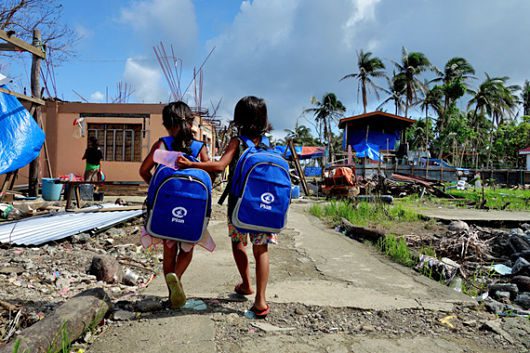
On April 25, 2015 a 7.8 magnitude earthquake hit Nepal. Two thousand schools collapsed, and five thousand others were damaged, forcing children to abandon their studies.

In the developing world nothing is more important than education, and when an already weak infrastructure crumbles under a natural disaster, it can be devastating for schools and a catastrophic defeat in the fight against poverty.

The Nepal earthquake was not an isolated incident. Every year natural disasters wreak havoc on underdeveloped nations, destroying the lives and property of millions. In 2013 the Philippines was the victim of a destructive typhoon that damaged 2,500 schools and disrupted the critical studies of 1.4 million children. And two years later, in March 2015, Cyclone Pam dramatically affected the Republic of Vanuatu.

The Global Program for Safer Schools (GPSS), recently created to address these issues, is managed by the Global Facility for Disaster Reduction and Recovery (GFDRR). The new initiative is not only building demolished school buildings but also reinforcing and retrofitting schools at risk in catastrophe prone areas.

GPSS maintains relationships with a wide range of international partners, including the United Nations and agencies such as UNICEF, UNESCO and UNISDR, international NGOs like Save the Children and private sector companies such as Arup. Additionally, it works with ministries of finance, public works and education, integrating risk considerations and investing in large scale education benefits for communities.

The lack of education around the world is shocking, and its effect on poverty are staggering. Nearly a billion people entered the 21st century unable to read a book or sign their name. Less than 1 percent of what the world spent every year on weapons was needed to put every child into school by the year 2000. Yet it didn’t happen. Based on enrollment data, about 72 million children of primary school age in the developing world were not in school in 2005.

Clearly education is a necessity, playing a vital role in alleviating poverty around the globe, but it is a luxury much of the world does not have, perhaps more so for girls. The state of school facilities in the developing world can be extremely fragile, and protecting them could make an immense difference.

Maternal deaths could be reduced by two thirds in the world if all mothers completed school, saving 98,000 lives. An extra year of secondary school boosts girls’ eventual wages by 15-25 percent. When women and girls earn income, they reinvest 90 percent of it in their families – buying books, medicine and bed nets and ensuring education for their children. Girls who stay in school for seven or more years typically marry four years later and have two fewer children than girls who drop out. And fewer dependents per worker allows for greater economic growth.

As much as 55 percent of the reduction in hunger from 1970 to 1995 can be attributed to improvements in women’s education and their status in society. School-based HIV/AIDS education programs are effective in preventing HIV infection, reducing the burden of this disease on families and communities.

Education can be one of the greatest tools fighting global poverty today. The Global Program for Safer Schools, through rebuilding disaster stricken institutions and retrofitting those at risk, ensures that disadvantaged children around the world have a chance.

– Jason Zimmerman

Sources: World Bank, Global Facility for Disaster Reduction and Recovery, Global Facility for Disaster Reduction and Recovery, New Internationalist, UNICEF, United Nations
Photo: Plan

June 24, 2015
https://borgenproject.org/wp-content/uploads/borgen-project-logo.svg 0 0 Borgen Project https://borgenproject.org/wp-content/uploads/borgen-project-logo.svg Borgen Project2015-06-24 02:02:582024-05-27 09:25:16How a New Program is Providing Safer Schools for the World’s Poor
Development, Global Poverty, Technology

How Mobile Phones Help the Poor

How Mobile Phones Help the Poor
Mobile technology has been shown to have a tremendous effect in helping alleviate global poverty. Over six billion of the approximately seven billion people in the world have access to mobile phones, as shown in a 2014 UNESCO report. By 2016, it is estimated that there will be one billion mobile phones in Africa. Such widespread access opens up a window of opportunity to utilize mobile technology as an instrument in improving the lives of users in developing countries.

According to UN Millennium Project Director Jeffrey Sachs, cell phones are the key instrument in transforming poverty-stricken lives.

“Poverty is almost equated with isolation in many places of the world,” he said, as quoted in a CNN article. “Poverty results from the lack of access to markets, to emergency health services, access to education, the ability to take advantage of government services and so on. What the mobile phone — and more generally IT technology — is ending is that kind of isolation in all its different varieties.”

From the educational sphere to the economy, access to mobile technology has already significantly improved the lives of many across various aspects of life.


4 Ways Mobile Phones Help the Poor

Literacy and education
Where there are no books, there are still mobile phones. Utilizing mobile technology is one of the easiest ways to increase literacy rates simply because phones are already in the hands of members of developing nations. Mobile reading provides a much cheaper and more convenient alternative to reading from books. While cell phones cannot teach users how to read, they are shown to significantly increase literacy retention rates. Several mobile applications and programs exist to increase access to mobile reading in the developing world. Programs such as MobiLiteracy Uganda provide parents with daily reading activities to complete with their children via audio SMS so that illiterate parents can still work to improve their children’s literacy. It is not necessary for users to own smartphones because even the cheapest mobile models allow access to mobile reading.

Agriculture
Mobile technology has completely transformed the lives of farmers in developing nations, as it allows them access to market prices without the timely concession of long-distance traveling to faraway markets. Additionally, access to weather information can help farmers prepare for in-climate conditions that may affect their crops. Several mobile applications exist to provide farmers with information about nearby markets and prices, mapping to potential clients, feeding schedules for cattle and local veterinary information.

Banking
Millions of Africans utilize mobile technology as a banking instrument. Since 2007, Safaricom and Vodafone’s M-PESA application has allowed users to store funds on their mobile decides in order to transfer funds to other users, pay bills, or make other purchases. In 2009, a 10th of Kenya’s GDP was being circulated via M-PESA. Former Safaricom CEO Michael Joseph noted that mobile technology has been transformative for the informal business sector, which comprises about 70 percent of jobs in Kenya. This increase has been instrumental in helping surge GDP rates throughout the developing world.

Health
Mobile phones allow endless distribution of health resources, which has led to the development of mHealth, or mobile health, programs. Field workers can use their mobile devices to work with experts to determine what conditions are treatable at a local level and what patients need to be transported to a hospital. This increased communication saves time and money and also helps to ensure appropriate treatment. Text messages have also shown to be vital in communicating stock levels of medications and resources in remote locations. Additionally, public health organizations have organized text message campaigns to increase preventative habits against fatal diseases.

– Arin Kerstein

Sources: CNN, Fortune, National Geographic, UNESCO, USAID,
Photo: Sustainable Brands

June 22, 2015
https://borgenproject.org/wp-content/uploads/borgen-project-logo.svg 0 0 Borgen Project https://borgenproject.org/wp-content/uploads/borgen-project-logo.svg Borgen Project2015-06-22 11:58:432024-05-30 22:22:56How Mobile Phones Help the Poor
Development, Global Poverty, USAID

U.S. Support for Mozambican Farmers

mozambican_farmers
In order to help improve access opportunities between smallholder farmers and private sector distributors in Mozambique, the United States Agency For International Development (USAID) initiated four public-private partnerships amounting to $30 million in 2014. On June 3, USAID signed four memorandums of understanding to further propel the partnerships into action. The memorandums were signed in the presence of Deputy Minister of Agriculture Luisa Meque, and U.S. Ambassador Douglas Griffiths.

USAID launched the partnerships as a part of Feed the Future Partnering for Innovation, a program that creates partnerships for development between USAID missions and the private sector. The partnerships in Mozambique are predicted to increase opportunities for 50,000 smallholder farmers in the provinces of Manica, Nampula, Tete and Zambezia.

The project has partnered the U.S.’s National Cooperative Business Association CLUSA International with farmer-owned company IKURU and start-up seed-provider Phoenix Seeds to facilitate better distribution of services and inputs. Various representatives from IKURU and Phoenix Seeds will also be trained to better serve small communities. This partnership is expected to assist 10,000 smallholder farmers within three years.

Export Marketing Company Limited, Agro Tractors and Techno Brain have also partnered to create 23 retail hubs comprised of agro-input retailers, equipment suppliers and storage facilities to benefit 23,000 smallholder farmers. Rental services and training workshops will be available for farmers, along with new market opportunities.

Additionally, 10,000 Mozambican farmers in Zambezia and Nampula will receive access to imported seeds and inputs through the new partnership between Portuguese supplier Lusosem Mocambique, Lda., Colorado-based International Development Enterprises and HUB Assistancia Technica e Formacao. The partnership will involve guidance in agro-dealer expansion and training for agribusiness development in rural communities.

Through the final partnership, Illinois-based Opportunity International will provide financial training to Banco Oportunidade de Mozambique in order to provide banking services for 5,000 sesame and soybean farmers.

These partnerships are part of a larger 10-year strategic agricultural development plan developed by USAID with the Mozambican government. According to USAID, Mozambique’s agricultural sector provides employment for the vast majority of the nation’s labor force and has the potential to boost the country’s economic growth significantly. Additionally, USAID in Mozambique focuses on agricultural development in order to create sustainable systems, which can ultimately decrease malnutrition and poverty rates throughout the country.

– Arin Kerstein

Sources: All Africa, Feed the Future, Partnering For Innovation, Star Africa, USAID
Photo: Feed the Future

June 22, 2015
https://borgenproject.org/wp-content/uploads/borgen-project-logo.svg 0 0 Borgen Project https://borgenproject.org/wp-content/uploads/borgen-project-logo.svg Borgen Project2015-06-22 10:45:462024-05-27 09:25:13U.S. Support for Mozambican Farmers
Aid Effectiveness & Reform, Development, Global Poverty, Women & Children

Poverty in Ahmedabad, India

Ahmedabad
With a population of around 8 million, the city of Ahmedabad is the largest in India’s western region of Gujarat. While India has long held a reputation for being one of the world’s least developed countries, it has steadily been shifting and is now one of the fastest growing developing countries. Poverty in India is starting to disappear; industry is thriving, literacy rates are increasing and the world community is beginning to see it as a real front-runner. There is no better example of this new shift in development than Ahmedabad.

Census information gathered in 2001 showed a literacy rate of around 79 percent. The next census, gathered in 2011, revealed a great increase, showing that around 85 percent of the population was literate. The first step in decreasing poverty is increasing education. For many years, India has faced issues with its large impoverished communities not allowing their children to attend school because they needed them to work in order to support the family. Now, with increased aid from various NGO’s and family structure organizations, Ahmedabad’s youth have been, for the most part, educated at least to an 8th grade level. This six percent gain is not the only leap that Ahmedabad has made.

When one imagines India, they might picture crowded streets, pollution, over-population, grand temples and the Taj Mahal, which would all suffice to describe it. However, recent census information has shown a 1.55 percent decrease in birthrates. While to some this may seem sad, it is quite the opposite. Many poor families will have upwards of 8 children in an attempt to have as many people working in order to support the family. Often, women are overwhelmed by the pressure to have kids, and with no safe methods of birth control available, many have more than ten in their lifetimes. While supporting 10 kids is hard enough, this amount of children can also be very detrimental to a woman’s health. Many women to die during childbirth. In the past few years, many women’s health organizations have gone to the slums of India to introduce birth control packs and condoms to the people. This decrease in birthrate is also accompanied by a 6 percent decrease in death rates of women during childbirth, as the amount of institutionalized deliveries has increased by 13 percent. While this may seem small, it marks a big change for the city of Ahmedabad and India as a whole.

As India continues to grow, poverty rates in Ahmedabad are decreasing. Occupying a large strip of the coastline, Gujarat is one of the best areas for businesses seeking to work overseas to take root. The business models in Gujarat and Ahmedabad have been described by UNICEF as “being a highly effective growth and private sector-driven model. In fact, the average growth rate of GDP in Gujarat over the past two decades has been higher than the national average, and more balanced than the other high growth-rate states.” This positive increase in GDP is primarily due to the agricultural and business sectors.

For now it looks like poverty is out and development is in for the great city of Ahmedabad, and this is a trend that the global community hopes to see a lot more of in the future.

— Sumita Tellakat

Sources: UNICEF India, Journal of Health Population and Nutrition, Ahmedabad Census 2011
Photo: Flickr

June 18, 2015
https://borgenproject.org/wp-content/uploads/borgen-project-logo.svg 0 0 Borgen Project https://borgenproject.org/wp-content/uploads/borgen-project-logo.svg Borgen Project2015-06-18 02:16:212024-05-27 09:24:15Poverty in Ahmedabad, India
Page 134 of 163«‹132133134135136›»

Get Smarter

  • Global Poverty 101
  • Global Poverty… The Good News
  • Global Poverty & U.S. Jobs
  • Global Poverty and National Security
  • Innovative Solutions to Poverty
  • Global Poverty & Aid FAQ’s
Search Search

Take Action

  • Call Congress
  • Email Congress
  • Donate
  • 30 Ways to Help
  • Volunteer Ops
  • Internships
  • Courses & Certificates
  • The Podcast
Borgen Project

“The Borgen Project is an incredible nonprofit organization that is addressing poverty and hunger and working towards ending them.”

-The Huffington Post

Inside The Borgen Project

  • Contact
  • About
  • Financials
  • President
  • Board of Directors
  • Board of Advisors

International Links

  • UK Email Parliament
  • UK Donate
  • Canada Email Parliament

Get Smarter

  • Global Poverty 101
  • Global Poverty… The Good News
  • Global Poverty & U.S. Jobs
  • Global Poverty and National Security
  • Innovative Solutions to Poverty
  • Global Poverty & Aid FAQ’s

Ways to Help

  • Call Congress
  • Email Congress
  • Donate
  • 30 Ways to Help
  • Volunteer Ops
  • Internships
  • Courses & Certificates
  • The Podcast
Scroll to top Scroll to top Scroll to top